Cyberbullying is defined as harassment of a peer in a systematic way through any electronic means, especially through social networks, using various types, such as defamation, public disclosure of private events with the intention to cause harm and emotional distress (Kopecký & Szotkowski, Reference Kopecký and Szotkowski2017). Regarding the scientific contributions on the subject, the bulk of publications has focused on teenage samples (Cerezo, Arnaiz, Giménez, & Maquilón, Reference Cerezo, Arnaiz, Gimenez and Maquilón2016; Garaigordobil, Reference Garaigordobil2015; Kowalski, Limber, & McCord, Reference Kowalski, Limber and McCord2019). However, generally, cyberbullying appears at the end of primary education and continues in many cases through to university (Delgado & Escortell, Reference Delgado and Escortell2018; Machimbarrena & Garaigordobil, Reference Machimbarrena and Garaigordobil2018).
The beginning of cyberbullying behaviors across the various participation roles (victims, perpetrators/bullies and observers/bystanders) is usually related to the minors’ access to the internet and social networks. Thus, the National Institute of Statistics (Instituto Nacional de Estadística, INE; 2018) pointed out that, at age 10, 85.7% of minors use the Internet and 26.2% have mobile devices. These figures rise to 96.2% and 86.2% respectively, when they reach 13 years of age. In addition, mentioning one of the most used social networks (Facebook), Marques, Marques-Pinto, Álvarez, and Pereira (Reference Marques, Marques-Pinto, Álvarez and Pereira2018) highlighted that the greater the use of Facebook, the greater the risk of being harassed through the Internet.
Regarding its relationship with psychosocial variables, previous publications have shown different results. Thus, the negative impact of cyberbullying on the mental image that victims and perpetrators have of themselves, that is, their self-concept (Ortega, Buelga & Cava, 2016) has been highlighted. In addition, the negative impact has also been shown to affect the emotional component linked to self-concept, that is, self-esteem. In this regard, previous evidence has highlighted that low levels of academic, family and personal self-esteem predict cybervictimization (Brewer & Kerslake, Reference Brewer and Kerslake2015, Ortega et al., Reference Ortega, Buelga and Cava2016). Likewise, the negative impact on self-concept has been shown to be higher in girls (Fernandes, Sanyal, & Chadha, Reference Fernandes, Sanyal and Chadha2015; Lohbeck & Peterman, Reference Lohbeck and Peterman2017). Regarding the school grade, there is no evidence regarding the relationship of cyberbullying and levels of self-concept.
Considering the relationship with school variables, although the negative impact of cyberbullying on academic performance (Garaigordobil, Reference Garaigordobil2015) and school adjustment (Ortega et al., Reference Ortega, Buelga and Cava2016) has been highlighted, the relationship with academic goals has been scarcely evaluated, being considered as a model or pattern of beliefs, attributions and/or emotions that guide behavioral interactions (Weiner, Reference Weiner, McInerney and Van Etten2004). In this sense, Herrera López, Romera Félix, Ortega Ruiz, and Gómez Ortiz (Reference Herrera López, Romera Félix, Ortega Ruiz and Gómez Ortiz2016) found, after analyzing a sample of 492 Spanish students in Secondary Education, that high achievement goals are keys for the establishment of good interpersonal relationships. Moreover, social goals have also been related to cyberbullying in minors. Thus, perpetrators are oriented towards popularity and social support goals (Romera, Cano, García-Fernández, & Ortega, Reference Romera, Cano, García-Fernández and Ortega-Ruiz2016) despite showing a lesser social competence (Zych, Farrington, & Tfofi, Reference Zych, Farrington and Tfofi2019). Regarding the mediation of the gender variable, it has been shown that in girls, the forms of victimization affect their grades, whereas this impact does not occur in boys (Lohbeck & Peterman, Reference Lohbeck and Peterman2017), there being no evidence related to the influence of the age variable.
In summary, and given the scarcity of data related to the explanatory role of self-concept and academic goals in the participating roles of cyberbullying in Primary Education, the present study aims to analyze the explanatory value of self-concept and academic goals in victims, perpetrators and bystanders of cyberbullying in a sample of students in 5th and 6th grade of Primary Education, in relation to the variables of gender and grade.
Based on the previous empirical evidence, lower levels in self-concept and academic goals are expected to be significant predictors of participating as a victim (Hypothesis 1). In addition, the role of victim in girls is expected to be explained to a greater extent by lower scores in self-concept and academic goals, there being no differences according to age (Hypothesis 2). As for the perpetrators, lower levels of self-concept and academic goals are expected to explain their participation (Hypothesis 3). Moreover, the role of perpetrator in girls is expected to be explained to a greater extent by lower scores in self-concept and academic goals, there being no difference according to grade (Hypothesis 4). As no studies on cyberbullying from the role of the bystander with the variables of self-concept and academic goals have been found to date, the present study may provide new and relevant information in this regard, as well as in relation to this relationship according to gender and grade.
Method
Participants
The reference population was students in 5th and 6th grade of Primary Education of the province of Alicante. Out of the 108,002 students enrolled in the academic grades in Primary Education centers, a random sampling of centers in the province was carried out. After the selection of four public and two private centers, the study sample consisted of 558 students, of which six were eliminated due to errors or omissions in their answers and four because they did not obtain parental consent to participate in the study. The total sample consisted of 548 students, aged between 10 and 13 years (M = 10.95, SD = 0.7), with 275 boys (50.2%) and 273 girls (49.8% girls). The distribution of the sample regarding their academic grade was: 276 (50.4%) students enrolled in 5th grade of Primary Education and 272 (49.6%) students enrolled in 6th grade of Primary Education.
The χ2 test was used to analyze the homogeneity of the sample, according to gender and grade, not finding any statistically significant differences across the four groups of Gender X Grade (χ2 = 2.50, p = .11).
Instruments
Cyberbullying. Screening for Peer Bullying (Garaigordobil, Reference Garaigordobil2013)
This is a standardized instrument with psychometric guarantees (Garaigordobil, Reference Garaigordobil2013) used to measure bullying and cyberbullying behaviors. In the present study, only the cyberbullying subscale was used. It evaluates 15 behaviors of harassment through electronic means (for example, sending offensive and insulting messages, making offensive calls, posting photos or videos on YouTube without permission, making anonymous calls to frighten, blackmail or threaten), and identifies victims, perpetrators and bystanders of cyberbullying. The questionnaire consists of 45 questions that must be answered using a Likert-type scale of 4 points that varies from 0 (never) to 3 (always). The response system is triangular, as the evaluated person must identify whether he/she has suffered the harassment behaviors as a victim, has performed them as the perpetrator or whether he/she has seen them being performed on another person or has knowledge about their occurrence (bystander) over the past year. The psychometric studies carried out in the original research supported the internal consistency of the test (α > .82; Garaigordobil, Reference Garaigordobil2013). Likewise, the internal consistency indices of the subscales in the present study were adequate: Victimization (α = .94), Harassment (α = .96) and Observation (α = .95).
Self-concept. Self-Description Questionnaire I (SDQ-I; Marsh, Reference Marsh1986)
It is an instrument designed to measure multidimensional self-concept in children between 7 and 12 years of age. It consists of 76 Likert-type response items, ranging from 0 (no) to 4 (yes), distributed into seven subscales: Physical ability (self-image that a person has regarding his/her own sporting abilities), Physical appearance (personal schema of aesthetic characteristics and beauty), Relationship with peers (self-image of popularity and social behaviors), Relationship with parents (personal image about his/her interaction with parents), Language self-concept (schema as a student in the language area), Mathematical self-concept (schema as a student in the area of mathematics) and General self-concept.
Marsh (Reference Marsh1986) developed the instrument based on Shavelson, Hubner, and Stanton’s (Reference Shavelson, Hubner and Stanton1976) multidimensional and hierarchical model of self-concept. The Spanish adaptation was carried out by González-Torres, Tourón, and Gaviria (Reference González-Torres, Tourón and Gaviria1994) with a sample of 674 students in 5th grade of Primary Education, obtaining adequate reliability indexes (α = .90). In the present study, the internal consistency coefficients, Cronbach’s alpha, obtained oscillated between .82 (Mathematical self-concept) and .71 (General self-concept).
Academic goals: Achievement Goals Tendencies Questionnaire (AGTQ, Hayamizu & Weiner, Reference Hayamizu and Weiner1991)
It is a self-report instrument composed of 20 items focused on the measurement of academic goals through three subscales: Learning goals (studying to learn and acquire knowledge and master the task), Achievement goals (studying to obtain good results and advance) and social reinforcement goals (studying to obtain the approval of parents, teachers and peers). Each item is answered using a Likert-type scale of 5 points (1 = never, 5 = always).
The exploratory factor analysis carried out by Hayamizu and Weiner (Reference Hayamizu and Weiner1991) in its original version revealed that the three factors explained 52.4% of the total variance. Furthermore, the internal consistency of the subscales was adequate (α = .71–.89). In the Spanish adolescent population, Inglés et al. (Reference Inglés, Marzo, Castejón, Núñez, Valle, García-Fernández and Delgado2011) confirmed the factorial invariance of the scores according to gender and academic grade.
In the present study, the following internal consistency indices (α) were achieved for the subscale scores: Cronbach’s Alpha = .71 (Learning goals), Cronbach’s Alpha = .73 (Social reinforcement goals) and Cronbach’s Alpha = .93 (Achievement goals).
Procedure
Initially, researchers met with the management team of the selected centers in order to explain the purpose of the study. Subsequently, an informative letter was sent to the parents of the minors to notify them about the study and request their written informed consent. The questionnaires were answered collectively and voluntarily in the classrooms during a class session, ensuring the anonymity of the participants. To this end, identification numbers were previously assigned to each of the response sheets for each participant. The researchers were present during the administration of the tests to clarify any possible doubts and verify the correct completion of the questionnaires, which were completed in an average of 15 minutes each. All human research guidelines were followed, in accordance with the ethical principles of the Declaration of Helsinki (Asociación Médica Mundial, World Medical Association; 2013).
Statistical analyses
To evaluate the predictive relationship of self-concept and academic goals on cyberbullying, a binary logistic regression analysis was carried out through the forward step procedure, based on the Wald statistic. Logistic modeling estimates the probability of an event, an incident, or a result occurring (for example, being a victim of cyberbullying) in the presence of one or more predictors (for example, general self-concept). To determine the adjustment value of the models, the Nagelkerke R 2 and the percentage of successful cases were calculated. The quantification of the probability of occurrence of an event was calculated through the Odds Ratio (OR), which provides information about the probability of occurrence (OR > 1 indicates that the probability of occurrence is higher than that of non-occurrence, while an OR < 1 indicates that the probability of occurrence is less than that of non-occurrence). To carry out these analyzes, the scores of the cyberbullying variable (victims, bullies and bystanders) were dichotomized using a design of extreme groups such as: (a) Non-victim / non-perpetrator / non-bystander: Scores equal to or lower than the 25th percentile and (b) victim / perpetrator / bystander: Scores equal to or greater than the 75th percentile.
Results
Self-concept and academic goals in the victimization of cyberbullying
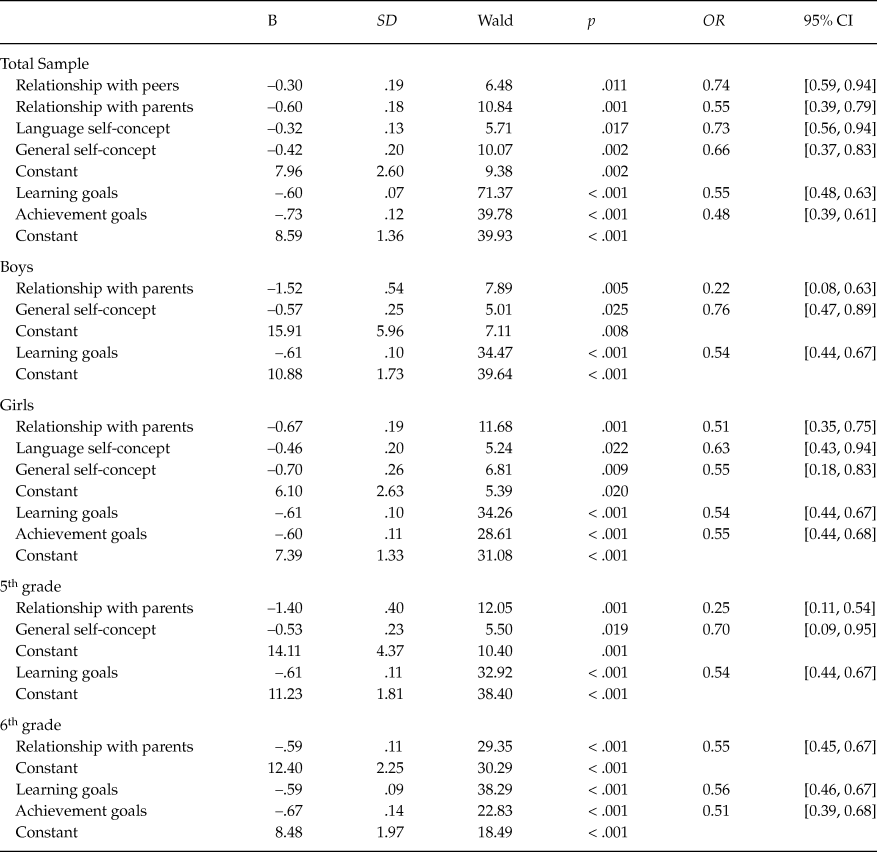
From the analyzed sample, it was possible to create five predictive models for the role of victim in the total sample and in the subsamples by gender and grade through the self-concept subscales (see Table 1). The model for the general sample allowed for a correct estimation of 99.4% of the cases (χ2 = 416.57, p = < .001). The models for the sample of boys (χ2 = 207.74, p = <.001), girls (χ2 = 201.87, p = <.001), 5th grade (χ2 = 210.65, p = < .001) and 6th grade (χ2 = 190.21, p = < .001) allowed for a percentage of successful cases of 98.2%, 99.4%, 98.2% and 98.8%, respectively. The adjustment values of the models (R 2 Nagelkerke) ranged between .93 (6th grade) and .97 (boys).
Results derived from the Binary Logistic Regression for the Probability of being Victim of Cyberbullying

Note. B = coeficient; SD = standard error; p = probability; OR = odds ratio; CI = confidence interval at 95%.
In summary, the ORs of the logistic model for the general sample indicated that students were less likely to be victims of cyberbullying as their score increased in the scales of self-concept referred to the relationship with parents (OR = 0.55), general self-concept (OR = 0.66), language self-concept (OR = 0.73) and self-concept regarding relationship with peers (OR = 0.74). In addition, boys and fifth-year students were less likely to be victimized as their self-concept about their relationship with parents and their general self-concept increased, while girls had a lower risk of being victims of cyberbullying as their self-concept in the relationship with their parents, their general self-concept and their academic self-concept in the language area increased. Students in 6th grade suffered less cyberbullying as their self-concept related to parents increased.
Regarding the academic goals, five predictive models were also created. The model for the total sample allowed for a correct estimate of 99.4% (χ2 = 447.52, p = < .001) of cases, with the learning goals and achievement goals variables becoming part of the model (R 2 Nagelkerke = .97). The models for the sample of boys (χ2 = 237.77, p = < .001), girls (χ2 = 208.72, p = < .001), 5th grade (χ2 = 138.29, p = < .001) and 6th grade (χ2 = 209.43, p = < .001) allowed for percentages of successful cases between 90% and 90.8%. On the other hand, the adjustment values (R 2 Nagelkerke) ranged between .72 (total sample) and .96 (6th grade).
In conclusion, the ORs for the general sample indicated that students were less likely to be victims of cyberbullying as their score increased in the scales of learning goals (OR = 0.55) and achievement goals (OR = 0.48). In addition, boys and 5th grade students were less likely to be victimized as their learning goals increased, while girls and 6th grade students were less likely to be victimized as they increased their learning goals and their achievement goals (Table 1).
Self-concept and academic goals in cyberbullying perpetration
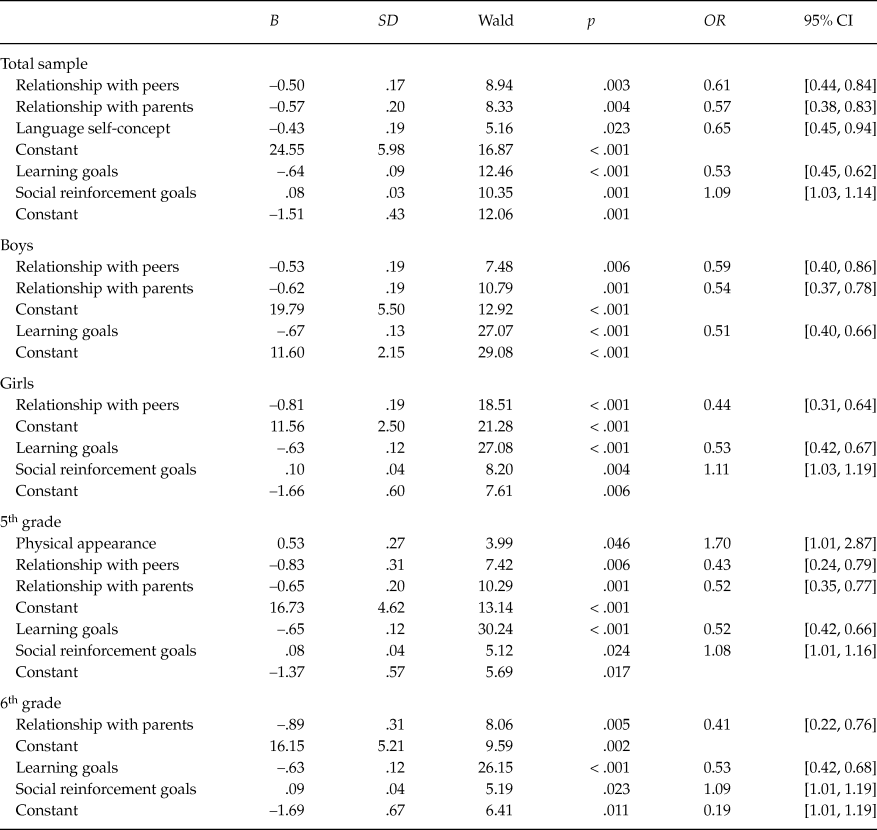
Five logistic models were created for the prediction of cyberbullying perpetration, based on the self-concept dimensions (see Table 2). The predictive model for the general sample allowed for an estimate of 98.9% of the cases (χ2 = 356.14, p = < .001), while for the sample of boys (χ2 = 173.85, p = < .001), girls (χ2 = 143.81, p = < .001), 5th grade (χ2 = 201.57, p = < .001) and 6th grade (χ2 = 139.29, p = < .001), the percentage of correctly classified cases was 98.5%, 97.8%, 98.7% and 96.5%, respectively. The adjustment values (R 2 Nagelkerke) of the models ranged from .88 (girls) to .98 (total sample).
Results derived from the Binary Logistic Regression for the Probability of Being a Cyberbullying Perpetrator

Note. B = coeficient; SD = standard error; p = probability; OR = odds ratio; CI = confidence interval at 95%.
In summary, the ORs of the logistic model for the total sample indicated that students presented 43%, 39%, and 35% less probability of acting as a bully as the scales of relationship with parents, relationship with peers, and language self-concept increased in one unit, respectively. In addition, boys showed less risk of being bullies if their social self-concept with parents and peers increased, while girls and 6th grade students were less likely to be bullies as their self-concept about their relationship with peers and parents, respectively, increased. On the other hand, 5th grade students were less likely to bully as their social self-concept increased (relationship with peers and relationship with parents), while they were more at risk of presenting bullying behaviors if their self-concept related to their physical appearance increased.
In terms of academic goals, five predictive models were also created for the role of perpetrator. The model for the total sample allowed for a correct estimation of 90.3% (χ2 = 216.14, p = < .001), with the learning goals and social reinforcement goals variables becoming part of the model (R 2 = .70). The models for the sample of boys (χ2 = 118.82, p = < .001), girls (χ2 = 97.31, p = < .001), 5th grade (χ2 = 124.99, p = < .001) and 6th grade (χ2 = 90.00, p = < .001) allowed for percentages of successful cases oscillating between 68.2% and 92.4%. In addition, the adjustment values (R 2 Nagelkerke) ranged between .70 (total sample) and .84 (girls).
To conclude, the ORs for the total sample indicated that students were less likely to be cyberbullying perpetrators as their score on the learning goals scale increased (OR = 0.53), whereas they were more likely to become bullies as their social reinforcement goals (OR = 1.09) increased. In addition, boys were less likely to perpetrate cyberbullying as their learning goals increased. The ORs of the models created for the group of girls, and for the students of 5th and 6th grade indicated that they were less likely to be bullies as their learning goals increased, and their social reinforcement goals decreased.
Self-concept and learning goals in the observation of cyberbullying
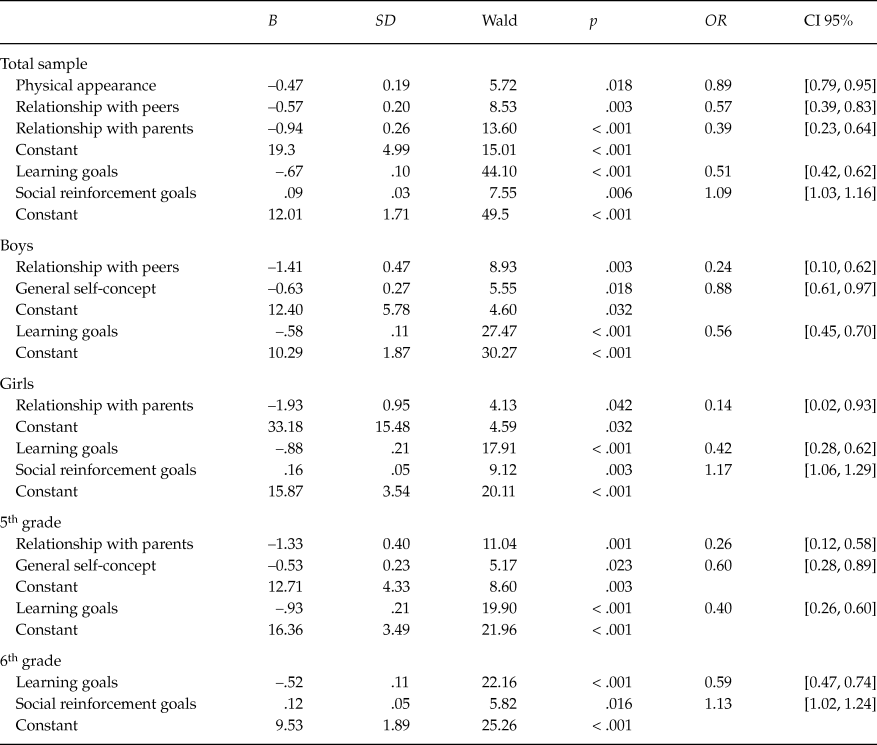
Four models were obtained that predicted the cyberbullying bystander role through the self-concept dimensions (see Table 3). The logistic model correctly predicted 99.1% of the cases (χ2 = 289.98, p = < .001) for the total sample, 98.4% (χ2 = 163.80, p = < .001) for the sample of boys, 99% (χ2 = 123.79, p = < .001) for girls and 97.6% (χ2 =159.58, p = < .001) for 5th grade students. The adjustment value (R 2 Nagelkerke) of the models ranged between .96 (5th grade) and .97 (girls).
Results derived from the Binary Logistic Regression for the Probability of being a Cyberbullying Bystander

Note. B = coeficient; SD = standard error; p = probability; OR = odds ratio; CI = confidence interval at 95%.
In summary, the ORs of the model for the total sample reported that students presented 61%, 43% and 11% less probability of being cyberbullying bystanders as the self-concept scales related to the relationship with parents, relationship with peers and physical appearance increased one unit, respectively. Boys were less likely to observe cyberbullying behaviors as their self-concept about their relationship with peers and their general self-concept increased. However, girls were less likely to become cyberbullying bystanders as their self-concept about their relationship with their parents increased. Likewise, 5th grade students presented less risk of observing cyberbullying behaviors if their relationship with their parents and their general self-concept increased.
In terms of academic goals, five predictive models were created for the bystander role. The model for the total sample allowed for a correct estimate of 91.1% (χ2 = 182.84, p = < .001), with the learning goals and social reinforcement goals variables becoming a part of the model (R 2 Nagelkerke = .72). The models for the sample of boys (χ2 = 102.85, p = < .001), girls (χ2 = 80.40, p = < .001), 5th grade (χ2 = 117.92, p = < .001) and 6th grade (χ2 = 67.11, p = < .001) allowed for percentages of successful cases ranging between 71.3% (6th grade) and 91.8% (boys). Meanwhile, the adjustment values (R 2 Nagelkerke) ranged between .65 (6th grade) and .78 (5th grade).
In conclusion, the ORs for the total sample indicated that students were 49% less likely and 9% more likely to be cyberbullying bystanders as their scores in learning goals and social reinforcement goals increased, respectively. In addition, boys and 5th grade students were less likely to observe bullying as their learning goals increased. The models for the sample of girls and 6th grade students indicated that they were less likely to become cyberbullying bystanders as their learning goals increased and their social reinforcement goals decreased.
Discussion
The objective of the study was to analyze the explanatory relationship of self-concept and academic goals regarding victimization, perpetration and observation of cyberbullying behaviors, among the general sample and in relation to gender and grade.
Regarding Hypothesis 1, cybervictimization was explained by low scores in social self-concept (relationship with parents and peers) and academic self-concept (general academic self-concept and language area), and by the low learning and achievement goals, thus maintaining the aforementioned hypothesis. This result is consistent with previous research that confirmed the explanatory nature of the academic (Brewer & Kerslake, Reference Brewer and Kerslake2015; Ortega et al., Reference Ortega, Buelga and Cava2016) and family (Navarro, Ruiz-Oliva, Larrañaga, & Yubero, Reference Navarro, Ruiz-Oliva, Larrañaga and Yubero2015; Ortega et al., Reference Ortega, Buelga and Cava2016) dimensions of self-concept in the role of victim. Moreover, as Miñano Pérez, Castejón Costa, and Gilar Corbí (Reference Miñano Pérez, Castejón Costa and Gilar Corbí2012) pointed out, self-concept and achievement goals are related to academic adjustment, which could lead victimized students to present a lower performance (Garaigordobil, Reference Garaigordobil2015).
Regarding the influence of the gender variable, both girls and boys were characterized by explaining their participation as victims through the general self-concept, social relationship with parents self-concept, and the learning goals, thus rejecting Hypothesis 2. However, only in the sample of girls, the cybervictimization was explained from the academic self-concept in language and achievement goals. These results coincide with studies that identified low scores in academic self-concept and achievement goals as risk factors for being victimized (Herrera López et al., Reference Herrera López, Romera Félix, Ortega Ruiz and Gómez Ortiz2016; Ortega-Barón et al., Reference Ortega, Buelga and Cava2016) but does not support that the negative impact on self-concept is greater in girls (Fernandes et al., Reference Fernandes, Sanyal and Chadha2015; Lohbeck & Peterman, Reference Lohbeck and Peterman2017). In any case, these contributions highlight the tendency of girls to present greater academic self-concept and mastery in the subject of Language and Literature, and to be oriented towards academic achievement (Delgado, Inglés, García-Fernández, Castejón, & Valle, Reference Delgado, Inglés, García-Fernández, Castejón and Valle2010), which protects them, according to this study, from being cybervictimized.
According to school grade, 5th and 6th grade students explained victimization from a low self-concept of their relationship with their parents and low learning goals, showing the general self-concept as a protective and representative factor only in 5th grade students and achievement goals in 6th grade students. These results reinforce previous findings, which emphasize that, at younger ages, self-concept plays an important role in the development of young people (Romund et al., Reference Romund, Golde, Lorenz, Raufelder, Pelz, Gleich and Beck2017), while the motivational orientation of achievement is more characteristic of older students (Delgado et al., Reference Delgado, Inglés, García-Fernández, Castejón and Valle2010).
Regarding cyberbullying perpetration, low scores in social self-concept (relationship with parents and peers), academic self-concept (language area), and learning goals decreased the probability of perpetration, thus maintaining Hypothesis 3. In addition, social reinforcement goals positively explained cyberbullying behaviors. These findings are consistent with those of Zych et al. (Reference Zych, Farrington and Tfofi2019), who found good academic performance and social and emotional skills oriented towards others as the most important protective factors against perpetration. In addition, it is congruent with the results obtained by Romera et al. (Reference Romera, Cano, García-Fernández and Ortega-Ruiz2016), in which the bully presented more popularity goals (a need to be recognized) with fewer social skills. Therefore, academic goals geared towards the social reinforcement of bullies would coincide with the objective of harassment to strengthen their social position (Navarro et al., Reference Navarro, Ruiz-Oliva, Larrañaga and Yubero2015) and seek the approval of their peers (Varjas, Talley, Meyers, Parris, & Cutts, Reference Varjas, Talley, Meyers, Parris and Cutts2010).
Regarding Hypothesis 4, social self-concept with peers and learning goals protected against acting as perpetrator for both genders, while self-concept in the relationship with parents only explained in boys and social reinforcement goals explained only in girls, thus, partially maintaining the hypothesis. These results can be understood based on the function that both genders give to digital devices. Thus, girls tend to prefer communicative and relational use (chats, messaging, social networks, etc.), becoming a fundamental source in the construction of their self-image and self-assessment, while boys prefer the ludic use of the Internet (online games, music, etc.) (Fernandes et al., Reference Fernandes, Sanyal and Chadha2015). In addition, as pointed out by Bleakley, Ellithorpe, and Romer (Reference Bleakley, Ellithorpe and Romer2016), the greater the use of the Internet, the worse the relationship with the parents, which would explain the low self-concept of the relationship with the parents of the perpetrator boys.
Regarding the school grade, self-concept in the relationship with parents and learning goals negatively explained perpetration, whereas social reinforcement goals explained perpetration positively for both grades. Additionally, the profile of bully in 5th grade was explained by a low self-concept in the relationship with peers, and a high physical appearance self-image. These findings are congruent with those found in adolescents, who point out the motivations towards the search for affiliation, notoriety (popularity), acceptance and belonging as key elements in socio-emotional development (Rodkin Ryan, Jamison, & Wilson, Reference Rodkin, Ryan, Jamison and Wilson2013) and that in the present study’s sample has an impact in 5th grade.
Special mention should be made about the study of the role of the bystander, as it is a key element in the perpetuation of harassment (Schultze-Krumbholz, Hess, Pfetsch, & Scheithauer, Reference Schultze-Krumbholz, Hess, Pfetsch and Scheithauer2018). Specifically, the low scores in social self-concept (parents and peers), physical self-concept (physical appearance) and learning goals, as well as high rates in social reinforcement goals explained their participation. These findings shed new information to the study of the role of the bystanders. Thus, physical appearance was, in this case, a protective factor, which is congruent with the contributions of Noack, Kauper, Benbow, and Eckstein (Reference Noack, Kauper, Benbow and Eckstein2013), who found a positive relationship between physical self-concept, self-esteem and positive interpersonal relationships. In addition, like perpetrators, the low learning goals and high social reinforcement goals explained participation as a bystander. The similarity between the profiles of bullies and bystanders was also found by Obermaier, Fawzi, and Koch (Reference Obermaier, Fawzi and Koch2016), as the majority of the harassment bystanders remain silent or even support the attacks of the bullies so as not to become the next victims.
Regarding gender, the bystander role was explained by low learning goals in both sexes. The difference was found in that girls were more likely to act as bystanders when their orientation towards study was aimed at obtaining the approval of their parents, teachers and peers, possibly by placing themselves on the side of the bully so as not to become future targets (Obermaier et al., Reference Obermaier, Fawzi and Koch2016), but the risk decreased if their self-concept based on family relationships was high (Desmet et al., Reference Desmet, Veldeman, Poels, Bastiaensens, van Cleemput, Vandebosch and De Bourdeaudhuij2014). These findings reinforce the idea that the role of bystander and the decision to participate is related to the perception of the family (Bastiaensens et al., Reference Bastiaensens, Pabian, Vandebosch, Poels, van Cleemput, DeSmet and De Bourdeaudhuij2016) and with family support and recognition, that is, with the evaluation and social support that their actions receive (Desmet et al., Reference Desmet, Veldeman, Poels, Bastiaensens, van Cleemput, Vandebosch and De Bourdeaudhuij2014), an effect that in the present study’s sample was characteristic of girls. As for boys, the decision to participate as bystanders was related to a negative self-assessment as a student and as a friend. In this sense, in the face of cyberbullying incidents, friendship becomes a key contextual factor in the behavior of the bystander, whether it is positioned on the side of the victim because they have a relationship and they protect each other, or whether they position themselves on the side of the aggressor (Bastiaensens et al., Reference Bastiaensens, Pabian, Vandebosch, Poels, van Cleemput, DeSmet and De Bourdeaudhuij2016), circumstance that in the present study’s sample seems to occur only in boys.
Finally, being a cyberbullying bystander was explained by low learning goals of both 5th and 6th grade students, being the low social self-concept (relationship with parents) and the general self-concept explanatory aspects of 5th grade students and the social reinforcement goals of the 6th grade students. Regarding this differentiation, it seems that social reinforcement goals become more important in higher grades, especially considering that the transition stage from primary to secondary education is a time of great changes, where the opinion of peers is considered as the most important (Isorna, Navia, & Felpeto, Reference Isorna, Navia and Felpeto2013).
The study has certain limitations, among which the impossibility of generalizing the results to other educational levels should be highlighted. In addition, the cross-sectional design used in the study precludes the establishment of causal relationships. Therefore, it would be advisable to carry out longitudinal studies that may provide information on the development of this phenomenon over the years. Finally, it is important to note the limitations inherent to the lack of consensus when defining the cyberbullying construct, taking into account the constant progress of ICTs, which may be giving rise to new forms of cyberbullying that are not being taken into account.
In conclusion, the present study highlights the importance of social self-concept (relationships with parents and peers), learning goals and social reinforcement goals in the emergence of cyberbullying. This research provides new and relevant information regarding the study and understanding of cyberbullying and its relationship to self-concept and academic goals of minors. On the one hand, it focuses on age ranges that have been scarcely studied. On the other, it facilitates the characterization of each role involved (according to gender and grade), thus allowing the creation of defined profiles that facilitate the understanding of the phenomenon, and therefore, improve the effectiveness of preventive strategies, especially in relation to the role of the bystander, given its importance in the perpetuation of harassment.