Urinary tract infection (UTI) is the most common and overdiagnosed infection in nursing homes (NHs).Reference Montoya and Mody1 The 2004 National Nursing Home Survey in the United States reported a 5.7% point prevalence of UTI in NH residents aged >65 years.Reference Jones, Dwyer, Bercovitz and Strahan2 In Europe, the 2013 point-prevalence survey on healthcare-associated infections and antimicrobial use in long-term care facilities (HALT) reported a prevalence of 10% for confirmed UTIs.3 The treatment of UTIs is becoming more challenging because resistance to commonly used antimicrobials among uropathogens is increasing.Reference Wagenlehner, Tandogdu and Bartoletti4 Particular problems for NHs include increasing numbers of infections with multidrug-resistant (MDR) gram-negative bacilli and the 8-fold increase in Clostridium difficile infections (CDI) following antimicrobial treatment of a UTI.Reference Chopra and Goldstein5, Reference Denkinger, Grant, Denkinger, Gautam and D’Agata6
Urine culture testing plays an important role in antimicrobial overprescribing, thereby contributing to antimicrobial resistance.Reference Sloane, Kistler, Reed, Weber, Ward and Zimmerman7 In general, testing for bacteriuria is not recommended in older people who do not have specific clinical evidence of UTI.Reference Cormican, Murphy and Vellinga8 However, nearly 50% of the prescriptions in NHs are for asymptomatic bacteriuria, and reported rates are particularly high in residents with urinary catheters.Reference Phillips, Adepoju and Stone9 Whenever antimicrobials are used, the probability of developing resistance increases, irrespective of the condition for which they are prescribed.Reference Goossens, Ferech, Vander Stichele and Elseviers10
Many studies have reported a correlation between increased use of antimicrobials, particularly broad-spectrum antimicrobials such as fluoroquinolones, and increased antimicrobial resistance among uropathogens.Reference Cek, Tandoğdu, Wagenlehner, Tenke, Naber and Bjerklund-Johansen11, Reference Horcajada, Shaw and Padilla12 High rates of antimicrobial usage are reported in NHs, ranging from 4.8 to 12.9 courses per 1,000 resident days, and as many as 38% are fluoroquinolones such as ciprofloxacin or levofloxacin.Reference Benoit, Nsa and Richards13 The high use of fluoroquinolones occurs despite the fact that the Infectious Disease Society of America (IDSA) advises not using fluoroquinolones as first-line therapy for acute cystitis.Reference Gupta, Hooton and Naber14 Additionally, adverse effects from antimicrobial use account for nearly 20% of the adverse drug events observed in NHs.Reference Gurwitz, Field and Avorn15 Importantly, fluoroquinolone use is more frequently associated with adverse events than are other common antimicrobials.Reference Tandan, Cormican and Vellinga16 A “black box” warning label has been added with the fluoroquinolones because of severe adverse events, most commonly tendinitis and tendon rupture.Reference Cek, Tandoğdu, Wagenlehner, Tenke, Naber and Bjerklund-Johansen11, Reference Tanne17
Since November 2017, all US NHs are required to implement antimicrobial stewardship programs.Reference Sloane, Kistler, Reed, Weber, Ward and Zimmerman7 In North Carolina a 24-month antimicrobial stewardship intervention program was carried out prior to the implementation of this new requirement; its aim was to optimize antimicrobial use and thus reduce bacterial resistance in participating NHs. This paper presents our evaluation of urine culture data from that trial. Our specific goals were (1) to identify the prevalence of opportunistic and antimicrobial-resistant bacteria in a sample of urine cultures from a representative sample of US community NHs, and (2) to identify whether (and if so, how) resistance patterns changed during the antimicrobial stewardship intervention.
Methods
Study setting, and design
In this study, we analyzed data from a 2-year antimicrobial stewardship intervention conducted in 27 NHs in North Carolina. Participating NHs were recruited between August and November 2014. All participating NHs were either affiliated with specific for-profit regional NH chain or had medical directorship by a regional long-term care practice group. Every NH received the same intervention. To better understand the antimicrobial resistance patterns in urine cultures and to assess the possible impact of the antimicrobial stewardship intervention on resistance patterns, participating NHs faxed copies of all urine cultures performed before and during the study period to the research team. Baseline (ie, preintervention) urine culture results were collected from September 2014 through May 2015; intervention period results were collected from June 2015 through May 2017.
This study was approved by the Institutional Review Board of the University of North Carolina at Chapel Hill.
Antimicrobial stewardship intervention
The antimicrobial stewardship intervention was designed to improve knowledge and understanding of nurses, physicians, residents, and families. UTI-related training modules (ie, narrated PowerPoints for nursing staff and case discussion podcasts for medical providers) were developed, and these were provided to each facility and to the 145 medical providers (87 physicians (60%), 20 physician assistants (14%), and 38 nurse practitioners (26%) working in the study NHs. Training included 6 topics: causes of antimicrobial resistance; urinalysis; urine culture reports; asymptomatic bacteriuria; symptoms of UTIs; and management of UTI. Supportive material included posters and pocket cards with NH infection guidelines, general guidelines for urine testing, and priorities for antimicrobial stewardship. In addition, audit reports were generated monthly and reported quarterly to medical providers, administrators, and directors of nursing in participating NHs; these reported antimicrobial prescribing rates by NH, anonymously comparing each home’s rates with the other NHs in the study. Informational brochures on the importance of antibiotic stewardship were also provided for residents and families in the NHs.
Measures
Urine cultures from participating NHs were processed by 28 different laboratories. Faxed urine culture reports from the NHs were reviewed by the study research staff and entered into Microsoft Access (Microsoft, Redmond, WA). Double data entry was performed to maintain quality and consistency. The information recorded included date of culture, NH and laboratory identification number, urine culture result (positive, negative, or polymicrobial), pathogen(s) isolated, colony count, and antimicrobial susceptibility results for 29 different antimicrobials. The antibiotic susceptibilities of up to 2 isolates from a positive culture were included; a report of >100,000 colony forming units (CFU) per milliliter was considered a positive urine culture.18
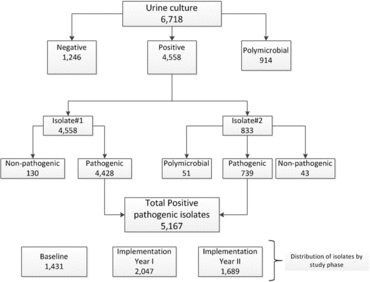
Only potentially pathogenic bacteria causing UTIs were included for analysis (Fig. 1). Reported bacteria that we included as potentially pathogenic included Escherichia coli, Proteus spp, Klebsiella pneumoniae, other Klebsiella spp, Enterococcus spp, Pseudomonas spp, Streptococcus spp, Staphylococcus spp, Enterobacter spp, Citrobacter, Providencia, Morganella morgani, Serratia spp, Faklamia hominis, Stenotrophomonas matophilia, Aerococcus spp, Raoultella spp, Pantoea agglomerans, Alcaligenes faecalis, Brukholderia cepacia, and Cedecea lapagei. We excluded reports of Lactobacillus, Corynebacteria, yeast, and Gardnerella vaginalis, as well as reports that were labeled as polymicrobial and did not isolate any organism. The final dataset included 6,718 cultures with 5,167 results of potentially pathogenic bacteria from the 27 participating NHs.
Flow diagram showing urine specimens and isolates used for analysis.

Antimicrobial susceptibility testing
All laboratories were licensed and followed the standards for antimicrobial susceptibility testing of the Clinical and Laboratory Standards Institute.18 Susceptibility results for each pathogen were recorded as susceptible (S), intermediate (I), resistant (R), or not reported. For the analysis, the outcome “intermediate” was recoded as resistant. Even though antimicrobial susceptibility testing was recorded for 29 different antimicrobials, only the most often prescribed antimicrobials used to treat uropathogenic bacteria are presented. For E. coli, K. pneumoniae, Proteus spp, and all Enterobacteriaceae spp, results for resistance to ciprofloxacin, nitrofurantoin, trimethoprim-sulfamethoxazole (TMP/SMX), tetracycline, third-generation cephalosporins, and carbapenems are presented. For Enterococcus spp, results regarding resistance to levofloxacin, nitrofurantoin, tetracycline and vancomycin are reported.
Multidrug resistance (MDR)
The MDR criteria were applied according to the approach of Sievert et al,Reference Sievert, Ricks and Edwards19 which approximates the interim standard definition for multidrug resistance.Reference Magiorakos, Srinivasan and Carey20 For E. coli, K. pneumoniae, Proteus spp, and all Enterobacteriaceae, MDR was defined as resistance to at least 1 agent in at least 3 of the following antimicrobial categories: (1) extended-spectrum cephalosporins, (2) fluoroquinolones, (3) aminoglycosides, (4) carbapenem, and (5) piperacillin or piperacillin/tazobactam. For every MDR pathogen tested, resistance to ≥1 antimicrobial in ≥3 antimicrobial categories was required for the organism to be labeled as MDR. Pathogens with intrinsic resistance to antimicrobial agents or categories were excluded before MDR rates were calculated. More detailed information on the categorization and microbiological analysis is provided in the Supplementary Table A online.
Statistical analysis
The proportion of potentially pathogenic bacteria identified in urine cultures and the rates of urine culture and positive culture were calculated, and comparisons were made between baseline and the second intervention year, using χ2 tests. The culture and positive culture rates were calculated per 1,000 resident days. Generalized linear mixed modeling (GLMM) was performed to compare urine culture and positivity rates over the study period. A 2-tailed P value of <.05 was considered statistically significant. All statistical analyses were performed in R version 3.4.1 software (R Foundation for Statistical Computing, Vienna, Austria), except for GLMM, for which STATA version 13.0 was used (StataCorp, College Station, TX).
Results
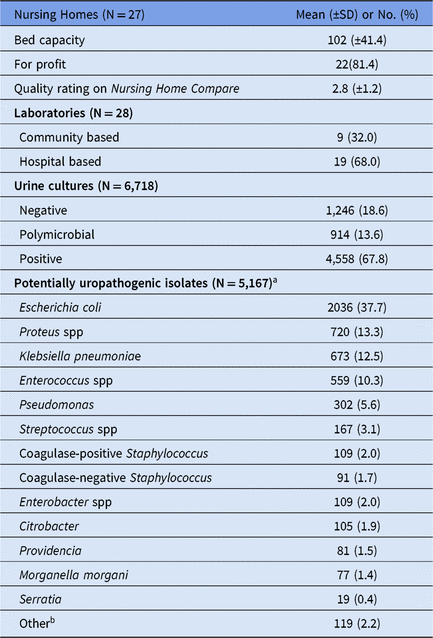
Of the 27 participating NHs, 22 (81%) were for-profit facilities. The mean number of beds was 102 (range, 46–165) and the mean quality rating on the US Centers for Medicare and Medicaid Services’ Nursing Home Compare website was 2.8 (range, 1–5). None of these figures differed significantly from all US NHs.21 Of the 28 laboratories processing urine cultures for participating NHs, the majority (19.8%) were hospital-based (Table 1), but most of the cultures (74.9%) were processed by a few commercial laboratories.
Characteristics of the Study Sample of Nursing Homes (NHs), Laboratories, and Associated Urine Cultures
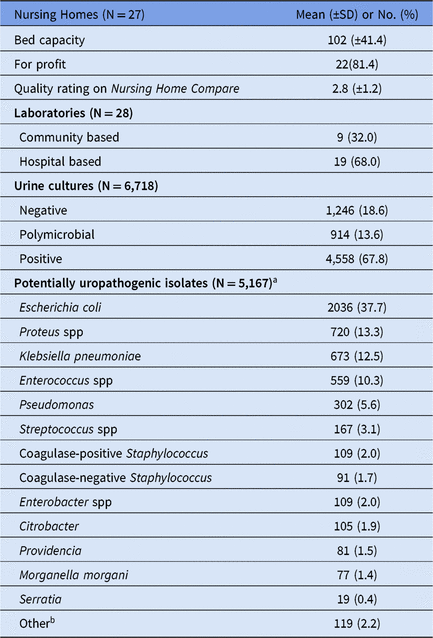
a Of the positive cultures, 5,391 total isolates were reported and total isolates (n = 5,391) were used as denominator to calculate % of pathogens in the table.
b Other potentially pathogenic organisms reported included gram-positive cocci or gram-negative rods without specification of the organism, and without a subsequent report (79 isolates), Faklamia hominis (1 isolate), Klebsiella ornitholytic (1 isolate), Klebseilla Planticola (1 isolates), Stenotrophomonas matophilia (1), Aerococcus spp (14 isolates), Aerococcus urinae (8 isolates), Aerococcus viridans (4 isolates), Raoultella ornithinolytica (1 isolate), Raoultella planticola (5 isolates), Pantoea agglomerans(1 isolate), Alcaligenes faecalis (1 isolate), Brukholderia cepacia (1 isolate),Cedecea lapagei (1 isolate).
For analysis purposes, we excluded the following isolate reports: 51 of polymicrobial as a secondary organism, 52 that reported Lactobacillus, 22 reports of Corynebacteria, 98 reports of Candida spp, and 1 report of Gardnerella vaginalis.
Urine culture and culture-positive rates
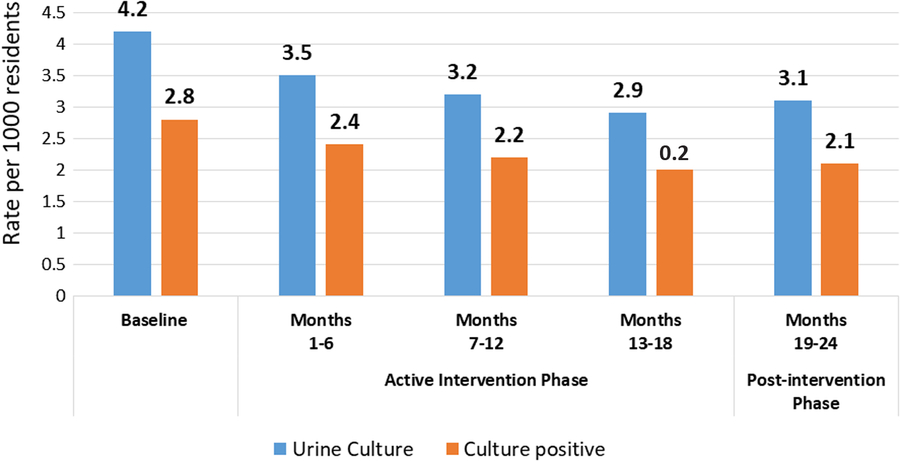
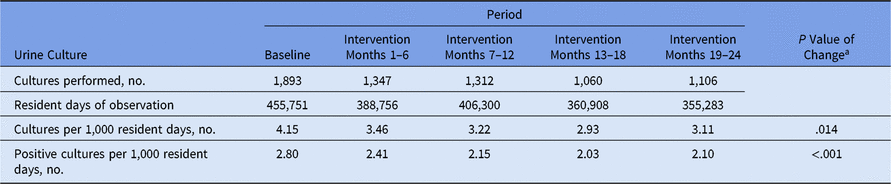
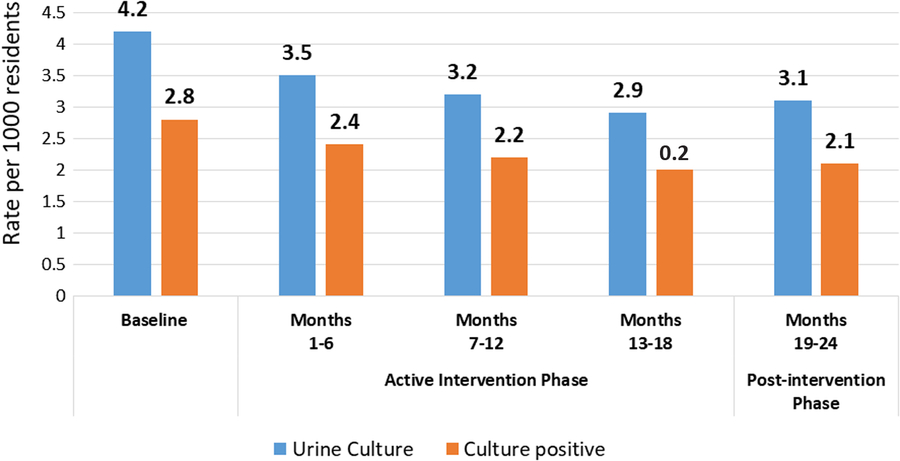
Of the 6,718 urine cultures studied, 68% were positive, 18% were negative, and 14% were recorded as polymicrobial (Table 1). Both the urine and urine positive culture rates per 1,000 resident days showed a decrease from baseline through the active antimicrobial stewardship intervention period (Fig. 2 and Table 2). These differences were statistically significant for both the urine culture rate (P = .014) and the positive culture rate (P ≤ .001).
Urine culture and positive culture rates (per 1,000 resident days) by intervention period.
Nursing Home Urine Culture Rates at Baseline and During the Antimicrobial Stewardship Intervention
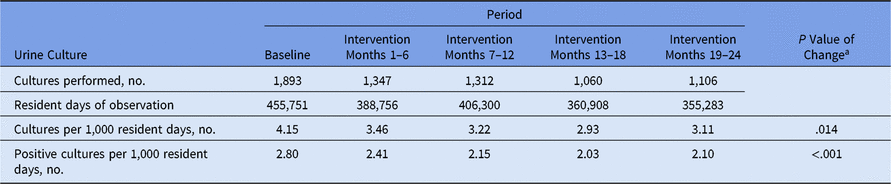
a P values were considered significant at <.05.
Uropathogenic isolates and their resistance to antimicrobials
From the positive cultures, a total of 5,391 organisms were recorded, of which 5,167 (97%) were potential uropathogens. The most common isolate was E. coli (38%), followed by Proteus spp (13%), K. pneumoniae (12%), Enterococcus spp (10%), and Pseudomonas (6%) (Table 1).
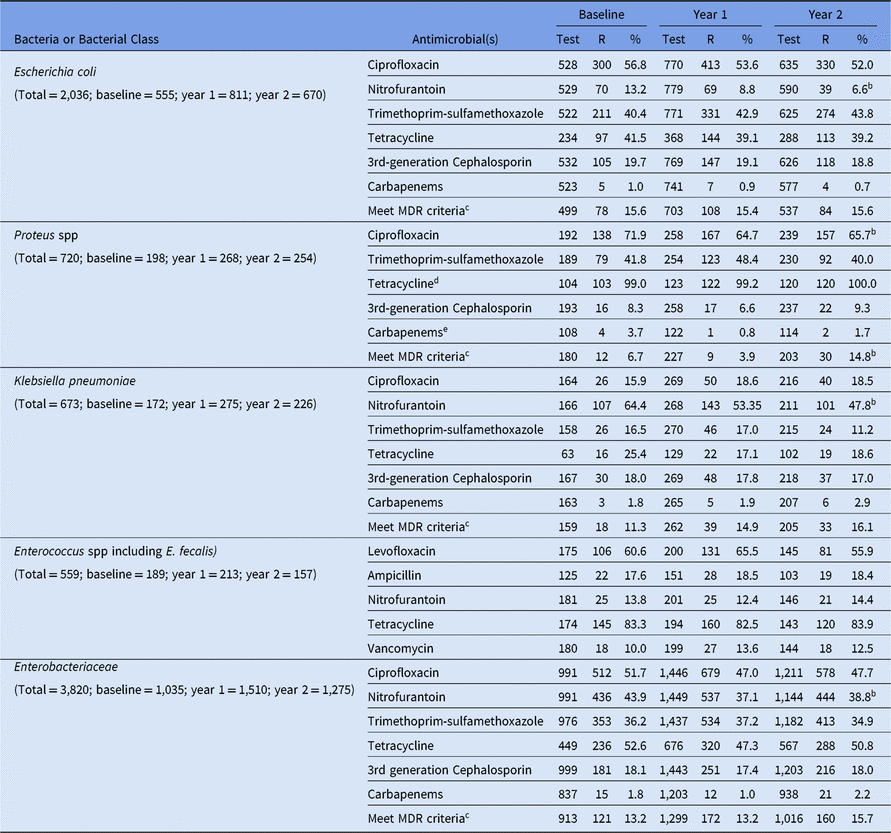
Antimicrobial resistance patterns of the common uropathogens at baseline and during the 2-year antimicrobial stewardship intervention are shown in Table 3. Antimicrobial susceptibility testing was performed on isolates of 2,036 E. coli, 720 Proteus spp, 673 K. pneumoniae, 559 Enterococcus spp, and a total of 3,820 Enterobacteriaceae specimens.
Antimicrobial Resistance Patterns of Common Urinary Pathogens at Baseline and During the Antimicrobial Stewardship Interventiona
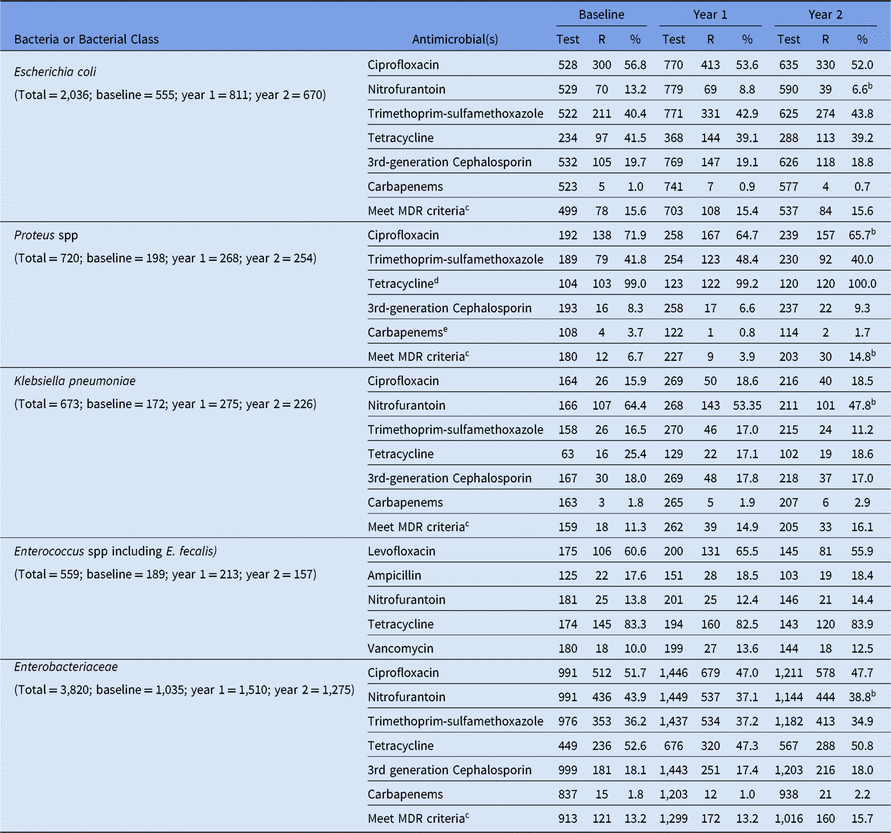
Note. Test refers to particular uropathogens tested for specific antimicrobials, R refers to resistant; % refers to percentage of isolates resistant.
a Based on 5,167 positive isolates from 6,718 urine culture specimens from 27 community NHs collected between September 2014 and June 2017.
b Highlighted P values are significant at <.05. P value was calculated using χ2 test between baseline and year 2. The P value was not calculated for 100% resistance.
c MDR criteria: [nonsusceptible or resistance to ≥1 agent (antimicrobial) in ≥3 categories of 5 antimicrobial categories: (1) extended spectrum cephalosporin [third- and fourth-generation cephalosporin (ceftriaxone or cefixime or cefotaxime or cefpodoxime or cefdinir or ceftazidime or cefepime)] (2) fluoroquinolones [ciprofloxacin or levofloxacin (for Enterobacteriacae, only ciprofloxacin was included)] and (3) aminoglycosides (amikacin or gentamycin or tobramycin) (4) carbapenems (imipenem or ertapenem or meropenem or doripenem), and/or (5) piperacillin or piperacillin/tazobactum. Taken from Seivert et alReference Sievert, Ricks and Edwards19 and Magiorakos et al.Reference Magiorakos, Srinivasan and Carey20
d 100% resistance, P value not calculated.
e Imipemen was excluded because of intrinsic resistance.
Resistance varied among uropathogens. Escherichia coli resistance to ciprofloxacin, TMP/SMX, and tetracycline did not change significantly over the intervention period compared to the baseline, and resistance remained high, especially to ciprofloxacin and TMP/SMX, at >40% for both (Table 3).Escherichia coli resistance to nitrofurantoin did decrease from 13.2% to 6.6% (P < .001) from the baseline to year 2 of the intervention; all other changes were not significant (Table 3).
Proteus spp resistance to ciprofloxacin decreased significantly (P < .001), but the proportion of resistance in intervention year 2 remained high: 66% compared to baseline of 72%. Proteus resistance to carbapenems decreased slightly in intervention year 2, but the result was not statistically significant (Table 3).
For K. pneumoniae, nitrofurantoin resistance decreased from 65% at the baseline to 48% in year 2 (P = .001). Small decreases in resistance to TMP/SMX (from 16% to 11%) and tetracycline (from 25% to 18%) were also noted, but these changes were not statistically significant (Table 3).
For all Enterobacteriaceae, resistance to ciprofloxacin, TMP/SMX, and tetracycline decreased slightly, but resistance remained high (>35% for each). Among Enterobacteriaceae, resistance to nitrofurantoin declined significantly in intervention year 2 from the baseline (P = .015), but resistance remained >35%. Enterobacteriaceae resistance to third-generation cephalosporins did not change (<20%), and carbapenem resistance remained <1% during the intervention (Table 3).
Enterococcus spp resistance to levofloxacin was >60% and resistance to tetracycline was >80%; neither changed significantly over the antimicrobial stewardship intervention period. Changes were also not significant for nitrofurantoin and vancomycin (Table 3).
In general, an increase in MDR rates was observed for the tested uropathogens (K. pneumoniae, Proteus spp, and all Enterobacteriaceae) except for E. coli, which remained constant at 15%. However, only Proteus spp showed a significant increase between baseline and year 2 (P = .011) (Table 3).
Discussion
This study of urine cultures from 27 US community NHs documents a wide range of potentially pathogenic bacteria and a high level of antimicrobial resistance, even after a 2-year antimicrobial stewardship intervention. Overall, 68% of urine cultures were positive for significant bacteriuria; these results are consistent with previous NH studies.Reference Sloane, Kistler, Reed, Weber, Ward and Zimmerman7 As in prior research, E. coli was the most commonly cultured uropathogen, though not as frequent as the 75%–90% prevalence in non-NH patients with uncomplicated UTIs.Reference Gupta, Hooton and Stamm22 Our identified proportions of Proteus spp, (13%) and K. pneumoniae (12%) were higher than in general populationsReference Flores-Mireles, Walker, Caparon and Hultgren23 but were similar to levels observed in previous NH studies.Reference Rowe and Juthani-Mehta24 Perhaps more surprising were the high proportion of Enterococcus and other less common uropathogens, which may be due to high antimicrobial exposure in the NH populationReference Rowe and Juthani-Mehta24 or to the application of newer microbiological detection techniques that allow better species differentiation.Reference Florio, Tavanti, Barnini, Ghelardi and Lupetti25
The antimicrobial stewardship intervention during which these data were collected reduced overall prescribing by 20% over 2 years.Reference Sloane, Ward and Kistler26 However, these analyses indicate that the impact of this prescribing reduction on downstream outcomes was modest at best. One reason for this may be antibiotic exposure in hospital settings because hospitalizations did not decrease under the intervention and because hospital-associated antimicrobial use could have limited reduction in resistance from the intervention. However, most changes, while small, were in the direction of reduced resistance (Table 3). Studies from hospital settings have shown that decreases in antibiotic resistance of gram negative bacteria do occur after the introduction of antimicrobial stewardship,Reference Elligsen, Walker and Pinto27–Reference Jenkins, Knepper and Shihadeh29 but the changes typically take years.Reference del Arco, Tortajada and de la Torre30 In NHs, we expect a similar slow rate of reduction in resistance, especially when considering other risk factors, such as hospital antimicrobial exposure, can rarely be concomitantly controlled.Reference Ikram, Psutka, Carter and Priest31 Thus, the trends we observed are encouraging.
High levels of antimicrobial resistance were noted among the most frequently cultured uropathogens. Resistance to ciprofloxacin and TMP/SMX among E. coli and Proteus spp were >40% and >50%, respectively, and resistance to nitrofurantoin in Klebsiella was >60%. Nitrofurantoin and TMP/SMX are recommended first-line antimicrobials for empiric prescribing in long-term care facilities, whereas ciprofloxacin is considered an alternative ‘reserved’ antimicrobial for confirmed acute cystitis.Reference Gupta, Hooton and Naber14, Reference Rowe and Juthani-Mehta24 The observed resistance patterns suggest deviation from first-line antimicrobial prescribing recommendations. Prescribing fluoroquinolones could also result in treatment failure; in our study NHs, more than half of the 4 most common identified uropathogens were resistant. Similarly, TMP/SMX would result in treatment failure for 40% of E. coli and Proteus spp, which together comprise about half of the uropathogens. Thus, prescribing in this population is challenging, and based on our findings, the best policy is to postpone antimicrobials whenever possible until culture results are available.Reference Gupta, Hooton and Naber14 Additionally, to improve evidence-based practice, feedback to medical providers and nursing staff on urine culture tests should be made available on routine basis, including feedback on resistance in relation to prescribing.
Since 2008, the US Food and Drug Administration has released several admonitions to restrict fluoroquinolone use for uncomplicated infections because of the risk of adverse effects.32 These warnings and the common cross-resistance between ciprofloxacin and other fluoroquinolones led our antimicrobial stewardship intervention team to prioritize reducing their use, with the goal of lowering bacterial resistance. Therefore, the trend toward reduction in ciprofloxacin resistance observed in this study among Proteus spp (P < .001) and E. coli (P = .090) is encouraging. Given the link between ciprofloxacin resistance and extended-spectrum β-lactamase (ESBL) production in E. coli, Klebsiella spp, and Proteus spp,Reference Goltsman, Mizrahi, Leibovitz, Gal, Gorelik and Lubart33 future antimicrobial stewardship efforts should even more intensively target routine practice of fluoroquinolone prescribing for uncomplicated urinary infections.
Carbapenem-resistant Enterobacteriaceae (CRE) are an emerging public health concern. Our data showed a low frequency of CRE (ie, <3%) among Proteus, Morganella, and Providencia spp, which have been shown to have intrinsically elevated MICs to imipenem.34 Carbapenem-resistant genes are carried on mobile genetic elements that can be spread horizontally among different genera and thus contribute to the reservoir of resistance in both environmental and clinical Enterobacteriaceae.Reference Lutgring and Limbago35 Continuity of antimicrobial stewardship activities and ongoing monitoring of CRE and their potential impact on prescribing is desirable to prevent the spread of CRE and to achieve optimal patient outcomes.
Our study has several limitations. Because the intervention aimed to change the frequency and indications for cultures, decreased testing might have affected the observed results. In addition, the time frame of 2 years may have been inadequate because changes in bacterial resistance may take many years.32 Also, the study design, which did not include prescription information, did not allow us to determine any relationship between changes in culture results and changes in prescribing. Furthermore, this study was relatively small, and a much larger multicenter trial might have demonstrated stronger statistical relationships among the findings. On the other hand, this is the largest antimicrobial stewardship trial reported to date in community NHs with urine culture results, and as such, our results provide benchmarks as well as guidance for future research.
In conclusion, an antimicrobial stewardship intervention program was associated with reductions in urine culture and culture positive rates in NHs. No strong inferences can be made in relation to changes in the pathogens’ resistance patterns to common antimicrobials, though trends in multiple organisms toward reduced resistance were observed. Direct feedback on the resistance-level results should support a more conservative approach to empiric prescribing with a strong emphasis on the need for UTI symptoms as well as urine culture results before an antimicrobial prescription. A sustainable reduction in the culture requests paired with culture-informed prescribing can improve patient outcomes while also decreasing antimicrobial resistance.
Supplementary material
To view supplementary material for this article, please visit https://doi.org/10.1017/ice.2019.108.
Author ORCIDs
Meera Tandan 0000-0002-7742-7980
Acknowledgments
This research was conducted using data provided by the Program on Aging, Disability and Long-Term Care at the Cecil G. Sheps Center for Health Service Research, University of North Carolina, Chapel Hill.
Financial support
Support for this research was provided by the US Agency for HealthCare Research and Quality (grant no. R18 HS022846-01) and by the Elizabeth and Oscar Goodwin Professorship of the Department of Family Medicine of the University of North Carolina at Chapel Hill.
Conflicts of interest
All authors report no conflicts of interest relevant to this article.