A recently described model explains the relationship between attention deficit hyperactivity disorder (ADHD) and oppositional defiant disorder (ODD) (Poulton & Nanan, Reference Poulton and Nanan2014). In this article we develop the model further and discuss its implications for approaching behaviour management. At this stage, the application of the model is as a theoretical construct; it is based on our clinical experience rather than any formal and rigorous data collection. We also show how the model can be used to develop an approach to therapy using positive rumination and positive reappraisal. By presenting it here and describing the ways that it could be used in practice, we hope that in due course clinical evidence will be forthcoming that may support our use of the model.
Children with ADHD typically show impairment in some or all of the following domains: the ability to conform to the behavioural expectations of at least two separate settings: academic achievement relative to ability and the ability to establish and maintain long-term peer relationships. To be consistent with a diagnosis of ADHD, this impairment has to be directly attributable to symptoms of ADHD. These symptoms relate to difficulty with maintaining attention, particularly for tasks that require mental effort; difficulty suppressing a high level of motor activity; and a tendency to act quickly without having time to consider the consequences (inattention, hyperactivity and impulsivity) (American Psychiatric Association [APA], 2013). Children with ADHD often tend to have a short-term view of life, with difficulty making an emotional connection between an action and its outcomes. This means that when they either act impulsively or choose to behave in a particular way that contravenes instructions, the consequences may appear to have little relevance to them. They may then experience punishment simply as a frustration but have little interest or connection with the reason for the punishment. This disconnection can compromise the effectiveness of conventional behavioural intervention based on rewards and consequences.
In addition to showing behaviour related to the core features of inattention, hyperactivity and impulsivity, children with ADHD frequently also show a negative mood and a defiant attitude (APA, 2013), which in around 40% of these children may be diagnosable as comorbid ODD (MTA Cooperative Group, 1999).
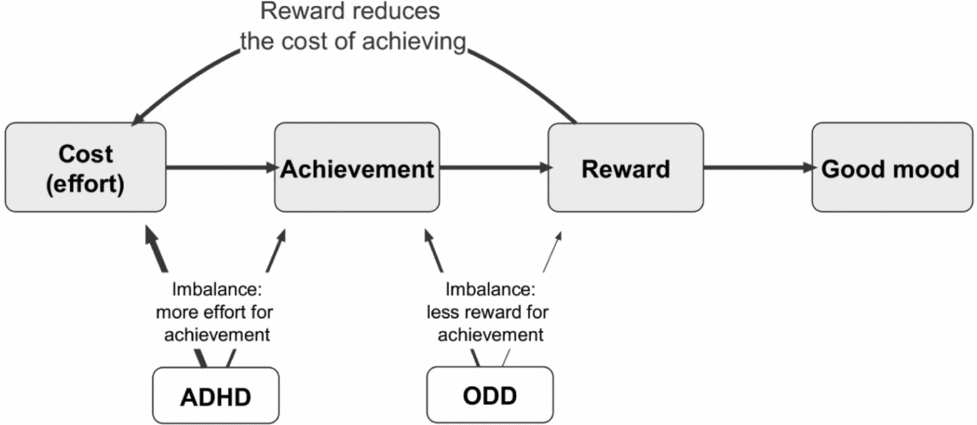
The Mental Effort-Reward Imbalances Model (MERIM; Figure 1) views the difficulty with sustained concentration in ADHD as an imbalance in the level of mental effort for achievement, such that individuals experience disproportionate mental fatigue for carrying out cognitive tasks (Poulton & Nanan, Reference Poulton and Nanan2014). Therefore, a higher level of effort has to be invested in order to experience the reward of task completion. We suggest that ODD may be considered to be a reward deficiency syndrome, defined as ‘a brain reward genetic dissatisfaction or impairment that results in aberrant pleasure seeking behaviour that includes drugs, excessive food, gaming/gambling and other behaviours’ (Downs et al., Reference Downs, Oscar-Berman, Waite, Madigan, Giordano, Beley and Blum2013, p. 3). Although the examples given in this definition appear to be more relevant to adults than children, the principles may also be applicable to children. Better examples of aberrant pleasure seeking in children might be excessive use of electronic games and deliberate bullying. Comfort eating leading to obesity could apply to people of all ages. We therefore suggest that individuals with ODD would experience less satisfaction from the daily achievements that contribute to a favourable mood and outlook on life. Individuals with ADHD in combination with even a minor degree of ODD would feel less inclined to put in the extra effort required for completion of cognitive tasks because they do not experience an adequate level of satisfaction. Therefore, the higher level of mental effort in ADHD and the lower level of satisfaction in ODD are effects that contribute independently to the reluctance of the individual to engage in and persist with cognitive tasks.
Mental Effort-Reward Imbalances Model (MERIM).

We suggest that several of The Diagnostic and Statistical Manual of Mental Disorders (5th ed.) (APA, 2013) diagnostic criteria for ADHD are outcome based and measure task persistence. Examples of these are: ‘often has difficulty sustaining attention in tasks or play activities. . . . often does not follow through on instructions and fails to finish schoolwork, chores or duties . . . often avoids, dislikes, or is reluctant to engage in tasks that require sustained mental effort . . .’ (APA, 2013, p. 59). These criteria are therefore not selective for any particular mechanism and apply equally to a low level of persistence due to an inadequate perception of reward (ODD) as they do to a poor persistence due to the effort of sustaining concentration (ADHD). Therefore, cohorts of children who meet diagnostic criteria for ADHD would be expected to show substantial rates of comorbid ODD.
The concept of ODD as a reward deficiency syndrome predicts that individuals with ODD will be actively seeking reward. It also predicts that individuals with a combination of ODD and ADHD will plan activities with a high level of reward in return for their mental effort. The tendency of individuals with ODD to show aggression or even to plan acts of spite (APA, 2013) may suggest that such behaviour is experienced as rewarding by the aggressor. It has been shown that adolescents with aggressive conduct disorder in association with ADHD had different responses to healthy controls when observing pain in others, particularly in their responses to inflicted pain. In addition to the typical activation of the areas of the brain associated with experiencing pain, the aggressive adolescents showed greater amygdala response, suggestive of a pleasurable stimulus (Decety, Michalska, Akitsuki, & Lahey, Reference Decety, Michalska, Akitsuki and Lahey2009). This atypical response could suggest that behaviour involving a victim may be abnormally pleasurable to such individuals, which could explain the associations between ODD and conduct disorder with bullying.
Potential behavioural consequences of the imbalance of mental effort to reward, including an individual's adaptive behaviour that enhances the level of reward experienced, are illustrated in the following case report.
Case 1
A 9-year-old boy (Harry) with ADHD does a piece of work that is well above his usual standard. His teacher praises him for a really good piece of work. He looks at her with a knowing smile, screws up his work and throws it on the floor.
The problem
The teacher's management is technically correct. She is praising Harry's good behaviour but this directly leads on to bad behaviour. Her management is clearly not working.
Interpretation
Harry has a combination of ADHD and ODD. He has done his work but not experienced the normal level of satisfaction of a good job done well. As his work gives him minimal reward, he attributes minimal value to it. In praising him, his teacher is communicating to him that she values his work. Therefore, she is vulnerable to being hurt. This gives him an opportunity to enjoy the more substantial reward that he experiences from seeing her pain as he destroys his work.
Harry subsequently finds he really likes his teacher. She cares about him and he tries very hard to please her. He has a good year and is in far less trouble than usual with his attitude and behaviour. His level of academic achievement improves. However, the following year he has a new teacher and his well-developed work avoidance strategies recur. He is clearly enjoying disrupting the class and he falls behind academically.
The problem
The favourable behaviour patterns have been specific to a particular teacher and are not generalisable to other teachers.
Explanation
Harry's reward for his good work and behaviour has consisted of seeing that he can make his teacher happy. He needs the experience of another person as the mediator for his satisfaction. He still finds that the work itself is not worth the effort it takes.
The problem of the individual finding tasks insufficiently satisfying to make them worthwhile is not addressed by applying external rewards and consequences. It would follow that the long-term solution to the imbalance of effort to reward would be to teach individuals self-regulation towards appreciating and valuing their work and so generate their own internal reward.
Self-Regulation
Self-regulation may be used as a management strategy in ADHD, with interventions aiming to encourage individuals to evaluate and reinforce their behaviour (DuPaul, Weyandt, & Janusis, Reference DuPaul, Weyandt and Janusis2011). Self-regulation can relate to task completion or regulation of emotion. Strategies for self-monitoring and emotional reinforcement are normal cognitive functions that develop as an individual matures. However, they involve an abstract style of thinking. This may make them more challenging for individuals with ADHD, who may therefore need to be specifically taught appropriate techniques.
Self-regulation has been used in the context of the classroom, with outcomes measured in the amount of on-task behaviour and academic productivity (Reid, Trout, & Schartz, Reference Reid, Trout and Schartz2005). Specific strategies have included self-monitoring of performance, with the outcome measured in the quantity or quality of work and on-task behaviour. Some programs also incorporate a reward system, which may be external, or the student may self-allocate their own reward. Sometimes, the reward is allocated according to how accurately the student evaluates the work against a standard. For example, developing reflective capacity and self-regulation may be achieved whereby students are taught to evaluate their classroom behaviour and work performance at routine intervals using a Likert scale, which ranges from poor to excellent grades. Teachers using the same scale can then evaluate student performance. Students are then provided with reinforcement dependent on their self-evaluated performance and the degree to which self-evaluation ratings match teacher ratings. As students gain proficiency in matching teacher ratings and improving both classroom behaviour and work performance, the frequency of teacher ratings is slowly reduced, until eventually only self-ratings are used. A review and meta-analysis has demonstrated that these strategies can be effective (Reid et al., Reference Reid, Trout and Schartz2005).
However, self-regulation can also involve regulation of emotion. Individual differences in the use of strategies for emotional regulation can influence affect, social functioning, and psychopathology (Aldao, Nolen-Hoeksema, & Schweizer, Reference Aldao, Nolen-Hoeksema and Schweizer2010; Gross & John, Reference Gross and John2003). A recent review noted an association of emotional dysregulation in ADHD with higher levels of impairment and comorbidity (Shaw, Stringaris, Nigg, & Leibenluft, Reference Shaw, Stringaris, Nigg and Leibenluft2014). This emphasises the importance of establishing effective strategies for emotional regulation. In children with ADHD, the emotional self-regulation strategies that are taught therapeutically may relate to anger management. Interestingly, although strategies such as distraction and relaxation are frequently recommended for individuals with anger issues associated with ODD, the evidence supporting their efficacy in children with ODD or ADHD is sparse, particularly in the recent literature, and consists mainly of small, uncontrolled cohort studies or case reports (Feindler, Reference Feindler1995; Singh et al., Reference Singh, Lancioni, Joy, Winton, Sabaawi, Wahler and Singh2007). However, a study that included 108 of the most disruptive 20% of school students demonstrated that the 60 randomised to a selective cognitive behavioural self-management program showed improvement in measures of social competence, authority acceptance and disruptive behaviour (Thompson, Reference Thompson2014). While research into the efficacy of strategies aimed towards calming negative emotions (anger management) appears relatively neglected, the possibility of therapy to promote positive emotions in ADHD appears to have been overlooked entirely (Carl, Soskin, Kerns, & Barlow, Reference Carl, Soskin, Kerns and Barlow2013).
Self-Regulation for Emotional Reward
Using the logic of the MERIM, self-management strategies would be directed towards the individual attributing value to a task or activity with the goal of obtaining the emotional outcome of feeling good about themselves through their achievement. Such strategies would include spending time reflecting on rewarding experiences and gaining further enjoyment and satisfaction (positive rumination, also called ‘savouring’; Carl et al., Reference Carl, Soskin, Kerns and Barlow2013). Alternatively, when a situation may have been unsatisfactory in some way, deliberately looking for any positive aspects is a strategy to help with getting over the disappointment and maintaining confidence for future achievements (positive reappraisal). Although not specifically related to ADHD, an experiment has demonstrated the effectiveness of both positive rumination and positive reappraisal for promoting positive affect in relation to a stressful or adverse experience (Rood, Roelofs, Bogels, & Arntz, Reference Rood, Roelofs, Bogels and Arntz2012). Although rumination is generally considered to be primarily negative or depressive in its outcome, involving repetitive thoughts about the causes, consequences and implications of stressful events (Nolen-Hoeksema, Wisco, & Lyubomirsky, Reference Nolen-Hoeksema, Wisco and Lyubomirsky2008), in this article we will consider it to be either positive or negative, depending upon the specific subject matter of the ruminant thoughts and the emotional response generated.
Positive Rumination
The general principles of positive rumination are to look for the positives, spend time reflecting on these, and then to be aware of the feeling of achievement. Initially, the therapist, teacher or parent would provide the structure, with the aim of teaching the child to incorporate the strategy as a regular part of their daily routine. For example, the teacher might sit with the student and physically show them specific aspects of their work that have been done well, perhaps pointing out up to three positive attributes. The student might then be invited to spend 30 seconds reflecting on these before finally being asked what it feels like to have achieved. During this discussion it is often a useful idea to ask the student to say or write a word or phrase to describe how they feel in response to their achievement. Encouraging individuals to reflect on both their work and their behaviours is more achievable in a relationship of mutual trust. This nurturing process would progress to the student independently identifying the positive aspects of their work, deliberately putting the time into reflection to generate the feelings of satisfaction, and then being aware of the positive feeling experienced.
At home, the parent could apply the same principles to activities such as getting ready, performing other chores, and doing homework. At bedtime, the parent could spend time encouraging the child to re-experience their three best achievements of the day. This might be assisted by written documentation of events that have occurred at school. Given that students with ADHD and ODD tend to have difficulties across settings, it is important to develop a home-school communication program. Through this program, which may be a daily or weekly report card system, all concerned are involved in helping the young individual to realise their potential. Both teachers and parents alike can help the student construct a paper version of a symbol or a word that captures their feelings related to their achievements. This word or symbol can be placed in a prominent place — for example, on their desk or table at school and at home. The student can then refer to the symbol or word subsequently in times of frustration and reflect on their progress and achievements. Documenting the identified positives in the student's diary could act as a prompt for parent-child discussions.
The anticipated outcomes of positive rumination would be that the experience of reward is manageable, everyday achievements are enhanced, a favourable affect is maintained, and the individual becomes less inclined to look for negative and destructive ways to enhance their experience of reward.
Case 2
Chloe, an 8-year-old girl with ADHD, had her best friend over to play. They played creatively, making an elaborate castle in the sandpit for their figurines. When her friend went home after 1½ hours of continuous playing, Chloe was mentally exhausted and snapped at her mother when it was time to have a shower and get ready for bed. Later, her mother lay down beside her and they talked about the events of the day. Her mother reminded her of how well she had played with her friend and the fun she had had. As Chloe's mood improved, her mother asked her, ‘Doesn't it feel good to have a friend to play with?’ Chloe was encouraged to name the three things she had enjoyed the most and to think about her positive feelings.
Interpretation
Chloe is learning positive rumination, spending time reflecting on her achievements, and using this to improve her mood and self-esteem.
Case 3
Cyril, a 14-year-old boy with the diagnoses of ADHD and ODD presented with challenging behaviour at school, with non-compliance to school rules leading to detentions and suspensions. He also had two incidents of absconding, and his school report indicated a decline in his level of academic achievement. His hostile attitude at home was having an impact on his relationship with his parents. At the time of the referral, Cyril was difficult to engage, gave monosyllabic responses, and refused to speak with his parents present in the room. The behaviour management strategies that his parents were attempting to use, which consisted of rewarding good behaviour, were clearly ineffective as they found little to reward. Punishment had the effect of making him more angry and rebellious.
Following a sustained effort of engaging Cyril, it became apparent that he had low self-esteem, which was partly attributable to his difficulty finding the motivation to do his schoolwork. This led to his failure to hand in assignments and he would then try to avoid the consequences by absconding from lessons. Cyril had abandoned his earlier ambition to become a software engineer, claiming he no longer cared.
With the help of his therapist, parents and teachers, Cyril was taught how to break his assignments into manageable portions. He would then draw a bar and divide it into sections corresponding to the parts of his assignment. As each part of the assignment was completed, he would colour in the section of the bar. This provided a visual aid and Cyril was helped to gain a sense of achievement by looking at the completed coloured sections. After finishing each assignment, he found that by sticking the completed bars to his bedroom wall, together with the marks awarded, he could more easily focus on his achievements and see that his ambition was achievable.
Interpretation
The strategies used shifted the external reward previously obtained through parental approval to self-regulation through internal self-appraisal of achievement, leading to a renewed focus. The visual aid provided a stimulus for positive rumination.
Positive Reappraisal
Children with ADHD and ODD may overreact emotionally to adversity. This can be associated with immediate temper outbursts, moodiness and resentment, or, over a longer timeframe, to deliberate acts of spite (APA, 2013). Individuals with ODD or conduct disorder may seek to compensate for a negative emotional response to adversity by seeking a victim to bully or someone to blame. For the aggressor, this could have the effect of improving their mood. They may attribute a hostile intent to an ambiguous social situation, which may then be used to justify their aggression (Fondacaro & Heller, Reference Fondacaro and Heller1990).
Positive reappraisal (also called benefit finding) in relation to an adverse or stressful event may be effective for improving the mood (Rood et al., Reference Rood, Roelofs, Bogels and Arntz2012) and have a longer-term positive impact on mental health (Helgeson, Reynolds, & Tomich, Reference Helgeson, Reynolds and Tomich2006). Techniques include thinking of the positive lessons that the individual could or did learn from the event and ways that it made them stronger (Rood et al., Reference Rood, Roelofs, Bogels and Arntz2012). This is illustrated in Case 4.
Case 4
Jayden is a 7-year-old boy with ODD who has trouble playing and taking turns in games with his classmates at school. He often takes over the group games and insists on being the ‘leader’ and to always have the first turn in the activities. As a result, the classmates often do not want to include him in their games. This upsets him, and his teacher has noticed that he often goes and bullies Roger, the smallest one. The teacher persuades the classmates to include Jayden and the classmates grudgingly give in and let him play with them. He initially feels happy and also powerful that he has managed to be included with some of the classmates, but they tell him that he can't be the leader and have the first turn. He manages to wait and then has his turn, but when they tell him he is out, he objects and argues that they are not playing fairly. Mike sees that Jayden is upset and starts mocking him and calling him names. Jayden loses his temper, punches Mike, and runs off crying to tell the teacher.
Afterwards, once the teacher has heard a description of the event from Jayden and from the other children, he talks to Jayden. Jayden knows he is in trouble for hitting Mike and expects that he will be on detention. Jayden says the other children are unfair to him and that he just wants to be included in their games, but he doesn't know how to do so. His teacher praises him for being honest and then discusses with him anything positive that he can learn about the experience. They agree that he enjoyed playing nicely for a little while, and that although he got angry and hit Mike, he then went and reported the incident to the teacher. He also did not take out his feelings on Roger. The teacher expresses confidence that Jayden can learn to stay calm and listen to his playmates. Jayden starts to feel better, accepts his detention, and looks forward to the next time he can play with the other children, resolving to try harder to control his behaviour.
Interpretation
The teacher, instead of overemphasising Jayden's aggression and loss of control, encourages him to reflect on any positive aspects of the incident. The teacher models confidence in Jayden, taking care to preserve his dignity and self-esteem. In the longer term, learning to use positive reappraisal independently may help Jayden to put aside his anger and resentment more quickly and may therefore be particularly useful as an alternative strategy for managing his anger.
Case 5
Travis, an 8-year-old boy, was referred following increasing non-compliance at school and daily fights with his younger brother. Both brothers had been on stimulation medication for ADHD for 1–2 years. However, over the last 6 months, Travis had been more verbally and physically aggressive towards other children, which at times appeared unprovoked.
During the initial contact, Travis showed little insight about his own behaviour and blamed his brother for most of the fights. Travis also expressed anger that his parents were always blaming him and not holding his brother to account.
Intervention consisted of Travis using art and craft materials for depicting his current self. He also made models of himself walking away from his brother when he was being annoying. Coupled with this type of ‘story making’, Travis depicted the ‘happy Travis’ who was able to choose not to react to provocation. Travis took the picture of the ‘happy Travis’ home with him as a reminder of his good qualities. He was also encouraged to use a behaviour checklist at the end of each day, so that he could reflect on his positive behaviour. Travis's parents noted a significant improvement in the ensuing 3 months, particularly in his ability to relate positively to his brother.
Interpretation
Travis had apparently been finding that blaming his brother made him feel better about his behaviour. He could actually be considered to be practising reappraisal of his behaviour, but in a negative and destructive way, denying responsibility and allocating blame to his brother, perhaps even persuading himself that his brother deserved to be hit. The stories helped him to take a more balanced viewpoint. His reflective, self-monitoring capacity for positive rumination was supported by the physical image of himself and by documenting his success using the checklist.
Conclusion
The logic of the MERIM supports the premise that teaching self-regulation strategies in relation to enhancing internal emotional rewards may serve a useful purpose in the management of ADHD, particularly in those with comorbid ODD. We suggest that such strategies may regularly be being practised by normal individuals and have the effect of optimising mood and promoting mental health. As they involve an abstract style of thinking, development of these techniques may be more difficult for individuals with ADHD. These strategies might fit well with a person-centred positive psychology approach, focusing on the strengths, dignity and self-esteem of the young person. Further research is needed to assess the effectiveness of training in these strategies for improving behavioural functioning, with the long-term aim of enhancing the quality of life of affected individuals and resulting in fewer incidents of destructive, reward-seeking behaviour in relation to those around them.