

Comparative literature scholars have deployed a range of taxonomic, theoretical, historical, and contextual approaches to grapple with the concept of genre. Though some approaches are tethered to abstracted theoretical analysis, others parse the “relations between literary texts and historically situated social practices and structures.”Footnote 1 A cultural studies turn raised questions about how genre might shift as it travels between historic-geographical spaces. Promising among these treatments, Martina Allen suggests “a cognitive approach [that] conceives of genre as expectations that guide literary production and reception.”Footnote 2 By emphasizing the expectations generated by particular localities in question, this approach offers a shift away from the universalized ideological notions that have defined “genres as literary artifacts that structure literary realities.Footnote 3 ” Framing genre as expectations imagines that postcolonial literary production functions beyond the limits of textual, genre-ordered artifact—an invaluable approach for postcolonial contexts where literacy remains a largely inaccessible prize and nonliterary social practices actively interpolate with literary concerns. The resulting experiments have the potential to destabilize conventional processes in literary practice and develop co-creative spaces that empower audiences.
Ranging debates about the nature of genre have deeply imbricated other disciplinary discourses. In art history for instance, theory, ideology, and history converged, when the Royal French Academy adopted seventeenth-century art theorist Andre Félibien’s “hierarchy of genres” as its organizing scheme.Footnote 4 Félibien argued that unlike the simply mimetic aims of genre paintings (still life, landscape, etc.), history paintings—“high” narrative representations of classical or antiquity subjects that valorized state narratives—were an intellectual endeavor “worthy of inclusion among the elevated or ‘liberal’ arts.”Footnote 5 This moment of convergence between art and literature demonstrates the entwined theoretical trajectories of art history and literary studies “since much of the authority of history painting rested on the considered application of the rules of literature to the visual field of painting.”Footnote 6 This period represented “the academies’ desire to inscribe extra-pictorial meaning onto the figural field of artmaking, and with it the opportunity to gain the ascendancy over those who functioned under a different pictorial paradigm.”Footnote 7 Directed inside and outside of the French artistic sphere of influence, this institutional desire to define and rank genres coincided with an upsurge in European colonial interventions in Africa that continued through the twentieth century. As such, this theoretical interaction has particular significance for postcolonial analysis in African visual and print culture.
By contrast to seventeenth-century France at the outset of the colonial project—propelled into a modernist period “not in spite of, but indeed because of, the fact that the public display of French art was more assiduously policed than that of other European nations”Footnote 8 —the postcolonial, modernist milieu of late 1960s Nigeria was primarily informed by rhetorically liberatory (not policing or consolidating) state interests. For one, ethno-nationalist political parties in the western region of Nigeria made social welfare reforms—including a free primary school education initiative—central elements of their party platform fueled in part by the pressing need to cultivate a populace capable of engaging in civic society after independence from Britain. These efforts by grassroots political organizations show an active desire to encourage popular participation in the post-independence era and align with the “open and incorporative” nature of cultural and artistic forms in West Africa.Footnote 9 These historic-political circumstances arguably contributed to a boom in the print and visual culture ecosystem in Nigeria that ushered photoplays into circulation by the late 1960s.
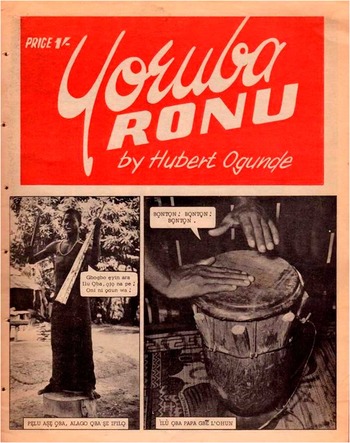
To this point, this paper explores the question of genre in arts and literature in postcolonial Africa through the prism of the Yorùbá Photoplay Series (Figure 1). Produced for a predominantly Yorùbá audience, photoplays were illustrated with sequential and mid-action photographs of a staged play, arranged in graphic panels, and narrated with thought and speech bubbles as well as caption boxes. Published by Lagos-based West African Book Publishers (WABP), the popular biweekly tabloid was in circulation from 1967 through the 1980s. For the majority of that time, the magazine was edited by theater-doyen Ṣẹgun Ṣofọwọtẹ and overseen by the owner of WABP, expatriate American businessman Richard Ian Gamble.Footnote 10 Ṣofọwọtẹ’s incomparable experiences—as a member of Wọle Ṣoyinka’s 1960 Masks, a producer with the WMTV station, print advertiser, radio announcer with Nigerian Television Service (NTS), and copywriter—uniquely equipped him to launch the WABP’s two inaugural projects: Magnet: The Nigerian Photoplay Magazine and the Yorùbá Photoplay Series, which, by 1971, was renamed Atọka: The Yorùbá Photoplay Series.
Cover page for “Yorùbá Ronu” (1967). vol. 1, no. 1: [unpaginated]

Photoplays made use of mythic, comedic, or melodramatic motifs to convey moral-didactic messages that were closely tied to cultural-historical events and present discourses.Footnote 11 Although its reproducibility and authorial uncertainty would disqualify it from a place in Félibien’s “hierarchy of genres,” increasingly accessible cameras offered a vehicle for popular sentiments and expressions. Indeed, this rich publication lends itself to myriad analysis, which I have taken up in other essays; this paper, however, is primarily concerned with the questions that this innocuous pulp serial raises about the concept of genre.
On the Historic-Geographical Contexts of Photoplays
Essentially, photoplays spring from a popular theater practice that has its roots in colonial Christian popular forms of expression that incorporated “indigenous, longstanding performance genres such as proverbs, oriki, Ifa poetry” to develop Yorùbá-language dramas that were made popular in the 1930s by the rise of the Aladuura churches and secularized in the 1940s under common cultural cause.Footnote 12 Later, Hubert Ogunde energized the nascent contemporary popular theater practice with his cast of professional actors, indoor proscenium stages, and secular public patrons.Footnote 13 These traveling troupes performed popular plays that inspired several related streams—radio programs, video-films, and photoplays—that endured in their own rights.
In fact, the proliferation and popularity of Yorùbá-language novels, plays, and poetry from the 1940s through the late 1960s were encouraged by political activity in the decade leading up to Nigeria’s independence from Great Britain in 1960. In her seminal text, Ẹbun Clark observes that during this independence period, there was an awareness of “the importance of a Nigerian theatre existing not only as a vehicle for entertainment and social comment but also as a platform for political action and education.”Footnote 14 Deeply rooted in Yorùbá performative practices, this contemporary popular theater became an important informal amplifier for Yorùbá cultural political organizations that crusaded for independence and competed to fill the leadership voids left by British withdrawal.
Although uniquely evolved, photoplays appear to be formal cognates of photonovels, which, scholars have argued, derived from the cinematically inspired fotoromanzi and cineromanzi formats that emerged in postwar Italy in the early 1930s.Footnote 15 These early European formats migrated along colonial channels of cultural exchange to France, Spain, and Latin America in the late 1940s before they finally appeared in South African markets in the 1960s, where they were adapted by Drum Publications.Footnote 16 Although the renowned publishing house experimented with the format throughout the 1950s, it did not produce stand-alone photonovels for African audiences until the late 1960s. Drum Publications’s first stride into this arena was African Film, an iconic crime-busters serial, illustrated with sequential and mid-action photographs, arranged in graphic panels, and narrated with caption boxes, thought, and speech bubbles. Known in South Africa as “look-reads,”Footnote 17 photonovels like African Film enjoyed expansive distribution and enthusiastic readership across the continent from Ghana to Kenya.Footnote 18
Importantly, “look-reads” and photoplays were lenses through which specific audiences could reconcile their contemporary realities and contradictions.Footnote 19 In her groundbreaking work on Yorùbá popular theater, Karin Barber argues for a “generative materialism” approach that investigates “how people’s lives, practices and knowledge give rise to certain kinds of texts”—that is, “a criticism of life by ideas” that seeks to understand cultural production through its constitutive processes and contexts rather than the artifact produced.Footnote 20 Barber writes that “generative materialism focuses on potentiality. When the performers start to devise a new play, infinite possibilities stretch in front of them, suggested rather than constrained by the genre within which they work.”Footnote 21 Photoplays in particular, were conceived of and distributed within “informal” sectors where the expectations of producers and consumers alike were primarily structured by nonliterary concerns.Footnote 22 The survival of photoplays was as entwined with its own commercial success as it was with live popular plays from which they derived. Although live theatre troupes were often popular and mobile enough to reconstitute its diverse audiences at each new location and with each new performance, the photoplays needed a specific kind of audience that was literate and possessed enough disposable income to eagerly purchase photoplays on an ongoing basis. This meant that its primary demographic were a literate, financially viable, intermediate socio-economic class situated between the illiterate, informal and super-educated, formal sectors.Footnote 23
Photoplays belonged to a diverse collection of emerging media forms, including glossy pictorial magazines that began to circulate in the 1950s. In her examination of “female audiences’ responses to the interlocking media forms around glossy magazines,” Tsitsi Ella Jaji argues that different media forms that emerged in this postcolonial period demanded a set of interpretive practices that “blurred textual, visual and other forms of literacy in [a] transsensory hermeneutic exercise” that she describes as “sheen reading.”Footnote 24
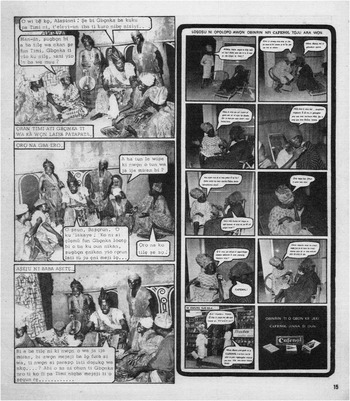
In this mediascape, the photoplays framed their readers as consumers of the narrative in the magazine, the photoplays, as merchandise itself, as well as the commodities advertised in its pages. In a convergence of these three registers of consumption, in the third issue of Ọba Koso (vol. 11), an ad for Cafenol (a tablet apparently formulated to relieve generic malaise) shares the page with the graphic panels at a particularly important point in the narrative (Figure 2). Where Oba Sango consults with his royal advisers about his young potential rivals (Timi and Gbọnka), the Cafenol advertisement interrupts the flow of the story just before the king’s dutiful wife, Oya, offers a wise resolution. Although the visual style of the advertisement was identical to the photoplays, the photo-panel scenes were set in a present context that disrupted the chronological flow of the photoplay. In the ad, a young woman calls upon her ill friend and recommends Cafenol tablets, the secret to her own good health. In the last two panels of the ad, we see that the ailing young woman has returned to her market stall, where she sells imported Bata shoes. The following panel shows a marketing photograph of several Cafenol boxes, and a closing imploration reads: “Wise women keep Cafenol close at hand.” The placement of the ad seems strategic because just a few frames later, Oba Sango and his royal advisers are shown listening intently to Oya’s political counsel. Though women were not the primary readers of these magazines, the content of their pages often engaged female readers, calling upon them “to be discrimination judges of value, and, as a result, despite their limited access to literacy and underrepresentation in urban spaces they were often . . . the target audience of much advertising.”Footnote 25 The photoplays support Jaji’s argument that these media often placed women at the center of debates about consumption, modernity, and politics after the 1950s.
“Ọba Koso” (1969). Cafenol advertisement, vol. 11, no. 3, page 15

To this point, photonovels and their cognates thrived insofar as they conversed with their (classed and gendered) audience and responded to the milieu in which they existed. In a Yorùbá market already experiencing a successful and widely popular theater naissance, African Film was popular but lacked the cultural specificity and active engagement to which Yorùbá audiences were accustomed. Photoplays, however, paraphrased the evanescent syntax of the popular theater vernacular and its cross-genre potential in a textual, literary form.
On “Genealogies” of Photoplays
Typically, this section of the paper would feature some attempt to trace a genealogy of the photoplays (the object of study); with the very question of genre that is at stake, however, the task takes on a particular significance. Though it is valuable to trace the origins of the photoplays, this alone cannot clarify the question of genre. As Barber compellingly argues, genre undergoes a “continual incremental transformation, [a] perpetual openness, which derives from the fact that it is not a set of laws but an accumulated way of doing things that gets changed in the doing.”Footnote 26 Here, Barber notes how genre itself is subject to use evolution even as it is deployed.
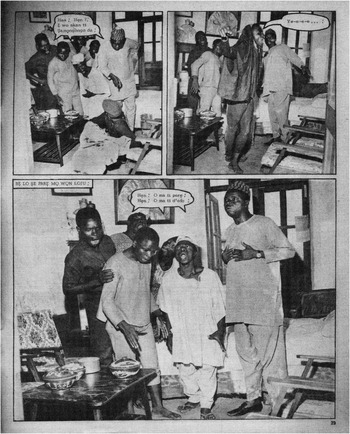
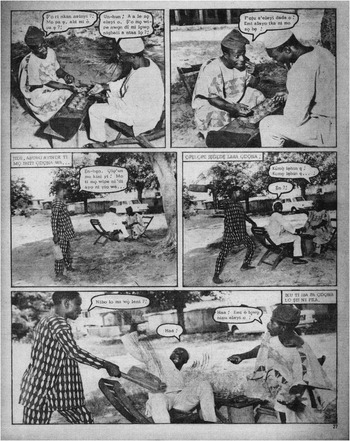
Notably, at its very founding the photoplay declares itself to be a genre not just by virtue of its label (photoplay) but in the processes implied by that label.Footnote 27 The term photoplay itself is an etymological and conceptual composite of action photography and Yorùbá popular theater.Footnote 28 Surprisingly, even with their limited parameters, the still photographs in the photoplays seemed to urge readers to imagine a live play that transcended the fixity of the depicted moment. In one dramatic conclusion to Èṣu Ọdara (vol. 30), Ayinde, the protagonist of photoplay, rebukes and unmasks the trickster deity (Èṣu), who had been masquerading as a friend (Figure 3). As the confrontation unfolds, Ayinde repudiates the spirit to the point where it sheds its skin/disguise and takes its true form before suddenly disappearing into thin air! The drama of the moment is captured in still photographs as Èṣu Ọdara seems to cower under the weight of Ayinde’s rebukes, even as the actor sheds a layer of clothing, seeming to transform before the reader’s eyes until he stands in a black bodysuit before finally disappearing from the scene in the last panel. A nearby group of friends witness the encounter with astounded reactions that facilitate the reader’s suspension of disbelief and solicit shocked responses to the sensational event. By capturing actors in energetic actions and demonstrative gestures that emphasized the physicality and embodied nature of the dialogue, these photographs worked in tandem with the text to activate the scene and advance the narrative. Moreover, the spirited actions captured in stills allude to the immediacy and presentness of the depicted events. To facilitate this process, some images were modified in post-production with techniques like motion blurring to give the impression of movement captured in the fixed image (Figure 4). In an earlier issue of Èṣu Ọdara (vol. 30), the trickster deity has provoked two men into a confrontation, and as they fight, hand-drawn lines appear across the photograph suggesting streaks of rapid movement in the still image. This visual intervention lured readers into an interpretive engagement with the photoplays that enlivened the inherent stillness and passivity of the format: Even as the gestural photographs invite viewers into the key dramatic moments of the performance, they also demand that these same readers envisage and animate the intervening actions, and thereby bridge the empty gutter spaces that separate empaneled images. That is, they demand that readers make their own sense of the images.
“Èṣu Ọdara” (1971). vol. 30, no. 4, page

“Èṣu Ọdara” (1971). vol. 30, no. 3, page 28

Even though the photoplays were modeled on photonovels, the magazine often referred to itself as iwe ere alaworan (play-watching book).Footnote 29 Inherent within the term alaworan is a sense of active, visual engagement with the process of watching the play (ere) that challenges a conventional understanding of iwe (book) as a written, passively read literary text. Moreover, the term privileges the pictorial material as the primary mechanism of narrative transmission, without abandoning the denotative value of script. With an increasingly, but not altogether, literate readership, it was undoubtedly vital that the concept of “reading public” not be limited to text or script—but rather, include images that could be “read,” as well.Footnote 30 Perhaps, it is unsurprising then that iwe ere alaworan is such a close cognate with iwe aworan (photo album). After all, photoplays are choreographed like photo albums—one of several already familiar, nonliterary texts through which audiences made sense of visual codes and conventions based on cultural and personal assumptions. Arranged like photographs in an album, the mid-action photographs in photoplays were read across the gutters that separated each panel. As readers’ eyes moved from one panel to the next, readers reflexively animated the narratives through the interplay of sequentially arranged, yet distinct, images.Footnote 31 Though these photographs were mediated by text and other elements, the fact that the design of photoplays was located within an already conversant visual genealogy that included photo albums and other genres was crucial to readers’ ability to make sense of the texts. Importantly, the terms used to describe these photoplays reveal how publishers, editors, and audiences understood and situated these texts within existing literary and nonliterary repertoires.
On Co-Creative Photoplay Audiences
The self-declared photoplays underscored their audience-engaged theatrical roots and the crucial role of the audience in this new production. Here, the emphasis is not simply on the literary artifact produced, but on a co-creative relationship with the audience that received and enlivened it. Many of the published stories had already been performed for some time by the originating troupe and enjoyed some popularity with theater audiences. These photoplays were published to capitalize on this previous success but also to access and convene previously untapped audience. By underscoring its connection to a uniquely indigenous practice, the Yorùbá Photoplay Series distinguished itself from photonovel cognates and operated in conversation with Yorùbá audiences and expectations.
Although Barber placed popular theater practices in dialectical opposition to literacy—that is, as “written representations” of “orally generated dramas,” photoplays represented the “virtual literacy” to which popular theater practices aspired—the lack of conventional creative process challenged clear bounds of authorship that literary artifacts were expected to maintain.Footnote 32 Like the popular plays, the photoplays were inspired by aggregate sources and reconstituted by various editors and editorial layers. As with the photoplays (which centered around the editor), the making of the popular plays hinged around the theater troupe leaders, who “began by ‘getting an idea’ from the sea of possibilities surrounding them in popular narrative, personal anecdotes, print fiction, traditional legend, and the plays of other theater companies, as well as their own past experiences.”Footnote 33 In this initial editorial layer, the troupe leader synthesized different source “texts” to create a unique script idea that became the “working tool” or “working text” for the production.Footnote 34 Then troupe actors were invited to collaboratively develop the idea by bringing the characters to life, fleshing out the scenes, and ultimately, producing a collective product through a process of rehearsals, re-articulations, and revisions. Unlike with the photoplays, the scripts for popular plays were rarely ever written down, and the “working text” continually evolved with each staging.Footnote 35 The photoplays intervened in this revising cycle, suspending it long enough to distill the cumulative effect of the actors’ organic gestures, expressions, and speeches into densely packed, still images that could be visually grasped and reanimated by the readers.Footnote 36
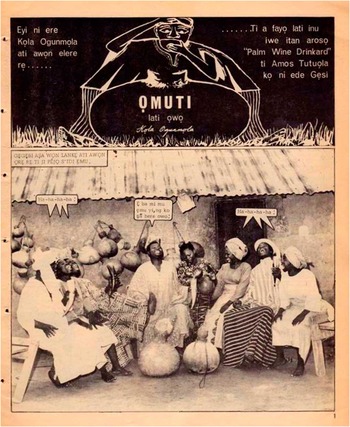
Nowhere was this authorial complexity more evident than in Ọmuti (vol. 3) (Figure 5). The illustrated banner on the title page introduced the photoplay as a unique, discrete work in and of itself while also crediting the co-creative parties that made it possible: “This is a play by Kọla Ogunmọla and his troupe. . . . We extracted it from the fictional story ‘Palm Wine Drinkard’ which Amos Tutuọla wrote in English.” This inscription not only recognized Amos Tutuọla for originating the tale, but also salutes the troupe leader, Kọla Ogunmọla, and his troupe of actors for their parts in reimagining the novel as Ọmuti. This example of shared creative collaboration supports Barber’s contention that “Yorùbá oral and written texts deeply interpenetrated, through mutual incorporation, quotation, emulation, and representation. The common people, not the educated elite, had command of it.”Footnote 37 In this particular instance, it seemed that the blurring of the lines among the literary author (Tutuọla), the theatrical author (Ogunmọla), and the troupe allowed for an informal reinvention of the “Palm Wine Drinkard” that implicated “the common people” (audience) as well. Notably, all of these parties were equally credited.Footnote 38 The most popular and recognizable collaborators involved in the creative process got top billing for authorial credit for the photoplays. Audiences cared more about those names than they did about those of mediators (like Ṣofọwọtẹ) who created the photoplays, and the authorial credits knowingly reflected this awareness. Thus, photoplays acknowledged authorship in a manner similar enough to popular plays so as to orient audiences to the new format.
Banner Inscription for “Omuti” (1968). vol. 3, no.1, page

Although it took some time before enabling mechanisms were introduced into the pages of the photoplays, audiences were not intended to be passive readers. The success of the Yorùbá Photoplay Series was due in part to the publication’s ability to induce reader participation in an otherwise passive reading experience. To this point, many of the stories chosen to be published had already been performed for some time by the originating troupe and enjoyed some popularity with theater audiences. These photoplays were published to capitalize on this previous success but also to access untapped audiences who may not have had occasion to see the theatrical production.
Moreover, these narratives exuded a sense of timeliness and timelessness that seemed to invite readers into currently unfolding stories. In one instance, the preface to the second issue of “Oju Eni Ma La” (vol. 13) entreats the audience to rejoin the developing story, reading: “E maa kàá lo” (or, “Come along with us”). The story is reframed as an excursion, a journey of revelation and understanding undertaken by readers and narrator alike, that promises not only an entertaining story but also moral guidance. This standing invitation to the story is never rescinded—any reader may return to the photoplay even decades after the initial publication and be greeted with the same ever-present welcome. Indeed, readers responded energetically to these invitations. The topical presentness of the stories in the photoplays crucially contributed to its ability to convene audiences. Yorùbá Ronu—the first volume in the Yorùbá Photoplay Series—made waves several years earlier as a play that delivered a scathing moralistic critique of the internal power struggles within Action Group, the predominantly Yorùbá political party that controlled the western government of Nigeria. Nearly two years after being banned by the western government of Nigeria, Hubert Ogunde’s controversial protest play was resanctioned and exploded back onto the political stage, capturing popular consciousness in photoplay form. Ṣofọwọtẹ explains the rationale for choosing plays, saying, “That was the time when armed crime started in Nigeria and we always wanted to be topical.” This topicality touched on the contemporary experiences of readers and organically drew them to the photoplays. Although not all photoplays were as politically critical as Ogunde’s work, several made use of mythic, comedic, or melodramatic motifs to convey moral-didactic messages that were closely tied to cultural-historical events and present discourses.Footnote 39 In this manner, photoplays often operated on multiple discursive registers and across genres in constituting engaged audiences.
By February 1971, Atọka began to publish reader responses in the magazine alongside the featured narratives. Reader write-ins quickly became a popular addition to the photoplay. Initially, these letters were printed on only a single page, but their allotted space soon increased dramatically and they began to share columns with advertisements and interrupt the stream of graphic panels. In the first instalment of “Iyawo Alalubọsa” (vol. 27), reader responses take up four pages of the magazine with letters to the editor (“E jọwọ, Olotu”), requests for advice regarding personal troubles (“Kini Idamu Re”), disastrous news items (“Kayẹfi”), recipes for local foods (“Ọgbọn ase”), and even music reviews (“Awọn Awo Tuntun Fun Igbadun Rẹ”). In one instance, two readers independently wrote to the magazine with uncannily similar comments and requests. The first writer felt compelled to testify about the “wisdom” he had culled from the magazine; both writers, however, suggested that Atọka fan clubs be established all over the nation for the sake of educating the masses, facilitating communications between readers and the editor, and, importantly, transforming casual post-reading experiences into organized assemblies where readers could convene as a collective. That two geographically unrelated writers arrived at such similar ideas regarding the photoplays demonstrated the success of the magazine’s homogenized approach to audience address. Other writers shared their own tangled tales of woe—often as dramatic as the photoplays—and sought advice from other readers and the editor. Indeed, these writers/readers saw elements of their own struggles reflected in those of the characters in the narratives. By writing to Atọka, they interpolated their own lives onto the pages of the photoplays and aligned their troubles alongside those of their favorite fictional protagonists.
In this post-independence era in southwestern Nigeria, photoplays complicated and experimented with genre in ways that propelled co-creative engagements between texts and audiences. Rather than a “container model” that frames genre as cultural artifact, photoplays recognize the textual qualities of genre but necessitate a cognitive approach that accounts for postcolonial concerns, nonliterary sources, audience reception, response, and re-incorporation.