It is estimated that over 80 million Americans are affected by coronary artery disease and it is the number one cause of death in patients over the age of 75 years.Reference Heron, Hoyert, Murphy, Xu, Kochanek and Tejada-Betzaida1 However, there is a very small population of patients less than 30 years of age who present with myocardial infarction potentially leading to acute complications or a life-long problem of chronic cardiac disease that has not been studied. Very often, these patients are not followed up by any physician at all. Therefore, it is not until they present with an acute myocardial infarction that they enter the health-care system. Despite the fact that physicians may be aware that atherosclerosis can begin in the teenage years or younger, it is not generally known that some patients may actually sustain a myocardial infarction in their twenties. Therefore, we decided to examine the extent of this problem in an academic community hospital in a suburban setting. Recently, the National Heart, Lung and Blood Institute convened a working group to provide basic and clinical research to develop an integrated approach for identifying individuals who are at high risk for a cardiovascular events such as acute coronary syndromes in the “near term”.Reference Eagle, Ginsburg and Musunuru2, Reference Doughty, Mehta and Bruckman3 Obviously this is always critical but perhaps even more so in this very young cohort, with years of potential cardiac problems possible.
Methods
This is a single-cohort, retrospective, observational study designed to evaluate the variables that either suggest or directly contribute to the risk of atherosclerosis in this age group utilising the cardiac catheterisation database. All patients aged 30 years or younger were selected. Only those patients who had significant atherosclerotic lesions at the time of catheterisation and also those who, on the basis of angiographic appearance, required intervention with angioplasty and stenting were studied. Therefore, patients with an acute coronary syndrome secondary to minimal atherosclerotic disease, thrombus, dissection, anomalous vessel origin, vasculitis, or vasoconstriction secondary to coronary artery vasospasm were excluded.
Results
A review of 14,704 cardiac catheterisations in our institution performed between January, 2006 and January, 2010 revealed 10 patients – two of whom had two different procedures – in this age group who had both cardiac catheterisation and an intervention for acute coronary syndrome. They sustained either an ST elevation myocardial infarction or a non-ST elevation myocardial infarction. None of these 10 patients had elective catheterisations for diagnostic purposes. All participating patients were screened for drug use and all screens were negative for cocaine or its metabolites. Family histories for premature coronary artery disease were also obtained. There were eight patients with parents or siblings having premature coronary artery disease defined as 55 years old or less. Finally, lipid values were also recorded, for the presence of familial hypercholesterolaemia.
An additional three patients with embolic lesions were excluded from the study. None of these patients had atrial fibrillation and unfortunately were not screened for abnormalities of coagulation.
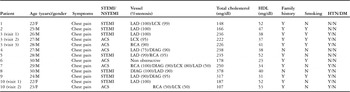
All patients had single vessel disease. The patient characteristics can be seen in Table 1. Traditional risk factors for coronary artery disease were noted in a large percentage of the cohort group. The only drug use reported was for marijuana and ecstasy. All patients received a stent and there were no hospital deaths. No significant complications, such as the development of congestive cardiac failure or ventricular arrhythmias, occurred. All patients were discharged and followed up by a private physician, with a zero percent 30-day mortality.
Patient characteristics and laboratory results.

ACS = acute coronary syndrome; DIAG = diagonal branch; DM = diabetes mellitus; F = female; HDL = high-density lipoprotein; HTN-hypertension; LAD = left anterior descending artery; LCX = left circumflex artery; M = male; N = no; NSTEMI = non-ST elevation myocardial infarction; RCA = right coronary artery; STEMI = ST elevation myocardial infarction; Y = yes
Discussion
Although limited in number, it is obvious that there is a highly unusual group of patients with an extremely aggressive form of coronary artery disease. All of these patients entered the health-care system at the time of an emergency; however, it seems likely that their underlying disease was unknown to them and probably undetected by previous physicians they may have been seeing. Currently, there is no known reason as to why this particular group of young patients is at an increased risk for not only the development of atherosclerotic cardiac disease, but even worse for sustaining an acute coronary syndrome.
In fact, in most studies the “young” are considered either 55 years or 45 years or younger. Our population is much younger than these more frequently recognised cohorts. We have attempted to review some of the factors that may be responsible for this rare but virulent form of the disease. All the included patients clearly showed underlying plaque and the usual pathogenesis of atherosclerosis was suspected. It is well recognised that the formation of a yellow streak can be seen in teenagers.Reference Holman, McGill, Strong and Greer4 An autopsy report of 760 trauma victims showed advanced atheroma in 2% of male patients in the 15–19-year age range, and 20% of men in the 30–34-year age group.Reference Joseph, Ackerman, Talley, Johnstone and Kupersmith5 Therefore, it is somewhat surprising that myocardial infarction has been rarely reported in young patients. In communities with a high prevalence of cocaine use, it is likely that patients will be evaluated for acute myocardial infarction, if the presenting complaint is chest pain. Patients with cocaine-related myocardial infarction cannot be distinguished from those without this condition on a clinical basis.Reference Lange and Hillis6 Approximately 50% of patients with cocaine-related myocardial infarction have no evidence of atherosclerotic coronary artery disease on subsequent angiography. Disease states such as familial hypercholesterolaemia are known to be associated with premature myocardial infarctions, but none of our patients had this problem. Workup for abnormal coagulation syndromes such as Protein S or C abnormalities were not performed.
Given the life-long risk in this cohort, they should be treated very aggressively for all risk factors associated with coronary artery disease. With the high incidence of single vessel disease in this population, it would be expected that the short-term prognosis would be good. Collateral circulation was also minimal, probably because of the acute onset and lack of history of myocardial ischaemia. In looking at only those patients with significant plaque, patients with hyper-coagulable states – such as nephrotic syndrome, anti-phospholipid antibody syndrome, Protein S, and factor XII deficiencies – were not screened for. Vasospasm was also excluded as only those arteries with significant plaque were included for study. Previous reports suggested the role of cocaine in promoting atherosclerosis; however, a negative drug screen likely ruled out this possibility in our patients.Reference Kolodgie, Virmani, Cornhill, Herderick and Smialek Kolodgie7
Despite the fact that our findings mimic those of a recent study in Switzerland, it is clear that this is an under-studied group that deserves increased attention.Reference Schoenenberger, Radovanovic and Stauffer8 There is a role for the identification of these patients as early as possible to prevent subsequent episodes of infarction, as evidenced by two patients in our cohort who developed new culprit lesions in different vessels after their initial presentation. Aggressive risk factor modification including smoking cessation, low-density lipoprotein cholesterol levels of 70 milligrams per decilitre or less, and the use of aspirin must be initiated. Screening for traditional risk factors in an attempt to identify an individual patient has not been successful. Thus, the goal for identifying markers for early cardiovascular disease, which could serve as a surrogate for disease progression and morbid events, is to improve early detection and treatment. Cohn et alReference Cohn, Duprez and Grandits9 devised an early cardiovascular disease score based on 10 non-invasive tests. It consisted of seven vascular tests – large and small artery elasticity, resting blood pressure and exercise blood pressure response, optic fundus photography, carotid intimal-media thickness, and microalbuminuria) – and three cardiac tests, including electrocardiography, [N-terminal pro-] B-type natriuretic peptide, and left ventricular ultrasonography. This score was more predictive for events than the classical cardiovascular risk assessment. Therefore, early detection of cardiovascular disease in asymptomatic patients rather than stratification based on the statistical assessment of their classical risk factors seems to be a better diagnostic and therapeutic strategy.
It is interesting to speculate on the reason for such an early and virulent onset of atherosclerosis in this small percentage of patients. The possible reasons include abnormal endothelial function, or abnormal nitrous oxide response, increased cytokines or other inflammatory reason, or a combination of genetic reasons involving a single nucleotide polymorphism, etc. In this context, imaging modalities based on molecular mediators of inflammation during atherogenesis are being studied. These include targeted ultrasound detection of vascular cell adhesion molecule within areas of inflammation in atherosclerosis and glucose uptake monitored by fluorodeoxyglucose.Reference Kaufmann, Sanders and Davis10, Reference Tahara, Hisashi and Hiroyuki11 Other modalities based on tracking phagocytosis of macrophages, modified low-density lipoprotein accumulating in lesions, and proteinases implicated in plaque destabilisation with microparticulate markers are also being utilised.Reference Kaul and Lindner12
The advent of genome-wide association screens has proven to be useful. Identification of chromosome region 9p21 in several studies confers susceptibility to coronary artery disease.Reference Roberts13 Abdullah et alReference Abdullah14 recently found allelic association between four single-nucleotide polymorphisms on chromosome 9p21 and the phenotype of premature coronary artery disease and myocardial infarction, with a mean age of 40 years in their patients.Reference Abdullah14 Studies such as this reinforce the future potential of genetics in identifying risk predictors and potential therapeutic targets.
Limitations
This study has its limitations as it is a retrospective study, but is probably indicative of how medicine is practised in a community hospital. Therefore, many potential tests and follow-up visits were not obtained. Given the prevalence of cocaine use associated with acute myocardial infarction in this age group, it was totally unexpected to see significant angiographic evidence of atherosclerotic disease. Most patients in this age group will be expected to have used cocaine as the precipitating factor for their acute coronary syndrome. Previous reports suggested the role of cocaine in promoting atherosclerosis; however, a negative drug screen likely ruled out concurrent use in our patients. Owing to the fact that this was a retrospective study and hair sampling was not done, perhaps remote cocaine abuse was possible but was still an unlikely precipitant of acute myocardial infarction in this group. Another problem was the use of angiography as the gold standard, as atheroma can be more readily visualised with other techniques. Therefore, we may have underestimated the number of myocardial infarctions that were not intervened on but were still caused by atherosclerotic cardiac disease with rupture of a vulnerable plaque, not visualised by angiography. For instance, optical coherence tomography allows high-resolution tomographic intra-arterial imaging with a histology-grade definition of coronary plaque microstructure in vivo and thus a better understanding of the mechanisms of coronary artery disease.Reference Yabushita, Bouma and Houser15
Very recently, de Kleijn et alReference de Kleijn, Moll and Hellings16 described the use of plaque osteopontin levels in plaque obtained from carotid endarterectomies as a biomarker for cardiovascular events in other vascular territories. Osteopontin is also known as early T-lymphocyte activator 1 and is a secreted multifunctional glycoprotein. They also found that plaque osteopontin was independent of plaque features such as presence of macrophage, a large lipid pool, and smooth muscle cell content. The results of this trial were in an elderly atherosclerotic patient population, which makes extrapolation to a population that has traditional risk factors but without clinical signs or symptoms difficult. Nevertheless, the predictive value of osteopontin plaque levels in asymptomatic patients is high and suggests that their findings might apply to a younger and broader population with advanced atherosclerotic plaques.
Conclusion
Hopefully, with further research a genetic link that could identify these patients early will be found. For now, we would strongly recommend that a prospective study be undertaken to identify this very high-risk population utilising new and novel risk factors and biomarkers. Perhaps intra-vascular ultrasound, optical coherence tomography, and genetic arrays in a “high-risk” group could be utilised. Although always important, given the life-long risk it is imperative that this virulent form of atherosclerosis be pre-morbidly identified and aggressively treated.