Introduction
Job stress and burnout among healthcare clinicians negatively impact (1) individuals, Reference Dewa, Loong, Bonato, Thanh and Jacobs1–Reference Costa and Moss5 (2) staff retention, Reference Moss, Good, Gozal, Kleinpell and Sessler6,Reference Mealer, Burnham, Goode, Rothbaum and Moss3 (3) patient safety, Reference Moss, Good, Gozal, Kleinpell and Sessler6,Reference Cimiotti, Aiken, Sloane and Wu7 and (4) patient satisfaction. Reference Moss, Good, Gozal, Kleinpell and Sessler6,Reference McHugh, Kutney-Lee, Cimiotti, Sloane and Aiken8 Studies have reported rates of burnout to be 38–54% among physicians, Reference Kane2,Reference Shanafelt, West and Sinsky9 40–86% among registered nurses, Reference Mealer, Burnham, Goode, Rothbaum and Moss3,Reference McHugh, Kutney-Lee, Cimiotti, Sloane and Aiken8 and ∼ 26% among advanced practice providers. Reference Kapu, Card and Jackson10 Providers working in critical care are at even higher risk for burnout, with reported rates of 50–86% Reference Moss, Good, Gozal, Kleinpell and Sessler6,Reference Kerlin, McPeake and Mikkelsen11 due to high patient morbidity and mortality, ethical dilemmas, traumatic encounters, and challenging day-to-day work. Reference Costa and Moss5,Reference Moss, Good, Gozal, Kleinpell and Sessler6,Reference Kerlin, McPeake and Mikkelsen11 Burnout in critical care clinicians increases when clinicians perceive insufficient time or resources to provide care Reference Costa and Moss5 and an overall lack of support from leadership. Reference Moss, Good, Gozal, Kleinpell and Sessler6
For nurses, higher burnout is associated with an increased risk of vacating their position. Reference Gensimore, Maduro, Morgan, McGee and Zimbro12 Job dissatisfaction, lack of a healthy work environment, and inadequate staffing were also associated with increased nurse burnout, Reference McHugh, Kutney-Lee, Cimiotti, Sloane and Aiken8,Reference Kelly, Johnson, Bay and Todd13 while there is evidence that perceptions of leadership support and quality work environments are associated with lower nurse burnout. Reference McHugh, Kutney-Lee, Cimiotti, Sloane and Aiken8,Reference Gensimore, Maduro, Morgan, McGee and Zimbro12,Reference Kelly, Johnson, Bay and Todd13 For advanced practice providers, nurse practitioners, and physician assistants, lack of control over workload and perceived lack of supervisor support have been associated with higher burnout rates, Reference Kapu, Card and Jackson10 while co-worker relationships were a protective factor for staying in their positions despite experiencing burnout. Reference Kapu, Card and Jackson10
There is a paucity of research investigating the level of distress and well-being of registered nurses and advanced practice providers in the paediatric cardiac ICU (PCICU). The primary objective of this survey was to evaluate Well-Being Index scores among registered nurses and advanced practice providers working in paediatric cardiac intensive care. The secondary objectives were to evaluate factors correlating with at-risk Well-Being Index scores and to determine potential predictors of at-risk well-being, including the coronavirus disease 2019 pandemic given the timing of the study period. The coronavirus disease 2019 pandemic had a significant impact on the US healthcare system and negatively impacted the well-being of healthcare workers. Reference Shanafelt, West and Dyrbye14–Reference Gee, Weston, Harshman and Kelly17
Materials and methods
Study approval was obtained from the Indiana University Institutional Review Board, Protocol #10628, approved on 9/21/2021. Indiana University is the coordinating site for the multicentre research collaborative entitled Collaborative Research from the Pediatric Cardiac Intensive Care Society. The Indiana University REDCap© Reference Harris, Taylor, Thielke, Payne, Gonzalez and Conde18 survey link was sent via email to registered nurse and advanced practice provider leaders at institutions that agreed to participate in the study within Collaborative Research from the Pediatric Cardiac Intensive Care Society (CoRe-PCICS). Registered nurse and advanced practice provider leaders forwarded the email with the survey link to their employees with an informed consent document, introduction text, and instructions from the research team. Consent was implied if participants completed the survey. To maintain anonymity, individual participant identifiers, including IP addresses, were not collected. Three emails soliciting participation were sent during the 90-day study period.
This cross-sectional study was conducted between October 2021 and January 2022. A convenience sample of registered nurses and advanced practice providers employed within US Collaborative Research from the Pediatric Cardiac Intensive Care Society sites that provide direct care to PCICU patients was eligible to complete the electronic survey. The survey included the nine-item Well-Being Index and multiple-choice questions regarding categorical demographic characteristics, registered nurse and advanced practice provider characteristics, and potential risk factors affecting well-being. The timing of the study period was during the end of the Delta wave and the beginning of the Omicron wave of the coronavirus disease 2019 pandemic. As such, additional questions about coronavirus disease 2019 were asked.
The Well-Being Index, created by the Mayo Clinic, is a validated tool that evaluates multiple facets of distress and well-being among healthcare workers, including stress, burnout, fatigue, depression, and overall level of well-being. Reference Dyrbye, Satele and Shanafelt19 The Well-Being Index was originally a seven-item tool and then expanded to nine items to assess meaning in work and satisfaction with work–life integration. Both versions are considered acceptable for use in healthcare workers and can be used to predict distress including low quality of life, burnout, and severe fatigue as well as high quality of life in registered nurses and advanced practice providers. Reference Dyrbye, Satele and Shanafelt19–Reference Dyrbye, Johnson and Johnson21
Well-Being Index scores range from -2 to 9, where -2 is the lowest risk and 9 is the highest risk. For registered nurses, a score of 2 is the threshold for risk for distress, and a score of 4 identifies risk for severe distress. For advanced practice providers, a score of ≥4 indicates an increased risk for adverse outcomes.
Our survey included 17 risk-factor questions in addition to the Well-Being Index. We asked about registered nurse and advanced practice provider health, self-care, stress, sleep, home and work support, job resources, traumatic event(s) in the last year outside of work, and intent to change job or career. Due to the timing of the study, we asked if sleep, stress, and job resources had changed since the coronavirus disease 2019 pandemic. Qualitative data were collected with this study, but the results are not a focus of this paper.
Categorical data were described using counts with percentages and continuous variables were described using mean with standard deviation. The Well-Being Index score was summarized as a continuous variable and as a dichotomized at-risk for distress score based on previously established cut-offs for registered nurses and advanced practice providers. Reference Dyrbye, Johnson, Johnson, Satele and Shanafelt20,Reference Dyrbye, Johnson and Johnson21 Given the Well-Being Index score distribution for registered nurses and advanced practice providers were both significantly non-normal (p < 0.05), bivariate relationships were evaluated using the non-parametric Kruskal–Wallis test. The group with the most participants with low Well-Being Index scores has the lowest mean rank, with the opposite interpretation for the highest mean rank. Finally, binary logistic regression was performed to identify potential predictors of registered nurse well-being risk using the appropriate Well-Being Index cut-off (score ≥ 2) for both non-coronavirus disease 2019 factors and coronavirus disease 2019 factors. Covariates that were significant in the bivariate analyses were included in the initial model. Subsequent models were tested using multicollinearity tests, R2, and Akaike information criterion to evaluate model fit. A p-value of < 0.05 was considered statistically significant, and results are presented as odd ratios (OR) with 95% confidence intervals (CI). Binary logistic regression analysis was not performed with the advanced practice provider participants due to the small sample size. All analyses were performed using IBM SPSS Statistics version 25 (SPSS 2017). 22
Results
A total of 246 surveys were completed. Participants who were not bedside nurses or advanced practice providers providing direct patient care and participants who did not complete the Well-Being Index were excluded. The final sample size was 218 participants, and only quantitative data were included in the analysis. The sample included 180 nurses and 38 advanced practice providers. Most respondents were female (95%) and 20–40 years old (71%; Table 1). Most respondents (65%) worked in a dedicated PCICU, worked dayshift (42%), and had more than five years of experience (59%) (see Table 1). The mean Well-Being Index score for registered nurses was 2.96 ± 2.23 (range −2 to 9) with 76% of nurse respondents meeting at-risk score criteria (Figure 1 ). The mean Well-Being Index score for advanced practice providers was 2.18 ± 2.4 (range −2 to 6) with 39% of respondents meeting at-risk score criteria (Figure 2 ). Additionally, 109 nurses (61%) and 13 advanced practice providers (34%) reported intent to leave their job within the next 6 months, 1 year, or 3–5 years.
Paediatric cardiac ICU registered nurses with at-risk Well-Being Index.

Paediatric cardiac ICU advanced practice providers with at-risk Well-Being Index.

Survey respondent characteristics

RN = registered nurse; APP = advanced practice provider; CICU = cardiac ICU; PICU = paediatric ICU.. Data represented as absolute counts with percentages.
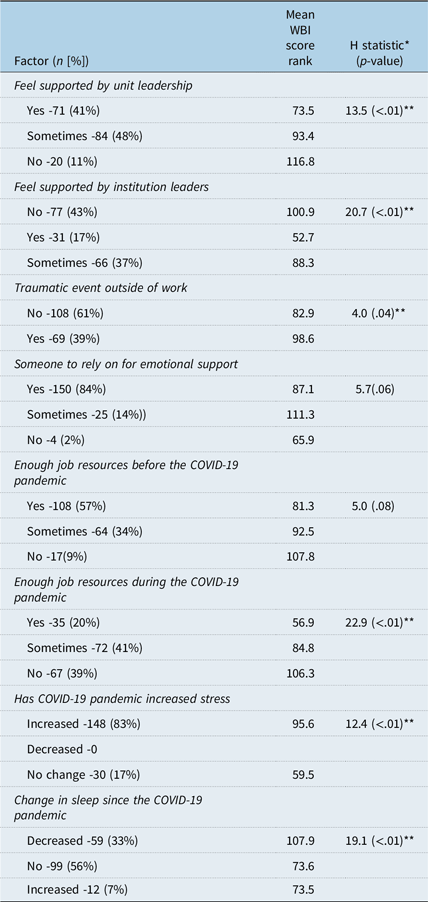
None of the individual participant characteristics nor use of self-care opportunities were significantly related to well-being. Bivariate analysis comparing potential factors contributing to poorer well-being for nurses and advanced practice providers are provided in Tables 2 and 3. Among registered nurses, significant factors contributing to distress included lack of support from the unit and institutional leadership and the experience of a traumatic event outside of work. Sources of poor well-being specific to the coronavirus disease 2019 pandemic that were significant included increased stress since the coronavirus disease 2019 pandemic, decreased sleep since the coronavirus disease 2019 pandemic, and lack of job resources during the coronavirus disease 2019 pandemic. For advanced practice providers, the presence of a chronic medical condition, a lack of unit leadership support, a lack of institutional leadership support, and a lack of job resources preceding the coronavirus disease 2019 pandemic were risk factors. A lack of job resources during the coronavirus disease 2019 pandemic was a factor for poor well-being in advanced practice providers related to coronavirus disease 2019.
Potential factors contributing to distress for RNs in the PCICU

RN = registered nurse; PCICU = paediatric cardiac ICU; WBI = Well-Being Index; COVID-19 = coronavirus disease 2019; n = number of respondents for the question; % = percentage of total respondents for the question. *H is the test statistic for the Kruskal–Wallis test; **statistically significant at p < 0.05.
Potential factors contributing to distress for APPs in the PCICU

APP = advanced practice provider; PCICU = paediatric cardiac ICU; COVID-19 = coronavirus disease 2019; n = number of respondents for the question; % = percentage of total respondents for the question.
*H is the test statistic for the Kruskal–Wallis test; **statistically significant at p < 0.05.
Non-coronavirus disease 2019 and coronavirus disease 2019 factors that were significant in the bivariate analyses for registered nurses were included in different models predicting risk of well-being. In the best-fitting model, support from institutional leaders and change in stress since the coronavirus disease 2019 were significant predictors of the at-risk Well-Being Index among registered nurses (Table 4). Specifically, perceiving appropriate support from institutional leaders reduced the risk of poor well-being by 68% compared to perceiving some or no support from institutional leaders (OR 0.32, 95% CI 0.10–0.94, p = 0.04) even after adjusting for stress during the pandemic. Additionally, reporting increased stress since the coronavirus disease 2019 increased one’s risk for poor well-being four-fold compared to reporting no change in stress (OR 4.17, 95%, CI 1.75–10.09, p = 0.001) even after adjusting for support from unit or institutional leaders. In a sensitivity analysis with non-coronavirus disease 2019 factors only, there were no significant predictors of at-risk well-being. This suggests institutional support and stress are important in the setting of a global health crisis.
Logit GLM regression on well-being risk by stress and sources of support for RNs

GLM = generalized linear model; RN = registered nurse; COVID-19 = coronavirus disease 2019; OR = odd ratio; 95% CI = 95% confidence interval; p = p-value; df = degrees of freedom..
Discussion
This study presents critical findings to the paediatric cardiac critical care community. Three-quarters of registered nurses surveyed had at-risk Well-Being Index scores, and almost two-thirds reported an intent to vacate their position. At-risk Well-Being Index scores are correlated with registered nurses vacating their position. Reference Dyrbye, Johnson, Johnson, Satele and Shanafelt20 Both job turnover and burnout in the healthcare field are costly Reference Yates23–Reference Muir, Wanchek, Lobo and Keim-Malpass25 and lead to negative impacts on patient safety Reference Cimiotti, Aiken, Sloane and Wu7 and quality of care. Reference McHugh, Kutney-Lee, Cimiotti, Sloane and Aiken8 Retention of experienced nurses in the PCICU is critical to maintaining a high quality of care. Nursing level of education and experience level has been associated with fewer complications and reduced mortality after paediatric cardiac surgery. Reference Hickey, Pasquali and Gaynor26 Turnover leads to significant costs for healthcare institutions to train new employees. Reference O’Brien-Pallas, Griffin and Shamian27 The turnover cost per nurse in the USA is reported as $21,514–$88,000. Reference O’Brien-Pallas, Griffin and Shamian27,Reference Jones28 Over one-third of PCICU advanced practice providers reported intent to vacate and had at-risk Well-Being Index scores. PCICU advanced practice providers are essential team members in the care of these critical patients. Improving PCICU registered nurse and advanced practice provider well-being could impact retention, save lives, and reduce costs. After this study was conducted, there were many nurse vacancies in PCICUs, and these positions were filled with travel nurses. Future research is needed on the impact of nurse vacancy on travel nurse utilization in the PCICU and the percentage of travel nurse staff impact on unit staff nurse well-being in the PCICU.
For registered nurses, perception of leadership support was a significant predictor of low-risk Well-Being Index scores. Nurses’ positive perception of institutional leadership support is a predictor of nurse retention. Reference Gensimore, Maduro, Morgan, McGee and Zimbro12 Nurses’ positive perception of hospital leadership and organizational support decreased their perception of workload, which reduced burnout. Reference Gensimore, Maduro, Morgan, McGee and Zimbro12 Burnout increases when higher demands are not met with organizational resources. Reference Bakker and Demerouti29,Reference Rehder, Adair and Sexton30 Organizations can improve well-being by balancing demands with increased support. Reference Rehder, Adair and Sexton30 Experience of a traumatic event outside of work was a risk factor for poor well-being in nurses. The critical care work environment is stressful. Reference Kerlin, McPeake and Mikkelsen11 Compounding work and non-work stressors, such as a traumatic life event, could reduce an individual’s capacity to recover from stress and negatively impact well-being. Registered nurses reporting plans to change jobs or careers was associated with poorer well-being. At-risk Well-Being Index scores are a predictor of intent to vacate. Reference Dyrbye, Johnson, Johnson, Satele and Shanafelt20 Improving PCICU registered nurses’ perception of support from leaders and improving support for employees experiencing non-work stressors, such as traumatic events, has the potential to improve well-being and retention.
The percentage of registered nurses reporting sufficient resources to do their job well prior to and during the coronavirus disease 2019 pandemic decreased. Registered nurses who reported insufficient job resources during the coronavirus disease 2019 pandemic were at risk for poor well-being. On the job, nurses experience workplace adversity, including increased workload, staffing shortages, and safety issues. Reference Gensimore, Maduro, Morgan, McGee and Zimbro12 In the Job Demands Resource Model, stress and burnout are increased when job demands are high and job resources are low. Reference Bakker and Demerouti29 Lack of resources leads to disengagement at work. Reference Bakker and Demerouti29 Improving nurses’ work environment can positively impact patient care and satisfaction. Reference McHugh, Kutney-Lee, Cimiotti, Sloane and Aiken8 Further research is needed to determine if PCICU registered nurses continue to report inadequate job resources after the coronavirus disease 2019 pandemic.
Registered nurses who reported increased stress and registered nurses who reported change in sleep since coronavirus disease 2019 were at risk for poorer well-being. Change in stress during the pandemic was a predictor of at-risk Well-Being Index scores, even after controlling for sources of support. Having support from institutional leaders could be protective in the setting of coronavirus disease 2019; it lowers the risk even for those whose stress level has increased. Paediatric critical care professionals reported high levels of moral distress during the coronavirus disease 2019 pandemic. Reference Thomas, Davis, Kumar, Thammasitboon and Rushton16 Studies suggest nurses will experience disillusionment after coronavirus disease 2019 that could increase burnout, secondary traumatic stress, grief, and moral distress. Reference Gee, Weston, Harshman and Kelly17 Further research is needed to determine if institutional leadership support is still predictive of PCICU registered nurse well-being given the current state of the coronavirus disease 2019 pandemic. The authors conducted a qualitative study in conjunction with this quantitative study, and although the qualitative results are not a focus of this paper, the future publication will include an analysis of registered nurse and advanced practice provider comments regarding leadership support.
This study suggests that advanced practice providers may have better well-being overall compared to registered nurses in the PCICU. The role of the advanced practice provider in the PCICU is different from the registered nurse. Potential differences in well-being may be related to opportunities for the advanced practice provider to advance professionally or work non-clinically in other roles. Advanced practice providers may feel more valued as a part of the medical team and are generally more informed about the global plans for patients. Conversely, registered nurses may be in one critical patient’s room for an entire shift, which can be physically, mentally, and emotionally taxing, particularly without knowing the broader trajectory for that patient. Additionally, advanced practice provider financial compensation is higher than registered nurse financial compensation. The Bureau of Labor Statistics reports the mean hourly wage for registered nurses as $45.42 31 and mean hourly wage for advanced practice providers as $61.78. 32 Despite the differences, there are still opportunities to improve the well-being of PCICU advanced practice providers, and more research is needed to confirm advanced practice provider well-being differs from nurse well-being. A targeted follow-up study with advanced practice providers would be beneficial in broadening the current knowledge about well-being for individuals in this role.
There are a few notable limitations to this study. We did not survey these healthcare workers before the pandemic. The findings reflect respondents’ sentiments during the coronavirus disease 2019 pandemic, a public health crisis when healthcare workers were under unique pressures. Post-coronavirus disease 2019 follow-up studies should be conducted to evaluate if these results are sustained. This study was a cross-sectional study with a small convenience sample, particularly for advanced practice providers, which limits our ability to draw definitive conclusions. Additional research is needed to expand upon advanced practice provider well-being, to define mechanisms to enhance registered nurse and advanced practice provider well-being, and to evaluate interventions to target modifiable risk factors for at-risk Well-Being Index scores for registered nurses and advanced practice providers. The authors were unable to calculate the response rate due to survey distribution mechanisms and to ensure confidentiality by not knowing IP addresses. Lastly, the Well-Being Index evaluation and scoring for question 8 was asked differently than the original Well-Being Index. Question 8, “Please rate how much you agree with the following statements: The work I do is meaningful to me.” uses a 7-point Likert scale in the response with “very strongly agree” and “very strongly disagree” anchored at either end of the scale. The researchers used a seven-choice response to this question and therefore had to correlate the responses to the Likert scale scoring for our participants. The researchers scored the responses with different score correlations to examine the implications, and it did not impact the results of the study.
Conclusions
This study highlights that PCICU registered nurses are at risk for poor well-being, and both registered nurses and advanced practice providers are at risk of vacating their position. The coronavirus disease 2019 pandemic may have negatively impacted registered nurses and advanced practice providers well-being, and further research is needed to establish Well-Being Index baselines for PCICU registered nurses and advanced practice providers. Further research is needed to identify factors contributing to well-being in the current state of the pandemic. This study suggests that advanced practice providers in the PCICU may have better well-being overall compared to PCICU registered nurses, although further research is needed. Leadership support is important to registered nurse well-being in times of high stress, such as a global pandemic. This is a wake-up call to the paediatric cardiac critical care community. It is time to prioritize improving registered nurses and advanced practice providers well-being, which would benefit paediatric heart centres and their patients.
Supplementary material
The supplementary material for this article can be found at https://doi.org/10.1017/S1047951125000599.
Acknowledgements
Registered nurse and advanced practice provider participants: thank you for your time and your voice. David K. Werho, MD, and Catherine Krawczeski, MD, also provided valuable guidance in the study design and provided a professional connection to Dr. Staveski and Dr. Mastropietro.
Financial support
This research received no specific grant from any funding agency, commercial, or not-for-profit sectors.
Competing interests
None.
Ethical standards
Not applicable