

Introduction
According to the World Health Organization [WHO, 2003], hypertension is estimated to cause 4.5% of current global disease and 7.1 million premature deaths and is as prevalent in developing countries as developed nations. In the United States, 70 million people have some form of hypertensive disease, only a third of whom are being treated adequately, whereas another third are unaware that they carry the disease [Aronson and Fontes, 2006]. In the United Kingdom, approximately 7.5 million patients suffer with hypertension, only 29% of these patients are treated, and only 45% of those treated with antihypertensive medications have controlled disease [Sear, 2008]. Colhoun et al [1998] have estimated that as few as 5.9% of patients with hypertension in the United Kingdom in 1994 had their blood pressure (BP) controlled to a level of equal to or less than 140/90 mmHg as recommended by the National Institute of Clinical Excellence [NICE, 2006].
BP is the pressure that blood exerts against the blood vessel walls. It is the highest during the systolic phase following contraction of the ventricles and is at its lowest during the diastolic phase following relaxation and refilling of the ventricles [Wallymahmed, 2008]. It is recorded as systolic over diastolic and measured as millimetres of mercury (mmHg). BP readings fluctuate each time it is recorded and there are a variety of factors that can affect BP readings, such as age, diet, emotion, weight and time of day. For instance, in healthy individuals, BP is usually lower at night than during the day [Hinckley and Walker, 2005]. The diagnosis of high BP, referred to as hypertension, is based on two readings taken over two separate visits after initial screening, ideally a month apart [NICE, 2006]. Hypertension is a significant risk factor for the development of cardiovascular disease (CVD), cardiovascular accident (CVA), myocardial infarction (MI), left ventricular hypertrophy (LVH), heart failure (HF), chronic kidney disease (CKD), peripheral vascular disease (PVD), retinopathy, dementia and premature mortality. Therefore, prevention, early diagnosis and treatment are paramount [Flack et al, 2003].
The Department of Health (DOH) [2004] introduced an 18-week target for all elective surgery by December 2008, increasing the pressure on pre-operative assessment clinics (POAC) to evaluate and optimise each patient appropriately for surgery in a timely manner. Before the introduction, patients were on waiting lists for surgery for up to 6 months [Jackson, 2009]. Pre-operative assessment (POA) allows practitioners to perform an evaluation of the patient's current medical status, indicate the risk of cardiac problems during peri/post-operative periods and provide a clinical risk profile that the practitioner and anaesthetist can use to make treatment and management decisions or identify further pre-operative testing necessary to further evaluate or optimise the patient [Eagle et al, 2002]. POA is a key process for the orthopaedic patient in minimising the morbidity and mortality of surgery, whereby effective pre-operative risk stratification may modify pre-operative therapy, surgical approach, choice of anaesthetic technique/agents, perioperative monitoring and post-operative care. The introduction of POA as part of the 18-week pathway should ensure that only patients who are fit for surgery are added to waiting lists. Therefore, POA nursing teams have become ‘gatekeepers’, responsible for determining which patients are fit for admission to waiting lists and which are unfit or unavailable for treatment [Jackson, 2009].
Historical Background of Pre-operative Assessment
Publication of a working party's report by the Department of Health and Social Security [1981] recommended POA of elective orthopaedic patients and the early 1990s saw the introduction of the concept of POA in the United Kingdom, in an attempt to provide a more effective and efficient model of care. Thus, in response to an increasing focus on improving surgical patient care in an environment of limited resources, such as theatre time and hospital beds, POAC in the United Kingdom became far more widespread and have become recognised as an essential component of the patient's surgical journey. The National Health Service (NHS) Modernisation Agency [2003] produced a guide to improve operating theatre performances and described how the POA of day case patients and inpatients can influence the utilization of theatre time. Almost 30% of operations that were cancelled on the day of surgery could have been avoided, if effective POA had been carried out [The Modernisation Agency, 2003]. This saw the development of POA criteria, see Box 1 [The Modernisation Agency, 2003].
Box 1 Criteria for pre-operative assessment

POA seeks to assess the patient physically, psychologically and socially, identifying the patient's needs before surgery, and liaise with others involved in discharge planning and ensuring effective use of hospital resources [Bramhall, 2002; The Modernisation Agency, 2004]. POA ensures that the patient understands the proposed operation, complications/risks and rehabilitation expectations upon discharge [The Modernisation Agency, 2003].
Several studies have retrospectively reviewed waiting lists over 6-month periods concluding that POAC lead to increased admission rates, resolve problems that might preclude or delay surgery [Kerridge et al, 1995] and reduce non-attendance rates [TibbIe et al, 2000]. More recently, Knox et al [2009] performed a retrospective analysis of elective surgical procedures performed over a 2-year period, studying the impact of POAC on elective surgical case cancellations. The results demonstrated that POA resulted in a significant reduction in case of cancellations for medical reasons; however, patient cancellations remained the same.
Rationale
Hypertension is characterised by elevated BP above 140/90 mmHg [NICE, 2006]. This value is defined as ‘the level of BP at which there is evidence that BP reduction does more good than harm’, in terms of reducing cardiovascular risk. Both the WHO [2003] and British Hypertension Society [BHS, 2003] guidelines target a BP value of <140/85 mmHg for non-diabetic patients and <140/80 mmHg for hypertensive patients with diabetes and CKD. The Seventh Report of the Joint National Committee [JNC, 2003] on prevention, detection, evaluation and treatment of high BP provides classification of BP levels seen in Box 2.
Box 2 Classification of blood pressure (BP) levels
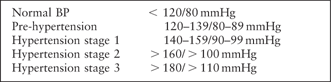
The introduction of ‘normal’ and ‘pre-hypertension’ stages within the JNC [2003] guidelines has broadened the target population for BP control, emphasising that even slightly elevated BP increases cardiovascular risk and urges both the patient and the physician to be more conscious of risks and to take action for prevention of hypertension through lifestyle modifications for all patients who fall within the pre-hypertension stage and the addition of drug therapy for those with pre-hypertension who have other indicators for CVD [JNC, 2003]. Flack et al [2003] identify physical inactivity, high-calorie intake, obesity, psychosocial stressors and excess sodium and alcohol intake as all contributing to the development of hypertensive disease.
Hypertension is one of the most common diseases in patients presenting for surgery and remains the most common medical reason for postponing surgery [Casadei and Abuzeid, 2005]. Chronic hypertension may go undetected for a long time and may well be found for the first time during a routine POA. POA is a unique opportunity to identify patients with pre-operative untreated or poorly controlled hypertension and those patients with the presence of pressure-related end organ injury such as angina, prior MI, prior cardiovascular revascularisation, HF, CVA, transient ischaemic attack (TIA), LVH, CKD, PVD, and retinopathy [Fleisher, 2002]. Although care guidelines exist for the medical patient with hypertension, there are no accepted guidelines for pre-operative evaluation and perioperative care of patients with hypertension who undergo non-cardiac surgery [Sear, 2008]. Therefore, management of hypertensive surgical patients remains unclear, whether BP level or BP-related target organ damage at the time of surgery predicts perioperative cardiovascular complications in patients undergoing major surgery, and thus whether deferring surgery in order to improve BP control will lead to a reduction in perioperative cardiac risk. Paucity of research findings in this area and the prevalence of inconsistent research findings provide the rationale for the chosen topic, warranting closer scrutiny of the literature. The literature review will critically evaluate the current literature on the topics of hypertension and the surgical patient, white coat hypertension (WHC), hypertension and obesity.
Search Strategy
Literature reviews of databases were searched including CINAHL, Ovid Medline, Proquest library and Annals of internal medicine library, Wiley Interscience, Springer Link and Pubmed central. The DOH, NICE, BHS, WHO, American Heart Association, dabl educational Trust and the Journal of the American Medical Association were all used to yield literature/clinical studies and guideline publications on the chosen topic. The authors Trust library sourced the literature and clinical studies from held journals such as the Journal of Hypertension and Anaesthesia. Owing to the lack of literature in the United Kingdom, the search was extended to international publications to obtain a global perspective. Caution was observed with this research in questioning its applicability to the UK healthcare system. The keywords in Box 3 were used to search, singularly and in combination, restriction to English language and full text. Historical evidence-based literature was sourced over several decades dating back to 1970 due to the paucity of research on the topic. The search yielded research studies, literature reviews, systematic reviews and national guidelines, of which 45 were subjectively deemed relevant, and were reviewed.
Box 3 Key words use in literature search

Hypertension and Surgery; Emergent Themes
Traditional recommendation to postpone elective surgery in patients with uncontrolled hypertension comes from a series of studies done in the 1970s: Prys-Roberts et al [1971] investigated the cardiovascular responses of hypertensive patients to the induction, maintenance and recovery of anaesthesia and surgery. They demonstrated that patients with poorly controlled untreated hypertension developed larger declines in their mean arterial pressure and systemic vascular resistance intraoperatively than did well-controlled hypertensive patients or those who were normotensive. Poorly controlled individuals also had an increased risk of arrhythmias or electrocardiograph changes indicative of myocardial ischaemia. The episodes of ischaemia were transient in nature and usually associated with mean arterial pressures that were 50% below the pre-operative baseline. Patients with well-controlled hypertension behaved in the same manner as normotensive patients. Prys-Roberts et al [1971] showed that responses to anaesthesia were dependent on the pre-existing level of arterial pressure rather than whether or not the hypertension had been treated. Having identical conditions of induction and maintenance of anaesthesia, during and after surgery, constituted a methodological strength. Goldman and Caldera [1979] conducted a prospective study involving 679 operations with general anaesthesia (GA) in patients over the age of 40 years; they found that, in contrast to patients with poorly controlled hypertension, those with mild to moderate hypertension do not appear to be at increased operative risk. They established that hypertensive patients with a diastolic BP (DBP) <110 mmHg had a similar outcome to normotensive patients and they found no relationship between a history of mild-to-moderate hypertension and the development of cardiac arrhythmias, myocardial ischaemia and HF. Although these studies have found contrasting results, they highlight that both the adequacy of hypertension control before, during and after surgery impact to some degree on operative risk. Both studies were limited due to their sample sizes. Goldman and Caldera's [1979] sample consisted of only five patients who had a DBP of >111 mmHg; the larger the sample size, the higher the chance of obtaining representative data [Parahoo, 2006].
Allman et al [1994] studied 325 patients undergoing elective non-cardiac surgery who had pre-operative ambulatory ECG monitoring performed. Sixty-four patients (20%) had one or more episodes of ST segment depression consistent with myocardial ischaemia. Of all the pre-operative cardiovascular variables measured, the presence of elevated arterial pressure, despite patients being maintained on long-term antihypertensive therapy, was the only factor associated significantly with the presence of pre-operative silent myocardial ischaemia. The incidence of silent ischaemia in these patients was 33–55%, resulting in admission arterial pressure being a useful screening test to identify patients at risk of pre-operative myocardial ischaemia. Howell et al [1997] studied 140 patients to examine the role of a number of risk factors in the development of silent ischaemia after GA. Patients were monitored pre- and post-operatively using a 24 hour ECG monitor. In conjunction with Allman et al's [1994] findings, Howell et al [1997] also demonstrated that pre-operative silent myocardial ischaemia was found to be strongly associated with post-operative silent myocardial ischaemia, and a history of hypertension, indicated by treatment with antihypertensive drugs, was associated with increased risk. A linear trend was found for risk associated with increasing admission systolic BP (SBP; odds ratio, 1:20 for each 10 mmHg increase in systolic pressure).
Howell et al [2004] performed a systematic review and meta-analysis of 30 observational studies examining the association between hypertension disease and elevated admission arterial pressure and perioperative cardiac outcome. They concluded that the likelihood of experiencing an adverse cardiac event is, on average, 1:31-fold higher in hypertensive patients than in normotensive patients. This is statistically significant but not clinically, as the mean odds ratio is very low and the significant heterogeneity between studies makes effective correction for confounding variables almost impossible.
Although the above studies have shown that there seems to be a tendency for an increased incidence of perioperative haemodynamic instability, myocardial ischaemia and cardiac arrhythmias in patients with severe hypertension (>180/110 mmHg), there was no evidence that treatment reduces the complication rate and surgery can proceed with extra care to maintain cardiac stability. These studies also complement the American College of Cardiology (ACC) and American Heart Association (AHA) guidelines [2002], which list uncontrolled hypertension as a ‘minor’ risk factor for pre-operative cardiovascular events, and state that mild-to-moderate hypertension (<180/110 mmHg) is not an independent risk factor for pre-operative cardiovascular complications but recommend that elective surgery is postponed in severely hypertensive patients (>180/110 mmHg) until their BP is adequately controlled 3–4 weeks before surgery.
Although the evidence is inconclusive regarding whether to proceed with surgery for a hypertensive patient, or to delay for treatment to be initiated or altered, it is ultimately the individual anaesthetist's decision and would depend on all migrating circumstances including the degree of hypertension, type and urgency of surgery, presence of cardiovascular risk factors and presence of target organ damage [Ward, 2009].
Dix and Howell [2001] conducted a postal survey to all anaesthetists in the South-West Health Service region of the United Kingdom, they aimed to determine the extent of variation in cancellation rate of patients presenting with stage 2 or stage 3 hypertension. They were asked if they were prepared to anaesthetise five imaginary patients presenting for surgery with varying degrees of hypertension, symptoms and evidence of end organ damage. The anaesthetist's comments revealed conflicting opinions on the management of the patients; most commented on the cut-off valves for deferring anaesthesia at DBP >115 mmHg and SBP >160 mmHg. Results suggest incompletely controlled hypertension to be a cause for concern, but did not articulate views on what constitutes unacceptable hypertension. The study was strengthened by using an anonymous questionnaire and had a high response rate of 52%; a 25–30% response rate is usually expected [Burns and Grove, 2005]. Bias may have been introduced into the results, if the views of those anaesthetists who responded to the questionnaire are not representative of the study population as a whole [Polit and Beck, 2006]. The wide variation in opinion among the 52% who did reply suggests that practice may vary widely or that those who did respond had strong views on perioperative care of patients with hypertension. Social desirability is a limiting factor with questionnaires as there is often no way to know whether the answer is the truth or is responding in a way that makes a favourable impression [LoBiondo-Wood and Haber, 2002].
White Coat Hypertension
Attendance at hospital departments or GP surgeries can cause anxiety in some patients; this may lead to an increase in BP, sometimes by as much as 30 mmHg, and is known as WCH [Oliver, 2003]. WCH describes patients whose BP is persistently elevated when measured in the physician's clinic, but normal at other times. It is a condition commonly seen in the elderly and within POAC. Through anticipation of BP measurement, patients may become aware of this condition through a feeling of anxiety and increased consciousness of the heartbeat (an autonomic neural reaction triggered by the process of measurement). This discrepancy may become more evident when results from an automated 24-h ambulatory BP recording are compared to clinical readings. WCH cannot be diagnosed simply on the basis of clinic and home pressure measurements because pressure might be high at work. To establish that BP is normal outside the clinics, Pickering et al [1995] recommends the use of an ambulatory blood pressure monitoring (ABPM) device.
Isolated systolic hypertension (ISH) is a part of the wide septum of hypertension, common in elderly patients, and characterised by SBP >140 mmHg with a DBP <90 mmHg [Stokes, 2009]. Any factor that increases stroke volume, such as exercise, apprehension or sympathetic nervous activation, results in a disproportionate increase in systolic pressure [Prys-Roberts, 2000]. The presence of ISH should be confirmed by several clinic measurements, preferably on more than one clinic visit, in a supine and erect posture. Ideally, 24-h recording of ambulatory BP is completed to exclude the WCH effect and to determine the circadian pattern if BP increases.
NICE [2006] hypertension guidelines do not recommend the routine use of ABPM devices in primary care because their value has not been adequately established; this is because studies on the use of ABPM versus clinic measurements vary in design, setting and conduction of measurements and analysis. Clinic and ABPM recordings may also differ due to their responses to the environment or doctor/nurse. However, JNC [2003] and BHS [2003] do recommend the use of ABPM and self-blood pressure measurements (SBPM) as it may benefit patients by providing information on response to antihypertensive medication, improving patient adherence with therapy and in evaluating WCH.
The prevalence and predictors of WCH were studied by Khalil et al [2009], whereby every patient referred to the cardiology unit was considered for ABPM, and the final sample size was 2462 patients. The result demonstrated a large difference between clinic and ambulatory BP and was associated with higher clinic BP and lower values of ambulatory BP. Overall, 33% hypertensive patients showed WCH. Gender (women were approximately twice as likely as men to exhibit WCH) and grade of hypertension were independent predictors of WCH. In addition, WCH patients showed significantly elevated BMI compared with patients with sustained hypertension. Felix-Rodondo et al [2008] had similar findings when studying the level of BP control in a hypertensive population when measurements are performed outside the clinical setting. This observational, cross-sectional, descriptive study consisted of a randomly selected sample of 237 Spanish adult hypertensive patients. Measured by CBPM, a BP >140/90 mmHg classified patients as poorly controlled and optimally controlled, if their BP was lower and self-measurements were taken over 3 working days. Patients whose mean BP was >135/85 mmHg were classified as poorly controlled and were withdrawn from the study. Patients with BP <135/85 mmHg were classified as optimally controlled and were invited to continue in the study using 24-h ABPM. They found a low sensitivity in detection of optimal control among hypertensive patients by means of conventional BP measurements compared to self-BP measurements. Both studies were strengthened by the inclusion of patients receiving antihypertensive treatment, previously excluded in other studies, therefore being more representative of the target population [Parahoo, 2006]. However, the latter study may have been limited due to selection bias (excluding patients who were immobile or who had cognitive or physical deficiencies), which may have decreased the proportion of patients suffering from hypertension, and due to the exclusion of poorly controlled hypertension.
Staessen et al [2005] compared the use of BP measurements taken in the clinical office and at home in the treatment of patients with hypertension. This multi-centre, blinded randomised control trial (RCT) conducted in Ireland enrolled 400 patients with DBP >95 mmHg and followed up for 1 year. Results demonstrated that more home BP than office BP patients could permanently stop antihypertensive drug treatment because their DBP was <80 mmHg and thereafter stabilised at or below the target range. However, at the 2-month follow-up visit, SBP and DBP were significantly higher in the home BP group than in the office BP group, with a similar trend for DBP at the 4-month visit. Therefore, BP reductions became consistently and significantly greater in the office BP than the home BP patients. This study was limited due to selection bias as General Practitioners (GP) recruited most of the patients [Parahoo, 2006] and about half of those randomised were prescribed antihypertensive drugs. In addition, the time that the office BP was measured was not recorded; however, the study was strengthened by its design.
Obesity and Hypertension
The increasing prevalence of hypertension occurs in conjunction with the increasing prevalence of obesity, which in England shows that 66% of men and 55% of women are either overweight or obese [Francischetti and Genelhu, 2006]. Obesity is an independent risk factor for development of CVD, CHD, HF and type 2 diabetes, where roughly 60% of all diabetic cases can be attributed to weight gain [Flack et al, 2003]. This was supported by Hirani et al [2007] who found that both men and women with abdominal obesity show a higher risk for diabetes, hypertension and hypertension–diabetes co-morbidity than those with a normal waist circumference (WC). They used data from the Health Survey for England (HSE) to look at the effect of increasing trends in generalised and abdominal obesity; the results show a generalised increase in obesity among men from 15.8% in 1993 to 26.3% in 2003, and among women from 19.3% to 25.8%. Abdominal obesity also increased among men from 26.2% in 1993 to 39% in 2003, and in women from 32.4% to 47%. Zhou et al [2008] went one step further and chose to compare the association between different obesity indices and the presence of hypertension. They chose five different anthropometric indices as obesity measures: BMI, WC, waist:statue ratio (WSR), waist:hip ratio (WHR) and conicity index (CI). The results showed that all five obesity indices were positively correlated with hypertension. After adjusting for age, WSR in men and BMI in women had the greatest association with the presence of hypertension. BMI had the strongest correlation with hypertension in both genders. Both studies had large sample sizes and, therefore, were more representative of the population [Polit and Beck, 2006]; however they were both limited due to their cross-sectional nature as there can be problems in inferring change and trends over time using a cross-sectional design [Polit and Beck, 2006], and in the latter study histories of disease were self-reported, which may give rise to social desirability [LoBiondo-Wood and Haber, 2002].
Stevens et al [2001] conducted an RCT examining the effects of weight loss and dietary sodium reduction, alone and in combination, in reducing BP in overweight adults with high normal BP. This study demonstrated that significant long-term reductions in BP and reduced risk for hypertension can be achieved with even modest weight loss. Consistent with other studies, they found that men had greater weight loss than women at 6 months, which persisted consistently thereafter independent of baseline weight. This was thought to be facilitated due to men having a higher lean body mass and metabolic rate than women. The study had a longer follow-up period and a high rate of data collection (92% for weight) at 36 months; however, any missing data were excluded from analyses, these participants may not have returned for data collection due to their experiencing less weight loss than those who did return.
He et al [2000] carried out an RCT looking at the long-term effects of weight loss and dietary sodium reduction on the incidence of hypertension. After 7 years of follow-up, BP was measured by observers blinded to the study, and the incidence of hypertension was defined as SBP > 160 mmHg and/or DBP > 90 mmHg and/or treatment with antihypertensive medication following follow-up. Results indicate that lifestyle modifications may be effective in long-term primary prevention of hypertension. This study was methodologically limited by its sample size, but strengthened by the extended follow-up period of 7 years not seen in any other study on this topic.
He et al [2000] are supported by Elmer et al [2006] who also looked at the effect of comprehensive lifestyle modification on diet, weight, physical fitness and BP control over an 18-month period. This multi-centre control trial demonstrated over an 18-month period, that motivated individuals with prehypertension and stage 1 hypertension can make and sustain multiple lifestyle modifications to control BP and reduce the risk for chronic disease. A total of 810 adults were randomly assigned to one of three groups: an advice only comparison group and two behavioural intervention groups with one of these following the Dietary Approaches to Stop Hypertension (DASH) dietary pattern. Compared with the advice only group, both behavioural intervention groups had less hypertension, had lost more weight and had better reduction in fat and sodium intake. The exclusion criteria and volunteer nature of the study may limit generalising to the general public, as volunteers recruited are usually highly motivated [Polit and Beck, 2006]. However, random assignment leads to high internal validity, particularly when follow-up rates are high and strong quality control measures are in place [Lobiondo-Wood and Haber, 2002].
Neter et al [2003] performed a meta-analysis review of RCTs on the influence of weight reduction of BP on 25 studies. Results concluded that a 1 kg loss of body weight was associated with an approximate 1-mmHg drop in BP. The Trial of Hypertension Prevention (TOHP) was one of the largest studies, which included a weight loss intervention group. In this group, a 2 kg loss in weight over a 6-month period resulted in a decline of 3.7 mmHg in systolic and 2.7 mmHg in DBP. In addition, a 42% decline in the instance of hypertension was noted on the sample. However, primary studies included in the review had small sample sizes, had relatively short follow-up, or were monitored at the maximum BP reduction often <6 months after the weight loss.
Conclusion
Although hypertension is the most common avoidable medical indication for postponing anaesthesia and surgery [Casadei and Abuzeid, 2005], there are few studies examining the influence of hypertension on morbidity and mortality in the surgical patient and there are no universally accepted guidelines stating the arterial pressure values at which anaesthesia should be postponed. Dix and Howell [2001] demonstrated the variability between practices of anaesthetists as to which patients would be cancelled; a number of factors are taken into consideration by anaesthetists including the degree and type of hypertension, duration of BP control, urgency of surgery, presence of cardiovascular risk factors and target organ damage [Ward, 2009].
The strength of the evidence suggests that patients with stage 1 and stage 2 hypertension (DBP<110 mmHg) will not benefit from further acute reduction of their BP into the normal range and are not at increased operative risk based on pre-operative BP level, and hence there is no scientific evidence to support postponing these patients in the absence of target-organ damage [Prys-Roberts et al, 1971; Goldman and Caldera, 1979; ACC/AHA, 2002; Howell et al, 2004]. In addition, complications from aggressive control of hypertension before anaesthesia may result in intravascular volume depletion, hypokalemia and an increased risk of hypotension, which may itself increase the risk of perioperative complications. These patients become an increased cardiac risk, when the pre-operative BP level is combined with evidence of end organ damage, such as significant CKD, CVD, CAD, IHD, prior MI or unstable angina and diabetes. In contrast, poorly controlled stage 3 hypertension with an SBP >180 mmHg or DBP >110 mmHg is associated with an increased operative risk and incidence of haemodynamic instability. Several studies have demonstrated the degree of BP elevation at the time of admission; any prior episode of severe hypertension or merely a history of hypertension is associated with adverse outcomes [Prys-Roberts et al, 1971; Goldman and Caldera, 1979; Allman et al, 1994; Howell et al, 1997; Howell et al, 2004]. Elective surgery should therefore be postponed until the patient's BP is <170/110 mmHg, and if time allows, the BP should be controlled to near 140/90 mmHg over several weeks [Fleisher, 2002]. Patients with ISH should have their SBP <160 mmHg before surgery and elective surgery should be postponed for those with SBP >180–200 mmHg.
Although ABPM is not yet part of routine evaluation of hypertensive patients, its use in clinical practice is growing steadily, and there is an increasing number of situations in which it provides unique information that could not be obtained by any other method. Although it is relatively expensive to perform, it has the potential of being cost-effective because it can identify patients who do not require treatment [Pickering et al, 1995]. Staessen et al [2005] support this as their study findings support the stepwise strategy for evaluation of BP in which self-measurement and ambulatory monitoring are complementary to conventional clinical office monitoring.
Obesity generally increases with age and its prevalence is becoming an increasing concern for the whole population. BP levels have been shown to be directly related to body weight and weight loss is associated with a decrease in BP [He et al, 2000; Stevens et al, 2001]. Hypertension is more prevalent in overweight individuals, and is often hard to control. He et al [2000] were the first to study and show the long-term effects of short-term weight loss and sodium reduction on the incidence of hypertension. Lifestyle modifications such as weight loss, sodium and alcohol reduction, increase in exercise and cessation of smoking should be recommended as a principal component of strategies to prevent hypertension and its complications in the UK general population [Elmer et al, 2006; Flack et al, 2003].


