Introduction
Behavioral and psychological symptoms of dementia (BPSD), including affective disorders, psychotic manifestations, and a behavior syndrome (Garre-Olmo et al., Reference Garre-Olmo, López-Pousa and Vilalta-Franch2010b), are displayed by 60–98% of patients with dementia (Sink et al., Reference Sink, Holden and Yaffe2005; Jeste et al., Reference Jeste2008). The variety and intensity of the symptoms strongly depend on both the subtype and the severity of dementia. BPSD are often transitory, showing regressions and relapses, and increasing frequency and intensity as dementia progresses (Mendez et al., Reference Mendez, Perryman, Miller and Cummings1998).
Delusions and hallucinations are the most frequent psychotic symptoms in patients with dementia, with a prevalence of delusions of 9–63%, and a prevalence of hallucinations of 4–41% (Ropacki and Jeste, Reference Ropacki and Jeste2005). In cases where neither cholinesterase inhibitors (CEI) nor behavioral therapies produce an improvement in the psychotic symptoms – despite the lack of scientific evidence – patients are treated with antipsychotics (APs) (Sink et al., Reference Sink, Holden and Yaffe2005; Jeste et al., Reference Jeste2008; Fort et al., Reference Fort, Formiga, Robles, Regalado, Rodríguez and Barranco2010).
APs can be readily classified in two groups: the so-called first generation or typical antipsychotics (TAPs), available from the early 1950s, and the second generation or atypical antipsychotics (AAPs), which were licensed in the 1990s. They differ in the lower frequency of extrapyramidal effects and tardive dyskinesia of the newer drugs, although other side effects, such as cerebrovascular adverse events and metabolic changes, must be taken into account (Liperoti et al., Reference Liperoti, Pedone and Corsonello2008; Woods et al., Reference Woods2010).
To our knowledge, most of the studies carried out so far regarding the use of APs in patients with dementia focus on memory clinical-based studies of particular AP use in restricted dementia subtypes and/or use the information contained in administrative databases (Ropacki and Jeste, Reference Ropacki and Jeste2005; Kales et al., Reference Kales2011; Weintraub et al., Reference Weintraub, Chen, Ignacio, Mamikonyan and Kales2011). These studies usually have low external and internal validity, mainly due to the selection bias of the clinical studies, and the low reliability of the administrative databases. In contrast, the data collected by an epidemiological surveillance system focused on dementia, combined with the information on AP use obtained from a drug prescription database, provides detailed and reliable information on the sociodemographic and clinical characteristics of the patients treated with APs. This methodological approach has been useful to estimate the clinical incidence of young onset dementia in a defined general population (Garre-Olmo et al., Reference Garre-Olmo2010a). The aim of our study was to describe the frequency of use of APs in patients with dementia, to identify the sociodemographic and clinical characteristics of these patients, and to compare the differences regarding the type of neuroleptic prescribed using the available information from an epidemiological surveillance system of dementia.
Methods
Design, geographical area of reference, and study population
This study used a cross-sectional design and was based on data from the cases registered by the Registry of Dementias of Girona (ReDeGi) from 2007 to 2009. The ReDeGi registers demographic and clinical data of all the new dementia cases diagnosed in the hospitals of the public healthcare system of the Health Region of Girona (HRG), which represents most of the cases of dementia. In Spain, only specialized services (secondary healthcare services) can prescribe cholinesterase inhibitor drugs. For this reason, all dementia diagnoses are performed in secondary hospital services, which are included in the public healthcare system. The HRG is located in the northeast of Catalunya, which is, in turn, in the northeast part of Spain. It has an area of 5,517 km2, a population of 737,344 inhabitants (according to the 2010 Citizens Municipal Registry), and a population density of 133.6 inhabitants/km2.
Registry procedure and registered variables
The ReDeGi registers all the incidents cases of dementia diagnosed in the seven hospitals belonging to the HRG, using standardized criteria for case definition, and following the guidelines proposed by the Center for Disease Control and Prevention for a surveillance system (German et al., Reference German, Armstrong and Birkhead2001). The methodological principles and the functional structure of the ReDeGi have been previously described (López-Pousa et al., Reference López-Pousa2006; Garre-Olmo et al., Reference Garre-Olmo, López-Pousa, Monserrat-Vila, Pericot-Nierga, Turon-Estrada and Lax-Pericall2007; Reference Garre-Olmo2009; Reference Garre-Olmo, López-Pousa and Vilalta-Franch2010b). All diagnoses are based on the medical chart, an interview with the patient and the caregiver, a general medical examination, hematology and blood chemistry tests, and neuroimaging diagnosis if required. A specialist technician of the ReDeGi periodically reviews the medical chart of the cases of dementia notified in each of the seven hospitals of the HRG, and registers the information in a clinical research form containing: (1) center identification, date of admission, and clinical history identification number; (2) sociodemographic characteristics; (3) characteristics of the diagnosis based on the Diagnostic and Statistical Manual of Mental Disorders (DSM-IV) (American Psychiatric Association, 1994), date of onset of the symptoms, and date of diagnosis; (4) clinical characteristics (date of administration and score of the Mini-Mental State Examination (MMSE) (Folstein et al., Reference Folstein, Folstein and McHugh1975), the Blessed Dementia Rating Scale (BDRS) (Blessed et al., Reference Blessed, Tomilson and Roth1968), and the Clinical Dementia Rating (CDR) (Morris, Reference Morris1993)), family history of dementia, diagnosis of hypertension, diabetes mellitus, dyslipidemia, cerebrovascular adverse events, thyroid disease, depression history, or personal history of psychosis (delusions and hallucinations occurring before the diagnosis of dementia). The collected information of the ReDeGi meets the confidentiality requirements stated by the Spanish legislation.
Drug consumption information
The ReDeGi database was linked with the HRG Pharmacy Unit database through the Public Catalan Healthcare Service (PCHS). This database contains all the drugs prescribed by the PCHS professionals that have been dispensed in pharmacies. Patient records were linked using the personal identification code included in their medical chart. AP drugs were provided by the PCHS database at fifth-level anatomical therapeutic chemical (ATC) classification system.
All APs prescribed to the cases in the ReDeGi were recorded, and were: TAPs: haloperidol (N05AD01), clotiapine (N05AX09), levopromazine (N05AA02), chlorpromazine (N05AA01), periciazine (N05AC01), and zuclopentixol (N05AF05); AAPs: risperidone (N05AX08), quetiapine (N05AH04), amisulpride (N05AL01), ziprasidone (N05AE04), olanzapine (N05AH03), and aripiprazole (N05AX12).
Information on AP use was collected during the three years of study regardless of non-adherence or treatment withdrawal. It must be noted, however, that the cases were registered the year they were diagnosed with dementia, and information on the drugs prescribed was also collected only in the year the diagnosis was made. Moreover, some patients were prescribed up to four different APs in the year they were diagnosed as having dementia, resulting in cumulative percentages of APs greater than 100%.
Data analysis
A descriptive analysis of the variables was performed using central tendency measures and dispersion for quantitative variables, whereas absolute and relative frequencies were calculated for qualitative variables. Relative frequencies of the registered dementia diagnoses were calculated and clustered into general groups. The clinical and demographic characteristics between AP users and non-users, and between TAP users and AAP users were compared using χ2 tests for categorical variables and the Mann–Whitney U test for continuous variables. Normality was checked using Shapiro–Wilk test (Shapiro and Wilk, Reference Shapiro and Wilk1965). Binary logi-stic regression models were performed to detect the main variables related to AP use in patients with dementia, and the type of AP used in patients treated with APs. Results are expressed as absolute numbers and percentages, means, standard deviations, odd ratios, and 95% confidence intervals (CI). Statistical tests were considered to be significant with a two-tailed p value <0.05. Processing and analysis of the data were performed using the statistical package SPSS v15.0 for Windows (SPSS, Inc., Chicago, IL).
Results
Study population characteristics
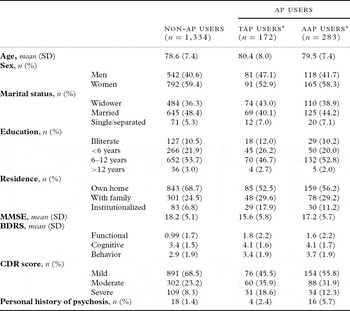
In the period 2007–2009, 1,894 dementia cases were registered by the ReDeGi in the HRG. The mean age was 79.1 (SD = 7.5) years, and 58.6% (95% CI: 56.3–60.8) were women. Only 10.7% (95% CI: 9.2–12.1) had severe dementia (CDR = 3), and 8.9% (95% CI: 7.5–10.2) of the cases were institutionalized. The frequency of severe dementia in the cases living in nursing home residences was 31.5% (95% CI: 23.6–39.4), whereas only 8.9% (95% CI: 7.5–10.4) of the patients living at home or with the family had severe dementia. The main sociodemographic and clinical characteristics of the registered cases depending on AP consumption are shown in Table 1.
Sociodemographical and clinical characteristics of the non-AP, TAP users, and AAP users registered in the ReDeGi from 2007 to 2009

Note: MMSE = Mini-Mental State Examination; BDRS = Blessed Dementia Rating Scale; CDR = Clinical Dementia Rating; AP = antipsychotic; TAP = typical antipsychotic; AAP = atypical antipsychotic.
*n = 105 (44 women and 61 men) were prescribed both TAP and AAP, and have not been considered in this table.
Subtypes of dementia
Alzheimer's disease (AD) was diagnosed in 57.7% of cases (95% CI: 55.4–59.9); vascular dementia (VaD) was diagnosed in 6.5% (95% CI: 5.4–7.7) of cases; and 12.1% (95% CI: 10.6–13.6) were mixed forms of vascular dementia (MD). Other secondary dementias (SD) accounted for 5.0% (95% CI: 4.0–6.0) of cases, whereas 3.4% (95% CI: 2.5–4.2) were frontotemporal dementias (FTD). Parkinsonian syndromes (PSd) were registered in 8.9% (95% CI: 7.6–10.2) of cases, of which 5.3% (95% CI: 4.2–6.3) were dementia with Lewy bodies (DLB). Finally, not specified dementias (NSD) were diagnosed in 6.3% (95% CI: 5.2–7.4) of cases.
Antipsychotics consumption
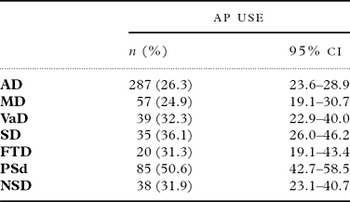
APs were prescribed in 29.6% (95% CI: 27.6–31.8) of the cases registered in the ReDeGi. APs were consumed by 46.8% (95% CI: 38.6–55.0) of the institutionalized patients, whereas only 28.8% (95% CI: 26.5–31.0) of the cases residing at home or with a family were prescribed a neuroleptic (χ2 = 34.411; df = 2; p < 0.001). Concerning the subtype of dementia, PSd were the diagnoses consuming more APs (χ2 = 57.135; df = 7; p < 0.001). In particular, DLB was the subtype of dementia with the highest frequency of AP prescription (60%, 95% CI: 49.9–70.1) (Table 2). Of all cases prescribed with APs, 69.3% (95% CI: 65.4–73.2) were treated with AAPs (χ2 = 14.64; df = 2; p = 0.041). In particular, 71.0% (95% CI: 65.4–76.4) of the cases of AD, 66.7% (95% CI: 53.6–79.8) of MD, 80.0% (95% CI: 56.3—94.3) of FTD, 71.4% (95% CI: 55.0–87.8) of SD, and 76.3 % (95% CI: 61.5–91.1) of NSD were treated with AAPs. In contrast, no preferences in the use of TAPs or AAPs were observed in VaD or PSd.
Absolute and relative frequencies of overall AP consumption depending on the diagnostic

Note: AP = antipsychotic; AD = Alzheimer disease; MD = mixed dementia, Alzheimer's disease with cerebro-vascular disease; VaD = vascular dementia; SD = secondary dementias: includes traumatic brain injury dementia, alcohol-related dementia, Creutzfeldt-Jacob Disease, Huntington disease, and dementia due to other medical conditions such as normal pressure hydrocephalus, anoxic encephalopathy, brain tumor, mental illness, multiple sclerosis, central nervous system infection, and multiple etiologies; FTD = frontotemporal dementia; PSd = Parkinsonian syndromes: includes Parkinson disease dementia, dementia with Lewy bodies, progressive supranuclear palsy, and corticobasal degeneration; NSD = not specified dementias.
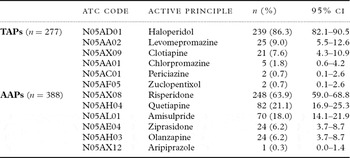
Risperidone was the most commonly prescribed AP (44.3% of the patients consuming APs, 95% CI: 40.1–48.5), followed by haloperidol (42.7%, 95% CI: 38.5–46.9). Among AAPs, risperidone was used in 63.9% (95% CI: 59.0–68.8), whereas 86.3% (95% CI: 82.1–90.5) of the cases treated with TAPs used haloperidol (Table 3).
Absolute and relative frequencies of the type of AP used

Note: AP = antipsychotic; ATC = anatomical therapeutic chemical; TAP = typical antipsychotic; AAP = atypical antipsychotic.
Predictors of AP prescription
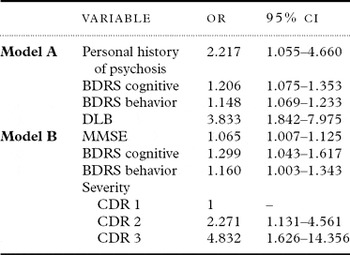
In a binary logistic regression model adjusted for the main sociodemographic and clinical variables, AP consumption was associated with having a personal history of psychosis, higher scores in the cognitive and behavior sections of the BDRS, and being diagnosed with DLB (Table 4). The use of AAPs or TAPs in those patients treated with APs was related to the severity of dementia as measured by the CDR score, and the BDRS and MMSE tests (Table 4).
Odds ratio of the variables in multiple logistic regression models. Model A: AP consumption vs. non-consumption; Model B: AAP consumption vs. TAP consumption

Note: Model A was adjusted for sex, age, residence, severity (CDR), MMSE, BDRS functional, dyslipidemia, hypertension, diabetes mellitus, cerebrovascular adverse events, and Parkinson disease history. Model B was adjusted for sex, age, residence, diagnosis, BDRS functional, dyslipidemia, hypertension, diabetes mellitus, cerebro-vascular adverse events, Parkinson disease history, and personal history of psychosis. AP = antipsychotic; TAP = typical antipsychotic; AAP = atypical antipsychotic; CI = confidence intervals; CDR = Clinical Dementia Rating; BDRS = Blessed Dementia Rating Scale; DLB = dementia with Lewy bodies; MMSE= Mini-Mental State Examination.
Discussion
The overall frequency of AP consumption in elderly patients with dementia in our study was high (29.6%), but other population studies carried out in Spain have reported still higher frequencies (45.2%) (Fort et al., Reference Fort, Formiga, Robles, Regalado, Rodríguez and Barranco2010). BPSD have been stated to increase in frequency and intensity as dementia becomes more severe (Mendez et al., Reference Mendez, Perryman, Miller and Cummings1998), thus the differences may be caused by the higher percentage of patients with severe dementia included in their study (47.5% with Global Deterioration Scale (GDS) = 6–7 vs. 10.7% (CDR = 3) in our study). Due to the greater severity of the institutionalized cases, and in agreement with other authors’ findings (Ballard et al., Reference Ballard2002; Fort et al., Reference Fort, Formiga, Robles, Regalado, Rodríguez and Barranco2010), patients living in nursing home residences consumed more APs (46.8%) than those living at home. The usefulness of these treatments to deal with BPSD has not been demonstrated, and serious side effects and mortality risk have been repeatedly documented (Sink et al., Reference Sink, Holden and Yaffe2005; Kales et al., Reference Kales2007; Vilalta-Franch et al., Reference Vilalta-Franch, López-Pousa, Garre-Olmo, Turón-Estrada and Pericot-Nierga2008), yet APs are extensively used, off-label, in patients with dementia (Radley et al., Reference Radley, Finkelstein and Stafford2006; Jeste et al., Reference Jeste2008; Tjia et al., Reference Tjia2010).
Although APs have been broadly shown to worsen the motor symptoms of PSd (Goldman, Reference Goldman2011), such as Parkinson's disease with dementia (PDD) or DLB, more than 50% of the cases in our study were prescribed a neuroleptic. For a long time, psychotic symptoms in these subtypes of dementia were suspected to be side effects of dopaminergic medications. Recently, some authors have described them as products of the disease itself, linking them with altered neurotransmitter systems (Zahodne and Fernandez, Reference Zahodne and Fernandez2008), with the deposition of Lewy bodies in specific brain areas (Harding et al., Reference Harding, Broe and Halliday2002), or depicting a “continuum hypothesis” in which sleep disturbances alter dreaming, and finally lead to hallucinations and/or illusions (Zahodne and Fernandez, Reference Zahodne and Fernandez2008). The treatment of Parkinsonism with the current recommended drugs usually increases the psychotic symptoms, and treating the psychosis with APs worsens the motor symptoms (Zahodne and Fernandez, Reference Zahodne and Fernandez2008). This complex equation requires new research to be done, in order to understand the nature of psychotic events in PDD and DLB, and to find new tools to maximize the quality of life of the patients by properly treating both psychosis and Parkinsonism (Goldman, Reference Goldman2011). Nevertheless, the high frequency of PSd treated with a neuroleptic in our study might be due to prescriptions administered at emergency rooms before transferring the patient to a specialist, who finally diagnoses dementia.
Sixty-two percent of the cases treated with APs in our study were prescribed an AAP. Since the approval of AAPs in the 1990s, more than 80% of the APs prescribed to treat BPSD have been AAPs (Glick et al., Reference Glick, Murray, Vasudevan, Marder and Hu2001). In 2005, based on several meta-analyses of clinical trials, the US Food and Drug Administration warned that using AAPs in dementia increased mortality (Schneider et al., Reference Schneider, Dagerman and Insel2005), but TAP drugs were not considered in this meta-analysis. As some other authors established later, both TAP and AAP present an increased risk of mortality and controversial side effects–benefit ratio (Kales et al., Reference Kales2007). Nevertheless, due to the fact that they cause fewer extrapyramidal side effects, and because of perceived enhanced tolerability, there is a clear inclination to treat elderly patients with dementia with AAPs (Jeste et al., Reference Jeste2008; Weintraub et al., Reference Weintraub, Chen, Ignacio, Mamikonyan and Kales2011). Surprisingly, there was no preference in TAP or AAP prescription in the PSd group, where due to the reported extrapyramidal side effects of TAPs, a prevalence of AAP use was expected. The AAP clozapine was recommended by a Quality Standards Subcommittee of the American Academy of Neurology to treat BPSD in PDD and DLB (Weintraub et al., Reference Weintraub, Chen, Ignacio, Mamikonyan and Kales2011), although they also pointed out that agranulocytosis was a serious side effect. In Spain, only psychiatrists are allowed to prescribe clozapine, and elderly patients with dementia are mainly treated by neurologists and geriatrists. Thus, none of the cases included in this study was prescribed this drug.
The main TAP prescribed in our study was haloperidol, in 86.3% of the cases. As suggested by other authors, there is no scientific evidence proving TAP to be useful in improving the BPSD, and only haloperidol was found to be slightly better than placebo to treat aggression (Sink et al., Reference Sink, Holden and Yaffe2005). Although the benefit–risk ratio is controversial, TAPs were used in 42.7% of the cases consuming APs in the ReDeGi, which may be due to its lower cost compared with other APs. Regarding AAP consumption, risperidone is approved for its use in dementia in Spain, and although its efficacy is still a matter of debate (Sink et al., Reference Sink, Holden and Yaffe2005), it was the main AP prescription (63.9%) among the cases in the ReDeGi.
According to our results, AP consumption in dementia patients is associated with DLB subtype of dementia, having a personal history of psychosis, and presenting more behavior disorders and cognitive impairment, which is consistent with the fact that BPSD become more frequent and severe as dementia worsens (Mendez et al., Reference Mendez, Perryman, Miller and Cummings1998). Other studies highlighted variables like being institutionalized, being male, and not having cardiac insufficiency as predictors of AP prescription (Fort et al., Reference Fort, Formiga, Robles, Regalado, Rodríguez and Barranco2010). Our regression model was adjusted for all sociodemographic and clinical variables collected by the ReDeGi, and sex, residence, or dementia risk factors were found to be confounding factors and not variables associated with AP consumption.
Fewer motor side effects and a better tolerance support the prevailing use of AAPs in elderly patients with dementia. On the other hand, other side effects such as metabolic changes and cerebrovascular adverse events have been reported in relation to atypical neuroleptics (Liperoti et al., Reference Liperoti, Pedone and Corsonello2008). As a consequence, dementia risk factors or vascular subtypes of dementia could be expected as predictors of TAP consumption. In our model, only the severity, functional and behavior BDRS, and the MMSE scores were found to be variables associated with the use of a specific kind of AP, suggesting that an advanced stage of dementia is more likely to be treated with AAPs than with TAPs, regardless of other considerations.
There are some limitations to take into account when interpreting these results. First, even if all diagnoses of dementia that require treatment with cholinesterase inhibitors are made in the secondary healthcare sector, we cannot rule out a selection bias due to a possible diagnosis performed in primary care settings. However, the similarities between our healthcare system for dementia and the Danish system indicate that most of the diagnoses would be made in specialized services (Thi Phung et al., Reference Thi Phung, Waltoft, Kessing, Mortensen and Waldemar2010). Second, the lack of information on the dosages prescribed and the duration of the treatments prevented the calculation of the defined daily doses for each AP. Third, we do not have data on the kind of BPSD causing the treatment with APs, or information on adherence, or treatment withdrawal caused by intolerance, which might provide evidence to describe groups of patients with specific BPSD and the appropriate treatments for every cluster. Future studies of the drug consumption of patients in the ReDeGi will include both drug costs and mortality data, which will allow the formulation of economic predictions, and the assessment of mortality risks.
To conclude, despite their disputed benefit–risk ratios, APs are extensively used, off-label, to treat BPSD, and AAPs are more commonly prescribed than TAPs. In our study, AP consumption was frequent in DLB, and was related to dementia severity indicators.
Conflict of interest
None.
Description of authors’ roles
Laia Calvó-Perxas had full access to the data used in this paper, completed all the statistical analyses, and substantially contributed to the interpretation of data and writing of the paper. Secundino López-Pousa, Joan Vilalta-Franch, and Josep Garre-Olmo substantially contributed to the study concept, design, analysis, and interpretation of data and writing of the paper. Rosa Maria de Eugenio, Fabian Marquez-Daniel, Raül Martínez, Joaquin Serena, Josefa Turbau, Marta Viñas, Oriol Turró-Garriga, and Anna Maria Roig substantially contributed to critically revising the paper.
Acknowledgments
The ReDeGi is funded by the Health Region of Girona from the Department of Health of the Generalitat de Catalunya, Spain. The funding source had no involvement in the decision to submit the paper for publication.
Appendix
The ReDeGi Group consists of the following co-investigators:
Department of Neurology, Hospital Universitari Josep Trueta: Mar Castellanos, PhD; David Genís Batlle, MD; Jordi Gich, BPsych; Rosa Meléndez, MD; Albert Molins, MD; Lluís Ramió, MD; Joaquín Serena, PhD; Yolanda Silva, PhD.
Dementia Unit, Hospital Santa Caterina: Marta Hernández, BPsych; Saioa Lejarreta, MD; Manuela Lozano, BPsych; Immaculada Pericot, PhD; Joan Vilalta-Franch, PhD; Antoni Turon Estrada, PhD; Josefa Turbau, MD; Oriol Turró, BPsych; Olga Soler, Bpsych.
Dementia Unit, Hospital de Palamós: Elisabet Alsina, BSw; Rosa de Eugenio, MD; Alain Luna, MD; Margarita Flaqué, Bpsych.
Neurology Department, Hospital de Figueres: Olga Carmona, MD; Marta Cullell, BPsych; Teresa Osuna, MD; Raül Martínez, MD.
Neurology and Geriatrics Departments, Hospital d'Olot: Josep Bisbe, MD; Marta Linares, BPsych; Fabian Marquez Daniel, MD; Natalia Vallmajó, MD.
Neurology and Geriatrics Departments, Hospital de Blanes: Fernando Espada, MD; Montserrat González, MD; Héctor Perkal, MD; Marta Viñas, MD.
Neurology Department, Hospital deCampdevànol: Isabel Casas, BPsych; Josefa Turbau, MD.
Pharmacy Unit, Healh Region of Girona: Anna Maria Roig, BPharm; Joan Coromina, Bpharm.