

Most bank-issued wealth management product contracts (WMPCs) are standard form contracts. Standard form contracts are popular in financial transactions because using them is more efficient than creating contracts on a case-by-case basis.Footnote 1 However, these contracts have been criticized from at least three perspectives: absence of freedom of contract,Footnote 2 lack of consensus between buyers and sellers,Footnote 3 and concerns about consumer protection.Footnote 4
The frequent use and vast amounts of research regarding standard form contracts in China does not mean that such contracts are well understood.Footnote 5 In the case of WMPCs in China, most studies focus on the general legal issues regarding wealth management products (WMPs), such as the regulatory enforcement toward the WMP market, the remedies for breach of WMPCs, and the protection of financial consumers.Footnote 6 A few studies have mentioned the clauses included in the WMPCs in the context of China, but their studies use descriptive rather than statistical analysis. For example, Yan compared the risk disclosure clauses in WMPCs,Footnote 7 and Huo linked the risk of WMPs with the risk disclosure clauses in WMPCs.Footnote 8 How exactly do banks draft their WMPCs to assign each party's rights and obligations? Can retail investors shop around for better terms? What motivations contribute to banks if they choose to design contracts that are more in line with the regulations? Answering these questions helps us understand the commercial banks’ standard form contracts and the impact of law and regulation on consumer banking practices more generally in China.
This study examines the bank-issued WMPCs associated with typical WMPs designed for retail investors to shed new light on the use of standard form contracts in China. Given that sales of more than 90,000 WMPs from banks exceeded 29.54 trillion RMB in 2017,Footnote 9 WMPCs deserve our attention. Moreover, a careful study of WMPCs can help focus the debates over the desirability of a specific regulation to handle the massive problems regarding WMPs.Footnote 10
The analysis in this study is based on a hand-collected sample of 66 contracts for WMPs. The WMPCs collected represent the major providers in the WMP market. These WMPCs are drawn from four types of Chinese commercial banks, including all leading state-owned commercial banks (SOCBs),Footnote 11 dozens of joint-stock commercial banks (JSCBs),Footnote 12 urban commercial banks (UCBs),Footnote 13 and rural commercial banks (RCBs).Footnote 14
This article fills a gap in the literature on standard form contracts by exploring the content of WMPCs in China's banking sector. After scoring the bias of 28 common and important terms, this article concludes that all the standard form WMPCs in the sample are tilted toward the banks compared to relevant laws and regulations. This is consistent with previous findings in more economically developed countries that standard form contracts are unbalanced.Footnote 15
The results further indicate that although the structure of WMPCs is similar among banks, the terms of WMPCs are substantially different. Some commercial banks provide elaborate terms, whereas others do not. Contrary to intuition, larger national commercial banks, compared with smaller local ones, provide less pro-seller WMPCs than the default rules provided by relevant laws and regulations. Also, the association between the type of bank and the overall bias of banks’ WMPCs is statistically significant. Such a finding challenges previous conclusions that larger firms have the tendency to design more pro-seller terms.Footnote 16
The remainder of this paper proceeds as follows. Section I critically reviews the debates over the advantages and disadvantages of using standard form contracts. Section II illustrates the regulatory framework that affects the banks to draft WMPCs. Section III describes the hand-collected sample of WMPCs. Section IV elaborates the methodologies we use to score the bias of 28 common and important terms. Section V provides explanations through analysing the correlation between bank-level determinants and the overall bias results of the sampled WMPCs. The last section is the conclusion.
The theoretical debates on standard form contracts
One of the characteristics of a standard form contract is its standardized contents, which leave the parties limited space for negotiation. In most cases, such a contract is drafted by sellers. Sellers use standard form contracts to create their dominant position in markets and strengthen their empires. In addition, sellers will use their advanced position in contracting to limit their obligations toward consumers.Footnote 17 Some scholars criticize standard form contracts, calling them ‘worthless junk’Footnote 18 or ‘instruments of fraud’.Footnote 19
Empirical evidence supports the criticisms of the standard form contracts. Using 80 written reports of standard form contracts regarding warranty in various markets, Bogert and Fink find that the terms of warranty were unduly favourable to the manufacturers and dealers. The contracts themselves indicate that sellers design provisions to narrow the coverage of warranty remedies and limit their liberalities in defeated product cases. In addition, buyers endured a heavy burden of proof.Footnote 20 Kessler then supplements the evidence on exploitation through his long-term observations of the practice of standard form contracts in the insurance industry. He finds that standardized insurance contracts constrained customers to decide without bargaining or shopping for the best terms.Footnote 21 Additional affirmation comes from Whitford, who studies warranty contracts in the automobile industry. He finds that automobile manufacturers intend to design warranties to minimize their costs, and they can do that because consumers are not fully equipped with the necessary knowledge to discern product defects.Footnote 22
The relationship between standardized contract practices and firm market power, however, is ambiguous due to the lack of statistical analysis. Most previous empirical research has been conducted through qualitative methods. Marotta-Wurgler's recent study fills this gap through a content analysis over a sample of 647 software license agreements from 598 companies. She finds that most of the sampled standard form contracts were more pro-seller than the default rules prescribed in the Uniform Commercial Code.Footnote 23 She also finds that the bias of the agreements varied across companies. Her conclusion is that ‘larger and (controlling for size) younger firms tend to have more pro-seller terms than smaller and older companies’.Footnote 24
Counterarguments mainly come from economists who believe that standard form contracts are the products of the market economy. Economists argue that if a small group of consumers read and compare contract terms, sellers will have incentives to draft contract terms in response to these consumers’ preferences.Footnote 25 In certain industries, providers even compete for marginal consumers.Footnote 26 Reputation is also an incentive for businesspersons to avoid exploiting consumers. Businesspersons may be worried that the continued use of exemption clauses in their standard form contracts can tarnish their reputation, which is disadvantageous in the long run.Footnote 27 Businesspersons can avoid this disadvantage if they discover that the group of savvy consumers is tiny or if they can easily preserve their reputations.Footnote 28 If businesspersons cannot easily develop ways to identify savvy consumers, they will continue to offer these consumers competitive boilerplate terms.Footnote 29 Therefore, consumers can shop for the best terms by selecting sellers with good reputations.Footnote 30
Similar academic debates have also arisen in China. They became heated even after the Contract Law of the People's Republic of China 1999 (hereinafter ‘Contract Law’)Footnote 31 and its judicial interpretation. The concept of standard form contract was assimilated into standard terms, which were adopted in the Contract Law.Footnote 32 Classification of the standard terms according to their different content was suggested. Also suggested was that different rules should be applied to core presentation terms and incidental terms because market mechanisms could affect these two types of standard terms in distinct ways.Footnote 33 However, court decisions have been inconsistent with what scholars have argued, as they seem reluctant to interfere with the freedom of contract between the parties.Footnote 34 Although scholars devote much attention to ex-post contract practice, they are less interested in ex-ante contract design.
Standard form contracts are widely used in transactions between banks and customers in China, and banks’ wealth management services are no exception. Banks have often been reported to embed unfair standard terms in WMPCs that gave them many privileges, such as unilateral modifications of contract terms or termination of product management.Footnote 35 Although banks are required to make true statements about their products and incorporate specific warning statements in WMPCs,Footnote 36 critics are concerned about the efficacy of relevant provisions since they observe the banks’ different practices on contract design in WMP transactions. Some scholars argue that besides the specific warning statements, standardized methods of contract design barely exist. Banks design terms regarding product specification, customer rights and obligations, risk disclosure, and liability in different ways.Footnote 37 For instance, Yan compares the risk disclosure clauses in WMPCs and finds that banks adopt different manners to design these clauses to reflect the risk level of their WMPs due to the lack of standardized methods of risk disclosure. Some banks use symbols to reflect the product risk, while other banks use alphabets.Footnote 38 He argues that the different methods banks adopt to reflect product risk make the risk disclosure clauses likely to be functionally incomparable.Footnote 39 Other scholars are concerned by the efficacy of relevant disclosure rules governing the design of WMPCs because they are often ‘contingent upon whether the disclosed information is read or understood by consumers’.Footnote 40 The large quantity of information conveyed through WMPCs may overload financial consumers, and the complexity of information may be beyond their comprehension.Footnote 41 The existing literature highlights the issues regarding WMPCs but discusses them at a theoretical level. This article tries to fill the research gap by conducting a systematic empirical investigation of standard form WMPC terms.
Law and regulation on wealth management product contracts
Financial regulators have issued specific notes, administrative measures, and regulations to promote the transparency of WMPs and normalize the market. In 2005, the China Banking Regulatory Commission (CBRC)Footnote 42 issued an interim measure to respond to the emerging WMP market.Footnote 43 The interim measure aims to strengthen the administration of exchanges of commercial banks’ WMPs and build a healthy market.Footnote 44 The interim measure was replaced by the Measures for the Administration of the Sale of Wealth Management Products of Commercial Banks 2012 (hereinafter ‘2012 Measures’), which provides detailed standards and rules for commercial banks to sell their products.Footnote 45 Some guidelines and measures are more general, covering all of the commercial banks’ businesses, such as information disclosure and reputational risk control.Footnote 46
The 2012 Measures was critical for examining the quality of WMPCs because it provides guidelines and specific instructions on the design of WMPCs. A WMPC is required to consist of four parts: product-specific information, risk disclosure statement, notice on the client's rights and interest, and sales agreement.Footnote 47 When designing WMPCs, commercial banks are to be guided by the objective of making the sales process fair, equal and transparent.Footnote 48 Commercial banks shall use clear and concise language to describe material information of WMPs, and shall not use ambiguous words or complex sentences that can confuse and mislead clients.Footnote 49
The 2012 Measures also requires commercial banks to provide clients with the following information when drafting WMPCs: nature and objective of the product;Footnote 50 investment portfolio and risks of the product;Footnote 51 rates and methods for charging fees;Footnote 52 suitable clients and their risk tolerance;Footnote 53 rights and interests of clients;Footnote 54 and warning, disclaimers, and exclusions. If a commercial bank decides to include the expected return of the product, it must provide scientific and reasonable estimation formula and examples to help intended clients understand the expected return of the product and warn clients that ‘Estimations do not represent the actual return of the product, please be cautious when making your investment’.Footnote 55 Any illustration of past performance of the product shall be accurate, complete, and verified.Footnote 56
The 2012 Measures also set out detailed requirements for the form, manner, and content of mandated disclosure of terms and conditions. Commercial banks shall use visual emphasis (eg, underline, bold and italics) to help draw clients’ attention to important disclosures, such as ‘A wealth management product is not the same as deposit. Please be aware of the risks associated with the product and make prudent investment decisions.’Footnote 57 And ‘If any factor affecting your risk tolerance changes, please complete a risk tolerance assessment promptly.’Footnote 58 When quoting statistical figures, diagrams, and other materials such as third-party performance appraisal, commercial banks shall identify their sources and date of publication.Footnote 59
However, the effectiveness of these notices, administrative measures, and regulations needs further examination. The regulatory methods succeed to an extent because they set the boundaries for the WMP market and provide general principles for WMP exchanges. But these methods are far from being unconditionally successful given the many scandals that transpired in 2012 and that these scandals continued in recent years.Footnote 60 Therefore, stricter regulations have been issued to address imprudent operations and market irregularities.Footnote 61
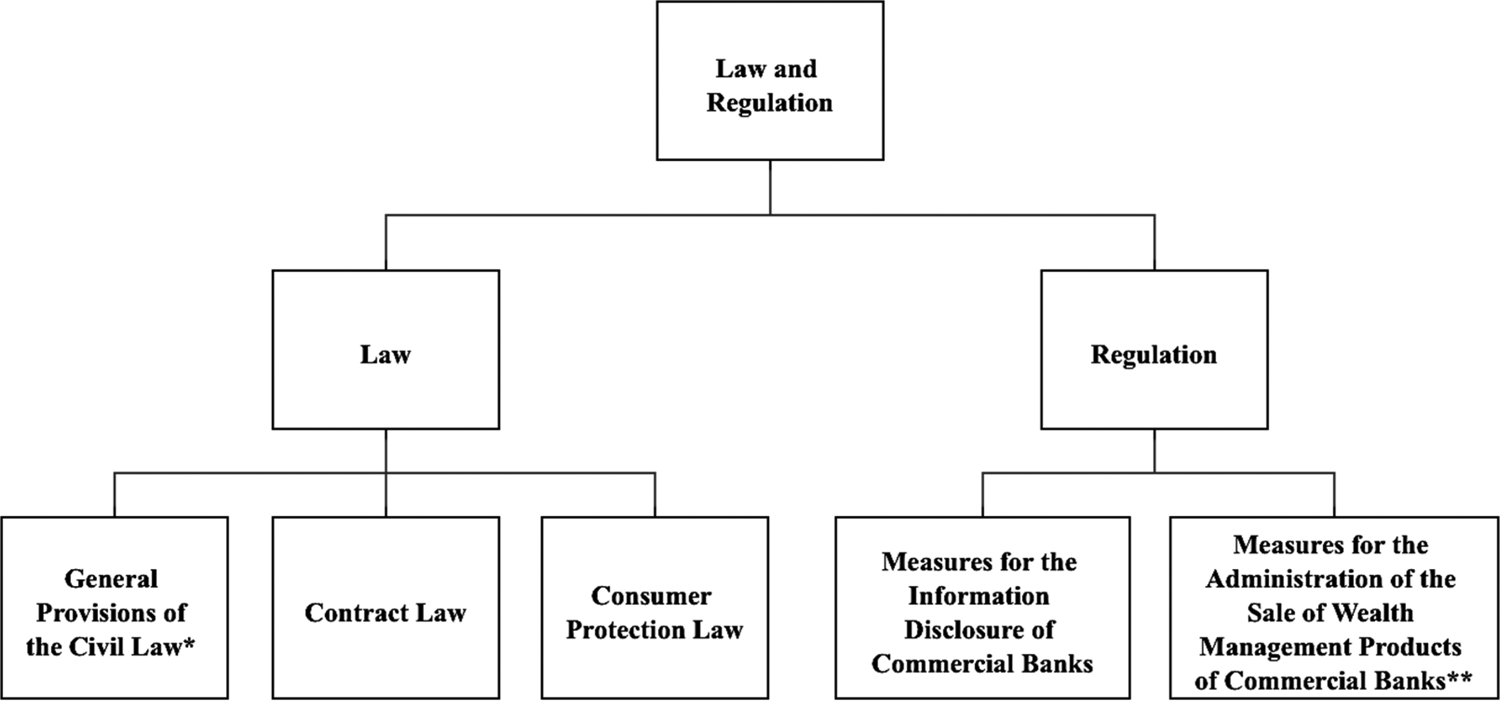
Besides specific regulations governing the design of WMPCs, some statutes control contractual clauses (see Figure 1). The primary legislation addressing the design of contracts is the Contract Law, which provides default rules that can be contracted around by party autonomy, and mandatory rules that cannot be opted out of by contractual parties.Footnote 62 For example, any contractual clauses that exclude one party's liability for personal injury or property loss caused to the other party shall be invalid.Footnote 63 If there are any disputes concerning the construction of standard terms, the interpretation of such terms shall base on common sense. Whenever there are two or more interpretations of the standard term, such a term shall be interpreted against the party drafting it.Footnote 64 The General Provisions of the Civil Law of the PRC and the Consumer Protection Law of the PRC may be influential when commercial banks design WMPCs. The former provides general principles and rules to adjust civil relations (eg, contractual relations),Footnote 65 and the latter applies to all consumers who purchase commodities or receive services (eg, financial products).Footnote 66
Law and Regulation Governing WMPCs
NOTE: *The 13th NPC passed the Civil Code of the People's Republic of China on 28 May 2020, and it took effect on 1 January 2021.
**The China Banking-Insurance Regulatory Commission (CBIRC) issued the Measures for the Supervision and Administration of the Wealth Management Product of Commercial Banks in 2018.

We use the 2012 Measures as an important reference for three reasons. First, the 2012 Measures was a landmark regulation governing the design of WMPCs. The 2012 Measures set general rules to guide banks’ design of WMPCs and instruct banks to incorporate specific warning statements.Footnote 67 Second, while the 2012 Measures expired in 2018, its main parts have been retained by the newly issued Measures for the Supervision and Administration of the Wealth Management Business of Commercial Banks. For example, the new regulation also requires banks to design WMPCs that can provide accurate and complete information about the features of products (eg, investment portfolio, risks, and charges).Footnote 68 Third, the WMPCs in our sample – which will illustrate more about in Section III – were collected before 2018, when the 2012 Measures was still in effect and influenced banks’ practices on WMPC design. Hence, we believe it is appropriate to use the 2012 Measures as a benchmark to assess WMPC terms’ bias.
Sample of wealth management product contracts
This study fills the gap in the literature of standard form contract practice by adding empirical data from the Chinese banking sector. The newly emerged WMP market provides an appropriate environment to test for bias in standard form contracts. First, WMPCs contain several standard form terms that are important to understand, given that the sales of WMPs exceed 29.54 trillion RMB in 2017.Footnote 69 Second, the high structural uniformity of the WMPCs is associated with substantial variation in particular terms. Some commercial banks provide elaborate terms, whereas others do not. Third, specific regulations lead to homogeneous WMPCs from bank to bank, which allows for meaningful comparisons of their standard form terms.
The findings and conclusions are generated from a hand-collected sample of 66 bank-issued WMPCs before 2018.Footnote 70 To establish the database, we followed two steps: first, selecting the banks and, second, obtaining the WMPCs of their flagship products. We selected virtually all well-known national commercial banks, as well as some typical local ones. The leading players in the WMP market are the national-wide commercial banksFootnote 71, which had raised more than 70% of the WMP funds at the end of 2016.Footnote 72 Our sample contains almost all of the national commercial banks – all (6) SOCBs and the majority (11 out of 12) of JSCBs, and some local banks (42 UCBs and 7 RCBs).Footnote 73 The local banks included in the sample are located in the coastal cities of China, which are the most affluent regions of the country.Footnote 74 We did not include WMPCs from foreign banks in the sample for two reasons. First, the money that foreign commercial banks raised from sales of WMPs each year only constitutes a tiny portion of the total annual amount of fundraising via the sale of bank-issued WMPs.Footnote 75 Second, foreign commercial banks governed by special regulations such as Regulation on the Administration of Foreign-funded Banks Footnote 76 tend to have different corporate governance and business strategies. Therefore, we do not include foreign banks because this paper aims to explore the relationship between the nature of Chinese commercial banks and the quality of their WMPCs.
Next, we collected the WMPCs for the flagship series from each selected bank. Banks, in general, advertise all their WMPs. However, the flagship series is the one that matters most to banks and customers (ie, the predominant product that the bank seems to market).Footnote 77 We attempted to identify a bank's flagship product in consideration of its performance period and its popularity. Performance period means the time since the name of a product appeared. The longer the period over which a WMP has existed, the greater the number of WMPs sold by banks. The product thus becomes well known among customers. For example, ‘Qian Yuan’, a WMP sold by the China Construction Bank, has existed in the market for at least seven years.Footnote 78 The number of WMPs under the name of ‘Qian Yuan’ is the greatest among all the WMPs sold from this bank.Footnote 79
In general, the selection of a flagship WMP of a given bank in the sample was straightforward. The name of the flagship product either appeared the most frequently on the list of the products provided at the bank's counters or was emphasized and elaborated on the bank's website. We selected the flagship product for the remaining banks by referring to the official website on which the WMPs of all the commercial banks in China are registered (chinawealth.com.cn). We recognized a flagship product when it appears most frequently on the official website.
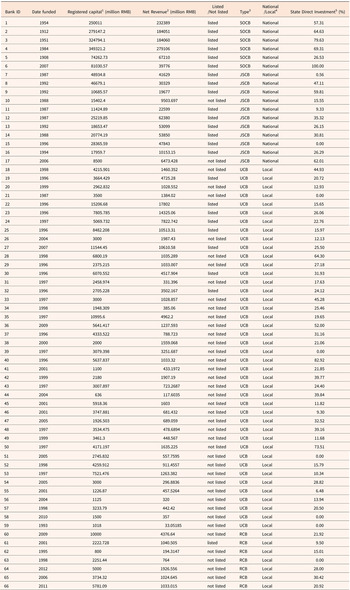
To sum up, the sample contains 66 WMPCs from 66 Chinese commercial banks. Readers might be concerned that the sample is subject to some types of selection bias due to the process of sample collection and the relatively small sample size. This concern is not prohibitive for several reasons. First, we do not claim that our sample represents all commercial banks in China. Instead, it represents the national commercial banks and local commercial banks in the coastal region. The sample size is acceptable given the total number of banks that sold WMPs each year. According to the search results from the chinawealth website, 6 SOCBs, 12 JSCBs, 72 UCBs, and 32 RCBs raised funds by selling WMPs in 2017.Footnote 80 Our sample contains more than half of the banks. In addition, our sample represents the commercial banks and their WMPs that clients are most likely to encounter and that matter most to both commercial banks and their clients (see Appendix 1).
Second, the WMPC of a bank's flagship product is representative given the high uniformity of WMPCs provided by the same bank. A typical WMPC consists of four sales documents: a sales agreement, a specification, a risk disclosure statement, and a note for customer rights and interests.Footnote 81 Within the same bank, the differences between WMPCs only exist in the WMP specification, in which the necessary information varies across products.
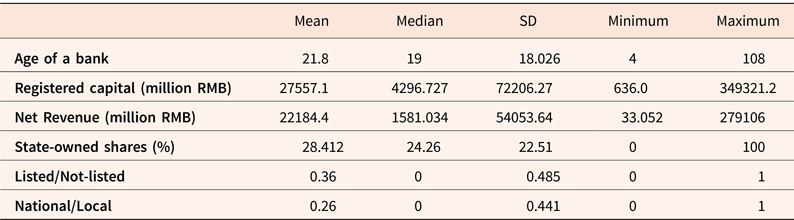
We included essential characteristics of each bank (see Table 1). The age of a bank is 2016 minus the year of founding, with the youngest at four years and the oldest at 108 years (Mean = 21.8, SD = 18.03). Specifically, the average age (74.2) of SOCBs is much higher than that of the rest (17.72), among which only two banks are over 100 years old.Footnote 82 The size was identified according to a bank's registered capital and its revenue. In the sample, the registered capital ranged from 636 to 349,321 million RMB (Mean = 27,557, SD = 72,206). In addition, the net revenue ranged from 33 to 279,106 million RMB (Mean = 22,184, SD = 54,053). Compared with other banks, the SOCBs are larger. The average registered capital of SOCBs is more than 28 times that of the rest of the banks. Moreover, on average, SOCBs generate 22 times more net revenue than the rest of the banks.
Commercial Bank Summary Statistics

NOTE: Results based on 66 commercial banks data, including years since founding, registered capital, revenue, public listed, direct state investment, were searched in the National Enterprise Credit Information Publicity System.
We also collected data regarding the banks’ shareholders – whether the government has invested in the bank, and if so, to what extent. Among the 66 banks, over 90% have direct investments from the state – either from the State Council or the Ministry of Finance (MOF). However, the amount of state investment varies from bank to bank. The average percentage of state investment is 28.41% (SD = 24.26%). Furthermore, whether a bank has been publicly listed or not was also included and presented as a dummy variable. Of the 66 banks, only a small portion (36%) are publicly listed (SD = 49%).Footnote 83 Finally, we also considered whether a commercial bank was operated nationally or locally. We generated a dummy variable, coding 1 if a bank ran its business around the country, coding 0 if a bank mainly focused on local business. All the data were collected through the National Enterprise Credit Information Publicity System,Footnote 84 a state-established search engine that allows the public to get information about market entities.Footnote 85
Evaluating important terms of WMPCs: methodology
This section analyzes the content of WMPCs. A typical WMPC includes four sales documents containing 28 important standard terms to allocate rights, duties, and risks. These terms can be grouped into five main categories. The first category, ‘Nature of Wealth Management Product’, contains essential information for customers to make a purchase. This category includes the type, investment period, scope of investment, requirements for purchase, anticipated profit, and management fee. The second category, ‘Risk Disclosure’, contains terms describing the possible risks that will jeopardize the safety of the customers’ investments. The third category, ‘Customer Rights’, includes terms that illustrate the risk tolerance rating, channels for customers to acquire information regarding WMPs, and other rights that matter to customers’ interests. The fourth category, LIMITATIONS ON LIABILITY, comprises terms that list the situations in which a bank's responsibilities are waived and the privileges they enjoy. The last category, ‘Conflict Resolution’, includes terms that affect customers’ choices regarding the methods of resolution (arbitration clauses), locations to claim the dispute (forum-selection clauses), and which sales document should be the reference in the contractual relationship.
In deciding on the measurement of bias of a given term, we rely on the laws and regulations mentioned in Section II. In particular, the terms are mainly assessed against an objective benchmark, the 2012 Measures, because it is the main regulation that the banks refer to when they design their WMPCs. The 2012 Measures mainly mandates the design of WMPCs—what must be included and what should not. For example, Article 17 of the 2012 Measures requires banks to place a warning statement in a conspicuous position in their WMPCs, which reads, ‘A wealth management product is not the same as deposit. Please be aware of the risks associated with the product and make prudent investment decisions.’ The 2012 Measures also provides many detailed rules that the banks can directly copy and paste into their WMPCs. Therefore, we chose the 2012 Measures as the benchmark to assess the bias of most terms. We assessed the remaining terms according to the general principles in the relevant laws and regulations or by referencing the questions used in previous studies.Footnote 86
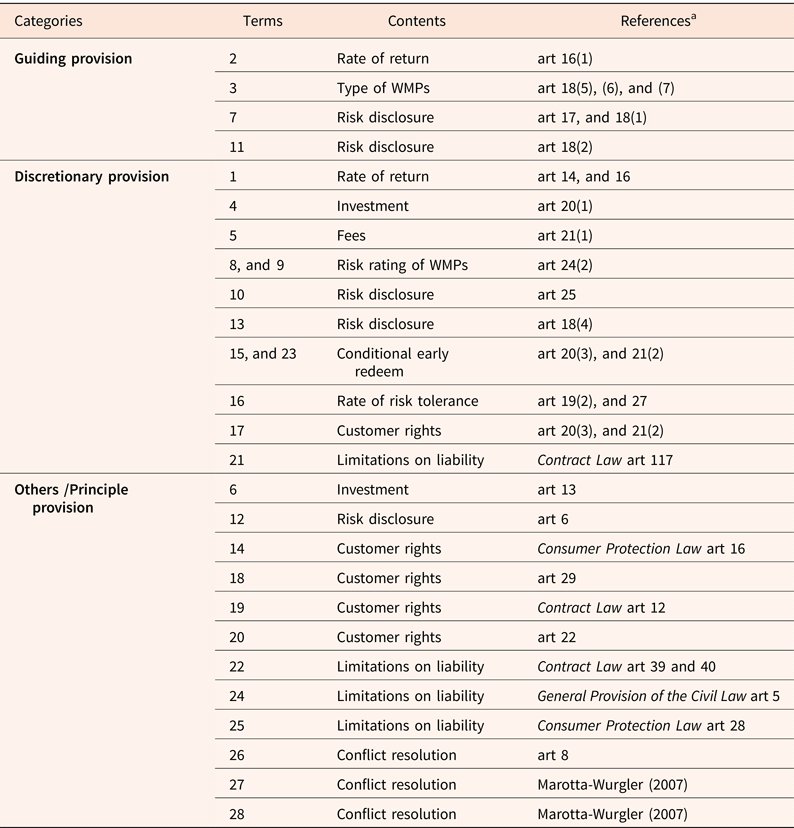
Table 2 lists the terms and their references. We grouped the 28 terms into three categories according to the way they apply the provisions. The guiding provision refers to the provision that contains the sentences that can be directly copied and pasted into the contract terms. For example, all the WMPCs contain the phrase ‘I have read the above risks disclosure, and I am willing to assume the investment risks’, which is in Article 18(9) of the 2012 Measures.Footnote 87 The discretionary provision refers to the provision that specifies what information must be included in the WMPCs but leaves the banks to decide how to display such information. Using investment information as an example, Article 20(1) of the 2012 Measures requires the sales documentation to specify the scope of investment.Footnote 88 In addition, it gives banks the freedom to decide whether they would illustrate the scope of investment precisely or roughly. The rest of the WMPC terms that do not belong to the above two categories are named other/principal provision.
List of Terms and References

a. If no special notification, the number suggests the Article number in the Measures for the Administration of the Sale of Wealth Management Products of Commercial Banks.
It is worth emphasizing that a given WMPC term is not accessed subjectively but measured against an objective benchmark provided by the default rules in the 2012 Measures (and relevant Contract Law provisions). In the best-case scenario, the sampling banks do not merely comply with the default rules but provide terms that favour clients. Commercial banks will not get extra credits if they comply with the relevant provisions. However, in the worst-case scenario, the sampling banks will ignore the default rules and take advantage of clients through one-sided terms. Commercial banks may not always find clear default rules when drafting WMPC terms. In such scenarios, we will also consider the general principles of fair trading, industry-specific practices and standards applied in previous studies when accessing a given term.
Like the methodology that Marotta-Wurgler adopted to track the bias of end-user license agreements,Footnote 89 we identified a given term in worst-case scenarios to be more pro-seller relative to the default rules and assigned a negative one-point score for such a term. We gave a zero score if a given term matches the default rules in the 2012 Measures. We assigned a positive one score to a given term in two types of scenarios. In the first type of scenario, if a given term does not merely match the default rules but favour clients, we considered such a term is more pro-buyer than the default rules. In the second type of scenario, a given term provides additional information or entitlement to clients where the provisions of the 2012 Measures are silent about specific rules. For example, the risk level of a WMP is crucial to customers. Thus, banks shall adopt scientific and rational methods to calculate risk ratings that can reflect the risk of the WMP accurately. However, no rule in the 2012 Measures suggests how detailed the description of risk ratings should be. Customers prefer the term that not only offers the rated risk level but also elaborates the meaning of a risk rating. Such a term can enhance their understanding of the risk level. We gave a positive point to the term that explained the meaning of risk rating instead of merely showing the risk rating result. We found that the best-case scenario rarely occurred. Thus, like Marotta-Wurgler's study (assigning positive marks to 6 out of 23 terms), we assigned more negative marks than positive ones.
The score of each item will be summed up to constitute a ‘bias index’.Footnote 90 Obviously, all terms are assumed to matter equally and that customers have the same preference. Of course, this process may not be realistic. Some customers may care about the risk rating, whereas others make their purchases mainly based on the anticipated profit. Nevertheless, a portion of customers may pay more attention to the right to redeem and the exception of the banks’ liabilities.
Nature of wealth management product
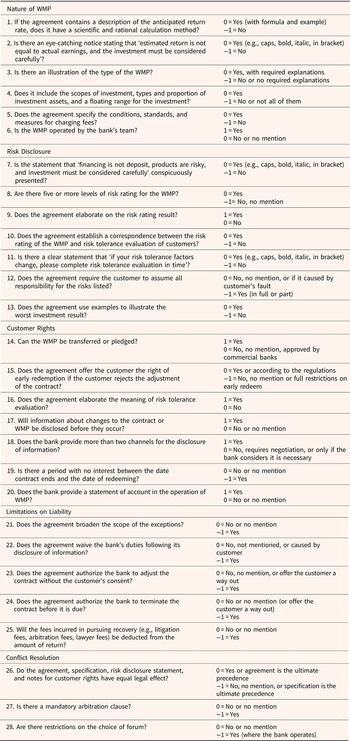
This category contains information that is essential for customers to make their purchases. The general principle of designing WMPCs is that all the information regarding the nature of the product should be accurate, explicit, and truthful.Footnote 91 Such a principle is supplemented by three other articles, which offer detailed requirements regarding the estimated rate of return,Footnote 92 scope of investment,Footnote 93 and charged fees.Footnote 94 A WMPC that includes the required information is coded as zero; a negative one point is coded otherwise. For example, Article 16 of the 2012 Measures requires the promotion and sales texts of WMPs containing the descriptions involving ‘rate of return’ or ‘interval of return’ to provide the basis for scientific estimation and the approaches of the rate or interval of anticipated profit. Therefore, if a WMPC fails to include the calculation mode, it receives a negative one point. Otherwise, a zero score was assigned. In addition, Article 16 also states that customers should be reminded with eye-catching words stating that ‘estimated return is not equal to actual earnings, and investment must be considered carefully’. If a WMPC meets this requirement, then a zero score is given. Otherwise, a negative one point was given. The first five terms were coded in this way (see Table 3).Footnote 95
WMPC Terms and Bias: Methodology

NOTE: The table describes the measures of scoring each term in the WMPC to calculate the overall bias of the contract. Zero scores mean the terms are neutral or terms that meet the demands of the laws and regulations (in particular, the Measures for the Administration of the Sale of Wealth Management Products of Commercial Banks). Positive one captures pro-buyer terms, and negative one captures pro-seller terms.
Whether a bank sells and manages its own WMPs or sells products managed by other financial institutions matters to the contractual relationships between the bank and its customers. However, the 2012 Measures does not specifically provide for this. Sale by proxy would increase uncertainty and risks to engage in more complicated cases when disputes occur.Footnote 96 Therefore, if a WMP is sold and managed by the bank, a positive one-point score was given. Otherwise, a zero score was given.
Risk disclosure
Risk disclosure is crucial for customers. Unlike bank deposits, WMPs are not adequately secured by commercial banks. Some risks, such as natural disasters, political changes, and market fluctuations, may jeopardize the safety of customers’ investments. Such importance is also reflected in the 2012 Measures, in which the relevant provisions occupy two chapters.Footnote 97 Article 18 explicitly lists nine elements that should be disclosed to customers.Footnote 98 It begins with mandated alert statements. We measured WMPC terms to observe whether they include notice sentences stipulated in the 2012 Measures.Footnote 99 If a WMPC term conspicuously (eg, in capital, bold, italic, in bracket) expresses the required notice sentence, then a zero score is given. Otherwise, a negative one-point score was given. In addition, the WMPC should include a term that exemplifies the investment results in the worst-case scenario.Footnote 100 A negative one-point score was given if such an example is absent.
Next, we considered how the banks measure and display the risk rating of their WMPs. Article 18, Section 4, and the whole Chapter Four of the 2012 Measures request banks to rate the risk of the proposed WMPs scientifically and rationally. In addition, the risk rating result should be in the form of risk grades, that is, in the form of at least five grades in ascending order.Footnote 101 However, assigning risk grades has no uniform standard and method. Discretions are left to the banks, and the ways they display risk grades differ. In this study, a WMPC that offers risk rating results in the form of five (or more) grades receives a zero score, and risk rating results of less than five grades or risk rating never mentioned receives a negative one-point score. In addition, a single risk rating result without explanation does not mean much to customers.Footnote 102 All else being equal, customers prefer detailed information that can tell them the actual risk of the proposed product. We gave a positive one-point score for the presence of an explanation of the risk grades. Finally, a WMPC with a match between the risk grade of a product and the assessed risk tolerance of clientsFootnote 103 was scored zero; otherwise, a negative one-point score was given.
However, ‘[a] disclosure mandate can similarly backfire when the discloser who complies with the disclosure mandate is free to engage in other forms of sharp dealing’.Footnote 104 While the commercial banks all disclose risks somewhere in their WMPCs, some add a term to assign the risk exclusively to the buyer after the disclosure. Therefore, if a term casts the burden on customers to take all the potential risks after the bank discloses information, then a negative one-point score was given. Otherwise, a zero score was given.
Customer rights
The protection of customer rights is one of the fundamental principles in the 2012 Measures. Article 19 of 2012 Measures alone expresses the content that should be included in the note for customer rights.Footnote 105 Besides the mandated information, some banks spill more ink on explanations of risk tolerance. We scored a positive one-point score for the presence of additional explanation.
Second, while clients have the right to access information related to the product, the banks have discretion regarding how the information is disclosed. In practice, banks often release information in two ways: through their officers at the counters or on their websites. Some banks, however, provide additional channels such as email, phone messages, or phone lines. Everything else being equal, customers can benefit from more channels and more frequency in disclosing information. Therefore, if a bank provides more than two channelsFootnote 106 to disclose information, it receives one positive point. Otherwise, it was given a score of zero. Besides, how a bank releases information when it releases information also matters. If a term requires the commercial bank to disclose information before a new term takes effect, it receives one positive point because this allows the customers to have the freedom to choose to stay in the adjusted contractual relationship or to leave it.
The next term indicates whether the customer has the right to redeem the WMP early. As stated before, banks should inform the client of the type and the proportion of the assets invested and ensure reasonable floating according to the floating return rate stipulated in the sales documentation.Footnote 107 However, since the financial market is unpredictable, it is necessary to give banks the discretion to adjust their investments. Correspondingly, customers deserve the right to redeem the WMP in advance if they refuse to accept such adjustments.Footnote 108 A WMPC scores zero points for the presence of such a customer right; otherwise, a negative one point was given.
Finally, three additional rights, although not included in the 2012 Measures, deserve our attention. In practice, some banks impose restrictions on the transfer and pledge of WMPs to avoid being involved in a debt chain. The 2012 Measures keeps silent regarding this, and whether allowing the transfer and pledge of WMPs is legally feasible or not is under debate.Footnote 109 Customers prefer WMPs to be freely transferred or pledged, so a positive one point was given to a WMPC if the bank allows customers to make such an arrangement. In contrast, the presence of such restrictions was recorded as zero points. Moreover, since there is no legal rule requiring commercial banks to provide a statement of account for managing the WMP, even though the absence of such a statement does hurt customers’ substantial interests, a zero-point score was given if the WMPC lacks it. The last term indicates the method for calculating interests. If a bank does not count the period between the end of WMPC and the date of redemption in its calculation of interests, that portion of the interests becomes the bank's profits, thus harming its clients’ interests. We therefore assigned a negative one point if a bank calculates interests in this way.
Limitations on liability
This is the portion of the WMPCs that banks pay particular attention to carefully write the standard form terms for limiting banks’ liabilities. The first term that we recorded is whether the WMPC broadens the scope of the exemptions according to the Contract Law.Footnote 110 Although the parties are allowed to agree on terms limiting liability, there is a statutory exemption for a force majeure event.Footnote 111 A force majeure event, for the Contract Law, refers to actual situations that are unforeseeable, unavoidable, and insurmountable. Therefore, if the bank broadens the scope of the force majeure event to embrace additional situations, the clause was regarded as pro-seller and was given a negative one-point score. For example, some banks include the risk that arises from fund management in the limitations on liability, and for that, they receive a negative one-point score.
On occasion, banks also restrict their liability following the disclosure of information to customers. No matter how the banks disclose relevant information, either at the counter or through their websites or even by phone calls, messages, or emails, if they disclose the information, they will waive their liability for any consequential losses. In some WMPCs, contain a clause claiming that ‘any damage caused by customers’ reluctance to check information or any loss of possible investment opportunity due to the customers’ delay for checking information should not be liable to the bank’. If a WMPC contains such a disclaimer to waive the bank's duties after disclosing information, it receives a negative one-point score; otherwise, it was given a score of zero.
Next, we consider conditions for the termination of the contract. The basement of a contract is the parties’ consensus. Correspondingly, to terminate the contract often requires both parties’ agreement.Footnote 112 However, some banks authorize themselves to terminate the contract without the customer's consent. We identified these disclaimers as pro-seller as they limit customers’ rights to choose whether to continue the contractual relationship or not. The 2012 Measures allows customers to redeem products in advance under the sales documents when the customer rejects such adjustments.Footnote 113 We thus interpreted disclaimers emphasizing the banks’ authority to adjust or terminate the WMPCs without notifying customers of their rights to redeem in advance as pro-seller and assigned a negative one-point score to such terms.
The last limitation on liability that we examined is the right of recourse clause. A right of recourse is common in contractual relationships if they involve a third party. In the case of WMPs, the bank will represent the customers in pursuing the recovery of funds if the third party has a capital shortage and is likely to default on the fund management contract. The allocation of additional fees in the pursuit of recoveries, such as litigation fees, arbitration fees, and lawyer fees, is important to both the customers and the banks. While the 2012 Measures is silent in allocating additional fees, customers prefer not to have such fees deducted from the money recovered from the third party. Therefore, if the WMPC has no clause or the clause does not mention the relocation of additional fees, we interpreted it as neutral and assigned a zero-point score. If there was language such as ‘The fees in pursuing recovery (eg, litigation fees, arbitration fees, and lawyer fees) shall be deducted in the amount of return’, we gave a negative one-point score.
Conflict resolution
The last category involves dispute resolution. Banks may strategically use the choice of forum and mandated arbitration to increase inconvenience for customers seeking recovery of their loss from investments in WMPs, thus reducing their costs or eliminating the possibility of class actions. For example, if a customer purchased a 50,000 RMB WMP and lost 20% (10,000 RMB) in capital, the customer must choose: receive 40,000 RMB or file the case in court with the possibility of recovering less than 40,000 RMB.Footnote 114 Customers may also have to advance additional expenses such as mandated arbitration fees, attorney fees, and travel costs during the dispute resolution process. Even though choice of forum and mandated arbitration clauses are not legally forbidden in China, we interpreted WMPC terms that constrain customer's choice of methods and locations of dispute resolution as less buyer-friendly in regard to the imbalance of bargaining power between banks and their customers.Footnote 115
Finally, we recorded whether the WMPC specifies which sales documents should be the ultimate reference for the courts or arbitration tribunals to make an adjunction. Common sense indicates that the WMP agreement should be the ultimate reference because it contains terms that allocate rights and duties of the parties. However, some banks clearly state that the specification should be the ultimate reference when there are differences between the WMP specification and the agreement. Considering that the agreement has been signed by both parties, while the specification does not necessarily include their signatures, we thus interpreted WMPCs that give precedence to the specification as pro-seller and assign a negative one-point score.
Results and analysis
Overall WMPC bias results
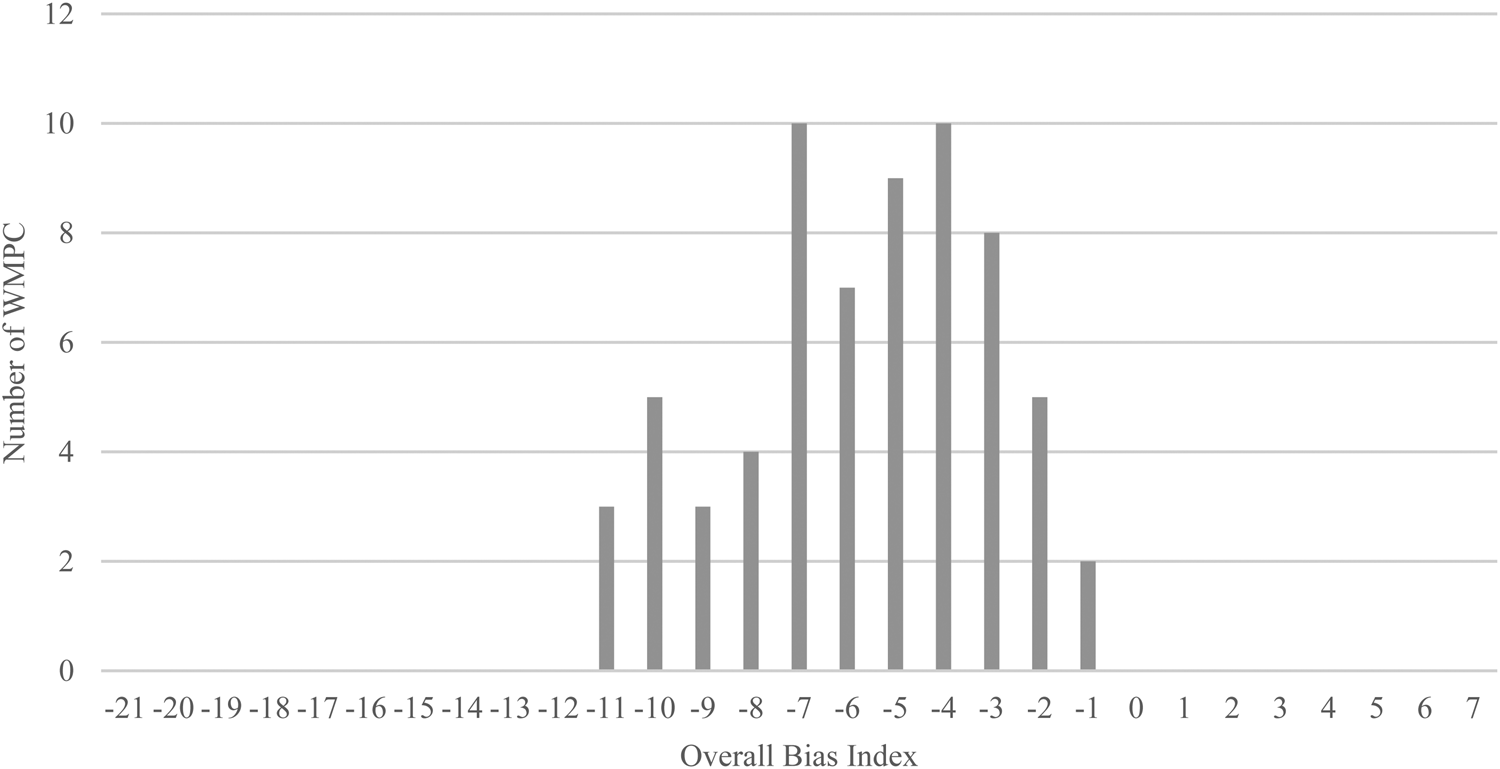
Figure 2 shows the distribution of the overall WMPC bias index. According to our coding methodology, the attainable score of overall bias ranges from -21 to 7.Footnote 116 The x-axis in Figure 2 reflects the theoretical extremes of the bias scores. No WMPC in our sample reaches either of the extremes. A majority of the WMPCs are scored in the region between -7 to -3, with an average score of -5.68 (SD = 2.64). The distribution nearly has a bell shape.Footnote 117 The minimum score in our sample is -11, and the maximum is -1, indicating that when considered as a whole, WMPCs are always tilted toward the banks compared to the default rules in the 2012 Measures and relevant laws. This finding supports the argument that Chinese commercial banks always offer ‘hegemon clauses’, at least when selling WMPs.
The Overall WMPC Bias

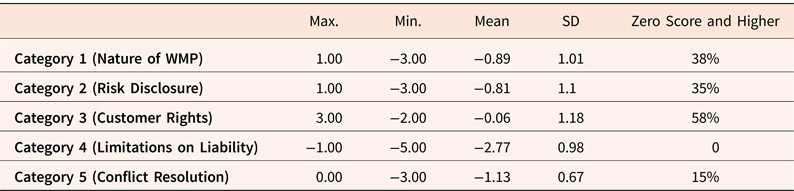
While the WMPCs are not favourable to customers relative to the default rules provided by laws and regulations, there is a certain degree of variation among the WMPC terms from different banks. As previous studies of standard form contracts in other industries had similar results, such a finding is not unique.Footnote 118 It indicates that the banks treat the terms of WMPCs differently. Table 4 breaks the overall bias results down into five categories of terms. It shows the maximum, minimum, and mean score of each category of terms and the proportion of the banks with zero or higher scores. Some categories of terms are more pro-seller than others. For example, category four, ‘Limitations on Liability’, is the most unfair one.Footnote 119 In this category, the overall bias scores ranged from -1 to -5, indicating that all banks use pro-seller terms. Its average score is -2.77 (SD = 0.98), meaning that the terms of this category are, on net, about ‘three terms worse’ than the relevant default rules. By contrast, the average score of the terms in category three, ‘Customer Rights’, is near zero (Mean= -0.06, SD = 1.18), meaning that the terms of this category are almost fair on average. Fifty-eight per cent of the bias score in this category is zero or greater, suggesting that more than half of the sampled banks either matched the rules or were pro-buyer. This is the fairest category compared with the rest.Footnote 120 The other three categories (‘Nature of WMP', ‘Risk Disclosure' and ‘Conflict Resolution') are slightly pro-seller than the default rules: the average score of these categories are close to -1. No statistically significant difference was found among the average scores of the three.
WMPCs Bias for the Five Categories

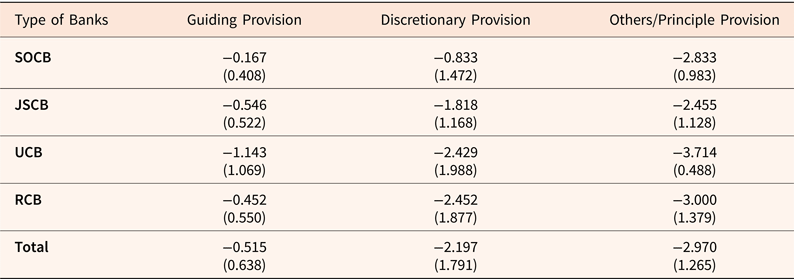
In addition, recall that commercial banks use different measures to design terms in different parts of the WMPCs, but we still have no clue about their strategies' rationales. Table 5 helps us to answer this question. We surmise that the terms in the Guiding Provision group are less pro-seller than those in other groups, and the terms in the Principle Provision group are the most pro-seller. The data in Table 5 verify this assumption, as the average score of the terms in the Principle Provision group (Mean=−2.970, SD = 1.265) is smaller than the score in the Discretionary Provision (Mean=−2,197, SD = 1.791) and Guiding Provision (Mean=−0.515, SD = 0.638) groups. This is not surprising if the contents of the provisions in the three groups are compared. Guiding Provisions contain specific clauses that should be included in the WMPCs, leaving no opportunity for commercial banks to modify them. It is safer for the banks to simply copy and paste those sentences into the WMPCs. This does not harm their interests because these clauses only serve a notification function. Thus, the average score of the terms in the Guiding Provision group should be closer to zero, if not necessarily equal to zero. This trend might not apply to the terms that have no clear standards for reference. The Principle Provisions, in general, are more abstract, leaving commercial banks more room to modify them according to their interests. In addition, the type of bank is still crucial for a bank's strategy in adopting the provisions. The national commercial banks are more compliant than the local banks if the rules are clear.
WMPCs Bias—Summary on Means of Groups of Provisions

NOTE: SD is reported in the parentheses.
Subindex bias and bank characteristics
After describing the overall bias index results and the subindex bias by different categories, this section will examine the extent to which bank characteristicsFootnote 121 can explain the bias of WMPCs.
We conducted OLS regressionsFootnote 122 and found no significant association between bank age, net revenue, the percentage of State Council shares, the two dummies for whether the bank is publicly listed and whether its business is nationwide, and our dependent variables (the results are presented in Appendix 2). Therefore, none of these variables was included in the following analysis.
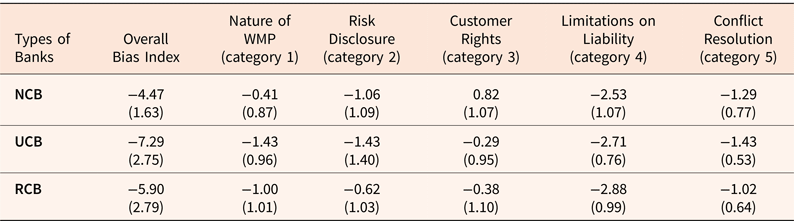
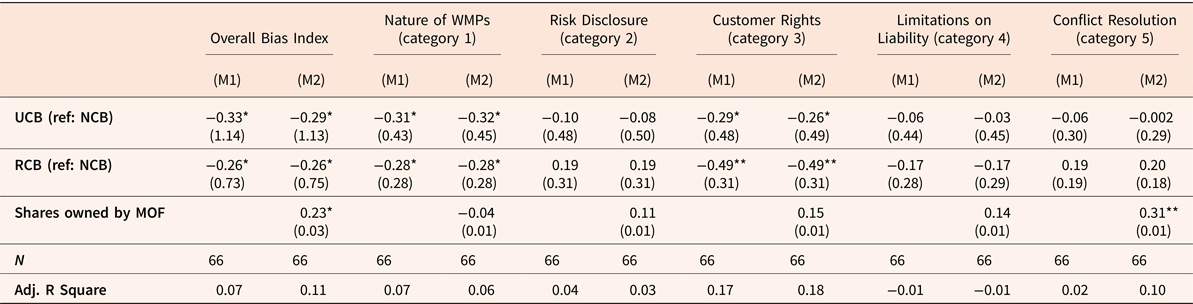
The regression results indicate that bank type is the key independent variable.Footnote 123 As shown in Table 6, compared to the WMPC terms designed by national commercial banks (ie, the SOCBs and JSCBs), those provided by local commercial banks (ie, the UCBs and RCBs) are more pro-seller than the relevant default rules. The terms provided by the UCBs (Mean= -7.29, SD = 2.75) are, on average, about ‘three terms worse’ than those provided by the national commercial banks (Mean= -4.47, SD = 1.63). The OLS regression analysis suggests that such a difference is statistically significant (Beta= -0.33, p = 0.02) (see Table 7). Similarly, the RCBs tend to have more pro-seller WMPC terms than the national banks (Beta= -0.26, p = 0.05) (see Table 7).
WMPCs Bias—Summary on Means of Categories of Terms According to Types of Banks

NOTE: SD is reported in the parentheses.
Summary of OLS Regression Analysis for Variables Predicting WMPCs Bias

NOTE: This table reports Beta and SEs (in the parentheses). * p ≤ 0.05; ** p ≤ 0.01.
The results for individual subindexes are generally consistent with those in the overall bias index. However, the level of influence of the type of bank on WMPC bias varies across different categories of terms. As shown in Table 7, for terms in subindex (2), (4), and (5), the national commercial banks design less pro-seller terms, relative to the default rules, than the local commercial banks. Still, the differences are not statistically significant.Footnote 124 Regarding subindex (1) and (3), the type of bank exerted stronger influence. In addition, a more interesting finding is that national commercial banks, on average, design terms in favour of customers in the category of Customer Rights (Mean = 0.82, SD = 1.07) (see Table 6). Such findings are counter-intuitive due to the belief that powerful national commercial banks would take advantage of customers via one-sided standard form contracts.Footnote 125 Therefore, it is worth carefully analysing these findings in the discussion part below.
Other than the type of bank, the percentage of shares owned by the MOF plays a role. Commercial banks with a higher percentage of shares owned by the MOF, controlling the type of banks, are more likely to have less pro-seller terms (Beta = 0.23, p = 0.05). However, when we break the results down into five categories, this variable only significantly affects category 5 (Beta = 0.31, p = 0.01).Footnote 126
Why the national commercial banks offer less pro-seller WMPC terms?
The above findings reaffirm the previous conclusion that ‘consumers do have some degree of choice’ over standard form contracts, even if their boilerplates are non-negotiable.Footnote 127 This is because there are certain degrees of variation among banks’ WMPCs. Customers will have less pro-seller WMPCs if they choose to buy the products from national commercial banks, especially those that are state-owned. Why are national commercial banks’ WMPCs generally less pro-seller relative to the default rules provided by laws and regulations? We offer three possible explanations: first, national commercial banks are more concerned with their reputation, so they design good-quality WMPCs to minimize reputational risks; second, their stronger ties with the Party-State forces them to prioritize the Party-State's social and economic objectives instead of using one-sided WMPCs to maximize banks’ profits; third, national commercial banks are more aware of legal risks because they are more prone to being caught by the financial regulator.
National commercial banks are more concerned with reputation
Compared with local ones, national commercial banks put more weight on the value of their corporate reputations for the following reasons. First, national commercial banks have been perceived as semi-governmental organisations due to their strong attachments to the Chinese central government.Footnote 128 Thus, when bank-issued WMPs defaulted, retail investors not only blamed the commercial banks but also accused relevant regulators,Footnote 129 because retail investors mistakenly believe that the state would bail out the losses of investments if bank-issued WMPs defaulted.Footnote 130 Recent scandals caused by defaulted WMPs involving national commercial banks have threatened the government's and the banks’ reputations.Footnote 131 To avoid censure from the central government, national commercial banks are more cautious in designing their WMPCs to prevent reputational risks.
Second, national commercial banks value their reputations because they are more internationalized. For example, most sampled national commercial banks are simultaneously listed in the mainland and Hong Kong stock exchanges, while none of the sampled local commercial banks is.Footnote 132 Existing literature has shown the improvements in corporate governance and financial performance that national commercial banks have made after listing their shares in Hong Kong.Footnote 133 These improvements can be explained by the ‘legal bonding theory’, which emphasizes the importance of higher standards of corporate governance, investor protection and information disclosure for cross-listing firms to meet in a foreign jurisdiction;Footnote 134 or the ‘reputational bonding theory’, which focuses on the reputational benefits in accessing external finance.Footnote 135 Therefore, as an international firm, a national commercial bank would consistently ‘bond themselves by building their reputation’Footnote 136 by designing good-quality WMPCs to minimize reputational risks.Footnote 137
National commercial banks are more concerned with financial policy objectives
Compared with the local banks, national commercial banks prioritize their mission to accomplish the Party-State's financial policy objectives rather than seek profits for shareholders. Hence, national commercial banks must abide by the regulations to prevent systemic financial risks and preserve social stability.
The recent rotation of senior executives of national commercial banks reflects the Party-State's tendency to have closer ties with national commercial banks. A recent news report reveals that nearly half of the vice governors at the provincial level served as senior executives of national commercial banks before they held office in the provincial government.Footnote 138 Such postings aim at accomplishing broad financial policy objectives such as financial inclusions and the prevention of systemic financial risks.Footnote 139 To serve the interests of Party-State, national commercial banks have to consider the overall financial policies when approving the design of WMPCs. The national commercial banks would consider extremely one-sided WMPCs as an obstacle to promoting financial inclusion. Their compliance with laws and regulations would facilitate the prevention of systemic financial risks.
National commercial banks are more aware of legal risks
In the process of controlling systematic financial risks, national commercial banks, compared with local ones, are more likely to be the targets of regulatory watchdogs. For example, in 2018, the CBIRC imposed fines of US$22 million on six national commercial banks for violating regulations regarding bank-issued WMPs.Footnote 140 As one of us has found, most fines (121 out of 183) were issued by CBRC/CBIRC and their local offices to national commercial banks regarding their breach of regulations on bank-issued WMPs.Footnote 141
Thus, national commercial banks are more aware of the legal risks of severe punishments when designing their WMPCs. To achieve this goal, they adopt two strategies. First, national commercial banks often invite judges to conduct legal training programs to equip their directors, senior officers, and in-house counsels with legal knowledge regarding the purpose and practice of the latest regulations.Footnote 142 Second, national commercial banks, like many other central SOEs, have recruited former judges and prosecutors with unbeatable remuneration packages to enhance their legal compliance capabilities.Footnote 143
Conclusion
Standard form contracts are widely used in the banking industry. While many news reports cite banks’ ‘hegemon clauses’, and scholars have discussed their enforceability, there has been almost no systematic empirical study on the content of contracts provided by banks. Based on 66 hand-collected WMPCs from four major types of commercial banks in China, this article tries to provide some empirical evidence about the standard form contract practice in the Chinese banking industry.
By measuring the variation in 28 common terms, such as risk disclosure and customer rights, we calculate the scores of the WMPCs’ biases. The overall bias index indicates that all the standard form WMPCs in the sample are pro-seller relative to the objective benchmarks, the default rules provided by the 2012 Measures and other relevant laws. However, we find that national commercial banks provide less exploitative terms than local commercial banks. The explanation for such variation lies in the enforcement of relevant laws and regulations and the unique nature of national commercial banks. First, national commercial banks, which have been perceived as semi-governmental organizations and are generally more internationalized, are more concerned with their reputation. Second, national commercial banks must accomplish the Party-State's financial policy objectives to prevent systemic financial risks and preserve social stability. Third, national commercial banks are more aware of the legal risks of severe punishments when designing their WMPCs because they are more prone to being caught by the financial regulator. We find no evidence that other characteristics of the banks have a significant impact on the overall bias.
The results also indicate that the commercial banks, no matter what type they are, follow the regulations more stringently if the provisions are clear enough and leave no room for the banks to make modifications. On the contrary, if the provisions are too abstract, the banks design the WMPC terms to maximize their interests. This result is practically meaningful to the regulators. If they intend to normalize the WMP market, the best solution is to draft more explicit provisions.
Acknowledgements
We are grateful to the Centre for Banking & Finance Law at the National University of Singapore for the research support. We own sincere thanks to Lin Lin, and Charles Zhen Qu for valuable comments on earlier drafts of this paper. We also thank the participants of the 2018 Law and Society Annual Meeting at Toronto for insightful discussions. All errors are ours alone.
Appendix 1. Overview of the Chinese Commercial Banks in the Sample (N = 66)

Appendix 2. Regression: WMPC Bias and Bank Characteristics

Author Biographies
Qin Zhou, Postdoctoral Fellow at the Centre for Banking & Finance Law, Faculty of Law, National University of Singapore.
Jing Feng, Assistant Professor at the School of Law, Southwest University of Political Science and Law; Research Fellow at the Centre for People's Tribunal Study, Southwest University of Political Science and Law.