




No CrossRef data available.
REPARATIONS: Justice and Greed in Black and White
Published online by Cambridge University Press: 11 March 2004
Abstract
Proponents and opponents of reparations for Blacks vociferously disagree. Conservative opponents argue that reparations for Black slavery are a disastrous idea and that proponents are motivated by either greed or the desire to do harm to the republic. Liberal and left opponents of reparations argue that the advocacy on this issue will lead to great racial divisions and do potentially irreparable harm to progressive movements. Supporters of reparations argue that it is a case of simple justice. That during the colonial, slavery, and Jim Crow eras Blacks were systematically oppressed and exploited with the active support of the state. They also argue that both domestic and international precedents strengthen the case for Black reparations. This paper shows that there is a tremendous divide between Blacks and Whites on questions of both an apology to Blacks as well as monetary reparations. The racial divide extends to support for the reparations to Japanese-Americans who were victims of official incarceration during World War II. Finally, multivariate analyses demonstrates that for both Blacks and Whites, racialized views of politics are best predictors of support for or opposition to reparations.
Information
- Type
- STATE OF THE ART
- Information
- Copyright
- © 2004 W.E.B. Du Bois Institute for African and African American Research
We now, as a people desires to be elevated, and we desires to do all we can to be educated, and we hope our friends will aid us all dey can…
I may state to all our friends, and to all our enemies, that we has a right to the land where we are located. For why? I tell you. Our wives, our children, our husbands, has been sold over and over again to purchase the lands we now locate upon; for that reason we have a divine right to the land.
And den didn't we clear the lands and raise de crops of corn, ob cotton ob tobacco, ob rice, ob sugar, ob eberything? And didn't den large cities in de North grow up on de cotton and sugars and de rice dat we made? Yes! I appeal to de South and to de North if I hasn't spoken de words of truth.
I say dey have grown rich and my people is poor.
—Bayley Wyatt (1866), qtd. in A Right to the Land: Essays on the Freedmen's Community, ed. Edward Magdol (Westport: Greenwood Press, 1977) 72.
The notion of collective guilt for what people did [200 plus] years ago, that this generation should pay a debt for that generation, is an idea whose time has gone. I never owned a slave. I never oppressed anybody. I don't know that I should have to pay for anyone who did [own slaves] generations before I was born.
—Congressman Henry Hyde, qtd. in Robert K Fullinwider, “The Case for Reparations” Philosophy and Public Affairs, 20 (Summer 2000) 2.
You never knew there could be such pain, but the thought of what you lost keeps running through your brain.
—Lou Rawls, “Stormy Monday” on the recording “Lou Rawls with Les McCann” (LTD: 1990).
INTRODUCTION
The idea of reparations, of having the government of the United States admit to its crimes against Blacks and agree to restitution, has a long and honorable history within Black political practice and thought. Black leaders from Frederick Douglass to Martin Luther King, international organizations ranging from Garvey's UNIA to Pan African Congresses held in the 1990s, ideologies from those of Du Bois to Malcolm X, the idea of the reparations in real material terms, not only symbolically, has been a constant within Black discourse.
Each historical period has had its own idea of what would constitute reparations. Toward the end of the civil war, Blacks throughout the South, particularly in the Sea Islands, confiscated the plantations of those they justly saw as traitors and oppressors and proceeded to distribute the land among themselves (with and without the support of local Union commanders).1
Eric Foner, Reconstruction: America's Unfinished Revolution, 1863–1877 (New York: Harper & Row, 1988); Edward Magdol, A Right to the Land: Essays on the Freedmen's Community (Westport: Greenwood Press, 1977); Willie Lee Rose, Rehearsal for Reconstruction: The Port Royal Experiment (London: Oxford University Press, 1976); Julie Saville, The Work of Reconstruction: From Slave to Wage Laborer in South Carolina, 1860–1870 (Cambridge, UK: Cambridge University Press, 1994).
Foner 1988; Magdol 1977.
The all too brief period of Reconstruction was followed by Redemption and the return of power in the South to those who were dedicated to reestablishing both a brutal white supremacy and an extreme economic exploitation of the Black population. At the turn of the century, this new regime was solidified at the state level with the passage of Jim Crow laws that legislated white supremacy across political, economic, and social spheres. The national state ratified this draconian racial order with the Supreme Court's infamous 1896 Plessy vs. Ferguson decision. Thus, except for a few years after the Civil War during the height of Reconstruction, Blacks were subordinated and exploited by official state codes at all levels of government. This regime was ruthlessly enforced by both state and private mass violence against Blacks. Throughout the century of Black subordination that followed the end of the Civil War, African Americans ceaselessly demanded reparations both for slavery and for the state sanctioned harms they suffered under the new Jim Crow regime.
A generation after the end of Jim Crow, a solid majority of Blacks are still waiting for an official acknowledgement of responsibility, for America to live up to its promise as a democracy, and for a material settlement of past wrongs. In his “I Have a Dream” speech, Dr. King said that America's check to Blacks had “bounced.” Most Blacks believe that that check remains bounced. In the early 1990s, 65% of Blacks thought that they would not achieve racial equality either now or at any point in their lifetimes. By 2000 this percentage had risen to 76%. Current generations of African Americans in response are making claims not only on the U.S. state, but also on private companies said to have profited substantially from slavery, the slave trade, and the uncompensated labor and misery of peoples of African descent. Blacks, by and large, see the question of reparations and an apology as one of justice delayed.
As we shall see, the great majority of whites have rejected African Americans perspectives on both reparations and an apology for slavery. King's metaphor of a bounced check seems bogus to whites. Decades ago, the majority of Whites believed that Blacks had already achieved racial equality. Indeed, according to a mid-1990s study, most Whites believed that Blacks had largely reached parity or had surpassed Whites on a variety of economic, social, and health indicators.
Many Whites have objected to reparations on a number of grounds. Representative Hyde, for one, complained that he owned no slaves. He rejected the ideal of collective guilt for crimes committed “over 200 years ago,” and saw no reason to pay reparations. This type of sentiment provides the foundation for contemporary opposition to reparations. In earlier eras, it was constitutional arguments of property rights, taxpayer relief, and states rights that cloaked white defense of state-mandated apartheid and opposition to land redistribution and expanded aid to newly freed slaves. Common to all periods are arguments that conceding to demands for reparations—whether land redistribution or funds to help rebuild devastated inner-city communities—would violate norms of fiscal prudence and anti big government sentiments. Furthermore, it is argued that reparations would also seriously undermine national unity, as it would tend to strengthen racial group identities at the expense of a national “American” identity. In all periods, often stated explicitly, is the view that Blacks are undeserving of further government (and White) largess. This sentiment was expressed in the period of Reconstruction as land redistribution was blocked and the Freeman's Bureau was crippled. A century later it was again expressed when most whites reacted in horror to James Foreman's demands for reparations from predominantly White churches and synagogues in the spring of 1969. Whites, by and large, see the quest for reparations as a manifestation of Black greed.
At the beginning of the twenty-first century, the debate on reparations has become more complicated. First, there has been an American precedent for reparations and an apology. Late in the twentieth century, Japanese-American activists and their allies successfully fought for reparations for the survivors of the unjust government incarceration of Japanese Americans into harsh camps during World War II (indeed during the San Francisco hearings there were objections raised to reparations for camp survivors because it would be opening a “whole can of worms”). On the other hand, a small but vocal set of Black conservatives have taken up the fight against reparations, blurring for some the racial lines of the debate. Third, in this period the call for reparations for slavery and its aftermath has a decidedly international character as the Organization of African Unity and other international forums have begun to address the question of reparations for slavery and colonialism for people of African descent both in Africa and for those scattered throughout the African Diaspora.
This paper will attempt to summarize the current debates around reparations within the United States and show the bases for support and opposition to reparations. First, we briefly outline some of the history around claims for reparations within the United States. Next, we summarize the cases for and against reparations in greater detail. Finally, we analyze support among Blacks and Whites for remedial initiatives, addressing both African and Japanese American injustices. We conclude with a brief discussion of the implications of the findings for racial conflict and American democracy.
THE CASE FOR AND AGAINST REPARATIONS
… [We are] Afraid to go back without proof that you were disposed to treat us justly and kindly; and we have concluded to test your sincerity by asking you to send us our wages for the time we served you. This will make us forget and forgive old scores, and rely on your justice and friendship in the future. I served you faithfully for thirty-two years, and Mandy twenty years. At twenty-five dollars a month for me, and two dollars a week for Mandy, our earnings would amount to eleven thousand six hundred and eighty dollars. Add to this the interest for the time our wages have kept back, and deduct what you paid for our clothing, and three doctor's visits to me, and pulling a tooth for Mandy, and the balance will show what we are in justice entitled to. Please send the money by Adam's Express, in care of V. Winters, Esq., Dayton, Ohio. If you fail to pay for us for faithful labors in the past, we can have little faith in your promises in the future we trust the good fathers have done to me and my fathers, in making us toil for you for generations without recompense. Here I draw my wages every Saturday night; but in Tennessee there was never any payday for the Negroes any more than for the horses and cows. Surely here will be a day of reckoning for those who defraud the laborer of his hire.
In answering this letter, please state if there would be any safety for my Milly and Jane, who are now grown up, and both good-looking girls. You know how it was with poor Matilda and Catherine. I would rather stay here and starve—and die, if it comes to that—than have my girls brought to shame by violence and wickedness of their young masters… .
Say howdy to George Carter, and thank him for taking the pistol from you when you were shooting at me.
—Letter from Jordon, former slave to Colonel P. H. Anderson of the Anderson Plantation in response to the latter's request to return as a wage laborer to the plantation.3
Qtd. in Robin D. Kelley, Freedom Dreams: The Black Radical Imagination (Boston: Beacon Press, 2002) 111.
Reparations for the descendants of slaves, as well as for those seen as the victims of the colonization of Africa, have justified their demands on a number of grounds. Historical, moral, and philosophical justifications have all been used as sources of justification. To a significant degree both the moral and the philosophical arguments themselves are grounded in the historical case. We discuss in more detail, therefore, the historical case than the other two.
Most, not all, historical arguments are rooted in the effect of slavery and the slave trade both on African society and the Africans put into bondage.4
Robert K. Fullinwider, “The Case for Reparations,” Philosophy and Public Policy 20 (summer 2000): 1–8.
Robert L. Allen, “Past Due: The African American Quest for Reparations,” Black Scholar 21, no.2 (1998): 2–17. Allen provides a good summary of these arguments, including a 40 billion dollar estimate of unpaid wages.
But as Kelley and Fullinwider argue, a very strong case for reparations can be made without any reference at all to slavery or the slave trade. Fullinwider for one would prefer that slavery not be referenced in pro-reparations arguments.6
Fullinwider.
First, Blacks at the beginning of Reconstruction felt betrayed after taking land from their previous masters or receiving land from Federal authorities when these lands were returned to their defeated former masters.7
Rose.
Foner 1988; Magdol 1977; Rose 1976; Joel Williamson, After Slavery: The Negro in South Carolina During Reconstruction, 1861–1877 (Chapel Hill: University of North Carolina Press, 1969).
Allen.
Allen.
Allen. Richard F. Bensel, Yankee Leviathan: The Origin of Central State Authority in America, 1859–1877 (New York: Cambridge University Press, 1991).
Allen 2.
During Redemption, the period after Reconstruction was smashed, there was a slow worsening of conditions for Blacks in the South culminating with the massive, state-sponsored disenfranchisement of Black citizens, the imposition by the state of apartheid in the economic, social, and political realms, and the entire regime reinforced by the unleashing of quasi-official terror against the Black population in the form of lynchings that resulted in thousands of brutal deaths. The fate of Blacks would be sealed at the state level not only by the violence, but also by the state constitutional conventions starting with Mississippi in 1891 and culminating with Georgia in 1906, which stripped Blacks of basic citizenship rights and instituted Jim Crow. The federal government was actively complicit on a number of fronts—the most notorious being the 1896 Plessy vs. Ferguson decision which found it was “constitutional” for states to establish separate facilities for Blacks. This formalized the regime of separate but “equal.” Justice Harlan in dissent correctly predicted the future when he stated, “In my opinion, the judgment this day rendered will, in time, prove to be quite as pernicious as the decision made by this tribunal in the Dred Scott Case.”
The resulting Jim Crow system provides a solid foundation, so the argument goes, for making a contemporary case for reparations to the government of the United States. Although the great majority of Blacks lived in the South until recent decades, Southern Blacks were not the only victims of this system. A similar system of social, residential, and labor market segregation and discrimination was also in place throughout the rest of the United States—formalized and enforced by private institutions such as the restrictive covenants that barred selling property in White areas to Blacks. In addition, many unions banned Black workers in entire industries and categories of jobs.13
Eric Arnesen, “'Like Banquo's Ghost, It Will Not Down': The Race Question & the American Railroad Brotherhoods, 1880–1920,” American Historical Review 99 no. 5 (1994): 1601–33.
The turn of the last century saw continued Black activism not only to protest the imposition of Jim Crow, but to also demand reparations for the continuing state-sanctioned harm done to African Americans. Callie House initiated a lawsuit for Black reparations and was supported by another exemplary anti-slavery movement stalwart—Frederick Douglass.14
Allen.
Randall Robinson, The Debt: What America Owes to Blacks? (New York: Dutton, 2000).
Kelley.
Virtually every radical Black activist organization from the Garvey's UNIA in the 1920s through the Black Panther Party, Republic of New Africa, and Nation of Islam in the latter third of the 20th century demanded reparations.17
Allen. Kelley.
Allen.
The sentiment that led nationalist and Black power organizations to demand reparations was long recognized by Black Americans, including the leaders of the Civil Rights Movement. The Reverend Martin Luther King, Jr. at the March of Washington discussed the unpaid debt owed to Black America in one of the less-used sound bites from the “I Have a Dream Speech” in August of 1963:
So we've come here to dramatize a shameful condition. In a sense we've come to our nation's capital to cash a check. When the architects of our republic wrote the magnificent words of the Constitution and the Declaration of Independence they were signing a promissory note to which every American was to fall heir. This note was the promise that all men, yes, Black men as well as white men, would be guaranteed the unalienable rights of life, liberty, and the pursuit of happiness. It is obvious today that America has defaulted on this promissory note in so far as her citizens of color are concerned. Instead of honoring this sacred obligation, America has given the Negro people a bad check; a check that has come back marked “insufficient funds.” We refuse to believe that there are insufficient funds in the great vaults of opportunity of this nation. And so we've come to cash this check, a check that will give us upon demand the riches of freedom and the security of justice.19
Martin Luther King, Jr., “I Have a Dream Speech” King, Jr., in A Testament of Hope: The Essential Writings and Speeches of Martin Luther King, Jr., James M. Washington (editor), (San Francisco: Harper and Row, 1986 [1963], p. 217–20.
Sentiments for reparations were sufficiently widespread among African Americans to have penetrated Black popular culture. The popular activist singer/songwriter Oscar Brown Jr., was singing about the need for Blacks to collect on “Forty Acres and a Mule” at the height of the Civil Rights Movement in 1964.20
Kelley.
The pleas for reparations voiced during the Civil Rights Movements were transformed into demands at the height of the Black Power Movement. Reparations were an integral demand within the Ten Point Program of the Black Panther Party. Point number 3 states:
We want an end to the robbery by the white man of our Black Community. We believe that this racist government has robbed us and now we are demanding the overdue debt of forty acres and two mules. Forty acres and two mules was promised 100 years ago as restitution for slave labor and mass murder of Black people. We will accept the payment as currency which will be distributed to our many communities. The Germans are now aiding the Jews in Israel for the genocide of the Jewish people. The Germans murdered six million Jews. The American racist has taken part in the slaughter of over twenty million Black people; therefore, we feel that this is a modest demand that we make.21
The Pacifica Radio/UC Berkeley Social Activism Sound Recording Project: Black Panther Party for Self-Defense 10 Point Program and Platform, http://www.lib.berkeley.edu/MRC/panthers10pt.html, last visited 12/17/03.
Like many other Black nationalist and Black socialist organizations which spread like wildfire at the height of the Black Power Movement, the Panthers linked the demand for reparations to self-determination for Blacks in the United States.
The demand for reparations during this era was put forward most forcefully, however, by James Forman and his compatriots. In the spring of 1969 Forman marched into the Riverside Church in New York and issued the Black Manifesto. The Manifesto called for:
… [a payment of] $500 million as “a beginning of the reparations due us as people who have been exploited and degraded, brutalized, killed and persecuted.”22
qtd. in Robinson 202.
The Manifesto also explicitly tied reparations back to the “land” question. In addition to the funds devoted to building up a multitude of institutions within Black communities, increasing the human capital store among African Americans, and generally building the capacities of Black communities, 200 million dollars was targeted toward building a “Southern Land Bank” for Black farmers.23
Kelley.
The organizational base for this reparations movement was the Black Economic Development Conference (BEDC). Coming out of Detroit, its core leadership was centered on Forman and members of the League of Revolutionary Black Workers. The League was by far the most important Black organization in Detroit at the time, and on par with the UAW in terms of political influence in the city, if not the region. While the campaign only garnered a few hundred-thousand dollars as this organizational initiative floundered under the weight of the conflicts, chaos, and eventual implosion which inflicted the Black progressive movement of the late 1960s and early-mid 1970s, it represented a serious attempt to try and put into practice sentiments that had deep roots in the Black community. This would be one thread that would not be broken with the end of organized Black militancy. Support for reparations would survive even Reagan's regime and remain strong at the turn of the millennium.24
Michael C. Dawson, Black Visions: The Roots of Contemporary African-American Political Ideologies (Chicago: The University of Chicago Press, 2001). Chapter 5 in Dawson 2001, provides more information on the League of Revolutionary Black Workers, their program, and ideology, see. For more on the Black Manifesto, see Kelley.
Today, reparations activists come from many different strands of Black mobilization. Some activists belong to activist organizations. For example, N'COBRA has roots in the Black-power-era nationalists associated with the Republic of New Africa. Others such as John Conyers, a member of Congress from Detroit, are Black elected officials. Others are liberal activists like Randall Robinson, author of The Debt: What America Owes to Blacks (2000), who was previously best known for founding and leading the extremely successful anti-apartheid organization Trans-Africa. Black academics such as the historian Robin Kelley have also embraced the issue.
Philosophical, moral, and international aspects to modern claims about reparations also exist. The philosophical claims are designed to both provide a rational foundation for reparation claims as well as to address the arguments of opponents. A fundamental philosophical grounding for reparations is the assertion that unlike how opponents characterize the demand for reparations, the demand is grounded in corporate, not personal responsibility.25
Fullinwider.
Joseph J. Ellis, Founding Brothers: The Revolutionary Generation (New York: Alfred Knopf, 2001); Joe R. Feagin, Racist America: Roots, Current Realities, and Future Reparations (New York: Routledge, 2000); Paul Finkelman, Slavery and the Founders: Race and Liberty in the Age of the Jefferson, 2nd ed. (Armonk: M. E. Sharpe, Inc, 2001); Fullinwider.
Fullinwider.
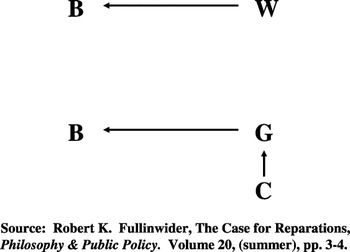
From this perspective, citizens—White, Black, Brown, Red, or Yellow—are not considered the victimizers of African Americans. The responsibility for Black oppression is corporate and lies with the state—the government of the United States. As Fullinwider argues, the usual framing of responsibility for reparations is not correct. It is wrong to construct the responsibility as that of one group to another, or more specifically as Whites (and perhaps Others) to Blacks. This framing is fraught with problems. Some Blacks owned slaves, many Whites are the descendants of immigrants who arrived in the United States after the end of slavery (even if very few arrived after the end of the system of state apartheid known as Jim Crow), many Whites today, and some in the past, found the system of both slavery and Jim Crow immoral. This incorrect relationship is captured in Figure 1 by the arrow leading from “W”(hites) to “B”(lacks). The correct way to view the relationship, according to Fullinwider is to note that citizens have an obligation to the state, and the state which authorized and enforced Black subordination well into the 1960s has an obligation to Blacks. Thus all of us, regardless of race or ethnicity, as citizens of the state have an obligation to the corporate entity, the government which in turn has an obligation to Blacks. This relationship is captured in Figure 1 by the arrow running from “C”(itizens) to “G”(overnment), and the arrow running from “G”(overnment) to “B”(lacks).

Models of liability for slavery.
It is critical to recognize that proponents of reparations argue that the moral liability lies with the government of the United States. Only by formally acknowledging that a great wrong has occurred and needs to be redressed can the moral stain on the nation be put to rest. According to this line of argumentation, both an apology on behalf of the government of the United States as well as material reparations are warranted. These proponents often go on to argue that the whole nation stands to benefit because a complete democracy can be achieved only when these steps are taken.28
Kelley.
If … African Americans will not be compensated for the massive wrongs and social injuries inflicted upon them by their government, during and after slavery, then there is no chance that America can solve its racial problems—if solving these problems means, as I believe it must, closing the yawning economic gap between Blacks and whites in this country. The gap was opened by the 246-year practice of slavery. It has been resolutely nurtured since in law and public behavior. It has now ossified. It is structural. Its framing beams are disguised only the counterfeit manners of a hypocritical governing class.29
Robinson 204.
There is concern that the reparations movement be democratic and inclusive. The lack of attention to gender issue has been singled out in particular as one area of concern.30
Kelley.
Kelley.
Third, modern reparations activists, such as those involved in the N'COBRA (National Coalition of Blacks for Reparations in America) organization, emphasize the international character of support and need for reparations.32
Kelley.
Robinson 219.
For all of the above reasons, historical, philosophical, moral and international, reparations activists believe that they have established a strong case for restitution and redress. Just as strongly, opponents of reparations have fiercely argued that even the idea of reparations is unjustified, dangerous, and immoral.
THE CASE AGAINST REPARATIONS
Conservative commentators such as political scientist Carol Swain, social commentator Dnesh D'Souza, and anti-reparations activist David Horowitz offer several arguments against the demand for reparations. First and fundamentally, Blacks are not owed anything by the government or people of the United States. D'Souza's view is fairly typical:
What do Americans today owe Blacks because of slavery? The answer is: probably nothing. If there is a social debt, it is to the slaves, and the slaves are dead. It makes little sense to say that the United States has an obligation to place African Americans in the economic and social position they would occupy “but for slavery”, since “but for” slavery they would probably be worse off in Africa.34
Dinesh D'Souza, The End of Racism (New York: The Free Press, 1995) 113.
Several points should be noted. First, D'Souza only talks about slavery. He is silent about what obligations are owed, if any, because of the century of apartheid that followed the ending of slavery. Second, consistent with the views of many conservative commentators, Blacks are better off being brought here as slaves, rather than being left in Africa. He goes on to argue that reparations are not warranted since some Blacks owned slaves, many slaves were sold into slavery by their fellow Africans, and the blood price was paid by Whites, who freed the slaves by fighting during the Civil War.
Carol Swain in a more recent work agrees with D'Souza that Blacks are better off in the United States. Unlike D'Souza, however, she grounds her belief in biblical faith:
Given the conditions in most African countries, the sale and transport of Black slaves to America has all the hallmarks of what and older interpretive tradition called providence (Swain 448).35
Carol M. Swain, The New White Nationalism in America: It's Challenge to Integration (Cambridge: Cambridge University Press, 2002) 338–449.
Drawing a parallel to the biblical tale of the Egyptian bondage, Swain continues that [there is] “an underlying divine plan.” By our ancestors being transported to this country we can now “help their African brethren.”36
Swain.
Swain, however, extends the argument against reparations. The central theme of her book is that there is a rise in White nationalism that is dangerous to the republic. Seven specific factors contribute to the rise of White nationalism. These factors include the rise in non-White immigration, which “threatens” to reduce Whites to a minority in many parts of the country. Second, is the process of the economic globalization, which forces poor Whites into competition with immigrants for low-end jobs. Third, also stimulating white resentment are race-based programs of “questionable constitutionality.” Fourth, is the “high Black-on-White” crime rates. Swain's fifth cause for the rise in White racism—or, as she puts it, “White nationalism”—is the phenomenon of multiculturalism which she sees as promoting “ethnic group pride and identity.” The sixth factor is the rising expectations of People of Color (they don't know their place). The seventh, and final, cause on Swain's list of horrors is the growth of the Internet and the ease with which it facilitates political mobilization and networking.37
Swain.
Due to her worries about these issues, Swain devotes enormous energy and space to attacking not only the activists who support reparations, but also the entire reparations discourse itself. She boldly states:
Talk about reparations at the present time is ill-advised and can be positively harmful in terms of improving race relations and garnering support for policies to help the truly distressed. Current reparations talk inflames the white electorate, undermines the bridge-building process across racial lines, fuels white nationalist sentiments, and is insufficiently targeted in its aims to help those members of minority groups who are most in need. Sowell here is undoubtedly correct when he says that the whole matter should be dropped.38
Swain 181.
Thomas Sowell is correct, Swain states, when he argues that there are more fruitful areas for reform than the quest for reparations. The problem with the reparations debate, according to both, is that it is being promoted by venal Black politicians who are selfishly pursing a “sham” agenda for their own political and electoral interests.
Swain asserts that all Whites cannot be held accountable for America's history of slavery. Her full argument contains the following points: there is no single group responsible for the crime of slavery and no single group benefited from its fruits; only a tiny minority of White Americans ever owned slaves and many others gave their lives to free the slaves; finally, most Americans today have neither a direct nor an indirect tie to slavery. Correspondingly, Swain argues that it is false to believe that all Black descendants of slaves have suffered economic harm due to slavery and discrimination. Claims for reparations simply serve to damage African Americans by consigning them all to the status of victim. Furthermore, if reparations are indeed owed to Blacks, they are already paid to them in the form of welfare and affirmative action. Swain suggests that instead one should inquire about the debt that Blacks owe America. Finally, she sees the demand for reparations as a separatist demand. Advocated by Black nationalists and the left, it hurts all Americans, particularly Blacks because it sets Blacks “against the nation that gave them freedom.”39
Swain 473.
Therefore, what should we do at this stage of the reparations debate? Swain is unequivocal:
End all discussions and all demands for racial reparations for Black slavery, since the continued presentation of this issue alienates potential allies of African Americans and contributes to a worsening racial climate, given white America's long expressed anger at racial preference programs.40
Swain 447.
Arguably the most visible and one of the most vociferous of the anti-reparations commentators is David Horowitz who launched a campaign in 2001 to place a strongly worded anti-reparations ad in seventy college newspapers. Besides listing “The Ten Reasons Why Reparations for Blacks? is a Bad Idea for Blacks—and Racist Too,” this ad triggered a firestorm of protest across many college campuses and in the media. Many of the ten “reasons” were similar to those already advanced by other conservative opponents such as Swain and D'Souza. Two of Horowitz's claims, however, deserve more attention. One is that Blacks are in debt to America. Distinguishing between the period that the English Crown ruled the slave territories and the period of “78 years” during which the U.S. sanctioned slavery, Horowitz argues that the U.S. did not start slavery, but in fact ended it for American Blacks. He asserts that the U.S. created a nation where Blacks thrive as nowhere else. (Not included in his calculations of when Blacks suffered harm is the period of Jim Crow.) Horowitz concludes by asking, “Where is the gratitude of Black America and its leaders for those gifts?”41
David Horowitz, “Ten Reasons Why Reparations for Blacks is a Bad Idea for Blacks—and Racist, Too,” http://www.adversity.net/reparations/anti_reparations_ad.htm, (posted 3 October 2001).
William H. Chafe, ed., Remembering Jim Crow: African Americans Tell About life in the Segregated South (New York: The New Press, 2001); Dalton Conley, Being Black, Living in the Red: Race, Wealth, and Social Policy in America (Berkeley: The University of California Press, 1999); Joe R. Feagin, Racist America: Roots, Current Realities, and Future Reparation (New York: Routledge, 2000); Melvin L. Oliver and Thomas M. Shapiro Black Wealth/White Wealth: A New Perspective on Racial Inequality (New York: Routledge, 1995).
Most controversial, perhaps, is the claim that African American support for reparations is evidence in and of itself of hostility toward Whites, and of anti-Americanism as well. The reparations movement “is one more assault on America, conducted by racial separatists and the political left.”43
Horowitz 2001.
David Horowitz, “Uncivil Wars: Alan Dershowitz's Capitulation to the Racial Left,” http://www.FrontPageMagazine.com (posted 7 June 2002) 5.
Conservatives are not alone in making arguments such as those of D'Souza, Swain, and Horowitz. The predominantly White wing of the Left also has grave misgivings about the appropriateness of and potential harm from a movement for reparations. Many commentators from this sector of the Left such as Todd Gitlin see race as a generally troublesome issue that divides the progressive movement. Reparations, then, is viewed as particularly dangerous.
How well have the supporters and opponents of reparations fared in the marketplace of contemporary public opinion? In the next section we will use survey data to build a more nuanced portrait of contemporary support for and opposition to reparations.
BLACK AND WHITE SUPPORT FOR REPARATIONS
Data
The data are from the W. E. B. Du Bois Institute at Harvard and the Center for the Study of Race, Politics, and Culture at the University of Chicago National African American Election Study. The Pre-election survey was composed of 831 Blacks and was conducted in October of 2000, the Post-election survey was conducted December 1 through 15, and includes 605 Black adults and 724 White adults. The data for Blacks are drawn from the pre-election panel, those for Whites from the post-election study. The principle investigators were Lawrence Bobo of Harvard University and Michael Dawson of the University of Chicago.45
See the Appendix for more information on the study design.
Both the program and documentation, as well as that for the Clarify program discussed later, can be downloaded from King's website: http://gking.harvard.edu/stats.shtml.
Results
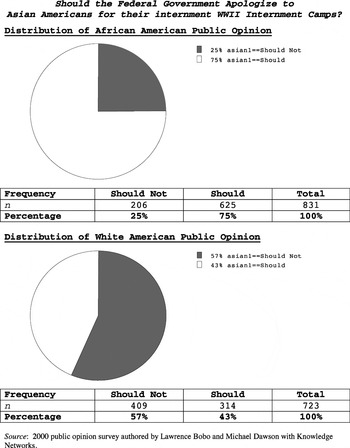
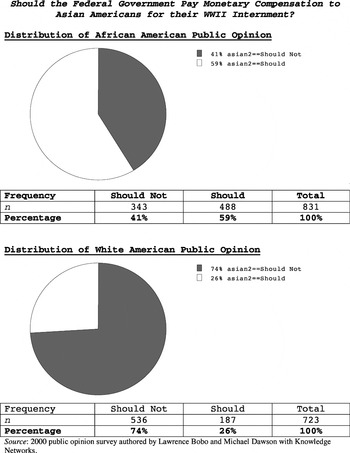
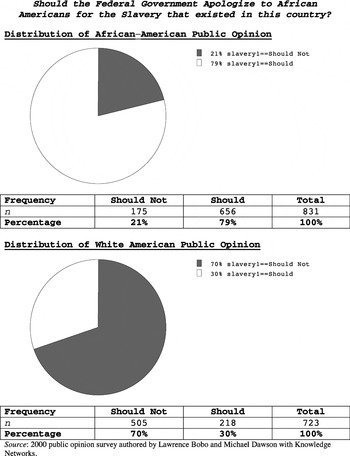
Let us begin with an examination of the marginals. Four sets of responses are considered. First, a distinction was made in the survey instrumentation between reparations and apologies for African Americans and reparations and apologies for Japanese Americans due to their internment in camps during World War II. Second, as implied above, questions were asked about whether the federal government should apologize to either group (for slavery or internment respectively), as well as about whether either group should have been granted monetary reparations. Figures 2, 3, 4, and 5 display the responses of Blacks and Whites to these questions.

Support for apology for Japanese Americans.

Support for reparations for Japanese Americans.

Support for apology for African Americans.

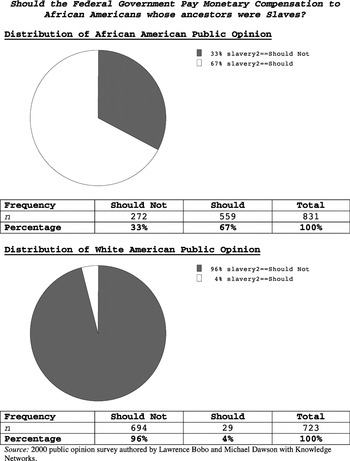
Support for reparations for African Americans.
One general comment is warranted before more detailed analyses are attempted, namely, that the size of the gaps in responses between Blacks and Whites is about as large as one is likely to see in American public opinion surveys. A very large majority of Blacks support a government apology to Japanese Americans while only a minority of Whites support an apology. A reduced, though still sizeable, majority of Blacks support monetary reparations for Second World War internment while only a small minority of Whites do. When we shift to considering Blacks, the overall picture remains the same, but the gaps grow to truly enormous proportions. A very large majority of Blacks, approximately four out of five, support an apology from the state to African Americans. Only a small minority of Whites, considerably fewer than those who supported an apology to Japanese Americans, believes that an apology should be forthcoming to Blacks. While this gap is very large, approximately 40 percentage points, it is overwhelmed by the gap when we consider reparations for Blacks. While a reasonably substantial two-thirds of Blacks support reparations for Blacks, a miniscule 4 percent of Whites do for a gap of 63 percent! This is an enormous difference in how Blacks and Whites perceive the politics of race at the beginning of the 21st century.
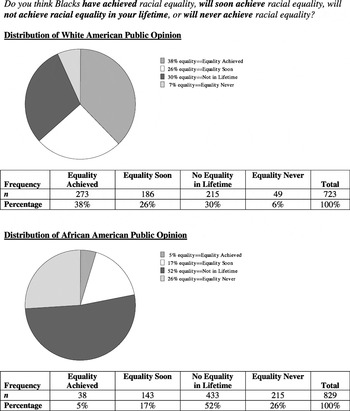
This gap is reflected, however, in the difference that Blacks and Whites perceive in whether Blacks have either achieved, or will soon achieve, racial equality. Black and White perceptions of the likelihood of racial equality for Blacks are displayed in Figure 6. A majority of Whites—60 percent—believe Blacks have either achieved, or will soon achieve, racial equality. An even stronger majority, over three-quarters of Blacks, believe the opposite—that Blacks will either not achieve racial equality during their lifetimes, or not at all within the United States. The disparities in perceptions about the state of racial equality in the United States begin to give us some understanding of the even larger differences in Black and White support for reparations.

Perceptions of African-American racial equality.
Models of Support for Reparations
What are the factors leading to such large differences between Blacks and Whites on their views on the desirability of racial apologies and reparations? Some trends are fairly clear in the following results.47
The estimates in the following tables are from probit regressions. We estimate the effect of the independent variables on support for apologies and monetary reparations after controlling for other variables. The raw (and generally uninterpretable) probit coefficients are translated into probabilities using Gary King's program Clarify program. See above for a reference for both documentation and a link to the software.
Black Support
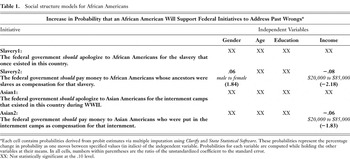
We start by reporting the results of Black attitudes toward reparations and a government apology. Table 1 displays the results from a simple model based on the social locations of the Black respondents. In general, this set of predictors provides little leverage for predicting Black attitudes on reparations and an apology. Nevertheless, men and the affluent are less likely to support monetary reparations for Blacks, and the affluent less so for Japanese American victims of the internment camps. Neither Age nor Education had predictive power.
Social structure models for African Americans

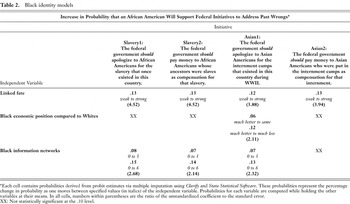
The second model is based on components of African American social embededness and identity. The following variables are used in the Black identity model: Linked Fate: do you believe that your own fate is tied to that of the race? This variable is highly predictive of a broad range of Black political attitudes and ideological orientations.48
Michael C. Dawson, Behind the Mule: Race and Class in African-American Politics (Princeton: Princeton University Press, 1994). Dawson 2001.
Dawson 1994; J. C. Turner, Rediscovery of the Social Group: A Self-Categorization Theory (London: Basil Blackwell, 1987).
Black identity models

We see that perceptions that one's fate is linked to race moderately increases the probability of support for Black and Japanese apologies and reparations. Perceptions of White economic dominance change only the level of support for an apology to Japanese Americans. Exposure to Black Information networks is a pervasive effect in increasing support. Overall, this model performs somewhat better than the social location model.
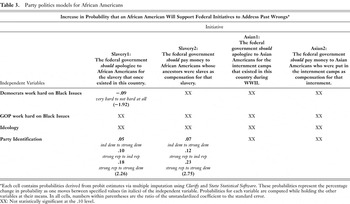
Next, we consider whether African American attitudes toward reparations are shaped by perceptions of the two major political parties. The key variables in addition to the standard ideology and party identification variables are two variables which assess the degree to which Democrats and Republicans work hard on issues of importance to African Americans. The results are displayed in Table 3. Generally, the party politics variables weakly affect Black attitudes toward reparations. The most noticeable exception is that Black Republicans are much more likely to oppose apologies and reparations for Blacks than Black Democrats.
Party politics models for African Americans

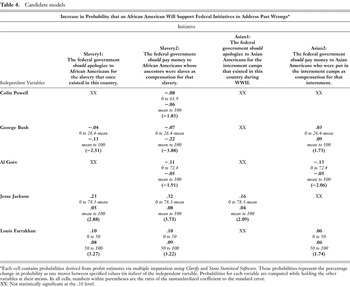
While political parties do not strongly shape Black attitudes toward reparations, what about Black attitudes toward major national political leaders? Black affective feelings toward a range of Black and White political leaders are used to predict support for reparations. We measure support for public figures on a scale of 1–100 with “1” designating coldness toward a leader, “50” neutral, and “100”, very warm feelings. Table 4 displays the results.
Candidate models

Secretary of State Powell's supporters are less likely to support monetary reparations for Blacks.51
We originally included Al Sharpton in this model, however the high correlation between support for Sharpton and Minister Farrakhan distorted the results. When run separately, the results for the two leaders were extremely similar.
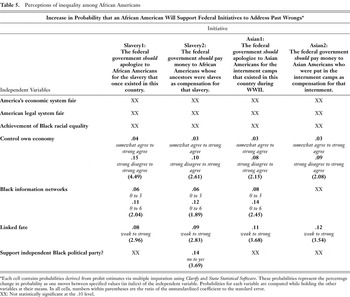
Our intuition would also lead us to predict that Blacks' perceptions of race, inequality, and the fairness of life in America would directly shape support for reparations (see Table 5). The fairness items have no effect on any of the apology or reparations items. Included as control variables, one's perceived attachment to the race and embeddedness within Black information networks reveal themselves as key predictors. Most impressively, support for community control of the economy strengthens support for all of the items. Support for an independent Black political party very strongly increases support for monetary reparations for Blacks, but does not have an effect on the other items. Within this model, the strongest predictor of support for Black and Japanese Americans receiving apologies and reparations is support for institutionalized Black autonomy.
Perceptions of inequality among African Americans

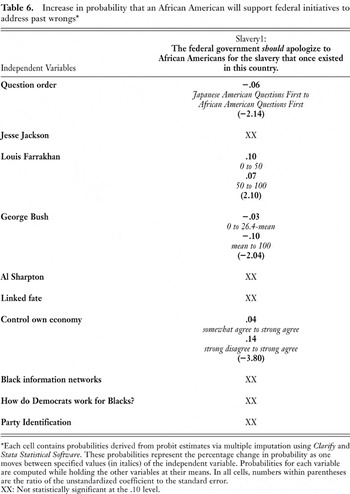
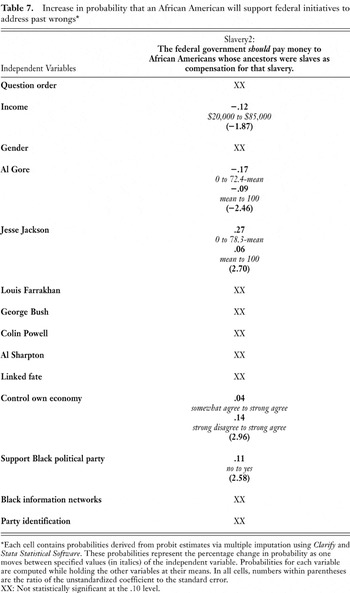
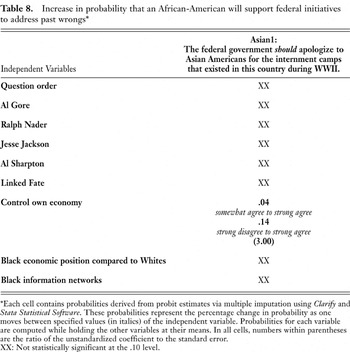
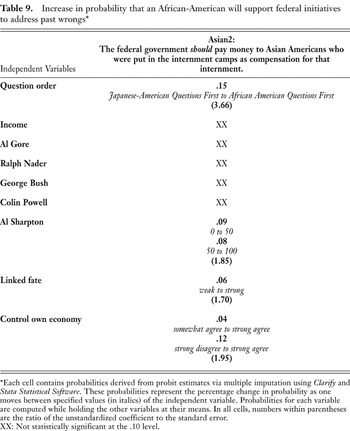
When these models are combined, what factors best predict Black support for reparations? The results are displayed in Tables 6, 7, 8, and 9. The most consistent, and often the most powerful variable is belief in community control of the economy of Black communities. This predictor shapes Blacks' views of reparations and apologies across all cases. The candidate support items have sporadic effect on views toward reparations. Where significant, the signs run in the same direction as before. Support for mainstream party politicians lowers support for reparations, while support for Blacks outside the mainstream strengthens support. This set of variables overwhelms political party evaluations, status indicators, and the Black identity variables. Rotating the order of whether the Japanese American or African American questions first has inconsistent and sporadic effects on support for reparations among African Americans. Overall, these results suggest that for Blacks, support for institutionalized Black political and economic control is the best predictor of support for reparations.
Increase in probability that an African American will support federal initiatives to address past wrongs*

Increase in probability that an African American will support federal initiatives to address past wrongs*

Increase in probability that an African-American will support federal initiatives to address past wrongs*

Increase in probability that an African-American will support federal initiatives to address past wrongs*

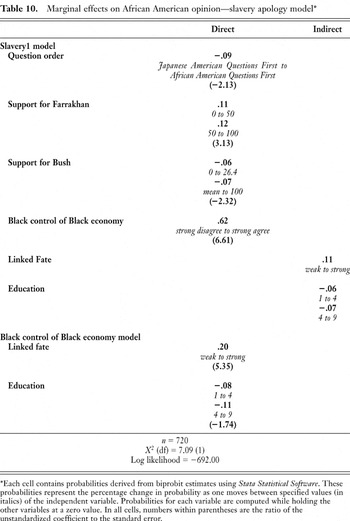
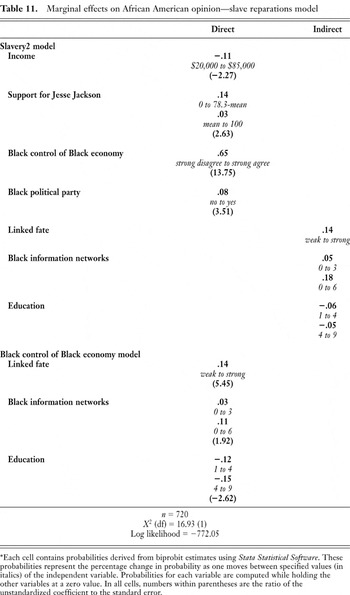
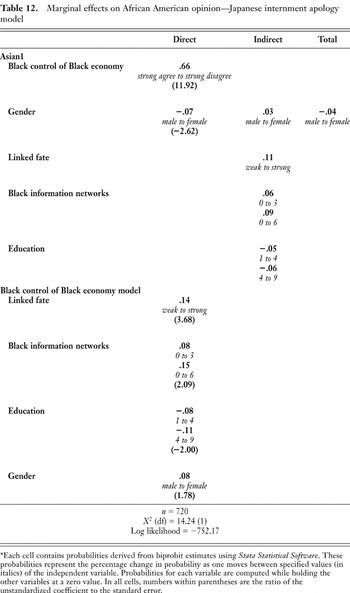
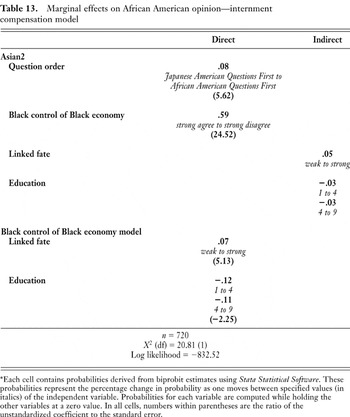
A reasonable question to ask is: Does the support for Black community control of the economy cause greater support for reparations, or does support for reparations lead to the view that Blacks need to control their communities' economies. We estimated a bivariate probit model to determine the possibility of reciprocal causation between views on reparations and an apology for slavery on one hand, and Black community control on the other. The results are displayed in Tables 10, 11, 12, and 13.52
William H. Greene, Econometric Analysis, 4th Edition (Upper Saddle River: Prentice-Hall, 2000) 19. Greene, chapter 19, offers a good review on the bivariate probit model as well as the procedures used to calculate the direct and indirect effects.
Marginal effects on African American opinion—slavery apology model*

Marginal effects on African American opinion—slave reparations model

Marginal effects on African American opinion—Japanese internment apology model

Marginal effects on African American opinion—internment compensation model

There is further information that can be gained from the two-equation models factoring in community control. We see the modest re-emergence of status and identity variables in these models through indirect effects. Since believing that one's fate is linked to the race leads directly to greater support for Black community control, this belief indirectly leads to greater support for apologies and reparations as well. Largely insignificant in earlier models, education emerges as a weak but persistent indirect determinant. Higher levels of education lead to diminished support for community control. Indirectly, education continues as a negative predictor of support for both reparations and apologies. Still, the single most important determinant (at least within these four models) of Black support for the proposed initiatives is clearly whether one supports Black economic control. The overall story remains the same: Black support for reparations and apologies is built primarily on support for institutionalized Black political power. Next, we turn to white opposition to reparations and apologies.
White Opposition
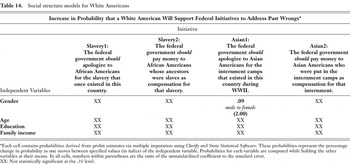
Among Whites, we should find few predictors of support for Black monetary reparations; moreover, the extraordinary lack of variation actually makes the probit and most other statistical model problematic—and good alternatives are lacking. We start as with Blacks with the social structure model; the results of which are displayed in Table 14. Social location has virtually no impact on White opposition to apologies and reparations although White women are slightly more supportive of an apology to Japanese Americans for WWII interment than White men. Affluence and education on at least this racial issue do not lead to more “liberal” views.
Social structure models for White Americans

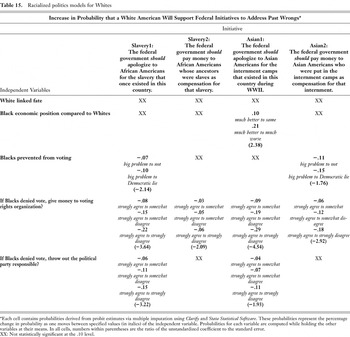
A racialized politics model, displayed in Table 15, shows that views about the politics of race do indeed shape Whites' attitudes toward reparations and slavery. The White equivalents of the Black identity variables have little impact in shaping White attitudes on reparations, although the economic comparison has some impact on views on an apology to Japanese Americans (which is also the item with the most variation among the models). The real payoff, however, comes with Whites' views of the 2000 election. If you thought that the accounts of voter disenfranchisement in 2000 were a Democratic lie, you were even more likely to oppose everything. The same holds for Whites who did not want to give money to voting rights organizations even if Blacks had been denied the vote. The same pattern is also seen for those who believed that Blacks had been denied the vote, but who didn't think that the party responsible for the denial should be thrown out. This effect, however, is only related to the apology items. Political hostility to the claims of Black disenfranchisement is critical for predicting White resistance to both reparations and apologies to Blacks and Japanese Americans alike.
Racialized politics models for Whites

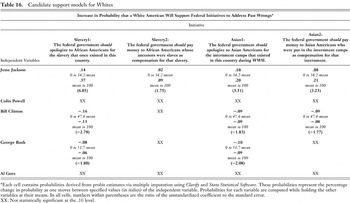
Table 16 displays the results regarding how White attitudes about various political leaders shape their views of reparations and apologies. What we find is a pattern remarkably similar to that for Blacks. Support for Jackson increases support for all items across the board. Gore and Powell have no significant effects. Support for Clinton and Bush increases opposition to both apologies and Japanese American reparations. Clinton supporters, if anything, are more hostile than even Bush supporters. The real dividing line, however, is along support for Jackson. The politics of racial ideology trumps all other considerations.
Candidate support models for Whites

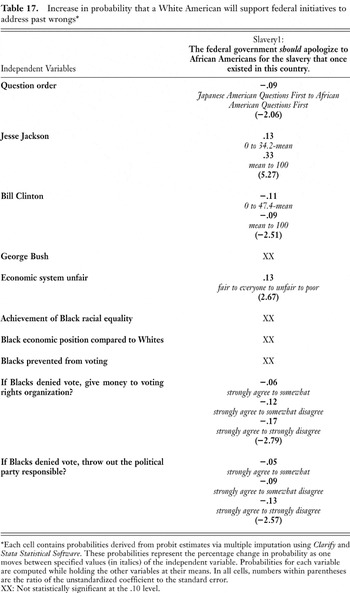
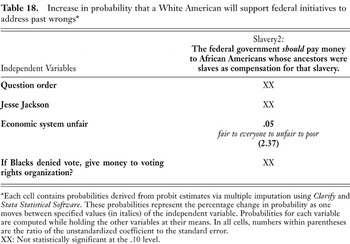
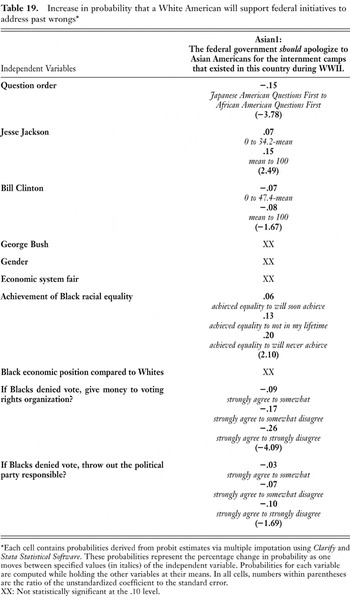
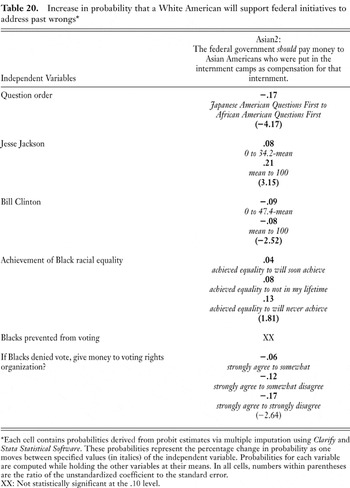
What happens in a combined model of opposition to reparations and apologies? The results are displayed in Tables 17, 18, 19, and 20. The results are revealing for all but the Black monetary reparations model (where the extreme lack of variance takes its toll). Very similar to the models for African American respondents, the racialized politics variables (albeit a different set for Whites than Blacks) and the candidate support items are consistent predictors of White opposition to apologies and reparations. Further, unlike with Blacks, asking the question about Blacks first consistently lowers the probability for Whites supporting either reparations or an apology for Japanese Americans.
Increase in probability that a White American will support federal initiatives to address past wrongs*

Increase in probability that a White American will support federal initiatives to address past wrongs*

Increase in probability that a White American will support federal initiatives to address past wrongs*

Increase in probability that a White American will support federal initiatives to address past wrongs*

Different factors influence Black support and White opposition to reparations and apologies. The overall pattern, however, remains remarkably similar: Americans' views of politics are highly racialized. Not only do these racialized views of politics powerfully shape support for reparations, it also trumps social background, political ideology, and partisanship as causal factors.
CONCLUSION
A friend of ours found the following item while reading a neighborhood Boston newspaper during October of 2002:
“Debating Reparations for Slavery” Thursday, October 10. Lecture and discussion featuring journalist James Hirsch, and professors Glenn Loury and Melissa Nobles. Old South Meeting House, 310 Washington Street. 6:30 p.m. Free, 373-5800.
Reparations is an issue that will not go away. This issue has left Black-activist, political, and academic circles, and entered the realm of the New York Times and major regional newspapers such as the Boston Globe and the Chicago Tribune, and is even beginning to seep into local consciousness. Reparations also present a debate that threatens great racial rancor. The polarization around reparations is intense, and while there might be room for the emergence of a hard-fought consensus on the need for an apology to Peoples of Color for state-sponsored, heinous acts of the past, it is absolutely clear that at least between Blacks and Whites, no common ground exists regarding reparations. Whites refuse to support reparations to either Blacks or Japanese Americans and are chillingly united when it comes to Blacks. Blacks nearly as strongly support monetary reparations for both Blacks and Japanese Americans. For many Whites, reparations is a question of Black greed. For Blacks, it is a question of justice.
Abigail Thernstrom has labeled one of the authors, and colleagues such as Larry Bobo, as part of the “doom and gloom” industry. But in many ways we are actually optimists. Some Black nationalists would label such optimism naïve and hopelessly misguided. We support the project that Lani Guinier and Gerald Torres outline in their new book, The Miner's Canary, Enlisting Race, Resisting Power, Transforming Democracy, to use struggles for racial justice to enhance and strengthen American democracy. Similarly, we agree with Robin Kelley when he argues in Freedom Dreams: The Black Radical Imagination, that race can be enlisted to engender a debate not only about racial justice, but also about the dreams of democracy and equality that all Americans pursue. For those dreams to be realized, America will soon have to grow up and learn how to discuss matters of race. The White Left, along with the rest of the nation, will have to come to acknowledge that, for over a century, ignoring issues marked by racial division—issues such as reparations and apologies for slavery—has delayed our democratic development. Such ignorance has no place in our future. The alternative, as Dr. King lamented, is to have racial injustice continue to be a cancer that eats at the moral fabric of the nation.
APPENDIX
The data were collected by Knowledge Networks. The sampling error for the Black sample is approximately 4.0 percentage points, and the sampling error for the White sample is approximately 3.6 percentage points. When comparing the two samples, the sampling error is approximately plus or minus 5.4 percentage points. Sampling error is only one form of potential error in public opinion surveys. The data were collected using a Random Digit Dialing (RRD) telephone methodology to develop a representative sample of households for participation in its panel. This form of selection makes it possible to reach every American household with a telephone. Knowledge Networks employs a complex sample stratification design that incorporates the known probabilities of selection associated with geographical location, the number of phone lines, and whether or not the phone number is listed. Once a Knowledge Networks household is selected, members are contacted first by an express delivery mailing and then by telephone for enrollment in the Knowledge NetworksTM panel. The panel structure enables clients to conduct surveys of low-incidence populations. The panel on both demographic and attitudinal dimensions appears to be very similar to one that would be generated by traditional CATI methods such as the 1993–1994 National Black Politics Study for which Ron Brown and I were the Principal Investigators.
References
REFERENCES
Allen, Robert L.
(1998)
Past due: The African American quest for reparations.
Black Scholar,
21:
2–17.Google Scholar
Arnesen, Eric
(1994)
‘Like Banquo's Ghost, It Will Not Down’: The race
question & the american railroad brotherhoods, 1880–1920.
American Historical Review,
99:
1601–1633.Google Scholar
Black Panther Party
(2003).
Black Panther Party for Self-Defense 10 Point Program and Platform.
Pacifica Radio/UC Berkeley Social Activism Sound Recording Project:
http://www.lib.berkeley.edu/MRC/panthers10pt.html, (last
visited Dec. 17, 2003).
Chafe, William H. (ed.)
(2001).
Remembering Jim Crow: African Americans Tell About Life in the
Segregated South.
New York:
The New Press.
Conley, Dalton
(1999).
Being Black, Living in the Red: Race, Wealth, and Social Policy in
America.
Berkeley:
The University of California Press.
Dawson, Michael C.
(1994).
Behind the Mule: Race and Class in African-American Politics.
Princeton:
Princeton University Press.
Dawson, Michael C.
(2001).
Black Visions: The Roots of Contemporary African-American Political
Ideologies.
Chicago:
The University of Chicago Press.
D'Souza, Dinesh
(1995).
The End of Racism.
New York:
The Free Press.
Ellis, Joseph J.
(2001).
Founding Brothers: The Revolutionary Generation.
New York:
Alfred Knopf.
Feagin, Joe R.
(2000).
Racist America: Roots, Current Realities, and Future Reparations.
New York:
Routledge.
Finkelman, Paul
(2001).
Slavery and the Founders: Race and Liberty in the Age of the
Jefferson, Second Edition.
Armonk, NY:
M.E. Sharpe, Inc.
Foner, Eric
(1988).
Reconstruction: America's Unfinished Revolution,
1863–1877.
New York:
Harper & Row.
Fullinwider, Robert K.
(2000)
The Case for Reparations.
Philosophy and Public Policy,
20:
1–8.Google Scholar
Greene, William H.
(2000).
Econometric Analysis: Fourth Edition.
Upper Saddle River:
Prentice-Hall.
Horowitz, David
(2001).
“Ten Reasons Why Reparations for Blacks is a Bad Idea for
Blacks—and Racist, Too,”
http://www.adversity.net/reparations/anti_reparations_ad.htm,
(posted 3 October 2001).
Horowitz, David
(2002).
“Uncivil Wars: Alan Dershowitz's Capitulation to the Racial
Left,”
http://www.FrontPageMagazine.com (posted 7 June 2002)
5.
Kelley, Robin D. G.
(2002).
Freedom Dreams: The Black Radical Imagination.
Boston:
Beacon Press.
King, Martin Luther, Jr.
(1986 [1963]).
I Have a Dream. In
James M. Washington (Ed.),
A Testament of Hope: The Essential Writings and Speeches of Martin
Luther King, Jr., pp.
217–220.
San Francisco:
Harper & Row.
Magdol, Edward
(1977).
A Right to the Land: Essays on the Freedmen's Community.
Westport:
Greenwood Press.
Oliver, Melvin L. and
Thomas M. Shapiro
(1995).
Black Wealth/White Wealth: A New Perspective on Racial
Inequality.
New York:
Routledge.
Robinson, Randall
(2000).
The Debt: What America Owes to Blacks.
New York:
Dutton.
Rose, Willie Lee
(1976).
Rehearsal for Reconstruction: The Port Royal Experiment.
London:
Oxford University Press.
Saville, Julie
(1994).
The Work of Reconstruction: From Slave to Wage Laborer in South
Carolina, 1860–1870.
Cambridge, UK:
Cambridge University Press.
Swain, Carol M.
(2002).
The New White Nationalism in America: Its Challenge to Integration.
Cambridge:
Cambridge University Press.
Williamson, Joel
(1969).
After Slavery: The Negro in South Carolina During Reconstruction,
1861–1887.
Chapel Hill:
University of North Carolina Press.
Models of liability for slavery.
Support for apology for Japanese Americans.
Support for reparations for Japanese Americans.
Support for apology for African Americans.
Support for reparations for African Americans.
Perceptions of African-American racial equality.
Social structure models for African Americans
Black identity models
Party politics models for African Americans
Candidate models
Perceptions of inequality among African Americans
Increase in probability that an African American will support federal initiatives to address past wrongs*
Increase in probability that an African American will support federal initiatives to address past wrongs*
Increase in probability that an African-American will support federal initiatives to address past wrongs*
Increase in probability that an African-American will support federal initiatives to address past wrongs*
Marginal effects on African American opinion—slavery apology model*
Marginal effects on African American opinion—slave reparations model
Marginal effects on African American opinion—Japanese internment apology model
Marginal effects on African American opinion—internment compensation model
Social structure models for White Americans
Racialized politics models for Whites
Candidate support models for Whites
Increase in probability that a White American will support federal initiatives to address past wrongs*
Increase in probability that a White American will support federal initiatives to address past wrongs*
Increase in probability that a White American will support federal initiatives to address past wrongs*
Increase in probability that a White American will support federal initiatives to address past wrongs*
 You have
Access
- 63
- Cited by