Introduction
Bromacil was first commercialized in 1961. It is an uracil herbicide (photosystem II inhibitor) with PRE and early POST activity for control of annual and perennial grasses and broadleaf weeds. It is mostly used in citrus, pineapple [Ananas comosus (L.) Merr.], and noncultivated areas at doses ranging between 1.6 and 3.2 kg ai ha−1.
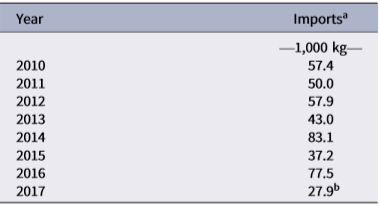
An estimated 25 kg ai ha−1 of pesticides are used yearly in pineapple plantations in Costa Rica (Bravo et al. 2013). Herbicides represent about 22% of those pesticides, of which almost a fourth was bromacil. Bromacil was also used to a lesser extent in citrus orchards. Importation in recent years was greater than 50,000 kg yr−1 (Table 1). Bromacil was banned in Costa Rica in 2017 because of contamination of water from agricultural use of the herbicide. Here we summarize incidents and circumstances leading to the banning of bromacil in Costa Rica.
Importation of bromacil in Costa Rica in recent years.

a Importation data provided by Instituto Regional de Estudios en Sustancias Tóxicas (IRET), Universidad Nacional, Costa Rica.
b Bromacil importation forbidden as of June 5, 2017.
Pineapple Production in Costa Rica
Commercial pineapple production for local consumption and production of pulps, jams, and canning in Costa Rica began in the 1970s (Pineapple Company 2019). Exports of the ‘Cayenna Lisa’ variety began in 1986, followed by ‘Champaka’, and from 2001, ‘MD-2’, a hybrid originally named 73-114 by the Pineapple Research Institute (CANAPEP 2019; Jiménez Díaz Reference Jiménez Díaz1999). Introduction of this new hybrid into the international markets started a new era of accelerated expansion of the crop area in tropical regions, beginning in Costa Rica and followed by some regions of Asia and, more recently, Africa. In 2018, pineapple was grown on 44,500 ha in Costa Rica, a substantial increase from the 9,900 ha planted in 1990; the main cropping areas being the northern (24,653 ha), Caribbean (11,188 ha), and Pacific (8,659 ha) regions (CANAPEP 2019). Since 2011, Costa Rica has been the leading world exporter of fresh pineapple with a FOB (free on board) value of US$989.6 million in 2018, which was just above that of bananas (Musa acuminata Colla) (US$980.4 million), greatly contributing to the rural economy of the country (Procomer 2019). In 2017, Costa Rica harvested 3.1 billion kg of ‘Gold’ (MD-2) pineapples, equivalent to 11.2% of pineapple world production, followed by the Philippines and Brazil (Shahbandeh Reference Shahbandeh2019). Costa Rica exclusively produces MD-2 pineapple, the Philippines grows mostly Cayenna Lisa for canning and less than 300 million kg of MD-2 for the international fresh market, and Brazil does not grow the hybrid.
Weed Control in Pineapple
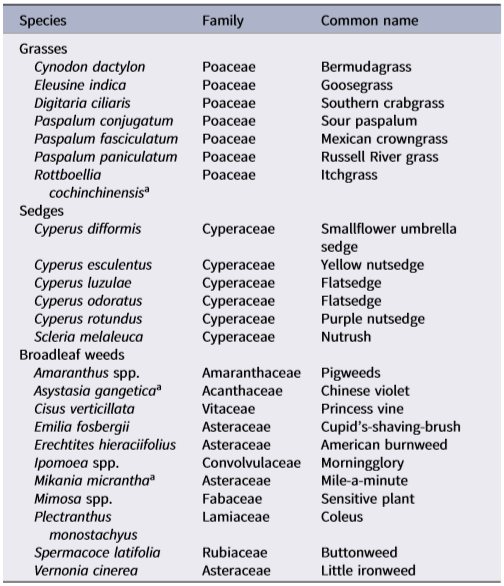
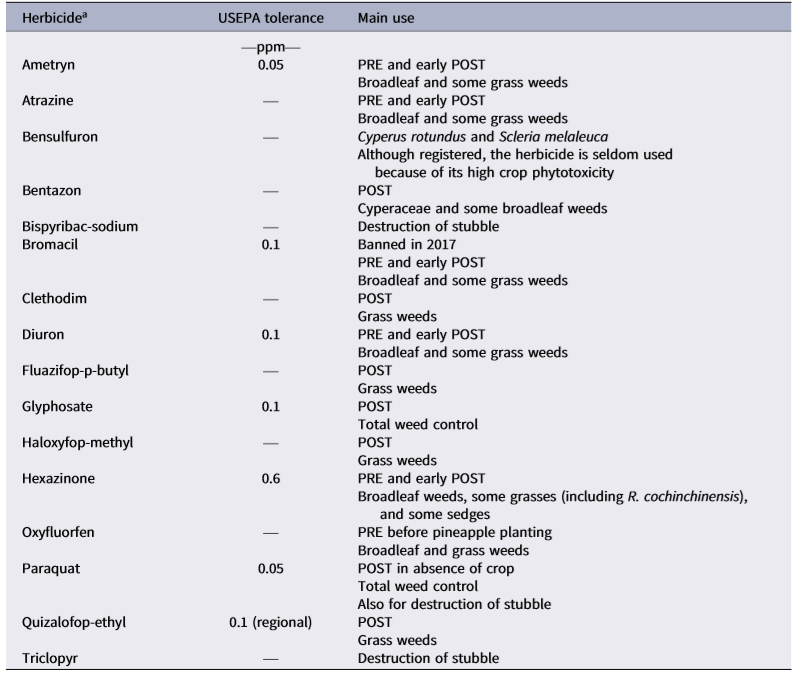
More than 160 species are recognized as weeds in pineapple production; more than 20 are of major importance (Table 2). As in any crop, they compete for valuable resources, including nutrients, water, and light. Pineapple is very vulnerable to weeds because of its slow growth, shallow root system, and poor competitive ability. Additionally, a few weed species of quarantine importance have drastic negative effects on the commercialization of the fruit; the presence of their propagules, particularly in the crown attached to the fruit, results in the rejection or even destruction of the entire shipment. This is the case for itchgrass [Rottboellia cochinchinensis (Lour.) W.D. Clayton], Chinese violet [Asystasia gangetica (L.) T. Anderson], and mile-a-minute (Mikania micrantha Kunth.). Seeds of oval-leaf false buttonweed (Spermacoce latifolia Aubl.) and spikelets of sugarcane (Saccharum officinarum L.) are often confused with those of winged false buttonweed [Spermacoce alata (Aubl.) DC.] and wild sugarcane (Saccharum spontaneum L.), respectively, both of quarantine importance. Cost of controlling weeds is second to that for dealing with insect pests and pathogens. Chemical control options are limited; only a few herbicides with established tolerances are registered for international trade (Table 3). Most herbicides registered for weed control are older chemicals also used in sugarcane or citrus. Market size, perceived risks, and difficulty in registering have limited registration of new products. Farmers usually integrate several tactics for weed management, including the application of nonselective herbicides aimed at depleting the soil seedbank, preplant and in-crop herbicides, manual weeding, and in some cases, crop rotation. The pineapple cropping cycle lasts about 24 mo: 13 and 11 mo for the plant (mother plant) and ratoon (sucker) crops, respectively. Herbicides are applied up to five times during the plant crop cycle and twice in the ratoon crop period. For more than 15 yr before its banning, bromacil was typically applied by farmers twice during this period, at the onset of either the plant or ratoon crop. It was a preferred herbicide for its efficacy in controlling a wide range of weeds and because pineapple could be planted only 4 d after application. No other residual herbicide registered for use in pineapple allows planting within fewer than 8 d after application.
Most important weeds of pineapple production in Costa Rica.

a R. cochinchinensis, A. gangetica, and M. micrantha are of quarantine importance.
Herbicides registered in Costa Rica for pineapple production and their tolerance according to the U.S. Environmental Protection Agency.

a Some herbicides are also commercialized in formulated mixtures, including diuron + ametryn, diuron + bromacil, diuron + hexazinone, and paraquat + diuron.
Environmental Fate of Bromacil
The behavior of a herbicide in the environment is greatly determined by its physical and chemical properties, the particular environment in which it is present (soil, water, air), as well as the hydrologic conditions of the area and climatic factors.
Bromacil is considered to be soluble (the solubility of its acid and lithium salt in water are 815 and 700 mg L−1, respectively) and soil mobile (log Kow 1.8 to 2.1). It is mostly absorbed by the roots, with slight foliar uptake. Bromacil kills plants by inhibiting electron transport in photosystem II (PSII). It is moderately persistent in soil and is nonvolatile. Bromacil can remain in the topsoil for several months after treatment depending on the dose applied, soil characteristics, and, especially, the amount of rainfall or irrigation, all determining the extent of its movement in the soil profile (Alavi et al. Reference Alavi, Sanda, Loo, Green and Ray2008). Bromacil is weakly adsorbed to soils; its adsorption is highly correlated with the soil organic matter content (Gerstl and Yaron Reference Gerstl and Yaron1983a). Soils with a low organic matter content adsorb only a limited proportion of bromacil that can be easily displaced by rainfall (Reddy et al. Reference Reddy, Singh and Alva1992). These characteristics make bromacil a potential surface and groundwater contaminant. Bromacil easily leaches in soil (Alva and Singh Reference Alva and Singh1991; Gerstl and Yaron Reference Gerstl and Yaron1983b). It was found to leach to a depth of 4 m after providing 110 cm of water in a field study; the amount of bromacil recovered from the soil profile after leaching was only a fraction of that applied, suggesting that degradation in the soil is an important factor determining the fate of the herbicide (Toiber-Yasur et al. Reference Toiber-Yasur, Rosner, Hadas, Russo and Yaron1999). Bromacil is degraded in soil following first-order kinetics at rates determined by temperature, moisture content, and soil type, with a half-life of 14 to 1,494 d (Gerstl and Yaron Reference Gerstl and Yaron1983a). The herbicide is highly downwardly mobile in sandy soil columns (Jhala and Singh Reference Jhala and Singh2017). Trace amounts of bromacil were detected in soil samples collected in Hawaii from as deep as 15.4 m (Zhu and Li Reference Zhu and Li2002).
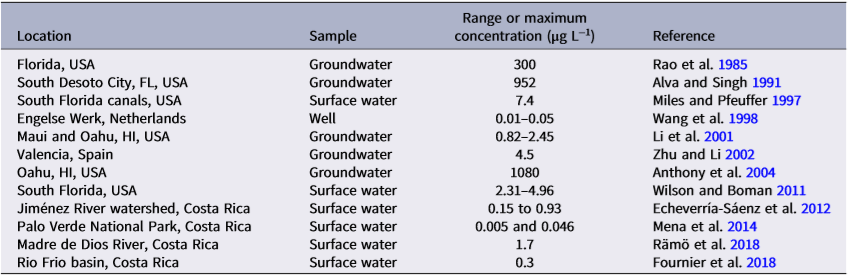
Bromacil has often been detected as an unintended contaminant of surface water bodies worldwide, frequently in relationship to use patterns in citrus and pineapple plantations (Table 4 and references therein). Bromacil, the most common pesticide found in groundwater in a 1999 to 2001 assessment in the island of Oahu, Hawaii, was present in 41% of tested public-supply wells at concentrations of up to 1.08 mg L−1 (Anthony et al. Reference Anthony, Hunt, Brasher, Miller and Tomlinson2004). Several reports associate bromacil groundwater contamination with its use in citrus in Florida (Table 4).
Selected reports of contamination of surface and groundwater by bromacil.

Bromacil is prevalent in groundwater once the herbicide reaches it. In a unique and nowadays impossible to replicate experiment (Gómez de Barreda et al. Reference Gómez de Barreda, Gamón Vila, Lorenzo Rueda, Saez Olmo, Gómez de Barreda, Garcia de la Cuadra, Ten and Peris1998), bromacil was deliberately introduced at a depth of 45 m into a 63-m irrigation well cutting through two gravel aquifers at 28- and 63-m depths, achieving a 190 µg L−1 concentration. Water samples were withdrawn at intervals up to 96 d after treatment to quantify bromacil. Bromacil concentration rapidly decreased to 12 and 1.4 µg L−1 at 8 and 96 d after application, respectively. In a replication of the experiment with an initial bromacil concentration of 10 µg L−1, bromacil also decreased rapidly to 0.5 µg L−1 at 8 d after treatment. Dissipation processes for bromacil were not reported, but the herbicide was more persistent than several triazines also included in the study, some of which were dealkylated.
Events Leading to the Banning of Bromacil in Costa Rica
Several studies in which surface water samples were collected in pineapple-growing areas, particularly in the Caribbean side of Costa Rica, reported the presence of bromacil as a contaminant (Castillo et al. Reference Castillo, Ruepert, Ugalde and Newman2009). Among 26 pesticides found in water samples collected between 2011 and 2012 from the Madre de Dios River that receives runoff water from agricultural areas where bananas, pineapple, and rice (Oryza sativa L.) are grown, bromacil (maximum concentration of 1.7 µg L−1) was identified as one of three herbicides (bromacil, ametryn, and diuron) posing moderate to high risk to aquatic primary producers given its PSII-inhibiting mode of action (Rämö et al. Reference Rämö, van den Brink, Ruepert, Castillo and Gunnarsson2018). Similarly, bromacil was one of three PSII herbicides found at a maximum concentration of 0.3 µg L−1 in water samples collected in the same years in the middle and lower sections of the Rio Frio basin (Fournier et al. Reference Fournier, Echeverría-Sáenz, Mena, Arias-Andrés, de la Cruz and Ruepert2018). Bromacil was also found at mean concentrations of 0.15 to 0.93 µg L−1 in the Jiménez River watershed at four sites impacted by nearby pineapple plantations (Echeverría-Sáenz et al. Reference Echeverría-Sáenz, Mena, Pinnock, Ruepert, Solano, de la Cruz, Campos, Sánchez-Avila, Lacorte and Barata2012) and at levels between 4.9 and 46.5 ng L−1 in surface water in the Palo Verde National Park area (Mena et al. Reference Mena, Fernandez San Juan, Campos, Sanchez-Avila, Faria, Pinnock, de la Cruz, Lacorte, Soares and Barata2014).
The Instituto Regional de Estudios en Sustancias Tóxicas (IRET), National University, analyzed pesticides in water springs and wells in the Caribbean region between 2002 and 2004 (Ruepert et al. Reference Ruepert, Castillo, Bravo and Fallas2005). One hundred sites were selected at which a single sample was collected. Sites where pesticides were found were resampled. Bromacil was found in two springs and six wells at concentrations between 0.5 and 20 μg L−1 (18 samples, including replicates). Contaminated wells (<0.1 and 3.5 μg bromacil L−1) supplied water for the aqueducts serving the Milano and El Cairo villages. A follow-up study with four bimonthly samplings found bromacil at 3.0 to 8.0 μg L−1 and 0.1 to 1.4 μg L−1 at the Milano and El Cairo springs, respectively (Sequeira Reference Sequeira2007).
Affected communities were informed, and the national press provided ample coverage of the findings. The communities became organized with the support of environmental groups demanding action to halt the contamination of water resources. Hydrogeological studies confirmed the vulnerability of the recharging zone of the Milano and El Cairo springs. The Water Institute (Instituto Nacional de Acueductos y Alcantarillados) and the Ministry of Heath advised residents not to drink water from faucets and began providing drinking water by truck to both communities in August 2007 at an estimated cost of US$27,000 mo−1.
Civil groups and organizations became involved at different levels. Members of the Permanent Special Commission on Environment from Congress visited the affected area to gather firsthand information about the conditions of the aqueducts and mitigation measurements in effect. Further action from the Ministry of Heath included prohibiting the use of bromacil in 2008 at specific pineapple farms located close to the aquifers serving the affected communities. Mitigation measures were also established to prevent spraying bromacil close to water bodies. This has been practiced elsewhere for the same purposes. Thus a buffer zone of 65 m is required in Canada between the point of direct application and the closest downwind edge of sensitive aquatic habitats, including lakes, rivers, sloughs, ponds, prairie potholes, creeks, marshes, streams, reservoirs, and wetlands (Schuler and Rand Reference Schuler and Rand2008). In central Florida, bromacil was withdrawn from citrus crops grown in vulnerable soils of the Ridge citrus region (Florida Department of Agriculture and Consumer Services 1995).
Seven years later, on March 20, 2015, the Inter-American Commission on Human Rights (IACHR) held a public hearing (Session 154) on the Right of Access to Water of Rural Communities in Costa Rica. The petitioners were the Centro de Derecho Ambiental y de los Recursos Naturales, the association in charge of the rural aqueduct of Milano, and the Frente Nacional de Sectores Afectados por la Producción Piñera under the advice of Emily Yozell, international human rights and environmental lawyer, and the International Human Rights Clinic of Santa Clara University, California. The State of Costa Rica was represented by authorities of the Water Institute. Petitioners alleged that the Costa Rican government was violating the right of residents of affected communities to clean water by ineffectively handling the pollution of water sources by pesticides and by not establishing the responsibility of pineapple growers for such damages. A video of the entire hearing is available at https://www.youtube.com/watch?v=32yxFaJHil0. These hearings, designed to provide an opportunity to establish dialogue among interested parties and to inform the IACHR and the international community about issues related to human rights, resulted in recommendations that are nonbinding.
Pressure on the authorities to withdraw bromacil from registration continued despite efforts from the government to alleviate the problems associated with the perceived risk of the presence of bromacil in sources of drinking water at levels well below those accepted elsewhere. The U.S. Environmental Protection Agency establishes a lifetime health advisory (i.e., the concentration of a chemical in drinking water that is not expected to cause any adverse noncarcinogenic effects for a lifetime of exposure) for bromacil of 70 µg L−1 (USEPA 2018). It is also known that bromacil rapidly degrades completely after water chlorination (Ibáñez et al. Reference Ibáñez, Sancho, Pozo and Hernández2011). A new aqueduct serving the affected communities began operation in 2017 at a cost of US$4.5 million.
Regulatory Action and Banning of Bromacil
The 2015 local standard for the quality of drinking water established maximum acceptable values of 0.1 µg L−1 and 0.5 µg L−1 for a single pesticide and for the sum of all pesticides present, respectively. This standard was further amended for the herbicides bromacil and diuron and the fungicide triadimephon to conform with requirements established by the Constitutional Court for “non-detectable by method.” Among considerations for the banning, the authorities took into account that pineapple is grown over a large area, in regions of elevated rainfall, making it likely that bromacil will contaminate aquifers even if used following good agricultural practices. They also considered that bromacil had been banned in Germany since 1993 because of its high soil persistence, leaching risk, and probability of surpassing the 0.1 μg L−1 limit in groundwater. Furthermore, the need to comply with the new standard resulted in the actual banning of this herbicide on June 5, 2017, by Executive Decree No. 40423-MAG-MINAE-S (MAG-MINAE-S 2017).
Concluding Remarks
Pineapple production is an economically important agricultural activity in Costa Rica. The crop is mostly grown in areas of heavy rainfall and with permeable soils that are prone to pesticide runoff and leaching. Because of its physical and chemical properties and use patterns, bromacil reached water sources as determined by several surveys but mostly at concentrations below limits internationally established for drinking water. Water contamination with bromacil, however, became a social and political issue. Well-organized social pressure and resolutions by the Constitutional Court, particularly the establishment of a “non-detectable by method” standard, finally forced the executive authorities to ban the herbicide. Pineapple farmers were left without one of their most useful herbicides among the few that are authorized for the crop. Additional studies conducted between 2015 and 2017 but disclosed after bromacil was banned also found the herbicide at concentrations of up to 7.6 μg L−1 in the pineapple area of the northern region (CICA 2015, 2016) (Supplementary Tables S1 and S2). Banning of bromacil appeared to be the only viable option to prevent it from reaching drinking water sources, although it is not uncommon to detect bromacil in water samples after the herbicide’s use has been halted (Ibáñez et al. Reference Ibáñez, Sancho, Pozo and Hernández2011).
Acknowledgments
Carol Mallory-Smith kindly edited the article and provided useful suggestions. This work received no specific grant from any funding agency or the commercial or not-for-profit sectors. No conflicts of interest have been declared.
Supplementary Material
To view supplementary material for this article, please visit https://doi.org/10.1017/wsc.2020.13