In 1888 The Society Herald described the typical day of a young bachelor: “He breakfasts, lunches, dines, and sups at the club. He is always at billiards, which he doesn’t understand, he writes innumerable letters, shakes hands a dozen times a day, drinks coffee by the gallon, and has a nod for everybody. He lives, moves, and has his being within his club. As the clock strikes 1 a.m. his little body descends the stairs and goes out through the big front door like a ray of moonlight, and until the same morning at ten of the o’clock no human being has the slightest knowledge of his existence or his whereabouts.”Footnote 1 For this man, as for hundreds of other upper-class men in London, clubland constituted an entire world.Footnote 2 For thousands more, clubs formed the backdrop of their lives; in the middle of the city, clubs afforded private spaces dedicated to relaxation and camaraderie. Both married and single men regarded their club as a central part of their lives, functioning as a surrogate home. According to contemporary ideals, the family was supposed to act as the space of refuge from the chaos of the hectic modern world, and yet in the late nineteenth century clubs were taking over this essential role.
John Ruskin's classic definition of the home centered on its role as a shelter from the physical and emotional toils of the world.Footnote 3 John Tosh notes that in everyday life, the domestic ideal was so popular because it addressed the needs of men who were suffering from the rapidly industrializing urban landscape.Footnote 4 Family life and the home were perceived as integral to men's identities in the nineteenth century to a degree never before realized, as the home was both a man's possession and where his emotional needs were satisfied.Footnote 5 Yet this largely middle-class ideal was not without challenges. The homes of even the most respectable middle classes could never live up to the walled gardens of the poetic imagination. As Leonore Davidoff and Catherine Hall demonstrate, the separation of public and private spheres was an ideal that did not change the fact that the family and the home took on many public functions.Footnote 6 The gentlemen's clubs, seemingly in the heart of the public sphere, actually provided their members the friendly intimacy and privacy ideally located in the home.
The membership of the gentlemen's clubs was drawn from the political, titled, and social elites whose homes were often at an even greater remove from Ruskian ideals than those of the respectable middle class. For members of “Society,” a London house was explicitly a public facade for the social season, providing little privacy or emotional release.Footnote 7 The homes both of the established and the ambitious were accessible to strangers visiting for business, pleasure, or politics. In fact, anyone whose family was even on the fringes of Society would have their family dinners, teas, and “at home” gatherings reported in the papers as public events.Footnote 8 Thus for elite men, the home might not have been able to provide either privacy or intimacy.Footnote 9
Because of this lack of domesticity in the home, it is perhaps natural to assume that upper-class men were largely immune from the domestic ideal. Historians have explained the popularity of the gentlemen's club in particular as an example of men's escape from the feminized home.Footnote 10 Tosh cites the incredible popularity of clubs in the late nineteenth century as one example of a more general male “flight from domesticity.” Boys who were raised in all-male public schools were thus uncomfortable when thrust into the mixed-sex environment of a family home. As Tosh notes, even later in life these boys would be drawn to male social spaces because they were familiar and congenial.Footnote 11 Men's retreat to homosocial spaces and activities thus signaled not only an escape from the tyranny of the Victorian home but also a search for a new form of emotional life.Footnote 12 What the gentlemen's clubs of London reveal is that one of the emotional needs being filled within their walls was, in fact, a form of domesticity.
In their luxurious clubhouses, men not only sought out all of the amenities of home but often found the emotional comfort traditionally associated with the family.Footnote 13 Although it seems impossible, domesticity as a concept can be separated from the home and family life. Yet the gentlemen's clubs catered to many of both the emotional and practical needs embodied in the idea of a home. Of practical comforts, the clubs provided a private space within the city that functioned as a dining hall, library, entertainment center, sleeping quarter, bathhouse, and study. In fact, the club offered the patterns and habits of leisure life usually reserved for the home.Footnote 14 Clubs also provided a number of emotional and even familial comforts.Footnote 15 Though they excluded women (an integral part of any home) almost entirely, clubs provided the emotional bonds of friendship as a substitute family. Men could enjoy some of the more public and convivial spaces within a club to strike up conversations with friends and acquaintances or use the back corners and small rooms for more intimate chats.
Clubs were thus the sites of an alternative domestic life for men, and consequently members’ relationship to their clubs complicates the perceived late nineteenth-century masculine rejection of domesticity.Footnote 16 In examining club life, it would seem that elite men accepted elements of the domestic ideology while rejecting dependence on the home. Tosh even admits that in its most basic sense, domesticity is not constrained by one's residence but rather is embodied both in a space and a state of mind.Footnote 17 In examining men's relationship to their clubs it becomes evident that domestic pleasures were their primary attractions, for the primary purpose of clubs was to act as a second home. As one club chronicler put it: “A man's club may not be his home, but to a member of old standing it has become something very akin to it.”Footnote 18 Clubs could be both a substitute for and a complement to the home, depending on a member's personal circumstances.
Clubmen's habits force the historian to reexamine the idea of domesticity. From the physical structure of club buildings, to the purpose of the clubs, to their place in men's hearts, the club functioned as a form of homosocial domesticity. This distinctly male domesticity does not mean that clubs helped to shore up family life, however. Rather, clubland functioned as a rival domestic space, in many ways surpassing what the family could hope to provide. In this way clubs are perhaps the perfect example of Martin Francis's characterization of the deeply ambivalent relationship of men with family life throughout the nineteenth century.Footnote 19 The club operated as a peculiar domestic space lacking both a real female presence and a basis in the family. The clubs presented a powerful incentive to leave the family home, yet clubland shared many elements the home was supposed to embody.
This article examines how the gentlemen's clubs of London took over the form and function of the home and how they both challenged and reinforced the domestic ideal. Looking at club histories and archives, along with clubmen's memoirs and their frequent reflections in the periodical press, it is possible to catch a glimpse of the place clubs held in men's lives. Starting with the clubhouses themselves, it is clear that, both in design and function, clubs were intended to cater to domestic needs. The next section focuses on men's emotional connection to their clubs. Men used their clubs as sanctuaries from the stresses and worries of the world; they also found the restrictive access of clubs granted them an attractive degree of privacy. Finally, men's reaction to their clubs’ annual cleanings and their sense of homecoming to a club demonstrate the deep sentimentality and emotion men felt toward their clubs. The domestic overtones of the homosocial culture of the clubs speak to both the pervasiveness of the domestic ideology and its failure to draw upper-class men into the home.
Descended from eighteenth-century coffeehouses, gentlemen's clubs had become a phenomenon by the nineteenth century. The most marked trend of the late nineteenth century was the sheer volume of clubs in London. By the mid-Victorian era, there were nearly two hundred gentlemen's clubs and their imitators, some with waiting lists as long as sixteen years.Footnote 20 By the turn of the century, this trend had only increased, with another wave of clubs created after 1870.Footnote 21 The decades leading up to the First World War marked the heyday of the West End club as the central institution in many men's lives.Footnote 22 The increase in clubs was undeniable, yet to find actual numbers is difficult. The exact definition of what qualified as a gentlemen's club varied, and there was no standard list of clubs existing in London. Observers did agree on the increasing popularity of clubs and that, despite new additions, waiting lists continued to be lengthy.Footnote 23 While many of the newer clubs had short life spans, the frequency with which new clubs were being formed speaks to their popularity.
The expansion of club culture was not limited to the upper classes. One reason for this was the extension of London Society and the fact that men who in midcentury would have seen no need for a London club later in the century found it essential.Footnote 24 Simon Gunn marks 1870–1914 as the peak of middle-class club culture, epitomizing homosocial leisure life.Footnote 25 Middle-class clubs closely paralleled the structure and function of the most elite, and many had a sprinkling of aristocratic names on their membership lists, if not in the clubhouses themselves. Fear that clubland was changing from an “exclusive and limited territory to [an] extensive and densely populated domain, offering hospitality to all who have the slightest claim to that somewhat elastic title of ‘gentleman’” was a recurrent theme.Footnote 26 The demarcation line between lower-status gentlemen's clubs and thoroughly middle-class clubs is difficult to make, though clubmen of the time would have argued vehemently against any confusion. In general, the growth of the “city” clubs catered to middle-class men, and these clubs were less insistent on rules barring business discussions within the clubhouse.Footnote 27 Without a doubt, however, the gentlemen's clubs were heavily populated by at least the upper middle classes.
Almost every type of society had their clubs in the nineteenth century. There was enough interest in club life to stimulate several periodicals aimed at its devotees. While some, such as Club Chat (1899) and Clubland (1910), were geared to elite clubs, the longest-lasting club journal was Club Life (1899–1937), devoted to working-class men. Workingmen's clubs were very popular but shared less in common with the gentlemen's clubs than their middle-class imitators. Unlike upper-class clubs, workingmen's clubs tended to be both purposeful and social in nature. While men were certainly encouraged to relax at their clubs, equally important were benevolent or charity work and a general spirit of self-improvement.Footnote 28 The only “clubs” that were fully cross-class in nature were the gambling “hells” that were constantly being raided, with both upper- and lower-class men arrested.Footnote 29
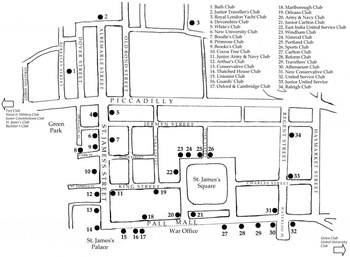
English gentlemen spread clubs as far as their travels took them, though the heart of elite clubland remained the West End of London, where clubs lined Pall Mall, Piccadilly, and St. James's Street (fig. 1). Members were drawn from the upper
Distribution of gentlemen's clubs in London's West End, ca. 1900

ranks of society, prominent in terms of pedigree, wealth, business, or talent. To gain access, candidates were nominated and often waited years before coming up to be balloted on by the members of their prospective club. The size of clubs varied from the Cocoa Tree Club, with 350 members, to the National Liberal Club, with 5,400 members.Footnote 30
The most pragmatic reason that gentlemen's clubs functioned as homes is that not all men were in a position to possess a home in London. Even among the most wealthy and established clubmen, the landed aristocracy, one-fifth did not have a fixed London address in 1880; by the early 1900s that proportion had grown to two-fifths.Footnote 31 These figures would have necessarily increased among wealthy bachelors, younger sons, and men of talent from the middle classes, many of whom kept only a small set of chambers in the city.Footnote 32 By midcentury, when club life was coming into its own, one of its greatest attractions was the luxurious surroundings of the clubhouses at cheap prices.Footnote 33 Since all clubs were centrally located in the heart of the West End, they were convenient for the politician, the businessman, the professional man, and the man of leisure.
The nineteenth-century gentlemen's clubs were often described as palaces, with architecture aimed at mimicking the home in the grandest sense; a true gentlemen's club had to be situated in a sufficiently distinguished clubhouse. Not only did clubhouses provide a permanent home for members, they bestowed a sense of prestige and distinction. When discussing the various associations of science and literature in the metropolis, one member of the Institute of British Architects felt that his association lacked the prestige that went hand in hand with a sufficiently grand and spacious headquarters. While acknowledging that it might not be fair to judge a group by the space in which they met, he nonetheless believed that “a beautiful building goes a long way in the adornment of a society with the character of respectability and importance.”Footnote 34 To achieve these palatial buildings, some of the most prominent architects of the day were employed, including Sir Charles Barry, who designed both the Reform and Travellers’ Clubs. The erection of a grand clubhouse was one of the defining features of the gentlemen's club.
There was a fine line between luxurious and decadent surroundings. The Military, Naval, and County Service Clubhouse took over the building that was formerly Crockford's in 1849 and continued its tradition of opulence. Each room was furnished in different colors, but the gilt moldings and accessories provided a constant accent throughout the house. The reviewer for the influential Builder magazine was overwhelmed by the sight of “gold, gold, gold; so that it might be thought, whether originally or now, that the tradesman, rather than the artist, had been the director of the works.”Footnote 35 One author warned that while the newer clubs were quickly able to acquire the marble halls, electric lighting, and rich carpets of the most elite clubs, the prestige they sought would be harder to attain.Footnote 36 As the clubhouses became larger, and the rooms became grander, clubs opened themselves up to the critiques levied against the houses of the nouveaux riches that they sacrificed comfort and conviviality for display and opulence.Footnote 37 With membership numbers increasing throughout the nineteenth century, club committees had to balance the need for space with a desire to retain a comfortable environment.
While clubmen were certainly proud of their beautiful buildings, the best-loved clubs also offered a sense of privacy and homeyness. This was particularly marked at the older clubs, which might have had little architectural grandeur but could boast pleasant and well-planned interiors. One guidebook pointed to Boodle's Club as a club that was somewhat ordinary from without but compensated within with its comfortable and sensible interior design.Footnote 38 The fact that few would have been granted access to the interior of Boodle's only added to its sense of private life. Though in the heart of the city, clubmen hoped to enjoy the intimacy of domestic life.
Clubhouses were certainly beautiful, but they were also functional. In attempting to explain the use of clubs to an American audience, one reporter noted that they were not a luxury but rather a necessity for London life. As he explained, “the custom of practically living in clubs is so widespread and so deeply rooted that it would be a matter of practical impossibility to the average Englishman to follow any other method of passing his time.”Footnote 39 Clubs had all of the essentials and luxuries a man could desire and thus it was quite possible to spend the greater part of the day at a club as though one were the occupant of a fully staffed mansion. On arriving at the club after nine o’clock, a member could have a complete breakfast and then move on to the writing or drawing room to complete any necessary correspondence and read the newspapers. At lunch a crowd would usually form after one o’clock and thus a man could indulge in a very good and well-priced meal with friends. While the clubs were typically empty between three and four thirty, the arrival of the evening papers brought in a new group of clubmen before dinner time, perhaps the most popular time in the club. After his meal a man could enjoy drinks, cards, or billiards, depending on his particular tastes.Footnote 40 And if his club had bedrooms, he could in fact enjoy all of the benefits of home.
It was natural for men to use their club rather than their home as a base. Many clubmen used their club as their main address, both receiving and answering mail there.Footnote 41 One etiquette book assumed that military officers having calling cards printed would have their regiment listed on the left-hand corner and their club name printed on the right in lieu of any other address.Footnote 42 Mail would often reach a man sooner at his club, as it was there a man first checked in after returning to town. When a friend of Bonar Law returned to London for a quick visit, he asked the Prime Minister to send him a message at the Royal Automobile Club, as it was his most frequent point of call and the most convenient place to reach him.Footnote 43 The author Matthew Arnold made it a habit to pop into his club whenever he was in London, and he carried out much of his correspondence from the Athenaeum club.Footnote 44 The everyday nature of men's use of their clubs is testimony to its importance in their lives.
Men could also use their clubs as a substitute for what they lacked at home. The most famous fictional member of the Reform Club, Phinneas Fogg, forsook a library at home because his club had two fine libraries specializing in literature, law, and politics.Footnote 45 While many clubs had some type of a collection of books, the Reform Club possessed a thoroughly planned out and organized library. In 1841 a library subcommittee was established to create a complete reference library with a specific focus on maps, books, and documents of a political nature.Footnote 46 In 1900 there were approximately 60,000 volumes in the club library, with nearly a thousand new accessions every year.Footnote 47 The Reform had its greatest competition in the Athenaeum Club, which spent almost £450 every year simply on maintaining and expanding its library. By 1900 it had amassed almost 70,000 volumes.Footnote 48 The Travellers’ Club library looks almost sparse by comparison, with its 10,000 volumes.Footnote 49 No private individual and few libraries could have competed with such collections.
For the gourmand, there were other, more savory club amenities. Perhaps the best-known chef of the nineteenth century, Alexis Soyer, was the cook for the Reform Club from 1837 until 1850. His skills were legendary, and his côtelettes de mouton à la Reform put the club kitchen on the map.Footnote 50 Men seeking the best food in the city relied on the clubs and the few private homes that employed the best chefs. Restaurants and hotels were scarce and of poor quality at the beginning of the nineteenth century, and it was only at the end of the century that they became fashionable. In 1910 one author still felt that the Carlton Club had the best culinary offerings in town, superior to even the top restaurants.Footnote 51 In fact, club services had become so good that many feared that no home could compare. A club was often coveted for its conveniences: “its chef, its cellar, its library, and so forth. It provides [a member] cheaply with luxuries and facilities which might otherwise be out of his reach.”Footnote 52 Clubs managed to balance a top quality of fare with reasonable prices and excellent selection, superior to what most men would have found in their own homes.Footnote 53
While clubs wanted to provide good food, this was not the sole purpose of their existence. Such an approach would render the club little more than an affordable luxury restaurant. Ultimately it was not the dinners but the diners that set a club apart. In describing the many unexpected joys of London at the end of August, Edward Hamilton, civil servant and man about town, noted the abundance of friendly companions as one of clubs’ great attractions.Footnote 54 Unlike the restaurant, the club had selective access and many men there would be friends, acquaintances, or at least share the same social circle. At Boodle's Club one could seek out companions at the central round dining table, where newspapers and books were banned and members were explicitly encouraged to socialize.Footnote 55 In his later years, and after the death of his wife, the popular civil servant Algernon West lived with his son in a house in Manchester Square, though he preferred not to dine there. Instead he was a frequent visitor to Brooks's Club until his health precluded his attendance. His biographer fondly recalled how “he would walk there and back, and was a diner out to the end of his life.”Footnote 56 A man left his home for his club with the intent of finding not only a good meal but also familiar faces and friends.Footnote 57 Men such as West left their family homes to enjoy the community of a supplementary home.
Not only did men dine informally at their clubs, but they could also use them as a place to entertain. Many men would invite small groups of friends to dine with them at their club even if they had an established home.Footnote 58 When ten men who attended Sandhurst together wanted to gather to celebrate after forty years, they chose the United Service Club as a place where they could dine instead of a restaurant or private home. They had official menus printed up, which served as nice mementos when signed by all of the men.Footnote 59 Sir Almerick Fitzroy, civil servant and chronicler of the Travellers’ Club, similarly chose his club as a venue where his friends could gather for the celebration of his fiftieth birthday.Footnote 60 The club provided a grand and ceremonial atmosphere when special occasions warranted, and many clubs had private dining rooms that members could reserve for such occasions.
A club dinner could solve the problem for men who had to entertain high-profile guests but whose homes were not up to the challenge. In 1882 the Prince of Wales gave a dinner at Marlborough house to the leading actors of the day. He repeated the affair at the Marlborough Club a few years later. To respond, leading members of the Garrick Club gave the Prince an invitation to dine with them at their club, which he accepted.Footnote 61 For the Prince of Wales in particular, clubs seemed to provide a much needed place to host and be hosted at with less of the pomp and ceremony than would have been required in a private home or public space.Footnote 62 Being the feted guest of a club in itself became a mark of social prestige much as the invitations to the homes of the grandes dames of London Society had been in generations past. To be invited to one of the Saturday dinners at the Savage Club warranted a mention in the Social Register honors section.Footnote 63
For some members, their club was their home mainly because they actually lived there. The provision of bedrooms originated in provincial clubs but soon became a valuable attraction for London clubland as well.Footnote 64 The American author Henry James divided his time between a residence in London and a house in Rye, but he quickly left his flat when the opportunity to live in a room at the Reform Club came up. In a letter to a friend he rejoiced that this new accommodation “seems to solve the problem of town on easy terms. They are let by the year only, and one waits one's turn long—(for years;) but when mine the other day came round I went it blind instead of letting it pass. One has to furnish and do all one's self—but the results, and conditions, generally, repay. My cell is spacious, southern, looking over Carlton Gardens: and tranquil, utterly, and singularly well-serviced; and I find I can work there.”Footnote 65 For a writer and lover of London like James, there was no greater situation than an affordable home in the center of the city where he could work. And by providing rooms by the year that members could decorate to their own tastes, the Reform Club was explicitly offering a space that men could make their own.
Like James, bachelors in particular appreciated the domestic charms of club life, but such a way of life also appealed to a variety of men: Young officers found the allure of clubland appealing. Guardsmen stationed in London almost always lived at the Guards’ Club, though they had the option of living elsewhere. A man could live quite frugally and in good style at the Guards’ for £20 a month.Footnote 66 Walter Besant, in his survey of London life, found that the club had an enduring appeal, for “those whose work is of a solitary character, will always want a club: those who want to meet old friends will belong to an exclusive club, such as a service or a university club, where they are likely to meet them: those who have retired from active life and want a place where they may escape monotony and solitude will always belong to a club.”Footnote 67 Clubs served a vital purpose for a variety of men—whether they lived there or simply used them as a frequent point of call—who found no other venue that quite suited their needs.
The club certainly offered a convenient home base in the center of London. As a space to read, write, eat, and meet with and entertain friends, it provided many of the trappings of domestic life. The homeyness of English clubs was often pointed out as the characteristic that separated them from other male venues and even from their international copies. Writing to an American audience, a journalist had to explain: “To an Englishman, if he is a bachelor, his club is his home. It is there that he sees his friends, writes his letters, dines, and spends the greater part of the day.”Footnote 68 Clubs lent a sense of familiarity, brought back pleasant memories, and provided a good opportunity to catch up with old friends.Footnote 69 While clubmen occasionally enjoyed some wild nights, for the most part clubland was a quiet and decorous center of male life, not unlike the peaceful everyday of the ideal home.Footnote 70 To point to the gentlemen's clubs as an example of a wholesale flight from domesticity, therefore, does not fit with how men perceived these spaces.
While men certainly enjoyed the function of clubs, it was the personal and sentimental attachments that explained why clubland became such a widespread phenomenon in the late nineteenth century. Men referred to their clubs with a great degree of emotion, and the gender segregation only enhanced the feeling of community. While club friendships may not have all been the most intimate, they were nonetheless important. These centers of male life fit into a larger pattern of elite homosociality that included public schools, the armed forces, the universities, and the professions, all of which fostered strong ties.Footnote 71 But above all other institutions, it was the club that functioned as a home away from home.
One reason some men sought the refuge of their clubs is that many upper-class homes were not, in fact, their own. While men were the head of the household in theory, in practice women had at least an equal claim to rule the roost. The hero of one tale learned this lesson quite abruptly when he was turned out of the house while his wife entertained. When he attempted to complain she rejoined: “A man's house is his Club, Sir; a woman's house is her boudoir. The castle idea is exploded.”Footnote 72 Some men sought the recourse of their clubs as homes because they were alienated from their own homes. Even when their wives were absent, one author doubted men held much sway in the home. In a house emptied of wives and children, the servants knew a man was not the master and thus would not obey.Footnote 73 The only solution was to flee the house and enjoy the rest of London life.
Such a feeling was particularly recognized among young men. Bachelors still living under their parents’ roof or in lodgings enjoyed almost no elements of patriarchal authority. One mother with a daughter of marriageable age noted that such men simply escaped the social world of their elders for other enjoyments. The main competition for men's attention was “the wicked Clubs—which have lately been largely increased for the express purpose of providing the Young Man with an evening resort.” The clubs were not wicked for any wild antics but rather for luring men to a quiet male community where “the Young Man of the Day finds that true enjoyment which in vain he would seek in the deserted halls of the Mothers.”Footnote 74 Rather than participate in the official London social world of balls and soirees ruled by women, many men fled to their palatial clubs.Footnote 75
When the family home became too frantic or too busy, the club could function as a sanctuary away from the stresses of life. In one Punch cartoon titled “Getting Out of It,” a husband uses the ruse of business at his club as a means to escape the chaos of his brood of children as they prepare for a holiday. While his wife and the female servants struggle with six children, a mountain of luggage, and even a barking dog, the husband tells his fretful wife: “Don’t trouble about me—I’ll get down by a later train, in time for supper.”Footnote 76 With his hand on the door, the husband is clearly making an escape. In this case surely the home is not providing a center of rest and comfort for anyone. Instead, the club was to be the husband's recourse for quiet.
The ability for men to escape to a club could actually undermine a wife's control of the home. In one story of a henpecked husband, who could not move a pillow without his wife's consent, his son suggests joining a club where one could enjoy both comfort and autonomy. The son attempts to convince his father that: “You only need belong to it for a year, and by then mother will have surely given in all along the line, and will be making concessions by the hundred to induce you to throw it up.”Footnote 77 In this case a man contemplated setting up an alternative domestic sphere in order to shift the balance of power within his own home.
Club life embodied the promise of a space free from both the worries of family life and the worries of the world. Club staff were coached in keeping the troubles of the larger world away from members. The hall porter was explicitly charged with barring moneylenders, inquiring attorneys, or solicitors from access to any member.Footnote 78 The committee at Brooks's Club decided that the hall porter should attempt to refuse a summons being delivered and, only on insistence, take it and place it for the member to pick up later.Footnote 79 At the Arts Club the committee expressly forbade giving out a member's address or any information as to their location or resources to inquirers.Footnote 80 When the actor Weedon Grossmith was facing some financial difficulties, he headed toward the intimacy of the Beefsteak Club with the purpose of forgetting his troubles. He was quickly relieved to see a group of friends enjoying themselves: “On entering I heard loud laughter from a merry set of about a dozen “bloods” … all assembled and in the best spirits. If I felt depressed, that feeling soon vanished in such cheerful company. Sir George pushed me into a chair at the top of the table, and requested me to be `merry and wise,' at the same time chanting the chorus of a famous old song of the past.”Footnote 81 Grossmith was able to find refuge from his personal finances at his club, which granted him the emotional relief traditionally associated with the home.
The hall porter acted as a barrier against the outside world, and this often included even a man's wife and family. As one chronicler of White's noted: “if [a member] tells the hall porter he is not in the club if anyone—even his wife—calls, well, he is as inaccessible as the Grand Lama of Tibet.”Footnote 82Punch published a cartoon that specifically detailed the possibility of a wife contacting her husband at his club. In the cartoon, the hall porter receives a call from a wife of a member who is quickly told that her husband is not in the club. She protests that she has not yet even given her name. The porter with a smile replies: “Quite unnecessary, Madam. Nobody's husband is ever here by any chance.”Footnote 83 The fact that no man is ever in the club by chance has a double meaning: both that husbands need not admit to being in the club, and that it is not by chance that a man secures the privacy of his club. Men sought out their clubs to enjoy ultimate anonymity and solitude, guarded by the hall porter.
In many ways, clubs offered a more private space than the home. From the wealthy middle classes to the most elite families, the home was always filled not only with the nuclear family but also with all of the servants necessary for such a lifestyle, family members visiting for short or extended periods, and a constant flow of visitors and callers throughout the day. While a servant was supposed to announce each visitor and seek permission for them to enter, not all guests waited on such formalities, and many visitors could not be turned away for fear of offense.Footnote 84 Unlike the restrictive access at the club, the private home was regularly open for public display and entertainment. The reality of home life for the elites was a constant tension between the desire for privacy and the need to present a respectable household to the world.Footnote 85
At first glance, clubs that accepted hundreds of members would not seem a space for a man to seek privacy. And yet, by the nineteenth century, the open conviviality of the early clubs had been trumped by the desire for quiet and solitude. While men certainly met friends at their clubs, and enjoyed some high spirits at the bohemian clubs, for the most part men enjoyed their clubs for the luxury of not being disturbed.Footnote 86 The desire to belong to a prestigious club and be conspicuous as one of its members did not exclude the desire to enjoy a very private space. The ability to enjoy privacy among a group of men is perhaps best demonstrated by the “Silence Room” at the Devonshire Club, where a member was guaranteed an undisturbed space.Footnote 87
Clubs were able to provide both privacy and sociability based on a member's whims. The chronicler of the Oriental Club explained the enormous popularity of clubs by their ability to cater perfectly to the character of Englishmen. He begins the history of the club by stating that the English are defined by both a love of privacy and a love of company: “They will, whenever possible, surround themselves with a high wall, but inside the enclosure there must be a few chosen spirits. A club is thus a typically British institution.”Footnote 88 Many clubrooms thus would have presented a rather somber feeling to an outside observer, with each man in his own private world. In such instances members tolerated one another's presence because of their shared desire for privacy.Footnote 89
Privacy might sometimes evolve into secrecy, and even illicit behavior. While it is obviously difficult to find concrete evidence of specific indiscretions, there are enough references to suspect that some men used their clubs as a means to plan and facilitate shameful acts. One member of Brooks's Club was caught entertaining a lady within the club itself, quite a shocking prospect in the all-male preserve. The carefully worded Club Minute Book records that a member had been habitually entertaining a woman in the lower dressing room.Footnote 90 Such behavior was highly improper, and one can assume it was hardly the man's wife who would consent to such a compromising situation. The club might have also formed a convenient site for homosexual liaisons. George Ives, poet and essayist, met a man on the street who propositioned him and then asked him to dine at the Army and Navy Club; the man's club membership helped ease Ives's suspicions of blackmail.Footnote 91 While it is unlikely that men ever used their clubs as actual sites of sexual intercourse, the privacy and secrecy that the clubs guaranteed would have made them a logical place to arrange for future sexual encounters.
In the popular imagination, a club was an ideal place for private or secret correspondence. While at home a nosy aunt or suspicious spouse could access communications, letters and telephone calls received at a club were inviolate. While obviously no such letters survive in the club archives, the frequent references in fiction suggest that they existed. In one piece of Victorian pornography about a photographic “club” where various dissolutes gathered to take nude photographs and engage in sexual acts, the ringleader made contact with her financier by way of telegraphs to his legitimate gentlemen's club.Footnote 92 Most wives knew that their husbands’ most interesting letters, and those of which they were not supposed to know, would all have been sent through his club.Footnote 93 In another work of fiction, a suspicious husband uses his club as a center for reports from his detective about his wife's activities. It is only later revealed that, while he was attempting to be unfaithful with a chorus girl, his wife had never strayed.Footnote 94 Whatever the frequency with which men actually used their clubs for illicit contact or correspondence, there was certainly a popular belief that men could use the privacy of their clubs for unscrupulous ends.
The desire for privacy meant that the admission of visitors was a serious issue. The connection between the feeling of home and the exclusion of nonmembers was made explicitly in one overview of clubland: “An Englishman's club for the time being is his private house. The members represent his family and friends. Strangers excluded from the club-rooms proper are relegated to apartments which have little or no communication with the members’ rooms.”Footnote 95 Any ambiguity as to the position of visitors was answered by the fact that throughout the nineteenth century, guests were referred to as “strangers.”Footnote 96 Over the years, each club struggled with the degree to which their institution should be accessible to nonmembers. Up until the nineteenth century, clubs granted access only to members and staff. In the 1850s more sizable strangers’ rooms with dining facilities were introduced into clubland, though it took many years for this to become a common practice.Footnote 97
Starting with small alcoves off the main hall where members could briefly chat with visitors dropping by, clubs gradually began to allow guests into different rooms of the house and to enjoy different entertainments. The early reception rooms were far from glamorous, if the Oriental Club is any indication; in July of 1843 when the club agreed to the need for such a room, the committee decided the urinal adjoining the foyer would be converted for such a purpose.Footnote 98 While not all strangers’ rooms were converted toilets, many were rather Spartan. When one of the characters in the novel Mammon and Co. waited for his lunch date at White’s, he became all the more anxious for his membership at the club to be successful: “he had to solace his waiting moments with the inspection of the room set aside for the reception of strangers. It was furnished with a table, on which stood an empty inkstand and a carafe of stale-looking water, two horsehair chairs, a weighing-machine, and a row of hat pegs hung up inside a shelfless bookcase.”Footnote 99 The lackluster surroundings of the waiting room did not discourage the man but only made him more anxious to see the delights of the interior. It was only for those men lucky enough to secure membership that the true delights of each club would be revealed.
Visitors who were allowed access were greeted by their hosts, signed their names in a book, and were then allowed only restricted access to the club. At the Travellers’ Club, the committee kept a record of admitted visitors in order to monitor their numbers.Footnote 100 By the turn of the century most clubs had relaxed their rules of access, though the Carlton Club provided admittance only to their hall, and at the Athenaeum strangers were confined to a small apartment near the front door.Footnote 101 The service clubs in particular were known for their inaccessibility, and while the Army and Navy prided itself on being the first military club to accept guests, until 1901, the Guards' Club was adamant that no outsider could enter its doors.Footnote 102 Nor was the extension of rights a straightforward process of inclusion; rights were sometimes granted and then taken away. After previously allowing guests use of the reception room, the Oriental Club later relegated them to the outer hall to carry on any correspondence they might need to conduct.Footnote 103 Each club had its own evolution of rights for visitors, and there was a constant redefinition of “public” spaces.
The issue of extending the rights of strangers was always contentious. At the Athenaeum Club, members wrote to the committee when the subject was being discussed, vehemently arguing the merits and drawbacks to any alterations. The question of opening the coffee room of the club to guests led one member to protest: “Our Club, from the sense of quiet which pervades it, is and always has been—as those of use who have had the privilege of being Members of it, and have frequented it for many years, well know—valued by men in every walk of public life as a safe retreat; and we appeal to our Fellow-Members not to adopt any measure tending to destroy the privacy which has thus, now for nearly three-quarters of a century, formed one of the greatest charms of the Athenaeum.”Footnote 104 Tradition was one way of framing any objection to a rule change, but it was more the sense of intrusion to which this member objected. The Travellers’ Club regulated not only the rooms to which members could admit guests but also how outsiders could access these spaces. By the twentieth century there was a well-established strangers’ room where guests could be served with dinner, but they had to enter this space by way of the coffee room lavatory. It was only in 1906 that the committee allowed guests to be met in the hall and conducted through the morning room into dinner.Footnote 105 While privacy was a prized possession, the convenience of entertaining guests ultimately triumphed as a necessary requisite of any second home.
Despite the stringent rules and the army of servants guarding the sanctity of clubs, some unwanted guests also managed to gain access. One member of Brooks's was chastised for “certain irregularities committed by you in the admission to the Club of a person not authorized to be admitted.”Footnote 106 There are no details on why this guest was unacceptable, but the committee took the intrusion quite seriously. This interloper at least had the introduction of a member. Even more surprising was an incident at the Guards’ Club in 1882 when a well-dressed young man gained access to the club twice, enjoyed a luncheon and dinner, and cashed two bad checks. The waiters had not recognized the man, but when questioned he asserted with confidence that he was a new addition to the Coldstream Guards, and he was accepted as such.Footnote 107 Such insolence was especially daring at the Guards’ Club, which was small and did not allow guests.Footnote 108 Generally, such lapses were rare, and clubs put great efforts into maintaining their exclusivity. Guests needed to be strictly regulated in order to maintain the privacy of the members and to avoid the open access men were fleeing at home.
Because men relied on their clubs as a home base, it was quite inconvenient when they underwent their yearly closures. In the late summer and throughout the fall, almost every club had to close its doors for a short time for a thorough cleaning or for a longer period for renovations. Most of the landed elite fled to the countryside to escape the heat, and much of London was under construction. While many clubs staggered their closings, the numbers affected could be quite high. In August of 1902, the Pall Mall Gazette estimated that twenty-one West End clubs were closed, with a total of 28,000 members turned out.Footnote 109
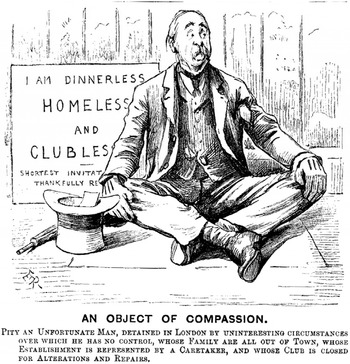
Not all clubmen were able to leave the city, and many felt the loss of their club as acutely as the loss of their home. An article detailing the annual cleanings notes: “The regular London habitué is lost without his club; he misses his favorite corners, his familiar friends, the particular armchair in which he studies the journals or tranquilly snores.”Footnote 110 It was not only the amenities of their clubs that members missed but also the club's familiarity and routine. The “homeless and clubless” man depicted in figure 2 was rendered pitiable not because there was actually nowhere to dine in the city but because he was without a place to call his own. By the 1890s a man could easily eat at a tavern, a hotel, or even a restaurant, but this fellow lacked a place where he could effortlessly enjoy his meal in the company of friends and familiar faces. This is why his sign asks not for funds but for invitations to dinner.
Though closures happened every year, the consistency with which they were reported is remarkable. Each year, without fail, they were mentioned in the society press. And while details of the exact dates of closure may have been useful, it was also common to find articles explaining the losses clubmen felt. In Vanity Fair the ritual of club cleaning was used as an example of the change of seasons, and the upheaval caused by the cleaning and repairs was described as a scene of trauma: “The belongings of the late possessors are rudely turned about, the precincts of the most holy places are disregarded; even the household gods are treated with
From Punch, 23 August 1890. Reprinted with permission of Robarts Library.

irreverence.”Footnote 111 Routine club cleaning is transformed in this description into an invasion of a sacred space, and it was not an isolated occurrence.Footnote 112 Closures represented disruption and imposed change, two things that clubmen did not relish.
Closures were so unpalatable that a few clubs never closed. The Windham and Garrick Clubs prided themselves on never closing, and the Oxford and Cambridge only closed every seven years.Footnote 113 While such devotion to their membership was admirable, it must have been at one such club that a poet wrote the following verse:
I’ve whitewash on my head
And whitewash down my back,
The paint is neat upon my seat,
Nor graining do I lack.
I’m glazed and scrubbed and cleaned,
My hair is thick with size;
If I don’t go, this beastly show
Will really damn my eyes.Footnote 114
The cleaning and refurbishing of clubs was a necessary evil, and most clubs chose to close down rather than subject their membership to the troubles of construction and cleaning.
The solution for such inconvenience was a system of mutual hospitality. Some clubs had a system whereby they would exchange hospitalities with a club with similar membership year after year. For example, the members of the East India United Service and the Oriental Clubs would have likely found some commonality between members.Footnote 115 One year, the Bachelor's Club did not set up a system of mutual exchange when it closed, as it found so many of its members were also members of the St. James's Club that they could be “thrown on the world” and not suffer greatly.Footnote 116 The writer Matthew Arnold used the United Service Club as a convenient place to meet while his beloved Athenaeum was being cleaned.Footnote 117 Another clubman actually liked the change of scene during club closures and enjoyed meeting new people at his host club.Footnote 118 His views were almost certainly in the minority, however; most clubmen did not adapt happily to new surroundings.
Clubmen forced to reside in London after the end of the season found the situation distinctly unpleasant, as they missed their own clubs and found their host clubs strange. In one man's poem about the loneliness of London in the fall, club life is prominent among the losses he feels most keenly:
I miss the chair I always chose,
The corner where at times I doze,
The table kept for me at eight,
The rubber I anticipate. … Footnote 119
Though the host club would have offered all of the luxuries and amenities of his club, the sense of loss and disorientation remained because of the emotional connection to a man's home club. Members typically spoke of the inability to relax, of not knowing the routines or customs of their new “homes.”Footnote 120 What men missed the most was the sense of belonging that their own clubs provided. The system whereby members were at the same time part of their host clubs and guests did not lend itself to a sense of ease and relaxation. When hosted by another club, members could have enjoyed the decor, location, and amenities of the other club, but they lacked the intangible sense of home.
The club functioned as a home not only for the men constantly making use of its facilities but even for those away from London for extended periods of time. Many clubmen were absent due to business, diplomatic, or military obligations, and clubs accommodated them by reducing or waiving annual fees.Footnote 121 When they returned, some after many years, “naturally, the first place to visit on arrival was the Club.”Footnote 122 For men of the empire, their London club represented a center of familiarity and a place to get reacquainted with life at home. The Oriental Club was formed in 1824 specifically to deal with easing the transition of expatriates back to their homeland, and by the late nineteenth century several clubs were serving this need.Footnote 123 Other members of a club could find such imperial travelers useful, as their firsthand knowledge of distant lands could be helpful in their own travels.Footnote 124 Adventurers and imperialists could thus be drawn to the club, which served as both a center of discussion and a transition back to domestic life.
This process of integration was seen as so vital and so successful that the setting up of clubs went both ways. The Bengal Club was founded in Calcutta in 1827 along the lines of the Oriental Club, in an attempt to bring a little bit of England to India. The historian of the club notes that, in the empire, the idea of a club had a special appeal to men. For those who were divided from their families by thousands of miles, a club could “afford some consolation for the pains of exile and loneliness.”Footnote 125 Historian Mrinalini Sinha has demonstrated that, in India in particular, clubs had an explicit function in replicating the civil society of the British metropolis.Footnote 126 Many of the top London clubs also had privileges at clubs overseas. A guide produced in 1880 pointed out the opportunities of reciprocity clubmen had both on the continent and throughout the British Empire.Footnote 127 The global club network helped ensure that clubmen had a place to call home in almost every outpost of the globe.
After years abroad exploring the farthest reaches of the empire, clubmen sought out their London clubs upon return for sentimental reasons as well as practical ones. The caricaturist and writer Max Beerbohm encountered one such Australian adventurer who had the misfortune to return only to find his club had recently closed and the building had been torn down. The poor man's pathos was almost palpable: “The one thing which enabled him to endure those ten years of unpleasant exile was the knowledge that he was a member of a London club. Year by year, it was a keen pleasure to him to send his annual subscription. It kept him in touch with civilisation, in touch with Home.”Footnote 128 The destruction of his club was in many ways as devastating as the destruction of a family home. Especially for imperial travelers and bachelors, gentlemen's clubs could function as their only permanent connection.
Deep emotional attachment is perhaps the best proof of all that men viewed their clubs as homes. Many long-standing clubmen had trouble resigning when age or infirmity made attendance at their club impossible. The Reform Club has an impressive repertory of letters of resignation in its archive from regretful clubmen. While most tend to be short and direct, some members could not resist reminiscing about their many years of membership. Joseph Sykes resigned in 1892 after a membership of fifty-four years because he no longer traveled into the city.Footnote 129 While E. Lees was a member for only seventeen years, his pathos was no less great when he wrote: “Owing to increased years and failing health which prevents me leaving the House, I very reluctantly tender my resignation of membership at the Reform Club.”Footnote 130 The sheer longevity of many men's membership, and the fact of their frequenting the club so often, made their clubs a more permanent home than any domicile.
Some men ensured their presence in their beloved club even after death by bestowing legacies. The author A. A. Milne gave the Garrick Club 25 percent of the profits of his books upon the death of his widow, while playwright and composer Noel Coward donated his visitors’ book to the club, which was a favorite of actors.Footnote 131 Members donated portraits, money, and accessories to the clubs they loved so dearly. Another way to keep a connection was to ensure the membership through future generations. Weedon Grossmith's favorite club was the Beefsteak, and it was one of his greatest desires to have his son elected as a member. By a strange coincidence, on the day of the father's death, the son was elected a member.Footnote 132 Either through donations or through genes, clubmen ensured that a little part of them survived at their clubs even after death. Such legacies helped contribute to a sense of family at many clubs and reinforced the domestic spirit.
Clubs formed a comfortable haven for upper-class men of the late Victorian era. Many men routinely left their homes to spend time at a club. Yet as this article has demonstrated, this flight was from the family home in particular rather than from domestic habits and comforts per se. The luxurious clubhouses and their staff aimed to make men feel as comfortable and domesticated as possible. Men used their clubs as they would a home—to read, write, dine, and meet with friends. Most importantly, the emotional ties men felt for their clubs went far beyond the convenient location and a gourmet menu; for many members, a club conjured up all of the images and sensations of home. Domestic impulses were strong even among men who sought comfort in their clubs rather than in their family homes. Thus any threat to family life from clubs was because they functioned as a rival homosocial domestic space, not because their spirit was antithetical to domesticity.
Many upper- and upper-middle-class homes were far from being domestic havens of quiet reflection and withdrawal from the world. As the center of women's social lives, the home served the function of showpiece and entertainment center, and men's dominion there was limited and selective, their place often redundant. Many men found their home lacking in comfort, privacy, and intimacy, and thus sought out these qualities in their clubs. Continued work needs to be done to understand men's place within the home, as the existing research on middle-class homes and middle-class men does not always apply to the upper classes or to the many bachelors of all classes.
What men's use of their clubs does show is the incredible popularity of male-only activities and institutions in the latter half of the nineteenth century. This need for homosociality underlay men's determination to create, through clubs, an exclusively masculine domestic space. The deep desire for male affiliation implies a need to be separate from women that persisted until the early twentieth century with the resurgence of mixed-sex society. Instead of a flight from domesticity, the gentlemen's clubs may well be considered a flight from women and their social events. Nineteenth-century clubmen embraced the concept of domesticity in such a way as to provide for their own comforts while undermining the influence of the home.