Introduction
A stroke can have implications for all areas of a person's life. Among the reported consequences of stroke are physical and cognitive problems, depression, anxiety and social isolation (Davis, Egan, Dubouloz, Kubina, & Kessler, Reference Davis, Egan, Dubouloz, Kubina and Kessler2013; Kaufman, Reference Kaufman2011; King, Shade-Zeldow, Carlson, Feldman, & Philip, Reference King, Shade-Zeldow, Carlson, Feldman and Philip2002; Mukherjee, Levin, & Heller, Reference Mukherjee, Levin and Heller2006; Rochette, Tribble, Desrosiers, Bravo, & Bourget, Reference Rochette, Tribble, Desrosiers, Bravo and Bourget2006). Most people who sustain a stroke need rehabilitation, in order to adapt to the physical and psychological consequences. Research on adaptation to stroke has shown that finding meaning is associated with better adaptation (King et al., Reference King, Shade-Zeldow, Carlson, Feldman and Philip2002): use of the coping strategy ‘finding meaning’ was a significant predictor for less depression and better adaptation. The same applies to engaging in meaningful activities (Davis et al., Reference Davis, Egan, Dubouloz, Kubina and Kessler2013): people who were able to maintain participating in activities that were meaningful to them, showed better adaptation post stroke.
In a review of the meaning literature, Park (Reference Park2010) developed a meaning making model, in which she differentiated between global meaning and situational meaning. The term ‘global meaning’ refers to fundamental beliefs (regarding justice, control, coherence, etc.) and life goals (such as relationships, work, religion or knowledge). Global meaning provides individuals with cognitive frameworks to interpret their experiences and to motivate them in their actions. Global meaning influences the meaning making processes that are part of situational meaning. Situational meaning refers to meaning making processes in specific situations.
Park hypothesises that global meaning plays an essential role in adjustment to serious illness (Park, Reference Park2010, Reference Park2013). In a previous qualitative research project, we interviewed people with stroke and used a grounded theory approach to analyse their ideas about and experiences with global meaning. We found that global meaning in people with stroke comprises five interlinked, yet distinguishable aspects, namely core values, relationships, worldview, identity and inner posture (Littooij, Dekker, Vloothuis, Widdershoven, & Leget, Reference Littooij, Dekker, Vloothuis, Widdershoven and Leget2016a). Based on the narratives of the respondents and literature on the subject, we defined core values as fundamental beliefs about what is right and life goals worthy to be pursued. They give direction to thoughts and behaviour (Rokeach, Reference Rokeach1979). Relationships refers to a connection between a person and others, e.g., children, a spouse, a therapist or even a pet. Meaningful relationships and the experience of being connected are life goals. Based on the interviews and on literature, we found that worldview can be seen as a set of fundamental beliefs about life, death, and suffering, that structure people's ideas on how life events are related (Koltko-Rivera, Reference Koltko-Rivera2004). Identity refers to fundamental beliefs about one's deepest self. Expressing one's identity provides people with a sense of belonging, at the same time underlining their uniqueness and self-worth (Cloute, Mitchell, & Yates, Reference Cloute, Mitchell and Yates2008; Ellis-Hill & Horn, Reference Ellis-Hill and Horn2000). Besides these aspects of global meaning, we identified a fifth aspect, which we named ‘inner posture’. When confronted with challenging consequences of their stroke, respondents tended to encourage or calm themselves with prayer or meditation, or they reminded themselves of what they had learned earlier in life. This seemed to help them bear these consequences. Inner posture refers to the way in which people bear what cannot be changed, which is an important goal in life. Inner posture includes an element of acknowledgement and an element of choice and action. It involves acknowledging the facts of life and choosing how to relate to them (Littooij et al., Reference Littooij, Dekker, Vloothuis, Widdershoven and Leget2016a).
Given the fact that finding meaning is associated with better adaptation (King et al., Reference King, Shade-Zeldow, Carlson, Feldman and Philip2002; Thompson, Reference Thompson1991), and Park's hypothesis that global meaning plays a role in adjustment to serious illness (Park, Reference Park2010 , Reference Park2013), it can be hypothesised that global meaning may influence rehabilitation in people with stroke. Although little is known about the relation between global meaning and rehabilitation in people with stroke, aspects of global meaning have been described in research literature: worldview and core values have been described in the broad area of stressful life events, but not specifically stroke (Janoff-Bulman, Reference Janoff-Bulman1992; Koltko-Rivera, Reference Koltko-Rivera2004; Mooren, Reference Mooren1998; Park, Reference Park2010; Rokeach, Reference Rokeach1979; Tedeschi & Calhoun, Reference Tedeschi and Calhoun1995). In psychological literature on living with stroke, relationships and identity have been found to be of central importance (Anderson & Whitfield, Reference Anderson and Whitfield2013; Ellis-Hill & Horn, Reference Ellis-Hill and Horn2000; Ellis-Hill, Payne, & Ward, Reference Ellis-Hill, Payne and Ward2000; Haslam et al., Reference Haslam, Holme, Haslam, Iyer, Jetten and Williams2008; Hole, Stubbs, Roskell, & Soundy, Reference Hole, Stubbs, Roskell and Soundy2014; Kruithof, van Mierlo, Visser-Meily, van Heugten, & Post, Reference Kruithof, van Mierlo, Visser-Meily, van Heugten and Post2013; Ownsworth, Reference Ownsworth2014). However, these studies focus on the role relationships play in adaptation to stroke and on identity change after stroke. Hence, they focus on meaning making processes and not on the more fundamental level of global meaning. Therefore, the aim of this study was to explore the association of global meaning with processes and outcomes of rehabilitation as experienced by people with stroke.
Methods
Design
This qualitative study is part of a larger study on global meaning in people with spinal cord injury or stroke. In a previous phase of the study, we identified the content of global meaning in people with stroke (Littooij et al., Reference Littooij, Dekker, Vloothuis, Widdershoven and Leget2016a). In the present study, we explored the way in which people who experienced a stroke associated their global meaning with their rehabilitation. We interviewed people with a stroke and analysed the interviews using a grounded theory approach. Central in this approach are the experiences of the respondents and the meaning they give to their experiences. In grounded theory, data collection and analysis becomes more focused as the study and theory evolves.
Ethics Approval
The study was approved by the accredited Medical Research Ethics Committee Slotervaart Hospital and Reade (METC-study number P1153).
Participants
Participants were people who had sustained a stroke for the first time, and were receiving outpatient treatment at a Dutch rehabilitation centre. Participants were purposefully selected to include both men and women and people with a more optimistic and a more pessimistic attitude, according to the physician assistant in attendance. Inclusion criteria were as follows: adults, over 18 years of age, attending outpatient rehabilitation, living in the community with a stroke, and being able to engage in a conversation. Clients with severe communication problems were excluded. Approximately half of the respondents were familiar with the two spiritual counsellors in the rehabilitation centre, of which the first author is one. The relationships between researcher and participants ranged from an intensive counselling relationship to being unacquainted.
Procedure
Semi-structured interviews were conducted by the first author, who is an experienced spiritual counsellor. A spiritual counsellor, sometimes referred to as healthcare chaplain, or existential counsellor, supports people when the self-evident order of everyday life is broken; in situations of life and death, in the event of farewell and loss, in the case of experiences of great connection or of abandonment, and in ethical questions. They are proficient in dealing with life questions, meaning, spirituality and ethical considerations (VGVZ, 2015).
Interviews were held between 4 and 26 months after admission to the rehabilitation centre. Potential participants were selected using a mix of purposive sampling and snowball sampling. A letter was sent to potential participants to which they could respond by returning a consent form (purposive). Furthermore, people who spontaneously applied for participation in the study, because they heard about it from other participants, were also included if they met the inclusion criteria (snowball). In these cases, the invitation letter was sent to them as well, and they were admitted after signing the consent form. In the invitation letter supplementary counselling was offered, if participants wanted to further reflect on the subjects raised in the interview. One participant made use of this option and received supplementary counselling provided by the first author.
Data Collection
The main method of data collection consisted of semi-structured interviews with 16 participants that, with permission of the participants, resulted in 16 audio-recordings. The majority of the interviews took place at the participants’ homes. On average, interviews ran for approximately 1 hour: the shortest being 47 minutes and the longest being 1 hour and 38 minutes. They were conducted between October 2013 and July 2014. The interviewer registered in field notes the observations she made before, during and after the interview, giving details that could not always be heard on tape, such as the occasional presence of a partner or an adult child, and nonverbal aspects of the communication.
Interviews were loosely structured using a topic list based on literature concerning global meaning (Frankl, Reference Frankl1992; Janoff-Bulman, Reference Janoff-Bulman1992; Koltko-Rivera, Reference Koltko-Rivera2004; Mooren, Reference Mooren, Janssen and Uden1997; Park, Reference Park2010; Rokeach, Reference Rokeach1979) and on previous research on global meaning in people with spinal cord injury (Littooij et al., Reference Littooij, Widdershoven, Stolwijk-Swüste, Doodeman, Leget and Dekker2015) (see the Appendix). The last part of the interview focused on rehabilitation. One of the questions was ‘Has what we have discussed so far affected your rehabilitation? In what way?’. The interviewer did not use these exact words, but she would summarise the conversation so far and then elaborate on the perceived influence on processes and outcomes of rehabilitation.
Data Analysis
Verbatim transcriptions were made of the recorded interviews, which were then analysed by the first author, using structural, provisional and elaborative coding (Saldaña, Reference Saldaña2013). In the structural coding phase, the researcher structured the interviews in line with the research question about the relationship between global meaning and rehabilitation, and identified quotes about processes and outcomes of rehabilitation, using the codes ‘rehabilitation’, ‘process’ and ‘outcome’. Processes and outcomes were differentiated, following Donabedian's quality of care framework (Donabedian, Reference Donabedian1988). He describes processes as patient's and practitioner's activities in receiving and giving care, including technical and interpersonal processes. Outcomes he describes as the effects of care on the health status of patients.
In the second phase of the analysis, the quotes were analysed provisionally. Regarding global meaning, we used aspects of global meaning as codes (core values, relationships, worldview, identity, inner posture). Regarding processes and outcomes of rehabilitation, we used the International Classification of Functioning, Disability and Health (ICF) to create codes (e.g., motivation, handling stress and emotions, making decisions, physical functioning, emotional functioning, social functioning and quality of life) (World Health Organization, 2001). We searched for overlaps and relations between the coded quotes, to identify which processes and outcomes respondents associated with their global meaning, and to find relationships between global meaning and the various processes and outcomes of rehabilitation. The quotes coded with the same codes were compared and when appropriate, similar codes were grouped together under one theme, again using the ICF. The preliminary outcomes were regularly discussed with the other researchers, in order to deepen and intensify the analysis.
In the final phase of the analysis, elaborative coding was used to determine in what way global meaning affected processes and outcomes of rehabilitation as experienced by the respondents. Data were entered into a software program for qualitative data analysis and research, Atlas.ti (version 7.5.6). The analysis was based on the transcribed interview recordings, using interviewer's impressions, reported in field notes, as background material. The actual recording was readily available through Atlas.ti, and was used to listen to the tone of statements and remarks.
Results
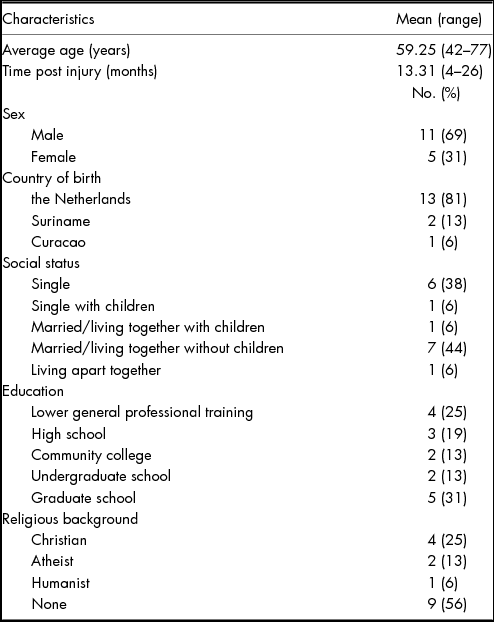
Out of 27 invitation letters and 4 spontaneous applications, 16 people reacted positively by sending back the consent form. Eleven of them were males and five were females. Their age ranged from 42 to 77 years (see Table 1). One respondent was living in a nursing home, and the other 15 in the community.
Participant Characteristics

The analysis reached a saturation point at 12 interviews, after which 4 more interviews were conducted, which added no new information.
Three themes were identified that pertained to how global meaning influenced rehabilitation processes: (i) fostering motivation, (ii) handling stress and emotions and (iii) interaction with rehabilitation professionals. The first two themes were derived from the ICF, and the last was created based on the narratives of the respondents.
Regarding the outcome of rehabilitation, two themes were identified: (i) physical functioning and (ii) acceptance.
All respondents alike mentioned these elements: men as well as women, younger and older respondents, respondents with right- and left-hemispheric injury and respondents from different cultural backgrounds.
Three aspects of global meaning, namely relationships, identity and inner posture, were mentioned regularly relating to processes and outcomes of rehabilitation. Core values and worldview were only mentioned by a few respondents.
Overall, the influence of global meaning on processes and outcomes of rehabilitation was described as positive: respondents felt that their motivation, their ability to handle stress, their physical functioning and their ability to accept their life after stroke improved because of their global meaning. In several cases, this influence was dependent on the way in which rehabilitation professionals addressed the global meaning of their clients.
Influence of Global Meaning on Processes of Rehabilitation
Motivation
Respondents described relationships, worldview, identity and inner posture as sources of motivation, and used them more or less consciously. In the interviews, respondents reflected on relationships as life goals that motivated them to do their exercises and carry on with their rehabilitation and with life. Worldview and identity were mentioned as resources that provided motivation to rehabilitate, while an active and positive inner posture in itself was providing motivation to carry on doing their exercises and not give up on rehabilitation.
One respondent, for example, wanted to maintain a meaningful relationship with his son. This had always been a life goal for him. He had built up a business, which his son had taken over. Until his stroke, he had regularly come by to help out.
Regarding my rehabilitation. . ., the relationship with my son, well, it stimulates me. (. . .) When he calls me, and asks: ‘will you come over to the company today?’ Well, that encourages me, I think that is great, for him to think about his father like that, you know, to say ‘I want to see you’. Then, however tired I am, I get up and go.
This respondent connected the relationship with his son directly with his rehabilitation. He was motivated to exercise and work on his physical condition, because he wanted to be able to come over, whenever his son needed him.
Another respondent's worldview was that life is an assignment: you need to make the best of your life and of yourself. Corresponding with this worldview, his inner posture was to always do your best. He had acted accordingly since the age of 16 and had become good at his job and the centre of many parties and groups of friends. Before his stroke he was already trying to change his lifestyle, because he wasn't sure anymore that success was the goal, but still he was trying to make the best of his life and of himself.
To do the best you can, for me, is now: searching for a good posture on the couch, taking a book that is as interesting as possible, listen to music and trying to get through the day. So that is what I do. And keeping my appointments. When I have an appointment with the doctor, I go to the doctor, when I have to take my pills, I take my pills.
This quote shows how this person's worldview and inner posture affected his motivation to rehabilitate. Although the goal of his life was already changing before his stroke, he still wanted to make the most of it, given the circumstances. Success was no longer the goal of his efforts, but being the best possible version of himself was.
Handling Stress and Emotions
Respondents regularly mentioned relationships, worldview, identity and inner posture as helpful in handling the stress and emotions raised by the consequences of their stroke. Relationships and worldview were used to seek comfort and distraction, in order to deal with stress and emotions. Identity and inner posture determined the way in which respondents tried to bear or overcome stress and emotions.
For one woman being connected with her family had always been a life goal. Besides that, her religious worldview was important to her, especially in handling stress and emotions.
Whenever I am afraid or sad I talk to my mother in heaven. She always was a religious woman and she used to comfort us. Or I listen to religious songs. Or I pick up the phone and call my sister. And one of my uncles, he came regularly to pray with me. That gives peace.
This respondent's religious worldview and her relationship with her family were closely connected, almost intertwined. She identified them as her most important sources in handling stress and emotions, also during her rehabilitation.
Another respondent's identity was defined by his being a sportsman. He described himself as a stubborn, strong, and independent person. He was never afraid to show emotions, but up until his stroke, the emotions he experienced were mostly frustration or anger, related to his sports.
Whenever I had a hard time in rehabilitation I used to cry. I don't go looking for help, or something. I think I have to overcome it by myself. I never went to support groups or something, that's just not me.
This quote shows how this respondent's identity affected his way of handling stress and emotions. He was not afraid to show his grief, but being an independent person, he dealt with it by himself, neither wanting to bother other persons nor needing them.
Interaction with Rehabilitation Professionals
The experience of rehabilitation was influenced by the way in which rehabilitation professionals addressed the global meaning of their clients. Not connecting to their clients’ global meaning lead to conflict in several cases. For example, one respondent's core values of being useful, and of respect, responsibility and independence influenced how he treated others and how he liked to be treated himself. This also played a role during his rehabilitation.
When I saw my schedule in the rehabilitation center I thought I might as well be at home. They gave me so little to do. So the physical therapist said that it was okay if I came and trained by myself. So that was good. And then I got into a dispute with the doctor. For I was having a beer with a fellow patient and the doctor said that I couldn't. I could understand that if I got drunk every day, but one beer! And then the doctor said that it was not healthy for my companion. What am I, his guardian? He is a grown man, I couldn't tell him what to do and what not to do, could I? I wouldn't want to.
This respondent's core values were met by his physical therapist, which he appreciated. But they brought him in conflict with the physician, who, in his experience, wanted him to act against his core values of respect, responsibility and independence.
If rehabilitation professionals took global meaning into account, respondents tended to associate this with quicker or better recovery. For example, one respondent showed an inner posture of searching for information, looking for confirmation, and then going his own way again. He had done so all of his life and that hadn't changed after his stroke.
I really appreciated the nurses and the physical therapists. Whenever I wanted something, they would listen and tell me what I needed to know. (. . .) They could see the progress every day and I was home within three months.
The confirmation and information the rehabilitation staff provided when needed corresponded well with this respondent's inner posture. He connected this with his quick recovery. As a result of this, he experienced his time in the rehabilitation centre as very positive.
Influence of Global Meaning on Outcomes of Rehabilitation
Physical Functioning
Respondents identified relationships, identity and inner posture as important elements in the improvement of their physical functioning. The life goal of the relationship with one's children, or the identity of a winner, or an inner posture of setting goals and trying, even when you are afraid, in respondents’ experience, was directly related to improvement of strength or function.
For one respondent, her children were the most important thing to give meaning to her life. After her stroke, she feared not being able to take care of her children the way she used to. She was right-handed and after her stroke she suffered a decrease of strength in her right side.
I used to make breakfast and lunch for my daughters, that was my passion, being their mother. That is what I wanted to be able to do again. And that is what I achieved. I wanted to make that sandwich, for them to take and eat and think ‘my handicapped mother made that for me’.
This mother connected her being able to make lunch and breakfast again with the importance of the relationships with her daughters. She felt that the importance of fulfilling her duties as a mother helped her to overcome the physical difficulties and to regain enough strength in her right arm.
Acceptance
Respondents experienced an influence of core values, relationships, identity and inner posture on the acceptance of their stroke. They felt that their global meaning helped them to live with their stroke and to accept it. Some of them were still in the process of accepting, others had accepted without a struggle. Core values and relationships were catalysts to acceptance. They helped people in accepting the consequences of their stroke. In some respondents, acceptance seemed to be part of their identity or inner posture, whereas in others, it was not. In one respondent, for example, his inner posture of not giving up strengthened his motivation to rehabilitate; however, it interfered with accepting his changed possibilities.
For another respondent, relationships had always been a life goal. This was closely connected to his core value of responsibility for each other when living in a community and to his inner posture of living with whatever life offers you. This did not change after his stroke. Before his stroke, he already took care of his mother, who suffered from dementia, and of his daughter, and he looked after his aunt, who was mentally challenged from childhood on.
Taking care of my family, that is still important, even though I have had a stroke. (. . .) I think it is important to live in a community and to make life happier for other people. For instance, in the rehabilitation center, I tried to make a good atmosphere. We ordered pizza's or drank a beer, watched a movie, and then to bed. I always say: learn to live with it. And I do.
After his stroke, this person tried to maintain taking care of other people. He also tried to do so in the rehabilitation centre, when he was in inpatient rehabilitation. Finding new ways of taking care of other people, even in the rehabilitation centre, helped him to live with his stroke and accept his changed life. In this process, his inner posture was a direct source of acceptance, for ‘accepting whatever life brings’ was a part of his inner posture.
Discussion
In this study, we explored how people with stroke experienced the relationship between global meaning and processes and outcomes of rehabilitation. We found that three of the five aspects of global meaning, namely relationships, identity and inner posture, were often mentioned as factors contributing to processes and outcomes of rehabilitation. Core values and worldview were mentioned less. Respondents reported a perceived influence on motivation, handling stress and emotions, interaction with professionals, acceptance and physical functioning. We found these elements in men and women, younger or older respondents, respondents with right- or left-hemispheric injury and in respondents with different cultural backgrounds. The content of the core values, relationships, worldviews, identities and inner postures differed, but all respondents reported the experience of aspects of global meaning affecting rehabilitation. Overall this influence was experienced as positive: respondents reported that their motivation, the ability to handle stress and emotions, their physical functioning and the acceptance of their life after stroke benefited from their global meaning.
In some situations, a direct influence of global meaning on rehabilitation was experienced, whereas in other instances global meaning seemed to be a source or a catalyst for meaning making processes (i.e., situational meaning). These processes in turn may have affected rehabilitation (see Figure 1). These findings are in line with research considering the influence of meaning making processes on adaptation to a stressful life event such as a stroke (Davis et al., Reference Davis, Egan, Dubouloz, Kubina and Kessler2013; Johnstone, Glass, & Oliver, Reference Johnstone, Glass and Oliver2007; King et al., Reference King, Shade-Zeldow, Carlson, Feldman and Philip2002; Park, Reference Park2010 , Reference Park2013; Rochette et al., Reference Rochette, Tribble, Desrosiers, Bravo and Bourget2006; Thompson, Reference Thompson1991).
Perceived influence of global meaning on rehabilitation.

In an earlier study on global meaning and rehabilitation in people with spinal cord injury (Littooij et al., Reference Littooij, Leget, Stolwijk-Swüste, Doodeman, Widdershoven and Dekker2016b), all five aspects of global meaning were found to affect processes and outcomes of rehabilitation. This is in contrast with the current study, in which core values and worldview were mentioned far less. However, it is in line with research on aspects of global meaning regarding people with stroke. In literature on spirituality and health in people with stroke (Johnstone, Franklin, Yoon, Burris, & Shigaki, Reference Johnstone, Franklin, Yoon, Burris and Shigaki2008), no relation was found between physical outcomes and religion or spirituality. However, in research on first-stroke recovery processes (Tsouna-Hadjis, Vemmos, Zakopoulos, & Stamatelopoulos, Reference Tsouna-Hadjis, Vemmos, Zakopoulos and Stamatelopoulos2000), family social support was associated with progressive improvement of functional status. Spirituality can be seen as related to the ‘worldview’-aspect of global meaning and family social support is related to ‘relationships’. Therefore, our finding that worldview was mentioned less than relationships appears to correspond with the above-mentioned studies. However, since our study is a first exploratory study on global meaning in rehabilitation of people with stroke, more research on all aspects of global meaning and their influence on rehabilitation is recommended.
Respondents expressed more contentment with their rehabilitation, if rehabilitation professionals addressed issues of global meaning. They associated fast or good recovery with the way in which professionals connected to these issues. When professionals did not address global meaning, this was experienced as a source of possible conflict. Based on the quotes in which respondents addressed this issue, we hypothesised that this may have to do with not addressing global meaning, or with differences in global meaning between the professional and the respondent (for example, different worldviews or core values). If the latter is the case, it is recommended that rehabilitation professionals are aware of possible differences in global meaning and that they attune to the global meaning of their patients. Cole (Reference Cole2011) states that in rehabilitation the relationship between patient and professional is more equal than that in the hospital. This is in line with our finding that respondents appreciated the connection of rehabilitation staff with their identity, core values or inner posture. If, for example, a professional treated a rehabilitant with an identity of an independent, self-supporting person as an equal, this motivated the rehabilitant to give his best in rehabilitation.
Study Limitations
In this qualitative study, we assessed how respondents experienced the role of global meaning in their rehabilitation. It shows that according to people with stroke, global meaning is important in processes and outcomes of rehabilitation. All respondents reported an influence of aspects of global meaning on process and outcome of rehabilitation. However, selection bias cannot be excluded: respondents may have had a prior interest in global meaning. We do not have information from the 15 people who did not sent back the consent form to take part in the study on why they did not react.
The relationships between researcher and participants varied, ranging from an intensive counselling relationship to being unacquainted. The existence or absence of a counselling relationship between respondent and researcher prior to the interview may have influenced the results.
One of the consequences of stroke may be the experience of cognitive problems. We did not explore in which way this interfered with respondents’ ability to reflect and give words to their ideas on global meaning and rehabilitation. We did observe that respondents differed in their ability to formulate their life goals and fundamental beliefs. Whether this was a result of their stroke has not been studied.
This is a first, exploratory study on how people with stroke experience the influence of global meaning on rehabilitation. The research group was small, and we did not differentiate between, e.g., different sides of injury, sex or age. The only inclusion criteria we used were ‘first-stroke’ and outpatient rehabilitation. Respondents were to be still in an early phase of adaptation but not in acute rehabilitation anymore. Further research in larger groups of people with stroke is recommended in order to replicate our findings and to explore possible differences related to side of injury, time since injury, cultural background, sex or age.
Conclusion
In this qualitative research project, it was identified that aspects of global meaning, namely relationships, identity, inner posture and, to a lesser extent, core values and worldview influenced rehabilitation. The elements of rehabilitation participants mentioned in relation to their global meaning were motivation, handling stress and emotions, interaction with professionals, physical functioning and acceptance. The influence was mostly positive. If rehabilitation professionals addressed their patient's global meaning, this facilitated rehabilitation. This suggests that it is important for rehabilitation professionals to address their patients’ global meaning. Addressing global meaning may lead to greater patient satisfaction and better rehabilitation care.
Acknowledgements
This study would not have been possible without the cooperation of the rehabilitation centre and of course the respondents, who generously welcomed us into their houses and lives.
Ethical Standards
The authors assert that all procedures contributing to this work comply with the ethical standards of the relevant national and institutional committees on human experimentation and with the Helsinki Declaration of 1975, as revised in 2008.
Financial Support
This study was financed by het Revalidatiefonds (project number R2011192), and it won the Duyvensz-Nagel Stichting Fellowship 2012 and the VGVZ Science Award 2015.
Conflict of Interest
The authors have no conflict of interest to disclose.
Appendix
Topic list global meaning
1. Could you tell me what happened to you?
2. What has changed?
3. What has remained the same?
4. Do you think your stroke has a meaning or a purpose?
5. Do you think life in general has a meaning or a purpose?
6. What is really important to you in life?
7. When do you get annoyed?
8. What do you hope others will say or think about you?
9. If I ask you: ‘Who are you?’ what would be your answer?
10. (Please finish the sentence: I am . . . someone who . . .)
11. Could you share some of your thoughts about death with me?
12. How do you manage to live with your stroke?
13. Has what we have discussed so far affected your rehabilitation? In what way?
14. Is there anything else you would like to say, in reaction to the interview so far?
15. How did you experience this interview?