Introduction
Preantral follicles could be an alternative to antral follicles as a source for oocytes used in embryo production. Offspring have previously been produced in mice when using embryos generated with oocytes from preantral follicles (Eppig & Schroeder, Reference Eppig and Schroeder1989), but not in other species. Embryo production from oocytes derived from in vitro grown preantral follicles was reported only for pigs (Wu et al., Reference Wu, Carrel and Wilcox2001a, b). While for other domestic animals, success has been limited to antrum formation in cultured preantral follicles only, viz. cattle (Gutierrez et al., Reference Gutierrez, Ralph, Telfer, Wilmut and Webb2000), sheep (Cecconi et al., Reference Cecconi, Barboni, Coccia and Mattioli1999) and goats (Huanmin & Yong, Reference Huanmin and Yong2000). In the buffalo, the ovarian follicular reserve is less in number, coupled with the limitation of a high rate of atresia (Danel, 1987; Aboul-Ela, Reference Aboul-Ela2000), both of which are major hindrances in the propagation of superior germ plasm in this species. Hence in recent years, efforts have been made to utilize preantral follicles as a source of oocytes for the production of embryos. To achieve this, previous studies by our group have isolated buffalo preantral follicles (Gupta et al., Reference Gupta, Nandi, Ravindranatha and Sarma2001a) and these were cultured successfully in vitro for the first time (Gupta et al., Reference Gupta, Nandi, Ravindranatha and Sarma2002a). In a recent report, (Santos et al., Reference Santos, Biondi, Corderio, Miranda, Dantas, Figuerido and Ohashi2006), thousands of preantral follicles were observed in the ovarian cortical sections of fetal buffalo ovaries. Nevertheless, to date, there has been no report of the production of embryos using oocytes retrieved from preantral follicles in this species. Somatic cells, such as cumulus cells or granulosa cells, have been reported to support the growth of oocytes (Nandi et al., Reference Nandi, Ravindranatha, Gupta and Sarma2001) and embryos (Nandi et al., Reference Nandi, Raghu, Ravindranatha, Gupta and Sarma2002) in buffalos. We hypothesized that somatic cell co-culture would be conducive for the growth of preantral follicles. Here, we describe the work carried out to culture preantral follicles using different culture media (conventional and unconventional) and somatic cells, in order to achieve higher growth and vitality rates and to produce embryos utilizing oocytes retrieved from in vitro grown preantral follicles.
Materials and Methods
All the chemicals were purchased from Sigma-Aldrich, India unless otherwise stated.
Isolation of preantral follicles
Preantral follicles were isolated from abattoir-derived ovaries of mature buffaloes. The combined mechanical and enzymatic method (Gupta et al., Reference Gupta, Ramesh, Nandi and Ravindra2006) was used to isolate preantral follicles. In short, ovarian cortical slices that had been made with a scalpel blade (no. 21) were incubated in trypsin (1%) at 37 °C for 10 min to retrieve the preantral follicles (150–500 μ m) by microdissection with fine sterile needles (26G). During dissection, cortical slices were kept moist with isolation medium comprised of Dulbecco's phosphate-buffered saline plus bovine serum albumin (BSA; 3 mg/ml) and gentamicin (50 μg/ml).
Isolation of mesenchymal cells
The ovarian surface epithelial cells (OSE) were scraped off with a scalpel blade from the surface of a buffalo ovary that was devoid of surface follicles. After the removal of OSE, the ovarian cortex was chopped into small pieces of approximately 1 cm width (Vigne et al., Reference Vigne, Lisa, Halburnt and Skinner1994) and washed in isolation medium. The cortical pieces, along with the isolation medium, was repeatedly aspirated with sterile Pasteur pipettes to allow the release of stromal cells and then filtered through sterile 20 μm nylon filters. The filtrate was screened under a stereo zoom microscope for the smallest size category cells, i.e. stromal cells.
Isolation of granulosa cells
Small, thin slices were made from the buffalo ovarian cortex and washed in isolation medium. Next, preantral follicles were dissected out under a stereo zoom microscope and washed three times in preantral follicle isolation medium. Oocytes were removed using a 26G needle and the granulosa cells were aspirated from oocytectomized follicles (Wu et al., Reference Wu, Huang, Tsay, Hsu, Liu, Chiou, Yen, Cheng and Ju2002).
Isolation of cumulus cells
Oocytes, together with cumulus cells, were aspirated from the surface of medium-sized ovarian follicles from abattoir-derived buffalo ovaries. The cumulus-enclosed oocytes were denuded by repeated pipetting to release the cumulus cells.
Preparation of coconut water solution
Coconut water solution was prepared with coconut water collected under sterile conditions from a single tender coconut. The osmolarity was adjusted to 300 mOsm/l with nanopure water and the pH was adjusted to 6.8 with 5% sodium citrate. The solution was filtered and stored in aliquots at −20 °C until use.
In vitro culture of preantral follicles
Immediately after isolation, the vitality of the preantral follicles was tested by trypan blue staining (Gupta et al., Reference Gupta, Nandi, Ravindranatha and Sarma2002b). Live follicles (265–295 μm in size) without abnormalities and with an intact theca membrane were chosen for in vitro culture. The preantral follicles were cultured for 100 days (45 replica samples) in groups of two to three per 50 μl drop of culture medium that had been overlaid with mineral oil and then incubated in an humidified atmosphere at 39 °C, 5% CO2 in air. The five culture treatments all included the same common additives. The five treatments were: (1) minimum essential medium (MEM; control); (2) coconut water; (3) ovarian mesenchymal cell co-culture (OMC co-culture; 0.05–0.07 × 10⁶ cells per 50 μl drop); (4) granulosa cell co-culture (GC co-culture; 0.5–0.8 × 10⁶ per 50 μl drop); and (5) cumulus cell co-culture (CC co-culture; 0.7–1.0 × 10⁶ per 50 μl drop). The background medium in the three co-culture systems was MEM. The additives used in all the culture systems were steer serum (10%), follicle-stimulating hormone (3 μg/ml), β-mercaptoethanol (10 μM), sodium pyruvate (0.23 mM), glutamine (2 mM), hypo-xanthine (2 mM), insulin–transferin–selenium (ITS: insulin 6.25 μg/ml, transferin 6.25 μg/ml, sodium selenite 6.25 ng/ml) and gentamicin (50 μg/ml). Heat-inactivated (at 56 °C for 30 min), filtered (through a 0.22 μm filter) steer serum from the same batch of medium was used for all the treatment groups. The culture medium was replenished every other day with freshly prepared medium. Follicular growth was monitored every 10 days with a micrometer fitted to a microscope.
Retrieval of oocytes from in vitro grown preantral follicles
At the end of the culture period, follicular vitality was assessed by the trypan blue staining technique (Gupta et al., Reference Gupta, Nandi, Ravindranatha and Sarma2002b) and recorded as the percentage of follicles surviving out of the total number of follicles cultured, at the end of the culture period. Oocytes were dissected out with fine needles (26G) under a stereo zoom microscope from all the surviving follicles. Oocytes with homogenous ooplasm and at least one layer of compact cumulus cell layer were considered as acceptable for in vitro fertilization. The recovery percentage of acceptable quality oocytes was calculated as the number of acceptable quality oocytes recovered out of the surviving follicles.
In vitro production of embryos
Production of embryos using the oocytes retrieved from in vitro grown preantral follicles was carried out by standard protocol as previously reported (Gupta et al., Reference Gupta, Nandi, Ravindranatha and Sarma2001b) with slight modifications. Groups of six to eight oocytes were cultured in 50 μl droplets of maturation medium, TCM-199 supplemented with steer serum (10%), follicle-stimulating hormone (FSH) (0.05 IU/ml) and gentamicin (50 μg/ml). The droplets were then covered with warm (39 °C) mineral oil and the Petri dishes were placed in a CO2 incubator (39 °C, 5% CO2 in air, 90–95% relative humidity) for 24 h. All cultured oocytes were inseminated in vitro. Frozen semen from a Murrah buffalo bull (purchased from the Central Frozen Semen Production and Training Institute, Bangalore, India) that was known to have high rates of fertilization and cleavage was used in the present study. Semen from two straws (0.5 ml, 30 million spermatozoa per straw) was washed in Brackett and Oliphant (BO) medium (without BSA) containing 10 μg/ml heparin and centrifuged twice at 500 g for 5 min. The sperm were suspended for swim-up in BO medium containing 10 μg/ml heparin and 2.5 mM caffeine. This suspension was placed in 100 μl droplets of BO medium containing 0.5% BSA, 10 μg/ml heparin and 2.5 mM caffeine in a Petri dish, covered with mineral oil, and placed in a CO2 incubator for 1 h at 39 °C before insemination. The sperm concentration was then adjusted to 8–10 × 106/ml before inseminating the oocytes. The dishes were placed in a 5% CO2 incubator at 39 °C. After 42–48 h of insemination, presumptive zygotes were evaluated under a stereo zoom microscope for evidence of cleavage. The cleaved embryos, at the 2–4-cell stage or further, were selected for in vitro culture study. Resulting embryos were cultured on oviductal cell monolayers of buffalo origin, as standardized previously in our laboratory (Gupta et al., Reference Gupta, Nandi, Ravindranatha and Sarma2001b). Briefly, the cleaved embryos were cultured in a complex co-culture system (TCM-199 supplemented with 10% steer serum (10%) plus 50 μg/ml gentamicin plus 20–40-cell clusters of oviductal epithelial cells) at 39 °C for 8 days.
Statistical analysis
The designs were randomized block arrangements of one control and four treatments each of 45 replicates. In this design, a plot (treatment/replicate) consisted of two to three follicles per culture drop. Statistical analysis was carried out using GraphPad Prism software (GraphPad Inc., USA). The percentage values were subjected to arcsine transformation before statistical analysis. The mean values of different treat-ment groups were compared by ANOVA followed by the Bonneforni Multiple comparison test. Differences between the mean values were considered significant if the p values were <0.05.
Results
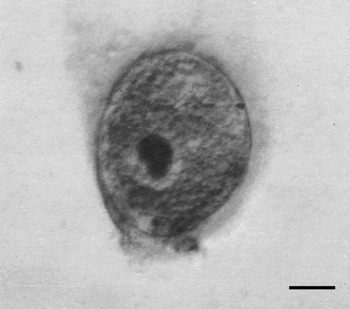
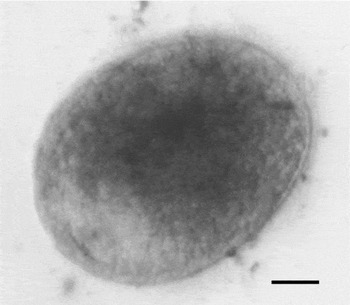
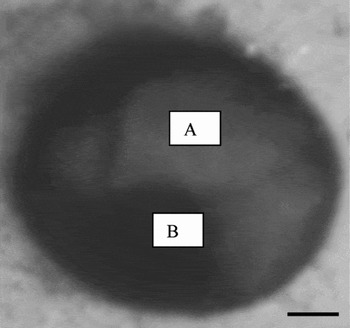
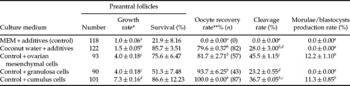
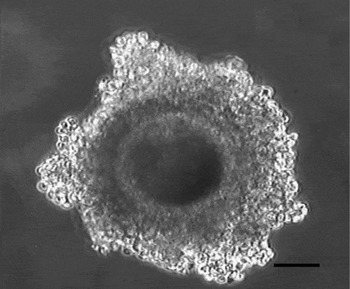
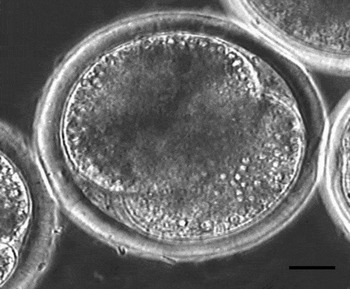
Among the different treatments there were no significant differences in the size of the preantral follicles at the start (day 0) of culture. After 100 days, the preantral follicles (Fig. 1) showed a significant increase in size in all the in vitro culture treatments (Table 1) and antrum formation (Figs. 2 and 3) was observed in the majority of cultured follicles.
Buffalo preantral follicle (scale bar: 100 nm).

Early antrum formation in buffalo preantral follicle during culture (scale bar: 100 nm).

Full antrum formation in buffalo preantral follicle during culture. (A) antrum, (B) oocyte (scale bar: 150 nm).

Effect of in vitro culture conditions of preantral follicles on their oocyte development and embryo yields

All values are in means ± SE.
a–dValues in a column with different superscripts differ significantly (p < 0.05).
Values are based on 45 replicates/treatment each with two to three preantral follicles per plot.
*Growth rate: growth in μm/day.
**Oocyte recovery rate: percentage of oocytes recovered from survived follicles after culture.
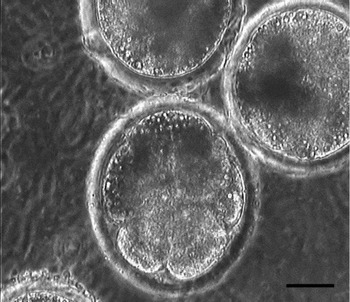
The daily growth rate was lowest in the MEM (control) culture group. Culture in the coconut water treatment significantly increased the growth rate to 1.53 ± 0.05 μm/day. The co-culture systems resulted in high growth rates of preantral follicles (4–7 μm/day). The highest growth rate was observed when the follicles were co-cultured with cumulus cells. The survival rate of preantral follicles in the MEM culture group was low (<25%), moderate in the GC co-culture (50%) and high (>75%) in the coconut water, OMC and CC co-culture systems. No oocytes were recovered from the control MEM preantral follicle culture system, but oocyte (Fig. 4) recoveries ranged from 79.6 to 100% in the other four treatment groups (Table 1). Cleavage rates for oocytes (Fig. 5) was low for those oocytes recovered from the coconut water and GC-cultured preantral follicles and significantly higher for those from the OMC and CC culture systems. Morulae/blastocysts (Fig. 6) developed from oocytes that had been recovered from the OMC and CC co-culture systems, but not from oocytes from the other treatment groups.
Good quality oocyte collected from in vitro grown buffalo preantral follicle (scale bar: 50 nm).

Two-cell embryo produced from oocyte collected from in vitro grown buffalo preantral follicle (scale bar: 25 nm).

Morula and early blastocyst produced from oocytes collected from in vitro grown buffalo preantral follicle (scale bar: 50 nm).

Discussion
The present study demonstrates, for the first time, the production of embryos from in vitro grown preantral follicles from buffalos. To date, production of pups with oocytes derived from in vitro cultured preantral follicles has been reported only for the mouse (Eppig & Schroeder, Reference Eppig and Schroeder1989), whereas in pigs, embryos could be produced with oocytes derived from preantral follicles (Wu et al. Reference Wu, Emery and Carrel2001a, b). In the present study, ovarian mesenchymal and cumulus cells were found to better somatic cells for preantral follicles co-culture in order to obtain maximum follicular growth, vitality and embryo production.
Use of preantral follicles as a source of oocytes for embryo production may be relevant for buffalo species compared with other domestic animals. This is because of the buffalo's inherent limitations in the reproductive system, such as low germ plasm reserve (Danell, Reference Danell1987) and a high rate of follicular atresia (Aboul-Ela, Reference Aboul-Ela2000), which lead to the low availability of antral follicles that are the normal source of oocytes for embryo production. Several in vitro culture systems are used for growth of the preantral follicles in different species. A culture system for buffalo preantral follicles was first reported from our laboratory (Gupta et al., Reference Gupta, Nandi, Ravindranatha and Sarma2002a), in which different growth factors, such as epidermal growth factor (EGF), fibroblast growth factor (FGF) and vasoactive intestinal peptide (VIP), were used to promote the growth and vitality of preantral follicles. In recent studies in our laboratory (unpublished data), insulin-like growth factor-I (IGF-I) was also tested for its efficacy in promoting the growth and vitality of buffalo preantral follicles. However, in our hands, these factors could not induce sufficient growth for the production of competent oocytes to develop to embryos. In preliminary studies in our laboratory, the co-culture of buffalo preantral follicles with somatic cells, such as ovarian mesenchymal cells, granulosa cells, cumulus cells or oviductal epithelial cells, led to higher growth and vitality rates compared with that of the control (without somatic cell supplementation, unpublished data). Among the four types of cells tested, the three former types of cells produced significantly (p < 0.05) better results compared with oviductal epithelial cells. We found that in an earlier study in our laboratory (Gupta, unpublished data) that the growth profile of preantral follicles in relation to time of culture, when using media containing different somatic cells, indicated consistent growth.
Embryo production using oocytes from in vitro grown preantral follicles was achieved in mice and pigs. In a study in mice, the growth of preantral follicle led to antrum formation, oocyte growth, ovulation in vitro and the birth of offspring (Eppig & Schroeder, Reference Eppig and Schroeder1989; Spears et al., Reference Spears, Boland, Murray and Gosden1994). In 2001, Wu et al. (2001a, b) reported the successful production of embryos with oocytes from preantral follicles in pigs with an in vitro culture system consisting of FSH, insulin, transferin, l-ascorbic acid and porcine serum.
In bovines, work on this aspect was limited to the antrum formation stage (Gutierrez et al., Reference Gutierrez, Ralph, Telfer, Wilmut and Webb2000). The effects of EGF, IGF-I, FSH, and co-culture with bovine granulosa cells on preantral follicular growth were analyzed, and these were found to promote growth and antrum formation by 28 days of in vitro culture. Follicular growth was halted by the slower growth of the basement membrane, as growing follicles occasionally burst the basement membrane, extruding their granulosa cells (Gutierrez et al., Reference Gutierrez, Ralph, Telfer, Wilmut and Webb2000). This phenomenon was not observed in buffalo preantral follicles in our studies. In another study in bovines (Itoh et al., Reference Itoh, Kacchi, Abe, Sendai and Hoshi2002), in which antrum formation was achieved in cultured preantral follicles, insulin, IGF-I, IGF-II, FSH, and LH all promoted growth and antrum formation in preantral follicles in serum-free medium. Compared with other previous survival studies of preantral follicles in bovine, this is the first report of the survival of preantral follicles after long-term (100 days) preantral follicle culture.
Cellular interactions in the mammalian ovarian follicle between its germ-line and somatic cell components were crucial for its development and function (Eppig, Reference Eppig1991). Somatic cells were reported to secrete certain compounds (Wu et al., Reference Wu, Huang, Tsay, Hsu, Liu, Chiou, Yen, Cheng and Ju2002) that might help in the growth of preantral follicles. Porcine cumulus and mural granulosa cells produced cumulus expansion enabling factor (Prochazka et al., Reference Prochazka, Naggova, Brem, Schellander and Motlik1998) and cumulus cells produced a diffusible meiosis-inducing substance (Guoliang et al., Reference Guoliang, Byskov and Andersen1994). Activin, a granulosa cell product, increased thymidine uptake by mouse preantral follicle granulosa cells in vitro (Li et al., Reference Li, Philips and Mather1995). Granulosa cells also produced c-kit ligand, which regulates thecal cell function, cell proliferation and growth (Parrot et al., Reference Parrot and Skinner1997). Several growth factors, viz. activin, inhibin, transforming growth factor α (TGFα), TGFβ, EGF, IGF II, FGF, platelet-derived growth factor, and interleukin-6, were found to be secreted or expressed in murine granulosa cells (Vanderstichele et al., Reference Vanderstichele, Delaey, De Winter, De Jong, Rombauts, Verhoeven, Dello, Van de Voorde and Briers1994). Mesenchymal cells express TGFα, TGFβ, keratinocyte growth factor (KGF) and hepatocyte growth factor (HGF), which could regulate granulosa cell growth during ovarian follicle development (Parrot et al., 1994; Nilsson et al., Reference Nilsson, Doraiswamy and Skinner2003; Kezel et al., 2005). KGF promoted the transition of primordial follicles to primary follicles in vitro (Kezel et al., 2005). In the present study, an increased growth for the preantral follicles, when co-cultured with somatic cells, indicated that some factors were secreted into the medium by follicles/somatic cells. As growth of preantral follicles varied in different co-culture systems, the secreting profiles of follicles/somatic cells in culture would also be different. Elucidation of these secreting factors in co-culture merits further investigation.
Addition of β-mercaptoethanol was observed to be beneficial for the growth and vitality of preantral follicles in a study at our laboratory (unpublished data). No report is available regarding the use of this compound in the in vitro culture of preantral follicles, although it has been incorporated in the in vitro maturation medium (IVM) of buffalo oocytes (Songsasen & Apimeteetumrong, Reference Songsasen and Apimeteetumrong2002). Embryos deve-loped faster and their quality was better when β-mercaptoethanol was added to the IVM medium. Incorporation of coconut water in the in vitro culture medium of preantral follicles was reported in one study of goats (Martins et al., Reference Martins, Santos, Celestino, Matos, Silva, Ferreira and Figueiredo2004), in which this solution stimulated the development of preantral follicles. However, coconut water has been added in vitro to goat ovarian cortical slices (Silva et al., Reference Silva, Van Den Hurk, Costa, Andrade, Nunes, Ferreira, Lobo and Figueiredo2004) and promoted the growth of primordial follicles and was also used for the preservation of preantral follicles in goats (Silva et al., Reference Silva, Lucci, Carvalho, Bao, Costa, Santos and Figueiredo2000) and sheep (Andrade et al., Reference Andrade, Amorim, Matos, Rodrigues, Silva, Dode and Figueiredo2002). Coconut water was also found to be suitable for use as a medium for the culture of cattle embryos (Blume et al., Reference Blume, Vale-Filho, Marques and Saturnino1998). The encouraging results obtained with coconut water solution in our study were probably due to the nutrient composition of this medium, which is rich in proteins, salts, sugars, vitamins, growth factors and plant hormones (Costa et al., Reference Costa, Santos, Ferreira, Machado, Rodrigues, Ohashi and Figueiredo2002). Coconut water contains indole-3 acetic acid (Combarnous & Nunes, Reference Combarnous and Nunes1995), an auxin that binds to certain animal growth factors, such as EGF, in the ovary and enhances their positive effects (Silva et al., Reference Silva, Van Den Hurk, Costa, Andrade, Nunes, Ferreira, Lobo and Figueiredo2004). In a recent report (Andrade et al., Reference Andrade, Seneda, Alfieri, Oliveira, Figueiredo and Toniolli2005), indole-3 acetic acid was found to stimulate growth and survival rates in preantral follicles in sheep. Ascorbic acid, a potent anti-oxidant present in coconut water (Leong & Shiui, Reference Leong and Shui2002), might also play an important role in the observed positive effect of this solution in the present study.
In conclusion, the present study demonstrates that embryos could be produced using oocytes derived from in vitro grown buffalo preantral follicles. Ovarian mesenchymal cells and cumulus cells can be used effectively for co-culturing with the preantral follicles in order to achieve higher growth and vitality rates and for the production of competent oocytes for embryo production. The biochemical characteristics of the factors secreted by somatic cells in co-culture and the elucidation of factors responsible for the development of preantral follicles in culture merit further investigation. Further studies are required to improve the embryo production rates when using oocytes derived from preantral follicles.
Acknowledgements
The authors thank the Director, National Institute of Animal Nutrition and Physiology, Bangalore, India for providing the necessary facilities for carrying out this work.