


Confronted with cases of historical wrongdoing, there are many things we can and should do. Many responses involve fostering a public dialogue and providing occasions for collective soul-searching (Barkan Reference Barkan2000). We can and should convene truth commissions to set the historical record straight (Rotberg and Thompson Reference Rotberg and Thompson2000). We can and should acknowledge past wrongs and apologize for them (Celermajer Reference Celermajer2009; Mihai Reference Mihai2013). We can and should publicly recognize the suffering, both of those wronged in the past and of those who feel their pain in the present (Booth Reference Booth2011). Such cathartic responses to past wrongdoings matter hugely (Kutz Reference Kutz2004, esp. 279–84).
But making a material response matters too (Fraser Reference Fraser1995). For wrongs far in the past, crafting such a response often proves difficult. It cannot be a straightforward matter of returning things wrongly misappropriated to their rightful owners: the rightful owners are long dead.Footnote 1 Neither is it always simple to return the stolen good to its owner's rightful successors: given the passage of time, we may be unable to determine who (if anyone) is the rightful heir, and reallocating material assets does require us to identify a legitimate successor in a way those other more symbolic responses do not.Footnote 2 Even less can we talk in terms of compensation restoring successors (if there are any, if we can find them) to the position they would have been in had the wrong not occurred: after the passage of any appreciable amount of time, we have no idea what that position would have been (Cowen Reference Cowen and Elster2006; Waldron Reference Waldron1992, 9).
Those blunt facts constitute serious barriers to restitution or compensation—the standard approaches to the material rectification of historical wrongdoing (Butt Reference Butt2009; Engerman Reference Engerman2009; Thompson Reference Thompson2001; Williams, Nagy, and Elster Reference Williams, Nagy and Elster2012). This article draws attention to another response—disgorgement—which requires solely that the fruits of wrongdoing be relinquished. People wrongfully in possession of goods should acknowledge that they have no legitimate claim to them and should be prepared to give them up. That can certainly be demanded of wrongdoers themselves (Law Commission 1997, pt. 3),Footnote 3 and it might even be required of third parties holding the fruits of a wrongdoing to which they were not themselves a party (Grantham and Rickett Reference Grantham and Rickett2003). In that limited sense, disgorgement is at least a partial undoing and rectification of the wrongdoing. It is corrective justice, in the sense of correcting one wrong (that goods are in the wrong hands) even if not the other (that goods are not in the right hands).
The advantage of disgorgement over other approaches is that, being informationally less demanding, it might be viable where those other approaches are not. For disgorgement, we need only know that current holdings are seriously tainted by grievous past wrongdoings.Footnote 4 We do not need to know exactly to whom the wrong was done, who (if anyone) is their legitimate heir in the current generation, or how well off that person would have been today had the distant past wrong not occurred.
Consider two cases that serve in this article as running examples of situations in which the conditions for disgorgement are met but those for compensation or restitution are not. The first concerns slavery. For a bricks-and-mortar example, take the College Edifice (now known as University Hall) at Brown University. According to the report of the Brown University Steering Committee on Slavery and Justice (2007, 12–13), the construction of that building
was financed through a public subscription campaign. . . . [M]any donors paid their pledges in kind. Wood for the building, for example, appears to have been donated by Lopez and Rivera, one of the largest slave trading firms in Newport. A few donors honored pledges by providing the labor of their slaves for a set number of days. [The University Curator] has found evidence of four enslaved men who labored on the building, including “Pero,” the bondsman of Henry Paget, “Mary Young's Negro Man,” “Earle's Negro,” and “Abraham,” apparently the slave of Martha Smith.
We know that today's University Hall is one and the same as the original College Edifice, which we know was built in part with lumber and labor obtained through wrongly enslaving people. If we were trying to make other forms of reparations to the heirs of the slaves, we would crucially need to know who they were and who are their descendants. In a few cases we may have this information, but in many cases we do not. For purposes of disgorgement, however, it does not matter. We know that the building stands today at least in part because of the wrongs done to the anonymous victims of Lopez and Rivera's slave trading and to Mary Young's unidentifiable “Negro Man,” just as surely as we know that it does so because of the wrong done to Henry Paget's bondsman Pero. And we know the same about a great many other buildings and fortunes built through slave labor.
For a second case, consider contemporary English holders of property resulting from enclosures of common lands. Some cases were sheer unilateral theft. Wolsey's 1517 Commission on Depopulation reports the case of Henry Smith, who in 1493 seized land in Warwickshire. According to that report, Henry Smith
enclosed the messuages [dwelling houses and out-buildings], cottages and lands with ditches and banks and he willfully caused the same messuages and cottages to be demolished and laid waste and he converted them from the use of cultivation and arable husbandry into pasture for brute animals. Thus he holds them to this day, on account of which. . . 80 persons who were occupied in. . . cultivation, and who dwelled in the said messuages and cottages, were compelled to depart tearfully against their will (quoted in Allen Reference Allen1992, 37).
Those enclosures were not only immoral but illegal: under the Depopulation Act of 1489, offenders could be prosecuted in the Star Chamber and fined heavily (Tate Reference Tate1967, ch. 11). In later centuries, enclosures came to be approved on a case-by-case basis through private acts of Parliament. But those acts still amounted to taking some people's land without their consent: Enclosure Acts required only three-quarters (or sometimes four-fifths) rather than unanimous agreement among those with rights and claims over the land being enclosed; furthermore, people's votes were weighted unequally, according to the size of their claims (Allen Reference Allen1992, 28). Although each person received a share of the newly enclosed land proportional to his or her prior rights and claims, “the cottager without [formal] legal proof of rights was rarely compensated,” and even “the cottager who was able to establish his claim was left with a parcel of land inadequate for subsistence and a disproportionate share of the very high enclosure costs” (Thompson Reference Thompson1964, 217). Most of these peasants were driven to the city, becoming industrial wage laborers in the newly emerging mills and factories.
Again, we know what land was acquired through enclosure and who is its present owner. (There are good records of land titles in England all the way back to William the Conqueror.) We know those things, even if we do not have any way of determining the rightful heirs of the displaced peasants from whom the lands were misappropriated.
Of course we could quash questions of historical injustice altogether through a statute of limitations, rendering wrongs committed long ago no longer actionable (Offe Reference Offe1992). Legally, we do that for all sorts of reasons, some principled and others pragmatic (Galanter Reference Galanter and Minow2002, 111) and not all morally of much merit (Roberts Reference Roberts2003; Reference Roberts2007). Even at law, however, there are some wrongs that are deemed to be so grievous that no statute of limitations can apply. Among them, at international law, are war crimes and crimes against humanity (UN 1968). Under domestic law, statutes of limitations typically do not apply to murder (ALI 1962, Sec. 1.06(1)) and a range of other offenses.Footnote 5 In this article I focus on historical wrongs sufficiently grievous that no statue of limitations should apply.Footnote 6
Rectifying wrongs is a matter of corrective justice. That is significantly different from—and typically takes precedence over—distributive justice. When a car has been stolen from someone who is undeservedly rich, we think that the police should nonetheless return the car to its rightful owner rather than giving it to someone else who needs it more (Goodin Reference Goodin and Chapman1991). Whatever deep relation there may be at the foundational level between corrective and distributive justice (Kutz Reference Kutz2004, 296–302; Perry Reference Perry and Horder2000), they clearly operate independently of one another on their surface.
Nonetheless, as I show, the strategy of corrective justice that I recommend for responding to historical wrongdoing makes available resources for distributively just purposes. That is true not merely of specific goods traceable to particular historical wrongdoings. General redistributive taxation might be justified as a tolerably close approximation to the requirements of disgorgement in light of pervasive past wrongdoings.
PUTTING DISGORGEMENT ON THE MORAL MAP
Before addressing the issue of historical injustice, some “mapping of the conceptual space” is required. The aim here is to identify what logically distinct options are available for responding to wrongdoing, how they are related, and how they differ.
There are three standard modes of responding to wrongdoing: compensation, restitution, and punishment.Footnote 7 In this section I place them in a taxonomy, with the aim of shining a light on a fourth mode. First I show that my two-dimensional taxonomy succeeds in capturing important respects in which those standard responses to wrongdoing resemble and differ from one another. Attention is then naturally drawn to a fourth cell created by the intersection of those two dimensions. Occupying that cell is the concept of disgorgement, the focus of this article.
Imagine a classic case of wrongdoing, in which Sam commits a wrong against Sarah. Sam gains and Sarah loses as a result. What are we to do about that? We could pursue various options, either separately or together. We could make Sam worse off, punishing him for his wrongdoing. We could make Sarah better off, compensating her for her losses. We could give Sarah back what she wrongly lost, by way of restitution. Or we could simply make Sam give up what he has wrongly obtained, using disgorgement.Footnote 8
Some of those alternatives might be morally preferable to others, either in general or for particular purposes. Perhaps some acts ought to be punished, even if the harm they have done has been or could be remedied through compensation or restitution. Perhaps some types of responses should (always, often, or in particular circumstances) be used in conjunction with one another; ideally, I would argue, we ought to make Sam give back Sarah what he has taken from her and pay her compensation for any loss beyond that. But my aim in this section is not to set priorities among alternative remedies. I aim merely to establish them as logically distinct options.
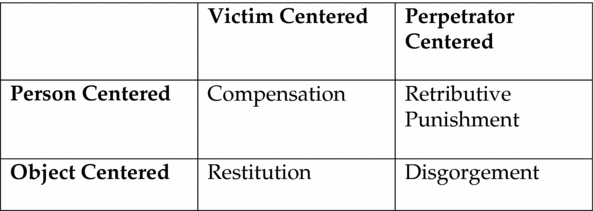
Responses to wrongdoing can be mapped in the two dimensions shown in Figure 1. In the first dimension, the response might be centered on either the victim or on the perpetrator. In the second dimension, the responses might be centered either on the persons and their welfare or on the objects and whose hands they are in.Footnote 9 Those two dimensions seem to best capture the entire range of standard responses to wrongdoing.Footnote 10
Basic Responses to Wrongs

I populate the cells in Figure 1 with illustrative practices described in terms borrowed from the law. I do so purely for the sake of having convenient, familiar labels. The exercise here is logical, not legal, and by using legal terminology, I am not attempting to invoke the law in support of my taxonomy. Nor am I claiming that this taxonomy faithfully captures all of the nuances in black-letter law that have accumulated over the centuries. My aim is merely to sketch one fruitful way of categorizing all the logically distinct possible ways of morally responding to wrongdoing, with legal practices serving as just the most concrete manifestation of that.Footnote 11
When saying that an approach is centered on persons or objects, victims or wrongdoers, the term “centered” is used advisedly. In no cases do the other elements disappear completely. Nonetheless, the center of attention for each type of response—its principal focus—is as indicated in Figure 1.
Each column and row of Figure 1 point to something that is in itself of moral importance. In responding to wrongdoing, it is morally important to make an appropriate response both to the victim and to the perpetrator, per the first dimension. The second dimension points to two distinct kinds of wrongfulness—one transitive (“the perpetrator wrongs the victim”), the other intransitive (“it is wrong that the object is in this person's hands”)—each of which again is independently morally important.
From those facts two things follow. First, an ideal response to wrongdoing would combine elements of all four cells in Figure 1. But second, because each response is of independent moral importance, we should do whatever of those things we can, even if circumstances are such that we cannot do them all.
Compensation
First consider compensation. In the classic slogan of tort law, compensation aims to “make the victim whole” again. That is the aim not merely of tort compensation but also of compensation in general.
With compensation, the focus is primarily on the victims and making them whole. True, the wrongdoers do not disappear from sight altogether: they cannot, when what we are doing is compensating victims for the results of a wrongdoing.Footnote 12 There can be no wrong without a wrongdoer, no tort without a tortfeasor. At law, tort is a private action, purely between the tortfeasor and the victim, and the wrongdoer is the sole source from which tort compensation can be extracted. Morally, we may not want to be so restrictive; socially, we have instituted various schemes for compensating criminal injuries from public coffers. Still, regardless of who pays, the point remains: no one is entitled to compensation under a criminal injuries compensation scheme unless there has been a crime, and hence there is a criminal.
Even where it is the wrongdoer who is supposed to pay the compensation, the focus of compensation is far more on the victim than the wrongdoer. Under schemes of pure compensation, compensating the victim is the end, and extracting what is required to do that from the wrongdoer would be merely the means.Footnote 13
Giving back what was taken—literally the same thing, as in paradigmatic restitution—is sometimes a good way of compensating the victim, but it is far from the only way.Footnote 14 Claims to compensation do not collapse just because the thing that was taken is no longer available to be returned.
In any case, compensation's focus is firmly on the victims and restoring their well-being, rather than (as with restitution) on the object and restoring it to its rightful place. Notice also that the victims might sometimes have lost far more than the wrongdoers gained through the wrongdoing. In such cases, for the wrongdoers to compensate their victims fully, they would have to give up much more than they wrongfully obtained—thus further underscoring compensation's focus on the victim rather than the wrongdoer.
Retributive Punishment
Punishment is another person-centered response to wrongdoing, focused in this case on the perpetrator rather than the victim. The point of punishment in its retributive mode is to make the wrongdoer worse off in consequence of the wrongdoing, thus restoring balance to the moral universe.
Typically (but not invariably) someone has been made worse off by the wrongdoing. Punishing the wrongdoer may make that person better off, either psychically (satisfaction in seeing the person who wronged him or her suffer punishment) or materially (stolen property being returned). But when it comes to punishment, benefiting the victim is not the main aim. The focus of retributive punishment is on the wrongdoers and making them worse off in consequence of their wrongdoing.
This focus is readily apparent in the punishment that the state metes out for criminal offenses. Those punishments are public actions, not private ones. They are taken by the state against the wrongdoer on behalf of society at large, rather than privately by wronged parties. Pragmatically, the success of those actions may depend on victims’ cooperation (pressing a complaint, giving evidence, and so on). But criminal punishment is not imposed for the satisfaction of the victim alone. Criminal prosecution is meted out for a “public wrong” that, as Blackstone (Reference Blackstone1765, bk. 4, ch. 1) says, “is a matter of universal concern” across the entire community. Once a criminal prosecution is underway, the victim cannot formally quash it by forgiving the wrongdoer and withdrawing the complaint. Nor is there any thought that a criminal prosecution will necessarily redound to the benefit of the victim particularly (much less exclusively and perhaps not at all). Its purpose is to punish the criminal.
In the second dimension of the taxonomy, punishment is person-centered rather than object-centered. True, the objects wrongfully acquired may be confiscated, in partial punishment for the wrongdoing. But with punishment, the focus is on the wrongdoers and diminishing their welfare, not on the objects in their own right (as with disgorgement, to be discussed in detail shortly). In any case, notice that stripping people of whatever they gained from they wrongdoing is not really punishment because that would merely ensure that the wrongdoers are no better off, whereas punishment is supposed to make them worse off for having committed the wrong.
Restitution
Different though they are in other crucial respects, punishment and compensation are both person-centered responses to wrongdoing: the former focusing on diminishing the well-being of the person who has committed the wrong, the latter on restoring the well-being of the person who has suffered it. Next consider a pair of responses that focus instead on the fruits of wrongdoing—on the objects themselves and who is in possession of them.
Restitution of the sort I discuss here focuses on the objects that the victim has lost through the wrongdoing.Footnote 15 The aim of such restitution is, first and foremost, to get those objects back to the right place—into the hands of their rightful owner.
The victim will (ordinarily at least) be made better off by having the object returned. But the object's possession, not the victim's welfare, is the focus of this sort of restitution. Restitution might even involve the return of an unwelcome object to its rightful owner.Footnote 16 Its focus is on the objects and ensuring that they are returned to the right places (viz., back in the hands of their rightful owners).
When the wrongfully displaced object still exists, restitution is a simple matter of “giving it back” to its rightful owner. Then restitution is merely a matter of “tracking” where the object has gone, in the terminology used later. Where that object itself is no longer extant, restitution is a matter of “tracing” what it has turned into and giving that back.
Disgorgement
Recall now the “torchlight strategy” underlying this taxonomy. Assuming my two-dimensional taxonomy effectively captures the three familiar ways of responding to wrongdoing just discussed, the torchlight is thus shone on an additional cell. In this cell is a way of responding to wrongdoing that is missing from that standard list of remedies for historical wrongdoing: disgorgement.
Like restitution, disgorgement of the sort here under discussion is object-centered. But whereas restitution focuses on the objects that someone has lost, disgorgement focuses on objects that someone else has gained, objects that are now wrongfully in someone else's possession. Whereas the prime injunction of restitution is to “give it back,” that of disgorgement is to “give it up.” That is to say, whereas restitution restores objects to their rightful owners, disgorgement enjoins people to relinquish objects that are wrongfully in their possession.
Again, when being forced to give up a good, the wrongdoer will (ordinarily) be made worse off. For some writers, that is precisely the point of disgorgement: to deter wrongdoers from their wrongdoing by ensuring that they get nothing out of it (Elhauge Reference Elhauge2009; Gibbs and Fleder Reference Gibbs and Fleder2003; McCall Reference McCall2006). Rationalized in that way however, disgorgement would be just another form of person-centered punishment of the wrongdoer, rather than being a distinct way of responding to wrongdoing.
Here I focus instead on another way of looking at disgorgement—a way that is genuinely distinct in its being object-centered rather than person-centered. When disgorgement is viewed in this way, its primary aim is to get goods out of someplace they should not be—out of the hands of people who hold them wrongly. If doing so makes wrongdoers worse off, that would be merely an incidental effect of disgorgement rationalized in this object-centered way.
Disgorgement can sometimes be combined with restitution, with misappropriated goods being removed from the wrong hands and returned to the right hands. But although these approaches can sometimes be conjoined, they need not always be. We can—and under the “proceeds of crime” acts we do (Australia 2002; UK 2002)—require those who are wrongly in possession of something to relinquish it, even if we have no idea to whom it should rightfully be returned.
BACKING OFF BLAME
There can be wrongful happenings (intransitive, “wrong that”) and wrongful doings (transitive, “wrong to”). States of affairs can be bad—it can be wrong for the world to be like that—without anyone having committed any wrong. Or a person can have done something wrong without being morally to blame for it. Or a person can be the wholly innocent beneficiary of someone else's wrongdoing: from that individual's own point of view, it was merely a wrongful happening that he or she came to be in possession of property that had been stolen.
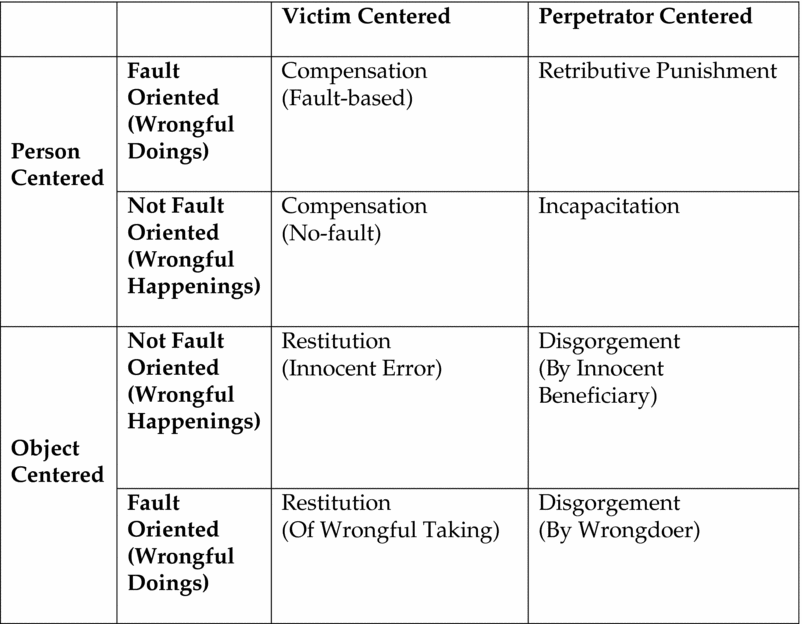
Responses to those less fault-laden sorts of cases can be arrayed along the same basic dimensions as in Figure 1: they can center either on the person or the object and either on the victim or the perpetrator. The fault-oriented responses from the previous section reappear as the top and bottom rows of Figure 2. This section focuses on the responses that are “not fault oriented” in the middle rows of Figure 2.
Fault and Responses to Wrongs
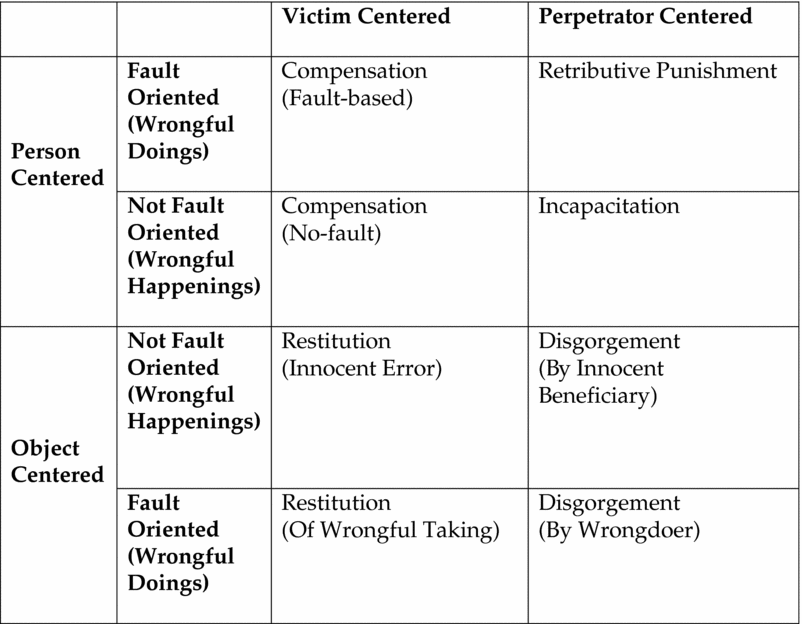
No-fault Compensation
When tort lawyers think of compensation, they are thinking of using it to remedy harm inflicted as a result of a tortious wrongdoing against the victim. But when insurance underwriters think of compensation, it is for losses that have occurred through no fault, certainly of the insured party's own or (often) of anyone else either. In one of the earliest steps toward the modern welfare state, no-fault workers’ compensation insurance replaced tort remedies for workplace injuries precisely to avoid the difficulties in proving fault in such cases (Swaan Reference Swaan1988, 177–217).
Compensation in general focuses on the victims and what it takes to restore them to their position before the harm that had befallen them. No-fault compensation simply takes that focus on the victims to its logical extreme, suppressing any inquires whatsoever into the behavior of any other people and whether any wrong has been committed. The focus of no-fault compensation is purely on the victims and making them whole again.
Incapacitation
There is a fault-free analog to punishment as well. Take the case of a person who does something wrong (he has killed someone, say) but who fails some of the criteria for ascriptions of responsibility (he is legally incompetent to plead, say), so he is not to blame for what he has done. Insofar as he has done something wrong (and especially if he is likely to do so again), such a person may need to be confined to prevent harm to himself or to others. But in the absence of fault or responsibility, that should be conceived of as fault-free incapacitation rather than fault-based retributive punishment.
Like punishment, incapacitation is a person-centered, perpetrator-centered response to the wrongful happening. Unlike retributive punishment, however, the aim of incapacitation is not to make the perpetrator suffer for any faulty performance. In the case of incapacitation, that person-centered perpetrator centeredness instead concerns the perpetrator's future conduct. True, insofar as the deprivation of liberty is bad, the person so confined is made worse off in consequence. But diminishing the perpetrator's well-being is incidental to the purpose of fault-free confinement, the main aim of which is to avert future harm from further actions for which he could not be blamed.
Restitution of Innocent Error
Sometimes restitution of the sort I have been discussing concerns goods that have been misappropriated through a wrongdoing. Other times restitution concerns goods misdirected through innocent error. A classic example is a case of wine that is delivered to your house by mistake. Full restitution would require you to relinquish it to its rightful owner, even though neither you nor anyone else has committed any wrong against anyone. True, the delivery person got something wrong (the delivery address). A wrongful happening has occurred; the wine ended up at the wrong door. But that was merely a mistake, an innocent error to which no fault attaches.
This form of restitution, like its fault-based counterpart, is object-centered rather than person-centered. When making restitution of goods supplied through an innocent error, one person is indeed made worse off and another better off. But neither of those effects is really the main point of the exercise, as here understood. The main aim of this sort of restitution, whether or not fault was involved, is simply to get the objects back into the right hands—those of the rightful owners.
Disgorgement by Innocent Beneficiary
Just as all those more familiar responses to wrongdoing come in both fault-based and non-fault-based forms, so too does disgorgement. With disgorgement, the fault-free form arises when someone is innocently in possession of something that has come to him or her as a directly traceable result of someone else's wrongdoing. Disgorgement could be required in this case, even though the innocent beneficiary is in no way at fault.
Ex hypothesi, in such cases, there was a wrong committed somewhere along the line. But, also ex hypothesi, the innocent beneficiaries are in no way to blame for that wrongdoing. It is nonetheless wrong that they have that object, even if they themselves did nothing wrong to get it. And the sheer fact that it is wrong for them to have it can be sufficient reason for them to be morally required to relinquish it.
Maybe innocent beneficiaries should not always be morally required to relinquish the object. “Good faith purchasers” are often allowed to retain (or are compensated for being required to relinquish) goods that they had no way of knowing were stolen at the time of purchase; that is particularly so if they have innocently done something subsequently to make themselves reliant on those goods’ continuing possession (Levmore Reference Levmore1987’ Seavey and Scott Reference Seavey and Scott1937, §§172–76). Beneficiaries who are innocent only in the sense of not being implicated in the original wrongdoing, but who knew (or could and should have known) that the goods were stolen, can much more reasonably be morally required to disgorge them (Luban Reference Luban1999; Smith Reference Smith1983).
Disgorgement of this sort focuses on the object, not the person. It aims simply to remove the object from somewhere it does not belong. From this perspective, people who find themselves wrongly in possession of an object must relinquish it, even if they are innocent of any wrongdoing in obtaining it. The innocent beneficiary should be required to “give it up,” just as the recipient of goods through innocent error should be required to “give them back.”
As with restitution, the duty to disgorge applies not only to the specific object that was wrongly misappropriated but also to whatever else it has since turned into. So the same sort of “tracking” and “tracing” described in connection with restitution is also required in the case of disgorgement.
DIFFERING INFORMATIONAL DEMANDS
Possible ways of responding to wrongdoing thus differ in many respects, and those differences may morally matter. But before going to great lengths to rank responses or mixes of approaches, we ought first to check to see whether it would actually be feasible to implement them.
Often it is possible to implement some responses but not others. With wrongdoings that are far in the past, constraints are commonly such that disgorgement is the only response that is implementable. I do not claim that “disgorgement alone” is morally superior to all those other responses or any mix of them. Quite the contrary: my claim is merely that disgorgement is often possible where other responses are not—and that it is better to make some response to wrongdoing rather than none, when no other response is possible.
A main constraint on the ability to implement the alternative responses is the kind of information that each requires. Informational demands systematically vary across those responses. Among the viable responses to historical wrongs—compensation, restitution, and disgorgementFootnote 17 —compensation is informationally the most demanding and disgorgement is the least.
An ideal response would combine disgorgement with elements of all of the others.Footnote 18 But in the nonideal circumstances of distant historical wrongdoing, information is often insufficient for the other sorts of responses. Still, disgorgement is an important aspect of corrective justice in its own right: it gets things out of the hands of people who wrongly possess them. If that is all we can do, we should do that much.
To see just how informationally demanding it would be to try to respond to historical wrongs through full-bore compensation, we need look no further than Nozick. He famously analyzes the justice of a state of affairs in terms of the history of how it came about. “A distribution is just if it arises from another just distribution by legitimate means,” Nozick (Reference Nozick1974, 151) writes. He offers this analogy:
As correct rules of inference are truth-preserving, and any conclusion deduced via repeated application of such rules from only true premises is itself true, so the means of transition from one situation to another specified by the principle of justice in transfer are justice-preserving, and any situation actually arising from repeated transitions in accordance with the principles from a just situation is itself just.
The opposite, of course, is also true. If the starting point or if any one of the subsequent transitions is unjust, then that renders unjust the resulting state of affairs. Nozick freely admits that there are many “actual situations” of which that is true.Footnote 19
On that view—which I take to be true, for derivative reasons even if not the foundational ones Nozick imaginesFootnote 20 —the only way to restore justice in the face of historical wrongs is to backtrack and literally undo all the wrongs. Here is Nozick's (Reference Nozick1974, 152–53) specification of what would be entailed in rectifying wrongdoings in that way:
Idealizing greatly, let us suppose theoretical investigation will produce a principle of rectification. This principle uses historical information about previous situations and injustices done in them. . ., and information about the actual course of events that flowed from these injustices, until the present, and it yields a description (or descriptions) of holdings in the society. The principle of rectification presumably will make use of the best estimate of subjunctive information about what would have occurred (or a probability distribution over what might have occurred, using the expected value) if the injustice had not taken place. If the actual description of holdings turns out not to be one of the descriptions yielded by the principle, then one of the descriptions yielded must be realized.
Knowing all of that information is a very tall order. Thus it comes as no surprise when Nozick says, “I shall not attempt that task here.” No one else has either, and they have turned instead to other approaches for dealing with large-scale historical injustices (Lyons Reference Lyons1977; Sher Reference Sher1981, 4; Simmons Reference Simmons1995, 156; Thompson Reference Thompson2001).
With that as the job description, no argument for rectification is likely ever to be up to the task. But that job description is unnecessarily demanding. We need only broaden the class of responses beyond compensation, which is the sort of rectification to which Nozick's job description applies. Compensation is only one of several possible responses to historical wrongs. With other responses, informational demands are appreciably fewer.
Full-bore compensation would require us to know all the following things that Nozick lists:Footnote 21
-
1. We would have to know (a) who did what (b) to whom.
-
2. We would have to know all of the consequences that followed from that.
-
3. We would have to know all the counterfactuals concerning what would have happened had the wrong not occurred.
-
4. If the principals are no longer alive, we would have to know who (if anyone) in the current generation has inherited (a) the responsibilities and (b) the claims of each of the individuals involved in the original wrongdoing.
Restitution requires us to know some—but not all—of that information. We would still need to know items 1, 4, and some version of 2.Footnote 22 But for purposes of restitution we do not need to know all the complicated counterfactuals involved in item 3.
Recall that restitution is object-centered rather than person-centered. Remedies such as compensation that are person-centered focus on how well off people are compared to how well off they would have been, had the wrongdoing not occurred. Suppose the Maori from whom land was stolen would, for sure and certain, have “lost it in a poker game” next week (Waldron Reference Waldron1992, 9). Then he is only a little worse off (by a week's enjoyment of the land) than he would have been had the land not been stolen, and he would be owed little compensation for its theft, in consequence. When thinking in terms of people and their well-being (what it would take to “make them whole” again), that is the sort of counterfactual that compensation requires us to contemplate. And validating a wide range of such counterfactuals is of course a very tall order. It is the most arduous part of Nozick's list of informational demands and what leads us naturally to join him in throwing up our hands in despair.
Restitution requires no such counterfactualizations. Its focus is on the object and on where it currently sits compared to where it properly belongs, rather than (as with compensation) on the person and how well off the individual is compared to how well off he or she would have been. The concern of restitution is to get the object back into the hands of its rightful owner. Restitution brooks no question about what that owner would have done with the object, had it not been wrongly taken. Suppose the Maori really would have gambled away the land (as indeed he did all his other possessions) in a poker game the very next week. From the point of view of restitution, that would be entirely beside the point. That “he would not have had the land now anyway, even if I had not stolen it” is not an argument that restitution will entertain for not returning it to him now.
By bracketing as it does all such counterfactual considerations, restitution makes fewer informational demands than does full-bore compensation. But restitution still requires information about items 1, 4, and some version of 2. In particular, unlike disgorgement, restitution requires knowledge of “from whom” the object was wrongly acquired (in item 1) and “to whom” the object should be restored in the current generation (in item 2). Neither is straightforward. Recall the story of the Brown College Edifice: we do not even know the names of some of the slaves who helped build it, much less who their successors today might be. Or consider the 80 Warwickshire peasants displaced by Henry Smith's illegal 1493 enclosure, whose names are lost to history.
Disgorgement makes even fewer informational demands yet again. Being object-centered, disgorgement—like restitution—has no need for the complex counterfactuals in item 3 that full-bore compensation requires. Like restitution, disgorgement still requires knowledge of (some, indeed the same, version of) item 2. But whereas restitution, like full-bore compensation, requires knowledge of both components of items 1 and 4, disgorgement requires only half as much in each case.
Restitution requires information about both sides of the dyad, in both cases: both “who wrongly acquired the object from whom?” and “who has inherited the responsibility to restore it to whom, in the current generation?” With disgorgement, the “whom” parts of both 1 and 4 drop away, and the “who” of 1 does as well. All that we need to know is the following: (1) This object was wrongly removed from some rightful owner (we do not need to know who committed that wrong, but merely that the wrong was committed), and (2) this person's present possession of it is traceable to that wrongdoing. We know those facts about the College Edifice at Brown. What is now called University Hall is the same structure as the one built with slave labor and the proceeds of slave trafficking. We know that the land in Warwickshire was wrongfully taken from commoners by Henry Smith's enclosure and passed down to its present-day owners.
FOLLOWING OBJECTS THROUGH TIME
Disgorgement thus dispenses with many of the informational demands made by other responses to wrongdoing. There is no need to know all the counterfactual information that is essential for full-bore compensation. There is not even any need to know who was the victim or who is the victim's successor or what claims they may have in the current generation (which compensation and restitution would both require). Disgorgement does nonetheless pose one crucial informational demand: it requires that we know that that object that you hold is traceable to the fruit of previous wrongdoing, either as the fruit of that wrongdoing or the successor to it.Footnote 23 Then and only then can we require you to disgorge it, on the grounds that your title to it has been tainted.
Finding the Fruits of Wrongdoing
Corrective justice requires people to disgorge what they obtained as a result of wrongdoing.Footnote 24 But understanding “as a result” purely causally would make the requirement far too strong. It is not the case that everything that comes causally downstream of a wrongdoing necessarily needs to be relinquished.
Imagine a couple of variations on the story of Henry Smith. His wrongful 1489 enclosures drove many peasants off that land, and in consequence Smith had far fewer neighbors from whom he could catch the plague that struck 20 years later. Suppose that in consequence Smith survived to inherit the estates of a kinsman killed by the plague. Had Smith not wrongfully enclosed the commons and driven away the peasants, he too quite probably would have died. His inheritance would then be causally downstream of his wrongdoing. Still, his newly inherited land would not bear the right sort of relationship to the wrongdoing (enclosure of the other land) for a requirement of disgorgement to apply. Smith's newly inherited land is something he obtained in consequence of his wrongdoing, rather than in any way being something that he obtained in the course of that wrongdoing.
Contrast that with this other version of the story. Suppose Henry Smith sold his country estates, made much more valuable by the enclosures, and invested the proceeds in ships that made him a great fortune. The proceeds of that investment—as direct products of the money that came directly from the sale of the illegally enclosed commons—do look like something we would reasonably require Smith (and arguably his heirs) to disgorge as the proceeds of crime.
Thus, there may be all sorts of benefits that are attributable in some causal way to an act of wrongdoing (by yourself or others) and to how that act intersected with the rest your life. Not all of those benefits are properly regarded as fruits of that wrongdoing, however, or hence are properly subject to disgorgement. Identifying the fruits obtained in the course of wrongdoing—and tracking and tracing them and their successors through time—is therefore an essential part of disgorgement.
Tracking and TracingFootnote 25
Disgorgement and restitution are both object-centered responses to wrongdoing. They focus on the object, with restitution saying “give it back” and disgorgement saying “give it up.” In both responses, therefore, the identification of “it” is of signal importance.
Sometimes the identification of the object to be given back or given up is a simple matter just of trackingFootnote 26 the same physical object as it passes from one person to another. Other times, it is a slightly more complicated matter of tracking the physical object as it goes through physical transformations. The land that Henry Smith enclosed and took as his own is the same parcel of land today, even though a factory now sits on the site. Nothing essential has changed, the identity conditions defining a plot of land solely by its geographic coordinates.
In yet other cases, one object is swapped for some wholly different object. To determine what you have to give back or give up in such cases, we do not track the same physical object through time and space. Instead, we look for the new things that have taken the place of the old. Sometimes substitutions are “clean, uncomplicated swaps,” with one object or set of objects simply being exchanged for the old. Imagine, for example, that the proceeds of Henry Smith's sale of the wrongfully enclosed lands went into the purchase of his shipping fleet, without remainder. Other times the substitutions are “mixed,” as would have been the case if Henry Smith bought those ships with the combined proceeds of the sale of his Warwickshire estates and of other untainted properties elsewhere.Footnote 27
The fundamental point is simply this: the duty to give it back or give it up does not necessarily lapse when “it”—the original physical object—is no longer available to be given back or given up. The same duty extends to whatever can be shown (through some suitable procedure tracing the substitution of one thing for another) to have taken the place of the original.
Whereas “tracking” is of physical objects, “tracing” is of something more abstract. “The only connection” between the old thing and the new, in such cases, is “that. . . the new thing . . . was acquired with the original thing” (Smith Reference Smith1997, 15). What we are tracing is the value that is embodied in the one thing, which is exchanged for the value embodied in another (Birks Reference Birks and Birks1995, 300; Smith Reference Smith1997, 15).Footnote 28 Thus, in the example just given, we can trace “the land that Henry Smith wrongfully enclosed” through “the ships he bought with the proceeds of their sale” to “the fortune that he subsequently came to enjoy and pass on to his heirs.” That fraction of the fortune traceable to the wrongdoing of Henry Smith should accordingly be subject to a duty of disgorgement.Footnote 29
EXTINGUISHING TAINTED TITLE
Disgorgement can be analyzed in precisely the same manner that Nozick's logic would have us analyze rectification in general. In the process of original acquisition and the subsequent transfer, one seriously wrong step anywhere along the line prevents the process from being “justice preserving.” One seriously wrong step anywhere along the line suffices to taint the holder's title to the object.
What happens to titles that are tainted? They are extinguished;Footnote 30 they are rendered void. If your title to an object is tainted, then the object is not rightfully yours. Your have no legitimate claim to it, and you may properly be required to relinquish it.Footnote 31
Back into the Common Pool
But relinquish it in favor of whom? Not any other particular person, as with restitution. In the process of disgorgement, property is relinquished simipliciter, without its being transferred to anyone. That means simply that the property in question passes back into the common pool of unowned things. In practice, that means that the property passes back to the state, as the agent with responsibility for overseeing that common pool.
For an analogy, consider the common law doctrines of escheat and bona vacantia. According to those doctrines, property passes back to the Crown when someone dies intestate or when undistributed assets of dissolved companies remain unclaimed for a certain period (Blackstone Reference Blackstone1765, bk. 2, ch. 15; UK Crown Estate 2012; UK Treasury Solicitor's Office 2012). Many U.S. states deal similarly with unclaimed property. Similarly, the proceeds of crime can be confiscated by the state (Australia 2002, pt. 2–2; UK 2002, pts 2–3).
My proposal is that the same should be the case with property disgorged as the result of grievous wrongdoing. It should be relinquished in favor of “the public,” rather than of any particular individual as plaintiff (cf. Grantham and Rickett Reference Grantham and Rickett2003; Worthington Reference Worthington1999).
Reallocating Relinquished Goods
We tend to think of titles to property as being, first and foremost, things that are transferred from one person to another. That is our everyday experience of property law when we buy and sell houses and cars. But of course, behind all that transferring of titles stands a prior question.
Any theory of property based on the legitimate transfer of titles needs a theory concerning how legitimate titles are created in the first place. An analysis of just transfers as justice preserving only makes sense against the backdrop of some theory of just original acquisition. That is what gives rise to the “justice” that just transfers are preserving.
That theory of justice in original acquisition (whatever particular form it may take) tells us the terms on which we may legitimately take things out of the common pool of unowned things and call them our own. Suppose title to some object has been extinguished, owing to something that is seriously wrong in its original acquisition or in subsequent transfers. What then happens is that the object simply passes back into that pool of unowned things.Footnote 32 It is then available for allocation anew, according to whatever rules justly govern original acquisition and the distribution of titles to objects in the first place.Footnote 33
Permitting Continuing Possession pro tem
Although what we subsequently do with the objects disgorged is governed by principles of justice in original acquisition (which is a branch of distributive justice), disgorgement itself is a matter of corrective justice. Disgorgement corrects grievous wrongs by extinguishing a person's title to an object, if that title was tainted anywhere along the line. The present possessors may not themselves have done anything wrong. But if a “clean title” is what is required for their current possession to be legitimate, and their title is unclean in some respect that continues to be relevant (i.e., no statute of limitation rightly applies), then they have no legitimate claim to the property.
Even if in principle they ought therefore to disgorge it, we may nonetheless leave it in their hands pro tem, until we get around to allocating it anew. Blackstone (Reference Blackstone1765, vol. 1, Introduction, sec. 4, 105) says something similar about property titles in newly conquered lands (his particular referent being England immediately after the Norman Conquest). Similarly in postcommunist societies, people were typically allowed to remain in residences they had been allocated by the old regime, at least until the new authorities got around to allocating them to someone else (e.g., in restitution of earlier seizures).Footnote 34
Balancing Considerations
Certain considerations may favor leaving the property in the hands of the present possessors, certainly pro tem, and perhaps on further consideration for the long term.
One might be that the current holders themselves did no wrong in acquiring those goods. Their title is tainted, to be sure—but by acts performed by others long before they were born. Maybe that matters, sometimes or at the margins, even if in general there is as strong a case for disgorgement by innocent beneficiaries of others’ wrongdoing as there clearly is for restitution by beneficiaries of others’ innocent errors.
Another such consideration might be that the present possessors had no reason to suspect that their title was tainted, and their lives have become deeply entwined with the property during that period of unavoidable ignorance. Such people are akin to good faith purchasers of property that later turns out to be stolen (Levmore Reference Levmore1987) and may, once again, have some legitimate claim to continuing possession.
Even when tainted property would in principle be properly subject to a duty of disgorgement, such considerations might often lead us either (or both) (1) to leave it in the hands of present possessors or (2) to require them to disgorge it only partially or to pay money in lieu.
Forms of Disgorgement: In Kind or Cash in Lieu
The classic form of restitution is returning the object itself. But where “specific restoration” of the object itself is impossible or undesirable, payment of money in lieu can be required (Seavey and Scott Reference Seavey and Scott1937, §4). So too with disgorgement. The classic form would be relinquishing the object that is wrongly possessed. But that may be impossible or undesirable for some reason of policy or principle such as just discussed. Then, as with restitution, disgorgement may be done via cash in lieu.
Taking money rather than the object itself might seem odd, given that disgorgement is supposed to be a fundamentally object-centered remedy. But remember, it is to the value of the wrongfully misappropriated object that we look when tracing its subsequent substitutions, transformations, and mixings. In such cases, disgorgement amounts to surrendering that value, and thus surrender of cash in lieu is a wholly fitting remedy.
That payment might take various forms. It could be a one-off levy, a capital sum constituting disgorgement in full, or a series of installments designed eventually to accomplish the same.Footnote 35 Or it could be an annual charge, constituting in effect “rent” for the proportion of people's holdings that are not properly “theirs” but rather are the public's (the present possessors’ title being tainted and hence extinguished).
Distributing the Proceeds of Disgorgement
How ought we then disperse the proceeds? Remember, it cannot be a matter of giving it back to those from whom it was taken or to their heirs—in the cases here, we lack information concerning their identities.
Let us focus first on the form of disgorgement referred to earlier as “in kind.” In these cases, the specific object that was wrongly misappropriated can be tracked down, and it is that very object that is to be disgorged. The present possessor's title to that object is tainted and therefore extinguished. The object passes back into the common pool of unowned things, to be distributed anew according to the same principles of justice as are operative for distributing anew anything else in our society.
Those principles are an essential subset of society's principles of distributive justice. No subsequent transfer of objects can be deemed distributively just without there being some principle of justice in original acquisition in the first place. (Without that, we cannot say who is entitled to transfer title to someone else.) As regards specific objects that are disgorged-in-kind, therefore, the connection between disgorgement and distributive justice is purely analytic. Allocating those objects anew can only be done according to society's principles of distributive justice, specifically those pertaining to justice in original acquisition.
That is not to say, of course, that the principles adopted for that purpose in any given society are the right ones from any external moral perspective. Here I am making merely an internalist point: whatever principle a society uses for allocating unowned objects from the common pool to particular people, that principle functions as (and is regarded from the inside as) that society's principle of distributive justice pertaining to original acquisition. And any society that adjudges the legitimacy of present holdings wholly or partly by reference to a history of legitimate transfers must logically have some such principle in place.
On the face of it, things might seem more complicated with respect to the other form of disgorgement: the payment of cash in lieu of handing over the wrongfully held object itself. Again, handing over the cash to those who were wronged or their successors is not an option (we lack information as to who they are). Still, there are all sorts of other things we might do with the money. We might use it to fund transfers to the needy. Alternatively, we might just put it into general fund revenues or use it to build bridges or cut taxes or pay off the national debt or wage wars or send humans to Mars.
It is tempting—but mistaken—to regard the first use and that first use alone as “using the money for distributively just purposes.” Justice in distribution is not merely a matter of putting money into the pockets of the poor, however important a part of distributive justice that is. Distributive justice, rightly understood, refers instead to “the right distribution of social resources” among all the uses to which those resources might properly be put.Footnote 36 “Right” there is not to be equated with “rights” or confined to claimants with rights. It ranges across all legitimate purposes to which public resources might properly be committed.
When distributive justice is understood in that expansive way, it is once again analytically true that, by freeing up resources that are passed back to the public to be disbursed in whatever rightful ways, disgorgement necessarily frees up funds to be used for subsequent just distributions. That is not to say that the cash relinquished through disgorgement will necessarily be spent on improving the plight of the poor. That is simply too narrow a way of construing what constitutes justice in the distribution of public resources. That said, of course many of us believe (and hope that the societies in question will concur) that aiding those who are least well off is an important part of distributive justice and that they should have a strong claim on resources freed up through disgorgement.
Many will also believe that some element of corrective justice should enter into the decision to allocate those resources. Making compensation or restitution directly to the victims themselves or their successors is not possible because we lack information as to who they are. Still, corrective justice of a sort might be pursued through special provisions to assuage groups of people who are similar in some way to (or who feel an affinity with) those whose being wronged occasioned the disgorgement. Proceeds of the sale of disgorged art stolen by the Nazis from heirless Jews, for example, are put into a fund providing support to Holocaust survivors (O'Donnell Reference O'Donnell2011).
We might do something similar in the two cases I have been discussing throughout this article. We might require disgorgement of the value of edifices, estates, and fortunes amassed through slave labor or wrongful enclosures, typically in the form of cash reflecting the current unimproved value of the objects wrongfully taken. We might then use the disgorged resources to benefit blacks in the United States or the unemployed in the United Kingdom.
MORE AND LESS ROUGH APPROXIMATIONS
Nozick concedes that many people's titles have been tainted somewhere along the line. He speculates briefly that schemes of redistributive justice might be justified as a rough-and-ready remedy to rectify that fact. But he quickly dismisses that thought, given the heroic assumptions that would be required.
“Lacking much historical information,” Nozick (Reference Nozick1974, 230–31) considers the following proposal for approximating rectificatory justice:
[A]ssuming (1) that victims of injustice generally do worse than they otherwise would and (2) that those from the worst-off group in the society have the highest probabilities of being the (descendants of) victims of the most serious injustice who are owed compensation by those who benefited from the injustice (assumed to be those better off. . .), then a rough rule of thumb for rectifying injustices might seem to be the following: organize society so as to maximize the position of whatever group ends up least well-off in the society.
As with Nozick's job description for a theory of complete rectificatory justice quoted earlier, so too with this elaboration of what would be required to justify general redistribution as an approximation to it: Nozick's point in elaborating these assumptions so fully is to emphasize just how tenuous they are. The redistributions envisaged would simply be too rough as approximations to the true requirements of rectificatory justice for them to be justified in this way.
In saying that, however, Nozick clearly is once again thinking of rectificatory justice narrowly in terms of compensation, and of general schemes of redistribution as a rough approximation to that. Were compensation or restitution our aim, we would indeed have to know (or assume) something about identities and counterfactuals in all those ways. Where the requisite historical information is sorely lacking (as typically it is, in cases of wrongdoings far in the past), I quite agree that we should indeed set considerations of compensation and restitution aside, rather than making any so heroic assumptions about what those facts might have been.
Setting compensation and restitution to one side, however, one aspect of corrective, rectifatory justice still remains—and that is disgorgement. Being less informationally demanding than those other two approaches, disgorgement can still sometimes be pursued—either perfectly, or anyway much less approximately and with far fewer problematic assumptions. I consider each case in turn.
Perfect Partial Corrective Justice
Often enough, we have conclusive evidence that someone's present holdings are traceable to some grievous wrongdoing somewhere in the past. Recall the enclosed lands in Warwickshire and Brown's University Hall. Given such evidence, we could be justified in requiring those holdings to be disgorged and returned to the “common pool,” to be distributed anew according to our society's ordinary standards of what constitutes the “right distribution of social resources.” Insofar as present holdings are only partially traceable to grievous wrongdoings somewhere in the past, we would be justified in taxing away that part of their value, using the proceeds in similar fashion.
Such a program of disgorgement-and-just-distribution-anew constitutes not a rough approximation, but instead a program of “perfect partial corrective justice.” The justice is partial, insofar as it omits considerations that do indeed morally matter. Those omitted considerations should certainly be incorporated in an ideally just response to historical wrongdoing. But if the informational requirements for implementing that ideal are not met, so be it. Let us focus on such aspects of corrective justice that we can implement.
Although only “partial” in that respect, disgorgement-and-just-distribution-anew provides justice that is “perfect” at least so far as it goes. Where we have conclusive evidence tracing some object or value to the fruits of wrongdoing, title in it is tainted and hence properly extinguished. It is perfectly just, in corrective justice terms, to require that the present possessors relinquish it (or give cash in lieu), putting that object back into the “common pool.” And then it is perfectly just, in distributive justice terms, to distribute anew the contents of that common pool of unowned things according to whatever principles we have for “the right distribution of social resources.”
Disgorgement, Epistemic Modesty, and Redistributive Taxation
A rule of disgorgement-and-just-distribution-anew can serve a socially important purpose, even where we do not have conclusive evidence connecting historical wrongdoing to present holdings, such as would be required to implement that rule directly.
For a start, that rule puts people on notice that, if their title turns out to be seriously unclean (tainted by grievous historical wrongdoings to which no statute of limitation should apply), then their current holdings can legitimately be taken away from them. Most people have reason to suspect that at least some of their holdings were quite probably tainted in some serious way, when they go back far enough. Furthermore, it is not only inherited physical property that might be tainted in this way. The knowledge and know-how that form the core of “human capital” transmitted from one generation to the next through education and training might likewise have been initially acquired or subsequently transmitted through some highly discreditable processes somewhere along the line.
Knowing (or even just reasonably suspecting) that grievous wrongdoings in the past may have tainted their present title in their property and that they could rightfully be required to disgorge it in consequence, people should know that they have no very strong complaint against having some (perhaps a fair bit) of their property taxed away for some just public purposes. It may well be that it is not really “theirs” anyway. They may well just hold it on sufferance, as pro tem possessors. Appropriate epistemic modesty about the legitimacy of their title ought negatively at least to blunt people's complaints at having some of “their” property taken from them in taxes.
Indeed, we might positively justify redistributive taxation as a reasonable approximation to what disgorgement would require if only we could collect the requisite evidence.Footnote 37 When Nozick contemplated such a strategy for approximating the requirements of full-bore compensatory justice, he concluded that the assumptions required were just too strong and the approximations therefore simply too rough.
This characterization is not correct when thinking in terms of disgorgement instead of compensation. For a redistributive tax to be justified as a good approximation to disgorgement, the only assumption that is required is that much of what has been passed down to us has quite probably been tainted by some pretty grievous wrongdoing somewhere along the line. Who can seriously doubt that?



Comments
No Comments have been published for this article.