

Introduction
A bit facilitates a rider's control of the horse's speed, direction of movement and degree of self-carriage. The subtlety of the communication via the bit increases with the level of skill of the rider and training of the horse. The use of a bit and the manner in which it is adjusted within the horse's oral cavity have implications not only in the performance arena but also for equine welfare. In some sports, the horse's reaction to the bit is assessed as a component of the judge's score; for example, the objectives and general principles of dressage include ‘acceptance of the bit, with submissiveness/thoroughness’. However, this is not intended to imply that the mouth has to be totally quiet; it was later stated that ‘the horse may quietly chew the bit’1. In order to perform optimally, the horse should be comfortable with the size and shape of the bit, the way the bit is fitted, the amount of tension applied to the reins and the mechanical effects of that tension.
The presence of a bit has been implicated in the aetiology of clinical problems such as head shaking, dorsal displacement of the soft palate, exercise-induced pulmonary haemorrhageReference Cook2 and buccal ulcersReference Tell, Egenvall, Torbjörn and Wattle3, all of which are associated with obvious clinical signs. The presence of a bit and/or the application of excessive tension has also been associated with behaviours that are generally regarded as indicative of discomfort, such as drawing the nose back onto the chest, opening the mouth, grasping the bit between the premolar teeth, grinding the teeth, putting the tongue over the bit and sticking the tongue outReference Johnson4. These behaviours are readily visible to an observer, but there may be other more subtle intra-oral behaviours that are not visible externally. Knowledge of bit action and behavioural responses is helpful to horse owners and trainers in selecting the appropriate bit for an individual horse with the objectives of maximizing performance without compromising welfare.
The dense materials used in bit construction are readily visible radiographically, and fluoroscopic studies have been used previously to describe the position of a variety of bits relative to anatomical structures in the horse's oral cavityReference Clayton and Lee5–Reference Manfredi, Clayton and Rosenstein7. The study described here continues this line of research. The specific objectives were to use fluoroscopy to compare intra-oral behaviours in response to the presence of three bits with different mechanical actions, and to determine changes in behaviour elicited by rein tension comparable to that exerted by side reins. The experimental hypotheses are that the application of 25 ± 5 N rein tension affects the amount of time horses spend in different intra-oral behaviours, and that each type of bit is associated with specific patterns of behaviour.
Materials and methods
The experimental protocol was approved by the university's animal ethics committee under protocol 05/02-078-00.
Subjects
The subjects were six horses: one Oldenburg, one Trakehner, three Thoroughbreds and an Andalusian (age: 4–16 years; height: 152–161 cm; mass: 475–523 kg) that had at least 1 year of dressage training, and were capable of performing a novice dressage test. Each horse had been ridden in all three of the bits used in the study during the month preceding the data collections.
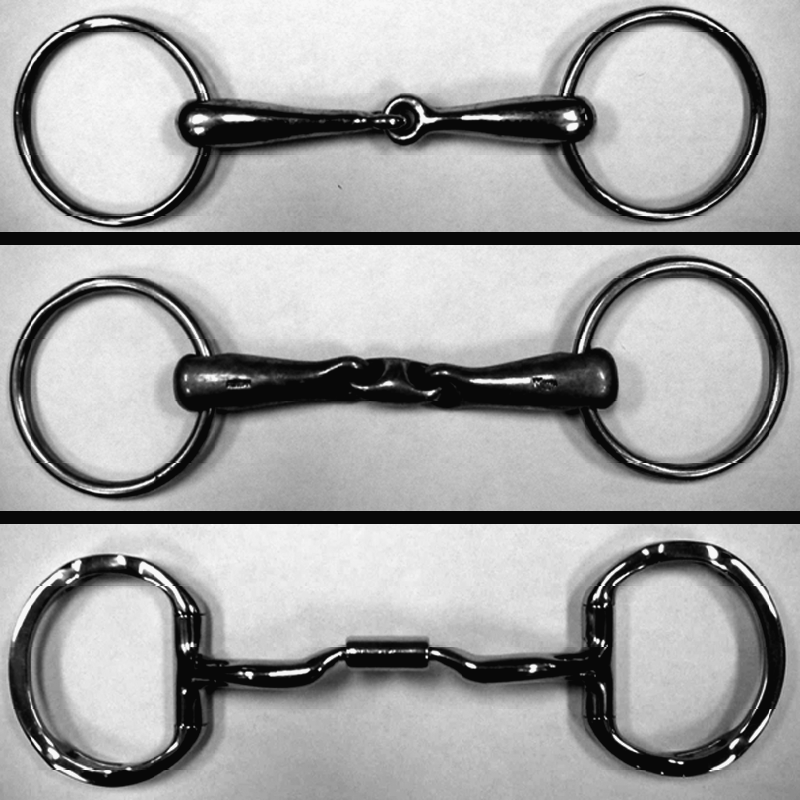
Three bits (Fig. 1) were selected for evaluation: a single-jointed snaffle; a double-jointed KK Ultra bit and a Myler low-port comfort snaffle. The single-jointed snaffle had a hollow mouthpiece with a loose ring attachment to the cheek pieces of the bridle. Single-jointed bits are purported to work via a ‘nutcracker’ action on the bars of the mouth when pressure is appliedReference Knox-Thompson and Dickens8. The KK Ultra (Herm Springer GmbH, Iserlohn, Germany) is a double-jointed bit with a short, oval-shaped, central link oriented at an angle to the left and right cannons of the mouthpiece (Fig. 1), which allows the link and its joints to lie flat on the horse's tongue. The Myler comfort snaffle (Mylers, Inc., Marshfield, MO, USA) avoids any hinge or nutcracker effect by encasing the central part of the mouthpiece in a barrel that lies flat on the tongue. The cannons swivel around the longitudinal axis of the barrel, but preclude any hinge-like motion that would move the two cannons closer together.
Photographs of the three bits used in the study. Above, jointed snaffle; middle, KK Ultra; below, Myler comfort snaffle

The horses were individually fitted with appropriately sized bits and a bridle according to the following criteria. The width of the bit was determined by measuring the intra-oral distance between the left and right commissures of the lips, and by selecting a bit that was the same width or up to 0.5 cm wider. The cheekpieces of the bridle were adjusted so the bit slightly elevated the corner of the lips, creating a small wrinkle. A flash noseband was tightened so that one finger could easily slip underneath it.
Fluoroscopic protocol
Fluoroscopic evaluations were performed using a fluoroscope (ADVANTX GE Medical Systems, Milwaukee, WI, USA) centred laterally on the horse's oral cavity with a 40-cm field of view. The horses stood in stocks during the fluoroscopic procedures. The reins passed through the top rings on a longeing surcingle to simulate the position of the rider's hand or a side rein. To comply with radiation safety procedures, the trainer who applied tension to the reins stood behind the horse wearing a standard protective equipmentReference Clayton and Lee5–Reference Manfredi, Clayton and Rosenstein7. Strain gauge transducers (MLP-75; Transducer Technologies, Temecula, CA, USA) with a mass of 21 g and dimensions of 4.2 cm × 1.9 cm × 1.6 cm and that are accurate up to 445 N of tension were inserted between the bit and the rein on each side to measure rein tension independently in the left and right reinsReference Clayton, Singleton, Lanovaz and Cloud9. Rein tension data were transmitted telemetrically to a dedicated computer (Telemyo; Noraxon USA, Inc., Scottsdale, AZ, USA). A video time-code signal was recorded simultaneously with rein tension data for synchronization with the fluoroscopic recordings.
Fluoroscopic data were collected from each horse during two sessions on consecutive days, with the three bits being tested in a random order. The two conditions, no rein tension and 25 ± 5 N bilateral rein tension, were randomized within recordings for each bit. Three trials of 20-s duration were recorded at 100 kVp for each bit/tension combination. Fluoroscopic images were projected to a television monitor and recorded on videotapes.
Data analysis
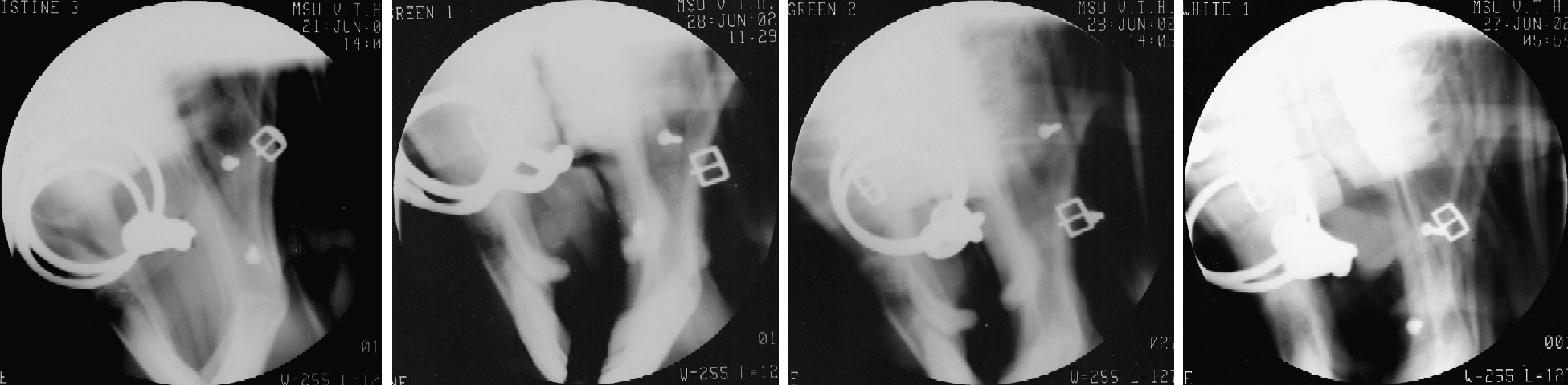
In the preliminary analysis, the videotapes were viewed to determine which behaviours were occurring. The following behaviours (Fig. 2) were observed to occur sufficiently frequently to be used as behavioural categories in the analysis: mouth quiet, no movement of mandible or tongue; mouthing the bit, mandibular and/or tongue movements that occurred without separating the incisors by more than 1 cm and without retraction of the tongue (this behaviour is not shown in Fig. 2 because it cannot be distinguished from mouth quiet in a still photograph); retracting the tongue, rostral part of the tongue retracted caudally; bulging the tongue, protruding the dorsum of the tongue between the bit and palate; and lifting the bit, using the tongue to elevate the mouthpiece towards or between the premolar teeth. In addition, other behaviours that were observed infrequently (retracting the chin towards the chest, shaking the head, flapping the lips and flicking the tongue out of the mouth) were grouped together into a single category (other) for further analysis. The time spent in each behavioural category was determined using Observer 3.0 software (Noldus Information Technology, Wageningen, The Netherlands), and then expressed as percentages of the 20 s recordings.
Still photographs of the behaviours assessed in the study. From left to right: quiet, lifting the bit, retracting the tongue and bulging the tongue over the bit. In a still photograph, mouthing the bit is indistinguishable from quiet

Statistical analysis
Mean values ± SD were determined for the percentage of time spent performing the different behaviours for each horse/bit/tension condition (N = 36). These values were used to calculate group means ± SD. Differences between conditions were sought using repeated-measures ANOVA with horse as a random factor, and bit and rein tension as fixed factors (SPSS, Chicago, IL, USA). This test assumes a multivariable normal distribution and variance and covariance matrices that are the same across the cells formed by the between-subjects effectsReference Clayton, Singleton, Lanovaz and Cloud10. These assumptions were tested using Mauchly's test of sphericity. If data did not pass this test, the degrees of freedom were corrected and the adjusted P values were used to determine significance. A probability of P < 0.05 α was chosen for all the statistical tests.
Results
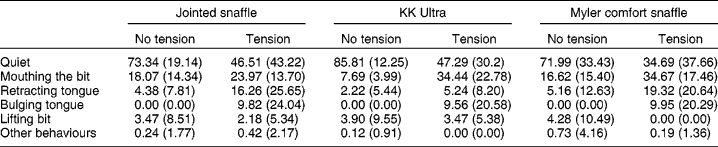
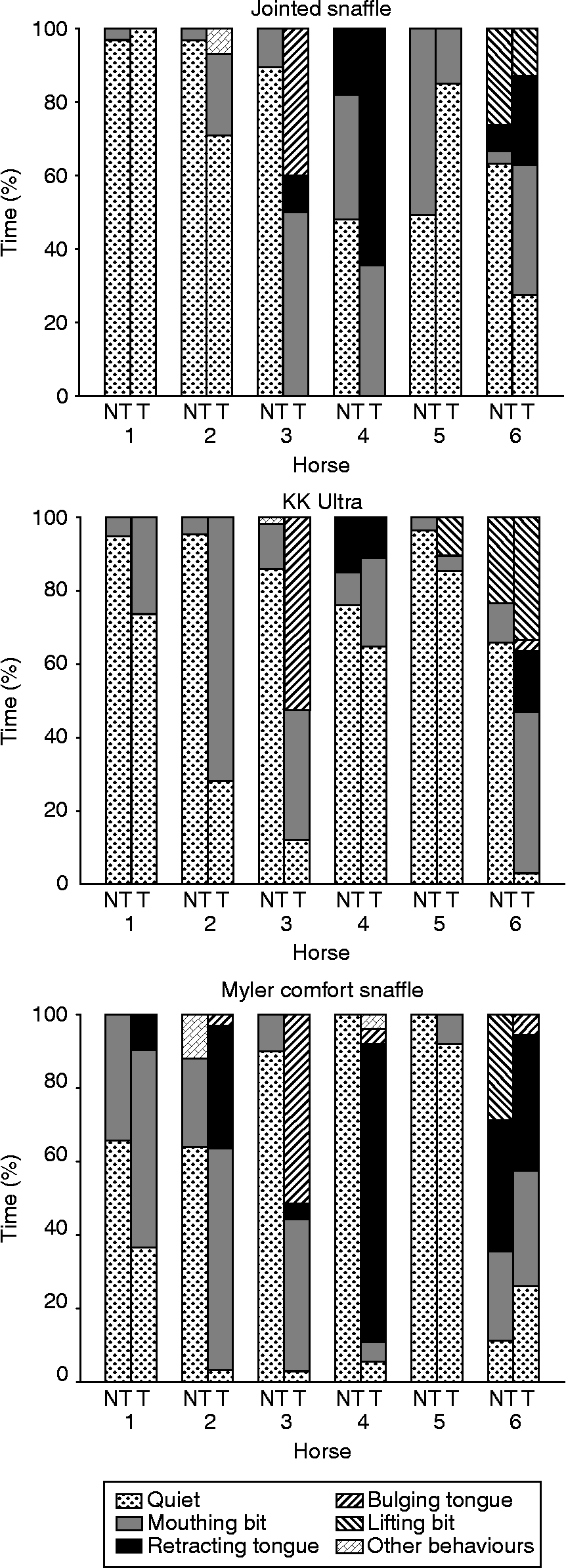
Mean values ± SD for the percentage of time spent performing each behaviour are given in Table 1. Two variables (bulging tongue and other behaviours) did not pass Mauchly's test of sphericity, so the degrees of freedom were adjusted and the corrected P values were used to determine significance of differences. There were significant effects of horse and tension, but not of bit. Significant interactions were present for horse × tension bit × tension and horse × bit × tension but not for horse × bit. Thus, individual horses varied in how the application of tension changed their behaviour (Fig. 3). Rein tension was associated with less time spent quiet, and more time spent mouthing, retracting the tongue and bulging the tongue. The findings support the hypothesis that rein tension affects the amount of time spent in different intra-oral behaviours, but do not support the hypothesis that type of bit affects the pattern of intra-oral behaviour.
Mean (SD) for the percentage of time spent in different behaviours (N=6 horses) for three bits with and without 25±5 N rein tension

The category labelled ‘other behaviours’ includes retracting the chin towards the chest, shaking the head, flapping the lips and protruding the tongue between the lips.
Comparison of the percentage of time spent in different behaviours by individual horses (1–6) without rein tension (NT) and with 25 ± 5 N rein tension (T). Above, jointed snaffle; middle, KK Ultra; below, Myler comfort snaffle

Discussion
This study compares the effects of three types of snaffle bits that are currently approved for use in dressage competitions by the Fédération Équestre Internationale1. In the training of dressage horses, salivation and gentle mouthing of the bit are encouraged; the horse should seek a steady contact with the bit with the mouth closed, the lower jaw chewing quietly and the tongue feeling for the contactReference Kapitzke11. Thus, both the categories of mouth quiet and mouthing the bit are regarded as desirable behaviours, whereas the other behavioural categories in this study are regarded as resistances.
It has been argued that the presence of a bit stimulates sensory pathways associated with the masticatory reflex that result in salivation and movements of the lips, tongue and jaw as in chewing of foodReference Cook2. Under the no tension condition, the mouth was quiet during the majority (>70%) of time for all bits, and was either quiet or mouthing the bit during >88% of time. We believe this indicates that horses become accustomed to the presence of the bit within the oral cavity, and cease to treat it as an object to be masticated.
The single-jointed snaffle bit is commonly used for training horses. It has been described as having a nutcracker-like action between the two cannonsReference Knox-Thompson and Dickens8. Radiographically, the joint can be seen protruding towards the palateReference Clayton and Lee5–Reference Manfredi, Clayton and Rosenstein7, but it moves further away from the palate as tension is applied to the reins and the mouthpiece indents the tongueReference Manfredi, Clayton and Rosenstein7. The central link of the KK Ultra gives this bit a U-shaped profile, rather than the V-shaped profile of the single-jointed snaffle, which accommodates the shape of the tongue and reduces the likelihood of putting pressure on the palate or compressing the mandibular rami between the cannons. When pressure is applied to the reins, the KK Ultra mouthpiece moves away from the palate and becomes more deeply embedded in the tongueReference Manfredi, Clayton and Rosenstein7. With the Myler bits, a central barrel provides a smooth contact surface against the palate and tongue. These bits were designed to prevent pinching of the tongue, to allow independent movement of each side of the bit and to facilitate swallowingReference Manfredi, Clayton and Derksen12, Reference Myler, Myler and Myler13. In this study, the Myler snaffle has been shown to lie further from the palate than the single-jointed snaffle or the KK Ultra when the reins are looseReference Manfredi, Clayton and Rosenstein7. When tension is applied to the reins, the cannons swivel but do not close towards each other, so there is no possibility of lateral mandibular compression. It is, perhaps, surprising that three bits with such different mechanical actions would be associated with the same behaviours in response to rein tension. Perhaps, the repertoire of behaviours available to the horse is limited, or inter-individual differences in oral morphology are more important in determining which behaviours will be adopted by a specific horse, regardless of the type of bit.
The amount of rein tension in this study (~25 N) was chosen as being equivalent to the mean value recorded when side reins are adjusted to a length 10 cm shorter than the neutral position of the horse's head and neck (Clayton, unpublished results), which is a length commonly selected for training a horse on the longe. A limitation of this study is that, since the horses had to stand in stocks during the fluoroscopic recordings, the inherent dynamics of the head and neck movements that are responsible for the normal oscillations reported in rein tensionReference Clayton, Singleton, Lanovaz and Cloud14–Reference Singleton16 were absent. Working within these limitations, the goal was to induce intra-oral behaviours associated with relatively high rein tension, but not to apply so much tension that the horses displayed discomfort by moving backwards out of the field of view of the fluoroscope. None of the horses moved within the stocks during the 20 s period of application of rein tension, which was taken to indicate that this amount of tension was not excessive.
Movements of the tongue observed fluoroscopically are particularly interesting, since these are not visible externally unless the horse's mouth is opened widely. Two lingual behaviours, retracting and bulging of the tongue, which are interpreted as resistances to the action of the bit, increased significantly with rein tension. This lends support to the suggestion that horses use their tongues to control the distribution of bit pressure within the oral cavityReference Kapitzke11, Reference Engelke and Gasse17. The horse's tongue is highly mobile and able to assume different shapes due to the diverse orientations of striated muscle fibres and the absence of a lyssa anchoring it ventrally to the floor of the oral cavityReference Dyce, Sack and Wensing18. The parts of the oral cavity where the bone has minimal soft tissue protection, including the palatine arch (hard palate) and the interdental space (diastema), are particularly vulnerable to bit-associated discomfort or injury. Inter-individual differences in morphology, such as variations in the shape of the palatine archReference Engelke and Gasse17, may predispose some horses to be more sensitive to bit-induced discomfort or trauma. We hypothesize that bulging the dorsum of the tongue over the bit may be a mechanism for relieving bit pressure on the palate by using the tongue as a ‘cushion’. An alternative explanation would be that the bulging behaviour was an attempt to relieve direct pressure from the tongue itself. When rein tension was applied, there were 12 episodes of bulging the tongue, nine of which occurred in Horse 3 (Fig. 3). In this horse, the tongue bulged over the bit in every trial with every bit when tension was applied to the reins. Intra-oral examination did not reveal any obvious pathological reasons for this behaviour; however, the tongue was noted to be larger relative to the size of the oral cavity as compared with the other horses.
Normally, the tongue covers the interdental space and forms a protective pad between the bit and the gum overlying the edge of the mandibleReference Engelke and Gasse17. In the absence of rein tension, only two horses retracted the tongue, whereas this behaviour was recorded in five of the six horses when tension was applied to the reins. It has been suggested that the tongue may be retracted to avoid compressing it between the bit and the bone of the mandibleReference Engelke and Gasse17, even though this would expose the interdental space to direct bit pressure. Possible consequences include mandibular damage in the form of a fractureReference Cook2 or bone spurReference Johnson4. However, there does not seem to be any scientifically based evidence showing a direct relationship between the amount or duration of mandibular pressure and the incidence of injuries. Furthermore, bone pressure would be more likely to induce a resorptive lesion than a proliferative lesionReference van Lancker, van den Broek and Simoens19. An alternative suggestion is that bone spurs in the interdental space arise from tension in the fibres of the buccinator muscle, which inserts along the interdental spaceReference van Lancker, van den Broek and Simoens19.
Lifting the bit involves using the tongue to elevate the bit within the oral cavity. With one exception, all occurrences of lifting the bit involved Horse 6, which performed this behaviour six times without rein tension and three times with rein tension. The fact that there were more occurrences without rein tension suggests that either this behaviour may have been more of a habit than a resistance in this particular horse or that tension in the reins made it more difficult to move the bit within the oral cavity. It has been observed in a previous study that when the bit is too wide or when an appropriately sized bit is adjusted too low in the horse's mouth, then the bit has greater laxity and this facilitates elevation of the bit by the tongueReference Clayton and Lee5. Sometimes the bit was lifted high enough to be grasped between the premolar teeth, which is not a modern development; evidence of wear on the second premolars consistent with bit contact has been reported in horses dating to 3500 BCReference Dyce, Sack and Wensing20.
Conclusion
This study has shown significant increases in tongue movements in response to static rein tension. These movements include mouthing the bit, which is regarded as a desirable behaviour, and retracting the tongue and bulging the dorsum of the tongue between the bit and hard palate, which are regarded as resistances, and may be used to relieve pressure on sensitive tissues. The individual horse's response, including the effects of rein tension, should be taken into account while choosing an appropriate bit. In spite of obvious differences in mechanical actions of the three bits, used in this study, behavioural patterns did not differ between bits but rather were specific to individual horses.
Acknowledgements
This study was supported by the US Eventing Association, the McPhail Endowment and the Merck-Merial Veterinary Scholars programme.