In June 2014 the Felsted Choral Society, conducted by Roger Lawrence, performed George Tolhurst’s oratorio, Ruth, to mark the one hundred and fiftieth anniversary of its premiere.Footnote 1 Ruth, the first oratorio composed in the British colony of Victoria, Australia, is the only Australian oratorio to be continuously performed in the United Kingdom, where, for the past century and a half, it has maintained an active performance tradition. In the UK, there have been dedicated Tolhurst societies and productions by significant musical institutions; it has been heard in the Royal Albert Hall and broadcast on the BBC. Yet Tolhurst’s Ruth – the earliest large-scale Australian work to receive any sort of European recognition – is practically unknown in its country of origin. Despite the traditional musical historiography that privileges ‘firsts’, few Australians have ever heard of Tolhurst or Ruth. Like much nineteenth-century Australian composition, Ruth was favourably received at its 1864 premiere, was repeated once the following year, and was then promptly forgotten.
Why should a relatively inconsequential work, unremembered in its birthplace, receive sustained promotion in Britain? In this case, the answer is ridicule. Despite its fairly positive Melbourne reception, when premiered in London in 1868, Ruth was widely criticized, openly mocked, and finally dubbed ‘the worst oratorio ever’.Footnote 2 The notoriety of this reception created a cult following for Ruth – described by Percy Scholes as a ‘succès de ridicule’Footnote 3 – that has endured from the nineteenth century to the present day.
This article examines the critical reception of Ruth through the lens of colonial social relations, arguing that its reception in both London and Melbourne is emblematic of broader trends in the nineteenth-century social and cultural relationship between parent state and settler colony. I argue that the reaction to Ruth in nineteenth-century London was shaped less by aesthetic judgement than by underlying prejudices toward artistic creations from the colonies. I further assert that Ruth’s reception in Melbourne was equally skewed by the colony’s desire for recognition of its cultural achievements in the parent state. Further, in exploring the twentieth- and twenty-first-century consumption of Ruth, I contend that some of the cultural hierarchies forged during the Victorian era continue to be reinforced in the present day.
The location of Ruth’s genesis places it in an under-theorized area of musicology – that of settler colonial composition. There is an established body of important work documenting and assessing musical life in the Australian settler colonies during the nineteenth century in historical, historiographical and reception studies, yet there remains a theoretical lacuna surrounding the practice of music in the colonies in relation to Empire. Given the evident influence of Britain on cultural development in its settler colonies during the nineteenth century, the same centre–periphery model often applied (although not without criticism)Footnote 4 to the relationship between colonizer and colonized can be usefully employed to fill this theoretical gap. Calls for a re-examination of colonial Australian music, such as those recently issued by Thérèse Radic and Graeme Skinner, can be informed greatly by an exploration of music in these terms.Footnote 5
While political and historical studies of settler colonialism and use of the centre–periphery model has expanded rapidly in recent yearsFootnote 6 – building on the prominent theoretical contributions of Patrick Wolfe on the relationship between race and metropolitan, settler, and indigenous societiesFootnote 7 – there has arguably been, until quite recently, a marked avoidance of discussion of social and cultural relations between European settlers (and their descendants) and their imperial parent states. This is most noticeable in the tendency of postcolonial studies to regard these two social groups as belonging to the same side of the dichotomous relationship between colonizer and colonized.Footnote 8 As Ania Loomba states, ‘white settlers were historically the agents of colonial rule, and their own subsequent development … does not simply align them with other colonized peoples’.Footnote 9 Thus, members of nineteenth-century settler societies, particularly those newly established like the colony of Victoria, occupied an awkward position: ‘estranged’ from Britain, yet not themselves ‘subject to the genocide, economic exploitation, cultural decimation and political exclusion felt by indigenous peoples’.Footnote 10 This creates, as illuminated by scholars of settler colonialism, not the binary centre–periphery of traditional postcolonial studies, but a triangular relationship, consisting of two interacting peripheral Others, with ‘immigrant exogenous Others’, alongside the indigenous.Footnote 11 Lorenzo Veracini argues particularly for this distinction, suggesting that despite similarities in race, colonialism and settler colonialism ‘actually operate in dialectical tension and in specific contradistinction’.Footnote 12 One of the ways the imperial centre ‘othered’ the settler periphery, in the case of Australia, was through emphasizing the spectre of convict transportation in their representations and discussions of the colonies. (This representation continued well into the period of this study – and arguably still continues – despite the cessation of transportation in most of Australia by the early 1850s.)Footnote 13 This ‘othering’ of those who migrated to Australia in British representations of the colonies could be used as a way of reinforcing the power hierarchies within the colonial relationship. While this tension between British colonialist and Australian settler – linked by their similar ‘ethnic’ origins – has in no sense the destructive and lingering effect seen between those colonized by invasion and their oppressors, it had a distinct impact on cultural negotiations between settler and metropolitan society, and thus had ramifications for the development of colonial Australian musical practice.
Some of the most relevant applications of the centre–periphery model to this study come from the fields of history and literature, and the ways in which representations (written, visual or in this case musical) of the colonies were interpreted. Robert D. Grant, significantly, has discussed the importance of representations of landscape in the British imagination as loaded devices for the dissemination of ‘intellectual, commercial, political, economic and racial objectives’.Footnote 14 Grant argues that while illustrations of colonial subjects have in the past tended to be viewed as ‘relatively unproblematic illustrations of their colonial subject’, they should instead be seen as ‘highly mediated metropolitan constructs’.Footnote 15 This is particularly pertinent to the representations of colonial musical works in the metropolitan press.
When studying colonial Australian music history, it is important to remember that Australia as a single political entity did not exist during the nineteenth century. The six individual colonies, federated in 1901, were founded under strikingly different circumstances. The earliest of these, New South Wales – along the eastern coast of a continent that had been home to its indigenous population for between 40,000 and 60,000 years – was claimed as a possession of the British government in 1770, and settled as penal colony in 1788.Footnote 16 While many histories of the nineteenth-century ‘British world’ tend to focus heavily on the transportation of convicts in their treatment of Australia, Van Diemen’s Land, now Tasmania, was the only other colony explicitly founded for the transportation of convicts. In contrast, South Australia – sometimes described as a ‘paradise of dissent’, for its strong links with religious Nonconformism – was established entirely by free settlers.Footnote 17 Similarly Melbourne (then Port Phillip, now the capital of Victoria) was founded in 1835 on pastoral leaseholds, by the sons of convicts, and Victoria declared a separate colony in 1851, three months before the discovery of gold in its central region.Footnote 18 Victoria was the most prosperous colony during the mid-century gold rush era, producing more than one third of the world’s gold, with a cultural, industrial and population boom to match.Footnote 19
Many of those who came from Britain as free settlers during the mid-century felt the ‘vast island-continent offered the chance to leave behind the evils of poverty, class, privilege and make a fresh start’, and this ethos contributed to the development of Australian social structures and institutions.Footnote 20 Yet the influence of Britain’s culture and history still had an effect on Australian thought and identity. Throughout the nineteenth century, and much of the twentieth, Australian identity was powerfully influenced by the British gaze, as demonstrated by the emphasis placed on the usefulness and prosperity of the colonies presented in self-expressions of colonial identity – and representations made by invested temporary visitors – aimed at the home market.Footnote 21 As Richard White states, such representations were ‘consciously tailored to suit the perceptions of the outside world. The periphery constructs itself as the metropolis likes to see it’.Footnote 22 Settlers conscious of the legacy of transportation on European perceptions of Australia, found it necessary to project an image of a progressive and thriving society as a means of attracting ‘labour and capital – men and money’ following the entrance of the colonies into the international economy as traders of crops and wool.Footnote 23 These economic aspirations were reflected in cultural spheres, in which Australians felt it important to assert that they were both distinct from, and equal to the metropolis in the practice of art and music.
Yet, in some ways Australian identity was British identity, albeit one beset with the power imbalance created by geographical isolation and convict associations. Indeed, the term ‘British subject’ only ceased to be used as late as 1984.Footnote 24 Yet, from nineteenth-century letters and diary sources (such as those presented in the work of Andrew Hassam and Richard White, cited throughout), it is clear that an Australian cultural identity distinct from Britain was present. It is important to appreciate this distinction that, as Hassam has argued, ‘has been too easily ignored. An Australian colonial identity is seen as either a British identity contaminated by living in Australia, or an Australian identity contaminated by and adherence to British cultural values’.Footnote 25
The struggle between oppositional self-definition and a desire to maintain imperial ties was also manifested in the search for an Australian musical identity during the nineteenth century.Footnote 26 However, the desire for European approval or acknowledgement of colonial composers has had a lasting effect on the focus of Australian historical musicology. The colonial-era composers considered worthy of study are generally those who achieved European renown before migrating, regardless of their success once in Australia. Isaac Nathan (1790–1864), perhaps the most well-known Australian colonial composer, had an established reputation and aristocratic patronage (including by Lord Byron) in England before migrating to Australia. While he is given a central place in many Australian musical histories, his influence is in fact hard to assess.Footnote 27 Similarly, European-trained and approved composers who settled in Australia – such as Leon Caron (1850–1905), Carl Gottlieb Elsässer (1817–1885), Paolo Giorza (1832–1914), Alberto Zelman (1832–1907) and Charles Edward Horsley (1822–1876, discussed below) – have received some scholarly attention. This can be contrasted with Charles Packer, who arguably had a significant impact on musical life in Sydney, with contemporary assessments describing him as ‘Sydney’s most talented resident musician’.Footnote 28 A conductor and composer of sacred music, writing the first oratorio in the colony of New South Wales (Crown of Thorns, which predates Ruth by one year – the first in any Australian colony), Packer has received far less scholarly interest.Footnote 29 Trained at the Royal Academy of Music, Packer was transported for forgery in 1839, and spent further time in prison for bigamy once settled. He did not have an established musical reputation in Britain before his conviction.
George Tolhurst is another of Australia’s generally overlooked early composers. There is little biographical information published about him, and while he has a small entry in the Oxford Companion to Australian Music, he is not mentioned in any other recent dictionary of music, Australian or otherwise.Footnote 30 It is thus necessary to provide some information about him and his most famous composition, Ruth.
George Tolhurst and Ruth
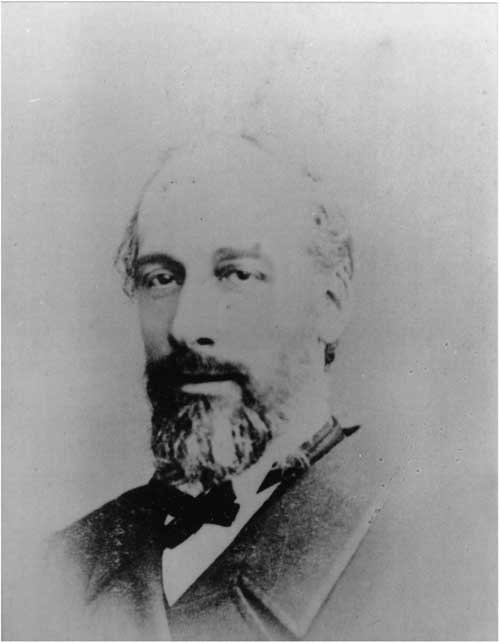
George Tolhurst (Figure 1) was born in Maidstone, Kent, on 2 June 1827. Known locally as a chorister and organist, he left England for Melbourne, arriving in December 1852. An active participant in the Melbourne musical community, he taught voice, piano and harmony, lectured, directed choral classes and acted as organist at St James’s cathedral. In 1854 he became an assistant to George Leavis Allan, the founder of Allan & Co., the largest musical warehouse in the Southern Hemisphere.Footnote 31 In May 1856 he married Ann Gibbons, who had arrived from Kent days earlier, with whom he had five surviving children, all born in Melbourne. In 1866 he returned to England, where, apart from promoting Ruth, he was active in musical life, working as a teacher and music-hall performer, and in 1869 was appointed a critic for the Athenaeum. Footnote 32 (Oral and written histories of the Tolhurst family today also suggest he was a friend of Gounod.)Footnote 33 He died of smallpox in Barnstaple, Devon, in 1877 while working as pianist for the music-hall performer ‘Jolly’ John Nash.Footnote 34 Tolhurst’s son, Adolphus Henry, returned to Australia permanently in 1904, and some of the Tolhurst family continue to reside in Melbourne today.Footnote 35
George Tolhurst (undated). Image courtesy of the Tolhurst Family Collection, South Africa

Though he spent only a few years in Melbourne, Tolhurst is regarded as an Australian colonial composer. The category of ‘colonial composer’ is rather broad; it is defined by Graeme Skinner as ‘any resident composer, long-term settler, recent emigrant, or even a short term visitor who either composed music here, or who introduced pre-Australian compositions locally’.Footnote 36 Such a definition, including the recent emigrant and visitor, highlights the liminal social space occupied by the colonial migrant, and in particular the colonial musician.Footnote 37 While the modern-day perspective may use the label ‘colonial’ for composers in these cases, this is a retrospective application of the term. There is little evidence to suggest that many composers in the Australian context, Tolhurst included, considered themselves colonial or ‘Australian’. (Indeed, many of Tolhurst’s other surviving works composed in Australia are settings of texts such as God Preserve Our Sovereign’s Viceroy, Christmas in Australia, and I Remember, all reflecting an identification with Britain as ‘home’.)Footnote 38 Yet it appears that residence in the colonies alters the social status of the composer in the ‘home’ society, if that composer did not have an already established European reputation. Many are perceived as no longer categorically European, notwithstanding their continuing composition of Western art-music based on European training. In Tolhurst’s case, despite the fact that he was born and educated in, and returned to Britain, he is clearly perceived as an Australian in both the Australian and British press. The oratorio Ruth was likewise considered a colonial product. This perception and the related social status of the ‘colonial composer’ had a significant impact on the reception of Ruth in both London and Melbourne.
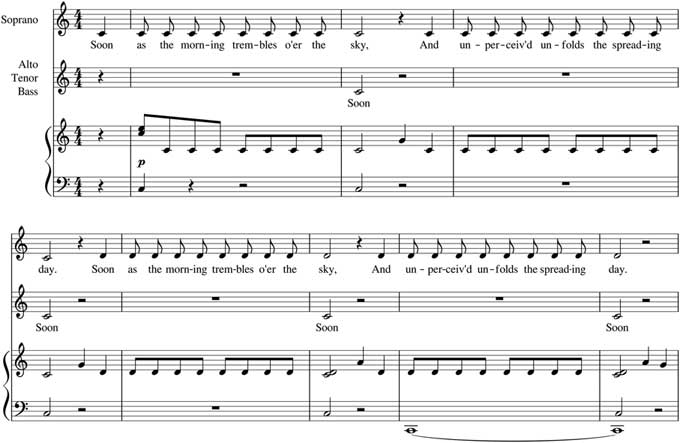
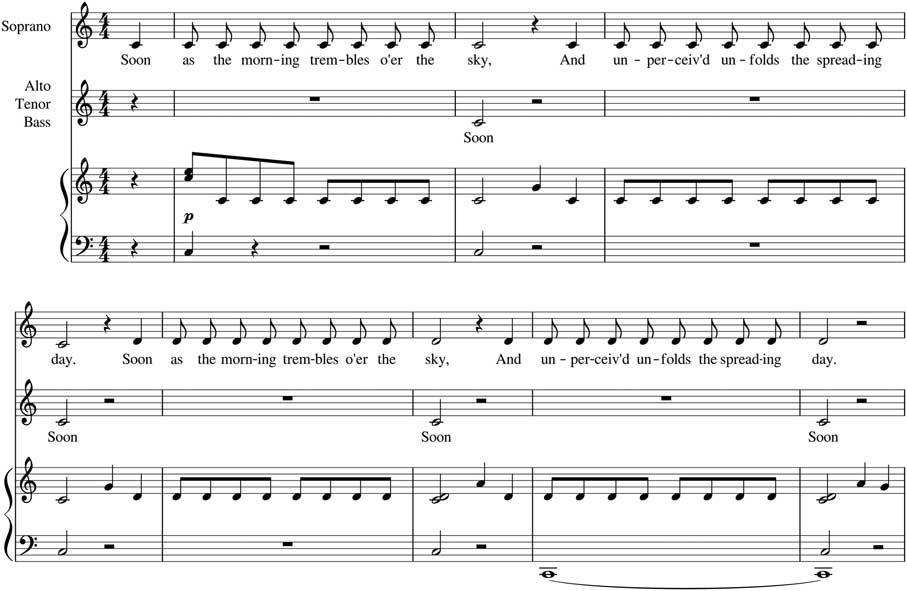
Ruth has been repeatedly assessed throughout its performance history as melodically uninventive, poorly constructed harmonically and clumsy in its text-setting. Yet the most striking feature of the work when considered in toto, is just how unremarkable it is. It is tonal, traditionally structured, and, as some critics point out, contains allusions to Handel that are almost too obvious.Footnote 39 In fact, often the characteristics singled out for criticism by many twentieth-century writers could just as easily be ascribed to much Victorian music, and in text-setting, much other English-language oratorio. Tolhurst appears simply to have magnified these.Footnote 40 While there are certainly sections that are aesthetically challenging to modern listeners, judging it by the critical standards of the present misses many points of its symbolic and aesthetic significance for the time and place of its composition. For example, the chorus ‘Soon as the Morning Trembles O’er the Sky’ (Example 1), described in the twenty-first century as ‘proto-minimalism’, and derided by Percy Scholes, was reportedly loudly applauded by 1860s audiences and singled out for praise by some critics.Footnote 41 Monotonous to modern ears, the repeated notes are clearly an attempt at word painting, depicting the ‘trembling’ morning, gradually ‘unfolding’ through slow, stepwise harmonic movement, in a manner that may have been obvious to nineteenth-century audiences.
George Tolhurst, Ruth (London: George Tolhurst, n.d.[1867]), No. 44: Chorus ‘Soon as the Morning Trembles O’er the Sky’
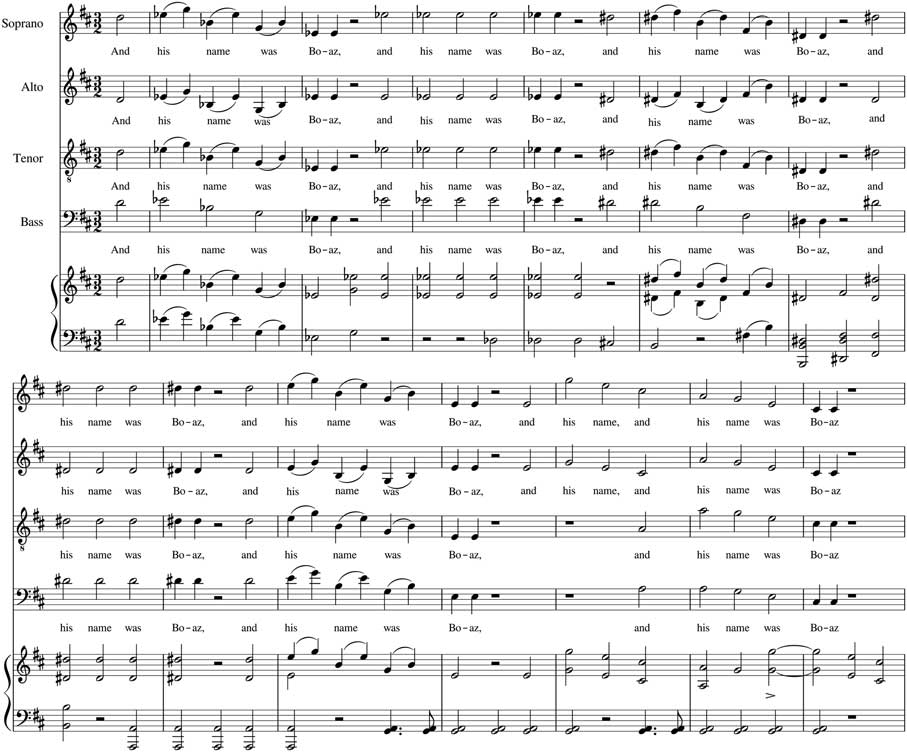
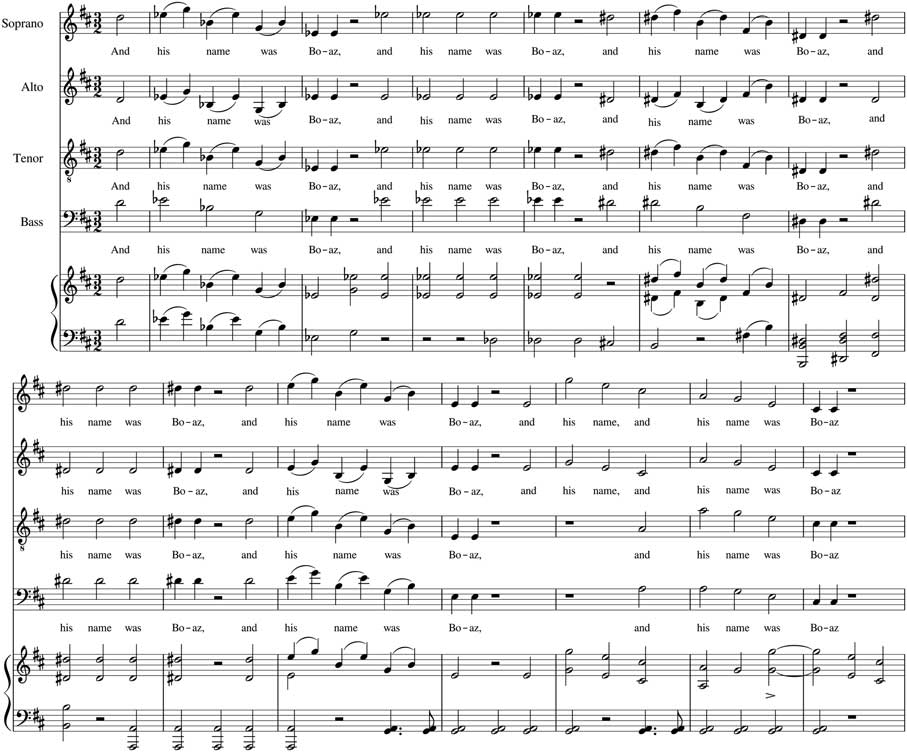
In terms of text-setting, much has been made of Tolhurst’s awkward and repetitive style. As one critic noted of the opening to part two (Example 2),
The composer is evidently desirous that the chief facts of the narrative should be well impressed on the minds of his hearers … the words … ‘And Naomi had a kinsman of her husband’s, a mighty man of wealth, of the family of Elimelech, and his name was Boaz’ … is … most elaborately treated … the words ‘a mighty man of wealth’ recur seventeen times, while the phrase ‘and his name was Boaz’ is repeated no less than twenty times. The hearers of the oratorio would be in very little danger of forgetting the name of the kinsman of Naomi’s husband!Footnote 42
George Tolhurst, Ruth, No. 26: Chorus ‘And Naomi had a Kinsman of Her Husband’s’.
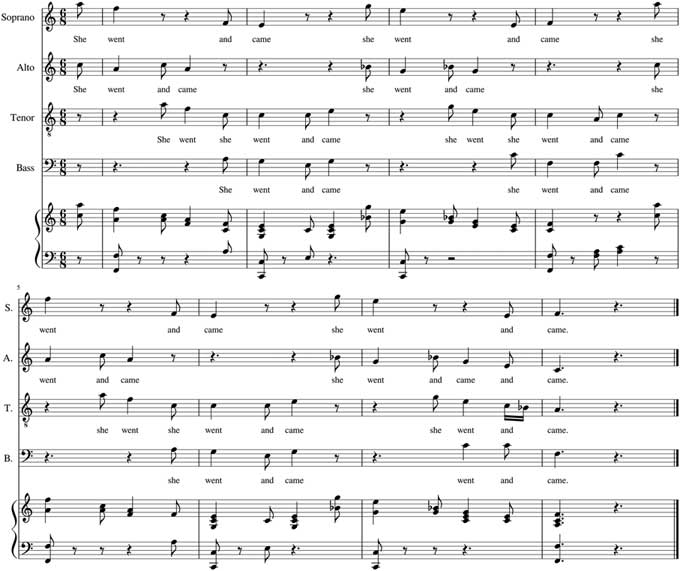
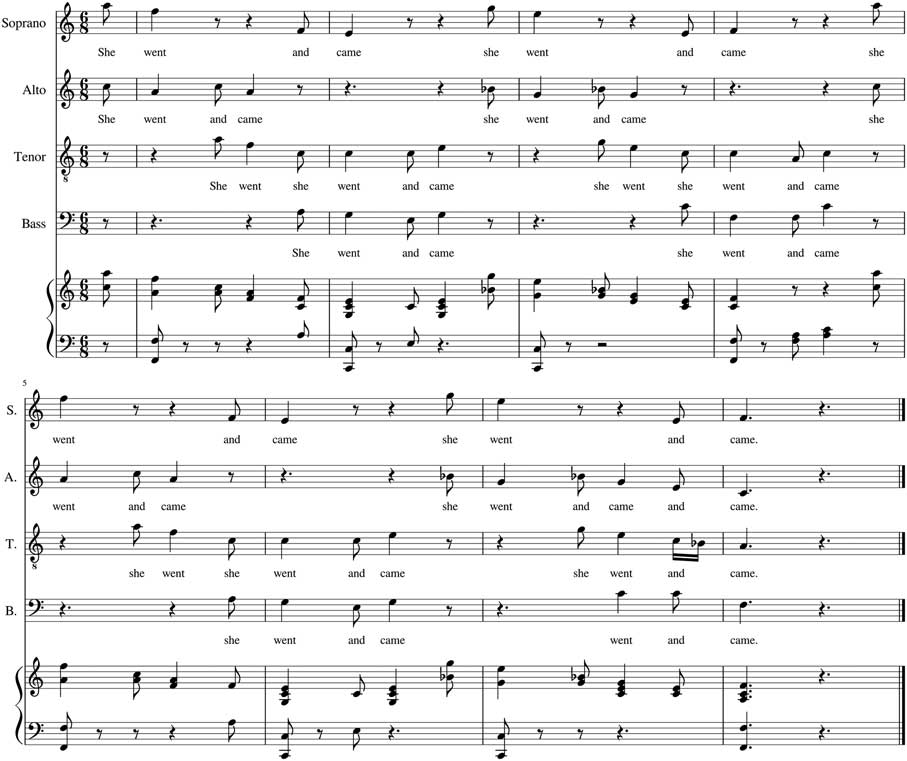
Similarly, the chorus ‘And she went, and came, and gleaned in the field after the reapers’ (Example 3) was described in 1868 as a ‘singular composition’, and that, despite the ‘unquestionable independence about Mr. Tolhurst’s music … He will not … expect students to follow him, without hesitation, through the somewhat tortuous ways he has chosen’.Footnote 43 Antony Lewis in 1973 described these passages as ‘antiphonal … in which the verbs of motion are tossed briskly from voice to voice’ in a manner than ‘surely betray[s] the influence of the great turba choruses in the Bach Passions’.Footnote 44 Lewis is just one of many twentieth-century writers focusing on this particular chorus as the subject of their rather tongue-in-cheek commentary.
George Tolhurst, Ruth, No. 30: Chorus ‘And She Went and Came’.
An extended critique of Ruth’s musical content has been offered repeatedly through its history with varying degrees of facetiousness. Rather than contribute to that, however, my aim here is instead to examine the motivations behind the striking differences in critical opinion in the Melbourne and London press. As Carl Dahlhaus states, ‘the criterion for judging competing views of a work does not reside in how close they come to its alleged “real meaning”, but rather how accurately, subtly and intensely they represent the age, the nation, and the class or social group which conditioned them’.Footnote 45 As such, in this article I will use the reception of Ruth as a way to open a hermeneutical window onto the imbalanced social and cultural relationship between metropolitan centre and colonial periphery. I also demonstrate the ways in which this relationship contributed to both the apparently optimistic reception in Melbourne, and in London the overarching contention that the antipodean genesis of the composition was responsible for its musical shortcomings.
‘Fresh, touching and true’: Ruth in Melbourne
Ruth was premiered on 21 January 1864, conducted by Tolhurst’s father,Footnote 46 at the Prahran Town Hall (a building opened in 1861, reflecting the growing population and wealth of what is now an inner suburb of Melbourne).Footnote 47 By the 1860s, Melbourne had developed a prospering tradition of oratorio and vocal music, supported by visiting artists, conductors, and impresarios as well as a large contingent of local musicians. While Ruth was praised as the first work of its kind to be composed in Melbourne, local composition of oratorio did not emerge ex nihilo. Melbourne audiences were already familiar with the genre.
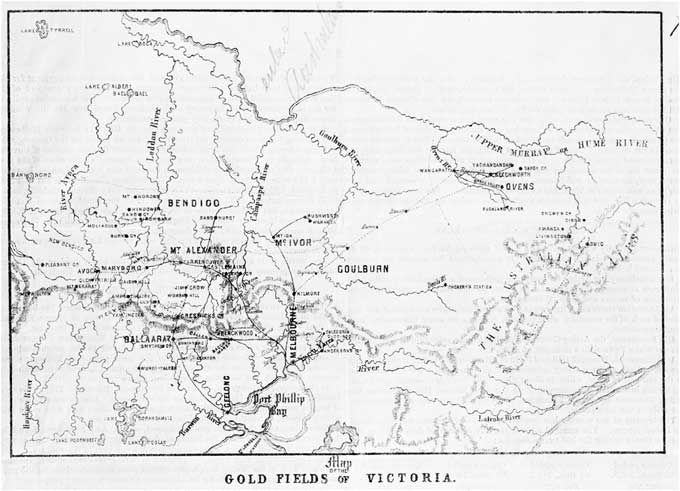
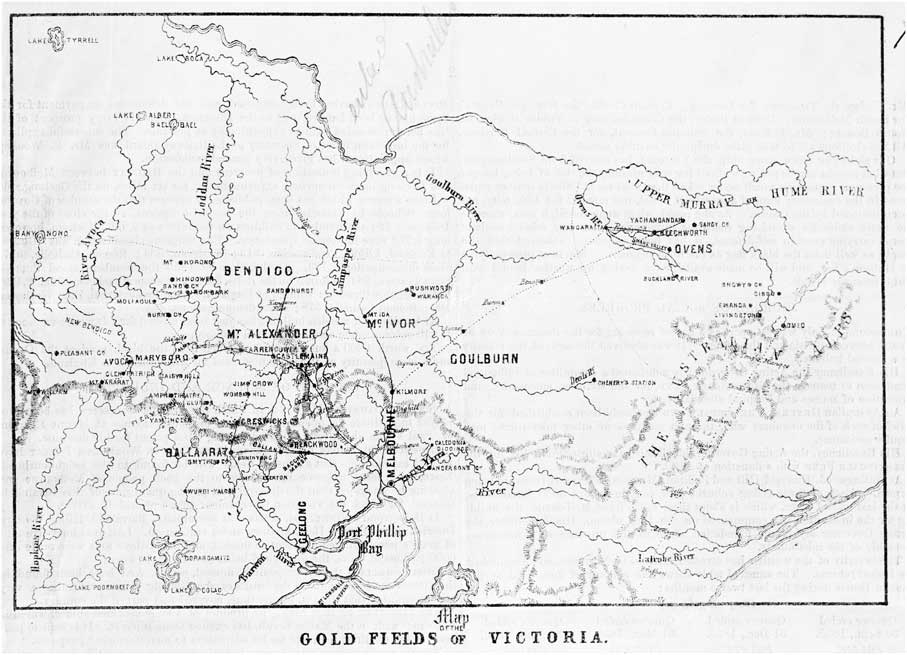
In 1853, the Melbourne Philharmonic Society was established in response an apparent dearth of cultural entertainment perceived by the many educated and ‘cultured’ Europeans who migrated to Victoria during the gold rush.Footnote 48 Hoping to transplant some of their familiar institutions to their new home in the colonies, the Philharmonic’s first few seasons saw performances of Handel’s Messiah,Footnote 49 Judas Maccabaeus, Samson, Israel in Egypt and Acis and Galatea, Haydn’s Creation and Mendelssohn’s Elijah.Footnote 50 Many smaller choral societies around the colony soon followed, including the German Liedertafel, Orpheus Union and major societies in the regional centres of Ballarat and Bendigo – both Victorian gold rush boomtowns – and Geelong, the closest major port to Ballarat (see Figure 2).Footnote 51 W.S. Lyster established Australia’s first permanent opera company in 1861, finding Melbourne, not ‘a wilderness’ but a ‘prosperous English provincial city suddenly hurled to the other side of the world’.Footnote 52
Map of the Goldfields of Victoria. Wood engraving published in The Newsletter of Australasia, August 1856 (East Melbourne Vic.: George Slater, 1856). Pictures Collection, State Library of Victoria: NLA00/08/56/1
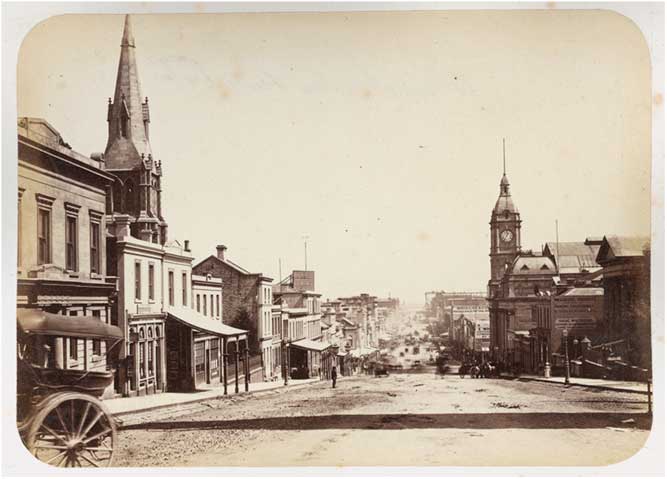
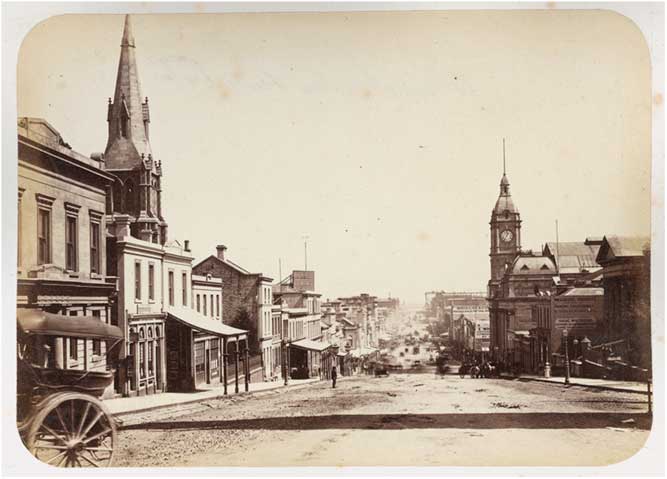
The Lyster Company, alongside the Philharmonic, were responsible for further oratorio premieres, including Mendelssohn’s St. Paul in the early 1860s. Charles Edward Horsley (a distinguished English musician and student and friend of Mendelssohn, Moscheles and Spohr, whose father had helped establish the London Philharmonic Society in 1813) arrived in Melbourne in 1861, and on becoming conductor of the Philharmonic the following year, arranged the Australian premieres of Mozart’s Requiem and Mendelssohn’s Athalie.Footnote 53 The influence of choral music was even reflected in the architecture of colonial Melbourne, with, for example, the Melbourne Town Hall (Figure 3, the Town Hall’s clock-tower can be seen on the right of the image) built in 1863, designed to mimic the acoustics of the Liverpool Philharmonic Hall.Footnote 54 As Katherine Brisbane asserts, it is a myth that Australia was culturally isolated in the nineteenth century. As a prominent financial and industrial centre of the global market following the gold rushes, the strong desire for cultural entertainment created audiences who were ‘cosmopolitan and discriminating’.Footnote 55
Melbourne Town Hall (at right). Collins St, Melbourne (looking west) n.d. [between 1860 and 1879], National Library of Australia, nla.obj-147325692
These Melbourne audiences were exposed to much of the same music as audiences were in Britain. In a pioneering survey of the influence of Britain on Melbourne’s musical programming, Janice B. Stockigt argues that the ‘major impetus behind the [Philharmonic] Society’s acquisition of new repertoire was the success of a work in the UK’.Footnote 56 More widely, as Thérèse Radic states, colonial institutions ‘passed on the established forms of British musical culture, reinforcing the old values by displaying imported British models in an atmosphere of excitement and adulation’.Footnote 57 These values and attitudes were pervasive: the Sydney Morning Herald reported in 1856 that ‘the more a new colony adopts the institutions of the old country, both of art and of science, the more it will approach to greatness and to perfection’, commenting on the ‘civilising influence of good music … admitted by all’.Footnote 58 Throughout the whole century, the colonial discourse of proving their ‘civilization’ through music runs through the press, the writings of individuals, and the aims of local musical institutions. The social mores and musical institutions of the parent state were seen as the model and standard to which the Australian colonies should aspire. Thus, by the time of Ruth’s premiere, Melbourne audiences, while well-served for choral music, were nonetheless excited by the local creation of an oratorio – a genre easily interpreted as symbolic of ‘civilized’ British culture and taste. The press described the audience as ‘not unmindful of the importance … of the rarity of the event to which their attention had been invited’.Footnote 59
This importance was outlined before the premiere, with the Argus newspaper of 19 January explaining that the score had been exhibited at the London International Exhibition of 1862 and had been ‘regarded with sufficient interest … to stimulate the author to hasten its production for the judgement of the public’.Footnote 60 This same article, however, takes issue with Tolhurst’s decision to set the biblical ‘Book of Ruth’ word-for-word without the consideration of a librettist: ‘a point which undoubtedly admits of diversity of opinion’.Footnote 61 Although this method of biblical text setting had been prevalent in sixteenth- and seventeenth-century Historiae,Footnote 62 later reviews suggest that Handel’s Israel in Egypt had been Tolhurst’s model. It is also possible that Tolhurst’s religious convictions, demonstrated through his involvement with Temperance societies and position as a church organist, may also have influenced his reluctance to edit or paraphrase the bible.Footnote 63
Of the premiere, the orchestra and chorus were poorly received, with the Age reporting that the artistic talent ‘was far from first-rate’.Footnote 64 Critics were therefore reluctant to be too scathing of the composition itself. Comparisons to the great oratorio composers were inevitable, with the Age stating that, while Tolhurst had ‘not yet eclipsed Handel or Haydn’ he had ‘made more than a respectable debut … in one of the loftiest departments of music’. The Argus similarly noted that while they had not found ‘a full-blown Handel in one of the suburbs of Melbourne’ Tolhurst was certainly ‘an ardent lover of the great art of that great master’.Footnote 65 In this respect, however, both major newspapers found Ruth to be too derivative, with the Age accusing the work of being marked by ‘not a few musical recollections’,Footnote 66 and the Argus suggesting that Tolhurst should ‘scan his subjects a little more closely before making use of them’ in noting the similarities to Handel.Footnote 67 Despite these apparent faults, the general tone of the reception was positive. The press felt the work displayed ‘an inspiring and sunny theme’,Footnote 68 demonstrating ‘a great deal of learning, art, and taste … [and] a good deal that is quite fresh, touching, and true’.Footnote 69 Reports also describe the audience applauding loudly and calls for Tolhurst to come forward at the close of the piece.Footnote 70
The Australian press of this period generally reviewed works of local composers and artists positively. Jennifer Royle argues, in her examination of Austin T. Turner’s 1874 cantata Adoration, that even the ‘attempt to compose such a work, regardless of success … [was] in itself worthy of congratulation and encouragement’.Footnote 71 This impulse evidently influenced the reception of Ruth, and, while not blind to the work’s shortcomings (the Argus described the overture as ‘rather too florid’ and the opening chorus as ‘not particularly striking’),Footnote 72 reviewers were generally optimistic.
An element of insecurity within the colonies surrounding their cultural products is evident. Yet there was also a desire, not only to encourage local composition, but to be recognized as equal to the metropolis in a climate of ‘assumptions of cultural superiority of Britain and “old world” civilizations’.Footnote 73 While individuals may have considered their productions of a high standard (and indeed, they may have been), the need to prove this internationally was demonstrable, as discussed above. Francis Campbell Brewer’s The Drama and Music in New South Wales, for example, written for the 1893 Columbian Exhibition in Chicago, concludes that the aim of the book had been to prove ‘that the progress of Australia, the youngest daughter of the British Colonial Empire, has kept pace with the rest of the world in the development of a taste for the Drama and Music’.Footnote 74
Equally, Skinner writes of a ‘boosterism’ that ‘coloured Australians’ view of themselves and their enterprises’.Footnote 75 Running parallel to the insecurity within the young colonies about their artistic, cultural, and even industrial products, there was also a staunch pride, such as was reported by Charles Wentworth Dilke in his Greater Britain: A Record of Travel in English-speaking Countries During 1866 and 1867. Dilke found that, in contrast to ‘unscrupulous traders’ in England writing ‘“From Paris” over their English goods’, Victorians sometimes placed the label ‘warranted colonial made … over imported wares, for many will pay a higher price for a colonial product confessedly not more than equal to the foreign, such is the rage for Native Industry’.Footnote 76 (Although as Hassam states, ‘at least some of the praise of Australia to be heard in the letters and diaries of Australians in Britain must have been a reaction to the snobbery displayed towards colonials’.)Footnote 77
Such colonial pride was clearly present in the reception of Ruth, and the encouraging critical reception prompted Tolhurst to take the work to London. One reviewer concluded:
That Mr. Tolhurst has done himself great credit by the skill with which he has handled an ambitious idea, and in which he has shown some genius and more talent, will be acknowledged by all who make themselves acquainted with his composition … But Mr. Tolhurst must not be satisfied with any present temporary success; he must go further on his way, satisfy the critical amongst the critical. There is then little fear that he will make for himself both fame and profit.Footnote 78
A revised version of Ruth was repeated in Prahran in 1865 to a similar reception, and in 1866 a benefit concert featuring selected arias was held to facilitate Tolhurst’s return to England. This was the last major performance of Ruth in Australia.Footnote 79
‘Perfectly unendurable’: Ruth in London
A short article in the April 1864 Musical Times informed readers of ‘the complete success’ of Ruth in Melbourne:
The production of a new Oratorio at the antipodes is an event which must interest all who watch with pleasure, the spread of music, as a humanizing influence, throughout the civilized world … it will no doubt act as an incentive to other resident musicians; and materially aid in promoting an artistic competition which may eventually lead to good results.Footnote 80
While the Melbourne reception of Ruth was encouraging, it was not a ‘complete success’. The eagerness of the Musical Times to report on the attainment of a ‘humanizing’ cultural institution in the colonies displays both a genuine, albeit paternalistic sentiment, and the common trope of the ‘civilizing’ effect of music, as discussed above.Footnote 81 Omission of any criticism from Melbourne highlights the fact that this did not fit within such a narrative. Metropolitan support for the transplantation of seminal British musical institutions like the oratorio, choral societies and sight-singing methodsFootnote 82 can be seen as attempts to use the same ‘civilizing’ forces in the colonies as were used at home to ‘civilize’ the poorer classes through means of ‘rational’ recreation.Footnote 83 This aligns with the impetus coming from within the colonies to demonstrate their ‘civilization’ through these institutions. However, the dismissive closing remark by the Musical Times, that such a work ‘may eventually lead to good results’, suggests that whatever might be considered a ‘complete success’ on the peripheries could not yet be up to the standard of the centre.
British conceptions of Australian culture at this time were vague at best, and greatly influenced by economic and industrial considerations. In the early part of the nineteenth century, reports in Britain were generally disparaging, emphasizing the moral ‘contamination’ of the Australian continent through convict transportation. While this tone changed considerably with the discovery of gold in 1850, there is little evidence of more than a superficial interest in the colonial cultural world beyond what would reinforce the geographical, political and economic reach of the empire.Footnote 84 As an 1857 article from Hobart Courier states:
Very little is known in the Mother-country of the actual state of the Australian Colonies. And yet a good-sized library of books has been written about us. Almost every traveller who has visited our shores has thought proper to give the world the benefit of at least part of his experience … [yet] our friends at home are almost as ill-informed … as ever.Footnote 85
As with colonials, returnees to Britain found themselves outside of accepted British society and greatly affected by perceptions of antipodean degeneracy. As a consequence of the newly established and rather ‘frontier’ Australian society, the rigid class distinctions maintained in Britain became ‘permeable and ever changing’.Footnote 86 Awareness in Britain of this unacceptable breaking of class delineations is demonstrated by the trope of the unwanted colonial returnee featuring prominently in contemporary literature. An oft-cited example is Magwitch in Dickens’s Great Expectations, whose prohibition from return to England, as Edward Said notes, is ‘not only penal but imperial: subjects … cannot be allowed to “return” to metropolitan space, which … is meticulously charted, spoken for, inhabited by a hierarchy of metropolitan personages’.Footnote 87 These mid-nineteenth-century British perceptions of Australia saw convicts as capable of expiating ‘their crimes in a technical, legal sense, but what they suffered there warped them into permanent outsiders’. They ‘were capable of redemption – as long as they stayed in Australia’.Footnote 88 By the mid-nineteenth century, this perception applied, not only to ex-convicts but to almost all Australian settlers who were not already of an established social position before leaving Britain. As Janet Myers states, the potential social mobility offered by migration to the colonies ‘was valued only if it did not reinfiltrate established British social systems; Greater Britain was not meant to facilitate colonial advancement in the imperial metropolis itself’.Footnote 89
For those who had not secured success in Britain before travelling to the colonies, antipodean creative success could only be achieved if it stayed there.Footnote 90 Tolhurst was a returnee, and while there is nothing to suggest his return to Britain was unwanted, in reviewing Ruth the press were certain of his Australianness. Previously a symbol of the humanizing influence of music, Ruth now became something to be mocked. The role of social class in these discourses is highlighted by the fact that, while forever ‘tainted’ as an Australian oratorio composer, when Tolhurst appears in the British press for non-compositional reasons (for example, as a performer) there is never mention of Australia. As a music-hall pianist or teacher (that is, distinctly lower or middle-class professions), Tolhurst’s Australian connection was not considered relevant. However, in attempting to compose in the lofty genre of oratorio, his ‘Australianness’ could be used pejoratively, employed to delegitimize his attempt at creative authority.
Ruth was premiered in London on 29 January 1868 at the Store Street Hall, performed by a number of well-known singers, including tenor William Hayman Cummings.Footnote 91 Critics across the London musical press were unanimous in their deprecation of the music and their condescension toward colonial musical culture. The Musical Times wrote:
We know nothing of Mr. Tolhurst, and should have been pleased to know nothing of his oratorio … How so crude a composition as Ruth could have been performed, applauded, and favourably commented upon – even as far off as Melbourne … – is to us a marvel … it is so utterly devoid of anything like interest … The choruses appear the work of a student groping his way in part-writing; and, with the mere pianoforte or organ accompaniment, are, in some portions, perfectly unendurable.Footnote 92
It was surprising to the Musical Times that ‘even’ Melbourne might appreciate the work. Regardless of the lack of refinement of taste attributed to colonials in metropolitan representations, the failings of the work were so evident that ‘even’ a colonial audience should be able to detect them. In a similar vein, the Musical Standard wrote of oratorio composition as an ‘unfortunate … disease of the mind’, describing Tolhurst as suffering from this illness:
The setting of the words … is frequently of the most mistaken character; the music is faded and inappropriate; and nowhere comes up to the dignity required by the subject … We are sorry to be compelled thus to speak of ‘Ruth’, because we well know with what enthusiasm the public of Australia look upon anything produced in the colony.Footnote 93
It was openly stated that metropolitan critics were the most authoritative and discerning, as the Morning Star proposed that had Tolhurst ‘obtained the opinions of some qualified judges’, should have been ‘content with such colonial honours as he seems to have gained, and to refrain from inviting English criticism upon his work’.Footnote 94 The idea of superior London criticism was, of course, perpetuated by the editors of these publications: Henry C. Lunn’s ‘Distant Music’ of 1872 warns composers like Tolhurst to ‘be cautious of allowing themselves to be influenced by the adulations of local papers’ given that such criticism was ‘rarely written by persons at all acquainted with the art’.Footnote 95 This view appears to have been accepted by those on the periphery, given the Melbourne press had urged Tolhurst seek out and ‘satisfy the critical amongst the critical’ in London.Footnote 96
Reviews also perpetuated ideas of remoteness and strangeness common to contemporary depictions of Australia. For example, a particularly facetious review in the Musical World described Ruth as a product of its environment:
An indigenous production … in harmony with the tastes of the people who, according to popular belief, have their heads where their feet ought to be … It may be, therefore, that Ruth is what it is for the same reason that Australian squirrels fly, and the kernels of certain Australian fruits grow outside. But, in any case, we should do wrong to judge of it by the standards used on this side of the world.Footnote 97
The critic applies several tropes of ‘upside-downness’ common to depictions of the antipodes from as early as the Middle Ages. These were initially propagated by ‘the geographical prejudice of medieval maps’ that depicted Europe as the centre of humanity and normality, and the antipodes as the inverse.Footnote 98 The critic seems to be specifically referencing John Lort Stokes’s 1846 Discoveries in Australia written on board the H.M.S. Beagle. Stokes described the ‘strange contrasts to the rest of the world which it [Australia] afford … its cherries with their stones growing outside – its trees, which shed their bark instead of their leaves – its strange animals – its still stranger population’.Footnote 99 This influential text would have remained well known in metropolitan Britain.
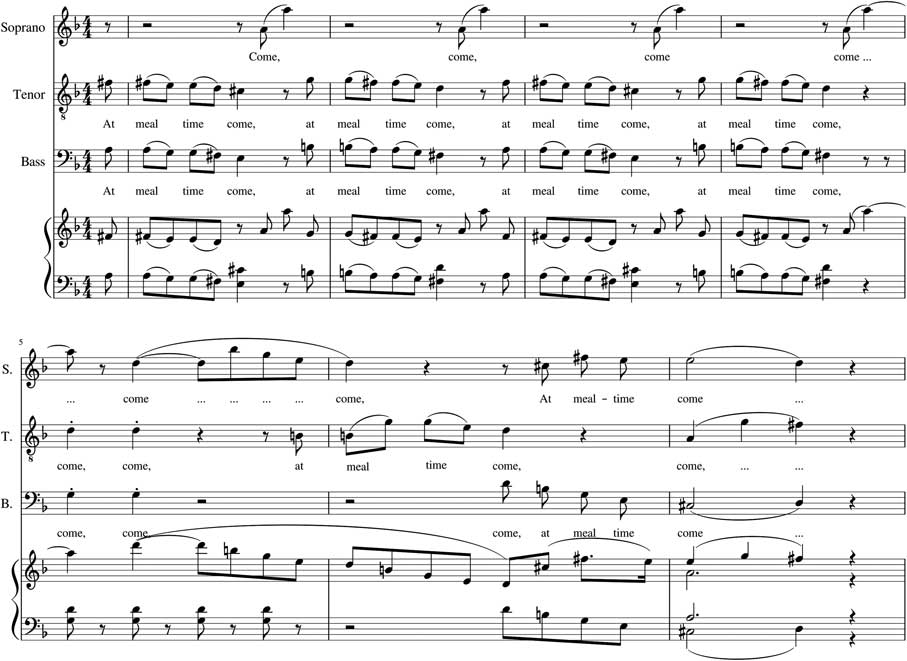
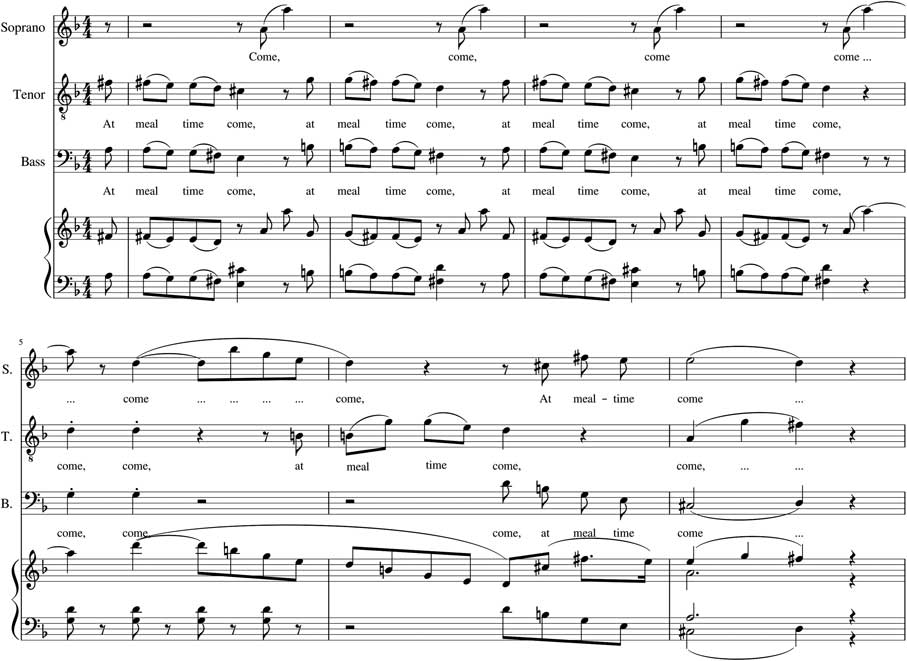
The Musical World review described Ruth as employing the ‘antipodean method’ of composition, labelling several sonic markers of Australianness. For example, what in another other context would be an octave leap, in Ruth becomes a ‘bush cry’ or ‘co-oee’ (Example 4). The cooee – a sonic device used in the bush to locate others – had by the 1860s made its way to London, and could be used, by those who performed it in the presence of Londoners, as an acting out of Australian identity.Footnote 100
George Tolhurst, Ruth, No. 42: Trio ‘At Mealtime Come’. The Musical World described the soprano line here as imitating cooees.
The Musical World review concludes:
A taste for Australian oratorio, as for Chinese cookery, must be acquired by those not ‘to the manner born’ … We hope Mr. Tolhurst will do little on this side the world … In Prahran … Ruth was a success. Why then divorce it from its native soil, and seek to plant it here, among strangers who do not, and cannot, understand it?Footnote 101
This clearly satirical review prompted a series of complaints from Tolhurst, writing repeated and rather tedious letters demanding the work be reviewed seriously. It also induced Horsley, still the conductor of the Melbourne Philharmonic, to write an extensive letter in defence of Australia, providing a particularly illuminating example of the tension between periphery and metropole. Horsley, through his European connections was still seen as British, (as the editor noted, the letter would be ‘a welcome communication’ to those in England who knew him). He was incensed by the tone of the review, writing that it contained ‘so much misapprehension’ and ‘want of knowledge as regards the progress of our art … in a small compass an amount of ignorance perfectly astonishing’.Footnote 102 Horsley’s tirade continued by juxtaposing the economic necessity of the colonies to the parent state alongside their artistic practice. While the original review nowhere uses the term ‘savages’, Horsley seems to have interpreted that as the reviewer’s implied meaning:
And yet we are savages? Yes – savages, who from 1851 to 1866 have sent you 31,731,844 ounces of gold from Victoria alone, representing … more than an eighth part of the national debt of England … Savages, from whom you have also had millions of bales of wool. Savages, to whom you are crying for your daily meat. Savages, who in Melbourne and in Sydney can give you as fine performances of oratorios, operas, symphonies … as you can hear in any provincial city in Great Britain, without London assistance.Footnote 103
Ruth, it seems, was not the real issue. Like many colonial writers, Horsley’s impassioned response displays both a frustration at metropolitan ignorance of the colony and insecurity and anxiety about the place of its art in the British consciousness: the same desire for recognition that prompted suggestions for Tolhurst to take Ruth to London.Footnote 104 The editor’s response to Horsley tidily completes this circular relationship. Dismissing Horsley’s concerns, the editor regrets that ‘residence in Australia takes away all perception of banter’, suggesting Horsley had lost his ability to ‘appreciate a joke’.Footnote 105 The editor concluded by questioning whether Horsley really believed that Australia was perceived in Britain as a wilderness of savages, proposing that if this was true, ‘we neither wonder at his vindicatory letter nor at the apparition of an Australian Ruth’.
‘An awfully good joke’: Ruth’s Afterlives
The polarized nature of the criticism of Ruth presented so far is complicated by its reception in other parts of Britain and at other points in history. During Tolhurst’s lifetime, Ruth was surprisingly well received in Britain outside of London. From 1869, Ruth received many performances around Kent, particularly in Maidstone (Tolhurst’s hometown), as well as in in Brockley, Chatham, Rochester and Lower Norwood, often sung by soprano Florence Ashton, and fellow colonial returnee, tenor Robert Farquharson.Footnote 106 The work was described as ‘bold, vigorous, and original … [with] endless variation of the most delightful melody, which charms and rivets the attention of all who hear it’,Footnote 107 and ‘written evidently with great earnestness … is throughout well constructed and melodious … [and is] far above mediocrity’.Footnote 108 Reviews for these performances often mention loud calls for the composer at the end, enthusiastic applause and numerous encores: many specifically reference the fact that this broke with the restraint customary at the performance of a sacred work.Footnote 109
The positive reception everywhere but London suggests that Melbourne’s optimism was not simply a case of colonial pride or insularity hindering the audience’s ability to judge the work impartially. Instead, the London press’s colonialist prejudices regarding ‘high-art’ from the colonies arguably influenced their criticism. However, the fact that the Kent reviews (particularly Maidstone) sometimes surpass Melbourne in their critics’ effusion could be the result of an equally parochial celebration of the achievements of a local composer.
A feature of many reviews – in London, Melbourne and elsewhere – is an acknowledgement that audiences visibly enjoyed the work. In marked contrast to the rejection of the work by London critics, Ruth regularly received standing ovations and demands for encores. While it may not be surprising that a work with many conventional features would appeal to a broad audience, this appears to have greatly perplexed the London critics themselves. By 1873, the Musical Times reported that, ‘notwithstanding much adverse criticism, [Ruth] appears to be constantly gaining ground’.Footnote 110 Some reviewers seemed particularly aggrieved by the general audience’s pleasure. For example, Thaddeus Egg (an alias used by Joseph Bennett)Footnote 111 withheld providing a genuine review in the Musical World (rather than the satirical one discussed above), for reasons that ‘can be stated in few words – I was present and heard it’.Footnote 112 He wrote that he ‘wished to avoid putting on record that any English audience, however made up of friends, could award frequent encores, and more frequent applause, to music which is simply unmusical’. While similar reports of audience behaviour are given elsewhere, the Musical Standard reported the presence of ‘unmistakable “friends”, who tried to encore all the songs, and did cause the repetition of about half a dozen’ suggesting that such displays of appreciation were orchestrated.Footnote 113
These reports raise a number of questions about the influence and power of critics, and the relationship between critics, composer and audience. As Harold Love points out, reviews themselves are the ‘main manifestation within the musical public of the critical rationality identified by Habermas as the defining characteristic of the bourgeois public sphere’.Footnote 114 A review in itself, though perhaps influencing public opinion, is merely the starting point for argument within a corpus of the widely varied public viewpoints.
Further, the reports of audience enjoyment, in contrast to the critics’ own aggressive assessments, problematize the assumption in reception studies that the opinions of critics are generally representative of the public through their shared experience of the work. However, as James H. Johnson has observed, ‘by correlating these aesthetic assumptions with their manifestations in behavior … one may perhaps make useful generalizations about the musical perceptions of those spectators whose behavior we see but whose thoughts are silent’.Footnote 115 Similarly, Leanne Langley points out that, while the nineteenth-century public may have increasingly used of the press to guide the formation of their own views, this does not necessarily mean the press represented the opinions of that audience: ‘Critical responses were often coloured by private motives; opinions could, and did, change over time. A continual flux and variety of views was characteristic of the age’.Footnote 116 The contrast between the reviews of Ruth in the London press with critics’ record of and objection to the behaviour of the audience suggests that the derision did not come from public consensus. Coupled with similar reports of audience behaviour and more positive critical responses in Melbourne and other British towns, it seems the rejection of Ruth came instead from the bastions of taste asserting their authority and pushing a particular agenda within the metropolitan musical press.
Catherine Hall contends in her work on the perception of colonies in the English imagination that ‘colony and metropole are terms which can be understood only in relation to each other, and that the identity of coloniser is a constitutive part of Englishness’.Footnote 117 This essential part of nineteenth-century British metropolitan identity, as well as the ‘right to colonial rule’ was reinforced by emphasizing distance and racial and cultural differences between metropole and colony. This emphasizing, as described by Partha Chatterjee, was done to preserve the ‘alienness of the ruling group’.Footnote 118 However, rule over settler societies, considered racially and culturally an extension of the home society, had to be maintained differently.
Viewed through Hall’s hypothesis, it seems the London reception of Ruth was inevitable. While perhaps of questionable aesthetic standards (particularly to modern ears), as one of the first Australian compositions to take on a British audience, Ruth’s London reception became part of a discourse framed to maintain the privileged position of the metropolis. The expression of aesthetic judgement can often serve as ‘a medium of social signification’, and in particular as ‘a means of locating oneself within hierarchies of economic class, employment and education’.Footnote 119 In this case, discussion was framed to preserve both the identity and status of the metropolitan critics, and the society they felt they represented (although, as discussed above, how much authority they truly wielded to influence public taste remains subject to debate). This was done by emphasizing the peripherality and perceived cultural inadequacies of the settler colonies. It also accounts for both the conflicting audience reaction, and the more favourable reception in smaller British towns. An individual London audience member’s enjoyment of the work was not invested in maintaining the imperial project. Equally, for a critic in a town peripheral to London itself, the idea of Australia and the conception of cultural superiority over the colonies may not have been relevant. Further, colonial cultural identity, particularly relating to music, can equally be understood through its relation to the metropole. Colonial critics were more likely to look favourably on local composition, particularly one in a ‘civilized’ genre like oratorio, representative of metropolitan taste, in an attempt to contract the distance and difference that placed them on the periphery.
Tolhurst had been heavily involved in the dissemination of his own work, and following his death in 1877 regular performances of Ruth ceased. Most oratorios in English, to quote David Brown, ‘produced after Mendelssohn and before Elgar have now passed into complete oblivion’, and at least for the rest of the nineteenth century, it seemed Ruth was destined for this outcome, just as it had been in Australia.Footnote 120 It is certainly not suggested that some of Ruth’s more conventional and unremarkable features should in themselves be a reason for an inevitable disappearance from programming – conventional pieces have and do survive to this day. Yet, the nature of Ruth’s sporadic revivals throughout the twentieth century in Britain (discussed below), all clearly linked to the legacy of its criticism, suggest that without this Ruth’s fate would have too, been conventional.
In the mid-1920s, Birmingham organist Samuel Royle Shore privately conducted research into Ruth’s dissemination, after being introduced to the work in 1915 by George Robertson Sinclair at Hereford. Ruth appears to have been a favourite in Hereford among the Three Choirs group, with many of the musicians associated with those festivals responsible for ongoing dissemination of the work. Both Walford Davies and Edward Elgar have at times been credited at times with its ‘rediscovery’ (the latter apparently describing it as ‘a fountain of joy’).Footnote 121 Letters and comments preserved by Shore in his copy of the piano score (a first edition originally owned by W.H. Cummings who sang in the London premiere) suggest that the work was something of an ‘in-joke’ in the community of British organists through the late-nineteenth and early-twentieth centuries. Shore distributed his copy to musicians around the country, asking ‘those who study this sublime work … to record their impressions’ within it. Here, correspondents with Shore recalled how Samuel Sebastian Wesley ‘always took his copy down when he felt down and it did him much good’, and Ebenezer Prout would ‘take down his copy and play, and sing at the top of his voice, page after page, of its most humorous numbers … in the early [eighteen] eighties’.Footnote 122
Shore claimed to be responsible for alerting Harvey Grace (the editor of the Musical Times) of the existence of the work, wishing the work ‘doubtless known to and cherished by many musicians, but … jealously guarded as a kind of professional secret’ to be known to a wider audience.Footnote 123 Grace went on to publish a satirical article under the pseudonym ‘Festes’ in January 1920. Affecting the persona of an 1860s critic, ‘with a friendly feeling towards the new work and its composer’, Grace changed Tolhurst’s name to Olthurst, as ‘he may have left descendants, and I would not willingly hurt their feelings’.Footnote 124 This was indeed the case, as, included in Shore’s volume of correspondence is a letter from Mary Tolhurst-Paton, Tolhurst’s great granddaughter, who wrote to ‘protest and to ask you to desist from such unseemly mockery’, suggesting that it ‘would be a very good thing if the young people of today were less enmeshed in ugly discordant sounds, and were able to write such simple, melodious, and harmonious music as that contained in my Great Grandfather’s oratorio “Ruth”’.Footnote 125
Grace’s article led to the inclusion of a section entitled ‘The Worst Oratorio Ever!’ in Percy Scholes’s The Mirror of Music. Attempting to make sense of the paradoxical reception of Ruth, Scholes questions the motives of performers appearing in the work, and the audiences who showed their appreciation.Footnote 126 Scholes concludes with the tongue-in-cheek suggestion that the success of the work was a collective joke at the expense of the sincere composer:
The fact seems to be that the oratorio had an enormous succès de ridicule – that audiences induced performers of importance to accept engagements to take part, prompted large sales of the scores, and inspired sarcastic critics – all of which phenomena the composer took seriously. No other explanation seems to be possible than that we see here a public conspiracy of bluff that has no rival in the long annals of the art of music!Footnote 127
Interest in the work was again revived during the 1960s and 70s, largely through the formation of the Tolhurst Society at the University of Oxford. For the most part a casual gathering of musicians meeting every few years to sing through Ruth for their own enjoyment, the Society helped to keep knowledge of the work alive and facilitated several public performances. Involving members of the Faculty of Music Sir Jack Westrup, Dr Sydney Watson (whose score was apparently marked ‘Stolen from Sir Walter Parratt’), Bernard Rose and AJ Croft, the Society included both undergraduate and graduate members.Footnote 128 The ‘prime mover’ behind its formation, Richard Drakeford ‘could often be heard (whilst dining at College) regaling other diners with choice bits’.Footnote 129 The choir was formed of members of Christopher Robinson’s Sine Nomine Singers, and notable soloists including Steuart Wilson of the English Singers.Footnote 130
In 1964, the centenary year of Ruth’s premiere, two separate performances were staged: the first, as part of Fritz Spiegl’s April Fool’s concerts at the Liverpool Philharmonic Hall, saw Ruth described in the Guardian as a piece acquiring its fame through the ‘ambiguous pronouncements made upon it by distinguished musicians’, who ‘were beguiled into writing masterpieces of sarcasm’ by the pomposity and ‘abysmal drivel’ of the work.Footnote 131 The second performance, by the Tolhurst Society, was a presentation of highlights at a meeting of the Oxford Music Club and Union in the Holywell Music Room. Felix Aprahamian amusingly reviewed ‘the succès de ridicule long enjoyed by the Amanda Ros of oratorio’ in the Sunday Times.Footnote 132
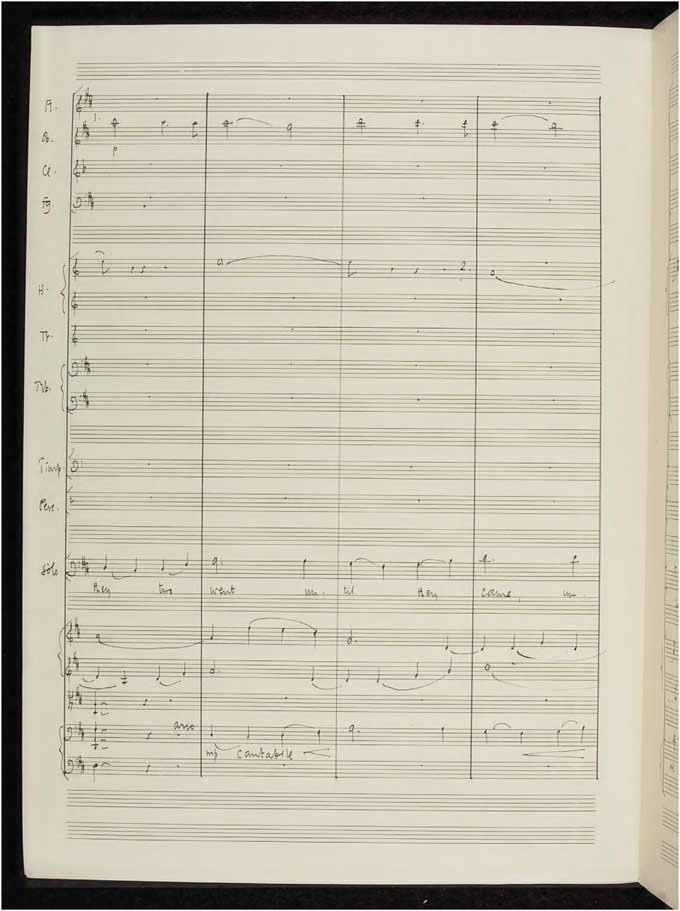
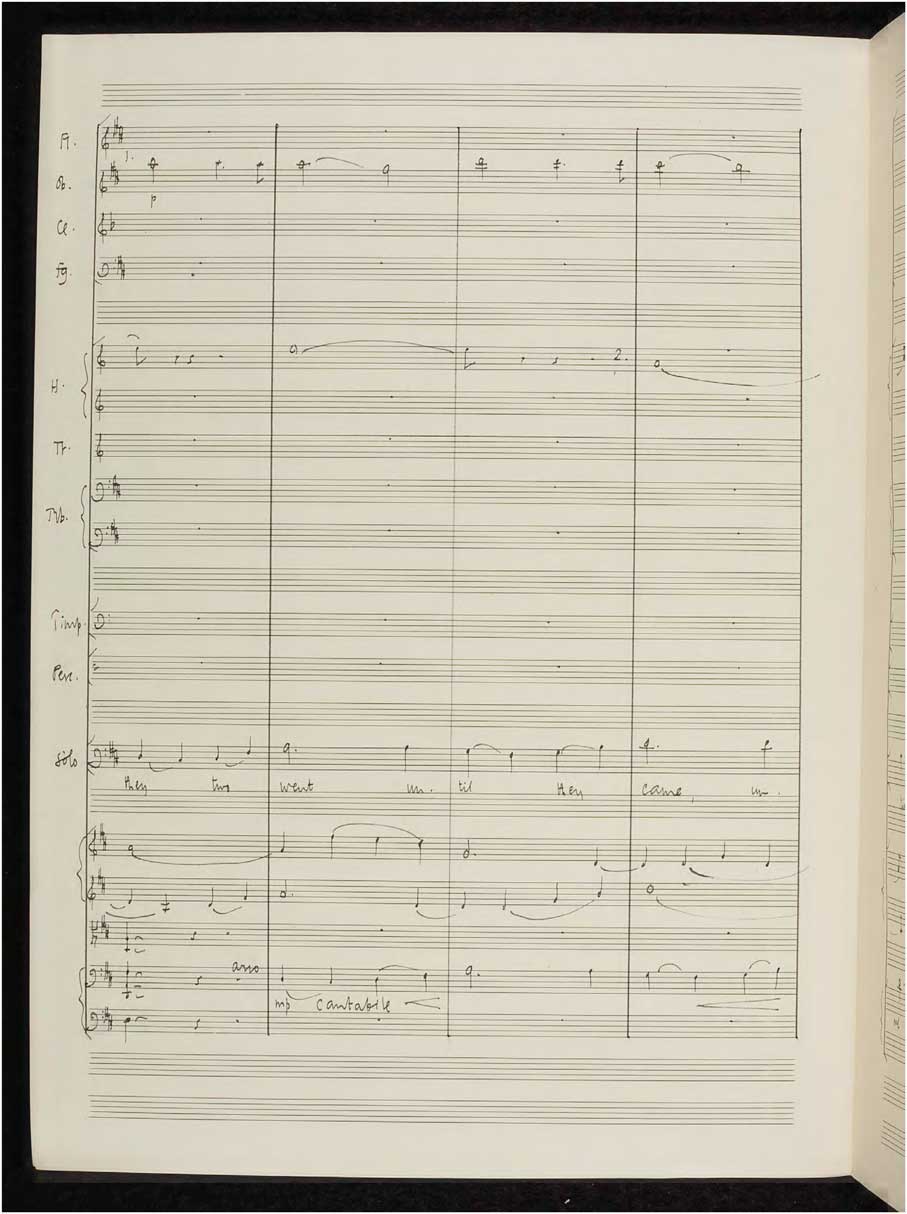
The most notable twentieth-century Ruth revival, however, is the 1973 re-orchestration organized by Antony Hopkins and the Royal Academy of Music. Conceived as part of a fundraising night of musical comedy at the Royal Albert Hall, Hopkins had the extant piano score orchestrated by 14 different British composers, including Michael Head, Humphrey Searle, Lennox Berkeley and John Gardner. Described in its promotional material as a ‘sublimely different’ work, aspects of this performance framed the piece through some of the same tropes of Australianness prevalent in the 1860s London reception.Footnote 133 In the most transparent allusion to Australia, John Joubert incorporated Waltzing Matilda as a counter-melody into his arrangement of the bass aria ‘They Two Went until They Came’ (Example 5).
Waltzing Matilda in the oboe line as a counter melody in John Joubert’s arrangement of the bass aria ‘And they two went until they came’, 1973. George Tolhurst, Ruth [re-orchestrated by various musicians for performance by the Royal Academy of Music at the Royal Albert Hall on 6 March 1973], London: Royal Academy of Music Library, MS440. Reproduced with permission from the arranger.
The 1973 press described Tolhurst quaintly and repeatedly as an Australian ‘market gardener’ and ‘spare-time musician’ (indeed, he was a member of the Melbourne horticultural society). According to The Times, he was credited besides Ruth with some ‘fiddle music’ and a song entitled ‘grub little mole, grub underground, there’s sunshine up above’,Footnote 134 while the Guardian drew comparisons with Florence Foster Jenkins and William McGonagall.Footnote 135 Antony Lewis’s ‘Tolhurst’s “Ruth”: Or, amid the Australian Corn’ was published in the Musical Times to coincide with this performance.Footnote 136 Referencing Tolhurst’s ‘trochaic subject [which] boldly renounces the iambic elements of the text’ in the chorus ‘And she went and came’ (Example 3, above), Lewis writes that one ‘can sense the pace of life in the Melbourne banlieues of the 1860s’.Footnote 137
Laden with sarcasm, Lewis’s article suggests that ‘so rare, indeed, is the talent displayed … that there must be something of a mystery regarding the identity of its composer’, pointing to the possibility of Tolhurst being a pseudonym (an anagram of ‘Ruth lost’). This is one of a number of references throughout the later reception joking that Tolhurst and Ruth may have been a hoax. The programme notes to a 2007 performance at Cambridge University ask the same, describing Ruth as ‘as mysterious and unknowable as a statue left by a vanished civilisation’, suggesting the ‘awfully good joke, whoever made it … may be on us’.Footnote 138
This Cambridge performance by the ‘Society for the Promotion of Bad Taste’ – formed through its members’ informal competitions to ‘produce the worst piece of (generally Victorian choral) music’ they could find – was staged for Comic Relief.Footnote 139 Organized by students and conducted by Stephen Cleobury, press distributed by the organizers described Ruth as a ‘horrortorio’, and noted that ‘musicologist Donald Tovey was reputedly once thrown out of the British Museum for laughing too loudly while reading the score to the piece’.Footnote 140 The presentation of Ruth here is obviously supposed to be taken in jest, and the hyperbole used in describing both Tolhurst and the music seems more in the spirit of affectionate teasing than vindictiveness. It is, however, interesting to note the ways in which the programme notes subtly perpetuate the cultural prejudices of the nineteenth century in both their structure and language. The notes contrast sections of the best reviews from Melbourne with the absolute worst from London, in a manner clearly arranged to emphasize an Australian parochialism. This is done in the same way the 1970s London press repeatedly referencing the ‘rapturous’ Melbourne reception of the 1860s,Footnote 141 while similarly highlighting some of the same tropes of ‘Australianness’ given in the earlier reception.
It is certainly not always the case that critics’ assessments influence whether a work is given repeated hearings. There are innumerable examples across the centuries of well-reviewed works being never heard again, and (if Nicholas Slonimsky’s Lexicon of Musical Invective is anything to go by) harshly-criticized works becoming part of the canon.Footnote 142 Yet for Ruth, the critics, who were ‘beguiled into writing masterpieces of sarcasm’ can ultimately be credited with its longevity.Footnote 143 As noted by many of the twentieth-century critics themselves, it is mainly Ruth’s nineteenth-century reception that has been remembered, rather than actual music. When Ruth is performed, it is always in light of its notorious London reception. The influence of this can be seen in that, for a work of over three hours duration, it is only the few particularly bad sections singled out for analysis in the nineteenth century (including the examples presented at the beginning of this article) that are included in discussions of the twentieth century. These later performances, therefore, form part of the legacy of the nineteenth-century London press’s ridicule of the work. In some revivals too – particularly Hopkins’s re-orchestration of 1973 – the legacies of Victorian social and cultural prejudices relating to the colonies presented in the press remain evident, manifested as a latent colonialist condescension.
Graeme Skinner and other Australian writers have noted that nineteenth-century British writers knew relatively little about Australia, and perhaps that remains the case today. For Ruth, however, the opposite is true. Although it might be expected that Ruth be remembered in Australia as the first colonial Victorian oratorio and one of the earliest works to be transmitted and performed overseas, it has been all but forgotten. It is instead remembered only in Britain, through the legacy of its critical reception – a critical reception that was framed around Tolhurst’s apparent Australianness.
The critic of the Melbourne Argus wrote in 1864 that Tolhurst ‘must not be satisfied with any present temporary success’ encouraging him to take the work to London, where there was ‘little fear that he will make for himself both fame and profit’. Notwithstanding profit, Tolhurst certainly made for himself a kind of fame, although perhaps not quite in the way the Argus critic imagined. Certainly, 150 years later, the colonialist condescension present in its reception in London ironically made Tolhurst, in certain British circles, one of the most famous colonial Australian composers of his era. Ruth itself is, in many places, known well beyond many other examples of ‘bad’ Victorian music. As Tolhurst wrote in 1868, the subject of the merits of his work should be left ‘to the unerring critic, “time”’.Footnote 144 The survival of such a bizarre work through time has provided opportunities to assess some important aspects of the musical and social relationship between Britain and Australia, and more broadly, parent state and colony.