Introduction
Patients with severe neurological diseases typically face problems with mobility, neuropsychological and cognitive disability, communication problems, and/or increased care needs (Allen et al. Reference Allen, Molloy and McDonald2020). These neurological conditions are largely incurable, reduce life expectancy, and may thus require palliative care (Boersma et al. Reference Boersma, Miyasaki and Kutner2014). The end of life for these patients is usually approaching with the onset of swallowing problems, frequent infections like aspiration pneumonia, and significant functional and cognitive decline reflected in high caregiver burden and weight loss, suggesting that a palliative care approach should be initiated (Ebke et al. Reference Ebke, Koch and Dillen2018; Oliver et al. Reference Oliver, Borasio and Caraceni2016). Palliative care aims to improve the quality of life of patients and their family members providing a holistic approach. Physical symptoms and psychological, social, and spiritual concerns are addressed with the help of an interdisciplinary and multiprofessional team specifically trained in palliative and hospice care (World Health Organization 2020). Integration of palliative care for patients with severe neurological diseases improves prognosis estimation, symptom management, patients’ quality of life, and family satisfaction (Oliver et al. Reference Oliver, Borasio and Caraceni2016). Although the number of patients with severe neurological diseases cared for in German palliative and hospice care structures has increased from 0.8% in 2005 to 4.8% in 2017, these patients are still underrepresented in palliative and hospice care structures considering their prevalence, morbidity, and mortality (Dillen et al. Reference Dillen, Ebke and Koch2019). Unsurprisingly, the most common place of death of neurological patients is the hospital and not an in- or outpatient palliative or hospice care setting (Boersma et al. Reference Boersma, Miyasaki and Kutner2014; Dasch and Lenz Reference Dasch and Lenz2022). However, little is known about how to integrate palliative care for neurological patients best as they present unique challenges that a palliative care approach developed primarily for oncological patients cannot sufficiently meet (Boersma et al. Reference Boersma, Miyasaki and Kutner2014; Turner-Stokes et al. Reference Turner-Stokes, Sykes and Silber2007). Yet, such information on a combined approach is crucial to improve care (Saleem et al. Reference Saleem, Leigh and Higginson2007) and can be ensured by a proper and valid outcome tool.
Patient-reported outcome measures are used to capture patients’ perception of their health and psychological, social, and spiritual concerns by means of standardized, validated questionnaires. This can help clinical staff to focus on the patients’ main concern (Bausewein et al. Reference Bausewein, Daveson and Currow2016; Dawson et al. Reference Dawson, Doll and Fitzpatrick2010). The Palliative care Outcome Scale (POS) is one of the few palliative outcome measures that captures the main concerns of patients with an incurable life-limiting disease (Hearn and Higginson Reference Hearn and Higginson1999). Although the POS is widely used in research studies and in the clinical routine, a more refined version was needed that would incorporate more symptoms and refine spiritual or existential issues (Higginson et al. Reference Higginson, Simon and Benalia2012; Murtagh et al. Reference Murtagh, Ramsenthaler and Firth2019), the Integrated POS (IPOS). Four versions were created, that is, patient self-report and staff proxy report both with a timeframe of 3 and 7 days, respectively. These have been cognitively tested and validated in various languages, including English and German (Murtagh et al. Reference Murtagh, Ramsenthaler and Firth2019; Schildmann et al. Reference Schildmann, Groeneveld and Denzel2016). The IPOS has proven very valuable in research studies to assess and measure patients’ symptoms and palliative care needs (Evans et al. Reference Evans, Bone and Yi2021; Golla et al. Reference Golla, Dillen and Hellmich2022, Reference Golla, Nettekoven and Bausewein2020; Schloesser et al. Reference Schloesser, Bergmann and Eisenmann2022; Schunk et al. Reference Schunk, Le and Syunyaeva2020). In the clinical care of palliative care patients, outcome measures are becoming increasingly important as well (Bausewein et al. Reference Bausewein, Daveson and Currow2016, Reference Bausewein, Schildmann and Rosenbruch2018). For example, the German Comprehensive Cancer Centers are currently planning to implement the IPOS as a palliative outcome measure which is in agreement with the IPOS being one of the few recommended palliative outcome measures in the German guideline for palliative care to screen for palliative care needs (Leitlinienprogramm Onkologie 2020). The IPOS is mainly used as a self-report by the patient itself, but proxy reports filled out by clinical staff also exist and gain in importance once patients cannot sufficiently assess their symptoms themselves anymore due to the progression of their disease. It is important for palliative outcome measures to capture the full range of concerns of patients with progressive incurable diseases. When applied to specific diseases such as neurological conditions, they might not be sensitive enough to detect key symptoms that require palliative care in that specific patient population. For this reason, the multiple sclerosis-POS (POS-MS) (Sleeman and Higginson Reference Sleeman and Higginson2013) and the IPOS Neuro (Gao et al. Reference Gao, Crosby and Wilcock2016; Wilson et al. Reference Wilson, Hepgul and Saha2019) have been developed. The latter is a reliable and valid psychometric instrument, thus far only available as a self-report version, and allows for the identification of problems at an early stage and, if indicated, consultation of palliative care structures. Its full version comprises 45 items covering symptom experience, information needs, practical concerns, anxiety, and feeling at peace, which are scored on a 5-point Likert scale. There are 2 shorter adaptations containing 8 and 24 carefully selected symptom-specific items, which have both demonstrated satisfactory to good psychometric properties (Gao et al. Reference Gao, Crosby and Wilcock2016; Wilson et al. Reference Wilson, Hepgul and Saha2019). As a rather short tool, the IPOS Neuro-S8 (see Supplementary File 1) seems to be suitable in the clinical routine irrespective of being applied in an outpatient, inpatient, or semi-inpatient setting such as a private practice, hospitals, nursing homes, hospices, rehabilitation or day clinics, in general, or specialized palliative care settings and research studies. It is easy and quick to administer which is a prerequisite for patients with a severe or terminal disease as it will minimize their time constraints. It is also a validated measure for use in English-speaking populations, but translation and validation in non-English-speaking populations have not yet been done. Prior to its use in a specific country, measures must be translated, culturally adapted, and validated to create a reliable and relevant measure reflecting care concepts that are applicable to the target culture with its particular population (Bausewein et al. Reference Bausewein, Daveson and Currow2016).
This study aimed to translate and cross-culturally adapt the IPOS Neuro-S8 into the German health-care context and evaluate its face and content validity. Both are comparable forms of validity assessing whether a test covers all relevant parts of the construct with face validity being more subjective. This was done as groundwork before assessing its validity and reliability so that it can be used in Germany as a brief and feasible instrument in the clinical routine in various outpatient, inpatient, and semi-inpatient settings and research studies. In the current study, we used cognitive interviewing as the method of choice to ensure that the instructions and items were accurately expressed and to indicate face and content validity.
Methods
Design
The cultural adaptation study followed the first 6 phases of the manual for translation and cross-cultural adaptation developed by the POS team (Antunes et al. Reference Antunes, Daveson and Ramsenthaler2012).
Setting and participants
The study was conducted at the Departments of Palliative Medicine and Neurology of the University Hospital Cologne. The study followed the Declaration of Helsinki (World Medical Association 2014). All study participants provided written informed consent.
Complex neurological patients suffering from a largely incurable disease that reduces their life expectancy and are thus in need of palliative care of at least 18 years of age were recruited from the Departments of Palliative Medicine and Neurology. If a patient was unable to give written informed consent due to physical disabilities, a legal representative who had full command of the German language and could give written informed consent was allowed to act on behalf of the patient. Both had to be native German speakers, and patients additionally needed to have basic knowledge of the English language (understanding). Clinical staff with extensive experience in either palliative care or neurology were recruited from both departments. All clinical staff needed to be 18 years or older, native German speakers with basic knowledge of the English language (understanding), and able to give informed consent. Participants were screened by a clinical team member (Y.G., H.G., and C.W.) and, if interested, approached by a researcher (K.D.).
Measure
The IPOS Neuro was developed for people with progressive, long-term neurological conditions and has been adapted into 2 shortened forms, that is, IPOS Neuro-S8 (Gao et al. Reference Gao, Crosby and Wilcock2016) and IPOS Neuro-S24 (Wilson et al. Reference Wilson, Hepgul and Saha2019). Both of these shortened adaptations contain 3 key questions with instructions of which the second question lists a selection of core symptoms from the full 45-item version. The IPOS Neuro-S8 covers 8 physical symptoms, that is, pain, nausea, vomiting, mouth problems, sleeping difficulties, breathlessness, spasms, and constipation over the past 3 days. The response categories range from 0 (not at all) to 4 (overwhelmingly). The total score is obtained by summing the item scores, that is, 0–32. The English versions of both the IPOS Neuro-S8 and IPOS Neuro-S24 have been validated and evaluated using data from patients severely affected by multiple sclerosis, idiopathic Parkinson’s disease, multiple system atrophy, and progressive supranuclear palsy (Gao et al. Reference Gao, Crosby and Wilcock2016; Wilson et al. Reference Wilson, Hepgul and Saha2019). For the validation of the IPOS Neuro-S24, patients with motor neurone disease were also included (Wilson et al. Reference Wilson, Hepgul and Saha2019).
Phase 1. Conceptual definition
The conceptual definition clarifies the concepts underlying each item which is crucial to ensure that the new measure reflects the care concepts of the target culture (Antunes et al. Reference Antunes, Daveson and Ramsenthaler2012). This was done by following a 3-step process: (1) literature search on health-related quality of life issues relevant for palliative care and neurological patients; (2) identification, analysis, and definition of critical concepts underscoring each item using semi-structured interviews with clinical staff possessing knowledge in palliative care or neurology; (3) discussion of the concepts defined in step 2 with palliative care and neurological patients. Both interview guides were developed by the first author (K.D.) following the POS measures manual (see Supplementary Files 2 and 3) (Antunes et al. Reference Antunes, Daveson and Ramsenthaler2012).
Phases 2 and 3. Forward and backward translations
First, the original IPOS Neuro-S8 was translated into German (forward translation). This forward translation involved 2 independent translators with complementary backgrounds. One had clinical knowledge and was familiar with palliative care and neurology terminology; the other had no clinical or medical background and therefore used a language spoken by the general population. Both were native German speakers and proficient in English (i.e., they were very skilled in reading, writing, speaking, and listening). Discrepancies were identified by a third person who served as a mediator to reach a consensus. The mediator was knowledgeable about palliative care concepts but had no medical background and was not involved in the preceding forward translation. Next, this version was translated back into English (backward translation), ensuring the German version reflected the item content of the original English version. This check was done by a native English speaker who had no clinical or medical background, had no conceptual knowledge of the IPOS Neuro-S8, and was blind to the original English version.
Phase 4. Expert review
The translated intermediary versions were then evaluated, revised, and consolidated by a multidisciplinary panel of experts, including members from the research team and clinical staff with palliative care or neurological background through a one-time online video conference coordinated and chaired by the first author (K.D.) who was taking minutes. These were then discussed with the principal investigator of this study (H.G.) before the pre-final version of the measure was created by K.D. Using the conceptual elements from the first phase, this was done to achieve conceptual, semantic, experiential, and content equivalence.
Phase 5. Cognitive debriefing
By conducting cognitive interviews, verbal information related to the responses is additionally collected while administering a questionnaire (Beatty and Willis Reference Beatty and Willis2007). This can be ensured by the think-aloud technique during which interviewees are asked to verbalize their thoughts while answering and by using specific probes (Beatty and Willis Reference Beatty and Willis2007; Schildmann et al. Reference Schildmann, Groeneveld and Denzel2016). The think-aloud technique in particular can be useful in designing a questionnaire (Beatty and Willis Reference Beatty and Willis2007), and we thus opted for cognitive interviewing or debriefing as it relates to the qualitative pre-testing phase of a measure in the target language. Clinical staff and patients were interviewed separately using 2 different semi-structured interview guides to evaluate the measures’ comprehension, acceptability, clarity, relevance, and length (see Supplementary Files 4 and 5). This procedure allowed assessing content and face validity. All interviews started with a question about the interviewees’ overall impression and relevance followed by specific questions related to the test instructions and each item, each with probing questions to generate verbal information and record cognitive processes (think-aloud technique), and ended with an open-ended question for additional remarks. Each interview was conducted via online conferencing, recorded digitally, timed, and performed by the first author (K.D.), who is experienced in conducting qualitative interviews and did the verbatim transcription.
Phase 6. Proofreading
Upon completing all 5 phases, all required documents (i.e., forward translation, backward translation, records, final report, and pre-final measure) and completed templates as requested by the POS Development Team were sent as aggregate data to the POS Development Team (M.H.) for final proofreading.
Data analysis
Data collected during phases 1 and 5 were analyzed by the first author (K.D.) following the cultural adaptation phases (Antunes et al. Reference Antunes, Daveson and Ramsenthaler2012). Thematic content analysis was used to categorize and identify central themes following cognitive interviewing (Anderson Reference Anderson2007). Each interview was read thoroughly. Responses for each element and item were listed on a coding sheet. These were aggregated and compared for each item and finally compared between patients and clinical staff. Statements to the last question about additional remarks concerned similar issues, so they were clustered together. Ambiguous text segments were discussed with the last author (H.G.) until a consensus was found. Sample characteristics were described by medians and ranges or absolute frequency. Time to completion was calculated descriptively by medians and ranges.
Results
Demographical data
Five clinical staff members and 4 patients participated in an interview for phase 1. These were conducted between May and August 2020. Two more patients were approached but declined participation. The expert review panel (phase 4) consisted of 4 physicians, 3 nurses, 1 researcher, and all 3 translators from phases 2 and 3. Out of 12 patients who agreed to participate in a cognitive interview for phase 5, 3 had to be excluded due to physical deterioration at the time of the interview. Eleven eligible clinical staff members were identified, all of whom agreed to be interviewed. These interviews (phase 5) were completed between October and November 2020. The demographical characteristics of interviewees who participated in phases 1 and 5 can be found in Table 1. A summary of all participants is shown in Figure 1.
Characteristics of both patients and clinical staff who participated in phases 1 and 5

a Patients were carefully screened by a clinical team member (Y.G., H.G., and C.W.). Included patients either had problems with mobility, communication problems, increased care needs, or significant functional decline.
Summary of study participants.

Phase 1. Conceptual definition
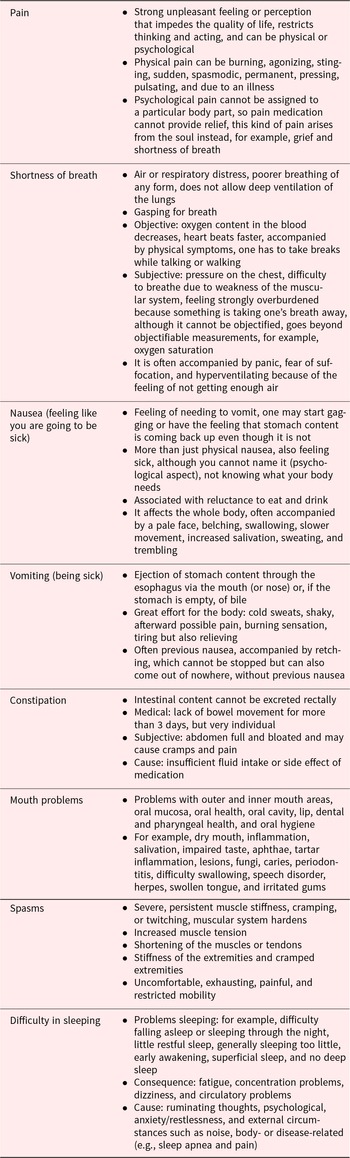
This phase aimed to define and discuss key concepts that underscore each item. A summary is shown in Table 2. In general, there was a high consensus between the concepts as defined by clinical staff (n = 5) and patients (n = 4), although clinical staff expressed clear, objective concepts while patients spoke from their own subjective experience. A few minor challenges were highlighted in defining the concepts for all but one item. When asked about the underlying concept of pain, both clinical staff and patients differentiated between physical and psychological pain.
On the one hand, I understand by pain physical pain that can be expressed neuropathically as a burning, stabbing, agonizing, sudden, spasmodic, or permanent sensation, but I also understand by pain a psychological pain component, that is, it cannot be assigned to anything at all, well, I’m aware of the term “total pain,” so simply the feeling of a comprehensive psychological pain that cannot be treated with pain medication alone. (K05)
A summary of the conceptual definition for each item

They expected the psychological component of pain and other items, including shortness of breath and nausea, in other countries and cultures to be neglected in favor of the physical component. Regarding the items nausea and vomiting, clinical staff explained that the English parenthesis to be sick is not associated with either of the symptoms mentioned earlier in the German language.
… sometimes this is related to language elaboration, for example vomiting (being sick), you wouldn’t say “I feel quite sick,” but “I feel nauseous,” “I have to throw up soon.” (K02)
All interviewees had difficulties defining mouth problems and listed more examples than a solid definition. The item spasms was difficult to define, especially the distinction of cramps versus spasticity. Difficulty in sleeping was also a controversial item pending among difficulties, problems, and disturbances. Potential differences regarding the importance of sleep in different cultures and countries were mentioned.
Phase 2. Forward translation
There were minor linguistic and content differences between both forward translations for the items vomiting (being sick), mouth problems, spasms, and difficulty in sleeping. As one translator was a clinician who knew which terms are easiest understood by patients, her suggested translations were used for the 2 items vomiting [Erbrechen] and difficulty in sleeping [Schlafstörungen]. These were adopted into the final version of the measure. The parenthesis being sick after vomiting was deleted as it was found to be idiomatic to the English language. The other 2 items (mouth problems and spasms) were discussed with the mediator until a consensus was found. For mouth problems, the literal translation [Mundprobleme] was chosen, not leaving room for interpretation. For spasms, 5 German words were initially considered by both translators [Spastiken, Spastik, Krämpfe, Spasmen, and Verkrampfungen], with one being mutual and generally understandable [Krämpfe]. To differentiate it from another disease-specific symptom, it was further narrowed down [Muskelkrämpfe] in mutual agreement with the mediator and both translators. However, these 2 items were further discussed during the subsequent expert review (phase 4) and cognitive interviews (phase 5) and eventually rewritten in the final version (see below for details).
Phase 3. Backward translation
This intermediary version of the preceding forward translation was then used for the backward translation. However, there were a few discrepancies in the backward translation compared to the original measure. The instructions and Likert response options of question 2 were particularly different, as were the following 4 items: nausea (feeling like you are going to be sick), constipation, spasms, and difficulty in sleeping. Two of these items were already considered problematic during the forward translation (spasms and difficulty in sleeping). All inconsistencies were discussed with the mediator, and a protocol was kept for further debate within the expert review.
Phase 4. Expert review
Both, the intermediary forward and backward translations were then discussed within the online expert review (n = 11). The instructions and Likert response options of question 2 and 2 items already considered challenging during the translation phases were particularly discussed. The distinction between symptom severity and impact as expressed in question 2 was clarified. During the backward translation, this phrase was translated as how severe the symptoms were, which did not match the original subsentence. Consequently, both the forward and backward translations were revised accordingly [wie sehr Sie sich dadurch … beeinträchtigt gefühlt haben – that best describes how the symptoms have affected you…]. Similarly, the backward translation for the Likert response option slightly was translated differently [leicht – light], that is, it did not describe how a symptom can affect a person, so both the forward and backward translations were updated [ein wenig – a little]. The translations were inconclusive for 2 items already discussed during the translation phases. First, the item constipation was translated as congestion [Verstopfung – congestion]. However, expert review members associated this with the sinuses rather than the gastrointestinal tract. Therefore, the forward and backward translations were modified for clarification [Verstopfung (Darmträgheit) – blockage]. The other item spasms was discussed at length, specifically the difference between spasticity and muscle cramps. Eventually, both intermediary translations of the preceding phases 3 and 4 were rewritten to reflect the concept of spasticity [Spastik] and not muscle cramps [Muskelkrämpfe] as agreed upon during the forward translation. The remaining 2 items that differed from the original measure difficulty in sleeping and the parenthesis feeling like you are going to be sick were not altered as experts felt they were not to be misunderstood or misinterpreted by patients in the German health-care context.
Phase 5. Cognitive debriefing
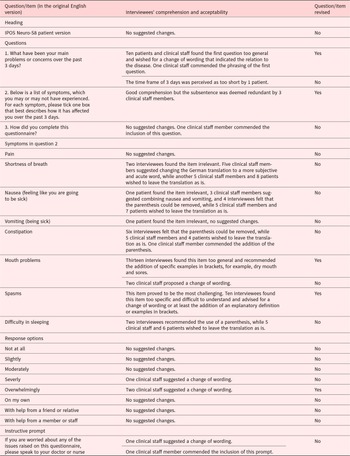
The pre-final version created after the expert review by the first author (K.D.) was then used in the qualitative pre-testing phase using cognitive debriefing or interviewing. Both patients (n = 9) and clinical staff (n = 11) found the measure comprehensible and well structured, especially the Likert response options were commended. Herein, only one response option was rewritten as suggested by 2 clinical staff members. The phrasing of the first 2 questions itself was criticized and modified accordingly in the final version.
Q1: I would replace the word problems with (medical) complaints [Beschwerden], problems are rather broad by definition, as in “my account was frozen,” these are problems but a (medical) complaint I would associate with the body and health. (K15)
Q2: This “Or not at all,” well I believe you could delete this, because either you have experienced it then you tick it off or you just tick “not at all,” then it is “or not at all”… that’s just the same thing twice, but I think that is a result of the English translation, because it is a standard phrase in the English language. (K3)
The length and time to completion were deemed acceptable (median time patients: 3:11 min, range 02:09–09:51; median time clinical staff: 1:22 min, range 1:02–2:05), only 1 patient felt that the time for completion was too long. The length of the measure was also commended for its brevity.
Well, I think the physical symptoms are well covered…. I would not make it longer, in no way longer, it should remain concise and clear. (K13)
Three patients considered the symptoms irrelevant to themselves. The items mouth problems and spasms posed some minor problems for both patients and clinical staff. Both groups felt that mouth problems were too general and nonspecific and proposed to add some specific examples, for example, dry mouth, which was considered highly relevant for the involved patient population. As a result, 2 of the suggested examples “dry mouth and sores” were incorporated into the final version. Comprehension difficulties were identified for spasms and solved by adding muscle cramps in parenthesis.
I stumbled across 2 things that might not be clear to some patients, mouth problems I wasn’t quite sure what was meant by that, I can imagine as a [occupation] what is meant by it, but I don’t know if a patient would think of it right away, I could imagine that dry mouth and things like that are meant by that or maybe swallowing problems… and with spasms I’m also not sure if every patient knows what is meant by it, if s/he never had it… if you could actually just add muscle cramps, then it is not isolated to spasms, but refers to a broader context. (K08)
All other items and elements of the measure were left unchanged after extensive discussion. Conceptual elements underlying each item were adjusted accordingly. For a detailed overview, see Table 3.
Issues identified within cognitive debriefing by all interviewees (n = 20)

Phase 6. Proofreading
The final version (see Supplementary File 2) and all aggregated documentation were reviewed and approved by the POS Development Team, facilitated by M.H. The external reviewer of the POS Development Team suggested minor editorial changes to the instructions for the first 2 questions and the instructive prompt, which we have incorporated into the final version.
Discussion
In this study, we culturally adapted and translated the IPOS Neuro-S8 for the first time and demonstrated acceptability and content validity through cognitive interviews with patients and clinical staff within the Department of Palliative Medicine and the Department of Neurology of the University Hospital Cologne. However, the translation for some items was too vague and needed cultural adaptation, emphasizing the importance of cognitive debriefing. This finding is in good agreement with other translations and cultural adaptations of the parent measure (Antunes and Ferreira Reference Antunes and Ferreira2020; Sterie and Bernard Reference Sterie and Bernard2019; Veronese et al. Reference Veronese, Rabitti and Costantini2019).
We followed the POS measures manual (Antunes et al. Reference Antunes, Daveson and Ramsenthaler2012) to create a version of the IPOS Neuro-S8 conceptually equivalent to the original measure. Although there was a consensus for all 8 items, the concepts of 4 items were slightly adjusted after cognitive interviewing, which attests to the significance of cognitive interviews as part of a cultural adaptation study of an outcome measure. Interestingly, for the 3 items pain, shortness of breath, and nausea, both patients and clinical staff mentioned psychological aspects during the conceptual definition. This might be considered controversial in other cultures, especially when it might be unusual to acknowledge psychological influences on physical sensations. In Germany, however, patients appreciated the psychosomatic aspects of illnesses and complaints and expected clinical staff and researchers to think within this dimension, too.
Overall, our results confirm the measure’s acceptability and comprehension, despite some minor problems with comprehension of 2 items questioning its conceptual equivalence, that is, whether the concepts of given items in both cultures actually exist and are equal (Antunes et al. Reference Antunes, Daveson and Ramsenthaler2012). Herein, agreeing on an appropriate term for spasms was a significant hurdle already during the translation process. Different wordings and parentheses were discussed while reviewing its concept. Ultimately, conceptual equivalence was ensured by adding muscle cramps. The second questionable item was mouth problems. It was considered too vague, and although some patients reported thinking of dry mouth, which is the intention of the item (Veronese et al. Reference Veronese, Rabitti and Costantini2019), not every patient did. This misperception has already been described in the translation and cultural adaptation study of the parent IPOS (Schildmann et al. Reference Schildmann, Groeneveld and Denzel2016). However, as the original item sore or dry mouth was intentionally changed to mouth problems in the neurological version (Veronese et al. Reference Veronese, Rabitti and Costantini2019), we only added dry mouth as an explanatory addition for clarification as proposed by many interviewees. While 2 clinical staff members additionally proposed a change of wording, we considered the addition of 2 specific examples sufficient as an explanation and to confirm conceptual equivalence.
Content and face validity were also revealed through cognitive debriefing. Overall, interviewees found the measure valuable and intelligible, confirming its clinical applicability. Nevertheless, 2 patients and 1 clinical staff member doubted the relevance and therewith content equivalence of 3 items (shortness of breath, nausea, vomiting), while all other symptoms were considered essential. Also, 9 clinical staff members and 1 patient suggested the addition of the following symptoms: psychological symptoms such as depression or anxiety, weakness, loss or change of appetite, hallucinations, difficulty speaking, tingling, restlessness, and tiredness. However, although we recognize the relevance of these symptoms, we did not incorporate them in the refined IPOS Neuro-S8 as the included 8 items are considered core items of the IPOS Neuro (Gao et al. Reference Gao, Crosby and Wilcock2016) and the intent of the current study was not to add or remove given items but to remain as close as possible to the original measure.
One clinical staff member criticized the period of 3 days (asked in questions 1 and 2) as neurological patients are often diagnosed with a progressive, long-term disease and instead suggested asking for changes. Similarly, the period of the past 3 days was considered too short by 1 patient who would have preferred a more prolonged time reference. This is in line with the findings of another translation and cultural adaptation study (Schildmann et al. Reference Schildmann, Groeneveld and Denzel2016). While the IPOS Neuro was developed as a self-report specifically for people with long-term neurological conditions (Gao et al. Reference Gao, Crosby and Wilcock2016; Wilson et al. Reference Wilson, Hepgul and Saha2019), the 3-day recall version does not incorporate the fluctuating symptoms this patient population might be affected by. As there are versions of the IPOS with a 7-day recall period, our results suggest developing a 7-day IPOS Neuro version, which is more reasonable for neurological patients. Shall such a version with an extended recall period be developed, it seems appropriate to use both versions in various clinical settings providing palliative care, including hospitals, private practices, rehabilitation or day clinics, hospices, nursing homes, and at home by specialized or general palliative home care depending on the patients’ condition, that is, for neurological patients with a progressive, long-term disease. It may also be used in non-palliative care settings, such as neurological units, to trigger the referral process (Gao et al. Reference Gao, Crosby and Wilcock2016). It might aid in the early initiation of palliative care for patients with severe neurological diseases approaching the end of life.
Additionally, there were some discrepancies with the phrasing of question 2. Herein, the severity of a symptom was rated instead of the degree of being affected by it (Schildmann et al. Reference Schildmann, Groeneveld and Denzel2016). This is one of the major differences between the HOPE+, already available in the German language, and the IPOS Neuro-S8, with the former evaluating the incidence and intensity of symptom burden, while the IPOS Neuro-S8 assesses explicitly the impact of symptoms on a patients’ everyday life within the past 3 days (Dillen et al. Reference Dillen, Ebke and Koch2019). Our own experience suggests that patients tend to rate the presence or incidence and intensity of a symptom rather than the impact it has on them. It might be easier for patients to indicate whether they have a specific symptom than how much they are affected by it as this requires a higher-level cognitive function and the capacity for emotional reflection skills. It is, however, clinically relevant to differentiate between the impact of a symptom and the incidence and intensity as treatment plans might be different; however, both views are important for a comprehensive understanding.
In general, both patients and clinical staff found the wording clear and understandable and felt that the Likert response options, length, and time to completion were appropriate. Clinical staff also commended the measure’s conciseness. This is crucial for a measure developed specifically for terminally ill patients. They even seemed to appreciate the opportunity to talk about certain aspects related to the symptoms (Beck et al. Reference Beck, Olsson Möller and Malmström2017). Therefore, our results suggest that the instructive prompt at the end of the measure is of essential importance. Instead of being left alone after filling out an outcome measure that might have triggered something in a patient, this prompt offers a follow-up consultation. Thus, while a measure must be easy and quick to administer, their wish to talk about it should also be considered.
Strengths and limitations
In our study, we used both the “think-aloud” and probing technique to optimize unintended and specific, detailed information flow (Willis Reference Willis2005). To enhance credibility, the interview guide was meticulously discussed with the last author (H.G.). We also ensured that the first author (K.D.) had the required knowledge and training to perform the study. A major strength of our study relates to the heterogeneity of our sample. We were able to cognitively interview a broad range of persons with various progressive neurological conditions at different stages of their disease, so we even included severely affected patients.
There are also some limitations that need to be discussed. The first caveat relates to the recruitment setting. All except one patient were recruited from the Department of Neurology. However, we carefully selected severely affected patients who were considered palliative care patients. Another limitation is the small sample size, which limits the generalizability. However, small sample sizes of 5–15 interviewees have been recommended for cognitive interviews (Beatty and Willis Reference Beatty and Willis2007), also by the POS team itself (Antunes et al. Reference Antunes, Daveson and Ramsenthaler2012), and our sample size is comparable to other translation and cultural adaptation studies (Beck et al. Reference Beck, Olsson Möller and Malmström2017; Gerlach et al. Reference Gerlach, Taylor and Ferner2020; Schildmann et al. Reference Schildmann, Groeneveld and Denzel2016; Sterie and Bernard Reference Sterie and Bernard2019).
Conclusion
The German IPOS Neuro-S8, a patient-reported measure used to assess and treat patient-related problems in clinical practice, is well accepted by severely affected neurological patients and clinical staff and demonstrated face and content validity. The cross-cultural adaptation and translation process resulted in changes for the items vomiting, constipation, spasms, and mouth problems. As a translated measure must stay as close as possible to the original measure, other items remained unchanged, although there were some inconsistencies. This is the first measure for neurological patients in need of palliative care that assesses the impact of symptoms on patients’ everyday life and can be used longitudinally to treat problems and direct conversations in routine clinical practice, which is essential for patients with a severe neurological disease with fluctuating symptoms. It is also appropriate for an international audience, so our results suggest cultural adaptations to other non-English-speaking populations and might already have raised awareness of the importance of such a tool. The tool is now available for download in German on the POS website (https://pos-pal.org/) for routine clinical assessments, clinical trials, and education to capture the patient-centered needs of neurological patients. Next, we will investigate its psychometric properties, including construct and criterion validity.
Supplementary material
The supplementary material for this article can be found at https://doi.org/10.1017/S1478951523000238.
Acknowledgments
We thank all patients and clinical staff for participating in our study. Our thanks are extended to Florian Dillen and David Browne for their translations and to Solveig Ungeheuer for her generous help with recruitment. The full list of members of the KOKOS-MS Trial Group is as follows: Anne Müller, Beatrix Münzberg, Clemens Warnke, Dirk Müller, Dorthe Hobus, Gundula Palmbach, Heidrun Golla, Isabel Franke, Kim Dillen, Martin Hellmich, Monika Höveler, Solveig Ungeheuer, Sophia Kochs, Veronika Dunkl and Yasemin Göreci.
Conflicts of interest
None.
Ethical approval
The Ethics Commission of Cologne University’s Faculty of Medicine (No. 20-1086, May 28, 2020) approved the study, which was registered at the German Clinical Trials Register (No. DRKS00021783, June 30, 2020).