Introduction
Patients are increasingly visiting urgent care centers (UCCs)—outpatient care facilities providing immediate medical treatment for acute and chronic illness and injury—before other types of healthcare facilities for low to moderate acuity conditions. Reference Poon, Schuur and Mehrotra1 Recent studies have found a significant overlap in conditions seen between Emergency Departments (EDs) and UCCs, and that UCCs could serve as an alternate care setting for at least 13% of Emergency Department visits. Reference Ho, Metcalfe and Dark2,Reference Weinick, Burns and Mehrotra3 These characteristics indicate that UCCs could support the healthcare system response during a natural or man-made disaster including infectious disease outbreaks.
Based on the symptoms most commonly seen in UCCs, they are particularly vulnerable to infectious disease exposures. A recent Urgent Care Association (UCA) benchmarking survey reported that the top 5 urgent care diagnosis codes were all related to acute infections; including acute upper respiratory infection, sinusitis, pharyngitis, cough and fever. 4 In New York City (NYC), patients having or suspected of having highly infectious diseases, including measles, mumps, and Ebola, have presented initially at UCCs. Poor implementation of infection prevention and control (IPC) policies and practices could put patients and healthcare staff at risk. Infection prevention is also an integral part of keeping the healthcare system prepared to prevent, detect and respond to communicable diseases of public health concern.
Additionally, UCCs are vulnerable to disruptions in operations during a disaster but they could also be a resource. NYC has experienced public health emergencies, such as Superstorm Sandy, that can disrupt the delivery of healthcare services across the system and exhaust or overwhelm the resources of healthcare facilities. Reference Redlener and Reilly5,Reference Smith, Braun and Portelli6 UCCs could support the healthcare system by treating patients with less severe injuries or illnesses, reducing the burden to nearby hospital emergency departments. Reference Weinick, Burns and Mehrotra3,7 They can also serve as alternate sites of care for higher acuity services. An example of this was seen during Hurricane Sandy when the ED of a large academic medical center was destroyed, and the 2 nearest hospitals were forced to close. They established an urgent care center which included an associated ED-run observation service where displaced ED and other hospital staff were able to deliver care in an alternate space. Reference Caspers, Smith, Seth, Femia and Goldfrank8,9
Subsequently, there has been an effort to establish national emergency preparedness standards for healthcare facilities to ensure adequate planning for both natural and man-made disasters, and coordination with emergency preparedness systems. In 2016, the Centers for Medicare and Medicaid released the final rule for Emergency Preparedness Requirements for Medicare and Medicaid Participating Providers and Suppliers. These rules require all participating facilities to have (1) an emergency plan, (2) policies and procedures that address emergency preparedness, which must include emerging infectious diseases, (3) a communication plan, and, (4) annual training and testing of emergency preparedness plans. 10 Since UCCs have unstandardized licensure and accreditation requirements due to varied regulatory mechanisms and oversight, many are not required to comply with the final rule, despite their potential role in disease control and disaster response. 11 As a result, information is lacking about their IPC and emergency preparedness (EP) practices. The NYC Department of Health and Mental Hygiene (DOHMH) aimed to determine the extent to which UCCs implement nationally recommended IPC and EP practices.
Methods
In March 2016, the investigators of this study attempted to identify all operating UCCs in NYC, working from a list of UCCs originally assembled during the 2014 DOHMH Ebola response through internet searches and telephone outreach. Investigators identified additional UCCs and refined the list in early 2016 based on a list of Urgent Care Association (UCA)-certified facilities and an inventory of New York UCCs compiled by the United Hospital Fund. Reference Chang, Brundage and Burke12 Facilities were then screened for eligibility based on inclusion criteria derived from UCA and the American Academy of Urgent Care Medicine. Eligible facilities accepted walk-in patients, treated a broad number of acute or chronic diseases, and had extended evening and weekend hours, a licensed provider performing minor procedures, and on-site diagnostics. Investigators screened all UCCs for eligibility, ultimately identifying 199 eligible UCCs in NYC. If there were multiple facilities under the same ownership, they were considered part of a network. Investigators included all UCCs within a network if each facility within that network met eligibility criteria as confirmed by network leadership. The study area extended to the NYC metropolitan area due to 1 UCC network with facilities located in areas adjacent to the 5 boroughs of NYC including Nassau and Westchester Counties.
Investigators developed a 45-question electronic survey that examined facility demographics, IPC practices, and EP practices using SurveyMonkey® (LLC, Palo Alto, CA). The survey consisted of questions adapted from the Centers for Disease Control and Prevention’s (CDC’s) Infection Control Assessment and Response Outpatient Settings Infection Control Assessment Tool and the Community Health Care Association of New York State’s emergency preparedness assessment for primary care facilities in 2 questionnaire modules to assess IPC and EP practices respectively. Reference Williams, Jean, Chen, Molinari and LeBlanc13,14 DOHMH subject matter experts on communicable disease control and outpatient emergency preparedness reviewed the questionnaire. The survey tool was piloted by 4 UCC stakeholders, and their staff’s feedback was incorporated into the final survey.
Investigators obtained the contact information for the office manager, chief medical officer, or other point-of-contact at UCCs at either the facility or network level and sent the electronic assessment via an e-mail link in August 2016 as part of a cross-sectional analysis. If they did not receive a completed survey, investigators sent the point-of-contact, 2 reminder e-mails and made 2 phone call attempts. In addition, we sent a paper copy of the survey to individual facilities or network central offices with pre-paid return envelopes 1 month before closing the survey.
The survey included a question whether the respondent represented more than 1 facility and if so, how many. If the respondent represented more than 1 facility, they were considered a network. A follow-up question asked if all sites within the network use the same policies and procedures; if yes, they were permitted to respond on behalf of all their facilities. In other words, if surveyed individually, each UCC within the network would have submitted identical answers.
The CDC and DOHMH classified this project as non-human subjects research; therefore, no formal institutional review board approvals were required. Descriptive statistics were calculated for all response variables in 2016 and early 2017. As some respondents represented multiple UCCs across a network with the same policies and practices, statistics were reported by the number of UCCs, not respondents, meeting each measure. We included an analysis excluding 60 UCCs in the largest network because larger urgent care networks have been found to be more likely to have plans, protocols, and training in place. 7
Results
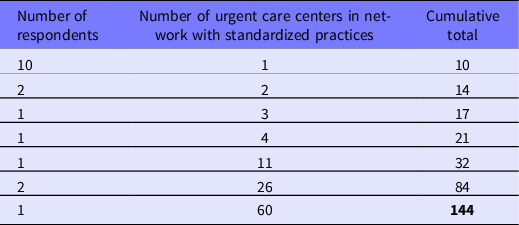
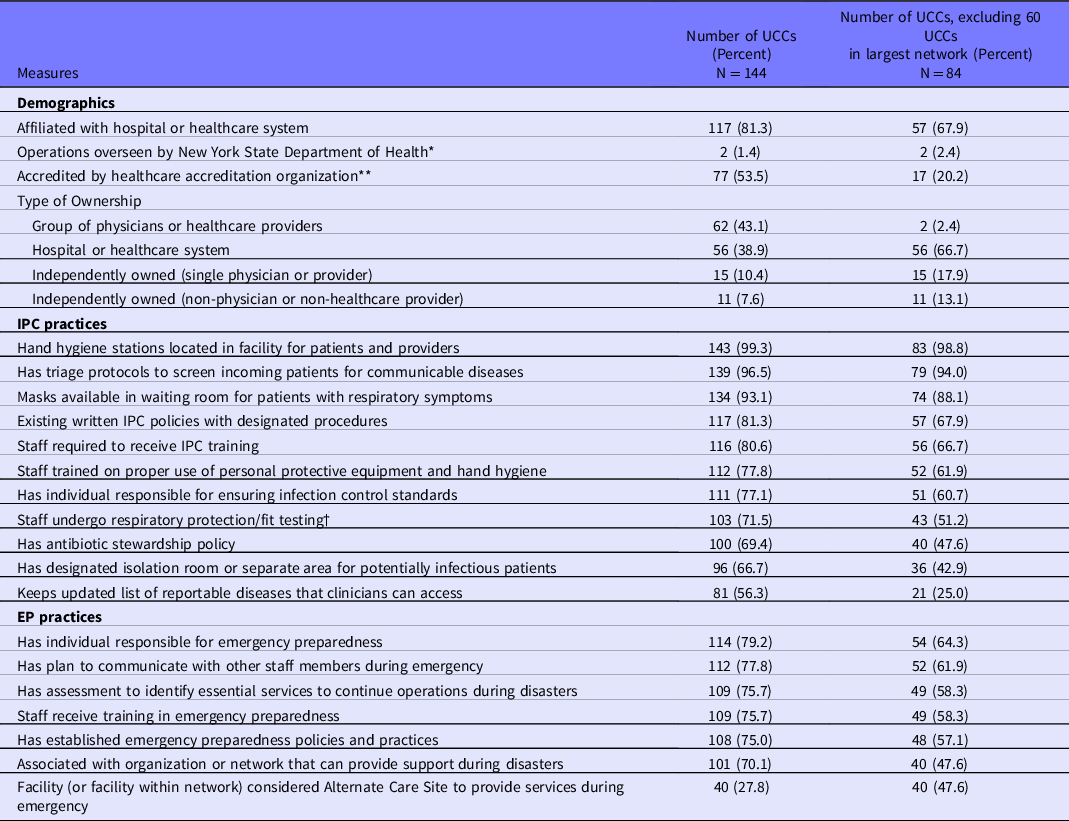
Representing 144 UCCs were 18 respondents which included 8 networks and 10 individual facilities (Table 1). Of these, 6 respondents (33.3%) reported having accreditation by a healthcare accreditation organization and of those, 5 represented a private network or were affiliated with an academic hospital. Table 2 illustrates reported IPC and EP measures, with and without including the largest urgent care network of 60 facilities. Regarding IPC among all UCCs, 117 (81.3%) UCCs have defined IPC policies and procedures, 112 (77.8%) train on the proper use of personal protective equipment (PPE) and hand hygiene, and 111 (77.1%) have an individual responsible for ensuring infection control standards. Nearly all (139, 96.5%) UCCs reported having protocols to screen potentially infectious patients, with initial screening occurring during 1 or more steps during the patient visit: upon arrival (n = 37 UCCs), during registration (n = 68), when taking vitals (n = 48), or during the provider encounter (n = 46) (data not shown). Of these, 96 (66.7%) UCCs have a designated room or area to separate potentially infectious patients (Table 2).
Number of urgent care centers represented by respondents, New York City metropolitan area, 2016

Infection Prevention and Control (IPC) and Emergency Preparedness (EP) practices among Urgent Care Centers (UCCs), New York City metropolitan area, 2016

Abbreviations: EP, Emergency Preparedness; IPC, Infection Prevention and Control.
* NY Pub Health L § 2801
** Accrediting organizations included Joint Commission, Urgent Care Association and Accreditation Association for Ambulatory Health Care
† § 1910.134: Fit Testing Procedures Washington, DC: United States Department of Labor, Occupational Safety and Health Administration.
Concerning EP among all UCCs, 114 (79.2%) UCCs have a designated individual responsible for EP. Moreover, 109 (75.7%) have a plan to identify essential services to continue operations during disasters, 108 (75.0%) have established EP policies and practices, 109 (75.7%) train staff in EP, and 101 (70.1%) belong to a network or organization that could provide support during disasters (Table 2). Removing the largest urgent care network from the analysis did not change the ranking of the most frequently occurring IPC and EP practices.
Discussion
To our knowledge, this is the first published study to date specifically analyzing infection control practices in urgent care centers in a major metropolitan area. We found that implementation of recommended IPC and EP practices varied among UCCs in NYC, potentially leaving individuals and the healthcare system vulnerable during outbreaks or other public health emergencies. This study and other recent literature demonstrate the need for public health and other preparedness partners to engage UCCs and encourage their participation in community-level infection control and emergency preparedness activities. Reference Dunnick, Olympia, Wilkinson and Brady15
Examining EP practices, nearly a quarter of UCCs did not have written policies and procedures, did not train staff on EP procedures, and do not have a communication plan; for those that reported training staff in EP, the content and quality of the trainings was not assessed. After excluding the largest network from the analysis, a higher percentage were missing these essential preparedness elements and less than half were associated with an organization or network that could provide support during an emergency. This highlights an opportunity for healthcare coalitions and community response partners to engage more with UCCs in joint planning and training activities. Such engagement could also improve UCCs understanding of their role and preparedness to serve as alternate care sites during a response.
Focusing on infection control, a fifth of UCCs did not train staff on essential IPC policies specific to their UCC such as PPE and hand hygiene. However, after removing the largest network, nearly 40% of the remaining facilities did not train staff on PPE and hand hygiene which have been identified as important best practices to prevent disease transmission. 16,Reference Goodman and Solomon17 Regarding screening for infectious diseases, nearly all UCCs reported having a protocol in place, however many reported that screening takes place after registration, which could delay identification of infectious disease and result in transmission to staff and other patients. Additionally, a third of UCCs lacked a designated area to isolate potentially infectious patients, which could also leave others exposed to infectious diseases.
While a majority of UCCs indicated having IPC and EP policies, these policies were inconsistent; the mere existence of policies cannot guarantee reduced risk of infectious disease spread or a facility’s effective response to an emergency. We cannot assume that these policies contain crucial IPC and EP components nor that staff members adhere to their contents, as the policies and their implementation were not reviewed as part of this study. Moreover, having most, but not all, UCCs engaged in IPC and EP practices is insufficient; one unprepared UCC could amplify an epidemic, putting staff and patients at risk. Without a sole regulatory agency, efforts should be undertaken to educate and provide resources to ensure that all UCCs implement recommended IPC and EP standards with additional outreach toward non-responding UCCs, as these facilities may be more isolated and in greatest need of support to improve their IPC and EP practices. This study and other recent literature demonstrate the need for public health, trade associations and other local partners to engage UCCs and encourage their participation in community-level infection control and emergency preparedness activities. Reference Dunnick, Olympia, Wilkinson and Brady15
This study is not without limitations. We piloted the survey and have confidence in its validity, though the sample size limited our ability to measure the reliability of instrument items. Findings only represent the surveyed UCCs in NYC and may not be generalizable to other markets or nationwide. Since no comprehensive registry of UCCs in NYC exists, some may have been missed, particularly those that lack any web presence. Also, several respondents represented urgent care networks with multiple facilities, including 1 network with 40% of facilities in the study, which weighted our results toward those networks’ responses. However, Table 2 demonstrates similar findings in terms of the most frequently occurring IPC and EP practices when the largest network was excluded from the analysis. Results represent 144 UCCs: 93 of which were part of the 199 facilities in the sampling frame, and 51 of these UCCs were identified through completed surveys. Findings revealed that some urgent care networks contained either more or fewer sites than investigators found during their original attempt to identify operating UCCs in NYC. We present results for 144 facilities, rather than for 93 facilities because doing so provides a more comprehensive representation of urgent care practices across the NYC metropolitan area.
We assumed no cross-site variation existed within networks since all respondents representing urgent care networks confirmed that all UCCs within their networks followed the same standardized practices. However, reported consistency between facilities within a network is not always guaranteed, as was seen with a recent vaccine accessibility study which demonstrated that while 80% of UCCs in Arizona reported offering influenza vaccines, the actual availability of vaccines to certain age groups varied widely between sites. Reference Beatty, Hager and McKeown18 Ideally, practices should be verified through observational site visits or other methods, whether or not UCCs share a network.
While there are resources providing guidance on implementing EP and IPC best practices in outpatient facilities, 16,19–Reference Rathore and Jackson21 many UCCs have limited resources and few incentives to fully do so. There is a need to develop UCC focused consensus guidelines, easy-to-use implementation tools and modifiable templates to better meet the needs of this unique practice type. 7 Mystery patient drills, which have been utilized in NYC emergency departments and primary care centers, are an example of tool that could be adapted to test the implementation of IPC or EP practices in other settings that see patients with acute illnesses such as UCCs. Reference Ali and Williams22–Reference Foote, Styles and Quinn24 These drills can assess healthcare facilities’ readiness to respond to patients with communicable diseases of public health concern; scenarios could be modified to fit the urgent care setting and test a variety of capabilities. Another opportunity would be to involve UCC stakeholders in jurisdictional planning and joint healthcare coalition exercises for disasters, including coastal storms and mass casualty events, where UCCs could serve as alternate care sites to decompress emergency departments. 7
Conclusion
These findings suggest that UCCs in NYC have varied capabilities in infection control and emergency preparedness. UCCs present opportunities to improve and standardize the implementation of best practices. Planning, training, and exercising needs could be supported by increased engagement in public health preparedness programs and infection control initiatives. To determine how public health and other partners can better support this sector, further studies are needed to further describe and validate how UCCs are implementing IPC and EP policies and procedures and to better identify specific gaps and best practices that can be shared. Strengthening UCC’s infection control and emergency preparedness capabilities can strengthen the healthcare system’s response and resilience to infectious disease outbreaks and other public health emergencies.
Acknowledgments
The authors would like to acknowledge representatives from urgent care centers who completed the survey. Investigators would also like to thank the Urgent Care Association, the Northeast Regional Urgent Care Association, and the United Hospital Fund for their assistance identifying urgent care centers and distributing the assessment to stakeholders.
Conflict of Interest
The authors have no conflict of interest to declare.
Funding Statement
This report was supported by the Grant Number 3U50CK000407-01S2, funded by the Center for Disease Control and Prevention. The findings and conclusions in this report are those of the authors and do not necessarily represent the official position of the Center for Disease Control and Prevention or the Department of Health and Human Services.