Introduction
Disaster preparedness is an important component of disaster management strategies. Disaster preparations reduce the risk and facilitate the capability for coping with the temporary disruption.Reference Paton 1 There is a need of studies for systematic and comprehensive understanding of the judgement that underpins decisions regarding general disaster preparedness (GDP).Reference Paton 1
It is important to gather data and address the knowledge, attitudes, and beliefs of the people about GDP. Using a valid and reliable questionnaire is one of the most acceptable ways for gathering data and obtaining important clues about disaster preparedness.Reference Rattray and Jones 2 An intervention study done by Ardalan and colleague to assess household preparedness for earthquakes found an instrument that consisted of six categories and 18 questions, including actions at the time of earthquakes, nonstructural safety, structural safety, hazard map, communications, drill, and safety skills.Reference Ardalan and Sohrabizadeh 3 There are a great number of earthquake measures in the literature.Reference Farley, Barlow, Finklestein and Riley 4 – Reference Spittal, Walkey, McClure, Sıegert and Ballantyne 9 Furthermore, there have been several studies using behavioral theories about disaster preparedness to examine the knowledge and perception about behavior modification.Reference Haraoka, Ojima, Murata and Hayasaka 10 – Reference Taylor and Yang 16 A systematic review done by Ejeta and colleagues to apply behavioral theories to disaster and emergency health preparedness found that the Health Belief Model (HBM) and other theories were associated with preparedness for diverse hazards.Reference Ejeta, Ardalan and Paton 17 In these theories, HBM is based on a model that attempts to predict health behaviors by focusing on the attitudes and beliefs of individuals.Reference Janz, Champion and Strecher 18 Significant relationship was identified between the constructs of HBM and individuals’ preventive health, illness, and role behaviors influenced their health.Reference Janz, Champion and Strecher 18 The HBM can be used for enhancing the peoples’ awareness, improving the motivation, and providing tools that explain social and cultural beliefs and attitudes toward GDP. Actually, this model focuses on the beliefs of individuals to explain health behaviours.Reference Glanz, Rimer and Viswanath 19 Furthermore, there are studies showing that differences in household preparedness behaviors were correlated with beliefs about preparedness.Reference Thomas, Leander-Griffith, Harp and Cioffi 20 , Reference Becker, Paton and Johnston 21
A new scale study, the General Disaster Preparedness Belief (GDPB) scale based on the HBM, was administered among Yalova University (Yalova, Turkey) staffs by the researchers from April through July 2014.Reference Inal, Altintas and Dogan 22 The 31-items scale consisted of six factors: self-efficacy (eight items), cues to action (five items), perceived susceptibility (six items), perceived barriers (six items), perceived benefits (three items), and perceived severity (three items) and was obtained in the study. The scale was carried out at first and it had good psychometric properties.Reference Inal, Altintas and Dogan 22 However, the study needed to be developed by the literature review and experts’ suggestions due to the following reasons: the previous study was limited to content validity and the sample size was restricted to a group built up of people who consisted of academic and administrative staff in a government university and were at a higher level of education as compared to the general population, so this study should be planned to provide and increase generalizability of the scale. Furthermore, the 31-items number is low for six factors. Increasing the number of items will make a contribution to evaluate GDPB. Based on these reasons, the purpose of this study was to improve and re-test all psychometric properties of the published GDPB scale based on HBM carried out in the general population.
Methods
Setting
This scale development study was carried out in the city of Yalova, Turkey. Yalova Province and its surroundings are located in an area where tectonic activity is intensely felt, and also it has the risks of landslides and other disasters.Reference Kurt and Haybat 23 For example, in Turkey, the earthquake disasters that occurred on August 17, 1999 in Kocaeli (Mw=7.6) and on November 12, 1999 in Düzce (Mw=7.2) hit extensive areas covering the cities of Kocaeli, Sakarya, Düzce, Bolu, Yalova, Eskişehir, Bursa, and Istanbul. One of the heaviest damaged cities was Yalova.Reference Akgiray, Barbarosoglu and Erdik 24
Instrumentation
An intensive literature review and experts’ suggestions were carried out to prepare the basic framework of the tool in the previous study.Reference Inal, Altintas and Dogan 22 Based on the previous study, 60 items consisting of six sub-scales were obtained and administered in a pilot study to a convenience sample of 30 individuals in order to ascertain the rating of item category and clarity of the items. During the pilot study, six items were discussed because of clarity of the items, and it was considered that six items had to be dismissed in the list and four items were added to the list, according to the experts’ suggestions.
The final scale consisted of 58 items and six sub-scales (Susceptibility, Severity, Barriers, Benefits, Cues to Action, and Self-Efficacy).
Measurement of the Tool
For content validity, the initial item pool was subjected to further review by a panel of nine content experts who had expertise in the field of disaster management (six individuals), instrument development, health education (two individuals), and Turkish language (one individual). The content validity index (CVI) cut-off was set at 0.80, which refers to the proportion of experts who rate an item as a three or four using a four-point ordinal rating scale ranging from “one” (not relevant) to “four” (very relevant).Reference Davis 25 An item that was rated as quite relevant or highly relevant by four out of five judges would have a CVI of 0.80.Reference Polit and Beck 26
An expanded scale measured by 58 items was prepared under the same structure that developed the GDPB scale that measured 31 items before. However, new items were added. This expanded scale was applied to 973 individuals. For the expanded scale, one to eight items were under perceived susceptibility dimension, nine to 15 items were under perceived severity dimension, 16-22 items were under perceived benefits dimension, 23-39 items under perceived barriers dimension, 40-44 items were under cues to action dimension, and 45-58 items were under self-efficacy dimension.
Theoretical Framework-The HBM
The HBM is the theoretical framework of the study. The underlying concept of the HBM is that any health behavior is determined by personal beliefs or perceptions about a disease and the strategies available to decrease its occurrence.Reference Petro-Nustas, Tsangari, Phellas and Constantinou 27
The HBM consists of a series of six constructs which influence adoption of a healthy action by individuals: (i) perceived susceptibility to an illness; (ii) perceived severity of the condition; (iii) perceived benefits of taking an action; (iv) perceived barriers to action; (v) an internal or external stimulus or cue to action [for example, exposure to information from the mass media or through discussions with other people]; and (vi) perceived self-efficacy in carrying out the required action.Reference Janz, Champion and Strecher 18 While the first four constructs have been developed over the years, the other two constructs, the self-efficacy and cues to action, have rarely been tested.Reference Carpenter 28
In the study, the model states that an individual’s decision about disaster preparedness is influenced by four beliefs: perceived susceptibility of experiencing a disaster, perceived severity of disaster, benefits of being prepared for a disaster, and perceived barriers to being prepared for a disaster. In addition to the four beliefs, it is influenced by cues to actions for disaster preparedness and self-efficacy in their own ability to deal with a disaster.
Study Group and Data Collection
A nonprobability convenience sampling method was used to recruit participants. Literature suggest a sample of 10 respondents per item to ensure a conceptually clear factor structure for analysis.Reference DeVellis 29 The usable sample size for this study was set at 973 due to exceeding the suggested maximum sample size for analysis. The inclusion criterion for this study was willingness to participate in the study and living in Yalova.
The mean age of the 973 participants was 37 years (SD=11.56 years). A total of 27.1% of respondents were high school graduates, whereas 20.7% were university graduates. A larger proportion of respondent were males (55.3%). Approximately 63.4% of respondents were currently married and the mean monthly salary of the participants was 2514 Turkish lira (TL) (SD=1186,93; US$651).
The questionnaires were administrated from February through November 2016. Data were collected through face-to-face interviews. All interviewers were trained and informed about the methods of gathering data in the fields, ethical considerations, and communication. A guideline was prepared for questionnaire codes and coding response items. The interviewers comprised university graduates or final year students. A total of 973 participants had usable data for this study.
Measures
Respondents completed scales assessing “susceptibility,” “severity,” “benefits,” “barriers,” “self-efficacy,” and “cues to action.” All items were scored on a five-point Likert scale from one (strongly disagree) to five (strongly agree). All sub-scales measured GDPB, and where negatively worded statements were used, the scores on the items were reverse-scored so that a higher score represented more positive disaster preparedness belief.
The GDPB score measured respondents’ positive disaster preparedness beliefs and was computed by summing up the six sub-scales (Self Efficacy + Cues to Action + Perceived Susceptibility + Perceived Low Barrier (items were reverse scaled) + Perceived Benefits + Perceived Severity).
Factor analysis results showed that sub-scale score was of the additive structure in terms of the items from sub-scale. Therefore, it was considered that GDPB scale score was the sum of all the sub-scales scores. It was found that GDPB level increased as sub-scale and GDPB score increased and GDPB level decreased as sub-scale and GDPB score decreased.
Ethics
Ethical approval was taken from University of Yalova Ethical Committee (Yalova, Turkey). People who participated in the study where given informed consent letters and were informed about the purpose of the study. Furthermore, they were also instructed that withdrawal from the study was optional at any time.
This study (Project Number: 2015/BAP/125) was supported by Research Fund of the Yalova University.
Statistical Analysis
Descriptive statistics were conducted for items, sub-scales points, and total scale points. The CVI was used for content validity. Exploratory Factor Analysis (EFA) and Confirmatory Factor Analysis (CFA) were conducted for construct validity. Lisrel 8.8 software (SSI Inc.; Stokie, Illinois USA) was used for CFA estimations. Internal consistency reliability of the questionnaire’s sub-tests was examined by Cronbach’s alpha, while stratified alpha was calculated for total scale score and test-re-test reliability was evaluated. Sub-scale/total scale score intercorrelations were assessed using Pearson correlation.
First, the data from application of the expanded scale were examined under EFA. According to EFA results, the items which the factor loadings were below 0.30 and which gave the factor loadings for more dimension were excluded from the data set. For construct validity, to determine the validity of the scale, an EFA was conducted with varimax rotation that maximized explained variance. Polychoric correlation matrix was used for this analysis. For ordinal data, the method of choice was to use the polychoric correlation matrix.Reference Gadermann, Guhn and Zumbo 30 Kaiser-Meyer-Olkin (KMO) and Barlett values were analyzed in order to determine whether the data were appropriate for the factor analysis.
The total scale and sub-scale scores for 31 items and 45 items were evaluated by calculating score range, mean, standard deviation, skewness, and kurtosis, as well as the floor and ceiling effects. The skewness and kurtosis values of the data were examined in the normality test of the data set. Skewness and kurtosis values must be between one and +one in a data set, which shows a normal distribution.Reference Huck 31
In addition, after EFA, the model was examined under CFA by diagonally weighted least squares (DWLS) estimation methods with asymptotic covariance matrix. Then, the estimations obtained from CFA for the expanded scale with 45 items were compared with the estimations obtained from the previous scale with 31 items. The CFA was performed to verify the factor structure of a set of observed variables. The chi-square test indicates the amount of difference between expected and observed covariance matrices. A chi-square value close to zero indicates little difference between the expected and observed covariance matrices. In addition, the probability level must be greater than 0.05 when chi-square is close to zero.Reference Suhr 32 It was evaluated the description of goodness of fit indices (GFI) and cut-offs for them in the model assessment of fit. Path coefficients are standardized versions of linear regression weights which can be used in examining the possible causal linkage between statistical variables in the structural equation modeling approach. In CFA, the standardized path coefficients also represent factor loadings.
The item-total sub-scale correlations were carried out in order to explain the relationship between the total score of the scale and the scores obtained from the items of the scale. Item analysis was conducted for discriminant validity of the items. Score of calculated items was removed from total score to prevent heightening the relationship between items and scale. Cronbach’s alpha coefficients were analyzed to assess internal consistency. Stratified alpha was calculated for total scale score. Pearson correlation was analyzed for sub-scale/total scale score intercorrelations.
To measure test-re-test reliability, the scale was re-administered three weeks after the first application of the scale. The three-week test-re-test reliability coefficient on the 45 items was 0.71.
Results
Based on the CVI results, all valid items ranged from 0.80 to 0.100. The KMO sampling adequacy on the tool with 45 items was 0.918, which indicated the sample size of 973 had been adequate for performing factor analysis. The Bartlett’s test was significant (chi square =14754.0; df=990; P=.00001).
For construct validity, the EFA lead to the removal of 13 items and retention of 45 items. According to EFA results, the items which the factor loadings were below 0.30 and which gave the factor loadings for more dimension were excluded from the data set. After EFA, a model measured six dimensions with 45 items was hypothesized: six items under perceived susceptibility, four items perceived severity, six items under perceived benefits, 14 items under perceived barriers, five items numbered items under cues to action, and 10 items under self-efficacy (Appendix 1 and Appendix 2; available online only).
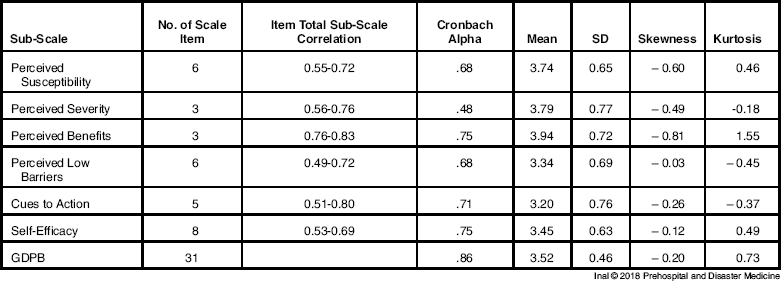
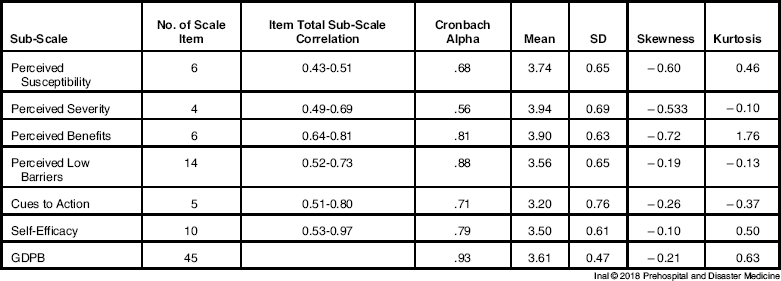
The Cronbach’s alpha of total scale (31 items) was 0.86. The internal consistency of the three extracted factors exceeded 0.70 with the exception of the susceptibility sub-scale (0.68), severity sub-scale (0.48), and barriers sub-scale (0.68). The highest mean scores were observed in the perceived benefits (3.94, SD=0.72; Table 1). The stratified Cronbach’s alpha of total scale (45 items) was 0.93, which was accepted as high reliability. The internal consistency of the four extracted factors exceeded 0.70 with the exception of the severity sub-scale (0.56) and susceptibility sub-scale (0.68). The highest mean scores were observed in the perceived severity (3.94, SD=0.69; Table 2).
Reliability Coefficients for Sub-Scales for Model 1 a

Abbreviation: GDPB, General Disaster Preparedness Belief.
a Model 1: scale with 31 items.
Reliability Coefficients for Sub-Scales for Model 2 a

Abbreviation: GDPB, General Disaster Preparedness Belief.
a Model 2: scale with 45 items.
The total scale reliability of Model 1 and Model 2 was found as 0.86 and 0.93, respectively. It was observed that the reliability of the perceived benefits, perceived barriers, and self-efficacy sub-scales were estimated at higher values in Model 2, depending on the increase in the number of items.
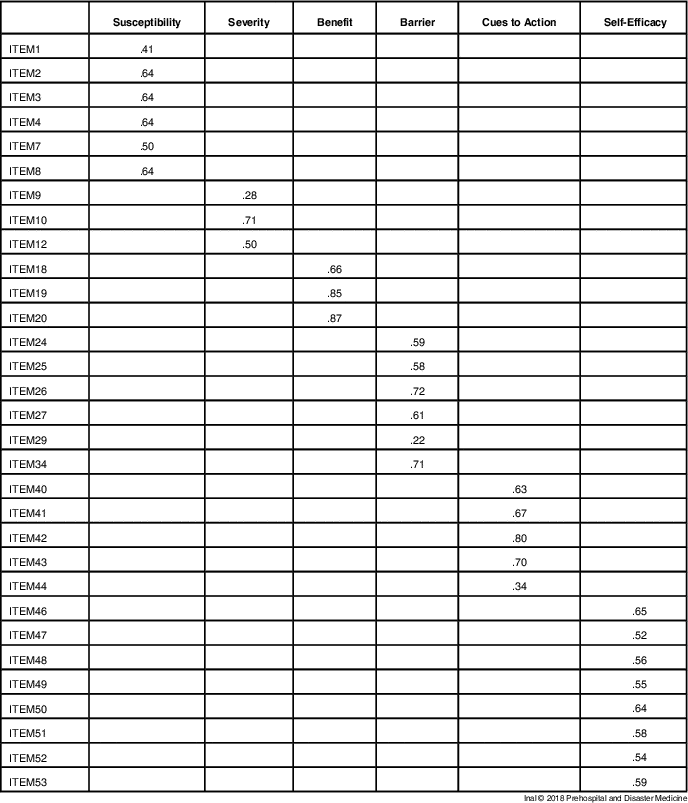
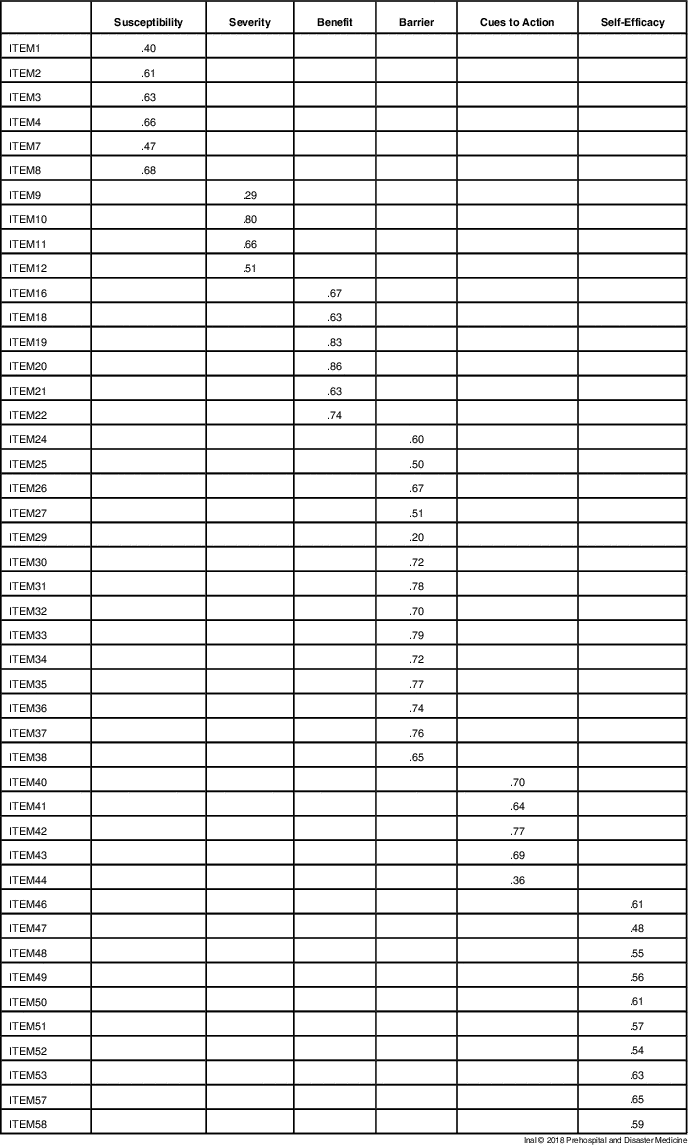
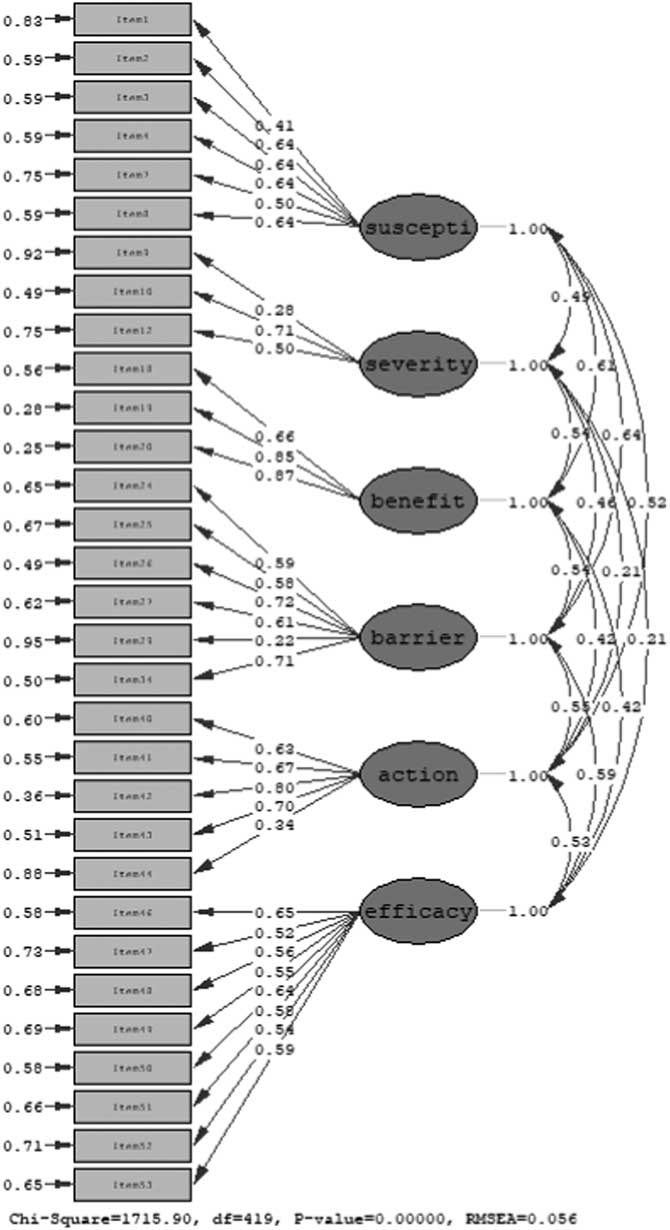
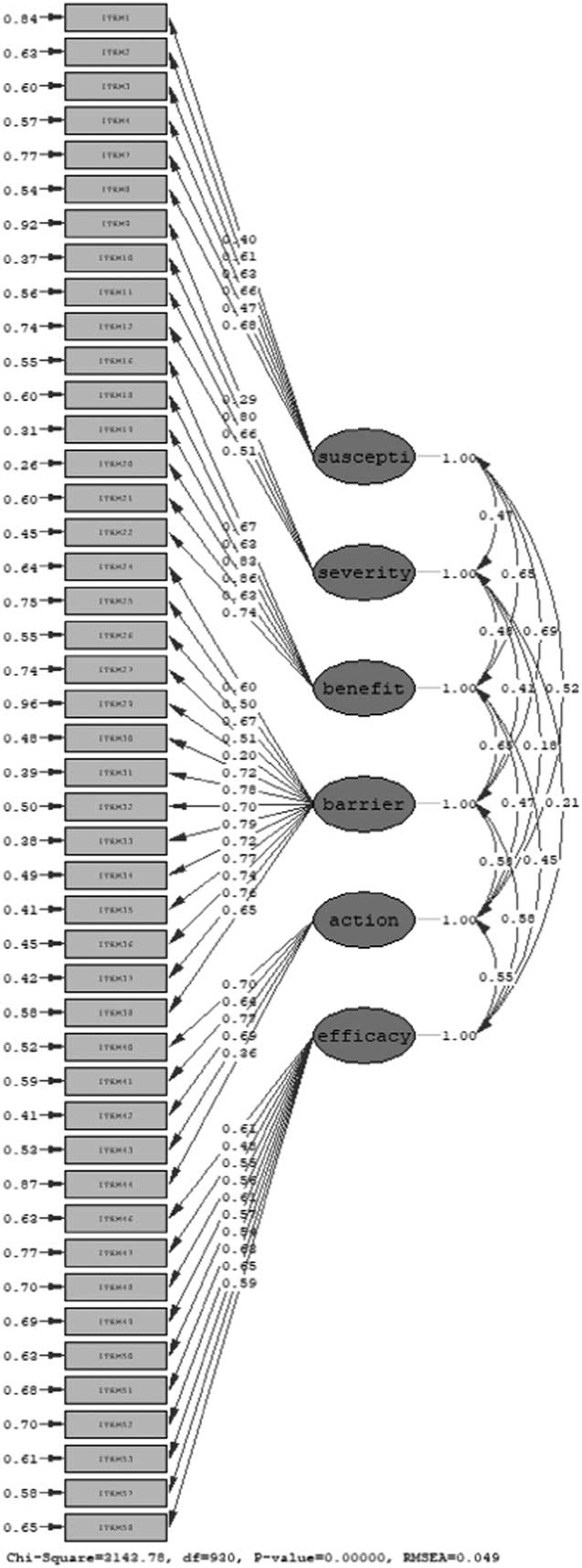
Standardized path coefficients are presented in Table 3 and Table 4 for Model 1 and Model 2. According to tables, and also Figure 1 and Figure 2, all signs of the associations between constructs in the model under analysis were in accordance with hypothesized relationships. In other words, all estimations for factor loadings were significant. These results suggest that Model 2 showed improvement in Model 1.
Standardized Path Coefficients Displaying the CFA for the Scale with 31 Items

Abbreviation: CFA, Confirmatory Factor Analysis.
Standardized Path Coefficients Displaying the CFA for Expanded Scale with 45 Items

Abbreviation: CFA, Confirmatory Factor Analysis.
Path Diagram Displaying the CFA for Standardized Solution for the Scale with 31 Items. Abbreviation: CFA, Confirmatory Factor Analysis.

Path Diagram Displaying the CFA for Standardized Solution for Expanded Scale with 45 Items. Abbreviation: CFA, Confirmatory Factor Analysis.

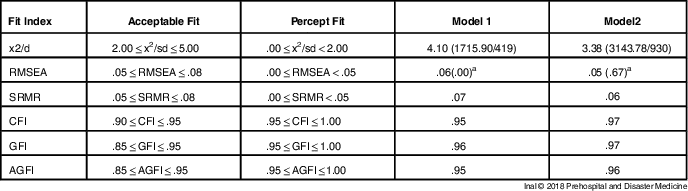
Table 5 presents a description of GFIs and suggested cut-offs for them in the model evaluation and assessment of fit,Reference Hooper, Coughlan and Mullen 33 – Reference Schermelleh-Engel and Moosbrugger 35 and ones estimated from two models used in the research. Table 5 gives that although the Chi-square test were found significant (X 2=1717.90; P=.00), the ratio chi-square/degrees of freedom were below 5.0; this is indicative of an acceptable fit for Model 1 (GDPB scale with 31 items). The adjusted goodness of fit index (AGFI=.95) and the comparative fit index (CFI=.95), as well as the root mean square error of approximation (RMSEA=.06) and standardized root mean square residual (SRMR=.07), also indicated acceptable fit for Model 1. For Model 2 (expanded GDPB scale with 45 items), RMSEA and SRMR were respectively 0.05 and 0.06, and the P value for close fit was .67. Although these indices indicated acceptable fit, the Model 2 fit because CFI, GFI, and AGFI were over 0.95.
Comparison of Goodness of Fit Indices Obtained from CFA Results

Note: Model 1 scale with 31 items; Model 2 scale with 45 items.
Abbreviations: AGFI, Adjusted Goodness of Fit Index; CFA, Confirmatory Factor Analysis; CFI, Comparative Fit Index; GFI, Goodness of Fit Index; RMSEA, Root Mean Square Error of Approximation; SRMR, Standardized Root Mean Square Residual.
a P value of close fit.
Discussion
This study developed and then tested all psychometric properties of the GDPB scale with 45 items and 31 items obtained from the previous scale,Reference Inal, Altintas and Dogan 22 based on HBM as a framework. This is a newly developed, theory-driven instrument and content validity of the items was found to be acceptable. The sub-scale internal consistency as estimated by Cronbach’s alpha for 45 items was high, which suggested that the items in each scale were homogeneous with the exception of the severity sub-scale and susceptibility scale. With regard to construct validation, the confirmatory factor analysis indicated that, in general, the model was a good fit for the data.
A similar study was conducted by the same methodology used in the study among 286 university staffs in a Turkish university from April through July 2014.Reference Inal, Altintas and Dogan 22 The stated study had some limitations.Reference Inal, Altintas and Dogan 22 One of the important limitations was that the study was carried out in a small sample group (only in a university). This study was administered in the general population and different socio-demographic groups. The other limitations in the stated study were removed in this study so this tool could be used for all groups in disaster preparedness surveys to promote GDP. Findings of the first studyReference Inal, Altintas and Dogan 22 were that the factor analysis extracted six factors: self-efficacy (eight items), cues to action (five items), perceived susceptibility (six items), perceived barriers (six items), perceived benefits (three items), and perceived severity (three items). The total item correlation for the total scale score and items ranged from 0.38-0.71. The total scale score correlations with the six sub-scales all exceeded the 0.50 level, five of the six coefficients exceeded the 0.60 level, and two of the six exceeded 0.70. Cronbach’s alpha coefficient for the sub-scales ranged from 0.90 to 0.74. The KMO value of the data was found to be 0.85. However, CFA couldn’t be performed due to the inadequate sample group.Reference Inal, Altintas and Dogan 22 In this study, the 31 items obtained from the first study were evaluated for reliability coefficients through this data, and were also compared with the estimations obtained from CFA for expanded scale with 45 items. The KMO sampling adequacy with 45 items was 0.918. The Cronbach’s alpha of total scale (45 items) was 0.93. For 31 items through this data, the Cronbach’s alpha of total scale was 0.86. The reliability of the perceived benefits, perceived barriers, and self-efficacy sub-scales are estimated at higher values in the scale with 45 items. These results show that 45 items are better in psychometric properties. Results of the CFA for the 45 - items model and 31-items model were a good fit to the data. However, CFI, GFI, and AGFI were over 0.95 in the 45-items model. Based on these values, it is possible to evaluate that the 45-items model fits perfectly.
Turkey has also witnessed its own share of disasters ranging from earthquakes, landslides, floods, and other disaster types.Reference Kaya, Çavuşoğlu, Şen and Çalık 36 Some studies show that the levels of awareness of people in Turkey are not sufficient.Reference Inal, Kocagöz and Turan 37 – Reference Sakiroglu 40 Previous studies have applied the HBM to study disaster preparedness, for instance, disease outbreak preparedness,Reference Teitler-Regev, Shahrabani and Benzion 14 and preparedness for climate change and heat waves.Reference Akompab, Bi, Williams, Grant, Walker and Augoustinos 11 This concept was the first study to assess psychometric properties of the GDPB scale using the HBM as a theoretical framework. Preparedness strategies can be effective with behavior change strategies. This is important to inform how the outcome of this process can translate into protective actions.Reference Ejeta, Ardalan and Paton 17 Effective disaster preparedness provides reducing risk, increasing mitigation level, and increasing community resilience.Reference Gregory, Philip and Erik 41 This study developed a HBM tool which is one of the behavioral change interventions. The six sub-scales in HBM interact level of people’s disaster and emergency health preparedness. This knowledge taken in these sub-scales can be used to inform education programs. This provides an opportunity to deliver messages informing and educating people about protective measures.Reference Ejeta, Ardalan and Paton 17
In a systematic review about behavioral theories to disaster and emergency health preparedness, it has been found that two articles were found addressing general emergency preparedness at the household level and with regard to volunteers’ willingness to respond to various kinds of hazards.Reference Ejeta, Ardalan and Paton 17 One of the two studies applied the Trans-Theoretical Model to investigate the individuals’ emergency preparedness.Reference Paek, Hilyard, Freimuth, Barge and Mindlin 42 The second study set out to further the previously existing knowledge on emergency preparedness by applying Extended Parallel Process Model.Reference Errett, Barnett and Thompson 43 There are no studies or tools applying HBM to investigate the individuals’ emergency/disaster preparedness in the literature. This study fills this gap.
Limitations
This study has some limitations. These are: no second implementation, attempt to keep the structure of the previous scale (Model 1), and sampling from only one city. In addition, since there was no similar scale developed earlier, some strength points have been found out in the definition of the psychological properties and in the establishment of the relations of these properties. Likewise, comparative results cannot be made with the literature, only the results of this examination were included. Although this research has been conducted in a large sample (n=973), more studies are needed to find out how to work this structure on people from different social-economical levels, languages, and cultures. Thus, the conceptual structure can be configured better.
Conclusion
This study indicates that the GDPB scale with 45 items based on HBM has acceptable validity and reliability. The results indicated that the scale with 45 items shows improvement in the scale with 31 items. This scale with 45 items is suggested to be used by researchers as it is better in terms of validity, reliability, and other psychometric properties. However, this does not mean that the 31-item scale cannot be used. Especially if the scale with 45 items is used in next studies about disaster preparedness, more information can be provided about behavior related to disaster preparedness. This information can facilitate the adoption of such approaches, making effective policies and plans for transforming preparedness knowledge into behavior.
Supplementary Material
To view supplementary material for this article, please visit https://doi.org/10.1017/S1049023X18001012