




No CrossRef data available.
Article contents
Supervisory attentional control following carbon monoxide poisoning
Published online by Cambridge University Press: 01 October 2004
Abstract
This study tested the hypothesis that carbon monoxide poisoning would produce a deficit of attentional control, the supervisory attention system, as indexed by attention switching and attentional scheduling, and that routine attentional orienting would be unaffected. Seventy-three cases of carbon monoxide poisoning were assessed at 3 days and 1 month post poisoning on tasks of attentional orienting, and tasks of the supervisory attention system. The results were compared to a group of 53 healthy community participants. A deficit of the supervisory attentional system was documented on a task of attention switching in survivors of both deliberate and accidental CO poisoning, leaving attentional scheduling intact. There was no deficit of attentional orienting in the current study. Alteration of consciousness was found to predict subsequent supervisory attention system impairment in correlation analyses, and the deficit was persistent for a 1 month follow-up period. (JINS, 2004, 10, 843–850.)
Information
- Type
- Research Article
- Information
- Journal of the International Neuropsychological Society , Volume 10 , Issue 6 , October 2004 , pp. 843 - 850
- Copyright
- © 2004 The International Neuropsychological Society
INTRODUCTION
Carbon monoxide (CO) poisoning is a significant industrial hazard where combustion engines are operated in poorly ventilated environments, and in Australia represents the second most common means of suicide. The central nervous and cardiovascular systems are particularly vulnerable to injury by CO poisoning (Lishman, 1998). In addition to hypoxia resulting from impaired oxygen delivery, CO is purported to have a direct histotoxic effect on tissue, and causes further injury by initiating cellular events such as lipid peroxidation, lactic acidosis, release of excitatory amino acids and the secondary vascular complications of cerebral odema (Mark, 1992; Seger & Welch, 1994). Although Caine and Watson (2000) explicitly excluded cases of CO poisoning in their review of hypoxia, they emphasized that the effects of hypoxia are liable to compromise a network of cortical–subcortical structures. In brain imaging studies following CO poisoning the most commonly reported cerebral changes relate to the subcortical white matter, globus pallidus, and the hippocampus (Gale & Hopkins, 2004; Jones et al., 1994; Miura et al., 1985; Parkinson et al., 2002; Silver et al., 1996; Taylor & Holgate, 1987; Tom et al., 1996; Vieregge et al., 1989), and a recent MRI study has reported significant atrophic changes in the fornix (Kesler et al., 2001). In contrast, widespread brain atrophy is reported less frequently (e.g., Gale & Hopkins, 2004), and generalized cortical changes have been linked with cardiac failure in very severe cases of CO poisoning (Murata et al., 1993).
Although cases of CO poisoning have been discussed in the literature since as early as 1927 (Haldane, 1927), there has been only limited progress made in developing a model of CO-induced neuropsychological dysfunction. In countries where suicide attempt accounts for the majority of admissions for CO poisoning, it is particularly challenging to isolate CO-induced impairment from pre-existing disorder and more information on specific CO-induced neuropsychological impairments would be informative. Early reviews of CO poisoning, based predominantly on single case reports, highlight extreme variability in neurological, neuropsychological and psychiatric outcome (Dunham & Johnstone, 1999). However, commonly reported neuropsychological impairments include impaired memory, dysfunctional attention, and executive disorder (Gale et al., 1999; Gale & Hopkins, 2004; Kesler et al., 2001; Messier & Myers, 1991).
One of the earliest attempts to provide a general model of the neuropsychology of CO poisoning was by La Plane et al. (1984), whose postulated neuropsychological syndrome, characterized by “psychic akinesia,” (or delayed responding), was later supported by the use of objective reaction time methodology (Starkstein et al., 1989). It has now been extensively argued that delayed responding in frontosubcortical syndromes does not represent a generalized slowing in attention orienting, but a slowing under conditions of attentional switching between past and present response sets (Gauntlett-Gilbert et al., 1999; Lacritz et al., 2000; McDonald et al., 1996; Owen et al., 1993; Plotnik et al., 1998; Raskin et al., 1992; Serra-Mestres & Ring, 1999). More recently, in addition to finding memory decline, research in CO poisoning samples has documented slowed mental processing speed on the Trail Making B test, a task of attentional switching (Messier & Myers, 1991; Gale et al., 1999).
Shallice and colleagues (Burgess & Shallice, 1996; Cooper & Shallice, 2000; Shallice, 1988) provide a model of attention in which they argue that involuntary, or routine, aspects of attention such as simple attentional orienting, are thought to be performed by a hypothetical contention scheduling system, whereby previously learned and reinforced response schemas are routinely triggered by environmental stimuli. To regulate contention scheduling, a supervisory attentional system (SAS) is called upon when there is conflict between past stimulus–response schemas and current adaptive demands. Routinely triggered responses, therefore, must be assessed for compatibility (i.e., similarities and differences between triggered schemas and environmental conditions) and, if appropriate, inhibited so that a novel response can be trialled, reinforced and eventually adapted. Cooper and Shallice argue that the model differs from others in that whether a task is predominantly cognitive or motor does not determine whether routine (contention scheduling) or attention control (SAS) resources are engaged. Implicit in Cooper and Shallice's conceptualization is the assumption that it is previous task experience, not necessarily task complexity that determines whether predominantly contention scheduling or SAS systems are called upon. Shallice (1988) argues that two separate but interrelated functions of the SAS are to switch attention flexibly between thoughts, perceptions and actions and to efficiently allocate both contention scheduling and SAS attentional resources between competing demands.
The primary aim of this study was to evaluate attentional function in survivors of CO poisoning. Specifically, we investigated whether the attention deficit reflects a generalized slowing of involuntary attention processes, or a higher level deficit of attentional control (the SAS). In addressing this question, an important aspect of our investigation was to disentangle CO-related attention impairment from that of other psychological factors associated with the poisoning event. We expected that, after controlling for emotional and psychiatric factors, CO poisoning would selectively impact upon measures of the SAS, especially attention switching. A secondary, and exploratory, aim of the study was to identify potentially useful clinical indices of poisoning to guide clinical management decisions.
METHODS
Research Participants
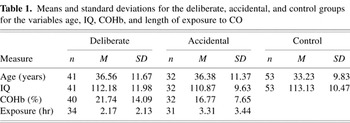
A three-group design was employed that included 73 survivors of CO poisoning (41 deliberate and 32 accidental poisoning episodes), recruited from a Melbourne metropolitan hospital over a 3-year period (see “Procedure” for details), and 53 community volunteers from similar demographic and employment backgrounds. All participants were aged between 18 and 65 years, were of English speaking background, and were screened for previous neurological history and learning disability. The three groups did not differ on age [MSE = 162.78; F(2,123) = 1.38, p = .26] and on IQ scores [MSE = 51.26, F(2,123) = 0.44, p = .65], estimated by the National Adult Reading Test (Nelson & Willison, 1991; see Table 1).
Means and standard deviations for the deliberate, accidental, and control groups for the variables age, IQ, COHb, and length of exposure to CO

In the case of deliberate CO cases, poisoning occurred by redirecting fumes into an enclosed space, predominantly by connecting a hose from the exhaust into the car via the boot. Other means included directing the exhaust through a hose into the house, or running a vehicle in an unventilated garage. One participant had attempted suicide by setting fire to a house. Those who were accidentally poisoned were either intoxicated by the use of combustion machinery in poorly ventilated areas (e.g., forklift trucks, cut-off saws, polishing equipment) or overcome by smoke inhalation in fires.
Measures
Severity of CO poisoning
Clinical indices of the severity of CO poisoning were based on clinical judgements and reports by medical staff who were trained in emergency care, and were defined as (1) percent carboxyhemoglobin level (COHb), obtained for all CO participants upon admission to the Emergency Department within 24 hr of admission; (2) length of exposure to CO (exposure), estimated from historical information from CO poisoning survivors, and available witnesses; (3) loss of consciousness (LOC), defined as the period during which participants could not be roused in order to make any purposeful response, and represented the interval between the poisoning event and the first documentation by medical staff that the participant was alert and aroused; and (4) post intoxication amnesia (PIA), defined as the period for which CO participants were disoriented to time, person and place, and represented the interval between the poisoning event and the first documentation by medical staff that the participant was oriented to their surroundings. LOC and PIA data distributions were much skewed and cannot be normalized by transformation. These data were dichotomized into zero, for no LOC or PIA, and 1, for some LOC or PIA.
Mood
In view of the relevance of mood in suicidal behavior, anxiety and depression were assessed using the Tension–Anxiety and Depression–Dejection subscales, respectively, of the Profile of Mood States self-report questionnaire (McNair et al., 1981). Participants responded according to their current emotional status (i.e., how they are feeling right now) to 24 five-point anxiety Likert-scale items, with nine items for anxiety and 15 items for depression producing the anxiety and depression T scores. In order to comply with ANOVA assumptions of normality, the positively skewed data for the POMS was inversely transformed and multiplied by 10 to display at least two significant digits (i.e., 100/T score).
Attention
Four reaction time tasks were selected from the Californian Computerized Assessment Package (CALCAP; Miller, 1996) which is a battery of tests developed to assess attentional and cognitive decline in subcortical syndromes (Durvasula et al., 2000; Llorente et al., 1998; Miller et al., 1991).
Two tasks were selected to assess the routine attentional orienting and vigilance network. In the simple reaction time task (simple RT), random digits appear singly in the center of the screen, with interstimulus intervals varying from 1000 ms to 5000 ms. Participants are required to press the spacebar as soon as any digit appears on the computer screen. The reaction time of this simple psychomotor task is considered to measure basic orienting of attention, or arousal. Simple RT was recorded at the start (Phase 1, 12 trials), 10 min (Phase 2, 12 trials) and 20 min (Phase 3, 12 trials) into the CALCAP battery of tests.
The choice-reaction time task (choice RT) task was selected as a second measure of attentional orienting based on the findings of better reliability than the simple reaction time (Miller, 1996). In this task, visually degraded digits randomly appear in the center of the screen for 70 ms, at an interstimulus interval of 800 ms. There are 100 trials with 15 target stimuli presentations. Participants are required to press the spacebar as soon as they see a specified digit (7) appear on the screen. The choice-reaction time procedure includes the additional component of selectivity (i.e., requiring that a decision be made), but places minimal demands on skills of inhibition (screening out distracting information). The choice reaction time is, therefore, considered a measure of complex psychomotor processing, or attentional orienting.
Two tasks were selected to gauge SAS performance. The sequential reaction time task (sequential RT) was used to probe the capacity for efficient scheduling of attentional resources between two streams of information, and has been previously employed as a measure of attention control by Miller et al. (1991). In this task, digits appear in the center of the screen randomly for 70 ms, at an interstimulus interval of 800 ms. The task incorporates a set of 100 trials and 20 target stimulus presentations. Participants are requested to press the spacebar whenever they see two of the same number appear in sequence, for example, if they see two consecutive 3s or 7s on the screen. SEQ requires that participants hold the previous digit in mind in order to compare it with subsequent information presented on the screen.
The response reversal task (reversal RT) was used to assess attention switching and interference resistance. In this task, target and distraction stimuli appear randomly in the center and periphery of the screen for 200 ms, at interstimulus duration of 1000 ms. The test requires the detection of 15 target stimuli amongst a set of 100 trials. Participants are required to respond only to the word SEVEN as it appears around the periphery of the screen, and ignore stimuli appearing in the center of the screen. Also appearing around the periphery of the screen are distracting stimuli that include the digit 7 and words with perceptual similarity to SEVEN (e.g., 7EVEN, SEVER). In addition to inhibiting responses to distracting information, the ordering of CALCAP tasks requires that participants switch cognitive set from the previous task (which required responses to stimuli only in the center of the screen). Response reversal, therefore, required that participants inhibit a previously trained response and therefore, incorporated a high degree of interference resistance.
Consistent with the findings by Miller et al. (1991) and Miller (1996), CALCAP reaction time data were also positively skewed. These data were normalized by inverse transform and multiplied by 1000 to display at least two significant digits (i.e., 1000/RT). Thus lower scores correspond to slower responding.
Procedure
Following consultation with medical specialists, the Emergency Registrar diagnosed CO poisoning based on clinical signs (i.e., nausea, vomiting, and coma) and information provided by witnesses (i.e., paramedical staff, family or friends who found the patient). Arterial carboxyhemoglobin was taken via carbon monoxide oximetry to rule out other causes of the observed symptoms. The COHb levels of CO participants ranged from 2% to 49%. CO participants were admitted to a medical ward and referred to the Hyperbaric Unit for daily oxygen therapy. Clinical indices of the severity of CO poisoning were extracted from medical records about the level of blood bound carboxyhemoglobin, the length of exposure to CO, the length of coma, and the length of postintoxication amnesia. Measures of attention and mood were obtained on test sessions conducted at 3 days post poisoning (Time 1) and at 1 month follow-up (Time 2). All participants read and signed a statement of informed consent approved by the hospital's ethics committee.
RESULTS
Severity of CO Poisoning
To explore the differences between the two CO groups on clinical indices of the severity of CO poisoning, we performed a series of t tests and Fisher exact tests. There was no significant difference between deliberate and accidental participants with regard to mean COHb, despite unequal group variances [t (62.39) = 1.91, p = .08], nor in length of exposure [t (63) = −1.63, p = .11]. However, using Fisher exact test, more patients in the deliberate group experienced LOC (25/35) as compared to those in the accidental group (4/28; p < .01). Likewise, more patients in the deliberate group experienced PIA (29/36) as compared to those in the accidental group (8/27; p < .01). Therefore, although the groups were similar in terms of primary poisoning indices (COHb levels, length of exposure), the indices of neurological impact of poisoning (presence of LOC and PIA) suggested that the deliberate group were more affected by the poisoning than the accidental group. If a group difference in attention variables emerges between the two CO poisoning groups, the indices of poisoning impact (LOC, PIA) will be adjusted for in the comparison analyses.
Mood
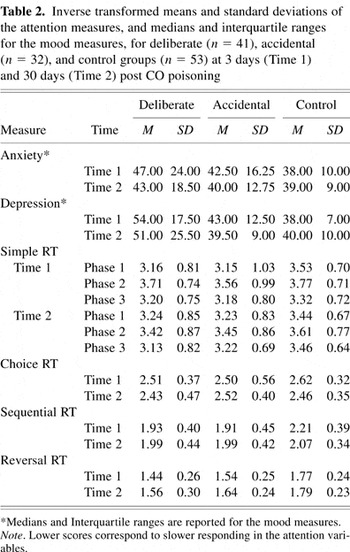
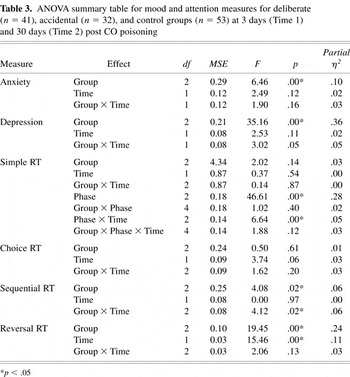
T scores of anxiety and depression were also positively skewed, especially in the control group. As shown in Table 2, the deliberate CO group appeared to experience higher levels of anxiety and depression than both the Accidental and Control Groups. Separate 3 × 2 mixed analyses of variance (ANOVA) revealed that these group differences were significant and although the effect size for anxiety was small, the effect size for depression was moderately large (see Table 3). Further post-hoc Student Newman-Keuls pairwise comparisons confirmed that the deliberate group reported significantly higher levels of anxiety and depression compared to the accidental and control groups, with no difference between the latter two groups.
Inverse transformed means and standard deviations of the attention measures, and medians and interquartile ranges for the mood measures, for deliberate (n = 41), accidental (n = 32), and control groups (n = 53) at 3 days (Time 1) and 30 days (Time 2) post CO poisoning

ANOVA summary table for mood and attention measures for deliberate (n = 41), accidental (n = 32), and control groups (n = 53) at 3 days (Time 1) and 30 days (Time 2) post CO poisoning

Attention
Means and standard deviations for the transformed attention measures are presented in Table 2. For transformed RT data, lower scores represent slower responding and higher scores represent fast responding. A 3 × 2 × 2 mixed ANOVA was conducted on simple RT between groups (deliberate, accidental, control) and across time (3 days, 30 days post-CO poisoning) and phases (start, 10 min, 20 min). The significant phase effect and Time × Phase effects merely indicate that reaction time varies across the short intervals of testing (i.e., start, 10 min, and 20 min) at 3 days and 30 days post-CO poisoning (see Table 3), which is consistent with phasic variation previously found on simple RT (Miller, 1996). However, more relevant to the hypotheses is the lack of significant group effects and small effect sizes, indicating that attentional orienting post-CO poisoning is unimpaired as compared to the control group. Similarly, there was no effect that would indicate impaired vigilance post CO-poisoning (i.e., Group × Phase effect). Furthermore, there was no interaction between the group, phase, and time effects that would suggest differences between groups across time on either attentional orienting or vigilance. Results of the mixed 3 × 2 ANOVA conducted on choice RT confirmed the lack of group differences in attentional orienting. Further analyses of covariance, adjusting for anxiety and depression at the time of testing, did not produce any change in the group effects on simple RT or choice RT.
In contrast, significant group differences were detected for measures of supervisory attentional control (i.e., sequential RT and reversal RT). Although the effect size for the sequential RT measure was small, the effect size for the reversal RT was moderately large (.24). For sequential RT, further examination of the Group × Time effect showed that both CO groups had significantly slower response times than the control group at Time 1 [MSE = 1.24, F(2,123) = 7.35, p < .01] but not at Time 2 [MSE = 0.09, F(2,123) = 0.58, p = .56], suggesting a recovery effect for the CO groups. For reversal RT, post-hoc analyses of the moderately large group effect, using Student-Newman-Keuls comparisons, revealed that both CO groups were slower responding than the control group, p < .01. There was also a significant time effect, although the effect size was small, which showed all groups to be faster responding at Time 2 than at Time 1, therefore possibly reflecting a practice effect across sessions. The findings for sequential RT and reversal RT were essentially unaltered in covariance analyses, adjusting for anxiety and depression at the time of testing.
In summary, no deficit of attentional orienting and vigilance (simple RT and choice RT) was documented in either deliberate or accidental CO survivors at either Time 1 or Time 2. A deficit of attentional scheduling as measured by sequential RT was documented that was no longer present at Time 2. Attention switching as measured by reversal RT was found to be impaired in both the deliberate and accidental CO groups at both Time 1 and Time 2. The deliberate and accidental groups did not demonstrate differential patterns of performance on any of the attention measures.
Predicting Attentional Outcome from Poisoning Severity
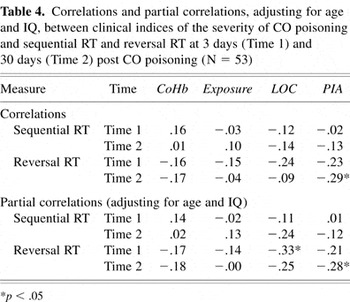
Correlation analyses were conducted to determine which, if any, of the clinical indices (i.e., COHb, length of exposure, LOC, or PIA) would be associated with impaired SAS performance of CO survivors, especially after adjusting for individual differences in age and IQ. Complete data on the clinical indices was available for 53 cases in the combined deliberate and accidental CO groups. Only low correlations were found between all the poisoning indices and sequential RT, and the poisoning indices did not significantly predict sequential RT at either Time 1 or Time 2, nor after adjusting for age and IQ. In contrast, modest correlations were achieved by all the poisoning indices with reversal RT at Time 1. However, by Time 2 only PIA significantly correlated with reversal RT. After adjustment for age and IQ, all indices again modestly correlated with reversal RT, LOC significantly; by Time 2 LOC and PIA achieved modest correlations, PIA significantly (see Table 4).
Correlations and partial correlations, adjusting for age and IQ, between clinical indices of the severity of CO poisoning and sequential RT and reversal RT at 3 days (Time 1) and 30 days (Time 2) post CO poisoning (N = 53)

DISCUSSION
The major aim of the current study investigating the neuropsychological impact of CO poisoning was to establish whether CO poisoning is associated with impaired attention. The second and more exploratory aim of the study was to identify predictors of attention impairment that may ultimately assist in the clinical management of CO poisoning. In support of the hypotheses, survivors of CO poisoning were found to be unimpaired on measures of routine attentional processes indexed by simple and choice RT measures and argued to depend on the orienting and vigilance attention networks. However, impairment of the higher level SAS or attention control system was evident as indexed by a measure of attention scheduling (sequential RT), and most significantly as indexed by a measure of attention switching (reversal RT). The deficit was unexplained by emotional status and was present in both the deliberate and accidental groups post-CO poisoning. Furthermore, the deficit in attention switching (reversal RT) was persistent for 1 month post poisoning, and was modestly predicted through correlation analyses by selected poisoning indices (LOC, PIA)
Our study employed reaction time methodology to investigate orienting of attention and its maintenance (vigilance), as well as the higher level voluntary control of attention (SAS). There was a lack of evidence in the current results to implicate either the orienting or vigilance networks in an attention deficit post CO poisoning when making group comparisons between CO survivors and healthy controls, even when adjusting for emotional status through covariate analyses. Our findings are consistent with other frontosubcortical syndromes, for example Parkinson's disease, in which several research studies have linked slowed response speed with attention switching on interference resistance and verbal fluency tasks (McDonald et al., 1996; Plotnik et al., 1998). Our findings also concur with a study of outcome following CO poisoning (Kesler et al., 2001) in which attention deficits were not detected on simple measures of attention, although the researchers also note that attention impairment may be detected if more challenging measures of attention are used. Indeed, we did find a significant slowing in performance post CO poisoning (deliberate and accidental groups) on tasks that required voluntary attention control, especially attention switching, which concurs with reports of impaired attention switching in Parkinson's disease and other frontosubcortical syndromes (Gauntlett-Gilbert et al., 1999; McDonald et al., 1996; Owen et al., 1998; Plotnik et al., 1998). The current findings of impaired attention switching also concur with a recent study on CO poisoning (Gale & Hopkins, 2004) that reported executive deficits and attention deficits in addition to memory impairments.
In regard to voluntary attentional control, Shallice (1988) has argued that two central functions of the SAS are to switch attention between cognitive sets (essentially interference resistance) and to schedule attentional resources among competing demands. Attention scheduling is purported to involve effective allocation of attention between competing demands, whereas attention switching involves the switching between past and present response sets. Whereas compatible schemas are routinely triggered by the CS system, the SAS's inhibitory power over existing schemas is called upon to slow response initiation until past schema information is integrated into the novel response. The attention switching function of the SAS appears to ensure any novel response is informed by, but not constrained to, past schema information. This hypothesized fractionation of the roles of the SAS has been tentatively reflected in the current results whereby there was a large effect of CO-poisoning induced deficit of attention switching but a relatively small effect of CO poisoning on attention scheduling. Whether this dissociation in attention deficit can be replicated in further study requires further investigation. Nevertheless, over the 1 month follow-up period, there was no evidence of recovery of function on the attention switching task (reversal RT). While all participants demonstrated a significant practice effect on task, the effect was proportional across groups, indicating that impairment was still apparent at 1 month post poisoning, and, furthermore, the effect size of the difference between groups was moderately large. In contrast, the effect size if the difference between groups for the sequential RT was small, and the deficit was no longer present at 1 month follow-up. Overall the results are consistent with a potential dissociation in attention control impairment post CO poisoning.
Survivors of deliberate CO poisoning suffered higher levels of anxiety and depression than both accidental cases of poisoning and control participants. Mood disturbance did not, however, explain the documented attention switching deficit. Covariate analyses did not alter the significant group effects when the variance of emotional status (anxiety, depression) was accounted for. Furthermore, our three-group design was employed in order to detect any difference in attentional performance between the deliberate and accidental groups. Although no substantial differences were detected between the patient groups, the potential for interaction between mood disturbance and attentional functioning is important to the clinical management of CO-poisoning survivors, and requires addressing in future research of cognitive and emotional post-poisoning outcome.
Correlation analyses established an association between attention switching and two poisoning severity measures (LOC, PIA) in the CO groups. There was, however, a lack of systematic correlation between attention scheduling and the poisoning severity measures. In addition to providing further support for a specific deficit of attention switching associated with CO poisoning, these findings offer some preliminary support for the utility of LOC and PIA in identifying patients at risk of neuropsychological difficulties post-poisoning. Interestingly, as argued by other research groups (e.g., Kesler et al., 2001), COHb levels were not a significant predictor of neuropsychological outcome.
The current study has been limited by the lack of complementary neuroimaging to explore the underlying neural networks implicated in attention deficits post poisoning. Our data is suggestive of frontosubcortical involvement following CO poisoning. However, this needs to be further explored by continuing research combining the methodologies of neuropathology and neuroimaging in combination with neuropsychological modeling (e.g., Gale et al., 1999; Gale & Hopkins, 2004). Additionally, although the study has documented the potential importance of altered consciousness in predicting neuropsychological outcome following CO poisoning, the findings are limited by a lack of objective documentation of altered consciousness. Further study of poisoning severity indices is warranted in the CO population.
In conclusion, the current study contributes to the emerging neuropsychological literature on CO poisoning by providing further information on attentional outcome. Our study accounted for the emotional status of the survivor by comparing outcome for both deliberate and accidental survivors and accounting for emotional status in covariate analyses. This is important for this population as incidents of CO poisoning are frequently associated with suicide attempts.
ACKNOWLEDGMENTS
The research was supported by a post-graduate medical scholarship to the first author, from the Alfred Hospital, Melbourne, Australia. The authors wish also to thank the Emergency and Intensive Care staff of the Alfred Hospital, and survivors of CO poisoning, all of whom gave their time freely under stressful circumstances.
References
REFERENCES
Burgess, P.W. &
Shallice, T.
(1996).
Response suppression, initiation and strategy use following frontal
lobe lesions.
Neuropsychologia,
34,
263–273.Google Scholar
Caine, D. &
Watson, F.D.G.
(2000).
Neuropsychological and neuropathological sequelae of cerebral
anoxia: A critical review.
Journal of the International Neuropsychological Society,
6,
86–99.Google Scholar
Cooper, R. &
Shallice, T.
(2000).
Contention scheduling and the control of routine activities.
Cognitive Neuropsychology,
17,
297–338.Google Scholar
Dunham, M.D. &
Johnstone, B.
(1999).
Variability of neuropsychological deficits associated with carbon
monoxide poisoning: Four case reports.
Brain Injury,
13,
917–925.Google Scholar
Durvasula, R.S.,
Myers, J.F.,
Satz, P.,
Miller, E.N.,
Morgenstern, H.,
Richardson, M.A.,
Evans, G., &
Forney, D.
(2000).
HIV-1, cocaine, and neuropsychological performance in African
American men.
Journal of the International Neuropsychology Society,
6,
322–335.Google Scholar
Gale, S.D. &
Hopkins, R.O.
(2004).
Effects of hypoxia on the brain: Neuroimaging and
neuropsychological findings following carbon monoxide poisoning and
obstructive sleep apnea.
Journal of the International Neuropsychology Society,
10,
60–71.Google Scholar
Gale, S.D.,
Hopkins, R.O.,
Weaver, L.K.,
Bigler, E.D.,
Booth, E.J., &
Blatter, D.D.
(1999).
MRI, Quantitative MRI, SPECT, and neuropsychological findings
following carbon monoxide poisoning.
Brain Injury,
13,
229–243.Google Scholar
Gauntlett-Gilbert, J.,
Roberts, R.C., &
Brown, V.J.
(1999).
Mechanisms underlying attentional set-shifting in Parkinson's
disease.
Neuropsychologia,
37,
605–616.Google Scholar
Haldane, J.B.S.
(1927).
Carbon monoxide as a tissue poison.
Journal of Biochemistry,
21,
1068–1075.Google Scholar
Jones, J.S.,
Lagasse, J., &
Zimmerman, G.
(1994).
Computed topographic findings after acute carbon monoxide
poisoning.
American Journal of Emergency Medicine,
12,
448–451.Google Scholar
Kesler, S.R.,
Hopkins, R.O.,
Weaver, L.K.,
Blatter, D.D.,
Edge-Booth, H., &
Bigler, E.D.
(2001).
Verbal memory deficits associated with fornix atrophy in carbon
monoxide poisoning.
Journal of the International Neuropsychological Society,
7,
640–646.Google Scholar
Lacritz, L.H.,
Cullum, M.,
Frol, A.B.,
Dewey, R.B., &
Giller, C.A.
(2000).
Neuropsychological outcome following unilateral stereotactic
pallidotomy in intractable Parkinson's disease.
Brain and Cognition,
42,
364–378.Google Scholar
La Plane, D.,
Baulac, M.,
Widlocher, D., &
Dubois, B.
(1984).
Pure psychic akinesia with bilateral lesions of basal ganglia.
Journal of Neurology, Neurosurgery and Psychiatry,
47,
377–385.Google Scholar
Lishman, W.A.
(1998).
Organic psychiatry: The psychological consequences of cerebral
disorder.
Oxford, UK:
Blackwell Scientific Publications.
Llorente, A.M.,
Miller, E.N.,
D'Elia, L.F.,
Selnes, O.A.,
Wesch, J.,
Becker, J.T., &
Satz, P.
(1998).
Slowed information processing in HIV-1 disease.
Journal of Clinical and Experimental Neuropsychology,
20,
60–72.Google Scholar
McDonald, C.,
Brown, G.G., &
Gorrel, J.M.
(1996).
Impaired set-shifting in Parkinson's disease: New evidence
from a lexical decision task.
Journal of Clinical and Experimental Neuropsychology,
18,
793–809.Google Scholar
McNair, D.M.,
Lorr, M., &
Droppleman, L.F.
(1981).
Profile of mood states.
San Diego, CA:
Educational and Industrial Testing Service.
Mark, P.
(1992).
Carbon monoxide poisoning: A review.
South Pacific Undersea Medical Society Journal,
22,
27–34.Google Scholar
Messier, L.D. &
Myers, R.A.M.
(1991).
A neuropsychological screening battery for emergency assessment of
carbon monoxide poisoned patients.
Journal of Clinical Psychology,
47,
675–654.Google Scholar
Miller, E.N.
(1996).
The Californian Computerized Assessment Package (CALCAP).
Los Angeles, CA:
Author.
Miller, E.N.,
Satz, P., &
Visscher, P.H.
(1991).
Computerized and conventional neuropsychological assessment of
HIV-1 infected homosexual men.
Neurology,
41,
1608–1616.Google Scholar
Miura, T.,
Mitomo, M.,
Kawai, R., &
Harada, K.
(1985).
CT of the brain in acute carbon monoxide intoxication:
Characteristic features and prognosis.
American Journal of Neuroradiology,
6,
739–742.Google Scholar
Murata, S.,
Narabayashi, I.,
Asaba, H.,
Naritomi, H.,
Hiraishi, K., &
Sakai, T.
(1993).
Magnetic resonance imaging findings on carbon monoxide
intoxication.
Journal of Neuroimaging,
3,
128–131.Google Scholar
Nelson, H.E. &
Willison, J.R.
(1991).
The National Adult Reading Test (NART) manual.
Windsor, UK:
NFER-Nelson.
Owen, A.M.,
Doyon, J.,
Dagher, A.,
Sadikot, A., &
Evans A.C.
(1998).
Abnormal basal ganglia outflow in Parkinson's disease
identified with PET: Implications for higher cortical functions.
Brain,
121,
949–965.Google Scholar
Owen, A.D.,
Roberts, A.C.,
Hodges, J.R.,
Summers, B.A.,
Polkey, C.E., &
Robbins T.W.
(1993).
Contrasting mechanisms of impaired attentional set-shifting in
patients with frontal lobe damage or Parkinson's disease.
Brain,
116,
1159–1175.Google Scholar
Parkinson, R.B.,
Hopkins, R.O.,
Cleavinger, B.S.,
Weaver, L.K.,
Victoroff, J.,
Foley, J.F., &
Bigler, E.D.
(2002).
White matter hyperintensities and neuropsychological outcome
following carbon monoxide poisoning.
Neurology,
58,
1525–1532.Google Scholar
Plotnik, M.,
Flash, T.,
Inzelberg, R.,
Schechtman, E., &
Korozyn, A.D.
(1998).
Motor switching abilities in Parkinson's disease and old age:
Temporal aspects.
Journal of Neurology, Neurosurgery and Psychiatry,
65,
328–337.Google Scholar
Raskin, S.A.,
Borod, J.C., &
Tweedy, J.R.
(1992).
Set-shifting and spatial orientation in patients with
Parkinson's disease.
Journal of Clinical and Experimental Neuropsychology,
14,
801–821.Google Scholar
Seger, D. &
Welch, L.
(1994).
Carbon monoxide controversies: Neuropsychologic testing, mechanism
of toxicity, and hyperbaric oxygen.
Annals of Emergency Medicine,
24,
242–248.Google Scholar
Serra-Mestres, J. &
Ring, H.W.
(1999).
Vulnerability to emotionally negative stimuli in Parkinson's
disease: An investigation using the Emotional Stroop Task.
Neuropsychiatry, Neuropsychology and Behavioural Neurology,
12,
52–57.Google Scholar
Shallice, T.
(1988).
From neuropsychology to mental structure.
New York:
Cambridge University Press.
Silver, D.A.T.,
Cross, M.,
Fox, B., &
Paxton, R.M.
(1996).
Computed tomography of the brain in acute carbon monoxide
poisoning.
Clinical Radiology,
51,
480–483.Google Scholar
Starkstein, S.E.,
Berthier, M.L., &
Leiguarda, R.
(1989).
Psychic akinesia following bilateral pallidal lesions.
International Journal of Psychiatry in Medicine,
19,
155–164.Google Scholar
Taylor, R. &
Holgate, R.
(1987).
Carbon monoxide poisoning: Asymmetric and unilateral changes on CT.
American Journal of Neuroradiology,
9,
975–977.Google Scholar
Tom, T.,
Clark, R.I.,
Abedon, S., &
Wong, W.
(1996).
Neuroimaging characteristics in carbon monoxide toxicity.
Journal of Neuroimaging,
6,
161–166.Google Scholar
Vieregge, P.,
Klostermann, W.,
Blumm, R.G., &
Borgis, K.J.
(1989).
Carbon monoxide poisoning: Clinical, neurophysiological and brain
imaging observations in acute disease and follow-up.
Journal of Neurology,
236,
478–481.Google Scholar
Means and standard deviations for the deliberate, accidental, and control groups for the variables age, IQ, COHb, and length of exposure to CO
Inverse transformed means and standard deviations of the attention measures, and medians and interquartile ranges for the mood measures, for deliberate (n = 41), accidental (n = 32), and control groups (n = 53) at 3 days (Time 1) and 30 days (Time 2) post CO poisoning
ANOVA summary table for mood and attention measures for deliberate (n = 41), accidental (n = 32), and control groups (n = 53) at 3 days (Time 1) and 30 days (Time 2) post CO poisoning
Correlations and partial correlations, adjusting for age and IQ, between clinical indices of the severity of CO poisoning and sequential RT and reversal RT at 3 days (Time 1) and 30 days (Time 2) post CO poisoning (N = 53)
 You have
Access
- 3
- Cited by