The wide geographical range, the limited population structure and the speciation pattern observed in several species, or cluster of species, suggest that the bone fish of the genus Hippocampus Rafinesque, 1810 may disperse long distances passively (Teske et al., Reference Teske, Hamilton, Palsbøll, Choo, Gabr, Lourie, Santos, Sreepada, Cherry and Matthe2005, Reference Teske, Hamilton, Matthe and Baker2007; Woodall et al., Reference Woodall, Koldewey and Shaw2011; Boehm et al., Reference Boehm, Woodall, Teske, Lourie, Baldwin, Waldman and Hickerson2013). Previous studies suggest that juveniles of Hippocampus exhibit rafting behaviour (Powell, Reference Powell2000; Kanou & Kohno, Reference Kanou and Kohno2001; Vandendriessche et al., Reference Vandendriessche, Messiaen, Vincx and Degraer2006), and recently, juveniles of Hippocampus patagonicus Piacentino & Luzzatto, Reference Piacentino and Luzzatto2004 were observed directly exhibiting this behaviour (Luzzatto et al., Reference Luzzatto, Estalles and Díaz de Astarloa2013). Thus, rafting is hypothesized as an important mechanism of passive dispersion of this genus, even though evidence of long distance dispersion is limited.
The patagonian seahorse Hippocampus patagonicus has an extended geographical range in the south-west Atlantic Ocean. It is distributed from Brazil (Casey et al., Reference Casey, Hall, Stanley and Vincent2004; Boehm et al., Reference Boehm, Woodall, Teske, Lourie, Baldwin, Waldman and Hickerson2013) to Puerto Madryn, North Patagonia, Argentina (Piacentino & Luzzatto, Reference Piacentino and Luzzatto2004). Along the Argentine coast its distribution is patchy and sparse; two stable and discrete populations inhabit shallow waters at depths less than 15 m, near the shoreline. Isolated records between these populations have been reported as by-catch by fishermen (Luzzatto et al., Reference Luzzatto, Sieira, Pujol and Díaz de Astarloa2012).
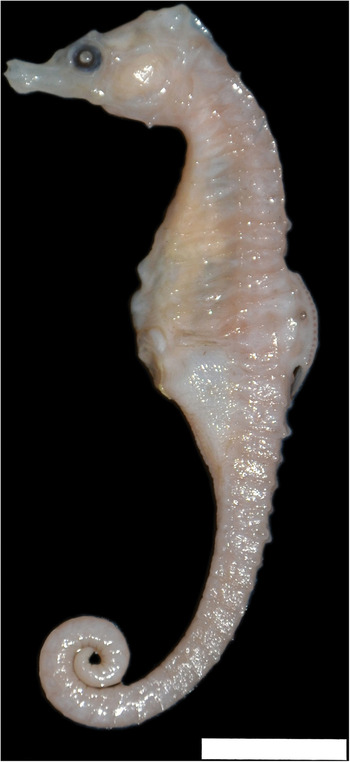
This paper describes a Hippocampus specimen captured in a research survey, aiming at assessing the common hake (Merluccius hubbsi Marini, 1933). Surveys were carried out by the Instituto Nacional de Investigación y Desarrollo Pesquero (INIDEP) covering the Argentine–Uruguayan Common Fishing Zone (AUCFZ). Five benthic surveys were conducted in this area: OB-05/98; EH-05/99; OB-06/00; OB-09/01; and CC-12/09. The Hippocampus specimen was captured during the first research mentioned by the RV ‘Capitán Oca Balda’, on 23 May 1998 at 35°34′S 53°33′W; AUCFZ, approximately at 120 km from the coastal city of La Paloma in Uruguay. The capture occurred at 60 m depth. The Hippocampus specimen was fixed in 10% formaldehyde and it was deposited at the INIDEP Fish Collection as INIDEP 614 (Figure 1). No other Hippocampus individual was captured during these research surveys (Martín Ehrlich, Ichthyoplankton Laboratory, INIDEP, personal communication). The specimen collected was measured following the methods of Lourie et al. (Reference Lourie, Foster, Cooper and Vincent2004). It was a male of 6.8 cm height with 18 dorsal fin rays, 14 pectoral fin rays, 4 anal fin rays, 11 trunk rings and 37 tail rings. Using these taxonomic criteria, it was identified as H. patagonicus (Piacentino & Luzzatto, Reference Piacentino and Luzzatto2004).
Hippocampus patagonicus individual sampled (35°34′S 53°33′W): deposited in the INIDEP fish collection as INIDEP 614. Scale bar: 1 cm.

The zone in which this H. patagonicus individual was collected corresponds to the transition between two biogeographical provinces, Argentinean and Magellanic. The main distribution of H. patagonicus is along the Argentinean Province (Rosa et al., Reference Rosa, Oliveira, Osório, Moraes, Castro, Barros and Alves2011; Luzzatto et al., Reference Luzzatto, Sieira, Pujol and Díaz de Astarloa2012), which is characterized by being influenced by the Brazilian warm oceanographic current. The Magellanic Province corresponds to colder and deeper waters influenced by the Malvinas/Falkland cold current (Ballech & Ehrlich, Reference Balech and Ehrlich2008).
Evidence from a previous study proposes that H. patagonicus has a potentially dispersive juvenile stage characterized by rafting (Luzzatto et al., Reference Luzzatto, Estalles and Díaz de Astarloa2013). The record in deeper waters of the individual described above suggests that some can successfully settle further away from their original populations after dispersing by this mechanism.
An alternative hypothesis is that some Hippocampus species may perform seasonal migrations to deeper waters during the winter months (Foster & Vincent, Reference Foster and Vincent2004). This behaviour had been proposed for Hippocampus erectus Perry, 1810 (Wicklund et al., Reference Wicklund, Wilk and Ogren1969), the sister species of H. patagonicus (Luzzatto et al., Reference Luzzatto, Sieira, Pujol and Díaz de Astarloa2012).
Isolated and sporadic Hippocampus specimens indicate that those individuals do not belong to a stable population and might be the consequence of long-distance migration. On the other hand, they might have the potential to interconnect with existing populations, potentially contributing to the wide distributional range found in this and other seahorse species with limited population genetic structure (Woodall et al., Reference Woodall, Koldewey and Shaw2011).
ACKNOWLEDGEMENTS
We thank R. Estalles who helped revise and proofread this paper, and the anonymous referees who guided the process of reshaping this work with their valuable contributions.