In recent years it has been common after mass casualty events to offer bereaved families the opportunity to visit the site where their loved ones died. Although the significance of site visits so far has been uncertain, some recent reports suggest that such visits can be beneficial for the bereaved, both after natural disastersReference Kristensen and Franco 1 - Reference Kristensen, Tønnessen and Weisæth 2 and after terrorist events.Reference Kristensen, Dyregrov and Dyregrov 3 For some, such a visit may even improve symptoms of post-traumatic stress disorder (PTSD).Reference Murray, Merritt and Grey 4 , Reference Heir and Weisæth 5 Several factors, both cognitive and emotional or existential, can account for this. For example, a visit to the site of death can make the loss more real, it can provide a sense of closeness to the deceased, as well as facilitate cognitive clarity and a better understanding of the circumstances of the death (P Kristensen et al, unpublished observations). However, a visit can also be a distressing experience.Reference Kristensen, Dyregrov and Dyregrov 3 Exacerbations of trauma and grief reactions (eg, re-enactment fantasies) are reported, with some of the bereaved also experiencing adverse reactions after the visit (P Kristensen et al, unpublished observations). Subsequently, proper preparations are a prerequisite before such visits take place.
This article describes how to optimize visits to the site of death after disasters or terrorist events for bereaved families. It discusses important questions—for example, concerning those who should be responsible for organizing a visit, those who should be invited, the timing of the visit, what can be done at the site, the need for support personnel etc—and general guidelines are recommended. Recommendations are based on the authors’ clinical experiences after working with families bereaved by disasters and terrorist events, combined with recent research findings.
Who Should Be Responsible for Organizing a Visit?
When a major national or international disaster strikes, national authorities may decide to organize a collective visit for bereaved families to the site of death. In other cases, the company or organization responsible for the safety of those who were killed may arrange a visit for bereaved families. The latter can be a double-edged sword for the bereaved. On the one hand, it can be difficult because bereaved families may experience considerable anger and resentment against those whom they hold responsible for the disaster. On the other hand, it can be perceived as positive that the company is taking responsibility for the care of those who are affected. In any case, it will be of utmost importance that the leaders of the company are supported in their roles and step forward, so that they are prepared to face the frustration that might present itself.
Who Should Be Invited?
The magnitude of the disaster and the number of deaths will be decisive in determining who and how many should be invited to participate. As a rule of thumb, close family members of the deceased should have first priority. Although we also recommend that children should be included, it is essential that written instructions for children’s participation in rituals are followed.Reference Dyregrov 6 , Reference Søfting, Dyregrov and Dyregrov 7 Children should be asked directly whether they would like to participate in the visit, and it is important for adults (including parents or guardians) to not force or place pressure on children to participate when they are uncomfortable. Other individual considerations may also be taken, for example, cases of divorced or separated families and/or families with high levels of conflict. This should ideally be clarified in advance and could be handled by either arranging separate visits or ensuring physical distance between the family units.
In some cases, persons other than the biological family could be invited to participate if they have had a particularly close relationship with the deceased. Participating in such a visit may have the same beneficial effect among, for example, close friends,Reference Johnsen and Dyregrov 8 as has been reported by family members. However, practical aspects may limit this possibility. Finally, bereaved family members and non-bereaved survivors who were themselves directly exposed to the disaster may have different needs in connection with a visit. Thus, it is recommended that separate visits are planned for these 2 groups.
When Should Collective Visits Be Arranged?
There is still not enough research to guide “optimal timing” for organizing visits to the site of death. The needs concerning the timing of a visit will vary among the bereaved. Some will want to visit the site as soon as possible; others may need to wait a while before they can go through with it, because it may be too overwhelming or emotionally painful (P Kristensen et al, unpublished observations). As a general principle, bereaved families should have the opportunity to see the site of death before others, especially the media, as the site is considered a private or sacred place.Reference Clark and Franzmann 9 Following the Turøy helicopter crash near Bergen, Norway, in 2016, the first boat visit to the site was arranged only 2 days following the crash, whereas the second visit took place 10 days after the crash. This allowed more time for those who were not ready by the first visit; by the second visit, however, most family members wanted to participate. These early visits also demonstrated the site’s importance through showing the reality of the disaster (eg, marks from the fire and explosion, etc).
It is not always possible to organize visits in the early stages after an event. After the terrorist attack in In Amenas, Algeria, in January 2013, the Statoil Oil Company (the contracting entity) was not able to conduct a visit for bereaved families until 21 months after the attack. It involved complicated preparations because special transportation and a high level of security had to be arranged before the journey could be undertaken. Feedback from the bereaved families concerning the usefulness in visiting the site of death was identical to those reported after the 2004 tsunamiReference Kristensen, Tønnessen and Weisæth 2 and the Utøya killings,Reference Kristensen, Dyregrov and Dyregrov 3 which suggest that the need to visit the site of death and the perceived benefits of doing so do not change much in the early years after the loss.
When the Site of Death Is Inaccessible
Sometimes, the site of death is not directly accessible for the bereaved, for example, after airplane disasters in remote areas or because of safety reasons. In these situations, it is important to adapt rituals, which are feasible in the circumstances, such as showering flowers over the disaster area from a helicopter or filming the site of the disaster, etc.Reference Johnson 10 Virtual site visits can be an alternative using online resources, such as Google Earth or Street View.Reference Murray, Merrit and Grey 11
Preparations for Collective Visits
Adequate preparations are always essential before a visit to the site of death is conducted.Reference Johnson 10 , Reference Murray, Merrit and Grey 11 Generally, there must be sufficient space for a collective gathering of all bereaved family members and the area must be accessible. A tent may be needed, because of changing weather conditions and in order to provide structure and containment in a potentially chaotic situation (see Supplement 2 on suggestions for an equipment list).
The death site has to be cleared by the police before the bereaved can be allowed to visit. First, this is important for safety reasons. Second, family members should not risk finding any belongings of their deceased or, even worse, human remains at the site, which has in fact happened on occasion. At the same time, it is important that not all traces of the disaster are removed in order to counteract disbelief. Regarding the visits to Utøya Island, Norway, after the terror attack in 2011 it was considered necessary to wash the rooms where the killings had occurred as much as possible, as well as to remove empty cartridges and personal effects.Reference Kristensen, Dyregrov and Dyregrov 3 At first, the police wanted to hide the bullet holes in the walls by covering them with furniture, but after discussions it was decided not to cover the bullet holes or weak blood stains on the floor. The furnishings in rooms were reset to where they used to stand. All this was carried out in order for bereaved family members to see the places more or less as it was after the killings in order to reduce the sense of unreality. In order to ensure an optimal balance between reality and the need for shielding, it is recommended that trauma and grief specialists take part in the preparations before a site visit, together with representatives from the police.
Further, bereaved family members should be properly prepared for what they will encounter at the death site. For children, this preparation should be carried out as comprehensively as possible, including the consideration of how adults may react at the site. Preparations can be carried out by providing written information in advance of the visit (see Supplement 1). Information regarding what reactions they might expect, before, during and after the visit, and what one will see at the site can be specified. After the visit to In Amenas in Algeria, the bereaved said that the mental preparation they received in advance was particularly important. This had, for example, made them aware of the possibility of taking something back home from the desert, such as sand and stones, which represented a link between the lost loved one, the last place they were alive, and the grave at home. In the desert area in In Amenas, there were tracks in the sand where the cars had exploded. Family members were prepared for this beforehand and informed why it was judged as important to be seen. Also, photographs of what the site currently looks like can give specific information and allay fears of what the bereaved may meet there.
Usually, the media can be kept at a distance during such visits. However, using their equipment, they are able to zoom in and take pictures. Participants should be informed of the media’s interest and coverage from afar. Similarly, people should be asked to be careful with putting up photographs and videos on social media, especially if members of other families are visible in these.
What Can Be Done At the Site?
One important question that needs to be addressed, particularly if many have died in the same place, concerns whether one should escort all the bereaved families at the same time or one by one to the site where the deceased were found. If the families are kept together, they can provide mutual support to each other based on their collective experiences. However, this is challenging because of the requirement to ensure that a balance is struck between each bereaved family’s need for time to see and conduct rituals at the site and the overall time this procedure takes. Considering the distress that is associated with a visit to the site of death, it should be ensured that the bereaved do not have to wait unnecessarily. At the same time, each family should be able to spend as much time as they need to conduct personal rituals in a dignified and private manner and be given the opportunity to pose questions to the police. During this process, it is important that the police and the psychosocial support team communicate effectively with each other, so that the wait will not be unnecessarily long and burdensome. It is also important that both crisis health personnel and the police join forces in the preparations for collective visits to ensure a united understanding and agreement concerning the practice, thereby ensuring that is both practical and in the best interests of those who are participating. Priority should be given to families with smaller children and other persons with special needs.
At Utøya, up to 15 adolescents were killed in exactly the same place. During the collective visit, each family was followed from the central gathering place to the site, where their loved ones were found killed, by 2 police investigators and 1 volunteer from the Red Cross.Reference Kristensen, Tønnessen and Weisæth 2 Each family was told that they could spend as much time there as they wished to conduct rituals etc. Overall, this procedure took several hours; for some families, this involved a very long wait until it was their turn. Afterwards, bereaved family members confirmed that it was a burden to wait for many hours until they could visit the respective site of death. However, they were unable to see how this could have been carried out in a different way.
At the site of death, the bereaved should also be able to ask questions and receive important, but brief, information (eg, where the deceased was found). It is essential that this type of information is correct. The need for more detailed information may also be present (eg, bodily damage), but there may be different needs both between families and within families. As a rule of thumb, the police or support staff should answer questions that the bereaved may have, but not provide any information in addition to what is asked for at that time. An alternative is to provide tailored information after the site visit. Emergency health personnel, who were either at the site when the event occurred and/or persons holding important information about what happened, such as police officers, ambulance personnel, or other healthcare professionals, should also be present to provide information and answer questions unless they are suffering from PTSD or vicarious trauma themselves.
At most site visits, it is usual to perform rituals. A minister or priest will say a few words before family members carry out their personal rituals. After the Rocknes disaster where a ship capsized near Bergen, Norway, in 2004, priests from 3 different religious backgrounds performed rituals to accommodate the fact that there were different cultural backgrounds among the bereaved. Here, as in other maritime disasters, the bereaved symbolically showered flowers over the sea following the ritual. It is important to have flowers and candles available for the bereaved to be able to conduct personal rituals. Organizers should ensure that these are available at the site for those who, for various reasons, have not brought these with them.
The Need for Support Personnel
Bereaved family members will react individually at the site, but it is to be expected that a variety of reactions, such as sadness, crying, and despair, will come to the surface as the reality of the loss sinks in. Although it is difficult to estimate how many personnel will be needed, healthcare professionals, who can assist the bereaved during and after the visit, should be present as a preventive measure. Professionals with knowledge and experience in supporting grieving children should be available. Generally, it is important that professionals have a “watchful waiting” role in order not to not intrude or “medicalize” normal reactions, while being available if needed. It is also our experience that family members give much support to each other in this private sphere.
Uncertainty About Whether to Participate Or Not
The thought of visiting the site of death after a traumatic loss can arouse strong feelings among the bereaved. Some will be unsure whether they will cope if they visit the site, whereas others will simply not go through with it at all. As seen in our studies, only a few choose not to visit the death site, mostly because it was too overwhelming (P Kristensen et al, unpublished observations). It is important to emphasize to those who are uncertain about whether or not they should go that they can change their mind should they be unable to cope with taking part in the first visit. For those who initially decline to participate, one can underline the fact that their future mental health does not depend on such a visit, as well as reassure them that a visit can take place at a later date. Attending family members can be encouraged to take pictures and videos, which can be shared with family members and friends who are not present. It may also be important to make sure that they can ask for support later on if they want to visit the site.
Concluding Remarks
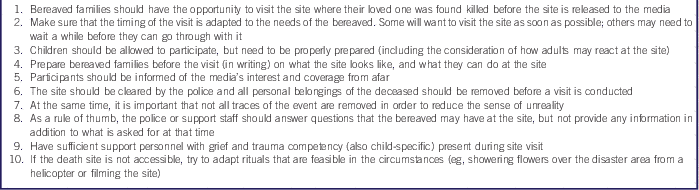
Visits to the site of death are experienced as being beneficial by the majority of bereaved families.Reference Kristensen and Franco 1 - Reference Kristensen, Dyregrov and Dyregrov 3 Nonetheless, more research is needed to explore whether the impact could be different for victims of natural versus man-made disasters, and whether exposure to the site could lead to PTSD symptoms in some. No matter the circumstances, in order for such a measure to be optimized, it is essential to have close cooperation between the authorities or companies in charge of organizing the visit, the police in charge of the death site, and healthcare personnel with competency in disaster psychology or psychiatry. Proper preparations regarding the site and for those who choose to participate are also necessary before such visits are conducted (see Table 1 for checklist).
Checklist for Planners of Visits to the Site of Death for Bereaved Families

Acknowledgment
This article is an up-to-date version of a summary prepared for the Norwegian Directorate of Health in 2015. The content is entirely the author’s responsibility.
Supplementary material
To view supplementary material for this article, please visit https://doi.org/10.1017/dmp.2017.94