The cartoon by Mike Luckovich is reprinted here with the permission of Creators Syndicate and the Atlanta Journal-Constitution, where it first appeared on September 7, 2005.
ORIENTATION
Readers of this article can be divided into two groups: those who are African slave descendants, and those who are not. If you are among the African slave descendants, your group can be further subdivided into three categories: 1) your enslaved ancestors were owned here in the United States; 2) your enslaved ancestors were owned elsewhere; or 3) some of your enslaved ancestors were owned in the United States, and some were owned elsewhere.
The most important variable here is slave ancestry, not race. As I hope to demonstrate, the ambiguity and variability of racial classification can often make race, paradoxically, a problematic starting point for discussing efforts to improve the conditions of African Americans. This is not to diminish the importance of race as an essential aspect of our social, cultural, and political identity. Indeed, contributions to this special issue of the Du Bois Review confirm Cornel West's (1994) understated assertion that Race Matters. Race matters in New Orleans, and race matters in Paris. It matters in Cape Town and probably every other major metropolis on earth. Race will always matter. But, in the United States, the historical institution of slavery has had, and continues to have, a more profound and far-reaching impact on the lives of African Americans than the color of their skin alone. Much of my own research has aimed at showing how the linguistic consequences of slavery, in particular, have been largely overlooked in our society, to the considerable detriment of slave descendants. For this reason and others described below, our primary focus throughout this discussion will remain on people with ancestral ties to enslaved Africans.3
It is important to recognize that Jews are also slave descendants, be they citizens of the U.S., Israel, or both. Hence my limited focus on slaves of African origin who were enslaved here in America.
RACIAL GENERALIZATION AND LINGUISTIC DIVERSITY
The summer of 2005 exposed news watchers around the world to the poverty suffered by large numbers of people of African descent throughout the United States and France. In both countries, public opinion was divided about the racial implications of the government's reaction to human suffering. Was the lack of a coordinated federal response to Hurricane Katrina purely the result of administrative ineptitude, or did it betray a tendency of people in high places to ignore the plight of poor Blacks? Could the same question be asked about the riots in France and the status of immigrants from former French colonies? Politicians, pundits, and reporters who commented on these events frequently referred to the race and poverty of those most noticeably caught up in the two tragedies. But, unlike the French rioters, the majority of those who felt the full brunt of Hurricane Katrina were not only people of African ancestry, they were also the descendants of Africans brought to this country as slaves. This is a distinction worth emphasizing.
Too often, discussions about racial equality in the United States tend to be cast in stark Black-and-White terms. This polarizing tendency is not only misleading, in that it masks the true range of American racial diversity, but it also misses a larger point. As Gates (1994) observes, Black people are highly diverse, wherever we reside. Regional and class differences among African Americans are readily evident and especially pronounced in some cases. The same can be said about language differences. My own linguistic work, and that of many other linguists, has repeatedly exposed important linguistic distinctions among Black populations throughout the world, including those descended from slaves.4
I dare not overlook the many outstanding linguistic contributions that bolster this observation. My mentor William Labov is perhaps best known for developing the field of advanced sociolinguistic science. His early theoretical work on “Nonstandard Negro English” has given rise to cutting-edge quantitative linguistic analyses throughout the world. Cherished colleagues, too numerous to mention here, deserve recognition that can be located elsewhere (Rickford et al., 2004).
A brief linguistic aside may be helpful here. It should not be news to anyone that many Americans, including some in the educational professions, equate Black language usage with improper, ungrammatical, or sloppy usage. Nor should it come as a surprise that “Black” ways of speaking in the United States tend to be subjected to harsher criticism than other vernacular forms that diverge, however slightly, from the European-based “American” standard. This observation is confirmed by ongoing studies of linguistic profiling in the U.S., France, and South Africa. We have observed elsewhere (Baugh 2000, 2003, 2004; Purnell et al., 1999), that the telephone is often used as an instrument of racial discrimination. The vast majority of people, upon hearing the voice of a stranger on the telephone, begin to create a mental image of the caller. This process is neither racist nor abnormal. However, if the caller is seeking goods or services, and if they are denied access to those goods or services, sight unseen, they may be the (unwitting or not) victims of linguistic racial profiling (Baugh 2000, 2003, 2005; Smalls 2004; Alim 2005). Prejudice against Black language usage can also be found throughout South America, the Caribbean, and Central America, among other places where slave descendants have settled (Baugh 1983, 1999, 2004; Hymes 1971; Winford 2003; Poplack and Tagliamonte, 2001; Wolfram and Thomas, 2002; Rickford and Romaine, 1999; Mufwene 2005; Singler 1984).
From a scientific point of view, the belief that African American Vernacular English (AAVE) is “incorrect” or “ungrammatical” is based wholly on social attitudes rather than linguistic facts. For as long as the study of language has been around, linguists have affirmed that standard and nonstandard language varieties are merely different from each other, yet entirely consistent and logical within themselves. Speaking a nonstandard dialect does not indicate linguistic or cognitive deficiency, nor does it impede learning (Labov 1972; Wolfram et al., 1999). Be that as it may, the undeniable reality we face is that AAVE has been devalued since the time of slavery, and those who speak it natively face considerable difficulty in gaining access to the world's inner circles of power, wealth, and influence. In order to do so, AAVE speakers must master the same knowledge and skills as everyone else while at the same time developing proficiency in a second dialect. This is not always easy, and the lack of linguistic understanding among the general public only compounds the problem and reinforces barriers to success. Worse yet, the biggest contributing factors to the existence of AAVE in the first place—namely, the statutory denial of literacy during slavery, the effects of Jim Crow laws, and decades of segregation, poverty, and inferior schools—are largely ignored.
By the same token, when it comes to matters of racial equality, race alone cannot account for the glaring social, economic, and political disparities that exist across the United States. Numerous external factors must also be taken into account—history being one of the most significant. No reasonable person could look at the last five hundred years of U.S. history and deny that the combined effects of the African slave trade, segregation, and educational apartheid have had profoundly negative, long-term implications for the descendants of African slaves. The legally sanctioned disenfranchisement of U.S. slave descendants is unparalleled among immigrant groups who have come to this country. Is it therefore unreasonable to suggest that, where the legacy of slavery can still be felt, the inheritors of that legacy deserve some consideration?
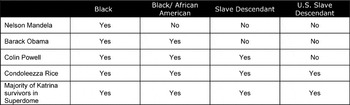
One way to begin addressing this question is by acknowledging the essential heritage differences among Blacks. Figure 1 compares four prominent Black political figures with the majority of Hurricane Katrina survivors left stranded in the New Orleans Superdome. Former South African President Nelson Mandela, Illinois Senator Barack Obama, former Secretary of State Colin Powell, and current Secretary of State Condoleezza Rice illustrate the important distinctions I wish to make.

Diversity among Prominent Black Political Figures and the Majority of Hurricane Katrina Survivors Stranded in the New Orleans Superdome
As you can see, of the four prominent political figures listed above, all of whom are Black, only Secretary Rice is a U.S. slave descendant. We call attention to this fact not to dispute the achievements of successful Blacks with no slave ancestors, nor to pay special tribute to Secretary Rice, but to position the issue of historical hardship front and center in the debate on racial equity. This can be a tricky proposition, given that most federal affirmative action policies, as well as the U.S. Census, have no provision for determining which of our citizens are the descendants of former slaves. To the best of my knowledge, neither do we have completely accurate records on the descendants of former slave owners, a conspicuously silent group to whom we will return in our concluding remarks. Nevertheless, if affirmative action programs and other efforts to “level the playing field” are to have any meaning in a country with a history of racial discrimination, then slave ancestry and the nationality of those ancestors must take precedence over all other considerations—including race. To suppose otherwise is to miss an opportunity to correct the injustices of the past, and to allow U.S. slave descendants to lag further and further behind the rest of society.
Regrettably, my own work on this subject has often been characterized by the same racial generalizations which I now criticize. Despite having written at length about changing terms of self-reference among American slave descendants (Baugh 1991), I have routinely referred to “Black Americans” or “African Americans,” when I should have referred more specifically to “U.S. slave descendants of African origin.” Many African Americans, like Barack Obama, no longer trace their history to Blacks who were once enslaved in America. To his credit, Senator Obama is sensitive to the subtle but important distinctions outlined here. In his powerful autobiography, Dreams from My Father, he reports that a (disinterested?) Manhattan publisher convinced him to overlook the myriad differences among Black people in favor of writing more generally about “all our various struggles” (Obama 2004, p. xvi). Senator Obama takes great and justifiable pride in being the first Black president of the prestigious Harvard Law Review; indeed, he emphasizes that he was “the first African American” to hold this position. He is also the first African American man to have been elected by the Democratic Party to the U.S. Senate.5
In addition to my scholarship, I have administrative responsibilities as Director of African and African American Studies at Washington University. As such, I cherish and celebrate advances by people of African descent whenever possible. Senator Obama's spectacular accomplishments are greatly valued by all African Americans, regardless of their ancestors' origins. Torn from Mother Africa in ways that voluntary immigrants rarely grasp, U.S. slave descendants take great pride and feel strong solidarity with Blacks throughout the African Diaspora.
THE ELUSIVE QUEST FOR COLOR-BLIND EQUITY
Although the lessons of Hurricane Katrina inspire my remarks about color-blind equality for poor people of African descent, I wish to emphasize the obvious fact that the quest for a color-blind society exceeds the boundaries of the United States (Mandela 1994; Cose 2002, 2005; Sears et al., 2000). By viewing these matters in global perspective, we do not seek to shift focus entirely away from events in the Gulf Coast region, but to use those events as a lens through which to view a larger, international, political picture. For the sake of space and simplicity, I will focus on African perspectives throughout the Diaspora.
Fryer et al. (2004) frame affirmative action policies as either being “color-sighted” or “color-blind.” Their discussion is helpful, allowing us to distinguish between affirmative action policies that make explicit reference to racial classification and/or preferences (i.e., “color-sighted,” as affirmative action policies often are in the U.S.), and those that formally exclude any racial considerations (i.e., “color-blind,” as in France).
Affirmative action policies for people of African descent remain controversial throughout the African Diaspora. In countries like Brazil and South Africa, the already complex issue of racial classification is made even trickier due to the early and extensive racial mixing resulting from Dutch and Portuguese slave traders who rarely traveled with their own women. Even so, residents of these democratic nations usually acknowledge that their Black citizens tend to fare less well economically and residentially than do their counterparts of European ancestry.
The same can be said here at home. In their studies on the educational performance and aspirations of African Americans, Fordham and Ogbu (1986) give prominence to the concept of “acting White,” with its implicit genuflection to racial attribution. More recently, Fryer and Torelli (2005) have reexamined the consequences of “acting White” based on popularity networks in school, along with academic achievement, and found that many middle-class and upper middle-class African Americans experience educational difficulties in affluent public schools where they remain in the minority. In an earlier study, Ogbu (2003) drew similar independent conclusions.
My own experience, as an African American who attended inner-city elementary schools in Philadelphia and Los Angeles and secondary schools in the predominantly White and affluent western San Fernando Valley during the 1960s, leads me to an alternative hypothesis—one that expands upon Steele's (1992) classic formulation of “stereotype threat.” Steele (1992) affirms that race matters when high-stakes standardized tests set the bar for admission to competitive institutions of higher learning. For the purposes of this discussion, it is perhaps best to view Steele's original formulation as an internal stereotype threat. That is to say, the individual may carry a psychological burden originating from within as a representative of a nondominant group. In the light of Ogbu's (2003) findings, which appear to be reinforced by Fryer and Torelli (2005), it is possible that U.S. slave descendants of African origin may also fall prey to an external stereotype threat. This could happen, for example, when a critical subset of teachers and counselors harbor negative stereotypes about students who are slave descendants, thereby resulting in low expectations, less attention, and less investment in their intellectual well-being, ultimately leading to fewer opportunities for advancement. One need only look at the demographic composition of highly competitive Advanced Placement (AP) high school classes across the nation to illustrate my concern. Such classes rarely serve significant numbers of students who are U.S. slave descendants (i.e., the children of Brown v. Board of Education (1954)).
Of the racist comments I encountered as a youth in school, some were benign or unintentionally offensive, while others were clearly intended to quash any hope of intellectual aspiration that I might harbor. The measure of academic success I did achieve owes more to my parents' extracurricular diligence and intervention than to the time and attention most public school teachers devoted to me, which was often not much. I offer my own (admittedly anecdotal) testimony here as relevant insofar as it introduces the possibility and conceptualization of an “external stereotype threat,” which may account for some of the same results described by Ogbu (2003) regarding the disproportionate failure of Black students in affluent schools.6
By “external stereotype threat,” I mean that U.S. slave descendants may fall prey to negative stereotypes from educational gatekeepers (regardless of racial background) who have been shown to invest less time in and give less attention to students they perceive to be less worthy (Varenne and McDermott, 1998). Rather than perpetuate the myth that these differences in professional attention are restricted to “racial” stereotypes alone, the Historical Hardship Index proposed herein lends greater demographic flexibility to African American educational salvation.
“WHOSE ANCESTORS WERE IMPORTED TO THIS COUNTRY, AND SOLD AS SLAVES?”: HAS AFFIRMATIVE ACTION MISSED ITS TARGET?
The question is simply this: Can a negro, whose ancestors were imported into this country, and sold as slaves, become a member of the political community formed and brought into existence by the Constitution of the United States?
—Dred Scott v. Sandford (1856)
Given all that has been said up to this point, is it possible to consider diversity in the United States without reference to race? The preceding quotation (with my italicized emphasis) would suggest that one can do so in the case of those of us “whose ancestors were imported into this country, and sold as slaves.” No explicit reference to race is necessary. Granted, the French experiment of a color-blind nation—where race is legally barred from official demographic figures—has incontrovertible limitations and weaknesses, painfully exposed through the clarity of hindsight. How else, then, might we recast human diversity, perhaps with an optional reference to race?
Ogbu (1978, 1992) provides a framework for accounting for caste-like discrimination in the U.S. (and other societies) without overt reference to race or ethnic group. Instead, he classifies U.S. residents based on their family heritage status as voluntary, involuntary, or autonomous immigrants. The vast majority of New Orleans residents left stranded in the wake of Hurricane Katrina would be, according to Ogbu's classification system, descendants of involuntary immigrants who happen to be of African ancestry.
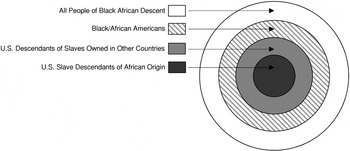
Figure 2 recasts Figure 1 as an affirmative action target pertaining to people of African descent, where the bull's-eye achieves the color-blind gold standard of focusing more closely on U.S. slave ancestry and less on the broader (and less precise) category of racial attribution. Clearly, in the case of African Americans, affirmative action programs that somehow miss or diminish U.S. slave descendant advancement and participation are probably missing their original target. Most college admissions affirmative action policies were originally formulated with the explicit intention of helping slave descendants in particular. However, most college admissions officers do not inquire as to whether their Black applicants are descended from former U.S. slaves.7
Affirmative action policies that are relevant to other groups besides U.S. slave descendants are important and worthy of more complete discussion than I provide here. However, I am mindful of concerns that “Black versus White” debates about race relations and affirmative action mask matters of diversity that can also be artificially subsumed in an article written by a Black author in response to post-Katrina events. As indicated above, for sake of expedience, my remarks tend to be focused on the circumstances impacting poor people of African descent throughout the Diaspora, rather than all groups that have experienced discrimination of some kind within the U.S.

Affirmative Action Target, Showing Increasing Precision of Group Classification with Respect to Nationality and Ancestry
THE HISTORICAL HARDSHIP INDEX: FACTORING ALTERNATIVE DIMENSIONS OF DISCRIMINATION IN THE UNITED STATES
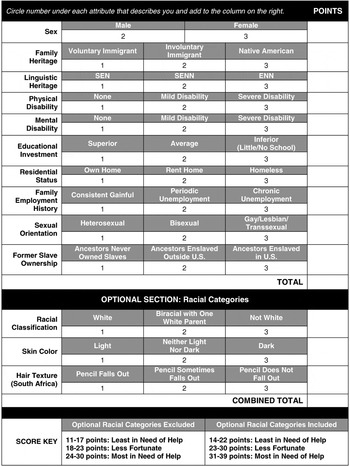
In order to “get past race” in the American quest for color-blind equity, it is necessary to explore a broader array of ways in which someone might experience unfair advantages or disadvantages as compared to their fellow citizens. That is to say, beyond race, what are the bases upon which someone might be discriminated against in the United States? Might one's sex be a barrier to opportunity? How about family immigrant status, or linguistic background? What of physical or mental disability? Could any combination of these account for the likelihood that a given individual might be subject to discrimination? For heuristic purposes, we will set an arbitrary scale, implying that various potential hurdles to equal opportunity share the same impact, when in reality their ultimate impact depends upon a range of circumstances that must be determined locally (see The Anguish of Calibration, below). The collective impact of various dimensions of U.S. discrimination is illustrated in the Historical Hardship Index (HHI) Self-Test in Figure 3, which is intended to be illustrative rather than exhaustive.

Historical Hardship Index Self-Test, Showing Potential Bases for Discrimination
Readers are encouraged to calculate their own personal HHI score, based on the following procedures. First, decide which of the categories in the left-hand column are relevant to your life. You need not include any category for which you personally believe the social playing field is now level and discrimination no longer occurs. Once you have identified all of the categories that you consider relevant, select the corresponding value between 1 and 3 that applies to you, and then write it in the right-hand column. Although I assign values to every category, I appreciate that some might argue that a more accurate calibration would convert to 0 values currently set at 1, since the lowest values correspond to people who have the greatest (inherited) advantages.8
Recognizing, of course, that historical hardship in one community will not match historical hardship in another, I encourage readers to experiment with local calibration, and the possible inclusion and exclusion of alternative categories as a means by which people can fairly compare their historical circumstances.
We will discuss the difficulties of confirming empirically accurate calibration in the next section. However, in an effort to calculate a preliminary personal score, consider the following issues for each category:
- Sex: Since this category has only two options, I have arbitrarily set values at 2 and 3 for men and women, respectively. However, those with compelling reasons to choose neither or both should do so.
- Family Heritage: If your ancestors immigrated to the United States freely and of their own volition, circle 1. If your ancestors were transported here involuntarily (i.e., as indentured servants or slaves), circle 2. If you are a Native American whose ancestors were either displaced from their land or killed, circle 3.
- Linguistic Heritage: If you are a native speaker of
standard American English, circle 1. If you are a native speaker
of nonstandard American English, please circle 2. If English is
not your mother tongue, circle 3.9
Deaf persons should circle 3, as well as 3 under the category of physical disability. The dual classification of deaf U.S. citizens within this index is intended to overcome their exclusion from government policies pertaining to English language learners. Native users of American Sign Language must learn English as a second language, but most government and educational policies do not fully recognize this fact, focusing instead on deafness as an individual disability.
- Physical Disability: If you have no physical disability, circle 1. Circle 2 if you suffer from a mild physical impairment, and if you have a severe physical disability, circle 3.
- Mental Disability: Those who have no personal history of mental illness or mental disability receive 1 point. People with some history of mental illness or cognitive disabilities receive 2 points. Those with severe mental illness or cognitive disabilities receive 3 points.
- Educational Investment: In this instance, the allocation of points is based not on your grades in school, but on the relative economic investment (public or private) that was made on behalf of your personal education. Since public education within the United States is decentralized, your impression about the educational investment made on your behalf should reflect the time and place where you were educated. With this temporal and regional variability in mind, if you received a superior education in affluent schools, circle 1. If your school was one that made average per capita investments to your education, circle 2. If you attended inferior schools, or if you have not had the benefit of any investment made on behalf of your education, circle 3.
- Residential Status: If you have lived most of your life in dwellings that were either owned by you or your caregivers, circle 1. If you have lived most of your life in dwellings where either you or your caregivers paid rent, circle 2. If you or your caregivers experienced prolonged homelessness at any point in your lives, circle 3.
- Family Employment History: If you and members of your family have been gainfully employed or supported by income from inherited wealth, circle 1. If you and members of your family do not have income from inherited wealth and have experienced periodic unemployment, circle 2. If you or members of your family have no inherited wealth and have experienced chronic unemployment or have lived for extended periods of time on welfare, circle 3.
- Sexual Orientation: If you are heterosexual, circle 1. If you are bisexual, circle 2. If you are gay, lesbian, or transsexual, circle 3.
- Former Slave Ownership: If your ancestors owned slaves in the United States, please do not accept any points. If your U.S. ancestors never owned slaves, circle 1. If your U.S. ancestors were enslaved in another country, circle 2. If your ancestors were enslaved in the United States, circle 3.
Many other categories could or perhaps should be added to those listed above, such as religious discrimination (against you or your ancestors), political affiliation, or various regional preferences specific to individual circumstances.10
I have not included a personal history of military service within the index because such service should not be a barrier to success. However, it is a strong indication of personal sacrifice, and I would diminish the vast military contributions of many Americans were I to overlook the importance of military service in the history of the United States. Should point allocation for military service be based on individual service, a family tradition of military service, or some combination thereof? In addition, the ratio of potential military service will vary substantially depending upon how long one's family has lived in America. Since slave descendants have been here longer than many other immigrants, our history of service to the U.S. military has provided the margin of victory on all wars upon which American liberties are maintained. Many White families also take great pride in military service, and here I seek to draw no distinction between families whose relatives fought for the North or South during the Civil War. If members of your family fought in the Civil War, that service is comparable in terms of its relevance to your HHI, should you choose to include it as a consideration.
For those who have completed every category within the HHI thus far, the lowest possible score that a U.S. resident might receive would be 11, whereas the highest possible score (regardless of race) would be 30. Testers who do not wish to include race within their personal HHI can stop here. However, as you will note, I have included optional racial categories which may or may not improve the local and/or historical accuracy of your score. It is important to stress that these are optional categories. For illustrative purposes, readers are encouraged to select among three possibilities:
- Personal Racial Identity: If you consider yourself to be White, circle 1. If you are biracial, with one White parent and one non-White parent, circle 2. If both of your parents are non-White, circle 3.
- Skin Color: If your skin is very light, circle 1. If your skin is neither light nor dark, circle 2. If your skin is dark, circle 3.
- Hair Texture: The Pencil Test11from South Africa: If you place a pencil in your hair and it consistently falls out, circle 1. If you place a pencil in your hair and sometimes it falls out, circle 2. If you place a pencil in your hair and it never falls out, circle 3.
Some additional background help may clarify the relevance of considering hair texture, and the previous South African practice of sticking a pencil in someone's hair to determine their racial classification is well attested and serves our present purpose. During Apartheid in South Africa it was common for government officials to classify citizens as White, Coloured, or Black, depending upon whether a pencil would fall from one's hair, or could be held firmly within one's hair. The pencil routinely fell from the hair of Whites, and would just as routinely stay fixed within the hair of Blacks, but because of the special nature of South African Apartheid, many “coloured” South Africans could not so easily be segregated based on skin color alone, so “the pencil test” provided greater statutory insularity to South Africa's ruling White classes.
If one were to include all three of these optional racial categories, your corresponding personal historical hardship index score could rise from between 3 and 9 points. Readers are encouraged to experiment with relevant racial inclusion, if for no other reason than comparison.
The Anguish of Confirming Accurate Local Calibration in Diverse Communities
Although your preliminary score may provide a good approximation of your relative privilege or hardship status as compared to your fellow U.S. residents, the challenge for future analyses is the more painstaking task of accurately calibrating scores to reflect the realities of various communities throughout the world. For example, I mentioned above that readers should rank all vertical categories based on their impression of the relative magnitude of potential social barriers. Is sexual orientation more of a hindrance to opportunity than linguistic background? Such answers must be confirmed in local contexts. Similarly, are the horizontal rankings adequate? That is, should the same value be allocated to family heritage as to residential status? Again, the empirical accuracy and validity of HHI scores will need to reflect local preferences, priorities, and prejudices.
Another question is whether the horizontal rankings are in the correct order. For example, by allocating a higher hardship score to women, I have implied that men routinely have more advantages over the opposite sex. However, anyone who believes the reverse is true need only provide a thorough explanation as to why, and then flip the position of these categories. Women might have historical advantages in some matriarchal societies, and I concede at the outset that other horizontal rankings may be subject to change, depending upon a combination of historical and regional circumstances that vary from one community to another.
Interpreting Your Preliminary Score
Because racial categories are optional for the purpose of this discussion, you will first need to determine whether or not you plan to include any race in your personal HHI evaluation. For the sake of clarity, I will discuss the fullest possible scoring range, focusing first on that part of the index that does not make explicit reference to race, skin color, or hair texture.
Those who exclude any racial considerations will receive scores ranging between 11 and 30, where those with HHI scores ranging between 11 and 17 are least in need of help, while those whose scores between 18 and 23 may be thought of as less fortunate, or perhaps in need of some assistance. Those who are most in need of help would be those who receive HHI scores of 24 to 30. If any of the three optional racial attributions are added in, your score may increase anywhere from 1 to 3 points among Whites, and anywhere from 2 to 9 points for those who are not White.
Assuming for the moment that someone has completed every category listed in Figure 3, the broadest racially inclusive HHI scores would range between 14 and 39. Those with scores of 14 to 22 would be expected to be the least in need of help. Those with scores between 23 and 30 would be less fortunate, and those with the highest scores ranging between 31 and 39 would, unquestionably, be greatly in need of help.
CONSPICUOUS SILENCE: WHOSE ANCESTORS WERE IMMIGRANTS TO THIS COUNTRY, AND PURCHASED OR OWNED SLAVES?
Thanks to advances in scholarship and DNA research, we now know that Thomas Jefferson had Black children, as did the late Senator Strom Thurmond. As a descendant of mulattos on both sides of my family, I often wonder who my White ancestors were. Although DNA matching holds great promise of confirming which Black and White Americans are blood relatives, I speak now to those U.S. citizens who are the descendants of slave owners.12
By remarkable coincidence, Gates's (2006) African American Lives recently appeared on PBS, utilizing DNA results exactly as I have envisioned. I was unaware of Gates's efforts during the writing of this essay, but his work confirms the new scientific reality of which I speak. Ironically, these same scientific techniques may also accelerate the decline of White supremacy, since they can empirically confirm (or disconfirm) the relative “purity” of anyone's European ancestry.
In short, do descendants of slave owners have any special moral duty or obligation to accelerate racial reconciliation in the United States? If so, what form should these acts of social responsibility take? Regrettably, the history of African exploitation is so pervasive throughout the African Diaspora that philanthropically inclined descendants of slave owners can select among many potentially worthy causes to support. Some may have the means and capacity to support “Black people” generally, meaning people of African descent everywhere. Contributing to the battle against AIDS in Africa and in North and South America would be an example of this kind of philanthropy. Others may choose to help “African Americans,” without drawing any distinction between voluntary and involuntary immigrant status. As stated above, many U.S. college admission offices make no substantive distinction between Blacks who trace their roots to voluntary immigrants and those of us whose ancestors were enslaved. In contrast, the historically Black colleges and universities (HBCUs) are heavily populated by U.S. slave descendants of African origin, and philanthropic largess devoted to the HBCUs would be highly likely to serve U.S. slave descendants in particular.
At different points in U.S. history, the terms Negro, Colored, Black, Afro-American, and African American have been used in reference to American slaves and their descendants. Readers of this article need no reminder of the other, more offensive term. But these terms of reference tend to gloss over the fact that not all Blacks in the United States are slave descendants. Where historical sexual atrocities are concerned, it is equally important to note that the descendants of slave rapists are not directly responsible for the sins of their White forefathers. Descendants of slave owners are also concealed by racial camouflage; there are no obvious signs to tell us who they are. The vast majority of slave descendants have no such racial camouflage; with the exception of slave descendants who have “passed” for White, our slave ancestry is still visually apparent, despite the passage of time since emancipation.
Many U.S. citizens have no family ties to slavery on either side of the racial divide. The industrial revolution and the expansion of U.S. agriculture did more than create the world's largest economy. It attracted wave upon wave of voluntary immigrants, most of whom never owned slaves. These more recent immigrants include Blacks from abroad who came here voluntarily. Indeed, since the end of slavery, voluntary immigrants of all racial backgrounds have continued to come to the United States in search of fortune, liberty, happiness, and prosperity for their children. They have also frequently brought with them negative, if not racist, stereotypes about U.S. slave descendants.
As one who works actively to implement Dr. King's dream, albeit through scholarly and scientific means, I know that many U.S. citizens grow weary of the persistent struggle for racial harmony in America. Du Bois (1903[1999], 1915[2001]) and Douglass (1855[1996]) knew well that the peculiar institution of slavery, and the inherent injustice and brutality that it spawned, would demand the constant vigilance of people of good will for years to come. Black suffering continues unabated in far too many places throughout the world, and, while it is my fervent hope that the sons and daughters of slave descendants and their former owners may ultimately reconcile, coming to know fair and equal measures of peace, happiness, and prosperity, I ultimately pray for the salvation of Mother Africa, and all of her children wherever they may be. Moreover, by formulating a Historical Hardship Index that can be adapted to serve various communities, I hope to do more than help Black people in America, Brazil, France, and South Africa. I hope to help reduce and eliminate all forms of human exploitation and inequality, wherever they exist.