Introduction
The success of laser surgery is reliant on the use of appropriate instruments which adhere to general safety precautions. Continuous evacuation of the smoke during endolaryngeal surgery improves visualisation of the surgical field. Microlaryngoscopes have been adapted for laser use by the addition of smoke evacuation channels on the sides of the laryngoscope. Although the addition of these channels enlarges the outer diameter of the laryngoscope, their presence greatly facilitates laser use.Reference Ossoff and Duncavage1, Reference Ossoff and Karlan2 However, there are drawbacks of handheld suction devices. For instance, they provide only intermittent laser plume evacuation, and because one hand of the surgeon is required to hold the suction device, their use slows the procedure. Nevertheless, continuous plume evacuation improves surgical finesse and accuracy, as particles within the smoke that can deflect or absorb the laser beam are avoided. In addition, continuous plume evacuation may lessen the likelihood of any viral particles contained within the laser plume spreading down the respiratory tract of the patient or to operating theatre personnel.Reference Courey and Ossoff3
Suction holder clip
The ideal fumes sucker for laser surgery should have the following features: it should be able to adequately suction the fumes; be readily attachable and detachable from the laryngoscope for suction in the event of bleeding; it should not obscure the view of the operating field; and it should be readily available and inexpensive.
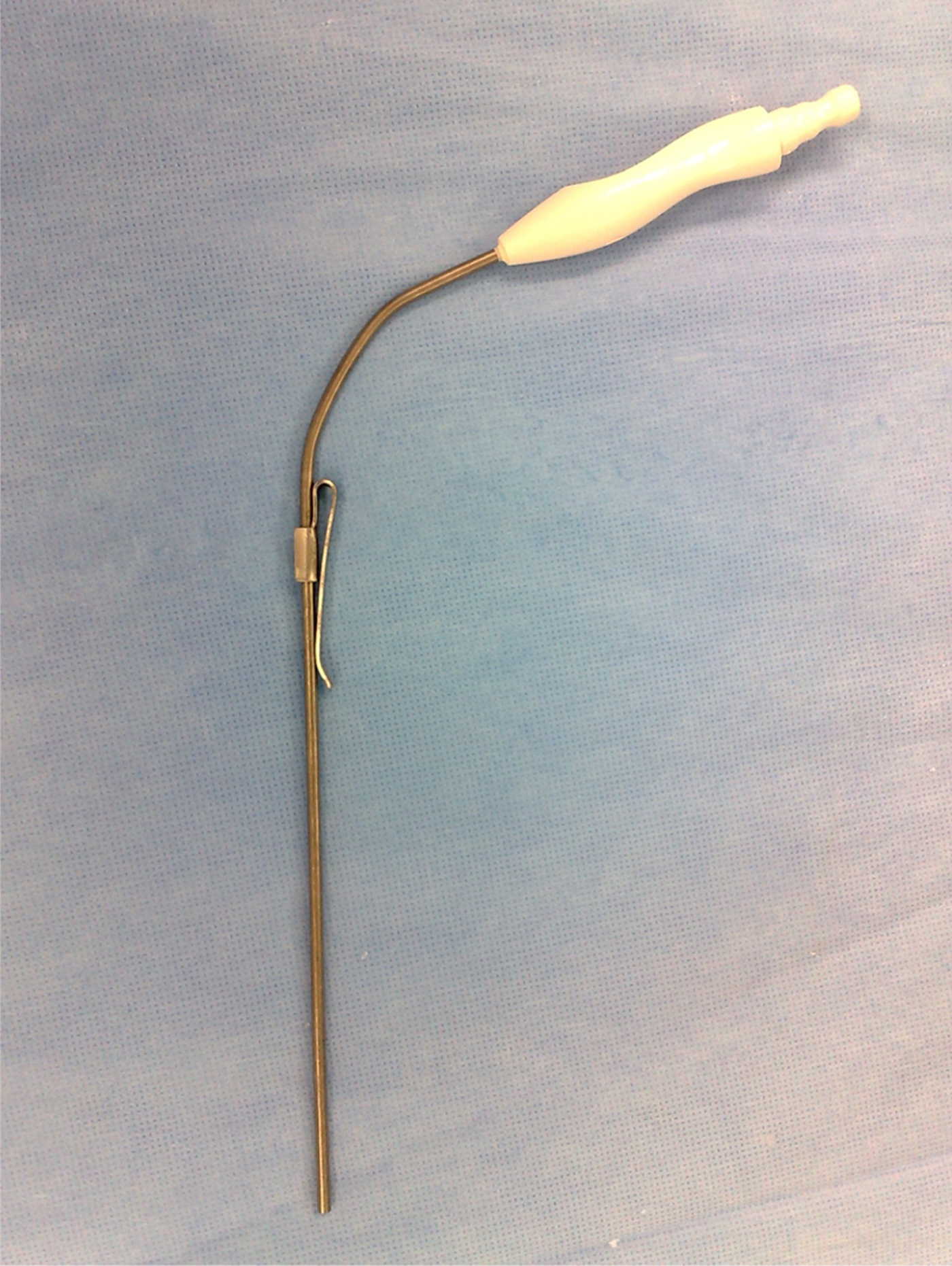
Taking into account all of the above, the senior author devised a suction holder clip that has distinct advantages over other types of suction holders. These clips can hold various sucker sizes as they feature an expandable slit (Figures 1, 2 and 3).
Views of the suction holder clip, with and without a laryngoscope, showing attachment to the sucker.

(a) Aerial and (b) lateral views of the suction holder clip with a laryngoscope, showing attachment to the sucker.

Sucker with suction holder clip attached.

Clip design
The clip is a strip of spring steel bent into the shape of a hair pin with a loop. A slot is present in one of the arms to hold the sucker. The clip is 4.5 cm in length. The inner and outer diameters of the suction holding slot are 3 mm and 5 mm respectively. Spring steel has a high yield strength which allows this clip to hold the laryngoscope and sucker together with grip. Further detail can be seen in the technical diagram (Figure 4).
Technical diagram of the suction holder clip.

With this clip, the placement of the sucker at the proximal end of the laryngoscope and the position of the sucker tip at the distal end are both easily adjustable for optimal suction. The clip easily attaches onto any laryngoscope, without obscuring the visual field (Figure 1d). Furthermore, in the event of any bleeding, this sucker is easily detachable and can then be used for suction.
We routinely use these sucker clips in all endolaryngeal surgery. Overall, we feel that they are simple, easy to use and extremely efficient in the suctioning of fumes.