“Divers and many goldsmiths strangers born which for their false and untrue working have been banished out of the countries where they were born and some have fled thence for fear of punishment and correction . . . have come [into] this city of London . . . and made much false workmanship of gold and silver and the same put to sale to the great deceit hurt and damage of the king's subjects.”Footnote 1 So began the order for governing alien craftsmen written in the London Goldsmiths’ Company's ordinances, approved in 1514. Such complaints were a common feature of institutional rhetoric around immigrants in England. Yet rhetoric and regulations did not necessarily reflect institutional practice nor social and economic realities in the premodern town. By using the example of one particular trade, goldsmithing, I explore how immigrants managed to build and maintain a living in response to changing institutional policies. My article sets out the complex political balance that existed within a guild whose membership both profited from and resented the success of immigrant artisans. Rhetoric as in the ordinance above coexisted with other responses that were more pragmatic but less explicitly articulated. In a trade like that of the goldsmiths, skill and a knowledge of fashion were prized commodities. The movement of craftsmen was of direct benefit to both the customer and local mercantile goldsmiths, who needed to commission wares in the latest fashions from abroad. Through analysis of this highly skilled trade, I argue that the place of immigrant communities in the economy was shaped by both an interaction between immigrants and those who regulated their trade and the flexible manner in which each responded to the practices of the other.
Because this discussion spans the putative late medieval/early modern divide and historians of each period tend to use different terminology for similar phenomena, some definition of terms is required. Aliens were defined for economic and taxation purposes as those born outside the realm— migrants from outside the kingdom of England, including all those from the continent and Scotland and sometimes those born in Ireland.Footnote 2 The term alien referred to their legal status but they were often referred to by contemporaries as strangers—not to be confused with the term foreigner, which could be applied to anyone (English or otherwise) without citizenship of a given town. Immigrant servants worked as both contracted live-in assistants and as journeymen employed by the day. The records of the goldsmiths’ craft in this period make no clear distinction between these states of employment and often conflate the words servant, journeyman, and the older term lowys (sometimes spelled allowes); therefore, I also use the terms interchangeably. Crucially, these are all descriptors of artisans who had already completed an apprenticeship—the group that is my primary focus.
Guilds and Immigration
Guilds were ubiquitous in the towns and cities of medieval and early modern Europe. Their precise form and function varied from place to place, but their responsibilities often included regulating access to trades, setting entrance requirements and overseeing training, and fostering social bonds and mutual support. Although the term guild can be applied to societies of merchants and religious fraternities, which shared some of these aims, in using it I am referring specifically to craft guilds, which were composed mainly (but not wholly) of artisans. In recent decades, the guilds have been a central concern of those who study premodern European urban history, occurring against a background of long-seated antipathy toward their economic impact. Adam Smith and Karl Marx both held guilds in low esteem, Smith because of their suppression of competition and enforcement of long apprenticeships, Marx because of their concentration of power and economic opportunity in the hands of guild-masters.Footnote 3 These attitudes cast a long shadow over the disciplines of both economics and history. Sylvia Thrupp, one of the most important twentieth-century historians of medieval London, was generally positive about the benefits of craft guilds in their early years but nonetheless concluded that over time “snobbery and extravagance made for exclusiveness and deadened enterprise. By this road, the gilds leading the way, medieval urban culture strayed into an economic and social cul-de-sac.”Footnote 4
Since the 1980s, a wave of revisionists has sought to rehabilitate the European guilds as serious drivers of economic and social development.Footnote 5 In a 1998 article, Stephan Epstein argued that their deleterious effects on technological innovation and flexibility in the urban economy had been overstated.Footnote 6 Instead, Epstein argued that the craft guilds made a positive contribution to the economy, especially through the institution of apprenticeship, which ensured transfer of skills, and through provision of a structure for migrating craftsmen to spread innovations in technology and processes between cities.Footnote 7 Historians have also supplemented the enhanced economic reputation of the guilds with a deeper understanding of their social role. Gervase Rosser has highlighted their important role in facilitating collective action and mutual aid, grounded in their religious origins and ideals of amicable fraternity.Footnote 8 The cultural contribution of guilds has also come under scrutiny as a logical extension of the investigation of their roles in nurturing and transmitting technical innovation.Footnote 9 In London, guilds developed into livery companies with an increasing political exclusivity from the fifteenth century and gained a governing class that often did not practice their company's trade.Footnote 10 Nonetheless, they have been credited, since the work of Steve Rappaport, with providing the stabilizing structures that prevented serious disharmony and economic disruption as the sixteenth-century city's population rocketed.Footnote 11
However, guilds have not been wholly accepted as supporting structures in the urban economy. Sheilagh Ogilvie has forcefully countered that guilds were rent-seeking organizations that operated a closed shop to their own monopolistic benefit, in doing so harming the wider economy.Footnote 12 Ogilvie has explicitly challenged Epstein based on her own research into German mercantile guilds, which squeezed out protoindustrial competition and kept the economy of whole regions controlled by the interests of a relatively small number of town-dwelling guild members.Footnote 13 Ogilvie's arguments have been highly controversial and have been challenged, most recently by Maarten Prak as part of his work on guilds’ contribution toward urban citizenship. He argues that while guilds were indeed protective of their members’ interests, they provided an important corrective to imperfect markets and ensured the diffusion of technical knowledge.Footnote 14 Prak counters Ogilvie's arguments, not by denying that guilds had a monopoly but by stressing that they generally accepted outsiders, even those new to a town, thus spreading around the benefits of monopoly.Footnote 15 Prak admits the range of experiences was wide, and so he ranks the guilds of different parts of Europe by how open or closed they were to migrants, characterizing English guilds as largely neutral.Footnote 16
Guilds’ framework of mutual support for immigrants and relative openness to migration are thus central to revisionist arguments in favor of their economic and social value. Contrary to modern popular perceptions, migration over short and long distances was common across medieval and early modern Europe.Footnote 17 A central plank of revisionist interpretations of continental European guilds has been an appreciation of the role the training system known as the wanderjahr played in supporting both migration and skills diffusion.Footnote 18 In this form of service mobility, artisans honed their skills in a city before moving on elsewhere. Scholars working on German-speaking regions have stressed that post-apprenticeship travel, whereby craftsmen gained new skills by moving from city to city before setting up their own workshops, was by the fifteenth century a key element in transmitting knowledge and fostering innovation.Footnote 19 The wanderjahr, or “tramping,” originated in the fourteenth century with the emergence of a new category of workers who had received their training as apprentices but not yet established workshops; often they were described as journeymen because of their pay by the day.Footnote 20 Journeymen in French- and German-speaking regions were highly mobile. In some areas, their movement was so common that it generated formal institutions offering accommodation in cities and meeting places where information about job opportunities could be shared.Footnote 21 Even where such formal arrangements did not exist, the wanderjahr became such a key part of skills acquisition and diffusion that guilds might specifically require those who completed apprenticeships to work elsewhere for a period or, in the late sixteenth century, might integrate it as part of apprenticeship itself.Footnote 22
By contrast, scholarship on England has thus far not uncovered a strong tradition of mobile journeymen. The yeomen and journeymen organizations that grew up in London in the fifteenth century were local and eventually became subsidiaries of the city's livery companies serving a body of post-apprenticeship journeymen and “small” (that is, poorer) masters resident within the city.Footnote 23 Although some who completed apprenticeships elsewhere did travel to London to become journeymen, the city's dominance of England's urban hierarchy meant that no other English-speaking cities could offer comparable levels of economic opportunity. The situation on the continent was radically different: German-speaking artisans traveled extensively, but they did so primarily within the expansive German-speaking region of Central Europe.Footnote 24 A widely spoken language shared across a region with a multitude of large urban centers encouraged artisans without workshops to travel in search of training and economic opportunity. By contrast, English was a little-known language beyond the Anglo-Celtic Isles.Footnote 25
Nonetheless, England was the destination for many European migrants. London was the entry point for many new arrivals, and 6 to10 percent of the city's population were classified as migrant aliens in the fifteenth century.Footnote 26 Thanks to recent research, we now have a much better understanding of the nature of migration to England in the late medieval period. The England's Immigrants project, headed by W. Mark Ormrod, has made a key contribution in providing the first general history of migration to England and its social and economic impact up to 1550.Footnote 27 Immigrants were widely dispersed through late medieval England, so that even most rural dwellers would have come into contact with someone from abroad, and migrants worked in most sectors of the economy.Footnote 28 The middle decades of the sixteenth century stand as something of a watershed owing to the arrival of large numbers of religious refugees fleeing continental wars. These new communities, the largest of them in London, were organized and governed by the so-called stranger churches, which provided important social networks.Footnote 29 In general, it is fair to say that few attempts have been made to draw connections between medieval and early modern migrant communities, and characterizations of London's immigrant population diverge considerably among historians of each period. James Bolton and Judith Bennett argued that immigrants from the continent in the fifteenth century had on the whole a social and economic profile similar to that of their English neighbors.Footnote 30 However, Jacob Selwood showed that most aliens in the early seventeenth century were concentrated in specialized and luxury trades, which he attributed to Elizabethan policy encouraging skilled migration.Footnote 31 Some early modernists, such as Laura Hunt Yungblut,Footnote 32 have assumed that such policies were unprecedented, but in fact they had antecedents as far back as the invitation of Flemish weavers to England in the 1340s.Footnote 33 Studies of migrants in London that purport to cover the whole early modern period have often focused on the period after 1550,Footnote 34 likely because of the greater surviving sources and the lack (until recently) of a general history of late medieval migration. An exception is Ian Archer's 1994 review essay on attitudes to migration spanning 1400 to 1650, in which he noted the significant differences in the attitudes of London companies to migrants and the remarkable success of the civic government in containing tensions in the long term.Footnote 35
Responses to migration in London were, as Ormrod, Mackman, and Lambert argue, shaped by the city's role as “a place where English merchants and producers struggled with international competition.”Footnote 36 Sometimes those struggles resulted in violence, such as the 1517 Evil May Day riots against immigrant craftsmen or the 1493 attack on the Hanseatic merchants’ London base known as the Steelyard.Footnote 37 Such incidents have sometimes been used to make claims of an “important and inherent” xenophobia in English society, recurring across time.Footnote 38 The early sixteenth century was certainly a period when immigrants could be scapegoated for straining London's common resources, with the population growing by as much as 40 percent between 1500 and 1550.Footnote 39 While this rise was not as precipitous as that of the latter half of the century, it was enough for there to be social consequences; the course of Henry VIII's reign (1509–1547) saw a growth of official concern with the mobile poor and increasingly harsh punishment of vagrancy.Footnote 40 Important pieces of national legislation in 1523 and 1529 were aimed at restricting stranger artisans from working. In anticipation of war with France in 1540, an act of Parliament threatened to strip all aliens of their right to work and keep assets in England unless they procured an exemption.Footnote 41 The legislation of the 1520s was, as shall be discussed, the result of explicit lobbying by London companies over immigration, as often occurred in times of economic hardship.Footnote 42
Perhaps surprisingly, given this historical background, immigration and the London companies’ attitudes to it in the early sixteenth century have until recently received relatively little attention from historians, beyond cursory mentions of Evil May Day.Footnote 43 Shannon McSheffrey's research on sanctuary has led her to assess in depth the treatment by London civic government and companies, particularly the Cordwainers’ Company, of alien artisans who exploited urban spaces exempt from guild regulation.Footnote 44 McSheffrey is currently engaged in research that promises to reassess Evil May Day itself.Footnote 45 In these circumstances, as in the development of legislation restricting stranger artisans, the London companies were an outward lobby to both the crown and civic government against the rights of immigrants.Footnote 46 Yet, as Matthew Davies has argued of London's companies, outward rhetoric did not necessarily reflect institutional practice in the governance of their crafts nor social and economic realities.Footnote 47 He has shown that from the late fifteenth century London companies became far more concerned with circumscribing who could participate in trades through changes to their ordinances but that application of the rules could be flexible.Footnote 48
Looking at the circumstances of individual London companies offers a route to understanding the rhetoric/reality paradox referenced by Davies as well as the divergent responses highlighted by Archer.Footnote 49 Both Prak and Jan De Meester, focusing on other European cities, have seen the complex power balance within guilds and their relationship with external authorities as crucial to the manner in which any given guild responded to competition from immigrant labor.Footnote 50 As Selwood and Archer both note, it was often English journeymen and poorer (“small”) masters who were allied in lobbying the mercantile rulers of their own companies against alien competition.Footnote 51 Wholly artisan companies formed the most united lobbies, such as the Coopers, who vociferously advocated restrictions on Dutch craftsmen in their trade in the 1520s and 1530s.Footnote 52 In composite companies with a predominantly artisan membership but a governing class of merchants, such as the Haberdashers, opinions diverged over the benefits of the presence of alien labor; while merchants were happy to buy and sell aliens fashionable wares, artisans feared the competition for work.Footnote 53 Judgments of a guild's openness in sharing the benefits of its monopoly thus need to be closely related to the internal balance of power as well as to immigrants’ position within the governed trade.
The Goldsmiths’ Company, the focus of this article, has been cited as an example of both an open and closed London guild. Lien Bich Luu argues that London was not an attractive city for immigrant goldsmiths and silversmiths. According to Luu, the policy of the London Goldsmiths’ Company, which regulated the trade in London and more widely across England, was hostile: she argues that its policies limited upward social mobility and encouraged migrant journeymen to look elsewhere to establish their own workshops.Footnote 54 Such a view is similar to Hugh Tait's characterization of the company during the reign of Henry VIII, which he describes as having “an unwelcoming and unrelenting attitude toward alien craftsmen.”Footnote 55 Tait based his impression on the treatment of individual virtuoso stranger goldsmiths, in particular Hans van Antwerp.Footnote 56 Luu utilized the work of T. F. Reddaway and Lorna Walker on the early history of the company, which finishes in 1509, as a comparison to her own research on the period after 1550. On the other hand, also relying on Reddaway and Walker's history, both Davies and Archer argue that the Goldsmiths integrated rather than excluded aliens to a greater degree than other companies.Footnote 57 Indeed, Reddaway and Walker suggest a “quiet absorption” of alien goldsmiths into the trade in the fifteenth century.Footnote 58 Despite her skepticism of the company's general treatment of strangers, Luu argues that the wanderjahr was the dominant form of migration bringing alien goldsmiths to London in the sixteenth century.Footnote 59 Given that journeyman mobility has not been noted within other London trades and that the wanderjahr has generally been perceived by revisionists as part of guilds’ openness and support for the diffusion of skills, this claim invites close attention to the Goldsmiths. We thus have something of a paradox: a trade that supported and relied on diffusion of skills but nonetheless, according to Luu and Tait, worked hard to limit strangers’ access to the economy.
Part of the reason for this paradox lay in the particular need of the goldsmiths’ trade for an immigrant workforce in the early sixteenth century. London, while not one of the great centers of Renaissance design and craft skill, was England's main hub for those seeking the latest imported fashions.Footnote 60 The city was well connected to trade routes that ran south, via Antwerp, to Italy, eastward along the North Sea ports to the Baltic, and westward by sea to Brittany, Spain, and Portugal.Footnote 61 During the period under consideration, and particularly during the 1520s, the new artistic styles of the Renaissance began to diffuse to England. When the courtly elite commissioned works of art or architecture, they increasingly patronized immigrants skilled in classically influenced design, including the Italian sculptor Pietro Torrigiano, who worked on royal tombs, and Hans Holbein the younger.Footnote 62 Holbein, himself a migrant from Basel, was a skilled painter of courtly portraits who also worked extensively on designs for fashionable metalwork in the “antique” style (an example is shown in figure 2).Footnote 63 Fashion-conscious consumers from the 1520s onward wanted to adorn their dining tables and buffets with such classically styled plate.Footnote 64 Although printed pattern books were beginning to gain popularity, and plate was sometimes imported, the primary means of knowledge transfer remained the movement of people from one place to another.Footnote 65 Goldsmiths’ wares were essential components of courtly display and power politics, as informed by the doctrine of magnificence.Footnote 66 A concept drawn from the work of Aristotle, magnificence dictated that it was proper or even virtuous for princes to display their wealth by adorning themselves with expensive and well-made things, thus making display part of the projection of a confident political regime.Footnote 67 The movement of individual craftsmen and their incorporation into the London trade's economic and social structure sustained the courtly culture of magnificence and the shift toward Renaissance fashions.
Immigrant Craftsmen and the London Goldsmiths’ Company
Since the early fourteenth century, the wardens of the Goldsmiths’ Company of London had regulated all aspects of the craft in the city with the powers granted them by the king. They performed assays of goldsmiths’ works to determine whether they met the legal standards for purity of silver and gold and from 1478 Stamped pieces deemed fit with the company's mark at the Goldsmiths’ Hall.Footnote 68 Tasked with upholding the standard of precious metal sold, and keen like any guild to defend the interests of its members, the company thus had strong motivations to monitor incoming migrant goldsmiths, especially masters who themselves would act as employers to servants in their workshops. Although grouped together in one guild, the goldsmithing and silversmithing trades encompassed people with a variety of specializations and levels of social and economic status. As well as skilled artisans who made and sold their own wares, there were merchant goldsmiths who traded in the work of others. Prominent goldsmiths might occupy both these categories, carrying out alterations inside their own workshops but also subcontracting work to others and keeping ready-made wares in stock. As shall be seen, the complexity of the trades’ organization provided great opportunity for immigrants to work in a number of capacities, as masters of their own workshops, subcontractors, servants, and, toward the end of the period, “free” journeymen.
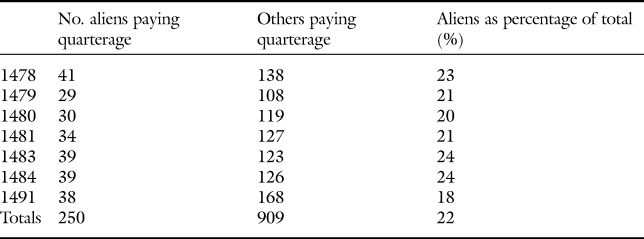
How large was the immigrant goldsmith community in London? In 1529, the wardens of the Goldsmiths’ Company estimated there were 120 English goldsmiths in the city and thirty alien householders (that is, master goldsmiths keeping their own workshops).Footnote 69 This figure probably represented a continuity from the late fifteenth century. For seven years between 1478 and 1491, the company separated its quarterage (membership payment) lists for aliens from English householders. As table 1 indicates, an average of 22 percent of householders per year were recorded as aliens. Thus, about a fifth of master goldsmiths who were known to the company in the late fifteenth and early sixteenth centuries were continental immigrants.
Aliens as a proportion of those paying quarterage, 1478–1491. Data source: Wardens’ Accounts and Court Minutes, Bks. A vol. 2, B, C, D, E and F, Goldsmiths’ Company.

In the late fifteenth century, the Goldsmiths’ Company developed an integrative approach to immigrant master goldsmiths. Previously, it had operated a system of licensing for stranger masters and cumbersome training contracts for alien journeymen, which, as Luu argues, offered little potential for social and economic mobility.Footnote 70 Immigrant servants were compelled to work for an English workshop for five years under this system before they could be employed by an alien.Footnote 71 In 1497–98, the wardens made a series of reforms liberalizing access to the trade and gave an amnesty to immigrant masters already working outside the company. Masters already set up could pay a fine of 26s. 8d. to register their workshops, and requirements for alien servants to work with English masters for five years were abolished.Footnote 72 One key reform, the mass registration of immigrant masters as quasi-guild members, removed what Luu perceives to be the greatest hindrance to stranger goldsmiths: the company's denial of the “assay and touch” to nonmembers.Footnote 73 Assaying and touching constituted the practice of testing and hallmarking silver that allowed it to be legally sold. In effect, access to assay and touch determined master goldsmiths’ ability to sell their own wares directly to a customer. It is evident that after the reforms, registered stranger masters were able to bring goods for touching at the Goldsmiths’ Hall; in 1502, the company recorded several punishments for stranger householders who brought goods to be touched that failed to meet the standard, including twelve silver harnesses presented by John Aleyn (alias John Brabander).Footnote 74 In 1513, an alien goldsmith named Michael Porro brought a chrismatory, made for the Earl of Northumberland, to be touched.Footnote 75 This is an important difference from the period after 1550, when strangers were rarely admitted to the company and were thus denied the means to legally sell their wares (although David Mitchell suggests that Luu is incorrect and that even in the later sixteenth century, strangers could have their works assayed and touched).Footnote 76
The licensing of masters continued through the early sixteenth century and formed the basis for the closer integration of immigrants into the governance of the trade. A new book of ordinances approved in 1514 made it clear that strangers and foreigners could set up shop so long as they presented sufficient sureties to the wardens.Footnote 77 In August 1521, Henry Ketilwode was admitted to the company in return for a payment of 53s. 4d.Footnote 78 Not only had the company come to accommodate stranger masters, but aliens were even involved with the regulation of the trade. In 1497, the wardens appointed a committee of four strangers and four native goldsmiths “to be the spiers and inquirers of all such new alien strangers that cometh now into England and all new English men goldsmiths who come to London.”Footnote 79 Stranger goldsmiths were also granted a constitutional role within the company, as they, alongside the yeomanry, nominated two of the “choosers” responsible for electing new company wardens each year until 1536.Footnote 80 In return for their cooperation with the company, stranger masters were able to enjoy access to arbitration of business disputes with other goldsmiths, English and alien, through the company court, just as other freemen of the company did. For instance, a dispute between Martyn Gerrard (from Heusden, Brabant) and John Harryson over two gold bracelets was arbitrated in June 1537.Footnote 81 This cooperative approach has echoes in the later management of religious refugees in the 1560s, where English local authorities collaborated with a committee of trusted community leaders to deal with crimes and disputes among the strangers.Footnote 82 As with these later migrant communities, integration suited the English governors of the trade as it provided trusted individuals with eyes and ears in the immigrant community who could help uphold trade standards and good order.
Masters were, however, a small section of the immigrant community. Far more numerous were the servants who came to London looking for employment in goldsmiths’ workshops. The wanderjahr process that brought them to London marks the goldsmiths’ trade as far closer to continental modes of migration than most occupations in the city. This system was sustained by the testimonial letters carried by journeymen. Testimonials assured authorities and new masters of the ability and good character of incoming servants; they were particularly necessary in high-skilled crafts where migration was typically far more wide-ranging than for low-skilled or semiskilled work.Footnote 83 Testimonials certified a journeyman's “true workmanship and good demeanor” and were written “under the mayor's, sheriff's, hedborowes, and other head officers’ seals from the city, borough or town that he came from.”Footnote 84 More than vouching for the artisans’ specific skill sets, testimonials asserted their good character and standing in the place from which they had come. The letters were a first step to establishing a good reputation in a new place of residence, an essential component of both trusting social relationships and financial credit.Footnote 85
The firm establishment of the testimonial system among London goldsmiths came as part of the integration of the immigrant community in the early sixteenth century. The company's 1514 ordinances introduced the requirement that all journeymen not trained in London present testimonial letters.Footnote 86 The presentation of testimonials, previously required only for English nonmembers, was apparently quite consistently applied to incoming aliens from 1514.Footnote 87 Beginning in July 1514, the company's court minutes recorded the presentation of testimonials (and any failure to present them).Footnote 88 This new adoption of a practice widespread on the continent but unusual in England reflects how ingrained wanderjahr migration had become in the goldsmiths’ craft. As a result of their mobile post-apprenticeship training, continental goldsmiths gained a more rounded skill set in the craft than their English counterparts, who might practice only the particular specialism of the master to whom they were apprenticed.Footnote 89 Aliens were also in a better position to create work in fashionable styles emerging in cities such as Paris, Antwerp, or Cologne, as they may well have worked there previously.Footnote 90 It is telling that, unlike in continental goldsmiths’ guilds, it proved impossible to compel those completing apprenticeships in the London Company in the later sixteenth century to produce a masterpiece, due to their lack of experience in completing a whole piece.Footnote 91 In the skill of the alien journeymen lay both the potential to enhance the marketability of a master goldsmiths’ products and a competitive edge over English servants seeking employment.
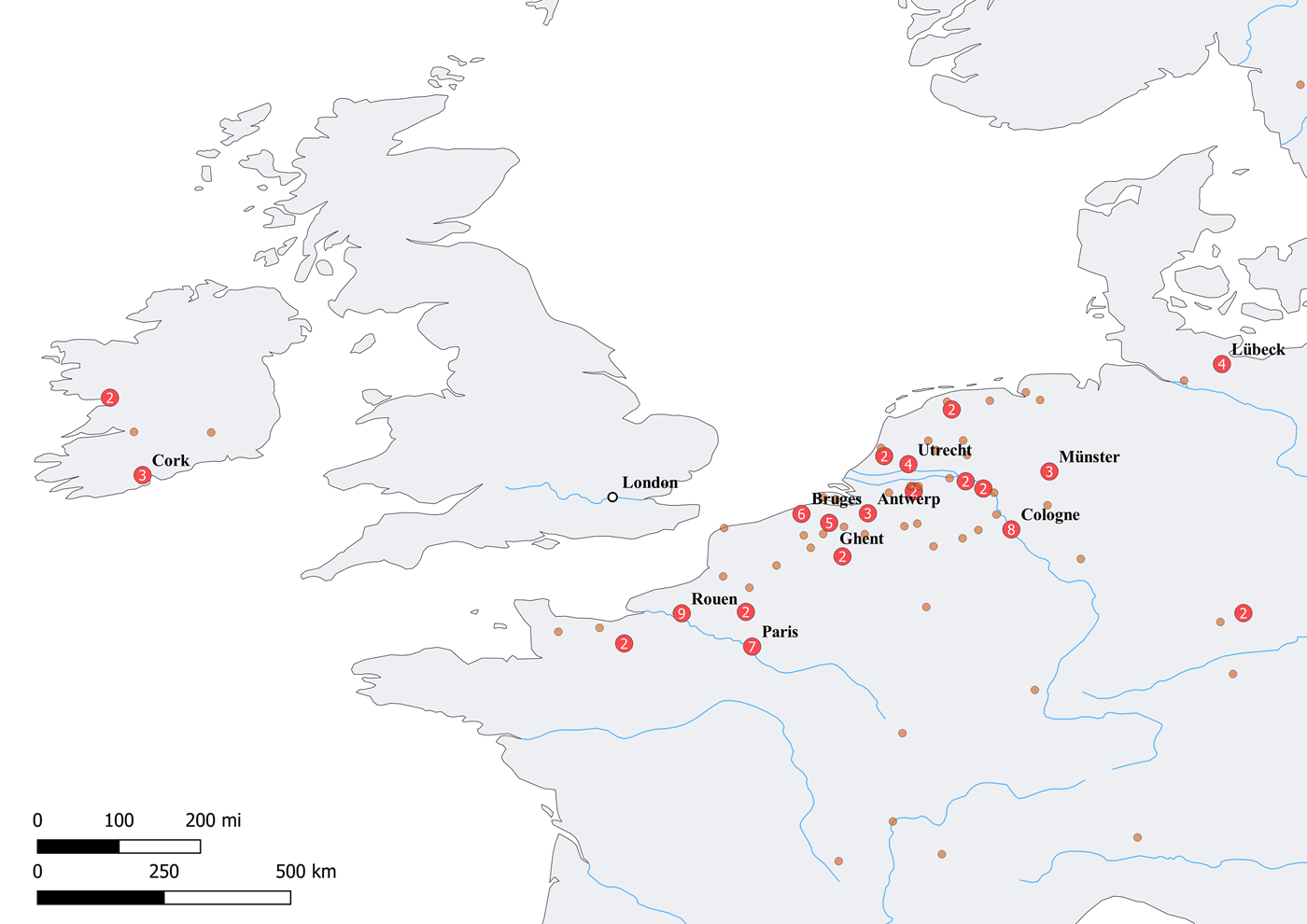
Testimonials indicate that servants arrived in London primarily through the city's best-trafficked trade routes: to northern France, the Low Countries, and Rhineland and eastward toward the Baltic. Figure 1 indicates the reported origins of stranger goldsmiths and journeymen sworn to the London Goldsmiths’ Company from 1488 to 1540. The map shows the 124 alien goldsmiths who were identified with a clear settlement or region (for example, Friesland or Hainault) of origin. It thus excludes those given more vague descriptions of origins, which are frustratingly common in the records: six called “Dutchman,” four from “High Almaign” (Germany beyond the Rhine), and one from “Estlond” (the Baltic east of Gdansk).Footnote 92 The French feature far more prominently among the goldsmiths (26 percent) when compared to London's alien subsidy return of 1483, where they made up 2 percent of recorded strangers in the city.Footnote 93 The proportion of goldsmiths originating in Germany and the Low Countries was high, 65 percent. In general, most goldsmiths had come from a zone along the North Sea coast from Normandy in the west to Friesland in the east and extending a little under one hundred miles inland.
Origins of alien goldsmiths sworn to the London Goldsmiths’ Company, 1488–1540. Data source: Wardens’ Accounts and Court Minutes, Bks. A vol. 2, B, C, D, E and F, Goldsmiths’ Company.

There was little identifiable change over time in the migration field of goldsmiths in this period; any underlying patterns that exist are obfuscated by the lack of recorded origins for most migrants. However, Luu's data for the second half of the sixteenth century indicate great differences in terms of migration field. Luu found that more than a third of testimonial letters presented to the company from 1546 to 1598 came from Antwerp alone, no doubt because of that city's declining fortunes and the mass emigration from that city after the Spanish siege of 1585.Footnote 94 In contrast, in the earlier period considered here, only three goldsmiths presented testimonials from Antwerp and the range of origins was much wider. Paris, Rouen, and Cologne were all far more significant as cities of origin, with between seven and nine migrants apiece. Crises in the Low Countries, such as the Saint Elisabeth's Day floods of 1421 and the banishment of rebels from Flanders in 1349–50, had prompted earlier waves of sudden immigration to England by skilled artisans.Footnote 95 In contrast to migration caused by political and religious turbulence or natural disasters, the widespread origins of goldsmiths reported in the period 1480–1540 are testament to London's place in the wanderjahr network
Those who carried testimonials were servants, expecting junior positions in a workshop, but the records suggest that many of them came with considerable experience in the trade. In 1516, Anthony Jourdan brought a testimonial from the mint master and headboroughs of Middelburg, and Hans Wale carried one from the mint master of Lübeck.Footnote 96 Two years earlier, John Cleve had brought a letter from Adolph van Haesell, goldsmith and mint master to the Duke of Cleve.Footnote 97 These men probably had specialist experience in the minting of coinage and may have found employment in the Tower of London Mint alongside their labor in the city's workshops.Footnote 98 As discussed above, most letters were described as written by the “headboroughs,” échevins, or “borough masters” of a city—magistrates similar in role to the aldermen of London. However, a few recommendations were recorded as coming directly from a goldsmiths’ guild. John Cruell, who was found working at Glastonbury, Somerset, during the company's 1519 “searching” of the goldsmiths there, had a testimonial from the wardens of the goldsmiths of Cologne.Footnote 99 In 1514, two men (John van Hersell and Garard van Sutven) brought a testimonial from the Cologne guild, and Nicholas Plokyng brought one from the wardens of the Bruges goldsmiths.Footnote 100 Two French goldsmiths brought letters under the seal of the French king, signed by public notaries, suggesting they had worked for (or with masters who worked for) the crown.Footnote 101 Such experience no doubt made them highly employable in London, and when restrictions were introduced on the employment of immigrant labor in the 1520s, stranger servants were not simply hounded out of the trade. Instead, the immigrants’ highly desirable skills meant that they were able to be flexible and become “free” journeymen providing services to more than one master.
The integration of both immigrant servants and masters into the company could be achieved in practice only if the wardens and other officers were empowered to enter workshops all over the city in person. For most companies, a major hindrance to integration of aliens was the jurisdictional anomalies known as liberties. Liberties were areas of the city that lay outside the governance of the mayor and companies; inhabitants enjoyed a range of privileges that varied from liberty to liberty and might include freedom from prosecution for debt, felonies, or practicing a craft without membership of the appropriate company.Footnote 102 Scholars have recently begun to consider that liberties and similar spaces, far from being legal curiosities, were important aspects of premodern cities, with the potential to make us reexamine the spatial basis on which urban governance depended.Footnote 103 Liberties were very attractive places for immigrants and ethnic minorities to settle and set up shop. In England, their legal and economic privileges were intertwined with the principle of sanctuary, and most (although not all) were sited in and around the precincts of institutions, such as hospitals, with a religious community attached.Footnote 104 Most London trades considered them a nuisance and threat to their livelihoods. The Goldsmiths’ Company sometimes worried about liberties: in the 1530s, they petitioned Lord Chancellor Thomas Cromwell over alien goldbeaters operating in St. Thomas's Hospital in suburban Southwark.Footnote 105 Such spaces were a thorn in the side of urban authorities because they denied both government and guilds the possibility of total social and economic governance in the city.
However, the Goldsmiths’ Company's relationship with immigrants living in the precinct of the largest London liberty, the College of St. Martin le Grand, was highly unusual. By the late fifteenth century, the precinct was a veritable immigrant enclave housing a large population of Dutch-, German-, and French-speaking craftsmen in an area measuring a little less than two and a half acres.Footnote 106 As McSheffrey has shown, a combined effort by the civic government and Cordwainers’ Company in the 1530s to raid stranger shoemakers’ workshops in the precinct acted as a test case of the city's ability to exercise jurisdiction there.Footnote 107 Despite a royal enquiry in 1535, the crown upheld its support of St. Martin's privileges against the claims of the city and guilds until the dissolution of the college in 1540, even providing specific exemptions for its residents from the 1529 act of Parliament restricting the workshop sizes of stranger craftsmen.Footnote 108
By contrast, the alien goldsmiths of St. Martin's appear to have been incorporated into the Goldsmiths’ Company with relative ease. The company's royal charter of 1505 granted the wardens powers to search throughout England without exception, which would have provided a legal basis for the incorporation of those otherwise outside the reach of the civic administration. The company's previous charter (dated 1478) had included specific exemptions for craftsmen in St. Martin le Grand and the Westminster sanctuary, but the 1505 charter notably excluded these clauses.Footnote 109 However, the Goldsmiths appear to have been able to search workshops here even before 1505. The company's quarterage (that is, membership payment) records first document St. Martin's goldsmiths in 1480–81, two aliens named Bartholomew Nailond and Philip Sprynger.Footnote 110 By 1506–07, no doubt helped by the changed alien registration process of the company, the number had gradually grown to fifteen, where it remained until records end in 1515–16.Footnote 111 These fifteen would have been masters employing multiple servants in their households, creating a significant community of goldsmiths in the precinct. The company's success in integrating sanctuary goldsmiths before 1505 may have been partly a result of geography: the Goldsmiths’ Hall lay on the east side of Foster Lane, opposite the boundary of the liberty of St. Martins to the west.Footnote 112 Perhaps such close proximity, and the high-status nature of many goldsmiths’ customers, made hiding from the wardens impractical.
While records from St. Martin's itself are patchy, they suggest that not many goldsmiths living there remained unknown to the company: of seven goldsmiths identified in a rental of the liberty in 1525–26, six were registered with the company.Footnote 113 The seventh, Robert Austen, lived in a single chamber with a low rent of 4s. 4d. per year, which suggests that perhaps only those operating on the smallest of scales were able to evade detection. Austen may have been an unregistered “free” journeyman hiring out his labor to others without being resident in their household. The quarterage records also show that, by 1515, those living in several other liberties around London were paying quarterage, including Westminster (four), Southwark (five), St. Katharine's Priory (two) and Austin Friars (one).Footnote 114
When compared with the struggles of the Cordwainers and civic government, it is remarkable how apparently successful the Goldsmiths’ conciliatory approach to aliens was in ensuring compliance with its authority even within the liberties. Most important to their success was that the Goldsmiths had legally enforceable rights explicitly valid within liberties. This meant that they could successfully integrate and monitor the immigrant workforce right across a jurisdictionally fragmented London. The motivation for integration also would have come from the fact that the English merchant goldsmiths governing the company relied on a system of subcontracting to smaller-scale workers, many of whom would have lived within liberties. Unlike companies dominated by artisans who resented labor competition and thus adopted a confrontational approach, the Goldsmiths were able to overcome the potential challenge liberties posed to their authority.
In the 1520s and 1530s, the lobbying of artisan London companies including the Cordwainers and Coopers brought about legislative changes to the treatment of immigrants. In 1523, an act of Parliament brought in a limit of two journeymen, or “covenant servants,” to be employed by any stranger master.Footnote 115 In 1529, another act, responding to petitions by London Cordwainers against the “daily increase” of aliens, repeated this provision and forbade any new strangers who had not received a letter of denization from the king from setting up shop.Footnote 116 Denization was a legal status, procured through payment to the crown, which permitted migrants a degree of protection from anti-alien laws and taxes. Aliens were also required by this act to swear an oath of allegiance to the king through the guild masters of any craft they practiced.Footnote 117
In that same year, the yeomen of the Goldsmiths staged a rebellion against the governors of the company, one of their complaints being the wardens’ lenient treatment of aliens.Footnote 118 The rebellion began in 1529 as a protest against the method of election of the company wardens but broadened to include wider complaints about its governance, with the yeomen's and wardens’ petitions heard in the London mayors’ court, the chancery, and star chamber.Footnote 119 Although they failed to gain the support of the city authorities against the wardens, the rebels nonetheless secured an exhortation from the aldermen to the company that they ought “to be set on work and to be preferred always afore any strangers.”Footnote 120 Contained in the rebels’ complaints against their elders, who they claimed were merchants lacking knowledge of the “science” of the craft, was a tension between the artisan and mercantile branches of the trade. Over the preceding thirty years, the leaders of the company had generally followed a pragmatic and conciliatory line that evidently contributed to wider tensions caused by economic disparities within the craft, which were the real focus of the young men's petition.Footnote 121
While the rebellion failed to change most aspects of governance of the company, the wardens did adopt a more repressive line against strangers from 1529 onward. The combined pressures of internal disputes and the new acts of Parliament perhaps made this course of action an attractive means to placate members of the trade excluded from governance without fundamentally changing the balance of power within the company. From 1536, the strangers were no longer noted as taking part in the annual wardens’ election.Footnote 122 In the same year, a general assembly of the craft (which included strangers) agreed to nominate two liverymen to sue strangers who contravened the acts of Parliament, with the company bearing the cost.Footnote 123
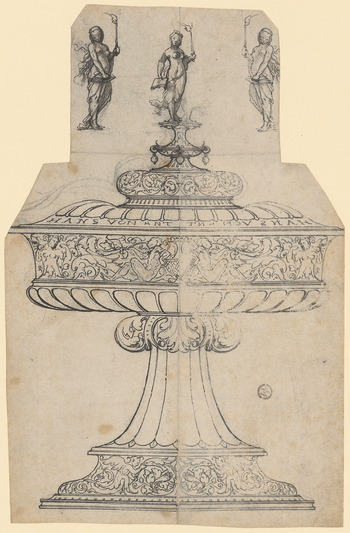
The increasing harshness of attitude in the 1530s was most clearly expressed through pressure applied to individual master goldsmiths. The company frequently demanded high-value bonds from strangers to ensure their compliance with ordinances. In May 1534, bonds of £20 each were demanded of four alien householders to obey the company, and they were ordered to present testimonials for all their servants.Footnote 124 In 1535, stranger Gerard Copilman's workshop was searched and one of his servants imprisoned for “rebellious manners and seditious language.” Copilman was ordered to bring in a bond of twenty marks for his future obedience, a demand later retracted thanks to the intercedence of his friends.Footnote 125 Similar treatment was given to the highest-profile stranger active in London—Hans van Antwerp, a renowned master goldsmith who worked for the king and collaborated with Hans Holbein the younger.Footnote 126 In 1529, the wardens of the company demanded that he and several other alien goldsmiths appear before them and be bound surety for a bond to the sum of £200 for their good behavior.Footnote 127 A few years later, in November 1536, the wardens imprisoned Antwerp for taking stranger servants without receiving license from the company.Footnote 128 He used his connections at court to get out of these difficulties, and six months after his imprisonment, Thomas Cromwell petitioned the Goldsmiths’ Company on Antwerp's behalf to procure his citizenship.Footnote 129 Aliens were technically forbidden from becoming citizens of London without unanimous assent of the city's Common Council—hence Antwerp's need to call on powerful friends.Footnote 130 The virtuoso skill that brought Antwerp such close connections with the court may well be exemplified by one of Hans Holbein's metalwork design drawings for a cup (depicted in figure 2). Inscribed “HANS VON ANT” and elaborately decorated with classical motifs, the design, it has been suggested, may have been drawn by Holbein for his friend Antwerp (who was to serve as witness to Holbein's will in 1543), and the cup may even have been intended for presentation to the company as a sweetener to his request for citizenship.Footnote 131 No evidence from the company's archives corroborates this story, but the design is nonetheless indicative of the high degree of skill and fashion that immigrant workshops could produce for high-status customers. In their crackdown on immigrants in the 1530s, the Goldsmiths’ Company wardens must at least have been aware that they were squeezing the businesses of those who were well placed to meet consumer demand for new Renaissance fashions. It may be that this competition for elite custom, when combined with internal pressures and the acts of Parliament, finally nudged the governing merchant goldsmiths into accession to artisan complaints about immigrants.
Design for a flat silver cup inscribed “HANS VON ANT” (probably referring to immigrant goldsmith Hans van Antwerp, active in London from ca.1511–1545), Hans Holbein the younger, perhaps ca. 1537. Source: Kunstmuseum, Basel, Sammlung Online.

Against this background of shifting policy within the company, strangers were nonetheless able to keep a foothold in the trade. Even as some prominent migrants faced harsh treatment by the Goldsmiths’ wardens in the 1530s, yet others were able to quietly turn the terms of the 1523 and 1529 acts of Parliament to their advantage. Since immigrants with denizen status were exempt from the acts’ restrictions on servant numbers, master goldsmiths with sufficient resources were able to apply for denization to continue work as usual. While denization was expensive and easier for those with powerful connections, highly capitalized master goldsmiths with clients at court would have been in a relatively good position to overcome these challenges.Footnote 132 The company responded in turn by quietly registering those who became denizens for a modest fee; Stephen Mabull, Cornelius Clouser, and John Ter van Hellen paid only 3s. when they presented proof of their denization and were admitted in the late 1530s.Footnote 133 One exceptional success story in terms of navigating the harsher environment of the 1520s and 1530s is Cornelius Hayes. A Hollander who became royal goldsmith in the 1530s, Hayes received letters of denization in 1523.Footnote 134 He subsequently became a freeman of the company and, after some struggle against the lobby of the Goldsmiths, a citizen of London.Footnote 135 Despite the company's initial hostility, Hayes was a rare example of an alien goldsmith who became completely integrated into the company; he was nominated to the livery in 1537 and even held office as renter of the Goldsmiths’ property in 1539.Footnote 136 Hayes was unusual but not alone: Gerard Copilman, whose workshop had been raided in 1535, went on to become a warden of the Goldsmiths’ yeomanry in 1542.Footnote 137 The fact that strangers and even a royal goldsmith could advance as officeholders in the midst of the company's drive against alien craftsmen suggests that the picture remained nuanced.
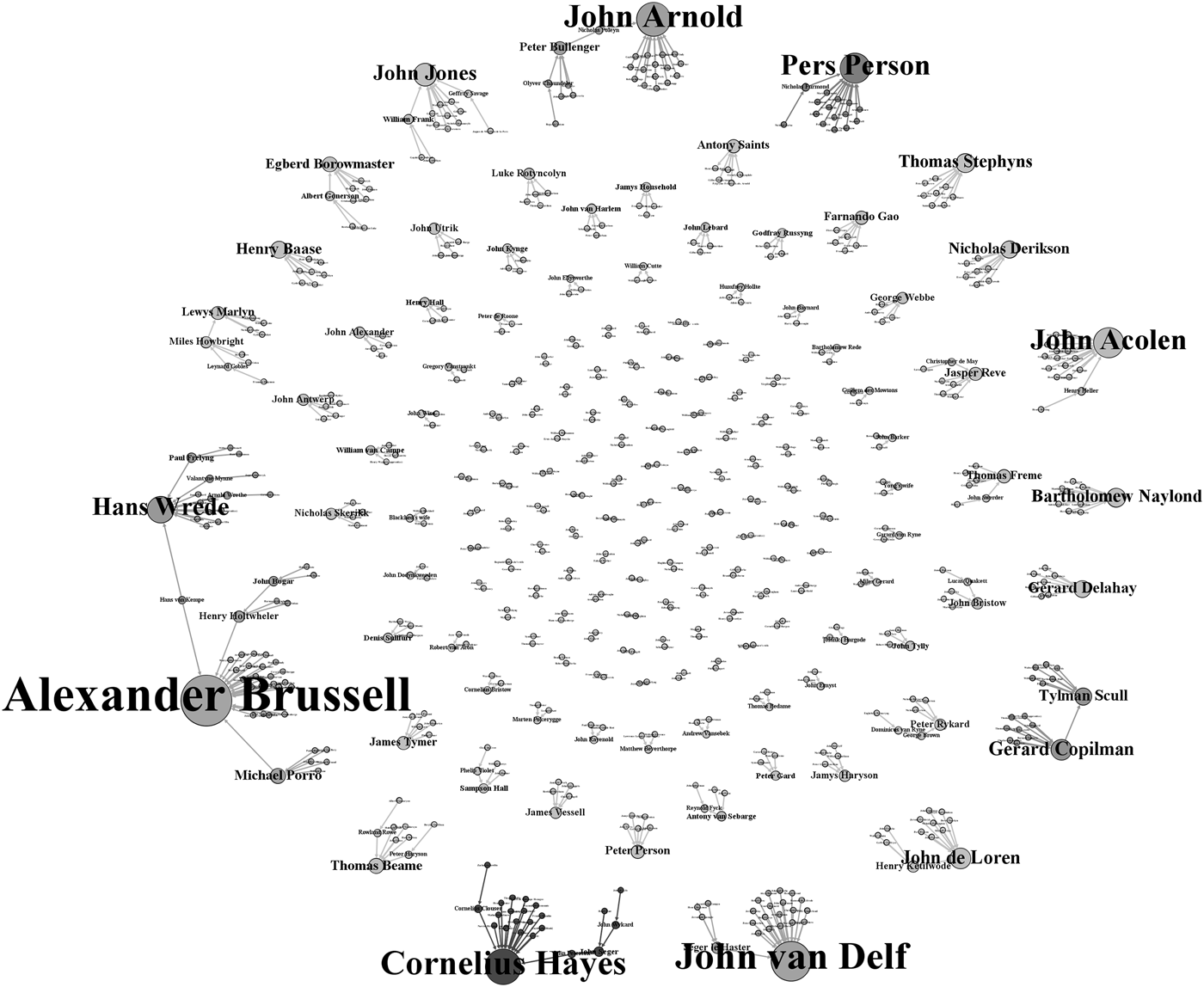
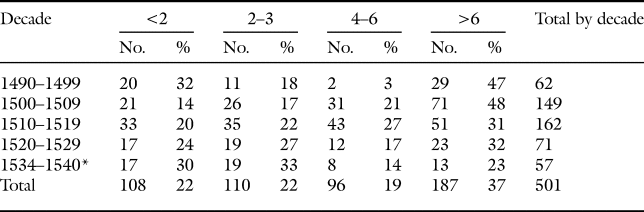
More significantly, however, immigrants responded to shifting regulations by shifting the manner in which they worked and thus their economic organization. The records resulting from their integration allow a unique insight into this process, particularly in terms of the changing workshops joined by those servants who came to the city via the wanderjahr. When journeymen presented testimonials, the Goldsmiths’ court minutes usually noted who they would be working with in London. Using these records, it is possible to address key questions about the structure of the immigrant goldsmith community over time, particularly whether there were connections of service between one “generation” of immigrants and another, and how changing regulations affected immigrants’ workshops. Social network analysis is a very useful tool for answering such questions, as it enables the clear visualization of relationships and invites the quantitative analysis of their characteristics.Footnote 138 Figure 3 and tables 2 and 3 demonstrate the relationships between 503 journeymen who came to London between 1488 and 1540 and the masters with whom they were recorded serving. There were palpable changes in the structure of the alien goldsmith community from the late fifteenth to the mid-sixteenth centuries that require careful teasing out from the data. The majority of servants were not recorded as becoming masters in London, and hence the network diagram does not form a wholly connected network. Furthermore, the majority of masters (59 percent) took only a single servant as recorded in the company minutes and accounts. As table 2 indicates, the proportion of servants joining masters where they were the only recorded servant varied between 14 and 32 percent over time, while the proportion serving with masters who took more than six servants significantly declined from 47 percent in the 1490s to 23 percent in the 1530s.
Network diagram of relationships between registered alien servants and their masters, 1488–1540. Data source: Wardens’ Accounts and Court Minutes, Bks. A vol. 2, B, C, D, E and F, Goldsmiths’ Company.

Numbers and percentages of alien servants serving with masters who took a given total of servants, 1490–1540, by decade. Data source: Wardens’ Accounts and Court Minutes, Bks. A vol. 2, B, C, D, E and F, Goldsmiths’ Company.

*As discussed in the text, there are no data for 1529–1533.
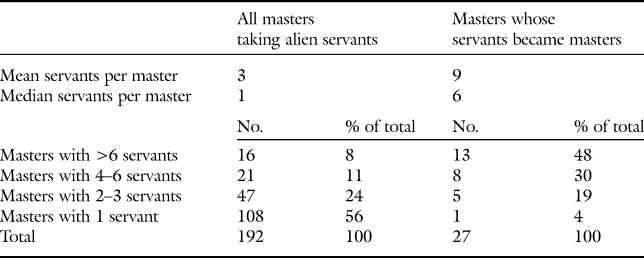
Comparison of numbers of alien servants taken by all masters and by masters whose servants became masters, 1488–1540. Data source: Wardens’ Accounts and Court Minutes, Bks. A vol. 2, B, C, D, E and F, Goldsmiths’ Company.

On the face of it, the data suggest that not only servants but also their masters were transient, passing through London relatively quickly. Historians of both fifteenth-century economic migrants and religious refugees of the later sixteenth century have characterized them as having a “sojourner” mentality, always intending to return home.Footnote 139 Most servants appeared, presented their testimonial (or were assigned a date by which they must present it), swore their oath, and were never mentioned in the Goldsmiths’ Company records again. What happened to them after the recorded act of swearing the oath to the wardens? It is only from exceptional cases that we can extrapolate the more usual experience. Some might serve in several workshops other than the one with which they initially registered. Warren van Booc, born in Gelderland, arrived in England around August 1511 at about the age of seventeen, when he swore his oath and entered the service of Cornelius Bristowe, a goldsmith from ‘s-Hertogenbosch, Brabant.Footnote 140 We would know nothing more of van Booc except that he happened to become a witness in a church court case regarding a neighborhood defamation dispute some years later. In 1515, van Booc appeared at the London consistory court. He was now twenty-one and serving an English goldsmith, Thomas Stephyns.Footnote 141 Nonetheless, despite staying in London for at least four years and serving two masters, van Booc never seems to have set up on his own and, after his initial testimonial, did not feature at all in Goldsmiths’ Company records. He probably headed elsewhere after his service with Stephyns, or he may have died young. Leaving the city after a period of service was the normal operation of wanderjahr migration. In April 1540, the company court minutes recorded that “Hans van Cute, being servant with James Household, is unsworn and is gone over the sea into his own country again.”Footnote 142 The same trade routes that facilitated movement to London made it relatively simple for migrants to return home or move on to another city.
Even so, there is good reason to be cautious about the degree to which the registrations of servants signifies transience. On a basic level, the inconsistent recording of names probably has a significant impact on the impression of how many servants went on to be recorded elsewhere in company records, either as masters to their own servants or in other capacities. This is particularly the case with locative surnames. The William van Coleyn (Cologne) who was sworn to work with John Haynes in 1505 could be any number of Williams who later took their own servants.Footnote 143 Paul Bugdrope was a servant who presented a testimonial in 1515 working for Michael Porro, a goldsmith resident in the precinct of St. Martin le Grand.Footnote 144 While the Goldsmiths’ records do not mention Bugdrope, he was probably the Paul Bugderam, goldsmith, who was murdered in St. Martin's two years later.Footnote 145 Even an established alien goldsmith could have multiple names under which the company would refer to him: the English-sounding John Aleyn, who registered a single alien journeyman in 1501, was in fact a goldsmith known variously as Hans or John Brabander or van Brabant.Footnote 146 The case of John Aleyn also points up a second issue, which is that masters could be very well established without apparently needing to register many or any servants. Aleyn had paid the company 26s. 8d. in 1497 for the right to keep his own household, by which time he had been paying quarterage to the company since 1490.Footnote 147 He continued paying quarterage to the company until 1504, so was in the city for at least fourteen years.Footnote 148
Secondly, the surviving records are undoubtedly only a partial view of alien service migration. Some masters may have evaded registering servants, particularly after the statutory restrictions on non-denizens in 1523 and 1529; this may explain the sharp drop in numbers of registrations in the 1520s and 1530s indicated in table 2. The wording of several runs of servant registrations suggests that, rather than being voluntary presentations, they were undertaken after the company had searched an immigrant's workshop. For instance, in November 1536, the wardens searched the shop of John Reynold, a French goldsmith, and finding Paul Hetchinger working there with no testimonial letter, imprisoned him. The same day, four other alien goldsmiths were imprisoned or subject to examination about their servants and apprentices; the servants (including Hetchinger) appeared in court over the following month to present their testimonials.Footnote 149 We have no way of knowing how effective or comprehensive company searches were in finding alien servants, although, as discussed above, the wardens’ ability to enter workshops in St. Martin le Grand and other liberties would have significantly improved the potential efficacy of searches. Subsequent loss of records probably also accounts for some gaps. There is good reason to believe that in the early 1530s the company was recording servant registrations in some separate document, now lost. Between April 1529 and June 1534, court minutes record no registrations of alien servants. Yet in 1537, when presenting his letters of denization to the company, Cornelius Clouser stated that he had been sworn as a free journeyer in 1530 while a servant with John a Colen.Footnote 150
Nonetheless, even allowing for problems in tracing individuals through the records, it seems that most journeymen visiting London were present for only a few years before moving on. This was, after all, the rationale for wanderjahr migration among journeymen who actively sought employment in many places in order to improve their skills. Evasion of the company's regulation was no doubt a reality but, as discussed, the wardens often followed a conciliatory policy that encouraged aliens to remain visible and integrated into its structures, backed up with the legal force of its power to search workshops in liberties. As a result, it seems it was difficult to keep a stranger workshop of any great size away from the company's attention. Even a man like Hans van Antwerp, as reluctant as he was to engage with its regulation, might find himself complying with and even joining the company, presumably in the hope of a quiet life.
Some who came to London as servants evidently settled in the city. However, what marked out those who became householders was that they tended to have started work with masters who registered very large numbers of journeymen. Those registered working with masters such as Alexander Brussell, Hans Wrede, or John de Loren, who took more than six alien servants, were far more likely to go on to establish their own workshops, in turn taking in multiple servants. For instance, Henry Holtwheeler was registered in 1500 as a servant working with Alexander Brussell, a prominent engraver working at the Tower Mint and a specialist in portrait coins, who registered twenty-four others in his service.Footnote 151 Holtwheeler went on to register three of his own servants from 1511 to 1518.Footnote 152 One of them, John Bogar, registered two of his servants in 1521.Footnote 153 This pattern is represented visually in figure 3, which plots the relationships between masters and the servants they registered. The large number of pairs in the center of the graph depict lone master-servant relationships—that is, where a master seems to have registered only a single servant. Around the edges are the groups formed by masters who registered greater numbers of servants. These groups tended to be more complex, since journeymen here were more likely to settle and become masters in London. This was the case with Brussell, Holtwheeler, and Bogar, three generations of men who served in large workshops. On the whole, masters registered a mean of 2.6 servants and a median of one servant. However, masters whose servants went on to settle successfully as masters themselves had a mean of nine servants and a median of six. Successful settlement in London was thus in large part determined by the size and stability of the workshop a journeyman initially joined.
This remarkable difference has important implications for how the shape of the community shifted over time. As table 2 indicates, by the 1530s, alien servants were half as likely to join masters with more than six servants as they had been in the 1490s. Despite gaps in the records from the early 1530s, the overall numbers of servants recorded in those decades are similar (sixty-two in the 1490s and fifty-seven in the 1530s), and so a meaningful comparison can be made. Therefore, servants arriving in the 1530s would likely have had less opportunity to progress to householder status in London. The statutory restrictions on aliens without denizen status taking more than two servants at one time almost certainly played a part in this decline. As discussed, denization was expensive and probably dissuaded all but the most determined to stay. Moreover, by the later 1530s, servants seem to have become more likely to register as “free journeyers” able to work with any householder. This strategy was probably a means of circumventing the restrictions on numbers of servants within a household. In the Elizabethan period, Luu found, strangers’ ability to advance in London was limited due to increasing restrictions on their workshops, the refusal of the company to admit alien goldsmiths as householders, and their lack of the elite contacts enjoyed by English goldsmiths.Footnote 154 By contrast, in the early sixteenth century, alien servants who came to London and wished to advance could do so provided they positioned themselves in the right kind of workshop. This situation began to change in the 1520s, but aliens were able to respond with some flexibility by shifting working arrangements, owing to the more cooperative nature of the company.
Indeed, in contrast to the lack of elite connections that Luu identified among Elizabethan strangers, what characterized many of the aliens most prolific in registering servants before 1540 is that they had prominent positions working for the crown. Alexander Brussell, John van Delf, Cornelius Hayes, John Arnold, and Henry Baase all worked on commissions from Henry VII or Henry VIII, and all kept more than six servants.Footnote 155 Others would have been working via subcontracting on royal commissions given to other goldsmiths. There were exceptions, and some very prominent stranger goldsmiths working for the crown registered fewer servants: for example, John van Utrecht (four, or five if a servant registered with his widow is included) and Hans van Antwerp (five). It seems likely that the contacts that prominent stranger masters developed with elite clients was an important factor in helping those of their journeymen who wished to stay and establish their own London workshop. Some may even have taken over existing businesses. John van Utrecht, for instance, was admitted to the company as a householder in 1504 with a note that “he wedded John Lebard's wife,” and he duly began registering his own servants that year.Footnote 156 Shortly thereafter, Utrecht was supplying Henry VII with gemstones and plate just as Lebard had done.Footnote 157 While Utrecht does not appear to have been registered as Lebard's servant, the example is suggestive of how attachment to well-established workshops could enable settlement. It also suggests the elusive role that immigrant women may have played in the trade, particularly by heading workshops in their widowhood and retaining capital in the alien community through careful remarriage.Footnote 158
What relationship did the immigrant workforce have with the native goldsmith community? English masters who took on immigrant journeymen tended to employ only one individual. Thomas Trappes and Fabian Wethers were prominent English members of the Goldsmiths’ Company who took on one or two alien servants; both worked for the crown, and perhaps for them employing a stranger servant allowed them to bring fashionable new techniques into their workshops.Footnote 159 Nonetheless, the scant evidence for their direct employment of alien journeymen tends to suggest that this method of skill diffusion must have been quite limited. Reddaway and Walker noted that, between 1479 and 1510, almost all of those employing stranger servants were aliens themselves.Footnote 160 The same pattern holds true over the expanded period considered here, although Thomas Stephyns was a notable exception. He registered eight alien journeymen between 1505 and 1539 and, as discussed above, employed at least one other, Warun van Booc, who had initially registered as a servant for another master.Footnote 161 Stephyns may have been something of a specialist among English goldsmiths, utilizing the city's pool of immigrant labor in his own workshop apparently far more than his contemporaries. In general, if English goldsmiths registered an alien servant, it was only one. This is a considerable contrast to the Elizabethan period, when alien servants were far more evenly distributed between English and stranger masters.Footnote 162 The shift toward service with smaller households in the 1530s, combined with the restrictions on servant numbers encouraged by the statutes of the 1520s, may have begun the decline in service in stranger households and encouraged journeymen to look elsewhere for positions.
Instead, in this period, the highest-status English goldsmiths were often merchants dealing in goods made by others; they would subcontract to talented immigrants when they required particularly fashionable work. Such an arrangement certainly existed between Cornelius Hayes and Robert Amadas, goldsmith to both the king and Cardinal Wolsey. Hayes's struggle to gain citizenship in London and his eventual success within the company have already been discussed. Amadas's accounts reveal extensive subcontracting of work for the king, cardinal, and other courtiers, with £2,000 worth of plate delivered by Hayes on Amadas's behalf between March 1528 and May 1529.Footnote 163 While Amadas never registered an alien journeyman in his service, Hayes took on eleven between 1515 and 1529;Footnote 164 through subcontracting with Hayes, Amadas had access to a workshop with wide continental expertise. After Amadas's death in 1532, Hayes developed a direct relationship with the crown and became one of the principal court suppliers in his own right.Footnote 165 Subcontracting was certainly an established part of the trade in this period, especially for large orders such as courtly New Year's gifts.Footnote 166 In 1537, royal goldsmith Morgan Wolf pressured his subcontractor John Gardyner to make a piece in time for New Year's celebrations, causing Gardyner to avoid bringing the piece for assay and attracting the ire of the wardens.Footnote 167 While the scale of Amadas and Hayes's business was extraordinary, the myriad of individuals who appeared just once as alien masters employing journeymen in the records likely represented a pool of small-time craftsmen available to take on subcontracts from English workshops. This method of working probably provided one of the key motivations for the integrative policy of the powerful merchant goldsmiths toward aliens, since their own business was reliant on immigrant subcontracting.
As a result of subcontracting in the trade, the line between “householders” and “journeymen” sometimes became blurred. Those registering as journeymen paid a far lower fee (2s. 6d., raised to 3s. in the 1530s) than aliens paying to be “admitted to house” (26s. 8d.) by the company up until 1514. After 1514, as we have seen, strangers were able to keep their own shop provided they presented sureties to the wardens. After 1529, only those with denizen status were allowed by statute to keep a shop. However, some sought to circumvent these restrictions. Luke Rotencolen paid the fee to keep his own household in 1504 but was nonetheless described as “with Barthelmew Nailond.”Footnote 168 Martin Gerard, a Hollander, was called before the company wardens in 1535 for having set up his own house while he was a servant for Henry Acastell.Footnote 169 These goldsmiths may have been working primarily for single masters but not resident with them and perhaps were free to take on work from others. The emerging use of the term free journeyer in the records in the 1530s appears to acknowledge this status. For instance, in 1536, Arnold Kotkyn, Dutchman, who was presently a servant with Henry Baase, appeared before the wardens and was “admitted free journeyer and servant allowes to work with all men being householders and sworn and paid and brought in his testimonial.”Footnote 170 Several other men sworn in the latter part of the period were described as “free journeyers” or “journeyers” without a named master; these included Barnaby Phanam from Ireland and Edmund Chamber, who, though an Englishman, had completed his apprenticeship with a goldsmith of Newcastle “in the north country.”Footnote 171 In May 1539, John Dermarsshe and William Garlettes, Dutchmen, were admitted, but rather than recording their master, the minutes noted that John Ellysworthe paid the two men's fees.Footnote 172 It can be inferred that the pair were working for Ellysworthe at the time but perhaps not resident within his household. The wording of Kotkyn's admission, and the increasing use of the term journeyer or free journeyer, indicate that the position of the servant working for multiple masters was an established one by the end of the period. The position was even granted a level of privilege in 1542 when the company reestablished its yeomanry organization for men outside the livery. Free journeyers, along with freemen and denizens, were able to join the yeomanry at half the quarterage costs of non-denizen aliens. In return, they gained benefits such as payment of funeral costs for those dying in poverty and the ability to receive loans of up to £10 from the common box.Footnote 173 What Luu depicts as a lower-status stranger goldsmith community in the later sixteenth and seventeenth centuries, their activities highly restricted by the company, thus originated during the 1520s and 1530s. However, change was by no means all in one direction, as the inclusion of the free journeyers within the yeomanry in 1542 indicates.
Conclusion
The structure of London's alien goldsmith community changed between the late fifteenth and mid-sixteenth centuries from one centered on large workshops headed by successful craftsmen toward a less integrated group with a greater reliance on journeymen outside of a master craftsman's household. This change was connected to shifting regulations, originating both in the attitudes of the London Goldsmiths’ Company and in national statutes. Journeymen in the 1530s were less likely to serve in the kind of well-established workshops that had assisted their forbears in settling in London. The increasing requirement for denization would undoubtedly have also introduced a further barrier to staying for those without the resources to procure it. This requirement was only to intensify after 1540, when sweeping legislation threatened the forced removal from England of all aliens without denization.Footnote 174
Nonetheless, this study has shown that the fraught issue of immigrant labor provoked a complex and flexible response from the wardens of the Goldsmiths’ Company, even as the groundwork was laid for the more hostile environment of the Elizabethan period. The company harshly disciplined high-profile goldsmiths evading its regulation. However, it could carry out its regulation of the trade only by keeping the alien community within its sights, and so a system of registration and monitoring held sway for most of the period considered here. This system was underwritten by the company's unusually comprehensive jurisdiction: the ability to regulate goldsmiths living in liberties gave the company an advantage over other London trades in stamping out evasion. Matching this legal stick, from the immigrant perspective, was the carrot of a formalized path to acceptance in the trade with its concomitant benefits, at least until the 1520s. This analysis shows the importance of moving beyond the letter of company ordinances and national legislation, indicating that immigrant communities adapted their working practices to maintain a position in their trade.
To ask whether guilds were “open” or “hostile” to newcomers is, then, too simplistic a question. As Maarten Prak and Jan De Meester have pointed out, the response to outsiders was highly contingent on negotiations between competing interest groups in and around the guilds.Footnote 175 Moreover, what this study of the goldsmiths and particularly of the role of servants in the trade suggests is that, even as regulations were notionally tightened, new modes of participation might open up or be developed by migrants themselves. The ways in which a trade absorbed immigrants and the structure of occupational communities could be the results of decades-long developments. This research has also shown the fruitfulness of studying the period of transition between “medieval” and “early modern” forms of migration and trade regulation. Strategies such as cooperation with trusted migrants to monitor the community, prominent in the reaction to religious refugees in the late sixteenth century,Footnote 176 had antecedents in earlier forms of economic management. The early sixteenth century was a period when London's companies and government began to grapple with an expanding population. Both companies and migrant communities could demonstrate flexibility and pragmatism in response to one another's practices.