INTRODUCTION
Benign Theileria parasites are tick-transmitted protozoa belonging to the phylum Apicomplexa (Mehlhorn and Schein, Reference Mehlhorn and Schein1984), which cause acute anaemia and icterus in cattle worldwide. These organisms have been designated differently according to geographical origin, described as T. sergenti in Japan, T. buffeli in Australia, and T. orientalis in Europe and elsewhere (Fujisaki et al. Reference Fujisaki, Kawazu and Kamio1994). Uilenberg et al. (Reference Uilenberg, Perié, Spanjer and Franssen1985), based on serological and morphological data, concluded that all of these Theileria parasites are the same species and proposed the name T. orientalis for the group, while Gubbels et al. (Reference Gubbels, Hong, van der Weide, Qi, Nijman, Guangyuan and Jongejan2000), on the basis of major piroplasm surface protein (MPSP) and 18S rDNA sequences, suggested T. buffeli as the appropriate name for the parasites. On the other hand, Fujisaki et al. (Reference Fujisaki, Kawazu and Kamio1994) divided the parasites into 2 taxa, T. sergenti and T. orientalis/T. buffeli, derived from biochemical and serological examinations and transmission experiments. Additionally, some workers such as Kakuda et al. (Reference Kakuda, Shiki, Kubota, Sugimoto, Brown, Kosum, Nopporn and Onuma1998) and Kim et al. (Reference Kim, Tsuji, Kubota, Wei, Lee, Ishihara and Onuma1998) designated these parasites as the T. sergenti/T. buffeli/T. orientalis group in their studies on the basis of MPSP or 18S rDNA sequences.
MPSP is expressed in the intraerythrocytic stage of Theileria species (Shiels et al. Reference Shiels, d'Oliveira, McKellar, Ben-Miled, Kawazu and Hide1995). This molecule is a glycoprotein with molecular weights ranging from 32 to 34 kDa (Matsuba et al. Reference Matsuba, Sugimoto, Hattori, Sako, Fujisaki and Onuma1995) and plays an important role in the host immune response and neutralizing the infectivity of the piroplasm. Recently, the gene encoding the MPSP has been considered as a highly useful marker in revealing the phylogeny of Theileria parasites (Kim et al. Reference Kim, Tsuji, Kubota, Wei, Lee, Ishihara and Onuma1998, Reference Kim, Yokoyama, Kumar, Inoue, Yamaguchi, Sentoku, Fujisaki and Sugimoto2004; Kawazu et al. Reference Kawazu, Kamio, Kakuda, Terada, Sugimoto and Fujisaki1999; Gubbels et al. Reference Gubbels, Hong, van der Weide, Qi, Nijman, Guangyuan and Jongejan2000; Zakimi et al. Reference Zakimi, Kim, Oshiro, Hayashida, Fujisaki and Sugimoto2006), as well as for diagnostic purposes (Jeong et al. Reference Jeong, Kweon, Kang and Paik2003, Reference Jeong, Kweon, Kim, Jang and Paik2005).
Despite the publication of many comparative studies (Uilenberg et al. Reference Uilenberg, Perié, Spanjer and Franssen1985; Irvin, Reference Irvin1987; Fujisaki et al. Reference Fujisaki, Kawazu and Kamio1994; Bai et al. Reference Bai, Liu and Hen1997) based on biological features such as aberrant piroplasm morphology, occurrence of macroschizonts, and tick vector specificity, the taxonomy of benign Theileria parasites remains confusing. The confusion is largely the result of the unreliability of distinguishing these organisms using these biological criteria. To address this problem, several molecular studies have been performed using MPSP gene sequences (Kim et al. Reference Kim, Tsuji, Kubota, Wei, Lee, Ishihara and Onuma1998, Reference Kim, Yokoyama, Kumar, Inoue, Yamaguchi, Sentoku, Fujisaki and Sugimoto2004; Kawazu et al. Reference Kawazu, Kamio, Kakuda, Terada, Sugimoto and Fujisaki1999; Gubbels et al. Reference Gubbels, Hong, van der Weide, Qi, Nijman, Guangyuan and Jongejan2000; Zakimi et al. Reference Zakimi, Kim, Oshiro, Hayashida, Fujisaki and Sugimoto2006). Kim et al. (Reference Kim, Tsuji, Kubota, Wei, Lee, Ishihara and Onuma1998) classified the 26 benign Theileria organisms into 6 types (Types 1–6) using amino acid sequence analysis of the MPSP gene. Their analysis indicated that 5 of 6 types were closely related and very weakly supported a sister-group relationship between Type 3 and Type 5 within the benign Theileria group. Unfortunately, only 6 parasites representing each type were used in their phylogenetic analysis. Recently, we (Kim et al. Reference Kim, Yokoyama, Kumar, Inoue, Yamaguchi, Sentoku, Fujisaki and Sugimoto2004) investigated the epidemiology of benign Theileria parasites of cattle in Japan based on 14 partial MPSP amino acid sequences. We identified an additional type, Type 7, and all the organisms examined were divided into 7 types. We also suggested 2 sister-group relationships: one was Type 2+Type 7 and the other was Type 3+Type 5. However, bootstrap values, representing the robustness of each node in the phylogenetic trees, could not be presented. Subsequently, Zakimi et al. (Reference Zakimi, Kim, Oshiro, Hayashida, Fujisaki and Sugimoto2006) reviewed earlier studies and examined the phylogeny of benign Theileria parasites with an emphasis on the Okinawa prefecture parasites using 23 partial MPSP nucleotide (nt) sequences. Their phylogenetic analysis revealed 2 sister-group relationships within the Theileria parasites; one was Type 2+Type 7 and the other was Type 3+Type 4, which were also not supported by bootstrap analysis. Therefore, more representatives and more extensive sequence information are needed to access benign theilerial phylogeny accurately.
To further investigate the phylogeny of benign Theileria parasites, we determined the complete MPSP gene sequences of 6 organisms and then analysed them along with published sequences for 39 parasites. We addressed the following specific questions. (1) What are the features of the MPSP gene sequences of benign Theileria parasites? (2) How many taxonomic divisions exist within the parasite group? (3) What are the phylogenetic relationships among the benign Theileria parasites? (4) Are there geographical influences on the spreading of these organisms?
MATERIALS AND METHODS
Field samples and DNA preparation
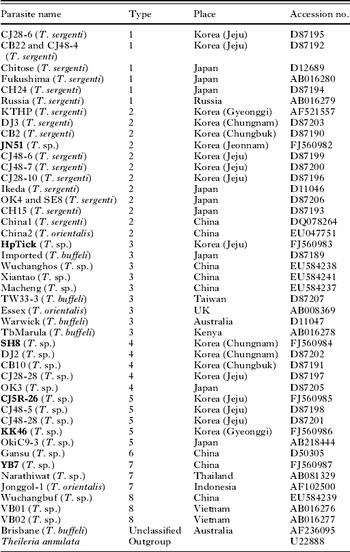
Six Theileria parasites were collected from South Korea and Yanbian China (Table 1). Of these, 5 were from infected bovine blood samples, and the remaining one (HpTick) was from a tick collected with a cotton flannel from pastures on Jeju Island. Immediately after sample collection, ticks were dipped in liquid nitrogen and blood samples were prepared to detect haemoparasites by microscopic examination of Giemsa-stained blood samples. Genomic DNA was extracted using the SepaGene Kit (Sanko Junyaku), according to the manufacturer's instructions. Purified DNA was then used as a template for polymerase chain reaction (PCR) amplification.
Theileria parasites used in this study
(Sequences reported in this paper are marked by bold type.)

Amplification of MPSP gene and sequencing
The primers used for amplification of parasite DNA were 5′-CACGCTATGTTGTCCAAGAG-3′ (Ts-U) and 5′-TGTGAGACTCAATGCGCCTA-3′ (Ts-R) (Tanaka et al. Reference Tanaka, Onoe, Matsuba, Katayama, Yamanaka, Yonemichi, Hiramatsu, Baek, Sugimoto and Onuma1993). Thirty cycles of PCR were carried out using a Thermo Cycler (Perkin Elmer Co.) with the following conditions: denaturation at 93°C for 40 s; annealing at 55°C for 30 s; and extension at 72°C for 1 min. The PCR products of the expected sizes (about 850 bp) were confirmed by electrophoresis on a 1% agarose gel, visualized under UV light, and then ligated into the pGEM T vector (Promega, USA). The amplicons were sequenced in both the forward and reverse orientations on an ABI 377 automated sequencer (Applied Biosystems, USA) using the corresponding MPSP PCR primers. Table 1 lists the parasites used in the study and their GenBank Accession numbers.
Phylogenetic analyses
The complete MPSP nucleotide sequences of benign Theileria parasites were initially aligned using the CLUSTAL X alignment program (Thompson et al. Reference Thompson, Gibson, Plewniak, Jeanmougin and Higgins1997), and then adjusted manually where necessary. Regions of uncertain alignment were eliminated from the final analyses, and alignment gaps were treated as missing data. Accordingly, analyses were limited to reliably aligned regions comprising a total of 819 nucleotide positions. The translation of nucleotide sequences and calculation of both nucleotide and amino acid sequence homologies were conducted using BIOEDIT 7.053 (Hall, Reference Hall1999). The complete dataset is freely available from the author upon request.
Phylogenetic reconstructions were performed using 2 different analytical methods, Bayesian inferences (BI) and maximum parsimony (MP). The BI was executed in MrBayes 3.1 (Huelsenbeck and Ronquist, Reference Huelsenbeck and Ronquist2001; Ronquist and Huelsenbeck, Reference Ronquist and Huelsenbeck2003) under the best fit model, TrN+G, as selected using hLRTs in the MrModel Test 3.7 (Posada and Crandall, Reference Posada and Crandall1998). We set the parameters of nst=6 and rates=gamma as the likelihood settings. The Monte Carlo Markov Chains (MCMC) were stimulated for 2 000 000 generations and sampled every 100 generations: 4 chains were run and 20 000 initial trees were discarded (burn in). Bayesian posterior probabilities were estimated based on the 50% majority rule consensus of the trees.
The MP analyses were also conducted using PAUP 4.0b10 (Swofford, Reference Swofford2003) with the closest stepwise addition options. The analyses employed a heuristic search using TBR branch swapping with random addition. Branch length was optimized according to the ACCTRAN option. The robustness of the phylogenetic analysis was determined by bootstrap analysis (Felsenstein, Reference Felsenstein1985) with 1000 replications. For all analyses, Theileria annulata was specified as the outgroup. Graphic output was produced using TreeView 1.6.1 (Page, Reference Page1996).
RESULTS
The first report of MPSP sequence of benign theilerial parasite from tick
We determined the first complete MPSP gene sequence of a Theileria parasite (HpTick) from tick species (Haemaphysalis punctata) as well as 5 additional corresponding sequences from cattle (Accession nos., FJ560982–FJ560987). Of the 80 ticks examined, the Theileria parasite was detected from 1 sample by PCR amplification. Compared with the various 44 complete MPSP sequences of the Theileria parasites, nucleotide and amino acid sequence identities of the theilerial MPSP sequences from the tick ranged from 72·7% (Gansu, included in Type 6) to 98·7% (Macheng, included in Type 3) and from 91·0% (Gansu) to 100% (Macheng), respectively. Phylogenetic analyses, based on MPSP gene sequences, revealed that the Theileria parasite from tick was a member of Type 3.
Sequence analyses
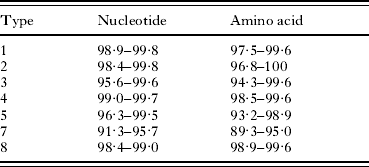
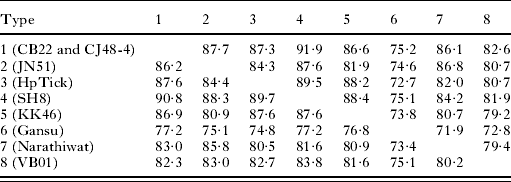
All of the benign theilerial MPSP sequences were the same length (852 nts), with the exception of only 4 parasites, Gansu, Wuchangbuf, VB01, and VB01. Gansu contained 873 nts and the remaining 3 parasites had 855 nts, respectively. Thus, the deduced amino acid sequences were 284 residues in length, except for the 4 parasites noted above; Gansu was 291 residues, and the remaining 3 were 285 residues each. Pairwise comparisons showed that the identities among the 45 theilerial MPSP sequences ranged from 70·9 to 99·8% for the nucleotide sequences and from 71·0 to 100% for the amino acid sequences. On the basis of phylogenetic analyses, the 45 MPSP sequences of theilerial parasites, excluding only 1 parasite (Brisbane), were classified into one of 8 types. While sequence homologies within a type were more than 91·3% for nucleotides and 89·3% for amino acids (Table 2), those among 8 different types were from 71·9 to 91·9% for the nucleotide sequences and from 73·4 to 90·8% for the amino acid sequences (Table 3).
Nucleotide (left) and amino acid (right) sequence homologies (%) within each MPSP type of Theileria parasites
(Type 6 is not included in this table because there is only a single sequence available.)

Nucleotide (above) and amino acid (below) sequence homologies (%) among the 8 different MPSP types of Theileria parasites
(Parasites in parentheses are representatives of each type.)

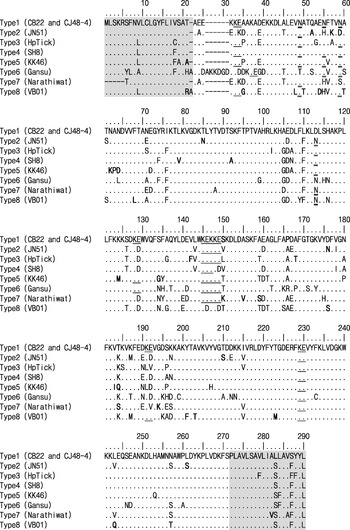
Multiple alignment of the deduced amino acid sequences is presented in Fig. 1, in which only representatives of the 8 types are shown for simplification. As the figure demonstrates, each of the types is characterized by the presence of several type-specific amino acid sequences (bold type): 4 for Type 1; 7 for Type 2; 4 for Type 3; 2 for Type 4; 8 for Type 5; 7 for Type 7; and 14 for Type 8. The amino acid sequences of approximately one-third of the sites from the C-terminus are conserved, whereas the sequences at sites 52–66 and 159–199 are more variable than other regions. The MPSPs also have both a deduced signal peptide and deduced membrane-anchoring domains at the N- and C-termini of the protein, respectively. In addition, deduced erythrocyte-binding motifs, KEK or KE, shown in Plasmodium falciparum (Sim et al. Reference Sim, Orlandi, Haynes, Kolts, Carter, Camus, Zegans and Chulay1990) emerged at 5 sites (33, 128, 145, 191, and 229), one of which, at position 229, was well conserved. Finally, 4 potential N-linked glycosylation sites were found at 49, 55, 59, and 113.
The deduced amino acid sequence alignment of MPSPs of the 8 Theileria parasites. Each parasite is a representative corresponding to the 8 types, respectively. The dots and dashes indicate identical amino acids and gaps, respectively. Type-specific sequences are marked by bold type. Grey boxes at the amino- and carboxyl-termini present a putative signal peptide and putative membrane-anchoring domain, respectively. Putative erythrocyte-binding motif and potential N-glycosylation sites are indicated by single and double underlines, respectively.

Phylogenetic analyses
We conducted phylogenetic analyses of the complete MPSP sequences of 45 benign Theileria parasites from across the globe (18 from Korea, 8 from China, 9 from Japan, 2 each from Vietnam and Australia, and 1 each from Thailand, Taiwan, Indonesia, UK, Russia, and Kenya) and of Theileria annulata (outgroup). Including insertions and deletions, the multiple alignment of all of these sequences spanned 873 nucleotide positions. Of those nucleotide positions, 54 sites that included insertion/deletions and therefore could not be unambiguously aligned were eliminated from the final analyses. Accordingly, our phylogenetic analyses were based on reliably aligned regions comprising a total of 819 nucleotide positions. Of these, 498 (60·1%) were polymorphic and 315 (38·5%) were parsimony informative.
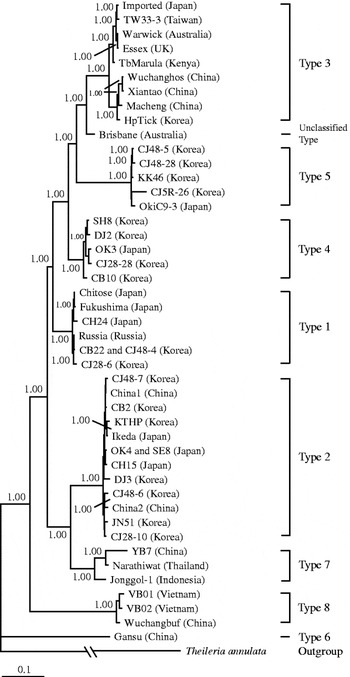
Figure 2 presents the Bayesian Inferences (BI) results using an alignment of complete MPSP nucleotide sequences of 45 benign Theileria parasites. The BI tree (−lnL=5938·88) indicated that all of the parasites, excluding only 1 (Brisbane), belonged to one of the 8 types. Of these, 7 were clearly depicted as monophyletic clades (all, PP=1·00), respectively. In the Theileria parasites, the first branching member was Type 6. Next to appear were, sequentially, Type 8, Type 2 (Ikeda)+Type 7, Type 1 (Chitose), Type 4, Type 5, Brisbane (unclassified Type), and Type 3 (Warwick), with very high posterior probabilities (all, PP=1·00). Here, Type 2 and Type 7 appeared as sister groups to each other with very high posterior probabilities (PP=1·00). Type 3 and Brisbane emerged as a reliable sister group, as well (PP=1·00).
Bayesian Inference tree (−lnL=5938·88) showing the phylogenetic relationships of the 45 benign Theileria parasites and obtained from the complete MPSP nucleotide sequences under the GTR+G model of sequence evolution. Posterior probabilities (⩾0·80) are indicated above the branches. Base frequencies: A=0·32, C=0·23, G=0·21, T=0·24. Theileria annulata was used as the outgroup.

Next, we focused on the compositions of the 7 types to study geographical influences on the distribution of benign Theileria parasites worldwide. Type 1 (Chitose) contained 2 Korean, 3 Japanese, and 1 Russian parasite, whereas Type 2 (Ikeda) consisted of 7 Korean, 2 Chinese, and 3 Japanese parasites. Type 3 (Warwick) consisted of 8 MPSPs, of which 1 was from a Korean parasite and the remaining 7 were from China (3 total), and Japan, Taiwan, UK, Australia, and Kenya (1 each). Both Type 4 and Type 5 consisted of 4 Korean and 1 Japanese parasite, respectively. Additionally, Type 7 consisted of 3 parasites from China, Thailand, and Indonesia (1 each), and Type 8 contained 1 Chinese and 2 Vietnamese parasites. Gansu and Brisbane parasites were included in Type 6 and unclassified, respectively.
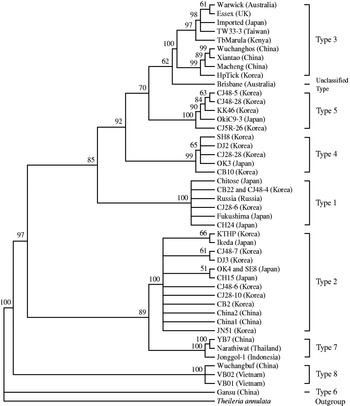
The maximum parsimony (MP) analyses of the same data set yielded a single most parsimonious tree (length=1052 steps; CI=0·68; RI=0·89) (Fig. 3). The MP tree conformed to all major aspects of the BI tree (Fig. 2) except for minor differences in topologies among the parasites within the 6 types (1, 2, 3, 4, 5, and 8). There were breakdowns of sister group relationships among parasites of types 1, 2, 4, and 8. Within Type 3, there was no sister-group among the 4 parasites, TW33-3, Imported, and Essex+Warwick. The MP tree also showed topological shifts within Type 5, e.g., the new branching order of CJ5R-26, OkiC9-3, KK46, and CJ48-28+CJ48-5 instead of the order of OkiC9-3+CJ5R-26, KK46, and CJ48-28+CJ48-5 in the BI tree. However, the bootstrap values that support these nodes were not significant.
Maximum parsimony tree (length=1052 steps; CI=0·68; RI=0·89) showing phylogenetic relationships of the 45 benign Theileria parasites and derived from the complete MPSP nucleotide sequences. Bootstrap values (⩾60%) are indicated above the branches. Theileria annulata was used as the outgroup.

DISCUSSION
We obtained the first complete MPSP gene sequence of the Theileria parasite from tick species (H. punctata) as well as 5 additional corresponding sequences from cattle. This new MPSP sequence of Theileria parasite (HpTick) from tick was defined as a member of Type 3.
Comparison of the complete MPSP sequence data of Theileria parasites showed a relatively low degree of genetic similarities (nucleotides, 70·9–99·8%; amino acids, 71·0–100%). Here, sequence homologies within a type were more than 91·3% for nucleotide and 89·3% for amino acid, whereas those among the 8 different types were from 71·9 to 91·9% for the nucleotide sequences and from 73·4 to 90·8% for the amino acid sequences. These results confirmed the view of Kim et al. (Reference Kim, Tsuji, Kubota, Wei, Lee, Ishihara and Onuma1998), who demonstrated that variation among the sequences within the same MPSP type was very small regardless of geographical differences, whereas variation among the sequences of different MPSP types was significantly larger even when the sequences were derived from the same infected cattle. Information about the genetic diversity of the Theileria parasite can also improve our understanding of its emergence and epidemiology, and aid development of new vaccines and diagnostic tests.
In terms of amino acid sequence configuration, our findings additionally indicated that each of the types, excluding Type 6, had several type-specific amino acid sequences: four for Type 1, seven for Type 2, four for Type 3, two for Type 4, eight for Type 5, seven for Type 7, and 14 for Type 8. The MPSPs also had both a deduced signal peptide and deduced membrane-anchoring domains at the N- and C-termini of the protein, respectively, in addition to the erythrocyte-binding motifs that emerged at 5 sites, 1 of which was well conserved. In addition, 4 potential N-linked glycosylation sites were found.
Although the classification of benign Theileria parasites has been studied in recent years using MPSP gene sequences, the present study provides further details on the classification. Our complete MPSP nucleotide data clearly indicate that at least 8 different types existed within the parasites; all parasites, excluding 1 (Brisbane), were classified into one of 8 types. This point was also strongly supported by our further analyses based on MPSP amino acid sequences (data not shown). There have been some suggestions that Type 6 or Type 8 could be established as new different theilerial species. Kim et al. (Reference Kim, Tsuji, Kubota, Wei, Lee, Ishihara and Onuma1998) maintained that Type 6 was a separate species, which is in concordance with the viewpoint of Gubbels et al. (Reference Gubbels, Hong, van der Weide, Qi, Nijman, Guangyuan and Jongejan2000). Kawazu et al. (Reference Kawazu, Kamio, Kakuda, Terada, Sugimoto and Fujisaki1999) also argued that Theileria sp. of the Asian buffalo (presented as Type 8 in this study) could be classified within the benign Theileria parasite group as a separate species from the cattle parasites. However, Gubbels et al. (Reference Gubbels, Hong, van der Weide, Qi, Nijman, Guangyuan and Jongejan2000) questioned this point because of the high variation observed inside this cluster. In addition, Gubbels et al. (Reference Gubbels, Hong, van der Weide, Qi, Nijman, Guangyuan and Jongejan2000) claimed that the PCR-RFLP profile observed in Brisbane was unique and did not correspond with any of the already known sequences.
For the phylogenetic relationships among the major theilerial types, our study supported several aspects of the study by Gubbels et al. (Reference Gubbels, Hong, van der Weide, Qi, Nijman, Guangyuan and Jongejan2000). Type 6 diverged first. Next to appear were, sequentially, Type 8, Type 2 (Ikeda)+Type 7, Type 1 (Chitose), Type 4, and 1 clade comprising the remaining theilerial parasites. However, the new composition of Type 5 and Brisbane (unclassified Type)+Type 3 (Warwick) in the clade differed from the composition shown in the Gubbels et al. (Reference Gubbels, Hong, van der Weide, Qi, Nijman, Guangyuan and Jongejan2000) ' tree, Brisbane+Type 3. Gubbels et al. (Reference Gubbels, Hong, van der Weide, Qi, Nijman, Guangyuan and Jongejan2000) proposed that all of the parasites either belonged to one of 4 types (types 1, 2, 3, or 6) or were unclassified (4 isolates). Here, we identified their unclassified isolates: Vietnam-1 and Vietnam-2 were clearly defined as Type 8.
Our MPSP nucleotide data also clearly revealed 2 sister-group relationships among the theilerial parasite types, Type 2+Type 7 and Type 3+Brisbane. This point was strongly confirmed by our further study based on MPSP amino acid sequences (data not shown). Some authors such as Gubbels et al. (Reference Gubbels, Hong, van der Weide, Qi, Nijman, Guangyuan and Jongejan2000) and Zakimi et al. (Reference Zakimi, Kim, Oshiro, Hayashida, Fujisaki and Sugimoto2006) mentioned that Type 2 and Type 7 were most closely related to each other based on MPSP nucleotide sequences. This viewpoint is in agreement with our present and previous (Kim et al. Reference Kim, Yokoyama, Kumar, Inoue, Yamaguchi, Sentoku, Fujisaki and Sugimoto2004) findings. On the other hand, the sister-group relationship of Type 3 and Brisbane (unclassified type) was supported by the study of Gubbels et al. (Reference Gubbels, Hong, van der Weide, Qi, Nijman, Guangyuan and Jongejan2000) based on MPSP nucleotide sequences. However, our previous works (Kim et al. Reference Kim, Yokoyama, Kumar, Inoue, Yamaguchi, Sentoku, Fujisaki and Sugimoto2004, Reference Kim, Tsuji, Kubota, Wei, Lee, Ishihara and Onuma1998) suggested that Type 3 was more closely related to Type 5 than other theileial types. In contrast to these reports, Zakimi et al. (Reference Zakimi, Kim, Oshiro, Hayashida, Fujisaki and Sugimoto2006) reported that the Brisbane had stronger affinities for Type 4 than for other types, based on the nucleotide sequences.
Next, we focused on geographical influences on the distribution of benign Theileria parasites worldwide. The distribution of only 7 of 8 types was presented because Type 6 and Brisbane isolate are singletons. Our results indicated that parasites of 5 different types (Type 1–Type 5) co-exist in Korea and Japan; both Korean and Japanese parasites were a mixture of 5 types. Chinese organisms were also a mixture of 5 different types (types 2, 3, 6, 7, and 8). The remaining benign Theileria parasites were scattered among types and geographical identity. Information about the geographical spreading and heterogeneity of Theileria parasites is significant for both taxonomic study and for vaccination. The mixed population structure and higher genetic diversity especially make vaccine development more difficult. Antigenic differences among MPSPs may also cause problems in serological diagnosis (Kawazu et al. Reference Kawazu, Sugimoto, Kamio and Fujisaki1992). Therefore, it is essential to continuously screen changes in the mixed population structure and monitor of the occurrence of novel genetic and antigenic types in Theileria parasites. Although the parasites in this group are often considered as ‘benign’, their pathogenicity varies from almost non-pathogenic to significantly pathogenic. Theileria infections often cause acute anaemia and icterus in cattle; therefore, prevention-and-control strategies against these organisms, including vaccination, are in great demand. The expanding database and phylogenetic information of Theileria MPSP sequences obtained from the present study could be very useful for our understanding of its emergence and epidemiology and aid in development of new vaccines and diagnostic tests.
In sum, we report new MPSP sequences for 6 benign theilerial organisms, including the first derived from tick, and use these sequences in conjunction with 39 published theilerial sequences to reconstruct the phylogeny of benign Theileria parasites. We presented the configuration of the MPSP sequences showing that the parasites had high sequence diversities, and excluding only 1 (Brisbane), were classifiable into one of 8 types. Each type, except for Type 6, also had several type-specific amino acid sequences. Regarding Type 6, we couldn't say which amino acid sequences were specific for Type 6 because it comprised only 1 parasite. The phylogenetic tree derived from the MPSP nucleotide sequences showed 2 sister-group relationships, Type 2+Type 7 and Type 3+Brisbane, with a new branching order: (Type 6 (Type 8 ((Type 2, Type 7), (Type 1, (Type 4, (Type 5, (Type 3, Brisbane))))))). Our analysis also showed no geographical influence on the spreading of Theileria parasites worldwide.
ACKNOWLEDGEMENTS
This project was funded by the National Veterinary Research and Quarantine Service (NVRQS) and Korea National Institute of Health (KNIH), Republic of Korea.We thank Mr Yong-Nam Jin of Yanbian Center for Disease Control and Prevention in China for providing Yanbian theilerial parasites.