Introduction
Tonsillectomy is one of the most frequently performed operations in ENT surgery. Management options for severe post-operative haemorrhage, which include revision surgery and interventional angiography, must be available. We present a rare case of coil extrusion 11 months after embolisation of a lingual artery pseudoaneurysm (including the proximal external carotid artery) in a patient who had experienced massive oral bleeding at day 4 following adenotonsillectomy.
Several cases of coil extrusion in the neck have been reported in irradiated patients. The case reported here illustrates that this delayed complication should also be considered in non-irradiated, otherwise healthy patients such as those treated for post-tonsillectomy haemorrhage.
Case report
A 23-year-old woman presented with dysphagia and odynophagia 11 months after selective embolisation of a lingual artery pseudoaneurysm. She did not report any episodes of oral bleeding.
Eleven months previously she had been admitted to our emergency department with severe oral bleeding 4 days after adenotonsillectomy in another hospital. The procedure and post-operative period had initially been without complication. The patient had no history of a bleeding diathesis.
Immediate revision surgery under general anaesthesia was performed, which entailed diathermy to minor vessels, application of oxidised cellulose polymer and suturing of the faucial pillars. Massive bleeding recurred 1 day later, leading to hypovolaemic shock and a fall in haemoglobin levels to 5.5 g/dl. After appropriate resuscitation, the bleeding was halted by manual compression under general anaesthesia.
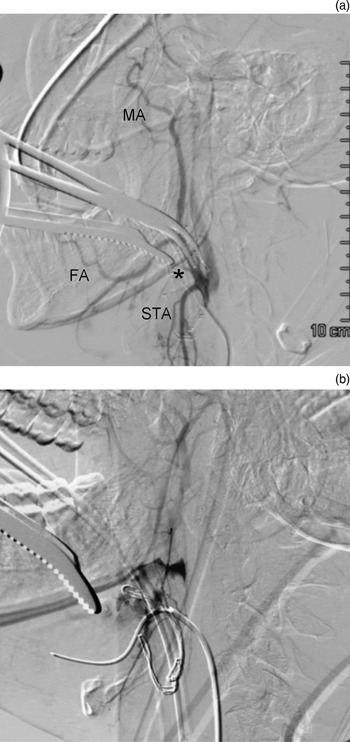
Once the patient was haemodynamically stable she underwent angiography during manual compression, which showed transection of the lingual artery (Figure 1a). After decompression we observed massive extravasation of contrast product at the lingual artery stump with suspected pseudoaneurysm formation (Figure 1b).
Angiographic images showing (a) transection of the lingual artery with the lingual artery stump (*) and (b) massive bleeding after decompression. MA = maxillary artery; FA = facial artery; STA = superior thyroid artery

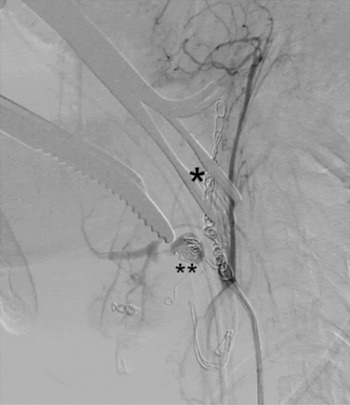
Retrograde embolisation of the lingual artery was performed but did not lead to definitive haemostasis. Subsequent retrograde embolisation of the proximal external carotid artery was necessary, which stopped the bleeding (Figure 2). Immediate post-operative recovery was uneventful, without any recurrence of bleeding.
Angiographic image showing retrograde embolisation of the external carotid artery (*), which was necessary after insufficient coiling of the pseudoaneurysm at the lingual artery stump (**).

Three months after selective embolisation, the patient presented with one minor episode of haemoptysis, possibly caused by the extrusion of a coil. However, clinical examination at that time, including flexible laryngoscopy, showed intact lingual and pharyngeal mucosa. A follow-up angiogram 1 day later showed no source of bleeding.
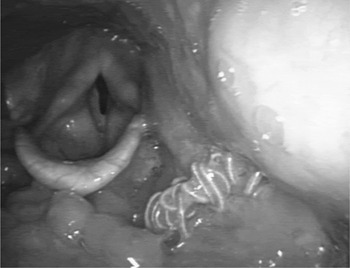
Eleven months after embolisation the patient was referred complaining of dysphagia and odynophagia. No further bleeding had occurred. Clinical examination showed coil extrusion at the left inferior tonsillar fossa (Figure 3). Doppler ultrasound examination of the cervical vessels showed fibrosis of the external carotid artery without aneurysm or pseudoaneurysm formation.
Video-laryngoscopic image (Olympus® ENF videolaryngoscope) showing the extrusion of coils at the left tongue base.

In the presence of an interventional radiologist, the extruded coils were easily removed during direct endoscopy under general anaesthesia. The symptoms subsequently disappeared and further follow up for seven months was uneventful.
Discussion
Pseudoaneurysm formation is a rare complication of surgical procedures. It is caused by trauma to the vessel wall leading to periarterial haematoma and development of a fibrous capsule. Later, liquefaction of the central part of the haematoma occurs, resulting in dilatation and subsequent rupture of the blood vessel.
Post-operative bleeding due to pseudoaneurysm is usually delayed and occurs several days after surgery. It often presents as repeated bleeding with spontaneous cessation.
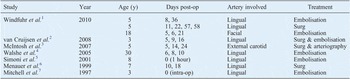
In the last few years, several cases of post-tonsillectomy haemorrhage due to pseudoaneurysm formation have been reported. A Medline search for articles tagged with the Medical Subject Heading terms pseudoaneurysm, hemorrhage and tonsillectomy was performed. The results were restricted to articles published within the last 15 years. Seven articles were identified, comprising nine case reports (Table I).Reference Windfuhr, Sesterhenn, Schloendorff and Kremer 1 – Reference Mitchell, Pereira, Lazar, Long and Fournier 7
Case reports of bleeding after tonsillectomy*

* Due to pseudoaneurysm formation, with a focus on bleeding incidence and the involved vessel. Y = years; post-op = post-operatively; surg = surgery; intra-op = intra-operatively
The age of the patients in the case reports varied from 3 to 30 years (average 9 years), and the timing of the bleeding ranged from intra-operative to 58 days post-operative. All patients with delayed bleeding presented with repeated episodes of bleeding. The vessel most frequently involved was the lingual artery (seven of the nine patients). The facial artery (one patient) and external carotid artery (one patient) were also subject to pseudoaneurysm formation. Treatment included embolisation (five cases), surgery (two cases) or a combination of surgery with angiography or embolisation (two cases). None of these articles reported the expulsion of coils within the upper aerodigestive tract.
Coil extrusion in the head and neck area is a well-known complication in embolised patients who have had radiotherapy. Irradiation impairs wound healing and reduces the immune response. In these patients, life-threatening complications such as septicaemia and the recurrence of severe bleeding have been reported,Reference Lin, Tierney, Richmon, Mark and Deschler 8 which require additional medical and surgical treatment. Radiation therapy also results in less stable tissue, allowing coil migration to adjacent regions such as the nasal cavity, middle ear, hypopharynx or cervical skin.Reference Shin, Kim and Moon 9 – Reference Kiyosue, Okahara, Tanoue, Sagara, Matsumoto and Mori 11
-
• Pseudoaneurysm formation after tonsillectomy can cause severe post-operative haemorrhage
-
• Typically, post-operative bleeding from a pseudoaneurysm is delayed and repeated
-
• Selective embolisation is a safe and effective treatment
-
• The possibility of coil extrusion has to be considered, even in otherwise healthy tissue
Coil migration and expulsion have also been described in non-irradiated tissue, mainly in the digestive tract. The clinical presentation can be without major consequence, as reported in the case of a 65-year-old woman with a coil from a splenic artery pseudoaneurysm, which had migrated through the gastrointestinal tract. The coil was passed per rectum without any serious effects.Reference Shah, Akingboye, Haldipur, Mackinlay and Jacob 12 However, it is also possible for the consequences of coil migration and expulsion to be fatal. Dinter et al. (2007) reported the case of a patient who had been treated 10 years previously by endovascular repair of a coeliac artery aneurysm.Reference Dinter, Rexin, Kaehler and Neff 13 Two days after admission for acute haematemesis, the patient died of recurrent gastrointestinal bleeding through an aortogastric fistula.
If delayed complications after embolisation are suspected, a thorough clinical examination should be performed followed by adequate imaging. Migrated coils constitute a foreign body and should be carefully removed in order to alleviate pain and avoid local complications and infection. Close collaboration between the surgical and interventional radiology teams is essential to ensure the best possible patient care and minimal risks during the procedure.
In our case, endoscopic removal of the extruded coil was performed without any bleeding. Doppler ultrasound examination before the procedure showed that the slow extrusion had led to fibrosis of the former lingual artery stump and proximal external carotid artery, which explained the absence of bleeding during removal.
Conclusion
Severe post-operative bleeding due to pseudoaneurysm formation is a rare complication following tonsillectomy. However, if delayed repeated haemorrhage with spontaneous cessation is observed, then this possibility has to be considered. Initial treatment usually includes revision surgery, which aims to achieve local haemostasis with diathermy or ligation of the bleeding vessel. If these methods fail, selective embolisation is one of the alternative treatment options. It permits a precise localisation of the source of bleeding and is generally safe and effective. However, delayed coil extrusion may occur, which can have serious consequences, especially in damaged tissue such as an irradiated neck. In healthy tissue, slow extrusion seems to be less dangerous, normally leading to replacement of the coil by fibrous tissue during its migration.