Introduction
Oil spills continue to be a source of significant ecological damage [Reference Carson, Mitchell, Hanemann, Kopp, Presser and Ruud1, Reference Walker and Fingas2, Reference Peterson, Rice, Short, Esler, Bodkin, Ballachey and Irons3, Reference Jernelöv4, Reference Dave and Ghaly5]. Improving remediation methods, including oil sorbent technologies, is imperative to further mediate the inherent risks of oil transport necessary in modern society. Methods for oil spill remediation are chosen to balance several concerns, including the physical location of the spill, ecosystem fragility, and economic priorities including oil recovery. For example, although burning and dispersing methods can be effective, they may also exacerbate economic loss or environmental damage [6]. For most open water spills, skimmers are preferred to recover most of the oil, whereas sorbents are deployed to remediate portions near the shore or to collect sections that have become dispersed into small droplets [Reference Federici and Mintz7].
Sorbent materials collect oil through adsorption and/or absorption processes [Reference Ge, Zhao, Zhu, Huang, Shi and Yu8]. Materials that are both hydrophobic and oleophilic with high surface area-to-volume ratio are ideal oil sorbents for marine environments. Both natural and synthetic materials are used as sorbents. Natural sorbents, such as cotton, are inexpensive and can biodegrade if lost, but are often hydrophilic and nonselective for oil sorption. Synthetic sorbents, such as polypropylene, are selective oil sorbents but pose a secondary environmental threat if they are not adequately collected after use [Reference Federici and Mintz7]. After collection, many natural sorbents can be burned productively as fuel if the water content is low enough, whereas synthetic sorbents must be shipped to landfills, further contributing to the environmental and economic cost of the spill [6].
One approach to improving the performance of natural sorbents is to modify their surface chemistry. Many examples of this approach have been reported in the literature using organic modifiers [Reference Wang, Peng, Zhong, Tan, Jing, Cao, Chen, Liu and Sun9, Reference Yu, Hao, Xiao, Yin, Xia and Jiang10, Reference Sai, Fu, Xing, Xiang, Li, Li and Zhang11, Reference Barry, Libera, Elam and Darling12, Reference Feng, Nguyen, Fan and Duong13, Reference Cojocaru, Pricop, Samoila, Rotaru and Harabagiu14]. Herein, we examine a new approach to surface modification that relies on depositing inorganic species using volatile metalorganic precursors commonly used for chemical vapor deposition and atomic layer deposition (ALD). These inorganic precursors, delivered in the gas phase, rapidly and inexpensively transform cellulosic products into hydrophobic/oleophilic materials appropriate for oil sorption applications. We test the fundamental performance of this new sorbent material as well as its performance in simulated real-world conditions and demonstrate that its performance is at least equivalent if not superior to previous technologies.
Results & discussion
General sorbent performance of ALD-treated cotton material
Similar to previous reports [Reference Lee, Jur, Kim and Parsons15, Reference Gregorczyk, Pickup, Sanz, Irakulis, Rogero and Knez17], we find that 1 to 2 cycles of TMA/H2O transforms cotton into a hydrophobic material. BET analysis shows minimal change in the surface area after treatment (Fig. S1). After only 1 to 2 Al2O3 ALD cycles, EDX cannot detect aluminum on the cotton fibers because of insufficient sensitivity (∼0.1 at.%) (Figs. S2 and S3). However, XPS analysis (Fig. S4) confirms the presence of aluminum on the cotton surface, consistent with the expected subnanometer metal oxide coverage. XPS also reveals a substantial increase in the hydrocarbon coverage for ALD-treated cotton, consistent with an increase in adventitious carbon on the surface as has been described by other researchers [Reference Lee, Jur, Kim and Parsons15, Reference Gregorczyk, Pickup, Sanz, Irakulis, Rogero and Knez17]. This combination of increased adventitious carbon and possible surface roughening is believed to create the increased hydrophobicity [Reference Lee, Jur, Kim and Parsons15]. Further investigations into these atomic scale mechanisms for hydrophobicity are beyond the scope of this study; instead, we focus on the selective sorption performance of these materials.
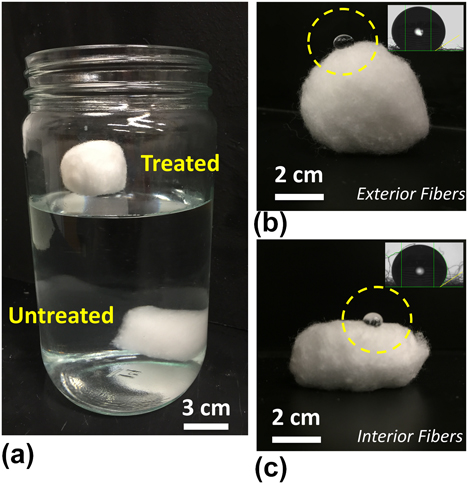
Figure 1(a) demonstrates that these treated cotton materials are sufficiently water repellant to be aqueously buoyant. This treatment is surprisingly rugged; we have had a similarly treated cotton ball floating in water for over 1 year in our lab. Figures 1(b) and 1(c) demonstrate that both exterior and interior fibers exhibit hydrophobic properties. This behavior is consistent with our vapor-phase deposition approach. The gaseous precursors readily permeate the entire cotton structure modifying each fiber’s surface chemistry, and unlike a liquid-phase modification process, no solvents or post-drying steps are necessary after the chemical modification.
(a) Picture of cotton balls dropped in water that are untreated and treated with 2 cycles of TMA ALD. (b) Water beading up on the surface of a cotton ball treated with 2 cycles of TMA ALD. Inset shows image of the water contact angle (WCA ≈ 153°). (c) A treated cotton ball cut in half, with water beading up on fibers that were previously in the interior of the cotton ball. Inset shows WCA measurement on the interior (WCA ≈ 146°).

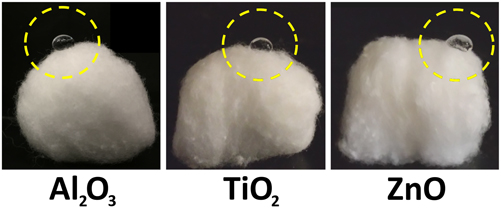
Figure 2 illustrates that this process is not restricted to only the TMA/H2O chemistry. Reactions with other precursors available in our lab, including DEZ and TiCl4, have proven equally effective in transforming the cellulose to a hydrophobic material. This chemical flexibility opens up a wide range of possibilities for modification.
Photographs of water drops on cotton treated with 2 cycles of 3 different ALD chemistries: Al2O3 using TMA/H2O, TiO2 using TiCl4/H2O, and ZnO using DEZ/H2O. (color online).

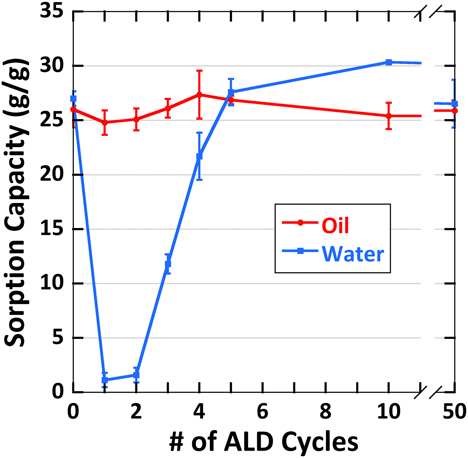
To evaluate baseline sorption performance, pure oil and pure water sorption capacities were measured (in separate trials) as a function of the number of TMA ALD cycles. Figure 3 summarizes this data series. After a single TMA/H2O dosing sequence, the cotton’s water sorption capacity drops precipitously (from ≈27 g/g to ≈1.1 g/g), whereas the oil sorption capacity remains mostly unchanged (within error). After two cycles, water sorption capacity remains low, but after three cycles, water sorption capacity begins to increase again. By five TMA/H2O cycles, the water sorption capacity is again near the untreated condition. These data suggest that preferential selective sorption of oil over water should be maximized around 1 to 2 TMA/H2O cycles.
Sorption capacities for cotton with different numbers of TMA ALD cycles in separate trials using pure water and pure oil.

Although an investigation of why hydrophilicity is again observed at higher cycle numbers is beyond the scope of this study, we conjecture that this change relates both to the morphology and the chemistry of thicker ALD coatings. As the number of TMA/H2O ALD cycles increases, the Al2O3 coating becomes more continuous. The surface of Al2O3 is known to have hydroxyl groups that make it hydrophilic [Reference Carchini, Garcia-Melchor, Lodziana and Lopez18]. With only a few cycles (<3), we believe the Al2O3 coating is not yet entirely continuous, and the less polar Al–O–C bonds exposed on the surface lead to adventitious carbon adsorption that makes the surface hydrophobic. Oil/water selectivity for cellulose treated with two cycles of TMA/H2O ALD is investigated more fully in section “Oil-to-water sorption selectivity”. Interestingly, if the higher cycle number materials were heated (in any atmosphere) to ≈150 °C, hydrophobicity was again induced and selectivity was again possible. Further investigations into this phenomenon are underway.
Water sorption kinetics
To better quantify the water repellency of these new materials, we measured the rate of water sorption and fit these data to commonly used kinetics models to extract rate constants. The rate of water sorption was chosen for study over rate of oil sorption because, whereas both treated and untreated conditions exhibit qualitatively similar rates of oil sorption, the two exhibit a dramatic qualitative difference in water sorption behavior. This suggests that the difference in selectivity between treated and untreated cotton is a consequence of the water sorption kinetics. Figure S6 in the Supplementary material plots the nonselective water sorption capacity as a function of time for various ALD cycle numbers. We fit these data to various sorption kinetics models and find the best agreement with the pseudo-second order model first presented by Blanchard and popularized by Ho and McKay [Reference Ho and McKay19, Reference Demirel, Yati, Donmez and Sonmez20, Reference Blanchard, Maunaye and Martin21, Reference Ho and McKay22]. This model describes the adsorption rate as following:
 $${{{\rm{d}}{S_t}} \over {{\rm{d}}t}} = k{\left( {{S_{\max }} - {S_t}} \right)^2}\quad ,$$
where k is the rate constant, S t is the sorption capacity (g/g) at time t, S max is the maximum sorption capacity (g/g), and t is time (s). Integrating Eq. (1) and the applying boundary conditions S t = 0 at t = 0 and S t = S t at t = t yield
 $${t \over {{S_t}}} = {1 \over {k{{\left( {{S_{\max }}} \right)}^2}}} + {1 \over {{S_{\max }}}}t\quad .$$
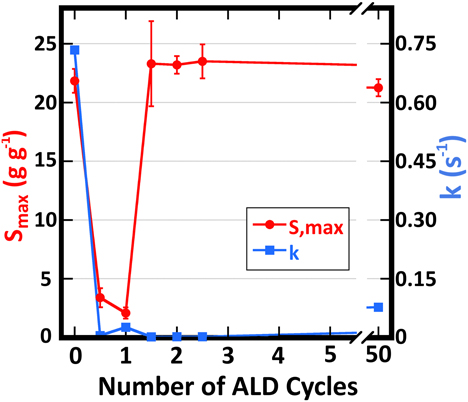
We can linearize our data by plotting t/S t versus t and extracting the maximum sorption capacity (S max, in g/g) and rate constant (k, with units of s−1) for the sorption process using the slope and intercept of the line, respectively. As shown in Fig. S7 of the Supplementary material, all data sets yield straight lines that closely match the model (with correlation coefficients R 2 > 0.98). Figure 4 summarizes this analysis by plotting the sorbents’ maximum sorption capacity and rate constant (k) as a function of ALD cycle number (the corresponding numerical values are given in Table S1 of the Supplementary material). Interestingly, at 3 cycles and beyond, the sorption capacity returns to a value similar to the untreated material (≈23 g/g), whereas the sorption rate remains significantly suppressed (<0.05 s−1). This result illustrates that all treated cotton sorbents act differently from the untreated material—water sorption rates are significantly slowed.
Maximum water sorption capacities for cotton treated with different numbers of ALD cycles (red with circular marker). Kinetic rate constant (k) for sorption using a pseudo-second order model (blue with square marker). All data are for cotton treated with varying number of TMA/H2O cycles.

We should also note that these sorption models only provide self-consistent comparisons of sorption kinetics and saturations. Fitting to a given model does not necessarily imply any physical insight about the underlying sorption mechanism. Insight about the mechanism will require more detailed chemical analyses of the process [Reference Tran, You, Hosseini-Bandegharaei and Chao23, Reference El-Khaiary, Malash and Ho24, Reference Plazinski, Rudzinski and Plazinska25].
Oil-to-water sorption selectivity
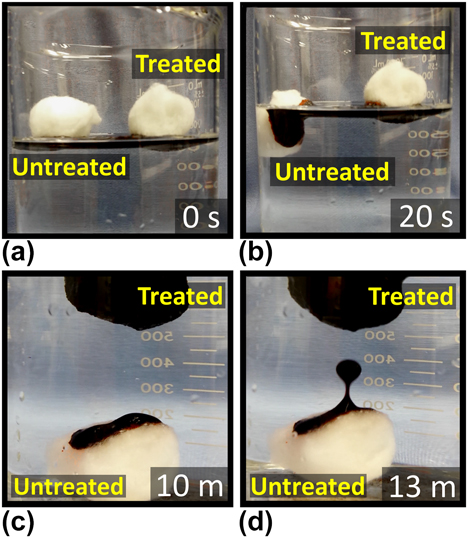
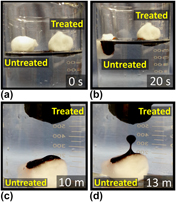
ALD-treated cotton sorbents are most impressive in their selectivity for oil sorption in mixed oil and water conditions. Although untreated cotton is a good nonselective sorbent for oil, it also readily sorbs water, with its selectivity favoring water sorption. ALD-treated cotton has the opposite selectivity, preferring oil sorption. In Fig. 5, we qualitatively demonstrate this preference in a series of photographs of each sorbent material dropped into an oil–water mixture. As depicted in this photographic time series (full movie included in the Supplementary material), untreated cotton quickly sinks through the top oil layer. Once in contact with water, the untreated cotton preferentially sorbs the water, increasing its density and eventually leading to it sinking through the water. Once fully immersed in water, droplets of previously sorbed oil begin to visibly desorb, indicating untreated cotton’s selectivity for water sorption over oil sorption. In contrast, the treated cotton sinks through the oil layer but does not substantially sorb water, allowing it to remain buoyant on the water’s surface and continually sorb oil.
Photographic time series of untreated and ALD-treated cotton immersed in an oil–water mixture: (a) 0 s, (b) 20 s, (c) 10 min, and (d) 13 min after immersion. Oil desorption from the untreated cotton is visible in image (d). The canola oil is dyed brown to improve clarity (see Supplementary material for full video).

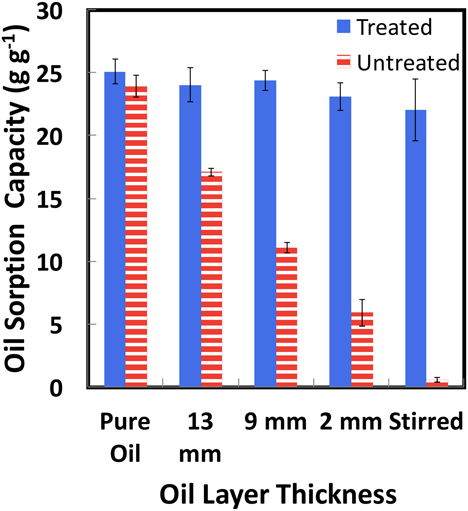
To further investigate selective oil sorption, we measure the oil sorption capacities for these materials in a series of use cases that maintain the same oil volume (25 mL) but alter the thickness of the oil layer. These conditions were achieved by changing the diameter of the cylindrical container from 45 to 125 mm; these different constraints varied the oil layer’s thickness from ≈13 mm to ≈2 mm (a photograph of this experimental setup is included in Fig. S8 of the Supplementary material). The sorption capacities measured in this set of experiments are plotted in Fig. 6. Although untreated and ALD-treated cotton exhibit comparable oil sorption capacity in pure oil, untreated cotton loses sorption capacity when exposed to mixtures of oil and water. As the oil layer’s thickness decreases, the untreated cotton more easily sinks through the oil layer and contacts water. Untreated cotton’s oil sorption capacity decreases as the oil layer thickness decreases (which results in more contact with water), showing that untreated cotton preferentially adsorbs water over oil. On the other hand, the ALD-treated cotton loses <10% of its oil sorption capacity as the oil layer thickness decreases. When the oil layer is no longer continuous, the difference in oil sorption capacity between untreated and ALD-treated cotton exceeds 35 times. This finding is significant because sorbent materials are typically deployed in open water oil spill remediation efforts to compliment skimming to collect more dispersed sections of an oil spill.
Oil sorption capacity of cotton treated with 2 cycles of TMA ALD versus untreated cellulose for a range of different oil thicknesses on DI water. Corresponding water sorption capacities are included in Fig. S9 of the Supplementary material.

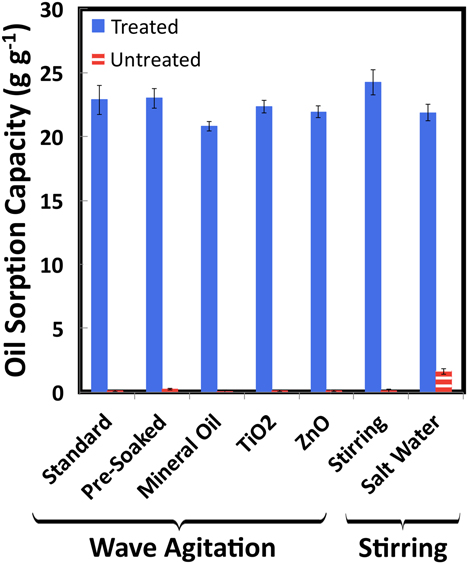
Next, we consider the oil sorption performance under a variety of modified use cases including active agitation (shaking and stirring), salt water, alternative oils (mineral), and presoaking with water (additional experimental details are provided in the Supplementary material). As shown in the Supplementary material Video 1, shaking agitation approximates ocean waves. Under these conditions, the untreated cotton ball is observed to immediately sink. In contrast, the ALD-treated cotton ball periodically submerges but remains selectively sorbent toward the oil component. As illustrated in Fig. 7, ALD-treated cotton (including three different precursor chemistries) substantially outperforms the untreated material in all cases and shows nearly equivalent oil sorption performance, within measurement error, for all conditions. A modestly lower sorption capacity for the mineral oil/water mixture can be attributed to the mineral oil’s lower density (≈0.823 g/cm3 versus ≈0.874 g/cm3 for canola oil) [Reference Sai, Fu, Xing, Xiang, Li, Li and Zhang11]. Perhaps most interestingly, when we presoak the ALD-treated cotton with water before use in mixed oil and water with simulated wave conditions, it retains its full oil sorption capacity (the second condition shown in Fig. 7). This result suggests that even if this sorbent gets wet, in, for example, a rain storm, it will retain high sorbent performance.
ALD treated versus untreated oil sorption capacity across different experimental conditions approximating real-world oil spill conditions.

Comparison to other sorbent materials
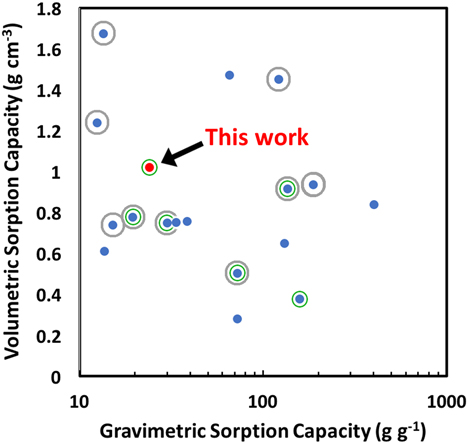
Finally, we compare the performance of our ALD-treated cotton with other oil sorbents reported in the literature. Figure 8 summarizes the performance metrics of our material compared with 17 other sorbent technologies. Note that many of the reports do not explicitly state the use of a dripping step, as recommended by the ASTM Standard [16] and which we find necessary for not overvaluing sorption capacity. Also, although gravimetric sorption capacity is easier to measure, we believe the volumetric sorption capacity is more appropriate for assessing practicality, including sorbent transport, storage, deployment, and collection. For example, below a critical density, ≈200 kg/m3 for UPS [26], transportation companies charge lightweight fees based on container volume, so at ≈33 kg/m3, cotton would need to be compressed to ≈6× its normal density to not be considered a lightweight shipping product. Although some compression may be feasible during shipping and storage, deployment and collection necessitate handling sorbents in their “swollen” state (again highlighting the importance of sorbing as little water as possible in cleanup efforts and the benefit of the high oil over water selectivity demonstrated by our sorbent).
Comparison between highest performing sorbents reported in the literature, with volumetric sorption capacity (g/cm3) plotted on the vertical axis and gravimetric sorption capacity (g/g) plotted on the horizontal axis. The sorbent described in this paper’s performance is shown in red and marked with an arrow. Cellulose-based sorbents are indicated by a smaller green circle, and aerogel-based sorbents are indicated by a larger light gray circle. Table S4 in the Supplementary material displays data and references related to this plot.

To better compare cost efficiency and commercial viability, Fig. 8 compares our sorbent with 17 other high-performance oil sorbent materials described in literature on a volumetric and gravimetric basis [Reference Wang, Peng, Zhong, Tan, Jing, Cao, Chen, Liu and Sun9, Reference Yu, Hao, Xiao, Yin, Xia and Jiang10, Reference Sai, Fu, Xing, Xiang, Li, Li and Zhang11, Reference Barry, Libera, Elam and Darling12, Reference Feng, Nguyen, Fan and Duong13, Reference Wang, McLaughlin, Pfeffer and Lin27, Reference Bi, Huang, Wu, Cao, Tan, Yin, Lu, Sun and Zhang28, Reference Karatum, Steiner, Griffin, Shi and Plata29, Reference Standeker, Novak and Knez30, Reference Zhao, Hu, Hu, Cheng, Shi and Qu31, Reference Nguyen, Feng, Le, Le, Hoang, Tan and Duong32, Reference Tanobe, Sydenstricker, Amico, Vargas and Zawadzki33, Reference Korhonen, Kettunen, Ras and Ikkala34, Reference Venkateswara Rao, Hegde and Hirashima35, Reference Gui, Wei, Wang, Cao, Zhu, Jia, Shu and Wu36, Reference Chen and Pan37] (see the Supplementary material for a description of our methods to calculate these values). To make fairer comparisons among this data series, we have also indicated the sorbents that are cellulosic (green circles) and aerogels (gray circles). Among the reports known to us, our system has the highest volumetric sorption capacity reported for a cellulosic sorbent. Combined with the simplicity of synthesis, the lack of solvent usage, and the non-necessity for drying after processing, ALD-treated cotton is a competitive new approach for oil sorption in marine environments, and once optimized for precursor usage, will likely have a net positive impact on the environment.
Conclusions
Subnanometer oxide surface modifications applied to cellulose via an ALD-like process transform this natural sorbent into a hydrophobic material that preferentially sorbs oil over water. One to two ALD cycles are sufficient to drive this transformation and create a cotton material that indefinitely floats on water. Compared with untreated cotton, this ALD-treated sorbent shows at least 35× greater oil sorption capacity in simulated use conditions of dispersed oil in water with wave agitation. No loss in this sorption capacity (24 g/g or 1.02 g/cm3) is observed, even if the ALD-treated cotton is first “presoaked” with water. This performance, along with the simplicity of synthesis and potential for retained biodegradability, makes these materials an exciting new sorbent technology for oil spill remediation in marine environments.
Experimental procedures
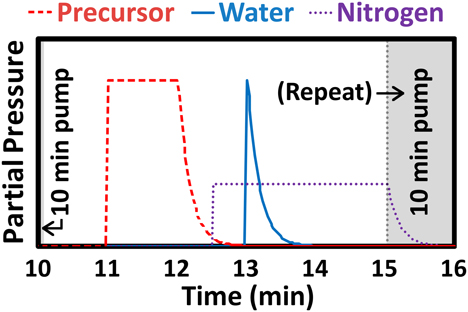
Commercially available cotton balls (Up&Up™ brand from Target) were used as the primary sorbent material. Other cellulosic materials were examined, including those with better documented purity, for example from Fisher Scientific, but no significant differences in performance were observed. A subnanometer inorganic “coating” was applied to the cotton via an ALD-type sequence. ALD was conducted in a custom-built hot-wall, viscous-flow tube reactor with two gate valves used for gas isolation. All depositions were performed at 90 °C using the following protocol: (i) pump down chamber for 10 min reaching <10 mtorr, (ii) isolate the reaction chamber (close off chamber from the rest of the system and maintain vacuum of ≈10 mtorr) for 1 min, then dose the metalorganic precursor (e.g., trimethylaluminum (TMA), diethylzinc (DEZ), or titanium tetrachloride (TiCl4)) for 1 s and hold this precursor dose in the chamber for 1 min, (iii) evacuate chamber for 30 s, then purge the chamber (i.e., flow nitrogen through at ≈2 torr) for 30 s, and (iv) dose H2O for 1 s, purge the chamber for 2 min, and then repeat steps 1–4 for subsequent layers. Figure 9 provides a graphical depiction of this sequence. A single cycle for this process takes about 15 min, but in our experience these pump/purge cycles are excessive, and a modified process taking only 1 min engenders a qualitatively similar degree of hydrophobicity in cellulose. All the data reported in this paper are for cotton treated with 2 cycles of TMA using the 15 min process (except for the sorbent samples used in the “cycle number study”, given in Fig. 3). We choose this as our “optimal” treatment because (a) we found it most effective in preventing water sorption (vide infra and Supplementary material Fig. S5), and (b) Lee et al. reported it as producing the highest water contact angle for TMA-treated cotton [Reference Lee, Jur, Kim and Parsons15]. Finally, it is worth noting that these reactions are self-limiting and usually deposit ≈1 Å of material per cycle, so the layer of oxide deposited for effective transformation of cotton to a water-repellant oil sorbent is well below 1 nm.
Schematic depiction of dosing sequence used to deposit inorganic materials in this study. The 10 min pump down step is abbreviated for clarity.

X-ray photoelectron spectroscopy (XPS, Thermo Fisher Scientific K-alpha, manufactured in West Palm Beach, FL), scanning electron microscopy (SEM, Phenom Pro X, manufactured in Eindhoven, the Netherlands) with energy dispersive X-ray (EDX) spectroscopy, and nitrogen sorption measurements (Brunauer–Emmett–Teller, BET, Micrometrics TriStar II 3020, manufactured in Norcross, GA) were used to characterize the chemistry and structure of ALD-modified cotton.
Commercial canola oil (Kroger Brand) was used for most sorption testing, although similar performance was observed for mineral oil (Johnson & Johnson Baby Oil) (vide infra) and in limited testing, crude oil. All reported sorption capacities are averages of at least three independent measurements. Sorption capacities were collected in the usual mass-per-mass (g/g) fashion, using an analytical balance to measure the mass of the cotton sorbent before and after liquid sorption. The sorbent was allowed to drip for 30 s before the second weighing. When testing in a mixed oil–water environment, the sorbent was weighed before testing (m i), after sorption of oil and water (m o+w), and then after a drying step that removed the water (m o). Water was removed by vacuum drying at 60 °C and ≈10 torr for 16 h. These drying conditions remove all water, as shown in the Supplementary material, Sec. III. These conditions minimized oil loss because of “spattering” that occurs when water is removed more rapidly. Using these mass values, the sorbent’s gravimetric sorption capacities for oil (S o) and water (S w) could be independently calculated:
 $${S_{\rm{o}}} = {{{m_{\rm{o}}}} \over {{m_{\rm{i}}}}}\quad ,$$
and
 $${S_{\rm{w}}} = {{{m_{{\rm{o + w}}}} - {m_{\rm{o}}}} \over {{m_{\rm{i}}}}}\quad .$$
To measure the oil sorption kinetics, cotton sorbents were placed on top of the oil for fixed periods of time, drip-dried for 30 s, and weighed. The dripping procedure was consistent with ASTM Standard F726-12 [16] and found to be necessary to get reproducible results. Each reported sorption capacity is an average of at least 3 separate experiments (independent cotton balls used in each experiment) with standard errors reported for error bars. Similar protocols were used for water sorption kinetics except that the cotton was forcibly immersed beneath the water’s surface to compel sorption for all cases, including water-repellant ALD-modified sorbents.
Supplementary material
To view supplementary material for this article, please visit https://doi.org/10.1557/jmr.2018.441.
Acknowledgments
We thank Alexandre Magasinski for performing BET measurements. Acknowledgment is made to the donors of the American Chemical Society Petroleum Research Fund for partial support of this research—Grant # 55526-DNI10. Additional support for this work came from the Georgia Tech President’s Undergraduate Research Awards (PURA) and the Roxanne D. Westendorf Undergraduate Research Fund. A portion of this research was conducted in Georgia Tech’s Materials Innovation & Learning Laboratory (The MILL), an uncommon “make and measure” space committed to elevating undergraduate research in materials science.