Introduction
Beryl (Be3Al2Si6O18) is the most abundant and widespread beryllium mineral in granitic pegmatites, especially those of the rare-element class where it is the first of the truly exotic phases to crystallise in their evolutionary sequence (Černý, Reference Černý and Grew2002; London, Reference London2008). Beryl precipitates usually during the main magmatic stage of the pegmatite evolution; however late-magmatic to post-magmatic (hydrothermal) beryl has been described in some pegmatites (e.g. Wang et al., Reference Wang, Cheng Che, Dong Zhang, Lan Zhang and Cheng Zhang2009; Novák and Filip, Reference Novák and Filip2010; Zachař et al., Reference Zachař, Novák and Škoda2020). Secondary beryl is also known as a product of the hydrothermal or metamorphic breakdown of primary Be-rich cordierite–sekaninaite solid solution in some granitic pegmatites (Jobin-Bevans and Černý, Reference Jobin-Bevans and Černý1998; Dixon et al., Reference Dixon, Cempírek and Groat2014; Gadas et al., Reference Gadas, Novák, Vašinová Galiová, Szuszkiewicz, Pieczka, Haifler and Cempírek2020) or alteration of K-feldspar by Be-rich fluids in greisenised granite (Markl and Schumacher, Reference Markl and Schumacher1997). Metamorphic transformation of primary magmatic phenakite to beryl is described from meta-aplites and meta-pegmatites (Schilling et al., Reference Schilling, Bingen, Skår, Wenzel and Markl2015). Moreover, metasomatic beryl, typically a Cr-rich emerald variety, in association with other Be minerals (chrysoberyl, phenakite), commonly originated on the contact between pegmatite or leucogranite magma and surrounding (meta)basic and ultrabasic rocks (Martin-Izard et al., Reference Martin-Izard, Paniagua, Moreiras, Acevedo and Marcos-Pascual1995; Černý, Reference Černý and Grew2002; Seifert et al., Reference Seifert, Žáček, Vrána, Pecina, Zachariáš and Zwaan2004).
Subsolidus alteration of magmatic pegmatite beryl shows a strong pH dependence from acidic to alkaline conditions (e.g. Černý, Reference Černý and Grew2002) and commonly produces numerous secondary phases. These are Be silicate minerals and typically comprise: secondary beryl; bavenite; bohseite; bertrandite; bityite; danalite; euclase; epididymite; eudidymite; helvine; milarite; and phenakite, or Be phosphate phases: beryllonite; hurlbutite; hydroxylherderite; moraesite; väyrynenite; and others (Lahti and Saikkonen, Reference Lahti and Saikkonen1985; Jonsson and Langhof, Reference Jonsson and Langhof1997; Černá et al., Reference Černá, Černý, Selway and Chapman2002; Černý, Reference Černý and Grew2002; Wang et al., Reference Wang, Cheng Che, Dong Zhang, Lan Zhang and Cheng Zhang2009; Novák and Filip, Reference Novák and Filip2010; Rao et al., Reference Rao, Wang and Hu2011; Zachař et al., Reference Zachař, Novák and Škoda2020). Breakdown of beryl to secondary phenakite and/or bertrandite (± euclase) is a common phenomenon in granites and pegmatites (Strand, Reference Strand1953; Vernon and Williams, Reference Vernon and Williams1960; Jonsson and Langhof, Reference Jonsson and Langhof1997; Markl and Schumacher, Reference Markl and Schumacher1997; Černý, Reference Černý and Grew2002; Palinkaš et al., Reference Palinkaš, Wegner, Cobić, Palinkaš, De Brito Barreto, Váczi and Bermanec2014; Zachař et al., Reference Zachař, Novák and Škoda2020). Secondary phenakite and bertrandite were also described, without genetic details, in beryl-bearing pegmatites of the Bratislava Massif, Western Carpathians, Slovakia (Ozdín, Reference Ozdín2010; Uher and Chudík, Reference Uher and Chudík2014).
Regardless of published experimental studies concerning stability of Be silicate minerals (e.g. Ganguli and Saha, Reference Ganguli and Saha1967; Burt Reference Burt1978; Hsu, Reference Hsu1983; Barton, Reference Barton1986; Evensen et al., Reference Evensen, London and Wendlandt1999; Barton and Young, Reference Barton, Young and Grew2002; Franz and Morteani, Reference Franz, Morteani and Grew2002; Wang and Li, Reference Wang and Li2020), there is still a paucity of detailed microtextural, paragenetic and compositional data on the processes by which beryl breaks down to phenakite and bertrandite in natural mineral assemblages. Consequently, the objective of this paper is to report a detailed textural and compositional study of subsolidus beryl breakdown to phenakite and bertrandite in granitic pegmatites, including associated minerals, breakdown reactions and a genetic scenario of the alteration processes, using examples from the broader region of the Tatric Superunit, Western Carpathians. This investigation contributes more generally to our knowledge of subsolidus breakdown processes in Be-bearing granite-pegmatite systems.
Geological setting and description of the pegmatites
The granitic pegmatites investigated and their adjacent granitic and metamorphic rocks are a part of Palaeozoic (Variscan) crystalline basement of the Tatric Superunit in the Central Western Carpathians, which was incorporated into a younger thrust and nappe tectonic structure of the Alpine (Cretaceous to Neogene) orogenic belt, a part of the Alps–Carpathians system. The parental granitic rocks form massifs of biotite to biotite–muscovite granites, granodiorites, and rare leucotonalites (locally with small amphibole–biotite diorite intrusions), which display an orogen-related, peraluminous calc-alkaline trend with S- to I-type geochemical affinity and subduction to collision tectonic settings (e.g. Broska and Uher, Reference Broska and Uher2001; Petrík et al., Reference Petrík, Kohút and Broska2001; Kohút and Larionov, Reference Kohút and Larionov2021). Locally, more evolved muscovite-(biotite) leucogranites, pegmatitic leucogranites and aplites occur in apophyses and/or dykes cutting the granitic massifs. The granitic intrusions were formed from numerous magmatic pulses, including mixing and mingling of more felsic and more mafic magmatic material, filter pressing and fractional crystallisation mechanisms, as was demonstrated in the Vysoké Tatry Mountains composite pluton (Gawęda et al., Reference Gawęda, Burda, Klötzli, Golonka and Szopa2016, Reference Gawęda, Szopa, Włodyka, Burda, Crowley and Sikorska2019). The granitic rocks show a Variscan (Hercynian) age of emplacement, usually between 340 and 365 Ma, based on multi-grain zircon U–Pb, whole rock and mica Rb−Sr, and K−Ar isotopic data (summarised in Cambel et al., Reference Cambel, Kráľ and Burchart1990), as well as in situ zircon isotopic and monazite chemical U−(Th)−Pb radiometric age determination (e.g. Finger et al., Reference Finger, Broska, Haunschmid, Hraško, Kohút, Krenn, Petrík, Riegler and Uher2003; Burda and Gawęda, Reference Burda and Gawęda2009; Kohút et al., Reference Kohút, Uher, Putiš, Ondrejka, Sergeev, Larionov and Paderin2009; Broska et al., Reference Broska, Petrík, Béeri-Shlevin, Majka and Bezák2013; Burda et al., Reference Burda, Gawęda and Klötzli2013a; Reference Burda, Gawęda and Klötzli2013b; Uher et al., Reference Uher, Kohút, Ondrejka, Konečný and Siman2014; Gawęda et al., Reference Gawęda, Burda, Klötzli, Golonka and Szopa2016; Broska and Svojtka, Reference Broska and Svojtka2020; Kohút and Larionov, Reference Kohút and Larionov2021).
The adjacent metamorphic rocks of the Tatric Superunit basement usually represent Lower Palaeozoic, mainly Ordovician-to-Devonian metapelites-to-metapsammites metamorphosed under greenschist-to-amphibolite-facies conditions to phyllites, biotite-, garnet-, staurolite- and sillimanite-bearing micaschists to paragneisses. Less widespread are metagranites (orthogneisses) and metagabbros to metabasaltic rocks (amphibolites), whereas metacarbonates, metaquartzites, carbon-rich metapelites (black schists) and serpentinised meta-ultrabasic rocks are rare (Krist et al., Reference Krist, Korikovsky, Putiš, Janák and Faryad1992, and references therein).
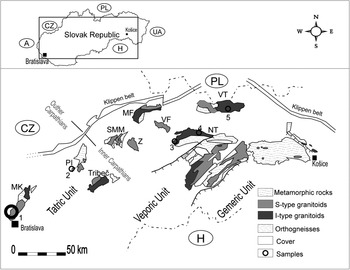
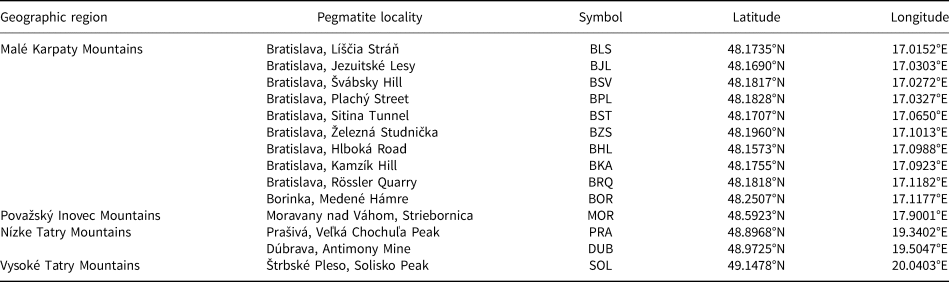
The beryl-bearing granitic pegmatites investigated represent the most evolved pegmatite population related to the Variscan granitic massifs of the Tatric Superunit, Western Carpathians. They occur mainly in the Bratislava Massif of the Malé Karpaty Mountains, and less commonly in other areas, such as the Bojná Massif of the Považský Inovec Mountains, Nízke and Vysoké Tatry Mountains (Uher, Reference Uher1991; Uher and Broska, Reference Uher and Broska1995; Uher et al., Reference Uher, Chudík, Bačík, Vaculovič and Galiová2010; Chudík et al., Reference Chudík, Uher, Gadas, Škoda and Pršek2011; Bačík et al., Reference Bačík, Fridrichová, Uher, Rybár, Bizovská, Luptáková, Vrábliková, Pukančík and Vaculovič2019), Fig. 1. Geographic locations of the investigated pegmatites with Be minerals are listed in Table 1. The beryl-bearing pegmatites in most cases intruded their parental granitic rocks and rarely the adjacent metamorphic rocks close to the granite intrusions. The pegmatites are usually tabular, rarely lenticular bodies. The thickness of the pegmatites generally ranges from 0.5 to 2 m, and locally reaches 8 m (Moravany nad Váhom pegmatite), they attain a length of several metres to ~100 m; the contacts with adjacent rocks are sharp.
Simplified geological map of the Western Carpathians with the locations of the investigated pegmatites investigated of the Tatric Superunit. Area 1 represents the pegmatites of the Bratislava Massif (BLS to BOR occurrences), 2: MOR, 3: PRA, 4: DUB and 5: SOL pegmatites. For locality symbols and their geographic locations see Table 1.

Geographic regions, locations and locality symbols of the Tatric beryl-bearing granitic pegmatites investigated.

The pegmatites usually show internal zoning, commonly with an aplitic to coarse-grained quartz + feldspar + muscovite (± biotite) border unit, an intermediate zone with coarse-grained to blocky K-feldspar (± quartz, muscovite, or biotite), and a quartz core zone. Locally, irregular late albite-rich assemblages with dominant saccharoidal albite or cleavelandite partially replaced the older units (especially in the most evolved Moravany nad Váhom and Bratislava, Jezuitské Lesy pegmatites). Primary magmatic beryl forms pale yellowish-green or bluish-green, semi-transparent euhedral prismatic hexagonal crystals, usually 1–5 cm, and exceptionally up to 20 cm in length. It is associated with quartz and muscovite, less commonly with K-feldspar (microcline) and albite in coarse-grained and blocky pegmatite units (intermediate quartz–feldspar–muscovite to quartz core), and rarely with albite-rich units (Uher et al., Reference Uher, Chudík, Bačík, Vaculovič and Galiová2010). Widespread almandine–spessartine garnet forms translucent dark red crystals (~0.3 to 8 cm in size) in border and intermediate, rarely core units (larger crystals) or tiny transparent pink crystals (~0.1−2 mm) in saccharoidal albite. Accessory minerals of the pegmatites include: Hf-rich zircon (Uher and Černý, Reference Uher and Černý1998); fluorapatite; rarely gahnite; monazite-(Ce); xenotime-(Y); pyrite; and other less common phases. The most fractionated pegmatites contain accessory Nb–Ta oxide minerals, mainly columbite–tantalite-(Fe) and columbite–tantalite-(Mn), and locally also tapiolite-(Fe), ferrowodginite, Ti-rich ixiolite, Nb–Ta-rich rutile and secondary fersmite, pyrochlore-supergroup minerals (usually microlite-group members), usually in association with muscovite, quartz, albite and beryl in intermediate to core zones or saccharoidal to cleavelandite albite units (Uher et al., Reference Uher, Černý, Novák and Siman1994, Reference Uher, Černý, Chapman, Határ and Miko1998a, Reference Uher, Černý, Chapman, Határ and Miko1998b, Reference Uher, Žitňan and Ozdín2007; Novák et al., Reference Novák, Uher, Černý and Siman2000; Chudík et al., Reference Chudík, Uher, Gadas, Škoda and Pršek2011).
The mineral association and geochemical signatures enable classification of the Tatric granitic pegmatites into the LCT family, beryl type and beryl–columbite subtype of the rare-element class (according to the Černý and Ercit, Reference Černý and Ercit2005) or the beryl ± columbite rare-element pegmatites of Group 1, generated from residual melt of granite magmatism (according to the Wise et al., Reference Wise, Müller and Simmons2022). Isotopic and chemical age determination of pegmatite minerals indicate a Variscan age (~355 to 340 Ma; Gawęda et al., Reference Gawęda, Müller, Stein, Kądziolko-Gaweł and Mikulski2013; Uher et al., Reference Uher, Kohút, Ondrejka, Konečný and Siman2014; Majzlan et al., Reference Majzlan, Chovan, Kiefer, Gerdes, Kohút, Siman, Konečný, Števko, Finger, Waitzinger, Biroň, Luptáková, Ackerman and Hora2020), synchronous with their parental Variscan granitic rocks.
Methods
Polished sections and polished thin sections of pegmatite rocks with beryl and associated minerals were used for the study. The identification and compositions of minerals were determined using a Cameca SX100 electron probe micro-analyser at the State Geological Institute of Dionýz Štúr, Bratislava (Slovakia), in wavelength-dispersive mode with an acceleration voltage of 15 kV, a beam current of 15−20 nA and a beam diameter of 3−5 μm. The following standards and X-ray lines were used: fluorapatite (PKα), wollastonite (SiKα, CaKα), synthetic rutile (TiKα), Al2O3 (AlKα), metallic Cr (CrKα), fayalite (FeKα), rhodonite (MnKα), willemite (ZnKα), forsterite (MgKα), SrTiO3 (SrLα), baryte (BaLα), albite (NaKα), orthoclase (KKα), Rb2ZnSi5O12 glass (RbLα), pollucite (CsLα), CaF2 (FKα), and NaCl (ClKα). Peak counting was 15 s for major elements and 30 s for minor elements, and 10 s on the background. Detection limits of the measured elements varied between 0.02 and 0.05 wt.%, standard deviations (3σ) of the measured elements range from ±0.02 to ±0.6 wt.%, depending on the element concentration. The matrix effects were corrected using the PAP procedure (Pouchou and Pichoir, Reference Pouchou and Pichoir1985). The same apparatus was used for a detailed study of mineral textural relations, in back-scattered electron (BSE) and cathodoluminescence (CL) modes.
Powder X-ray diffraction data were obtained with a BRUKER D8 Advance diffractometer (Dept. of Mineralogy, Petrology and Economic Geology, Comenius University in Bratislava, Slovakia) under the following conditions: the Bragg-Brentano geometry (Theta–2Theta), Cu anticathode (Kα1 = 1.5406 Å), accelerating voltage 40 kV and sbeam current 40 mA. The NiKβ filters were used for stripping Kβ radiation, and data were obtained using the BRUKER LynxEye detector. The step size was 0.01°2θ, the counting time was 3 s per step, and measurement ranged from 2 to 65°2θ. Analysed scans were fitted, and unit-cell parameters were refined with the BRUKER DIFFRACplus TOPAS software.
Raman spectroscopic measurements of thin sections were performed on LabRam HR800 microspectrometer (Horiba Jobin-Yvon), based on the Olympus BX41 microscope with a confocally coupled Czerny-Turner type monochromator (focal length of 800 mm), at the Institute of Earth Sciences, Slovak Academy of Sciences, Bratislava, Slovakia. A frequency-doubled Nd-YAG laser at 532 nm was used for excitation and 633 nm for verifying any luminescence effect. The Raman-scattered light was collected in 180° geometry through a 100× objective lens with numerical aperture 0.8 and dispersed by diffraction grating with a density of 600 grooves/mm onto a cooled CCD detector, total exposure time was 450 s. The system resolution was 2 cm−1, peak definition was improved using a 5-fold sub-pixel shift. The grating turret accuracy was calibrated between the zero-order line (180° reflection) and laser line at 0 cm−1. Spectral accuracy was verified on the 734 cm−1 line of teflon. The peaks were fitted and deconvoluted by Gaussian-Lorentzian functions in the LabSpec 5 program (Horiba Jobin-Yvon).
Results
Mineral associations and textural relationships
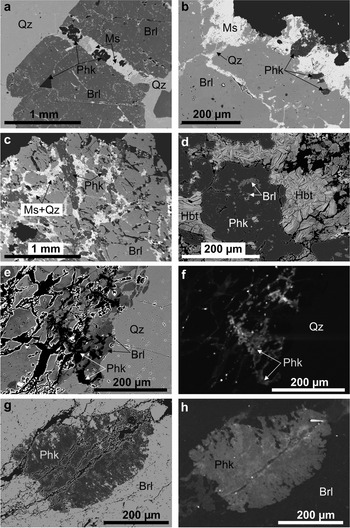
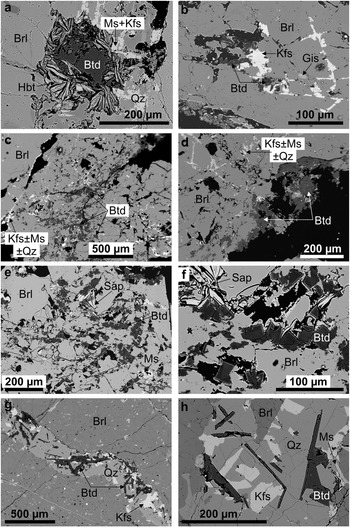
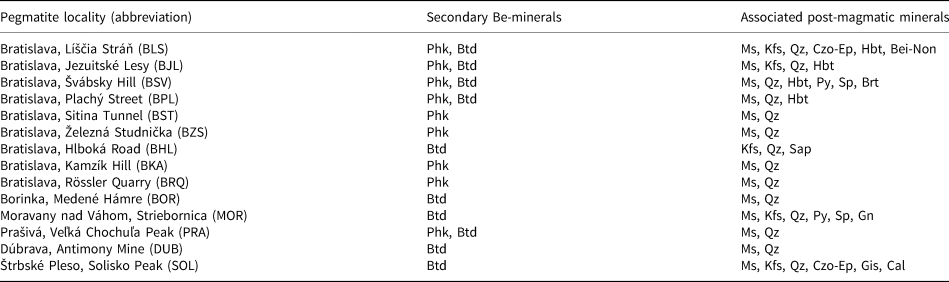
Primary magmatic beryl crystals display various alteration and replacement textures in BSE images. They are usually partly replaced by irregular veinlets and patchy domains filled with a secondary assemblage of phenakite, bertrandite, quartz, muscovite, K-feldspar, and other secondary minerals (Figs 2, 3). Exceptionally, groups of euhedral-to-subhedral crystals of phenakite or bertrandite (up to 2 mm in size) were found in vugs remaining from the leaching of beryl (the Bratislava, Líščia Stráň pegmatite). In several occurrences, both phenakite and bertrandite were identified in the same pegmatite dyke, though not in a close mutual association; in other pegmatites, only phenakite or bertrandite were detected (Table 2).
Beryl breakdown to phenakite and associated minerals from the Tatric pegmatites: (a−e, g) back-scattered electron (BSE) images; (f,h) cathodoluminescence (CL) images. Mineral abbreviations include Brl (beryl), Phk (phenakite), Qz (quartz), Ms (muscovite) and Hbt (mineral similar to hydrobiotite). Pegmatite locations: BRQ (a), BZS (b), BLS (c,d), BJL (e,f) and BKA (g,h). For locality symbols see Table 1.

Beryl breakdown to bertrandite and associated minerals from the Tatric pegmatites: (a−h) back-scattered electron (BSE) images. Mineral abbreviations include Brl (beryl), Btd (bertrandite), Qz (quartz), Ms (muscovite), Kfs (K-feldspar), Gis (gismondine-Ca), Hbt (mineral similar to hydrobiotite) and Sap (mineral similar to saponite). Pegmatite locations: BJL (a), SOL (b), BHL (c−f) and MOR (g,h). For locality symbols see Table 1.

Secondary beryllium and associated minerals in the Tatric pegmatites studied. Mineral abbreviations: Phk (phenakite), Btd (bertrandite), Ms (muscovite), Kfs (K-feldspar), Qz (quartz), Hbt (hydrobiotite-like mineral), Bei-Non (beidellite-nontronite-like mineral), Sap (saponite-like mineral), Py (pyrite), Sp (sphalerite), Gn (galena), Brt (baryte), Czo-Ep (clinozoisite-epidote), Gis (gismondine-Ca), Cal (calcite).

The intensity of beryl alteration is variable in the pegmatites investigated. In some cases, beryl crystals are without any visible alteration, or they show only a local, incipient stage with the rare presence of phenakite or bertrandite and associated secondary phases. In a more advanced stage of alteration, the secondary mineral products are scattered in a groundmass of beryl or they form phenakite- or bertrandite-bearing veinlets (Figs 2a,b, 3a−c, 3g,h). The most advanced stage shows a more distinct appearance of phenakite or bertrandite and associated alteration products (Figs 2c−h, 3d−f). Some occurrences reveal an almost complete replacement of beryl by the secondary minerals, where beryl forms only small, isolated remnants (10−50 μm in size) or it is totally replaced by a secondary assemblage (Fig. 2d).
Phenakite usually forms irregular aggregates or anhedral grains, rarely small subhedral to euhedral short prismatic crystals (≤500 μm) in irregular veinlets and domains (Fig. 2); it commonly shows a cathodoluminescence (CL) signal with various intensities; in some cases, there are small irregular domains (~10−20 μm) with stronger CL signal in grains or aggregates with a less distinctive signal (Fig. 2f,h). Bertrandite forms anhedral grains or irregular aggregates, rarely subhedral-to-euhedral prismatic tabular crystals (up to 400 μm in width), rarely as a part of 70−350 μm thick veinlets or irregular replacement domains (Fig. 3). Bertrandite locally shows zonal crystals with irregular domains, or more regular sector zoning in BSE images (Fig. 3f). Both phenakite and bertrandite replace primary beryl, in association with anhedral grains or irregular aggregates (usually ≤ 500 μm large) of secondary quartz, K-feldspar, and muscovite (Figs 2, 3).
Clay phyllosilicate minerals with composition similar to hydrobiotite, rarely beidellite, nontronite and saponite occur as aggregates of platy vermicular crystals, ~5 to 100 μm across, in altered parts of beryl in some pegmatites of the Bratislava Massif (Figs 2d, 3a,e,f). Rare clinozoisite–epidote, gismondine-Ca, calcite, baryte, pyrite, sphalerite and galena were identified as tiny inclusions (~10 to 40 μm) in association with altered beryl and the above mentioned secondary mineral assemblage.
Composition of minerals
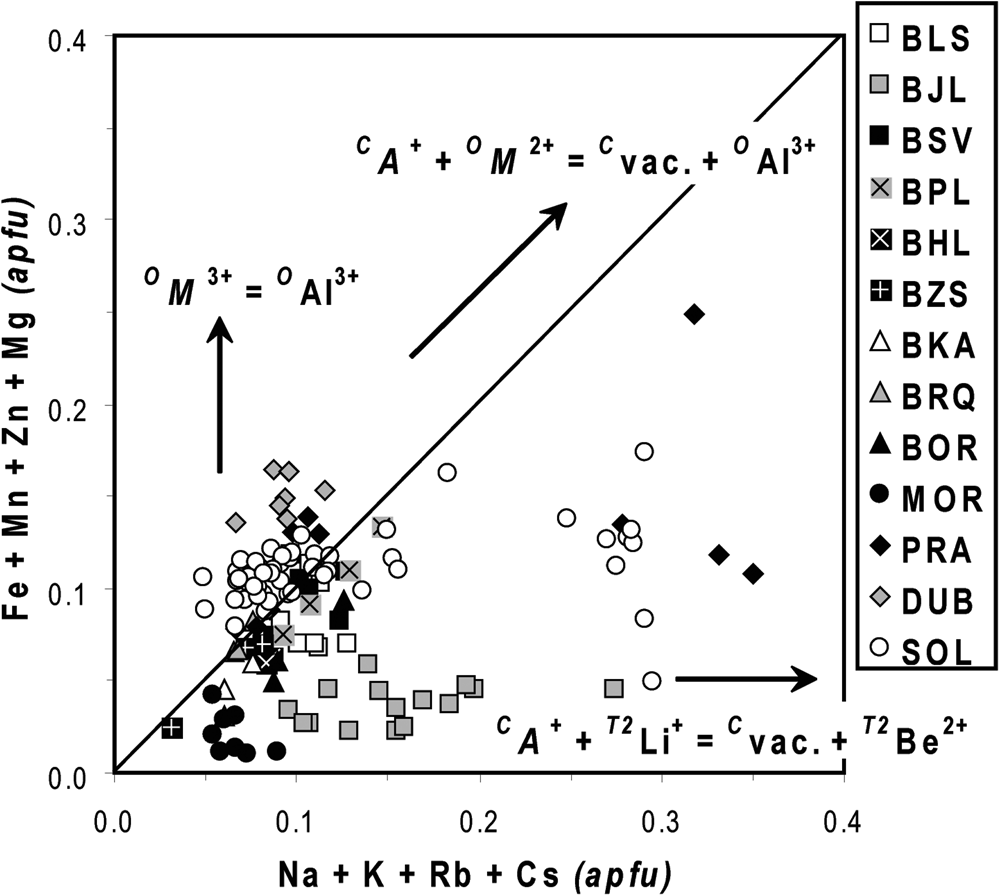
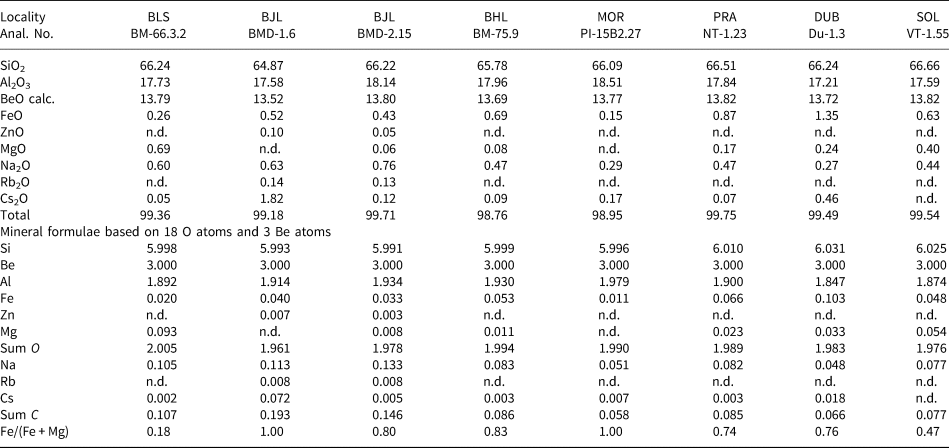
Beryl shows common compositions, slightly to moderately enriched in Fe, Mg and Na (Table 3). Cs-enriched zones were rarely documented in the Bratislava, Jezuitské Lesy pegmatite. Generally, the beryl investigated shows dominant channel(C)-octahedral(O) CA + + OM 2+ = Cvacancy + OAl3+ substitution, where CA + = Na+ and OM 2+ are divalent octahedral cations (mainly Fe and Mg); the octahedral OFe3+ = OAl3+ and the channel-tetrahedral(T2) CA + + T2Li+ = Cvacancy + T2Be2+ substitutions are negligible, or they are present in lesser amounts (Fig. 4). The Fe/(Fe + Mg) atomic ratio (Fe = Fe2+ + Fe3+) of beryl shows relatively wide variations (~0.2 to 1.0), where the highest values (0.9 to 1.0) are characteristic only for beryl from the most fractionated pegmatites (Bratislava, Jezuitské Lesy and Moravany nad Váhom) with the presence of accessory Nb–Ta oxide minerals of columbite–tantalite, tapiolite-(Fe) and wodginite-group minerals (Novák et al., Reference Novák, Uher, Černý and Siman2000; Chudík et al., Reference Chudík, Uher, Gadas, Škoda and Pršek2011). Detailed compositional data of beryl from the Tatric pegmatites (including trace elements) have been published by Uher et al. (Reference Uher, Chudík, Bačík, Vaculovič and Galiová2010).
The Fe + Mn + Zn + Mg vs. Na + K + Rb + Cs (apfu) diagram of beryl (Barton and Young, Reference Barton, Young and Grew2002) from the Tatric pegmatites. Fe = Fe2+ + Fe3+. For locality symbols see Table 1.

Representative compositions of beryl from the Tatric pegmatites (wt.%). BeO wt.% content was calculated by stoichiometry assuming 3 Be atoms per formula unit. For locality symbols see Table 1.

Total iron content as FeO.
n.d. = not detected elements (below detection limit).
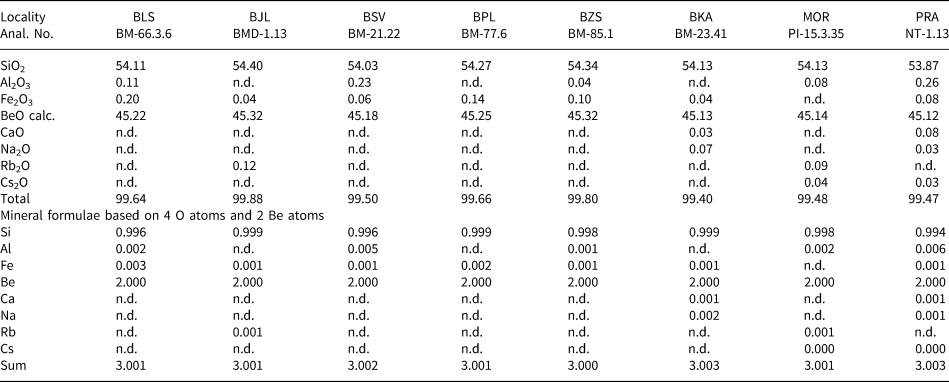
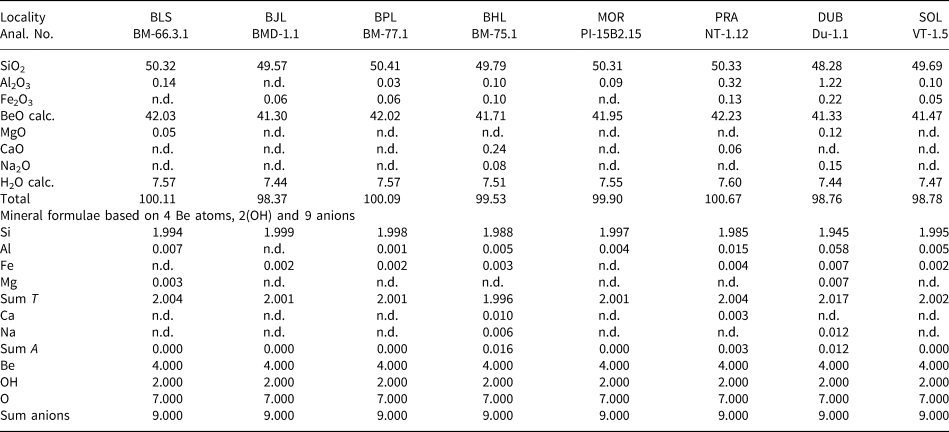
Phenakite and bertrandite usually show near end-member compositions with the contents of other constituents at or below detection limits (Tables 4, 5). Phenakite contains minor amounts of Al2O3 (≤0.3 wt.%; 0.006 atoms per formula unit Al), Fe2O3 (≤0.2 wt.%; 0.003 apfu Fe), and Rb2O (≤0.1 wt.% and ≤ 0.001 apfu Rb in more evolved Bratislava, Jezuitské Lesy and Moravany nad Váhom pegmatites; Table 4). Analyses of bertrandite reveal local admixtures of Al (up to 1.2 wt.% Al2O3; ≤0.06 apfu); contents of other elements (Fe, Mg, Ca, Na) attain only ≤ 0.1 to 0.2 oxide wt.% (Table 5).
Representative compositions of phenakite from the Tatric pegmatites (wt.%). BeO wt.% content was calculated by stoichiometry assuming 2 Be atoms per formula unit. For locality symbols see Table 1.

Total iron content as Fe2O3.
n.d. = not detected elements (below detection limit).
Representative compositions of bertrandite from the Tatric pegmatites (wt.%). BeO and H2O wt.% contents were calculated by stoichiometry assuming 4 Be atoms and 2 (OH) per formula unit. For locality symbols see Table 1.

Total iron content as Fe2O3.
n.d. = not detected elements (below detection limit).
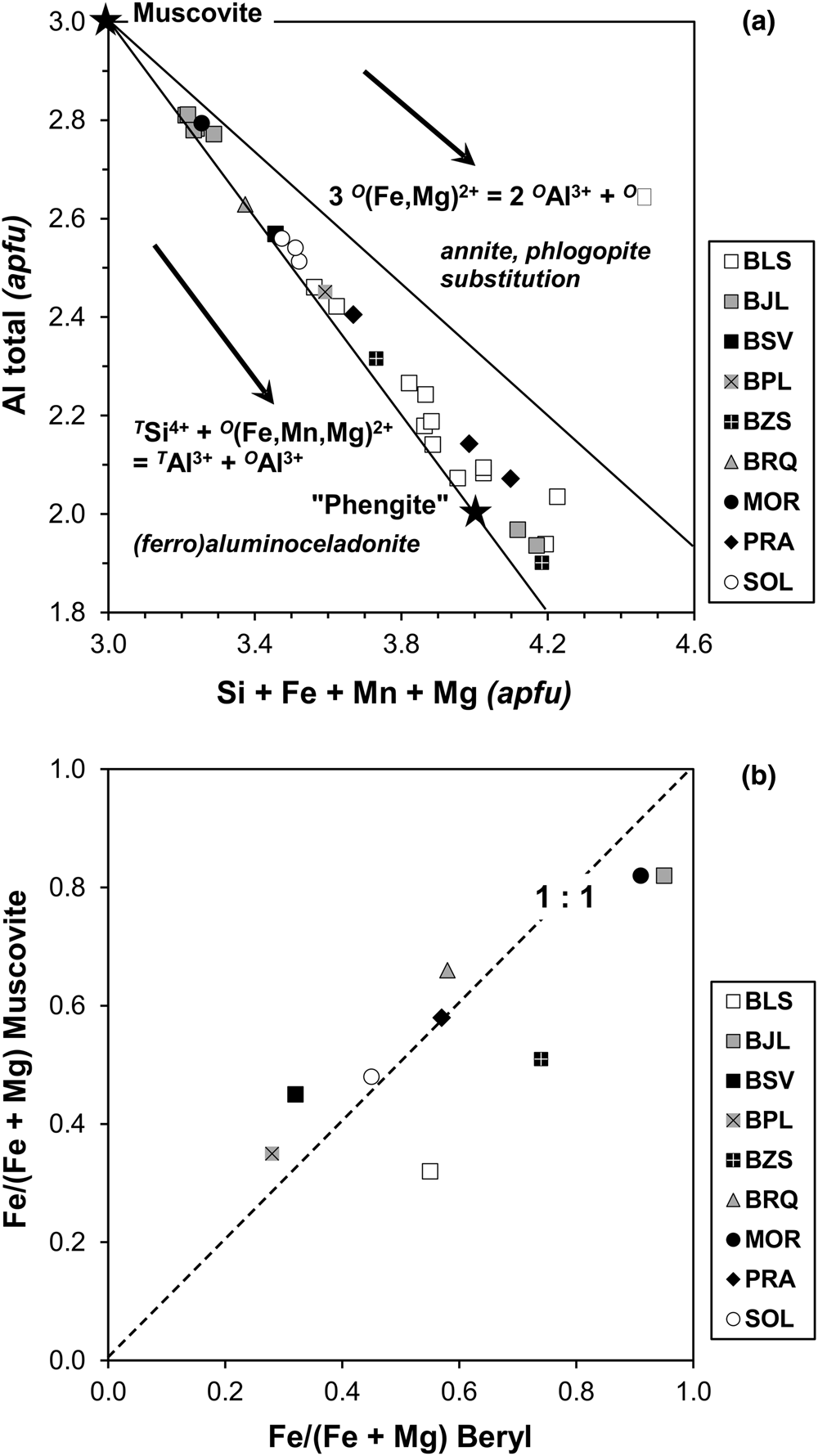
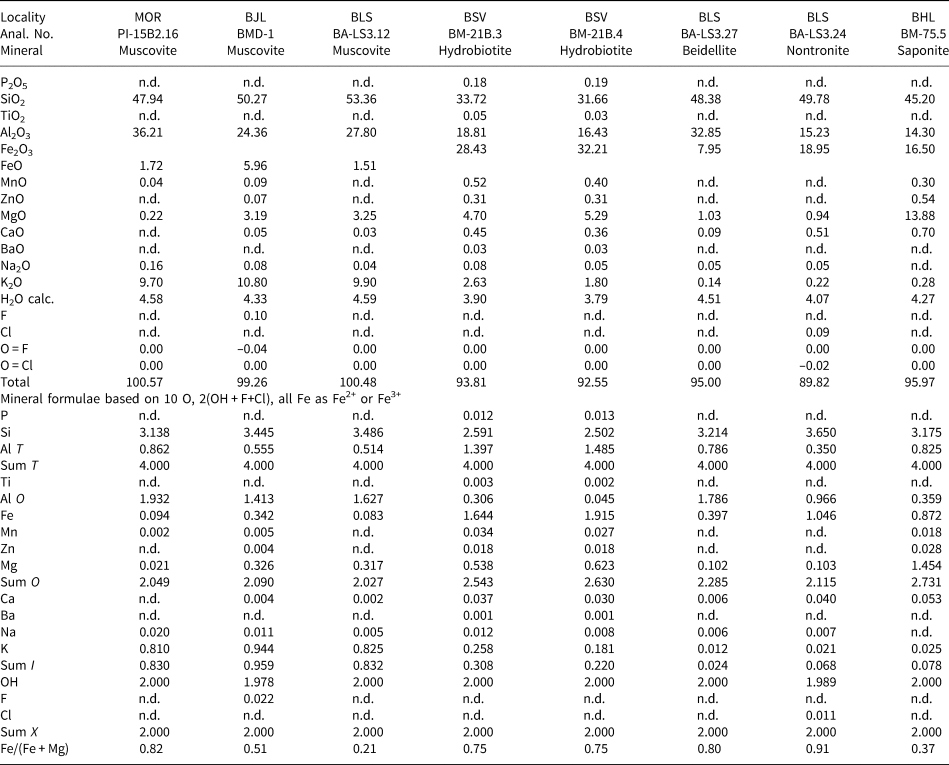
Secondary K-feldspar shows a near end-member composition (Kfs98–100Ab0–2An0). Associated muscovite features wide variations of Si, Fe and Mg contents approaching phengitic composition within the different pegmatite occurrences and commonly also within the same sample (Table 6; Fig. 5a): the analyses show 45−53 wt.% SiO2 (3.1−3.5 apfu Si), 1.5−7.5 wt.% FeO (0.08−0.44 apfu Fe; all Fe as Fe2+) and 0.03−5.90 wt.% MgO (0.003−0.610 apfu Mg). The atomic Fe/(Fe + Mg) ratio of muscovite ranges from 0.25 to 0.98 for all investigated localities; however, the average Fe/(Fe + Mg) values for muscovite–beryl pairs at each locality show a positive correlation (Fig. 5b).
(a) Muscovite composition in Al total vs. Si + Fe + Mn + Mg (apfu) diagram; (b) muscovite vs. beryl Fe/(Fe + Mg) diagram from the Tatric pegmatites. Fe = Fe2+ + Fe3+; atomic proportions. For locality symbols see Table 1.

Representative compositions of phyllosilicate minerals from the Tatric pegmatites (wt.%). For locality symbols see Table 1.

Total iron content as FeO (muscovite) or Fe2O3 (other minerals).
n.d. = not detected elements (below detection limit).
Clay phyllosilicate minerals show compositions similar to Fe-dominant hydrobiotite, beidellite, nontronite and saponite (Table 6). The phase similar to hydrobiotite shows 1.7 to 7.1 wt.% K2O (0.16−0.72 apfu K) and Fe/(Fe + Mg) = 0.50−0.85, whereas clays having compositions similar to those of beidellite, nontronite and saponite attain ≤0.7 wt.% K2O (≤0.07 apfu K) and Fe/(Fe + Mg) = 0.37−0.91.
X-ray diffraction and micro-Raman investigation of phenakite and bertrandite
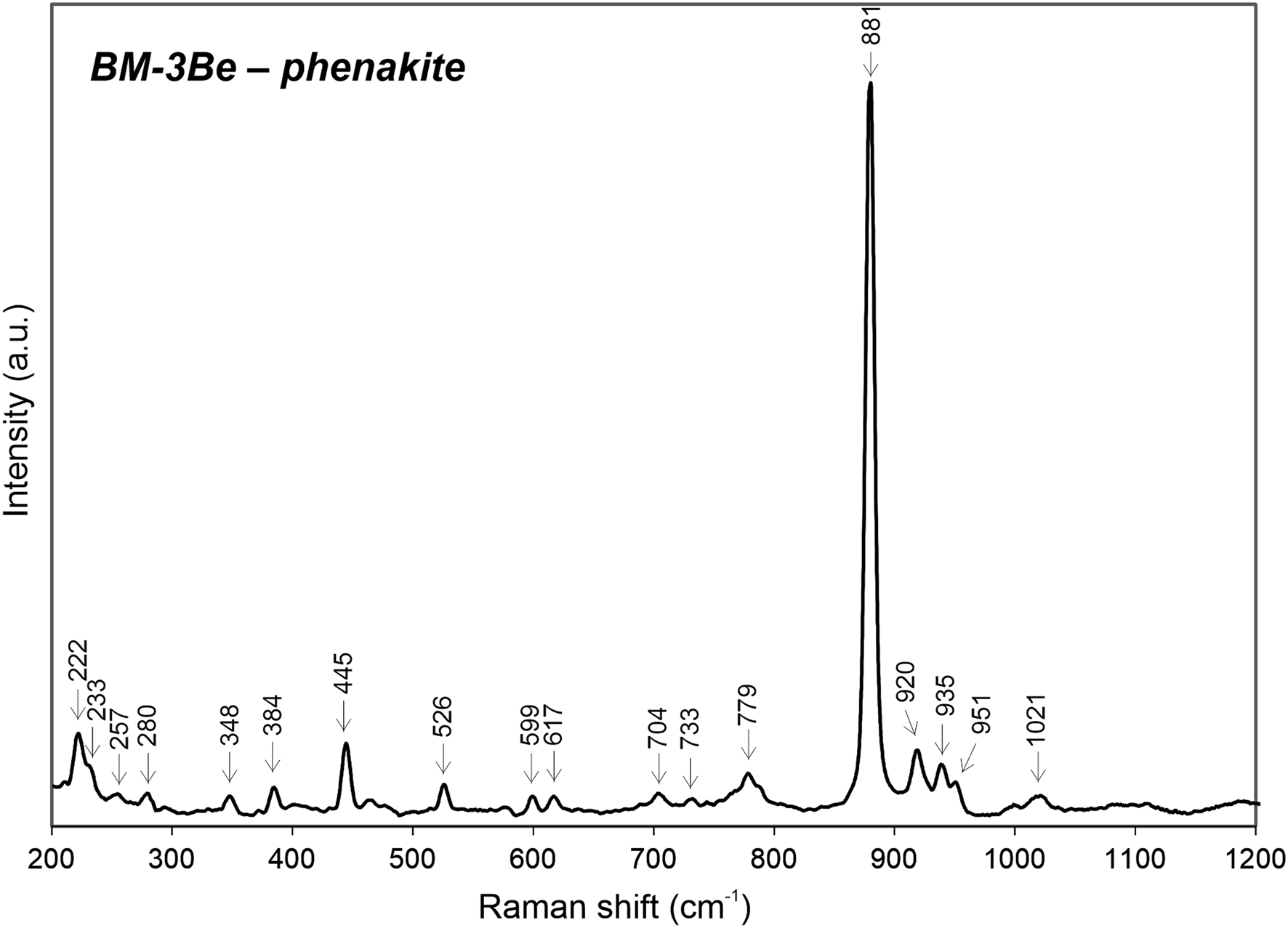
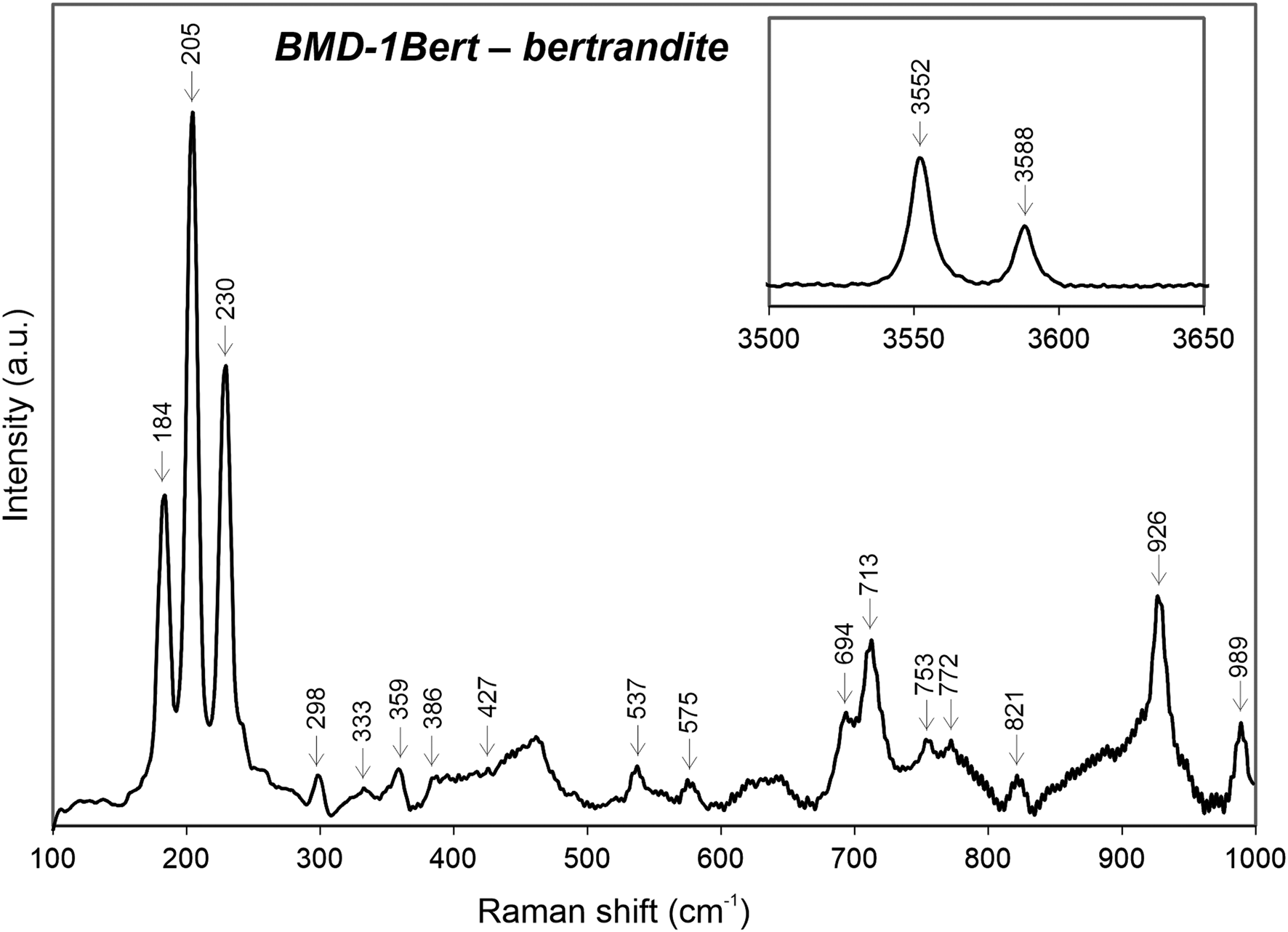
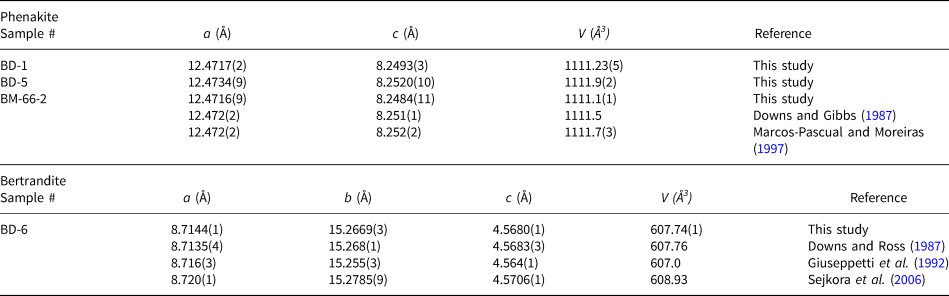
Both beryllium silicate breakdown products after beryl (phenakite and bertrandite) were confirmed by powder X-ray diffraction (pXRD) and in situ micro-Raman spectroscopy. The pXRD unit-cell parameters of both phenakite and bertrandite show excellent agreement with published results (Table 7). The micro-Raman spectra of representative phenakite and bertrandite samples are given in Figs 6 and 7; they are also in very good agreement with published data (Hofmeister et al., Reference Hofmeister, Hoering and Virgo1987).
In situ micro-Raman spectrum of phenakite, Bratislava, Rössler Quarry pegmatite (BRQ, sample BM-3Be).

In situ micro-Raman spectrum of bertrandite, Bratislava, Jezuitské Lesy pegmatite pegmatite (BJL, sample BMD-1).

Unit-cell parameters of phenakite and bertrandite from Bratislava, Líščia Stráň pegmatite (BLS locality; BD-1, BD-5, BD-6, BM-66-2 samples) with comparison to published data.

Discussion
Secondary minerals
Textural relationships indicate unambiguously a breakdown of primary magmatic beryl to secondary post-magmatic phenakite or bertrandite and associated quartz, muscovite and/or K-feldspar. Analogous subsolidus (hydrothermal) beryl alteration and its replacement by phenakite and/or bertrandite have been documented in numerous examples of granitic pegmatites and similar granite-related lithologies (e.g. Strand, Reference Strand1953; Vernon and Williams, Reference Vernon and Williams1960; Jonsson and Langhof, Reference Jonsson and Langhof1997; Markl and Schumacher, Reference Markl and Schumacher1997; Černý, Reference Černý and Grew2002; Palinkaš et al., Reference Palinkaš, Wegner, Cobić, Palinkaš, De Brito Barreto, Váczi and Bermanec2014; Zachař et al., Reference Zachař, Novák and Škoda2020).
Based on microtextures (Figs 2, 3) and mineral compositions (Tables 3−6), our study indicates that breakdown of beryl (Be3Al2Si6O18) to assemblages with phenakite (Be2SiO4), bertrandite [(Be4Si2O7(OH)2], muscovite [KAl3Si3O10(OH)2], K-feldspar (KAlSi3O8), and quartz (SiO2) most probably took place according to the following reactions:


The modified version of reaction (1) was suggested already by Barton and Young (Reference Barton, Young and Grew2002), and (4) by Strand (Reference Strand1953). Moreover, other reactions of beryl to phenakite or bertrandite breakdown have been suggested:


Reverse formation of beryl from phenakite in prograde regional metamorphism is proposed by the reaction:
 $$\eqalign{& {\rm 3}\;{\rm B}{\rm e}_2{\rm Si}{\rm O}_4 + {\rm 2}\;{\rm KA}{\rm l}_3{\rm S}{\rm i}_3{\rm O}_{10}({\rm OH})_2 + {\rm 9}\;{\rm Si}{\rm O}_2 \cr& = {\rm 2}\;{\rm B}{\rm e}_3{\rm A}{\rm l}_2{\rm S}{\rm i}_6{\rm O}_{18} + {\rm 2}\;{\rm KAlS}{\rm i}_3{\rm O}_8 \cr& + {\rm 2}\;{\rm H}_2{\rm O} \;({\rm Franz }\ {\it et}\ {\it al}{\rm .,}\ {\rm 1986};\;{\rm Barton}\;{\rm and}\;{\rm Young},\;{\rm 2002};\ &eqbreak; \vskip-0.7pc\quad\quad\quad{\rm Franz}\;{\rm and}\;{\rm Morteani},\;{\rm 2002}).}\quad\quad\quad\quad\quad\quad\quad\quad\qua\quad(8)$$
Beryl + K-feldspar, products of reaction 8, reacted with fluid during cooling to give muscovite + phenakite or bertrandite; however, due to the relatively small interval for phenakite stability in lower-temperature conditions, bertrandite + muscovite + quartz is the most common assemblage to replace beryl (Barton, Reference Barton1986). The hydrothermal alteration of beryl by aqueous solutions is considered as an important mechanism, where low solubility of Al2O3 and dissolution of BeO + SiO2 enables crystallisation of phenakite (Wang and Li, Reference Wang and Li2020). In some cases, deficiency or absence of quartz in the secondary mineral assemblage (Figs 2, 3) could be explained by partial or complete transport of Si probably in H4SiO4 form in the fluid/solution.
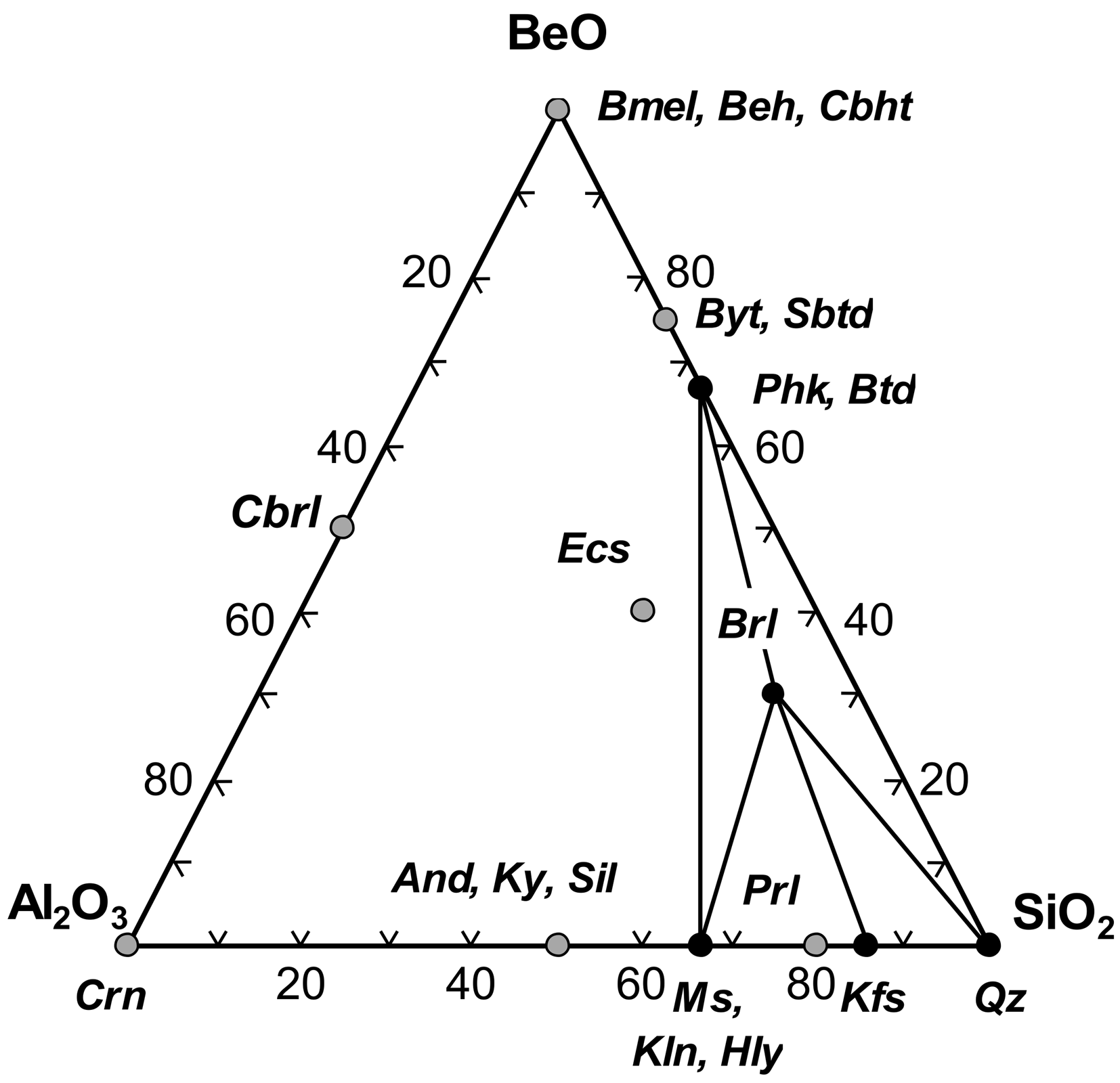
Beryl and its breakdown products form a SiO2–Al2O3–BeO–K2O mineral assemblage that can be projected from K2O onto the BeO–Al2O3–SiO2 plane (Fig. 8). The investigated pegmatite assemblages occupy a SiO2, BeO > Al2O3 part of the system, therefore Al2O3- and/or BeO-dominant phases deficient in SiO2 or lacking SiO2 (Al2SiO5 polymorphs, euclase, chrysoberyl, beryllite, sphaerobertrandite, bromellite, behoite and clinobehoite) are not stable here, and are thus missing from the mineral association investigated. Only compositions for pyrophyllite, Al2Si4O10(OH)2, lie within the assemblage field investigated (Fig. 8). The absence of pyrophyllite here could be explained by its instability in the presence of K-feldspar. The secondary minerals and proposed breakdown reactions (1−7) indicate a decomposition of primary beryl by aqueous fluid in the presence of K+ or with a simultaneous breakdown of associated primary K-feldspar (reaction 7). A relatively K-rich and Na-poor character of the fluid in Al2O3 + SiO2-saturated environment resulted in a precipitation of widely stable secondary muscovite or K-feldspar, absence of albite and the presence of a restricted number of newly formed Be phases (only phenakite or bertrandite). Moreover, the absence of beryllium secondary minerals rich in Na, Li, Rb, Cs, Ca, B, P and F such as: epididymite; eudidymite; bityite; bavenite; milarite; herderite; hurlbutite; and beryllonite, etc., indicate these elements (as cations or anions) have a negligible role in the fluid.
The BeO–Al2O3–SiO2–K2O system projected from K2O onto the BeO–Al2O3–SiO2 plane of identified (black circles) and other important minerals (grey circles). Ideal end-member mineral compositions are plotted. Mineral abbreviations include Brl (beryl), Phk (phenakite), Btd (bertrandite), Ms (muscovite), Kln (kaolinite), Hly (halloysite), Kfs (K-feldspar), Qz (quartz), Prl (pyrophyllite), Ecs (euclase), Byt (beryllite), Sbtd (sphaerobertrandite), Bmel (bromellite), Beh (behoite), Cbht (clinobehoite), Cbrl (chrysoberyl), And (andalusite), Ky (kyanite), Sil (sillimanite) and Crn (corundum, Al-oxide–hydroxides).

Textural patterns indicate a late origin for the clay phyllosilicate minerals (similar to Fe-dominant hydrobiotite, rarely beidellite, nontronite and saponite) and clinozoisite–epidote in the pegmatites. They are probably contemporaneous or younger minerals relative to phenakite and bertrandite. These minerals formed from primary Fe ± Mg-bearing pegmatite minerals such as garnet or biotite. The rare presence of a zeolite phase (gismondine-Ca), calcite, baryte and sulfides (pyrite, sphalerite and galena), also indicate their post-magmatic, hydrothermal origin.
P–T–X conditions for formation of phenakite and bertrandite
The stability range of beryl and its breakdown to phenakite, bertrandite or other Be-minerals and associated phases in the BeO–SiO2 ± Al2O3 ± P2O5 ± H2O ± F2O–1 system has been determined under various experimental P–T–X conditions (Ganguli and Saha, Reference Ganguli and Saha1967; Syromyatnikov et al., Reference Syromyatnikov, Makarova and Kupriyanova1972; Burt, Reference Burt1975, Reference Burt1978; Franz and Morteani, Reference Franz and Morteani1981, Reference Franz, Morteani and Grew2002; Hsu, Reference Hsu1983; Barton, Reference Barton1986; Markl and Schumacher, Reference Markl and Schumacher1997; Evensen et al., Reference Evensen, London and Wendlandt1999; Barton and Young, Reference Barton, Young and Grew2002; Wang and Li, Reference Wang and Li2020).
Phenakite was synthesised also at temperatures over 900 to 1500°C and from atmospheric up to ultra-high pressures of 4.5 GPa (Burt, Reference Burt1978; Franz and Morteani, Reference Franz, Morteani and Grew2002, and references therein). A magmatic, relatively high-temperature origin of phenakite ± beryl is also proposed for some granites (Schilling et al., Reference Schilling, Bingen, Skår, Wenzel and Markl2015) and granitic pegmatites (Rao et al., Reference Rao, Wang and Hu2011; Zachař et al., Reference Zachař, Novák and Škoda2020). However, textural relationships indicate a post-magmatic, medium- to low-temperature breakdown of beryl into phenakite in the Tatric pegmatites (Figs 2, 3). Such a subsolidus origin of phenakite is documented in several natural granite–pegmatite occurrences (e.g. Jonsson and Langhof, Reference Jonsson and Langhof1997; Markl and Schumacher, Reference Markl and Schumacher1997; Černý, Reference Černý and Grew2002; Zachař et al., Reference Zachař, Novák and Škoda2020). Medium- to low-temperature origin of phenakite at the expense of beryl (reactions 1−2 and 6) was also documented experimentally where beryl + K-feldspar + H2O is transformed into phenakite + muscovite + quartz (reversed reaction 8) under 270−340°C and ~10−250 MPa (Barton and Young, Reference Barton, Young and Grew2002).
The origin and stability field of bertrandite indicates only relatively low pressure–temperature conditions based on both experimental and natural data. Subsolidus, hydrothermal breakdown of pegmatite beryl to bertrandite is widespread in granitic pegmatites (e.g. Strand, Reference Strand1953; Vernon and Williams, Reference Vernon and Williams1960; Jonsson and Langhof, Reference Jonsson and Langhof1997; Markl and Schumacher, Reference Markl and Schumacher1997; Černý, Reference Černý and Grew2002; Palinkaš et al., Reference Palinkaš, Wegner, Cobić, Palinkaš, De Brito Barreto, Váczi and Bermanec2014), and its upper temperature stability is in the range of ~240 to 480°C (Ganguli and Saha, Reference Ganguli and Saha1967; Burt, Reference Burt1978; Hsu, Reference Hsu1983; Barton, Reference Barton1986; Franz and Morteani, Reference Franz, Morteani and Grew2002). Bertrandite is generally considered as a forming at a lower temperature than phenakite and it could be a product of phenakite hydration according to the reaction:

The boundary of this reaction is situated near 240−250°C over a very wide pressure range from ~10 to 800 MPa (Barton, Reference Barton1986; Barton and Young, Reference Barton, Young and Grew2002).
On the basis of the above-listed and our published data, we propose a post-magmatic, hydrothermal origin of beryl breakdown into phenakite and bertrandite in the presence of an aqueous fluid/solution. The proposed reactions (1−7) indicate the presence of K+ in the fluid or from the K-feldspar reactant. Experimental results also document precipitation of phenakite + albite or K-feldspar at the expense of beryl by NaCl/KCl water solutions (Parameshwaran, Reference Parameshwaran2016; Kurumathoor and Franz, Reference Kurumathoor and Franz2018). Černý (Reference Černý and Grew2002) suggested an acid to neutral character of such a solution (pH ~4 to 7), however, the resulting acidity is controlled by the K+/H+ activity ratio (Schilling et al., Reference Schilling, Bingen, Skår, Wenzel and Markl2015). Extensive alteration of beryl locally produced hexagonal prismatic vugs after leached beryl crystals (Bratislava, Líščia Stráň pegmatite) which indicate its dissolution into fluid/solution and partial transport of beryllium in the form of soluble Be2+-complexes and their eventual precipitation as phenakite or bertrandite druses in or nearby pegmatite cavities. Such dissolution and transport of Be is the most effective in the presence of increased fluorine activity as (BeF)+ to (BeF4)2– and (BeCO3F)– complexes at pH ≤ 7 (Wood, Reference Wood1992). However, the West-Carpathian pegmatites investigated generally lack F-rich minerals (such as topaz, fluorite, F-rich phosphates and micas); they contain only accessory fluorapatite. Therefore, more exact knowledge about the composition of the fluid/solution remains an open question.
Conclusions
The granitic pegmatites of the Tatric Superunit (Western Carpathians) document the subsolidus breakdown of primary magmatic beryl in the late post-magmatic, hydrothermal evolution stage. The breakdown products are phenakite and bertrandite, both Be-silicate phases without additional cations, in association with other alteration products, including muscovite, K-feldspar and quartz. Clay minerals (similar to Fe-dominant hydrobiotite, beidellite, nontronite and saponite), clinozoisite–epidote, and other minerals locally accompany the secondary assemblage. The beryl breakdown process is related to the circulation of hydrothermal K-bearing fluids or solutions, at temperatures estimated to be between ~400 and 200°C, and low pressure (generally ≤0.3 GPa). Phenakite formed at a higher temperature, followed by bertrandite. Hydrothermal breakdown of magmatic beryl to phenakite ± bertrandite is a relatively widespread process in granitic pegmatites during their late, subsolidus evolution.
Acknowledgements
We thank the staff of the electron-microprobe laboratory of the Dionýz Štúr State Geological Institute, Bratislava (P. Konečný, I. Holický, V. Kollárová) for their assistance in obtaining the compositional data and BSE images. The authors thank one anonymous reviewer and Jan Cempírek, Associate Editor Edward Grew, and Principal Editor Roger Mitchell for their constructive suggestions. The research was supported by the Ministry of Education, Science, Research and Sport of the Slovak Republic (grant numbers APVV-18-0065, VEGA-1/0137/20 and VEGA-1/0467/20); and the Ministry of Education, Youth and Sport of the Czech Republic (grant number SGS SP 2020/105).
Competing interests
The authors declare none.