Introduction
All psychotropic medications may cause unwanted effects (Lingjaerde et al., Reference Lingjaerde, Ahlfors, Bech, Dencker and Elgen1987). Among older persons, polypharmacy is common (Shah and Hajjar, Reference Shah and Hajjar2012). With aging, both the pharmacokinetics and the pharmacodynamics of medications change (Mangoni and Jackson, Reference Mangoni and Jackson2004), resulting in an increased risk of medication side effects (Turnheim, Reference Turnheim2004). Moreover, both a strong relationship between polypharmacy and psychiatric conditions (Tveito et al., Reference Tveito, Bramness, Engedal, Lorentzen, Refsum and Hoiseth2014), and between polypharmacy and negative clinical outcomes (Jyrkka et al., Reference Jyrkka, Enlund, Korhonen, Sulkava and Hartikainen2009; Maher et al., Reference Maher, Hanlon and Hajjar2014) has been observed. When medications are developed, older persons are under-represented (Konrat et al., Reference Konrat, Boutron, Trinquart, Auleley, Ricordeau and Ravaud2012) or, even, excluded from clinical research (McMurdo et al., Reference McMurdo, Witham and Gillespie2005), leading to less knowledge of the effects of medications in older people. Moreover, older patients are particularly prone to side effects of commonly used psychotropic medications (Masand, Reference Masand2000; Madhusoodanan and Bogunovic, Reference Madhusoodanan and Bogunovic2004; Mottram et al., Reference Mottram, Wilson and Strobl2006), and they are particularly susceptible to central nervous system effects (Trifiro and Spina, Reference Trifiro and Spina2011).
Medication side effects are difficult to assess, especially in older people, as signs of aging and functional decline due to other co-morbid disorders may overlap with medication side effects. To the best of our knowledge, the side effects of psychotropic medications in elderly psychiatric patients have not been comprehensively studied, except for studies of single medications or medication classes (Masand, Reference Masand2000; Kurzthaler et al., Reference Kurzthaler2001; Mottram et al., Reference Mottram, Wilson and Strobl2006), comparative studies (Allard et al., Reference Allard, Gram, Timdahl, Behnke, Hanson and Sogaard2004), and a recent study of side effects related to potentially inappropriate medications (Hefner et al., Reference Hefner2015). Studies on side effects in the elderly are needed because older psychiatric patients are at an increased risk of side effects due to polypharmacy and aging. More knowledge about the side effects of psychotropic medications, which are being utilized widely and also increasingly in the elderly (Lovheim et al., Reference Lovheim, Sandman, Kallin, Karlsson and Gustafson2008; Olfson et al., Reference Olfson, King and Schoenbaum2015), is of importance. Moreover, characterization of subgroups at highest risk for psychotropic side effects among older patients is of value when managing older psychiatric patients.
The UKU side effect rating scale was developed for use in psychotropic medication trials and clinical practice. It is a comprehensive rating scale with well-defined items, and it also contains a global assessment on how side effects of psychotropic medications may interfere with the patient's daily peformance (Lingjaerde et al., Reference Lingjaerde, Ahlfors, Bech, Dencker and Elgen1987).
The aim of this study was to use the UKU side effect scale to characterize patients who on admission to a geriatric psychiatric hospital had side effects that moderately or severely interfered with their daily performance.
Methods
Participants
This cross-sectional cohort study included all patients consecutively admitted to the Department of Geriatric Psychiatry at Diakonhjemmet Hospital in Oslo, Norway, during the study period between 2006, December 12 and 2008, October 24. The department admits patients aged ≥60 years from a catchment area of approximately 250,000 inhabitants, requiring hospital admission due to psychiatric illnesses. Patients are admitted to one of three wards, treating affective disorders, psychotic disorders, and psychiatric and behavioral symptoms of dementia, respectively. In Norway, psychiatric services are publically funded.
All patients admitted during the time period were invited to participate in the study. Exclusion criteria were as follows: patients admitted for planned electroconvulsive treatment; patients with a short expected stay (<7 days); and inability of patients and the next of kin to provide written informed consent.
Of 372 patients who were eligible for inclusion, 57 declined participation, 28 were unable to give informed consent and had no relative that could give consent on their behalf, and 40 patients withdrew their consent or were admitted to another department in the hospital during the study. The UKU side effect rating scale was missing in 30 patients, and for 11 patients other data were lacking, leaving a total of 206 patients (55%) with analyzable data in this study.
Assessments
The UKU side effect rating scale was developed by The Committee on Clinical Investigations, a standing committee under the Scandinavian Society of Psychopharmacology, for use in medication trials and clinical practice (Lingjaerde et al., Reference Lingjaerde, Ahlfors, Bech, Dencker and Elgen1987). The scale consists of 61 defined items describing psychic, neurological, autonomic, cardiovascular and other side effects, and a global score. The scoring in this study was based on all relevant available information, both based on patient report, physicians’ observations and reports from the ward personnel. The UKU subscores cannot be used for deriving a meaningful total side effect score, but a total side effect evaluation is of interest. Therefore, a four-point Likert-scale global score was added to evaluate the influence that the patient side effect could have on the patient's daily performance. For the present study, the patients were divided into two groups according to the global score: (1) patients with no or minor side effects, defined as “none” or “mild,” (2) patients with major side effects, defined as “moderate” or “severe” (effect on daily performance). The UKU side effect rating scale was performed on admission to the hospital by the treating physician.
The Mini Mental Status Evaluation (MMSE) (Folstein et al., Reference Folstein, Folstein and McHugh1975) was carried out on admission. The scale consists of 20 items, has a minimum score of 0 and a maximum score of 30. A higher score denotes better cognition. We also used the Charlson Comorbidity Index, a weighted index that measures somatic comorbidity and that takes into account the number and the seriousness of comorbid diseases (Charlson et al., Reference Charlson, Pompei, Ales and MacKenzie1987). The Charlson Index was scored based on all available medical information, and a higher score indicates more comorbidity.
The psychiatric diagnoses of the patients were recorded upon discharge. They were given by the physician responsible for the patient during the hospital stay and were based on all available information obtained during the patient's stay. Four main diagnostic categories were created for this study: dementia; affective disorders; psychosis; and other psychiatric diagnoses. The category “other diagnoses” included mainly personality disorders, alcohol or drug dependency, and organic causes of psychiatric symptoms (including patients with delirium).
Medication use and serum analysis
The referring physician's information of the patient's medication use was registered on admission. Serum samples were collected in the morning on the day after admission, before any morning medication was given to detect levels of 56 psychotropic medications, including all antidepressants and antipsychotics with market authorization in Norway, as well as the most commonly prescribed anticonvulsants and benzodiazepines, in all patients (Tveito et al., Reference Tveito, Bramness, Engedal, Lorentzen, Refsum and Hoiseth2014). The serum samples were analyzed at the Center for Psychopharmacology, Diakonhjemmet Hospital, Oslo, Norway. An ultra-performance liquid chromatography-mass spectrometry (UPLC-MS/MS) method, developed for routine therapeutic drug monitoring (TDM) at the Center for Psychopharmacology, was applied for the analyses of all medications, except for lithium. Lithium was analyzed using an ion-selective electrode measurement. Validation parameters for imprecision and inaccuracy were <15% for all analyses. All of the analytical assays were validated and certified for routine TDM. The laboratory has been accredited since 2007, NS-EN ISO 15189 Medical laboratories, particular requirements for quality and competence. A supra-therapeutic concentration of a medication was defined as “above the reference range,” as defined for each specific medication by the Center for Psychopharmacology. Unreported use was defined as use of one or more psychotropic medications detected in serum that was not reported by the referring physician.
Routine blood screen
Routine blood tests were performed in all patients on admission to hospital. The blood screen included a total of 27 standard items (see appendix), of which 26 were analyzed at the hospital's biochemical department. The tests included measurements of different haematological parameters, renal and liver function, markers of infection, concentration of vitamin B-12 and folic acid, electrolytes and glucose. Prolactin was analyzed at the endocrinological laboratory of Aker University Hospital, Oslo.
Ethics
The study was approved by the Regional Committee for Research Ethics in Norway and the Norwegian Medicines Agency. All patients or their next of kin (if the patients did not have the capacity to consent on their own) signed the informed consent form before participating in the study.
Statistical analysis
IBM SPSS® Software version 22.0 (SPSS Inc., Chicago, IL, USA) was used for all statistical analyses. Mean values and standard deviation (SD) were calculated for continuous variables, and frequency distributions were reported for categorical variables. For comparison between groups, independent Student's t-test was used for continuous variables and χ 2was used for categorical variables.
For the comparison of characteristics between the patients experiencing major side effects (moderately to severely impairment of daily performance) or minor side effects (mild or no impairment of daily functioning), a direct multiple logistic regression analysis was performed. Whether or not the patients had major side effects was entered as the dependent variable. Included in the regression analysis were 203 patients, three patients were missing due to lack of serum analysis and information on unreported use of psychotropic medication. First, analyses were made without any correction (presented as unadjusted values). Then, adjusted analyses were performed. Covariates, other than age and gender, were included if the variables differed between the two groups with a p-value < 0.1 in bivariate analysis. Only the total number, not the subgroups of psychotropic medications were included, as it would have been impossible disentangle the individual contribution of specific medication groups. Age, gender, main diagnosis of affective disorder, main diagnosis of dementia, total number of psychotropic drugs, total number of somatic drugs, sum of the Charlson comorbidity index, and unreported use of psychotropic drugs were entered as covariates. Main diagnosis of psychosis was not included, as no patient in this diagnostic group had major side effects.
Results
Of the 206 patients included in the analysis (mean age: 77.6 ± 8.9 years, female sex = 71.4%), 70 (34%) had major side effects as per the UKU assessment, and 69 (99%) of these used psychotropic medications. A total of 136 patients (66%) had none or mild side effects as per the UKU assessment (hereafter referred to as no/minor side effects), and 24 out of 25 patients not using psychotropic drugs on admission were in this group.
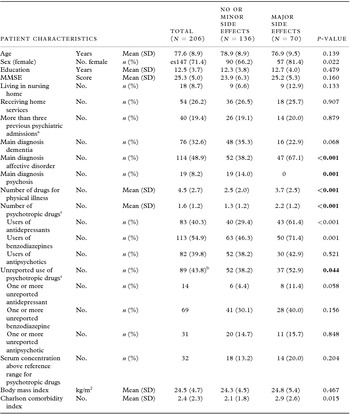
Patient characteristics for the total group are shown in Table 1. The patients with major side effects differed significantly in bivariate analyses regarding several characteristics from the patients with no/minor side effects. Patients with major side effects were more often women (p = 0.022), more likely to have a main diagnosis of affective disorder (p < 0.001), used a higher number of medications for physical disorders (p < 0.001), used a higher number of psychotropic medications (p < 0.001), had more unreported use of psychotropic medications (p = 0.044), and had more physical comorbidity measured by the Charlson comorbidity index (p = 0.015). For the psychotropic medications and unreported use, information on the three largest groups of medications is included in the table, with both use of and unreported use of benzodiazepines being most frequent.
Characteristics of 206 patients admitted to the department of geriatric psychiatry, Diakonhjemmet Hospital, divided into those with no or minor versus major side effects

aPrevious admissions to a psychiatric hospital. bBased on number of patients with serum analysis, n = 203. cIn total number of psychotropic drugs and unreported use of drugs, lithium and antiepileptics are included. Bolded values: p < 0.05, all characteristics with a p-value < 0.1 were included in further analyses (except from sub-group variables).
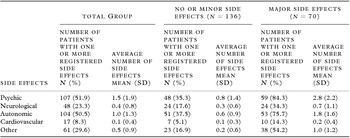
Table 2 shows the frequency of side effects, grouped into five main categories: psychic, neurological, autonomic, cardiovascular, and other side effects. The most frequent side effects for the total group were psychic and autonomic side effects, with 107 and 104 patients experiencing these, respectively. The mean number of side effects was highest for the psychic side effects (1.5 ± 1.9). The five most common side effects considered as possible or probable were: asthenia (31%), reduced salivation (31%), concentration difficulties (28%), memory impairment (24%), and orthostatic dizziness (18%).
Probable and possible side effects for the total group, measured by the UKU side effect rating scale divided into the five main categories: Psychic, neurological, autonomic, other, and cardiovascular side effects

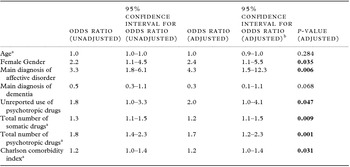
Table 3 shows the results from the multiple logistic regression analysis assessing the association between different patient characteristics and major versus no/minor side effects. After multivariable correction, characteristics that were significantly and independently associated with major side effects included female gender (OR = 2.4, 95% CI = 1.1–5.5), main diagnosis of affective disorder (OR = 4.3, 95% CI = 1.5–12.3), unreported use of psychotropic medications (OR = 2.0, 95% CI = 1.0–4.1), a higher number of reported psychotropic medications (OR = 1.7, 95% CI = 1.2–2.3), a higher number of reported medications for physical illnesses (OR = 1.2, 95% CI = 1.1–1.5), and higher score on the Charlson comorbidity index (OR = 0.2, 95% CI = 1.0–1.4). The total variance explained by this model was 23.8% (p < 0.001).
Logistic regression analysis of the predictive ability of patient characteristics for presence of side effects interfering moderately or markedly with the patient's daily performance (UKU Global assessment)

Bolded values: p < 0.05, a continuous variables, badjusted for age, sex, diagnosis of affective disorder and dementia, unreported use of psychotropic drugs, total number of somatic and psychotropic drugs, and Charlson comorbidity index. All covariates had a p-value < 0.1 in bivariate analyses, table 1.
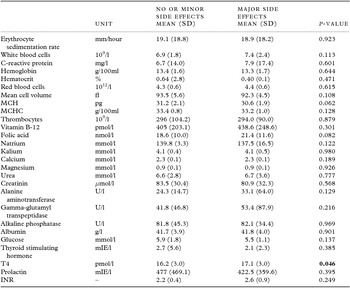
There were no differences between patients with no/minor compared to major side effects for any of the performed 27 blood tests, except for thyroxin concentration (16.2 ± 3.0 for the no/minor side effect group versus 17.1 ± 3.0 in the major side effect group). The detailed results are shown in table 4.
Results from routine blood-screen on admission, with results divided in no or minor and major side effects and compared between the two groups, n = 206

Bolded values: p < 0.05.
Discussion
Our study of 206 older psychiatric patients with an average age of 78 years admitted to a geriatric psychiatric hospital showed that female gender, main diagnosis of affective disorder, physical comorbidity, a higher number of both psychotropic and somatic medications, and unreported psychotropic medications use were each independently associated with having major side effects that interfered moderately or severely with the patients’ performance.
As for the specific psychiatric disorders, only a main diagnosis of affective disorder was significantly associated with experiencing severe medication side effects. Physical symptoms of depression or increased burden of physical complaints due to depression can be a diagnostic challenge in older patients with medical comorbidities (Drayer et al., Reference Drayer2005). We have previously shown that patients with affective disorders also used more psychotropic medications compared to the rest of the patients (Tveito et al., Reference Tveito, Bramness, Engedal, Lorentzen, Refsum and Hoiseth2014), which can increase the risk of side effects, although having an affective disorder and the number of psychotropic medications were each independently associated with more major side effects in the adjusted analysis.
In medicine in general, and in psychiatry in particular, it can be difficult to distinguish between side effects of psychotropic medications and the clinical symptoms of the disorder for which the medication is given (Lingjaerde et al., Reference Lingjaerde, Ahlfors, Bech, Dencker and Elgen1987; Mihanovic et al., Reference Mihanovic, Bodor, Kezic, Restek-Petrovic and Silic2009). Side effects are perhaps especially important to consider in older psychiatric patients, since use of psychotropic drugs is highly prevalent on admission to a psychiatric hospital, as we have previously found that nine out of ten patients used one or more psychotropic drug on admission (Tveito et al., Reference Tveito, Bramness, Engedal, Lorentzen, Refsum and Hoiseth2014). Since older patients have more physical comorbidities and use more medications in general, the complexity of an already difficult assessment is further enhanced. The Charlson comorbidity index has been shown to be useful as a prognostic factor for (re)hospitalization and survival in several somatic illnesses (Kobayashi et al., Reference Kobayashi2011). In older persons with mental disorders, physical comorbidity is particularly important to consider when assessing side effects of medications. Our study showed that patients with more comorbidities suffered more from major side effects. Notably, it was not possible to identify these patients by the routine biochemical blood screen on admission. There were no differences between patients with no/minor side effects and major side effects in any of the analyses, except for thyroxin, for which there was a minimal statistical difference with mean differences that are not considered clinically relevant. Moreover, the difference in thyroxin concentrations would not be significant after a correction for multiple testing (e.g. Bonferroni correction). Such a correction would be appropriate when analyzing 27 blood test results.
The present study supports previous publications showing more severe side effects in women than in men (Rademaker, Reference Rademaker2001; Barbui et al., Reference Barbui2005). Women differ from men both in incidence and presentation of side effects associated with psychotropic drugs, with a higher risk of weight gain and endocrinological side effects (Haack et al., Reference Haack, Seeringer, Thurmann, Becker and Kirchheiner2009). This difference may partly be due to higher serum concentrations in women when corrected for dose (Waade et al., Reference Waade, Molden, Refsum and Hermann2012), but a female vulnerability to neurological side effects has also been described (Bonelli et al., Reference Bonelli2005). In a study of tolerability of antipsychotic medications, sex was the strongest determinant of the overall subjective tolerance, with women reporting reduced tolerability (Barbui et al., Reference Barbui2005).
To our surprise, we did not find increasing age to be associated with having more major side effects, at least not within an elderly population. The relationship between age and increased sensitivity to medications has a clinical and theoretical basis (Uchida et al., Reference Uchida, Mamo, Mulsant, Pollock and Kapur2009). Clinical guidelines recommend lower dosing for the older persons (Alexopoulos et al., Reference Alexopoulos, Streim, Carpenter and Docherty2004), but few trials have directly compared older patients with younger patients (Uchida et al., Reference Uchida, Mamo, Mulsant, Pollock and Kapur2009). A study of serum levels of antidepressants showed that although dose correction of serum concentrations were made, the levels in the older patients comparable to younger patients were higher (Waade et al., Reference Waade, Molden, Refsum and Hermann2012). At the same time, in this population, serum levels above reference range for psychotropic drugs were not so common, and showed no association to major side effects. The explanation for the failing association between age and side effects could be that the present study was not designed to investigate the effects of age, and all the included patients were 60 years or older, restricting the age range within which differences would be observed. Also, a measure of frailty could have provided additional information on which patients are prone to side effects.
Our finding of an association between major side effects and a high number of psychotropic and somatic medications is consistent with previous studies that found a direct relationship between polypharmacy and medication complications in the ambulatory setting (Gandhi et al., Reference Gandhi2000; Gurwitz et al., Reference Gurwitz2003). The present study indicates that polypharmacy is a risk factor for more severe side effects in geriatric psychiatric patients. This finding should be a reminder for clinicians that polypharmacy should be minimized as much as possible. However, reducing polypharmacy is not a trivial matter, as physical comorbidity that is common, as measured by the Charlson index in our study, and that often requires additional medication use was also independently associated with a higher risk of major effects. Thus, a reduction of the treatment of physical disorders might increase the severity of these conditions, which may in turn increase the vulnerability to side effects.
Unreported use of psychotropic medications was also a risk factor for more severe side effects. To the best of our knowledge, our study is the first to assess and report this association. It is possible that patients with unreported use of psychotropic medications do not use these medications according to recommendations, which may make it more probable that major side effects occur. Alternatively, patients who were older and more brittle or cognitively impaired may have forgotten to report to their referring doctor all the medications that they took. Also, differences between the medications mentioned in the referral letter and what is actually being prescribed are not uncommonly found in clinical practice, and use of multiple sources would have provided valuable information. At the same time, we previously observed in this population that only in 11% of patients the psychotropic drugs that were reported as prescribed by the referring physician as were not detected in the patients’ serum (Tveito et al., Reference Tveito, Bramness, Engedal, Lorentzen, Refsum and Hoiseth2014), indicating that adherence was good.
The results of this study need to be interpreted within its limitations. This was a cross-sectional study of a heterogeneous sample of older patients admitted to a psychiatric hospital. In the analyses, we used the number of reported psychotropic medications, being aware that the drug analysis revealed use of unreported medications (Tveito et al., Reference Tveito, Bramness, Engedal, Lorentzen, Refsum and Hoiseth2014). Physical conditions as well as medications for physical disorders are possible contributors to the assessed side effects, and as the concentration of these medications were not measured in serum, we chose to study the number of reported medications, correcting for use of unreported psychotropic medications in the analysis. Further, different physicians performed the UKU side effect rating scale. Although all were experienced clinicians, and were trained to use the rating scale, this may have introduced inter-rater variability. This was not formally tested. There is also a risk of bias in the assessment in the direction of expected associations between psychotropic medications and side effects. Additionally, the use of multiple medications makes it difficult to distinguish the side effect contribution of each medication. The best way to study side effects would be to administer the UKU side effect scale before starting a new medication, but in an elderly population, nearly all patients already use multiple psychotropic medications upon admission to our geriatric psychiatric hospital. Finally, patients admitted to a hospital are a selected population, likely biasing the sample to a more severely ill population. On the other hand, only consenting patients or those with a next of kin were included. Finally, although we did not use a severity grading of the side effects, we believe that the global score, where impact on daily functioning is considered, is a clinically very valuable and valid measure of the clinical consequences of side effects for the patients.
Despite these limitations, strengths of this study include the fact that a consecutive sample was assessed, that a formal rating scale, the UKU, was administered to all patients before the global score was assigned, and that comprehensive safety laboratory tests, as well as uniquely, psychotropic drug levels were measured. Moreover, since the UKU rating scale evaluates how side effects interfere with the patients’ daily performance, this assessment is perhaps a more clinically relevant assessment compared to those only considering symptoms, especially in the elderly, where performance of daily living skills is of particular importance.
In conclusion, we were able to identify a number of patient, illness, and treatment factors that were independently associated with major side effects in geriatric psychiatric patients. Based on these results, clinicians should be especially aware of side effects in geriatric psychiatric female patients with a high use of psychotropic and somatic medications and physical comorbidity. Since unreported use of psychotropic medications was also significantly related to the risk for more severe side effects, clinicians should ascertain all medications taken by geriatric psychiatric patients in order to avoid drug–drug interactions and devise the most appropriate treatment plan.
Conflicts of interest
During the past 36 months, Dr. Correll has been a consultant and/or advisor to or has received honoraria from: AbbVie, Actavis, Actelion, Alexza; Alkermes, Bristol-Myers Squibb, Cephalon, Eli Lilly, Genentech, Gerson Lehrman Group, IntraCellular Therapies, Janssen/J&J, Lundbeck, Medavante, Medscape, Merck, Otsuka, Pfizer, ProPhase, Reviva, Roche, Sunovion, Supernus, Takeda, Teva, and Vanda. He has received grant support from Bristol-Myers Squibb, Janssen/J&J, Novo Nordisk A/S, Otsuka, and Takeda. The other authors declare no conflicts of interest.
Description of authors’ roles
M. Tveito collected data, performed the statistical analysis and wrote the article. B. Lorentzen and H. Refsum designed the study, collected data and assisted with writing the paper. K. Engedal, J. Bramness, and C. Correll assisted with writing the paper. G. Høiseth assisted in the statistical analysis and in writing the paper.