Introduction
One of Kant's lasting contributions to epistemology was to demonstrate the presence of a priori elements in empirical knowledge. However, grave doubts have been cast on the Kantian enterprise since later mathematics and physics have rejected some key elements of what Kant had regarded as a priori knowledge. In this paper, I propose a way forward in updating Kantian transcendental arguments in order to open up the a priori to adaptations to particular epistemic circumstances. My proposal is to identify transcendental arguments that have contingent conditions, in the following form: ‘If we want to engage in a certain epistemic activity, then we must presume the truth of some particular metaphysical principles’.
I am not a Kant scholar, and this paper is not intended as an exegesis of any works of Immanuel Kant. Rather, what I want to do is to take some central insights from Kant's work and adapt them freely to give them more immediate relevance to contemporary philosophy of science.
Aside from explaining my own proposal, I would like to draw a comparison-and-contrast with Michael Friedman's notion of the relativized a priori. I also want to trace an affinity between my proposal and C. I. Lewis's system of ‘conceptual pragmatism’, in which he advances a ‘pragmatic conception of the a priori’. I will in fact begin with a critical exposition of Friedman's and Lewis's ideas in the first part of the paper. Then I will move on to my own ideas.
Part A. What to do about the instability of metaphysics: Friedman and Lewis
It is regrettable that Kant fell into the trap of thinking that systems of knowledge like Euclidean geometry and Newtonian mechanics were necessarily and universally true. Looking at Kant from a little distance makes one thing clear: his location in the Newton-enraptured eighteenth century must have exerted a strong hold on his imagination. This Kantian predicament is uncomfortably close to Philipp Frank's assessment of the poverty of philosophical opposition to new scientific ideas: what parade as deep metaphysical truths are often simply ‘petrified’ remains of outdated scientific theories. In Frank's view, science needs to educate metaphysics, not vice versa.Footnote 2
Kant was, of course, not alone in this sort of error; there are many other cases from the history of science showing the pernicious effect of metaphysical beliefs that are leftovers from earlier scientific theories. In his opposition to orthodox quantum mechanics, Albert Einstein pleased himself by declaring that ‘God does not play with dice’; but how did he have this (not only direct but apparently exclusive) access to God, while Niels Bohr would seem to have been denied the direct telephone line? Erwin Schrödinger's objection to quantum jumps, the Cartesians’ objection to Newtonian action at a distance, and other similar cases all illustrate the same point. Scientific reactionaries protest that a new theory does not make sense, that it is unintelligible; these cries of unintelligibility cease to resonate with new generations of scientists, who grow up with the new theory and find it just as intelligible (or unintelligible) as any other theory.Footnote 3 If metaphysics is to serve as a guide for scientific work, we must try to do something about the lack of stability displayed by metaphysical beliefs.
A1. Michael Friedman's historicized universalism
It is in this connection that Friedman's pioneering work on a Kantian interpretation of scientific change has been so important. Friedman stresses the hidden continuity in scientific change, even revolutionary change. Accepting the basic historical reality of Kuhnian paradigm shifts, Friedman still detects continuity and progress at the level of constitutive principles. In The Dynamics of Reason, toward the end of the third lecture, Friedman issues quite a strong and definite prescription on how scientific change should be made:
How is it possible to venture a transformation of our present constitutive principles resulting in a genuine conceptual change or shift in paradigm? How, more specifically, can the proposal of a radically new conceptual framework be, nonetheless, both rational and responsible? In accordance with our threefold perspective on inter-paradigm convergence we can now say the following: first, that the new conceptual framework or paradigm should contain the previous constitutive framework as an approximate limiting case, holding in precisely defined special conditions; second, that the new constitutive principles should also evolve continuously out of the old constitutive principles, by a series of natural transformations; and third, that this process of continuing conceptual transformation should be motivated and sustained by an appropriate new philosophical meta-framework, which, in particular, interacts productively with both older philosophical meta-frameworks and new developments taking place in the sciences themselves.Footnote 4
When paradigm change is made in this way, we can have ‘a convergent sequence of successive frameworks or paradigms, approximating in the limit (but never actually reaching) an ideal state of maximally comprehensive communicative rationality in which all participants in the ideal community of inquiry agree on a common set of truly universal, trans-historical constitutive principles’.Footnote 5
Some questions must be raised about this universalizing picture of inquiry and scientific progress presented by Friedman. Why are universality and trans-historicity taken for granted as ideals we must all aspire to? Universality is clearly something that Kant himself aspired to, and Friedman's text perhaps reveals an unquestioning acceptance of Kantian universalism even as he renounces the immutability of Kantian categories. But in this ‘post-modern’ age, we cannot escape the pluralist question: what would be so wrong with having different parts of the human epistemic community pursuing the study of nature on the basis of different sets of constitutive principles? Would that not be more in keeping with the promotion of human freedom? And would having multiple lines of inquiry not be more conducive to more discoveries being made and preserved? There is at least a serious debate to be had about these questions.Footnote 6 Paul Feyerabend, Karl Popper and others detested Kuhn's view of normal science for its insistence on the monopoly enjoyed by the ruling paradigm within a given scientific discipline, but Kuhn at least allowed different sorts of paradigms for different scientific fields. It seems that Friedman's ideal does not allow that plurality; instead, there seems to be an expectation that mathematical physics must provide the constitutive principles that all other sciences must build on.Footnote 7
Similarly, when it comes to trans-historicity, why is it that a new conceptual framework or a new set of constitutive principles should be tied to the existing one so closely as Friedman dictates? The empiricist impulse would be to say that there is nothing wrong with abrupt change as long as the new set of constitutive principles come with appropriate theories that account for observed phenomena, phenomena as framed through the new constitutive principles. And is it impossible that we may actually achieve better results by introducing new constitutive principles in a discontinuous way, when the results are judged by various criteria such as empirical adequacy, useful applications, simplicity, explanatory power, etc.? These sentiments underlie the argument by Frank mentioned above, and they receive the boldest expression in Feyerabend's argument for ‘counter-induction’ as a method of escaping from the grip of an old cosmology.Footnote 8
A2. C. I. Lewis on the pragmatic a priori
In trying to formulate my own answers to all those questions, I find the work of Clarence Irving Lewis very helpful.Footnote 9 Lewis was a curious kind of Kantian, who reportedly said: ‘I am a Kantian who disagrees with every sentence of the Critique of Pure Reason.’Footnote 10 His best-known work, the 1929 book titled Mind and the World Order, will be the focus of my attention here.Footnote 11 In an apparently anti-Kantian move, Lewis denies that there are any synthetic a priori principles. He declares: ‘The a priori is not a material truth, delimiting or delineating the content of experience as such, but is definitive or analytic in its nature’.Footnote 12 For him, all a priori principles follow from the nature of the concepts we choose to craft and use:
The paradigm of the a priori in general is the definition. It has always been clear that the simplest and most obvious case of truth which can be known in advance of experience is the explicative proposition and those consequences of definition which can be derived by purely logical analysis. These are necessarily true, true under all possible circumstances, because definition is legislative.Footnote 13
He adds: ‘the powerful sweep and consequence of purely logical analysis has not been understood. The clearest example of this power of analysis is to be found, of course, in mathematics. The historical importance of mathematics as a paradigm of a priori truth needs no emphasis’.Footnote 14 And yet, Lewisian a priori principles in science are not mere tautologies; they do serve as significant laws of nature, in a way that I think is perfectly consonant with Friedman's views on what constitutive principles do. Interestingly, Lewis chose Einstein's definition of simultaneity in special relativity to help make his point about the role of definitions:
As this example well illustrates, we cannot even ask the questions which discovered law would answer until we have first by a priori stipulation formulated definitive criteria. Such concepts are not verbal definitions nor classifications merely; they are themselves laws which prescribe a certain behaviour to whatever is thus named. Such definitive laws are a priori; only so can we enter upon the investigation by which further laws are sought.Footnote 15
A3. Friedman vs. Lewis on the a priori
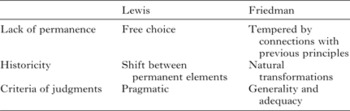
A very instructive comparison and contrast can be drawn between Friedman's and Lewis's views of the a priori. There are three points that I would like to highlight, summarized in Table 1.
Friedman and Lewis on the a priori

Lewis recognizes, as does Friedman, that ‘there will be no assurance that what is a priori will remain fixed and absolute throughout the history of the race or for the developing individual’. What he emphasizes in that situation is the freedom of the human inquirer: ‘If the a priori is something made by the mind, mind may also alter it’; and ‘the determination of the a priori is in some sense like free choice and deliberate action’.Footnote 16 In fact he seems to take it as definitive of the a priori that it ‘has alternatives’,Footnote 17 and maintains that an aspect of our mind about which we truly have no choice would not even be recognized at all.Footnote 18 For Lewis, ‘The necessity of the a priori is its character as legislative act. It represents a constraint imposed by the mind, not a constraint imposed upon mind by something else’.Footnote 19 There may be no direct contradiction between Lewis's remarks and Friedman's statements about the a priori, but the difference of emphasis is very clear. Even when Lewis quotes Einstein, which he does at length, it is only to hear Einstein concluding that the definition of simultaneity in special relativity is ‘a stipulation which I can make of my own free-will’.Footnote 20 Lewis's emphasis on the freedom of choice tends to go against, or at least allow a deviation from, the universalizing aspect of Friedman's prescription, which I have noted as less than compelling.
On the other hand, Lewis's liberal notion of the a priori can actually provide more stability to knowledge than achievable under Friedman's scheme. Because the Lewisian a priori is analytic, its truth is fixed and not subject to re-evaluation. As Lewis puts it: ‘That only can be a priori which is true no matter what’.Footnote 21 So, while Friedman accommodates historical change by demanding an orderly transformation of a priori principles, Lewis does it by allowing changes in preferences among all available conceptual structures, each of which remains fixed. When Lewis says that the a priori can be altered by the mind, he does not mean that each given a priori principle can change its content; rather, we switch our allegiance from one to another, as we do when we elect a new political leader. Confusion may be created by the same word being used to denote what are actually different concepts, as Kuhn showed so nicely with historical examples like the term ‘planet’ before and after the Copernican Revolution and the term ‘mass’ in classical mechanics and special relativity. We should not mistake such verbal confusion as something profound about the nature of the a priori. Along with the permanence of each version of a priori knowledge, also comes the permanence of empirical knowledge, once it has been achieved:
New ranges of experience such as those due to the invention of the telescope and microscope have actually led to alteration of our categories in historic time. The same thing may happen through more penetrating or adequate analysis of old types of experience—witness Virchow's redefinition of disease. What was previously regarded as real—e.g., disease entities—may come to be looked upon as unreal, and what was previously taken to be unreal—e.g., curved space—may be admitted to reality. But when this happens the truth remains unaltered and new truth and old truth do not contradict. Categories and concepts do not literally change; they are simply given up and replaced by new ones.Footnote 22
Finally, Lewis is adamant that the choice of a priori principles, right down to the principles of logic,Footnote 23 are made by pragmatic criteria:
while the a priori is dictated neither by what is presented in experience nor by any transcendent and eternal factor of human nature, it still answers to criteria of the general type which may be termed pragmatic. The human animal with his needs and interests confronts an experience in which these must be satisfied, if at all. Both the general character of the experience and the nature of the animal will be reflected in the mode of behavior which marks this attempt to realize his ends. This will be true of the categories of his thinking as in other things. And here, as elsewhere, the result will be reached by a process in which attitudes tentatively assumed, disappointment in the ends to be realized, and consequent alteration of behavior will play their part.Footnote 24
Lewis adds:
If we were jelly-fish in a liquid world, we should probably not add at all, because the useful purposes served by such conceptions would be so slight. Still if some super-jelly-fish should invent arithmetic by a jeu d'esprit (as Hamilton invented quaternions) he would find nothing in any possible experience to controvert it, and he might with some profit apply it to his own distinct ideas.Footnote 25
Contrast this with Friedman's criteria in judging the goodness of the transformations of constitutive principles: ‘we can thus view the evolution of succeeding paradigms or frameworks as a convergent series, as it were, in which we successively refine our constitutive principles in the direction of ever greater generality and adequacy’.Footnote 26 And although we are not in possession of ‘truly universal principles of human reason’, we can imagine ‘that our present constitutive principles represent one stage of a convergent process, as it were, in that they can be viewed as approximations to more general and adequate constitutive principles that will only be articulated at a later stage’.Footnote 27 I would again question the undisputed desirability of generality, and I am not sure what exactly Friedman means by the ‘adequacy’ of a constitutive principle. Adequacy may cover, in part, what Lewis means by pragmatic criteria. What is more certain is the affinity between Lewis's views and Poincaré’s conventionalism. Lewis says that although a priori principles cannot be rendered false come what may, ‘If experience were other than it is, the definition and its corresponding classification might be inconvenient, useless, or fantastic….’Footnote 28 In a wording strongly reminiscent of Poincaré, Lewis notes that the pragmatic choices are ‘questions of convenience or of value’.Footnote 29
Part B. Metaphysical principles and epistemic activities
B1. The connection between metaphysical principles and epistemic activities
Having made a brief review of Friedman's and Lewis's ideas on how to accommodate historical change in the realm of a priori knowledge, I am now ready to present my own ideas. And here I must begin with a brief complaint about Lewis: I think his pragmatism does not go far enough to deliver the full potential of his approach. He does consider what knowledge can do for ‘the human animal with his needs and interests’; however, in his conception of knowledge itself he is for the most part traditional, seeing it as an abstract system consisting of concepts, laws, and empirical statements. What I would like to do is make a full development of Lewis's idea of the ‘pragmatic a priori’. I propose to carry Lewis's major insights into an analysis of knowledge as a process of inquiry, which consists of ‘epistemic activities of an embodied and conceptualizing subject’, to use a phrase from Alirio Rosales.Footnote 30 My line of thinking is also highly consonant with Marjorie Grene's revision of Kant with an emphasis on the knower as an agent.Footnote 31 Taking Lewis at his word when he says that the a priori is pragmatic, I see a priori principles as necessary conditions for carrying out certain epistemic activities. This is a line of thought I initially developed in more detail in another paper,Footnote 32 which I will condense and update here.
I also want to stress that there are Kantian undertones in the basic insight I am trying to develop. This is particularly true on Henry Allison's interpretation of Kant's epistemology, according to which Kant was trying to elucidate the ‘intellectual conditions of human cognition’.Footnote 33 Kant linked the categories with the ‘universal logical functions of thinking’. What he called ‘functions of thinking’ can be linked with my idea of ‘epistemic activities’. However, in my view Kant was wrong in thinking that he had given a complete treatment of the functions of thinking. Or perhaps the trouble is that he only dealt with what he considered truly universal in all human judgment, leaving out many activities of the mind which are only contingently required depending on one's current aims and circumstances. On the other side, the Kantian impulse was to elevate to the status of universality any types of judgment he found sufficiently widespread. We can escape both of these difficulties by acknowledging that there is a large element of choice in the types of epistemic activities we enter into. I would like to say the synthetic a priori only exists in a contingent way—not as universal conditions of human cognition, but as local conditions of particular brands of cognition.
B1.1. How counting requires discreteness
The basic idea of my proposal can be illustrated most effectively through a very simple example, to begin with. If we want to engage in the activity of counting, then we have to presume that the things we are trying to count are discrete. In other words, the metaphysical principle of discreteness is required in the activity of counting, and enables that activity. What we have here may be considered a peculiar type of transcendental argument—laying out the necessary conditions of something that we may or may not choose to do, rather than investigating the preconditions of what is accepted as given. In other words, I am proposing to modify Kant's transcendental arguments for the synthetic a priori into a contingent form: ‘if we want to do X, then we must presume Y.’ Let me stress several aspects of this situation:
(1) It is obvious that the necessity here is conditional: it is only if we count things that discreteness has to be presumed. (Whether or not we ought to engage in counting is a separate question—recall Lewis's jelly-fish).
(2) The principle of discreteness says nothing about whether the world in itself is discrete or not, only that we need to take it as such if we are going to count things.
(3) What underlies the sense of necessity here is impossibility: we can try, but we just cannot count anything in an utterly undifferentiated continuum. The nature of that impossibility is interesting. It is a pragmatic impossibility, which is a notion I will take as a primitive rather than try to analyze it further in terms of other notions, which I think are less basic.Footnote 34
(4) The difference between empirical truth and pragmatic necessity should be clear. A given bit of the universe may or may not contain discrete pieces; if it does, then that domain is in fact discrete, which would be an empirical truth; that would be a fact, with no necessity about it. The necessity of discreteness only comes with our commitment to count.
(5) The denial of a metaphysical principle, while we are engaged in the activity that requires it, generates a sense of unintelligibility. If we are trying to count things that we cannot grasp as discrete, that makes no sense; it is an unintelligible activity that we are engaged in.
B1.2. How single value is necessary for testing-by-overdetermination
As a slightly more subtle example of a metaphysical principle, take what I call the principle of single value. This principle states that a real physical property can have no more than one definite value in a given situation; or, that two correct value-ascriptions about the same situation cannot disagree with each other, when we are concerned with a real physical property.Footnote 35 Consider what we get when we violate the principle of single value. Someone says: ‘The length of this stick is both 2m and 3m.’ ‘No,’ we would respond, ‘the value has to be one or the other, not both at once.’ (Even quantum mechanics in its Copenhagen Interpretation stops short of saying that a particle can have multiple positions at once; a particle can only have non-zero probabilities of detection in various places).
What are the grounds of the validity of this single-value principle? The first thing to note is that it is not an empirical generalization. To see that point, imagine trying to test the principle by experiment. If we went around taking measurements of various quantities to check that we get a single value each time, that would seem as silly as testing ‘All bachelors are unmarried’ by collecting a bunch of bachelors and checking each one carefully to see if he is married. Worse, if someone reported a counter-instance (say, that his weight is both 60 kg and 70 kg), our reaction would be total incomprehension. We would have to say that such an observation is ‘not even wrong’, and we would feel compelled to engage in a metaphysical discourse to persuade this person that he is not making any sense. The principle of single value is not a logical truth, either. One can easily imagine variables that have multiple values, especially in the realm of non-physical quantities and designations: for example, names of persons or places, or multi-valued functions in mathematics.
Still, where we do recognize it as valid, the principle of single value clearly seems to have a necessity about it. What could be the source of this necessity? I would like to propose that the necessity of the principle of single value comes from the requirements of testing.Footnote 36 Let me elaborate on that idea. Take an ordinary situation in which a theory is tested, in the simplified view given by the hypothetico-deductive model. We derive a prediction from the theory, and check it against observation. If the predicted and observed values differ, we decide that there is something false about the theory. This is usually regarded as a matter of simple deductive logic, but we are actually making a tacit reliance on the principle of single value. We predict that the temperature here at 10am today will be 15°C; our observation says it is 20°C. If the temperature could be both 15°C and 20°C, there would be no refutation here. To put it formally: there is no logical contradiction between ‘T = 15°C’ and ‘T = 20°C’, until we also put in the principle of single value, which gives ‘If T = 20°C, then T ≠ 15°C’. Now we do have a contradiction, because we have ‘T = 15°C’ and ‘T ≠ 15°C’.Footnote 37 Without the principle of single value, we cannot engage in this kind of testing. More generally, the principle of single value is required for what I call testing-by-overdetermination, in which we determine the value of a quantity in two different ways. If the values match, that gives credence to the basis on which we made the two determinations; if the values do not match, then we infer that there is some problem in our starting assumptions. The two determinations could be the familiar prediction–observation pair, or two observations, or even two theoretical determinations. So, what we engage in is attempted overdetermination, which is really just an elaborate way of saying ‘checking’.
To summarize: we need to subscribe to the principle of single value if we want to engage in testing-by-overdetermination. In other words, the necessity of the principle of single value springs from our commitment to testing-by-overdetermination. Or, single-valuedness is necessary for enabling the activity of testing-by-overdetermination. What we have is a pragmatic necessity—a necessity arising from the requirements of epistemic action, not some kind of hyper-truth that pertains to a proposition.
B2. Preliminary list of principle–activity pairs
So far we have examined two epistemic activities, and found a metaphysical principle that is required for each activity (single value for testing, discreteness for counting). This picture can now be broadened: to each well-defined basic epistemic activity, there is an associated metaphysical principle that makes it performable and intelligible.
The proposed one-to-one pairing of epistemic activity and metaphysical principle might seem too neat, artificial and contrived. But it will seem more natural if we recognize two things. First, the one-to-one correspondence only applies to the most basic epistemic activities; complex ones will require multiple principles. Second, in the principle–activity pairing, the metaphysical principle and the epistemic activity are mutually constitutive. A general link between ontology and epistemology will be easily granted, in the sense that the appropriate method of studying something is surely linked with the nature of that something. Here I am pointing to the purest and strongest version of that link: a distinct type of epistemic activity has its particular type of object, the essential characteristic of which is defined by the fundamental metaphysical principle associated with the activity. At the same time, the nature of the activity is shaped by the basic character of its objects. So the conditional statement that if we want to engage in activity X then we must presume the truth of principle Y, becomes analytic.
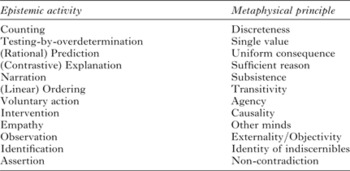
Table 2 gives a list of basic epistemic activities and their associated metaphysical principles that I have started compiling. Even a brief consideration of these pairings will reveal some quite interesting consequences of this way of thinking. About the first two activity–principle pairs I have already said enough. (There is just one brief note I must add on the second pair: there are other modes of ‘testing’, including a ‘trial run’, which can be made without a specific prior prediction of the outcome. This is why I must specify what I have in mind here as ‘testing-by-overdetermination’). The remaining activity–principle pairs deserve some brief explanations.
A partial list of activity–principle pairs

(Rational) Prediction – The principle of uniform consequence (‘principle of induction’ or ‘determinism’)
In order to make any rational predictions (as opposed to random guessing, or prophecy by oracle or divine illumination), we must take it for granted that the same initial circumstance will always have the same outcome. Induction is just this ‘principle of uniform consequence’ in action. As Wesley Salmon points out in his critique of Popper,Footnote 38 an attempt to do away with induction disables the activity of rational prediction. This is why we cannot seem to get away from induction, no matter what its logical deficiencies are. Induction is not merely a custom, nor an optional piece of scientific methodology, but a necessary condition for rational prediction. This is a more robust justification of induction as a practice than the ‘pragmatic’ argument given by Hans Reichenbach: in Reichenbach's view, induction is justified as a practice that would give us success if we could have success at all; my view is that induction is necessary regardless of any prospect of success, as long as we engage in the activity of rational prediction.Footnote 39
In a similar vein, it is instructive to view indeterminism or determinism as more than a mere metaphysical belief. Determinism is a commitment to engage in the activity of rational prediction in every individual case. That commitment was one important aspect of Einstein's insistence that quantum mechanics was incomplete, and it is shared by those who are still pursuing hidden-variable theories. But the justification for determinism is not as strong as the justification for induction in general, because it is possible to live with rational predictions only in a statistical sense.
(Contrastive) Explanation – The principle of sufficient reason
The activity of explaining why something (as opposed to something else) happened requires the assumption that when there is an observed difference, there is a reason behind it. I will call this the principle of sufficient reason, since it can be considered a weak version of that old metaphysical principle.Footnote 40 This principle of sufficient reason provides a very broad schema of explanation (‘X rather than Y, because C’, or, ‘X rather than Y, because A rather than B’). This schema is fully compatible with the subsumption model of explanation, and it is more general in that it does not require the explanans to contain any laws or even to be more general than the explanandum. And the explanatory factor may be causal, or anything else. As with testing, I should note that there are other modes of explanation than the contrastive.
Narration – The principle of subsistence
Next, consider the activity of narration. What is required for telling a story? It might be thought that something to do with time would be the most fundamental principle of narrative. But, contrary to expectation, it is not time-ordering that provides the most basic metaphysical principle behind narration. A narrative requires entities or persons whose identities last through time, which ‘house’ the changes that are narrated. Otherwise, we cannot even formulate narrative strands like ‘someone ran down the street’. Paradoxically, without postulating something that lasts, it is impossible to describe any change. In the context of physical science, this principle of persistence (or better, subsistence) manifests itself as more specific assumptions, such as that fundamental particles persist without alteration (‘atomism’), or that there is a substance or quantity that is conserved (mass, energy, etc.).
This, incidentally, is why the Big Bang makes an unintelligible narrative about the origin of the universe; I am not saying that the science behind Big Bang cosmology is unintelligible, but only that it is impossible to make an intelligible narrative about the Big Bang itself. The Book of Genesis at least offers an intelligible narrative about the origin of the universe (though one that I personally do not believe), since there is God, whose identity lasts through the act of creation. But if we demanded a story about how God came to be, we would run into the same unintelligibility as with the Big Bang. The story of ultimate origin is untellable, much as Kant taught us in his antinomies of reason, though for a slightly different reason from what he gave.
(Linear) Ordering – The principle of transitivityFootnote 41
If we want to put a set of entities into an ordered sequence, we must assume that the method of ordering (or, the relation that forms the basis of ordering) is transitive. This applies not only to numerical ordering, but all other kinds of linear sequencing such as time-ordering, status-based hierarchies, chemical affinity tables, and completely non-quantitative cases such as alphabetical ordering.
Voluntary action – Agency
Engaging in voluntary action makes no sense unless we presume that our will directs certain parts of ourselves to move in certain ways.Footnote 42 That presumption may be called the principle of agency.
Intervention – Causality
Similarly, intervening in the world with our own actions requires a presumption that our actions do make things happen; I am calling that the principle of causality for want of a better word, but this needs to be distinguished from the notion of ‘causality’ that putatively obtains in the interaction of things between each other, which I think is only a metaphorical projection of the causality in our own direct actions. Agency and causality together provide the most fundamental schemata for our bodily actions.
Empathy – Other minds
In the activity of understanding other people's intentions and emotions (which I have called ‘empathy’ for lack of a better word), one needs to presume that there are other minds who possess intentions and emotions like one's own.
Observation – Externality/Objectivity
Similarly, the activity of observation makes no sense unless we presume that there are entities ‘out there’ whose manifestations we cannot control at will. The last two activity–principle pairs give us the most fundamental constituents of the world: external objects and other minds.
Identification – Identity of indiscernibles
The identification of an object (or a property) as something of any given description must be based on something like Leibniz's principle of the identity of indiscernibles.Footnote 43 The principle itself can be divorced from various uncertain uses that Leibniz himself (and others) made of it.
Assertion – Non-contradiction
Even the principle of non-contradiction may be a metaphysical principle, associated with the epistemic activity of asserting a proposition.Footnote 44 It may seem odd to call a logical principle metaphysical, but we can think of non-contradiction as the essential nature of propositions involved in any reasoning. A new light may be thrown on the nature of logical necessity as well: the principle of non-contradiction is necessary because of a pragmatic impossibility, namely that we find it impossible to assert something without avoiding the assertion of its direct denial.
This is only a partial list, and I expect there will be more activity–principle pairs to be found. But already, thinking through this list gives me a whole new way of thinking and many interesting insights about some very familiar and fundamental issues in philosophy.
B3. Complex epistemic activities
In real life, we hardly ever engage in such simple and elementary epistemic activities as appearing in the above list. What we actually have, even in the practice of mathematics or theoretical physics, are mostly very complex and specific activities—such as, say, predicting the frequencies of molecular radiation by solving the Schrödinger equation using certain techniques of approximation. I think it is going to be a very interesting and informative challenge to extend my analysis to complex epistemic activities in various areas. A complex activity will involve multiple basic activities, each with its attendant metaphysical principle. Therefore, all of those metaphysical principles have to be satisfied for the complex activity to be performable and intelligible.
There are some very interesting and common conjunctions of basic epistemic activities which play essential roles in science and everyday life. For example, the activity of giving mechanical explanations can be seen as a synthesis of contrastive explanation, narration, and (imagined) intervention. The construction of physical objects is another crucial activity, but it cannot be conceived fully in terms of the basic activities and principles I have discussed so far in this paper. It involves first of all the assumption that every object is ‘located’ in space and time (‘physicalism’ as meant by Otto Neurath). We also presume that all sensations attributed to one and the same object are harmonious with each other (e.g., a big sharp edge felt in gently running a finger along a completely smooth-looking surface is not intelligible). Quite possibly there is a presumption of causality, too, embodied in the notion of a physical object. We can see that the analysis of a complex epistemic activity is a challenging task that will require imagination as well as care.
It would be wrong to think of a complex activity as made up of basic activities in an atomistic way. All distinct activities to which we give definite characterization are abstractions from what we actually do. Although it is often instructive to think of a complex abstraction as constructed from simpler abstractions, it would be a mistake to build up a whole universe of activities from basic activities.Footnote 45 Rather, the important thing to note is the relationships holding between the domains of applicability of various activity-descriptions. If an act that qualifies as an instance of activity A always qualifies as an instance of activity B as well, but not vice versa, we can say that activity B is more basic than activity A. Applying that idea to the basic epistemic activities that I have discussed so far, I find that some of them are more basic than others. For example, testing-by-overdetermination always involves assertion. Therefore, assertion is a more basic activity than testing-by-overdetermination, and the latter requires the principle of non-contradiction in addition to the principle of single value. Similarly, hardly any other activity can take place without identification.
It is beyond the scope of this paper to enter into a detailed analysis of any particular complex activities. But it seems clear to me that thinking along these lines provides a good framework for analyzing scientific practice, thus providing a new direction for a philosophy of science that engages better with the actual happenings in science, both historical and contemporary. I am currently engaged in developing such a philosophy of scientific practice.
B4. Pragmatic roots of necessity and ontology
I would like to close with some further reflections on the concept of necessity. I believe that necessity is a concept rooted in human action, which we project metaphorically onto the rest of nature—sometimes sensibly, and sometimes not. The ignoring of this human, pragmatic context is the main reason why we have such trouble understanding the notion of necessity, as we try to render ‘necessary truth’ as some sort of hyper-truth, with the help of possible-worlds semantics and such. Instead, I would like to propose that something is ‘necessarily true’ if it needs to be taken as true for the purpose of some epistemic action (here I deviate from Lewis, who still seems to take necessary truth as truth in all possible worlds.)
Necessity also does not imply universality. Metaphysical principles are not truly universal, as their necessity remains conditional on our commitment to engage in their associated epistemic activities. Even with some of the most basic epistemic activities, there are situations in which we would decline to engage in them. First, we may judge that the activity in question is not useful enough to bother with. Second, nature may be such that it is impossible for us to perform the activity (Lewis sees this as a matter of applicability of our concepts). Recall Lewis's jelly-fish, on both counts. Or imagine the prospect of attempting to make rational predictions in an utterly chaotic situation, or in a world ruled by a malicious controller bent on frustrating us. There is an element of choice and judgment in epistemic activity, just as in any other kind of human activity. Necessity is omni-present in human action, but not in a uniform way.
This is, again, the key difference I see between my way of thinking and the legacy of Kant. In my scheme there are no eternal and universal categories, since we are not compelled to engage in all the same basic epistemic activities all the time. It is a mistake to treat the activity-dependent conditions of performability and intelligibility as unconditional metaphysical truths. Even compared to William Whewell's scheme, in which the categories evolve with the general development of science,Footnote 46 or Friedman's system of the relativized a priori in which revolutions are allowed,Footnote 47 my scheme is distinct in allowing more freedom to epistemic communities and even individuals in their choice of epistemic activities, and in taking the pragmatic performability of activities as the ultimate basis of necessity. This expands and completes Lewis's idea of the freedom in the a priori.
Conclusion
In summary, I have proposed a novel way of extending Kant's legacy in order to accommodate the problem of scientific change. Albeit with undiminished admiration for Michael Friedman's effort to understand how a continuous evolution of the a priori dimension of physical knowledge is possible underneath the appearance of haphazard and radical shifts of paradigms, I follow C. I. Lewis in emphasizing our freedom in choosing our a priori, in our continual effort to meet pragmatic needs. I supplement Lewis's position with a reframing of the a priori as the pragmatically necessary preconditions of the epistemic activities we choose to carry out. The fully pragmatist notion of the a priori that I propose has some far-reaching implications in epistemology and metaphysics.
It is satisfying to see how our basic metaphysical conceptions arise from the way we engage with the world. The most fundamental part of ontology is not abstracted from what we passively observe; rather, it emerges and becomes established as an essential ingredient in our successful epistemic activities.Footnote 48 A whiff of scientific realism can be derived from that insight: if some of our epistemic activities are successful, that must be some sort of indirect vindication of the metaphysical principles presumed in those activities.Footnote 49 But this vague sense of vindication is all we can have, and it only points to an inarticulable harmony between the state of the world and our metaphysical principles. There is a Kantian insight here: nature in itself (not what Kant called ‘nature’, which consists of phenomena) is not the object of our epistemic activities; our activity-based ontology is not a direct representation of nature (or, the Kantian ‘thing in itself’). As Henri Bergson put it: ‘The bodies we perceive are, so to speak, cut out of the stuff of nature by our perception, and the scissors follow, in some way, the marking of lines along which action might be taken’.Footnote 50 When nature ‘speaks’ to us, it is only through the outcomes of our epistemic activities. That is not to deny that nature enters and rules our life, by determining which epistemic activities are pragmatically possible and profitable. But metaphysical principles do not give us the kind of direct representation of nature that the correspondence theory of truth would have us seek.