1. Introduction
Patient and public involvement (PPI) in health care has become increasingly important in European health systems (Florin and Dixon, Reference Florin and Dixon2004; Coulter, Reference Coulter2005, Reference Coulter2011; Tritter, Reference Tritter2009; Dent and Pahor, Reference Dent and Pahor2015; Ocloo and Matthews, Reference Ocloo and Matthews2016). PPI may be defined as the ‘active participation of citizens, users and carers and their representatives in the development of health care services and as partners in their own health care’ (BMA, 2015). Involvement is framed as positive for individuals, the health system, public health, as well as for communities and society as a whole (Coulter and Ellins, Reference Coulter and Ellins2006). There are a wide range of motives for involvement – from empowerment of patients and disadvantaged service users, strengthening democratic accountability and responsiveness – to improving service delivery effectiveness, and health outcomes (Crawford and Thelwall, Reference Crawford and Thelwall2003; Coulter, Reference Coulter2005, Reference Coulter2011; van Thiel and Stolk, Reference van Thiel and Stolk2013). These motives are mirrored in the variety of involvement activities facing patients and the public today in European health systems; activities with different aims, scope for participation in actual decision-making and level of control over decisions. Yet, the literature contains little evidence on the extent of involvement or of its impact, which is assessed in this article. Previous research has shown that although people generally feel it is important to have the opportunity to participate, for example in health prioritization decisions, relatively few actually participate (Litva et al., Reference Litva, Coast, Donovan, Eyles, Shepherd, Tacchi, Abelson and Morgan2002; Rosén, Reference Rosén2006). Furthermore, there is a lack of research about the impact of PPI, for example how services and service outcomes have been changed by involvement. In a review, Mockford et al. concluded that a primary limitation of the evidence on PPI is the poor quality in reporting the impact and lack of robust measurement (Mockford et al., Reference Mockford, Staniszewska, Griffiths and Herron-Marx2012). Lack of evidence on impact has also been established in relation to PPI in research (Staniszewska et al., Reference Staniszewska, Herron-Marx and Mockford2008; Brett et al., Reference Brett, Staniszewska, Mockford, Herron-Marx, Hughes, Tysall and Suleman2014a, Reference Brett, Staniszewska, Mockford, Herron-Marx, Hughes, Tysall and Suleman2014b). However, defining impact is complex as it is dependent of factors such as the purpose of involvement, organizational culture, policy, people and resources (Mockford et al., Reference Mockford, Staniszewska, Griffiths and Herron-Marx2012); impact is highly context dependent and comparisons between different activities, health systems or settings not straightforward. Yet, a broad dividing line can be drawn between extrinsic and intrinsic effects, or impact (Brannan et al., Reference Brannan, John and Stoker2006). In this paper, we focus on extrinsic effects, which are about optimizing the consequences of decisions in terms of individual and societal benefits, that is, a means to an end such as the achievement of effectiveness and efficiency-policies in health care (Christiaens et al., Reference Christiaens, Kohn, Léonard, Denis, Daue and Cleemput2012). Intrinsic effects or benefits are about empowerment or capacitating the individuals, and the process of participation is thus seen as a good in and of itself (Brannan et al., Reference Brannan, John and Stoker2006).
When studying the extent of involvement, it is important to consider activities framed towards patients as well as the public in a more broad sense. Although often referred to interchangeably in policy-making and research, patients and the public (often referred to as citizens) occupy two distinct ideal-type roles in relation to the health service; that of the ‘health service user’ and that of the ‘public policy agent’ (Charles and DeMaio, Reference Charles and DeMaio1993; Fredriksson and Tritter, Reference Fredriksson and Tritter2017). This is not a distinction between people – who may adopt the role of patient or citizen in different contexts – but between interests (Anderson et al., Reference Anderson, Florin, Gillam and Mountford2002): which may contrast between patients and the public (Peeters and Stiggelbout, Reference Peeters and Stiggelbout2010; Fredriksson and Tritter, Reference Fredriksson and Tritter2017). Put simply, it is the distinction ‘between what we want when we are using the health service and what we hope for as citizens or taxpayers’ (Coulter, Reference Coulter, Anderson, Tritter and Wilson2006, p. 28). Thus, the rationales for involving patients differ from involving the public (Warsh, Reference Warsh2014) and involvement associated with the two roles have different potential scope. Typically, patient involvement aims at personal decisions about the individual's own care and seeks to improve individual health outcomes and satisfaction, but may also refer to a group of patients helping to shape a particular service (Florin and Dixon, Reference Florin and Dixon2004; Coulter, Reference Coulter2011). In contrast, public involvement aims to take account of broader public interests and is associated with service development; that is, strategic decisions about health services and policy at the local or national level that address societal values and public health, determining health service priorities, etc. (Florin and Dixon, Reference Florin and Dixon2004). For patients the aim of involvement is often improvements in clinical care or culture, while for members of the public the aim is organizational or general policy changes. Thus, the distinction between patients and the public is important to consider when investigating the impact of involvement, but, in practice, it is less clear.
In this paper, we present the findings from the first national survey in Sweden of both PPI activities in relation to health. We have found no comparable studies internationally. Public involvement activities such as those investigated here, are usually studied by political scientists interested in the functioning of participatory democracy, while health service researchers interested in the patient–clinician interaction and health outcomes study patient involvement and empowerment. However, in health systems such as in Sweden where regional governments have dual functions – being both democratic arenas and service-provision organizations resolving collective needs and interests (Amnå, Reference Amnå2006) – these two research areas converge. Exploring PPI in this context helps us establish the link between these dual functions. More specifically the aim of this study was to investigate the extent to which people have been involved in a range of involvement activities and their assessment of the impact of their involvement. The study therefore investigates the perceptions of involved individuals, not the nature or actual impact of the involvement, which is the next step to explore in this research field.
1.1 Sweden: the case
In Toth's (Reference Toth2016) terminology, Swedish health care is a tax-based, universal health system, which was previously integrated but is becoming increasingly disaggregated due to policies supporting private provision and patient choice. In addition, Swedish health care is highly decentralized. The responsibility for health care is divided between three directly elected governing levels (Anell et al., Reference Anell, Glenngård and Merkur2012). The Swedish state is responsible for the overall health care policy and in the past 10 years conscious efforts have been made to strengthen the position of the patient; examples are the introduction of choice of primary care provider in 2010 and Sweden's first Patient Law coming into force in 2015. The responsibility for the funding and provision of health care and dental care rests with the 21 self-governing county councils/regions – hereinafter referred to as regions – and this is their major task requiring 90% of their budget. Also self-governing and locally elected, the municipalities are responsible for care for the elderly and those with disabilities.
In contrast to patient involvement, which has been the focus of national policy efforts, the regions handle issues of public involvement. Public involvement is channelled through the regional democratic system with representatives elected every 4 years; this implies that decision-making on health care is based on public interest (Magnussen et al., Reference Magnussen, Vrangbæk and Saltman2009a, Reference Magnussen, Saltman, Martinussen, Magnussen, Vrangbæk and Saltman2009b). Public involvement is generally framed as a way to influence the political process and decisions within the regions. To increase people's opportunities to be involved between regional elections and in more practical aspects of service planning and delivery, more participatory forms of public involvement (‘democratic innovations'; Lundell et al., Reference Lundell, Karjalainen and Serup2016) have gradually emerged (Arvidsson et al., Reference Arvidsson, Zambon and Östergren2015).
Generally, Sweden is a country with a vital civil society, high membership in voluntary associations (Trägårdh, Reference Trägårdh2007), and where participation is a fundamental characteristic of the health system (Magnussen et al., Reference Magnussen, Vrangbæk and Saltman2009a, Reference Magnussen, Saltman, Martinussen, Magnussen, Vrangbæk and Saltman2009b): mainly carried out through the regional representative political system. Patient-centredness and patient's rights are however weak in comparison with health systems in other high-income countries (Winblad and Ringard, Reference Winblad, Ringard, Magnussen, Vrangbæk and Saltman2009; Docteur and Coulter, Reference Docteur and Coulter2012). While Sweden is often portrayed as a National Health Service (NHS) system, it is in fact largely decentralized. Sweden is a particular case but our findings have significant implications for other Nordic countries and countries with tax-based universalist health systems, in particular those governed locally or regionally. To what extent our findings apply to social health insurance (SHI) systems is an empirical question. Some elements of involvement are similar while some diverge. For instance, the same type of development with a strengthening of patient rights and a change of the individual's role from a passive consumer towards a more active participant can be noted within both system types (Wildner et al., Reference Wildner, den Exter, van der Kraan, Saltman, Busse and Figueras2004; Sawicki and Bastian, Reference Sawicki and Bastian2008). Simultaneously, it is common the insured in the health insurance funds participate (Wildner e t al., Reference Wildner, den Exter, van der Kraan, Saltman, Busse and Figueras2004), and in Germany, in particular, patient involvement through self-help groups (Forster and Kranich, Reference Forster and Kranich2007; Härter et al., Reference Härter, Müller, Dirmaier, Donner-Banzhoff, Bieber and Eich2011) has developed significantly at the national level and the level of federal states (Kofahl et al., Reference Kofahl, Trojan, Knesebeck and Nickel2014) and gained increasing influence in the decision-making bodies of the SHI system (Busse and Blümel, Reference Busse and Blümel2014; Rojatz and Forster, Reference Rojatz and Forster2017). As in Sweden, collective patient engagement in Germany is focused at the policy level, while it is focused at the provision level in the Netherlands and in England (Haarmann, Reference Haarmann2018); illustrating crossovers between NHS and SHI systems in terms of involvement.
2. Methods
2.1 Sample and survey questions
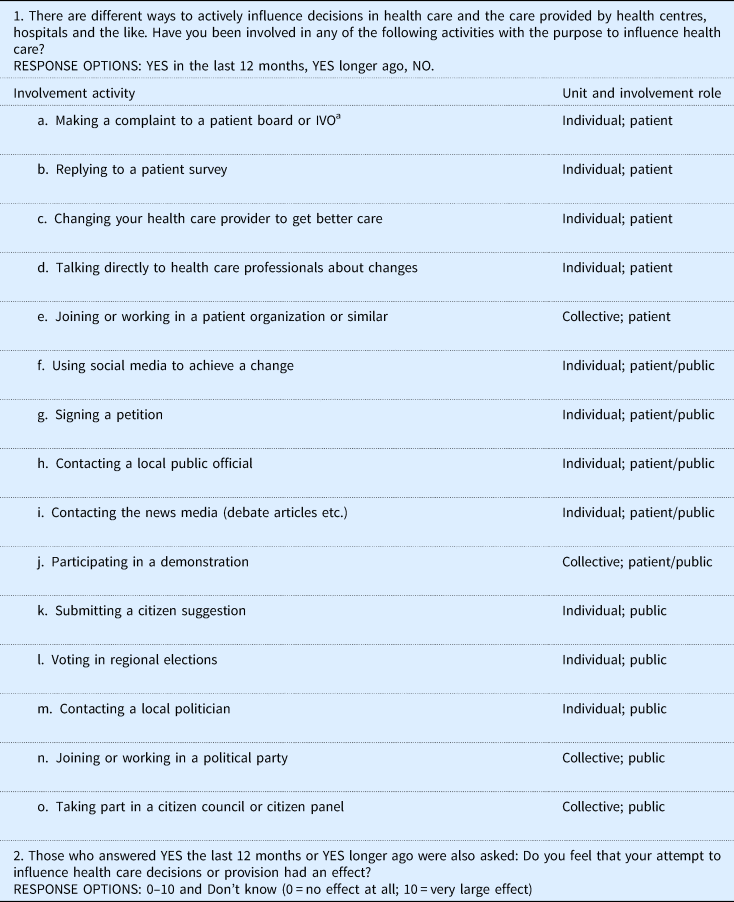
The data come from a Swedish telephone omnibus survey carried out by TNS Sifo in late January 2016. The sample includes 1500 members of the public, aged 15 years and over. The initial response rate among randomly selected residents in different regions was 35%. Substitute respondents were sought in pre-defined strata for those individuals that denied participation or that could not be reached after multiple attempts. Data were weighted by gender, age, working status and area code to be representative of the Swedish population (see Table 1 for sample characteristics). While not perfect, this is a common approach to reduce nonresponse bias (Wolf et al., Reference Wolf, Joye, Smith and Fu2016). On behalf of the authors, two questions investigating the extent of PPI as well as its impact, or effect, were included in the survey, see Table 2. The 15 involvement activities investigated were compiled from previous regional investigations of involvement in Sweden and from official information material on opportunities for people to influence regional health care. They differ in aims and methods and are an illustration of the broad range of activities present in health systems today. The order of the 15 involvement activities was rotated when presented to respondents to avoid response bias.
Sample characteristics

a Low (9 years of schooling = grundskola), average (12 years of schooling = gymnasium) and high (university/college degree = universitet/högskola).
b Mean 47.7 years, range 15–98 years.
Survey questions and response options

a IVO (Inspektionen för vård och omsorg, the Health and Social Care Inspectorate).
2.2 Ethics statement
The researchers had access only to the anonymized sample and thus no access to personal identifiable data. The data-set contained no sensitive personal information such as information about ethnicity, political orientation or health.
2.3 Data analysis and presentation
To investigate the extent of involvement as well as the estimated impact, data were analysed descriptively and percentages and means presented with 95% confidence intervals. Confidence intervals that did not overlap indicated that the real values within the population were significantly different (Greenland et al., Reference Greenland, Senn, Rothman, Carlin, Poole, Goodman and Altman2016). Tables and figures present the weighted data. Correlations were tested using Pearson's r.
In some cases data were grouped into clusters or indices to distinguish between (1) unit of participation: differentiating between individual and collective activities, that is whether people contribute with individual opinions or votes, or are approached, deliberate or act collectively as a group (Tritter, Reference Tritter2009; Michels, Reference Michels2011), and (2) involvement role: differentiating between patients and citizens, which for example have different roles, perspectives and interests (sectional vs societal interests) (Fredriksson and Tritter, Reference Fredriksson and Tritter2017). In relation to the indices the mean scores refer to the mean percentage of respondents taking part in, for example, an individual or a collective activity (extent) and their mean estimate of the impact for the same index of activities.
In our analysis we also distinguish between representative and participatory activities and between activities based on ‘exit’ and ‘voice’ respectively (Hirschman, Reference Hirschman1970). As voting is an activity that can be carried out only every 4 years and is distinct as it serves to elect representatives rather than involving people themselves, findings are presented both including and excluding voting. Furthermore, changing health care provider is also an activity distinct from the other activities. It builds on the opportunity to ‘exit’ (‘choice’ is often used synonymously) which frames the patient as a consumer and implies the possibility of withdrawing from a relationship. This is in contrast to ‘voice’ that transforms individuals and groups from consumers to citizens with a right to engage in decision-making processes (Fredriksson, Reference Fredriksson2013; Dent and Pahor, Reference Dent and Pahor2015).
3. Results
3.1 Extent of involvement
The results show that the majority of the respondents of voting age (76%) had taken part in regional elections, Figure 1. Among the activities carried out between elections four were more extensively used to influence health care: replying to a patient survey (36%), changing health care provider to get better care (29%), signing a petition (28%) and talking directly to health care professionals about the need for changes (20%). Only 6 of 15 involvement activities had ever engaged more than 10% of the respondents. See Supplementary file for additional information.
Extent of involvement and estimated impact

When grouping the activities into indices based on unit of participation and the involvement role, the participation in individual activities was more extensive ( ${\bar x}$ 20.10%) compared with collective activities (
 ${\bar x}$ 05.16%), see Figure 2. There was a large difference between being involved as an individual citizen (
 ${\bar x}$ 2.86% excluding voting) and as an individual patient (
 ${\bar x}$ 20.54% excluding changing provider). Overall the patient involvement activities attracted the most participants (
 ${\bar x}\,\,18.88{\rm \%} $); more than public/patient activities (
 ${\bar x}$ 12.40%) and public activities both excluding voting (
 ${\bar x}$ 03.69%) and including voting (
 ${\bar x}$ 17.07%).
Mean extent of involvement and estimated impact: indexed activities

During the last 12 months none of the activities intended to influence health care decisions or provision engaged more than 15% of the respondents, and 9 of 14 activities involved less than 5%, see Supplementary file. As shown in Table 3, more than half of the respondents (56.9%) had not engaged in any of the involvement activities available in the last 12 months. By contrast 19.7% of respondents had been involved in at least two activities during the same time period, and 2.7% of respondents had been involved in five or more activities. At any time in their life, 129 of the respondents had engaged in five or more participatory activities (8.6%), and 640 (42.7%) in at least two activities. Looking only at those activities oriented towards citizens or members of the public (voting excluded), about 90% had not been engaged at all over the last 12 months while about 10% had been involved in one to two activities. Including also voting in local elections, about 12% had never engaged in any type of involvement activity, and half of the respondents (50%) reported being engaged in one to two activities in their life.
Proportion and number taking part in involvement activities last 12 months

Weighted percentages.
a Citizen activities classified as contacting a local public official, contacting a local politician, participating in a demonstration, joining or working in a political party, taking part in a citizen council or citizen panel, and submitting a citizen suggestion.
3.2 Impact of involvement
The respondents generally estimated the impact of their involvement to be rather low. As shown in Figure 1, seven of the 15 activities (all individual) had an estimated mean impact between 2.4 and 3.0 out of 10, and seven activities had an estimated mean impact between 3.5 and 4.3. Only one activity, changing health care provider, had an effect on the upper half of the effect scale ( $ {\bar x} \; 6.0)$. No effect at all (0 out of 10) was the mode answer in relation to all involvement activities, and a relatively large share also replied they did not know if their involvement had any effect (4–35%). Thus, a relatively large share did not know or answered that their involvement had no effect at all (22–68%), see Supplementary file.
Looking at the four ‘between-election activities’ that had ever engaged more than 20% of the respondents we find activities with varying degree of estimated impact, Figure 1. Two of these activities had a low estimated impact; 36% had replied to a patient survey but only 51% of them estimated it had had any effect ( ${\bar x}$ 2.5) and 28% had signed a petition but only 50% of them estimated it had had any effect (
 ${\bar x}$ 2.9). The other two of the activities engaging the most respondents had a higher impact; 29% had changed health care provider to get better care and as many as 78% of them estimated it had an impact (
 ${\bar x}$ 6.0), and 20% had talked directly to staff about the need for changes: 58% of them estimated it had an impact (
 ${\bar x}$ 3.7). Overall, there was no correlation between the extent of involvement and the estimated impact (Pearson's r, −0.080, sig. 0.776).
When grouping the activities into indexes (Figure 2), we see that the estimated mean impact for patient activities ( ${\bar x}$ 3.84) was higher compared with activities carried out by either patients or citizens (
 ${\bar x}\, \;2.88$), or citizens only (
 ${\bar x}$ 2.66). However, looking only at ‘voice' activities (excluding changing provider which is an exit option) the mean estimated impact of patient, patient/citizen and citizen activities was similar. The mean estimated impact of citizen activities was significantly lower when including voting (
 ${\bar x}$ 2.66 compared with
 ${\bar x}$ 3.40). Furthermore, the collective involvement activities were estimated to have a slightly higher mean impact compared with the individual activities (
 ${\bar x}$ 3.69 compared with
 ${\bar x}$ 3.11); the difference being larger when only including voice-activities (
 ${\bar x}$ 3.69 compared with
 ${\bar x}$ 2.63).
4. Discussion
How widespread is PPI in health care in Sweden? Our findings show that about 43% of the respondents had been involved in some type of involvement activity in the last 12 months and 10% had never been involved even including voting in regional elections, which was the single involvement activity engaging the highest number of respondents. Under 10% of the respondents had engaged in more than five activities throughout their life (13% if including voting), a category that might well be referred to as the ‘usual suspects’ (Beresford, Reference Beresford2013). Overall, the extent of patient involvement was significantly higher than citizen involvement, even if voting is included. With the exception of election years, the involvement activities that respondents primarily had engaged in to influence health care decisions and provision were individual and mainly patient focused, which may well be reasonable within a health system. Over the last 12 months, about 90% of the respondents had not been involved in any citizen-oriented activities; regional elections took place in 2014 and 2018. Thus, between elections there seems to be a greater challenge participating as a citizen – a ‘public policy agent’, compared with as a patient – a ‘health service user’. Thus, between elections, involvement in health care seems to be more directed towards improving individual health outcomes and satisfaction rather than improving the system's effectiveness, responsiveness and accountability (Coulter and Ellins, Reference Coulter and Ellins2006; Forbat et al., Reference Forbat, Hubbard and Kearney2009). Whether the extent of participation reported here is widespread or limited in comparison with other health systems is difficult to establish, as there are no comparative numbers available. However, it is important to note that the vast majority of the 43% of respondents that had been involved in the last 12 months participated in activities such as replying to patient surveys, changing provider and signing petitions – activities that require little time and effort. For instance, changing the provider only requires a few minutes by making a telephone call or logging onto a web portal, and signing a petition can require even less time commitment. Furthermore, there is no a priori established definition of an adequate level of involvement, which would among other things be dependent on people's satisfaction with the health system and the actual quality of the services they receive. While it might be argued that the higher the level of involvement the better, as involvement empowers individuals and increases effectiveness in the health system, high involvement might be an indicator that patients and citizens are dissatisfied with the health system. This is perhaps best illustrated with the growing number of patient complaints in Sweden (Skålén et al., Reference Skålén, Nordgren and Annerbäck2016), which may be useful as a source for quality improvement, but may simultaneously indicate that people are dissatisfied with health services. As a declining share of the Swedish population think the health system works well on the whole – a drop from 44% in 2010 to 31% in 2016, compared with 60% in Germany in 2016 (The Swedish Agency for Health and Care Services Analysis, 2016) – it seems important to provide a range of opportunities for citizens and patients to be involved in individual as well as collective activities to improve health system functioning.
4.1 Most involvement activities have little impact
Most activities in our study were estimated by those who had been involved as having relatively low impact and all except for two of the activities were found in the interval of  ${\bar x}$ 2.4–3.9 out of 10. From this it is impossible to establish ‘actual’ impact, but it suggests that people generally feel they have little opportunity to actively influence decisions in health care and the care provided by health centres, hospitals and the like. This may be problematic as one of the aspects that determines whether people participate or not is that people believe that their involvement is making a difference (Lowndes et al., Reference Lowndes, Pratchett and Stoker2006). Another aspect might be low barriers to being involved, as discussed below. Furthermore, for the most frequently occurring activities, 42%–50% of the respondents believed that their involvement had no impact or they did not know if it had an impact. This suggests that there is poor feedback from decision-makers and staff to those who participate in activities to influence policy or service provision. One conclusion is that the communication of results of involvement needs to be more transparent and directed at those who are involved if people are to be encouraged to feel that their involvement makes a difference.
Furthermore, there was no correlation between the extent of involvement and the estimated impact. Some of the involvement activities with the lowest estimated impact were among the activities participated in by the greatest number of respondents, for example replying to patient surveys and signing petitions. Thus, our study indicates that prompted involvement activities based on a response to a request, are associated with a comparatively higher degree of participation. These activities have a low barrier to participation (cf. Garcia-Dominic et al., Reference Garcia-Dominic, Wray, Treviño, Hernandez, Yin and Ulbrecht2010); it does not require much time and little cost for the individual, and is a one-off effort. Thus, our findings align with observations from the UK where there is evidence that people prefer to be involved in health through relatively passive forms of one-off mechanisms and very few are prepared to participate in in-depth activities (Martin and Boaz, Reference Martin and Boaz2000). Face-to-face commitment at specific times is suggested especially demanding (Lundell et al., Reference Lundell, Karjalainen and Serup2016). The preference for participation in low-barrier activities is illustrated by our finding that few respondents had been involved in collective activities such as working in a political party (7%) or a patient association (4%) which usually require a more continuous and long-term involvement effort (cf. Lundell et al., Reference Lundell, Karjalainen and Serup2016). These two activities were, however, estimated to have a relatively high impact:  ${\bar x}$ 3.9 and
 ${\bar x}$ 4.3 respectively. Yet, it should be noted that some collective activities build on representation, for example, in citizen councils, which greatly reduces the number of people that are involved, thus making comparisons between the extent of individual and collective involvement complex.
Recent comparisons based on The Commonwealth Fund's 2016 International Health Policy Survey of Adults in 11 countries show that Sweden performs poorly compared with other high-income countries when it comes to patient information and involvement in decisions about care and treatment (The Swedish Agency for Health and Care Services Analysis, 2016). Our results suggest that the efforts to strengthen the weak position of Swedish patients (Winblad and Ringard, Reference Winblad, Ringard, Magnussen, Vrangbæk and Saltman2009; Docteur and Coulter, Reference Docteur and Coulter2012) may have had an effect, at least on the relative extent of involvement of individual patients, but not necessarily on the perceived impact of involvement. However, one activity stands out with the highest estimated impact – changing health care provider to get better care ( ${\bar x}$ 6.0) – which was also one of the most frequently reported activities to influence decisions in health care. This is the only activity that builds on ‘exit’ rather than ‘voice’. In the Nordic countries patients have been pushed to take a more active role through choice of provider (Magnussen et al., Reference Magnussen, Vrangbæk and Saltman2009a, Reference Magnussen, Saltman, Martinussen, Magnussen, Vrangbæk and Saltman2009b) and the intention behind making choice of primary care provider obligatory in all Swedish regions in 2010 was to strengthen the patient's position and their possibility to influence health care through the exit-option (Fredriksson, Reference Fredriksson2013). Thus, our results suggest that patient choice has had an empowering effect. At the same time, it is important to note that it has been questioned if patient choice is a form involvement as the patient becomes a consumer navigating a market rather than being actively involved in priority setting or decision-making for the health system (Dent and Pahor, Reference Dent and Pahor2015). In the Swedish context it has also been suggested that this kind of effort to empower patients may not only affect patients' chances of influencing health care but also those of citizens, who may lose collective ‘voice’ as a result (Fredriksson, Reference Fredriksson2013). This type of market-based model provides no aggregation of preferences, no deliberation or debate, no discussion on political objectives and questioning of political priorities, only the expression of individual preferences to service providers (Pierre, Reference Pierre2009). Thus it is unlikely to inform collective prioritization within health systems. However, more recently some scholars have argued that increasing opportunities for choice leads citizens to be more favourably oriented towards voice (Pierre and Røiseland, Reference Pierre and Røiseland2016); our study does not include a temporal element so we cannot make a judgement about the interaction effects between different types of involvement activities.
4.2 Challenging the traditional model of involvement
A key aspect of the politically governed and decentralized Swedish health system is the institutionalization of arenas for local and regional democratic decision-making (Magnussen et al., Reference Magnussen, Vrangbæk and Saltman2009a; Reference Magnussen, Saltman, Martinussen, Magnussen, Vrangbæk and Saltman2009b), which will serve to balance the diverse interests of the public and ensure common priorities (Urbinati and Warren, Reference Urbinati and Warren2008; Fredriksson and Tritter, Reference Fredriksson and Tritter2017). The act of voting is admittedly individual, but its purpose is to establish the composition of a representative assembly that governs a region's affairs on behalf of citizens. The Assembly has the power to make decisions on a collective basis – for example in which hospitals certain operations are performed, eligibility requirements for various treatments or how much money is spent on primary care – and voting in elections is assumed to be the most important mechanism for public involvement. The Swedish emphasis on voting as a mechanism to influence local and regional decisions in health and social care is noticeable in that Sweden ranks high in voter turnout in Europe (82% and 83% voted in regional and local elections respectively in 2014 in comparison with, for example, 34% in local elections in England in 2016), but less so on engagement in local/regional participatory democracy (European Commission, 2013). Nevertheless, in our sample, 51% of respondents who had voted in regional elections did not know or thought this activity had no impact. The rest of the respondents rated voting in regional elections, on average, as having little impact ( ${\bar x}$ 2.7 out of 10). This constitutes a challenge to the traditional representative involvement model and to the system's legitimacy. Lister and Pia (Reference Lister and Pia2008), for instance, argue that it is necessary (but not sufficient) for democracy to function that people participate in elections. Elections are the main way of aggregating the individuals' expressed political opinions, which means a collective decision may be reached based on individual preferences. In fact, they argue, ‘elections are the only form of political participation where every citizen's voice counts equally’ (Lister and Pia, Reference Lister and Pia2008, p 86). In Sweden as well as in other countries the solution to disengagement in politics at the national and local/regional levels has been to make it more ‘participatory’ through introducing a range of activities such as citizen councils, panels and forums (‘democratic innovations’ referred to as ‘citizen dialogue’ in Sweden). However, as many of the attempts to increase people's opportunities to participate are based on self-selection, they may create or exaggerate an imbalance between those who participate and those who do not (Urbinati and Warren, Reference Urbinati and Warren2008; de Freitas and Martin, Reference de Freitas and Martin2015; Lundell et al., Reference Lundell, Karjalainen and Serup2016). In Sweden, there is thus a need to pay attention to the weak effect attributed to voting in regional elections and to follow-up on who is involved between elections. There is reason to believe that the young and those with a low level of education are less involved in the political process (Demokratiutredningen, Reference Demokratiutredningen2016) and that those not being involved in patient activities are those who have the most to gain, that is, those with greater health care needs (Ocloo and Matthews, Reference Ocloo and Matthews2016).
4.3 Limitations and future research
There are a few limitations to the study. As data on actual participation and impact is not available in official national registries or surveys we had to collect the data with the help from TNS Sifo, Sweden's leading market-research company with extensive experience of societal and opinion research. Furthermore, we only surveyed activities previously investigated at the local or regional level and listed on the regions' websites (‘known activities’), and we may not have included some of ‘the action that publics take within their health systems’ (Stewart, Reference Stewart2016, p. 122). Our measure of voting participation among those 18 and over in the sample was lower than regional voter turnout in 2014 (76% compared with 82%). This may be due to the age distribution of our sample, gender balance or number of foreign born participants. However, our sample does not appear to have a bias towards low-activity individuals as the share taking part in public involvement activities is similar or higher to findings from the only comparable survey carried out in one of 21 the Swedish regions (Bergström, Reference Bergström2012). As very few people seem to engage in certain types of involvement some participant numbers become limited even in a sample of 1500 individuals (e.g. only 12 individuals had submitted a citizen suggestion and were able to estimate the impact): hence making confidence intervals broad. It is plausible that we would find higher levels of involvement in a patient population. Our study did not collect data on motivation – why people got involved – and this limits our capacity to interpret the reasons for the patterns of activity that we report. We also did not collect data on actual involvement but rather people's recollection of being involved. Similarly, there is no agreed measure of the impact of involvement and we rely on people's evaluation of the impact of their involvement as this, we argue, is most likely to be linked to a likelihood of being involved in the future. It may very well be the case that it is difficult for those involved to evaluate the impact, and that it is easier in relation to certain involvement activities, potentially individual ones. In addition, it may be easier for people to notice intrinsic impacts such as inclusion or increased self-esteem compared with extrinsic impacts such as greater health system effectiveness.
There is still little theorizing on the motivation of service users to be involved or how this relates to particular types of activities (Birchall and Simmons, Reference Birchall and Simmons2004). Important factors mentioned include skills, beliefs about impact and the own capacity, and confidence. Thus, further research is needed to explore how people conceptualize involvement activities and their motivation for getting involved. Furthermore, the extent to which people frame their participation as patients or citizens and how this relates to the type of activity and their assumptions of the impact that this makes on decisions need exploring. A complicating factor in discussing this distinction is that ‘the patient’ is a sub-category of ‘the public’ and that individuals may bring their more narrow patient perspective into activities that are oriented towards expressing the broader public interest. More focused investigation is also needed of why people perceived their attempt to influence health care decisions or provision had little effect. One explanation may be related to the design of involvement activities, and mismatched expectations (Charles and DeMaio, Reference Charles and DeMaio1993; Hogg, Reference Hogg1999; Forbat et al., Reference Forbat, Hubbard and Kearney2009; Warsh, Reference Warsh2014). There are also many examples of malfunctioning involvement, and some professionals and organizations are still threatened by the notion of active involvement (Ocloo and Matthews, Reference Ocloo and Matthews2016). Lastly, it is crucial to further explore whether there are sociodemographic differences relating to the extent of involvement in different types of activities or how individuals estimate impact (Ocloo and Matthews, Reference Ocloo and Matthews2016). If involvement impact is unevenly distributed between, for example, sociodemographic groups, involvement policies need to take that into consideration.
5. Conclusions
Most people reported being involved as individual patients, and overall our results are consistent with reports about the Swedish welfare state's gradual liberalization and individualization (Lapidus, Reference Lapidus2015; Olsen, Reference Olsen2013); trends which we also see in other European health systems. Our results also suggest that the Swedish health system, which is based on equity and participation through the regional democratic system (Magnussen et al., Reference Magnussen, Vrangbæk and Saltman2009a, Reference Magnussen, Saltman, Martinussen, Magnussen, Vrangbæk and Saltman2009b), needs to pay attention to the levels of citizen involvement between elections and the weak effect attributed to voting in regional elections. While levels of involvement are potentially low, there is no systematic evidence of what level of involvement should be expected; whatever the level, involvement is going to increase if people believe their participation makes a difference. Thus, one of the future challenges is to strengthen the support for long-term collective involvement through a range of different activities, which currently engage relatively few, but are estimated to have a comparatively high impact by the participants. To encourage greater involvement in health matters we suggest that both intrinsic and extrinsic impact measures are developed in a way that acknowledges the distinction between patient involvement and public involvement and that the impact of involvement is openly reported and fed back to participants.
Supplementary material
The supplementary material for this article can be found at https://doi.org/10.1017/S174413311900015X.
Acknowledgement
This study was funded by the Swedish Research Council (2012-06634).