The question of concern in this paper is cross-language priming in bilingual children, with a focus on the genre of the priming text, procedural versus narrative. The role of language in the storage and processing of information in bilinguals and second language learners has both pedagogical and theoretical implications. First, as nations become more multicultural, a growing number of individuals need to be educated and trained in their non-native language. Echoing Slavin and Cheung's (Reference Slavin and Cheung2005, p. 247) question regarding English, “What is the appropriate role of the native language in the instruction of English language learners?”, one may well ask the same question regarding any other language. Specifically, should educational and training programs incorporate the individual's first language or should the to-be-learned language be used exclusively in such settings? The language immersion movement explicitly excludes the native language in instructional contexts, viewing its use as detrimental and reliance on translation strategies as an evil to be avoided. For instance, Carroll (Reference Carroll, Dillon and Sternberg1986) argued that the first language should only be used when lack of comprehension is involved since “meanings (translations and the like) acquired solely through L1 are less likely to be properly incorporated into L2 competence” (p. 121). California's Proposition 227, which mandated that English only be used in public schools, reflects this view. Yet this view is not universal and the opposite argument is also prevalent. In this vein, Widdowson (Reference Widdowson1979, Reference Widdowson2003) and Stern (Reference Stern1992) have both argued for cross-language instruction in which translation is a critical feature. Jacobson (Reference Jacobson and Padilla1981, Reference Jacobson, Jacobson and Faltis1990) and Padilla (Reference Padilla, Faltis and DeVillar1990a, Reference Padilla, Jacobson and Faltisb) have similarly taken the position that there are instructional benefits to using the two languages concurrently, and Padilla (Reference Padilla, Jacobson and Faltis1990b) has even suggested that students can benefit from understanding material in the second language that they have already mastered in the first language. The debate between advocates of monolingual versus bilingual instruction is an ongoing one (e.g., Hakuta, Butler & Witt, Reference Hakuta, Butler and Witt2000; Rolstad, Mahoney & Glass, Reference Rolstad, Mahoney and Glass2005; Rossell & Baker, Reference Rossell and Baker1996; Salazar, Reference Salazar1998), and this is especially the case when it comes to reading instruction (e.g., Bernhardt & Kamil, Reference Bernhardt and Kamil1995; Koda & Reddy, Reference Koda and Reddy2008).
Yet the above debate largely ignores the cognitive processes deployed by second language learners and bilinguals. Second language learners apparently engage in spontaneous (Hakuta, Reference Hakuta1988; Malakoff & Hakuta, Reference Malakoff, Hakuta and Bialystok1991), or natural translation (Harris, Reference Harris1977; Harrris & Sherwood, Reference Harris, Sherwood, Gerver and Sinaiko1978), often translating from L1 to construct sentences in L2 (Karniol, Reference Karniol1990; Thiel, Reference Thiel, Titford and Hieke1985) and translating from L2 to L1 to gain better understanding of material. In fact, in reading, language learners spontaneously use translation to achieve, and to ensure, their own understanding (Chamot & El-Dinary, Reference Chamot and El-Dinary1999; Hosenfeld, Reference Hosenfeld and Jarvis1975; Kern, Reference Kern1994; Upton & Lee-Thompson, Reference Upton and Lee-Thompson2001). Jimenez, Garcia and Pearson (Reference Jimenez, Garcia and Pearson1996) found that successful readers use translation strategically when reading in their weaker language. In a study that addressed this issue directly, Goldman, Reyes and Varnhagen (Reference Goldman, Reyes and Varnhagen1984) had students read fables in their second language and answer questions about them in their first language. Comprehension was as high in this above condition as when students read the fables in their first language, suggesting that translation into L1 occurred spontaneously.
Research with fluent bilinguals has concluded they do not translate into L1 but rather, that they construct a language-free conceptual representation that is available to both language systems and allows them to move seamlessly between languages. For instance, MacKay and Bowman (Reference MacKay and Bowman1969) found that for fluent bilinguals, the presentation of a sentence in the other language but with the same word order led to the same facilitation as the presentation of the same sentence twice. Duran (Reference Duran, Chipman, Segal and Glaser1985), who exposed bilingual participants to affirmative sentences that had to be verified for their truth value, found that sentence verification time was the same, irrespective of the language in which the sentence was presented.
Friesen and Jared (Reference Friesen and Jared2007) examined this issue more specifically, questioning whether reading an expository text in one language facilitates its reading in another language, using overall reading times of the second text as the dependent measure. They suggested that there are three possible results of first-time reading in another language. First, if memory representations of the text are meaning-based and do not preserve language-specific information, transfer should occur from a text to its translation, shortening the time required for reading the translation. That is, if there is a language-independent representation that is common to both languages, it should not make a difference whether the text is read the first time in the same language or in a different language than the test text. If, on the other hand, the relevant memory representations are encoded in a language-specific fashion, there should be no benefit to having previously read the text in another language. Third, if the memory representation is meaning-based but also preserves language-specific information – as suggested by Levy, Barnes and Martin (Reference Levy, Barnes and Martin1993; but see also Raney, Reference Raney2003) – reading the first text could potentially interfere with subsequent cross-language processing so that the second text may be read more slowly when preceded by a translation than when preceded by an identical text. Participants in Friesen and Jared's study read pairs of texts and the second text of each pair was preceded either by an identical text or by its translation in another language. Irrespective of the language of the initial text, expert bilinguals read the second text more slowly when it was a translation than when it was the identical text they had read previously. This pattern of results is not consistent with the notion of a language-free conceptual representation. Moreover, it suggests that bilinguals may also encode the text in their primary language and use this L1 encoding when required, a possibility supported by recent brain research (e.g., Thierry & Wu, Reference Thierry and Wu2007) which shows that even fluent bilinguals unconsciously access L1 in performing tasks in L2. In line with this, in a study which compared Israeli high school students who had been explicitly taught to translate from English to Hebrew, their English language skills were more advanced than of those students who had not been explicitly taught to translate (Kozminksy, Weizman & Horowitz, Reference Kozminsky, Weizman and Horowitz1998).
In the research discussed above, bilinguals were exposed to either expository or narrative genre passages. Narrative text differs from expository text in that it is structured around goals and generally depicts sequential action taken in service of one or more goals. In reading narrative, both adults and children (e.g., Özyürek & Trabasso, Reference Özyürek and Trabasso1997; Trabasso & Nickels, Reference Trabasso and Nickels1992; Trabasso & van den Broek, Reference Trabasso and Van Den Broek1985) are highly sensitive to the goals of the characters and to the causal structure of the events depicted in the narrative. Research has shown that young children can use story grammars, which incorporate goals as central themes, to both comprehend and generate narratives (e.g., Stein & Glenn, Reference Stein, Glenn and Freedle1979; Stevens & Yussen, Reference Stevens and Yussen1988) and that bilingual children are similarly able to generate and comprehend narratives in both of their languages (e.g., Gutiérrez-Clellen, Reference Gutiérrez-Clellen2002). Despite the differences between narrative and expository texts, even kindergartners appear to be able to comprehend both types of texts without difficulty (Pappas, Reference Pappas1993).
Procedural text is similar to narrative text in that it is generally stated or written as an ordered sequence of steps that are meant to accomplish a specific goal. Ummelen (Reference Ummelen1997) defines procedural text in terms of goal orientation (i.e., its specification of a series of steps in which actions are to be taken to achieve a goal) but also in terms of being expressed in the imperative mode (e.g., “Take 3 eggs, separate, whip the whites. . .”). As discussed also by Dixon (Reference Dixon1982, Reference Dixon1987a, Reference Dixon and Tomlinb), procedural texts generally specify a goal, outline a set of executable steps, and provide instructions as to how to perform them. Instructional or procedural texts, such as cooking recipes, teaching texts (e.g., Littlefair, Reference Littlefair1991), and directions for equipment use and assembly (e.g., Kieras & Bovair, Reference Kieras and Bovair1986), all consist of a temporal sequence of instructions in the imperative mode that provide knowledge as how to reach an objective via a set of sequential actions. Adam (Reference Adam2001) discusses procedural texts as stipulating what is to be done and how it is to be done, further arguing that they “incite” action and engender transformations from an initial state to a desired end state.
Despite the ubiquity of procedural text in our lives, little is known about how procedural text is processed. In fact, the comprehension of instructions seems to be quite difficult (LeFevre, Reference LeFevre1987; Smith & Goodman, Reference Smith and Goodman1984), the recall of procedures over time is relatively low (Hagman & Rose, Reference Hagman and Rose1983), and research has therefore often centered on designing instructions that make learned skills more resistant to forgetting (e.g., Konoske & Ellis, Reference Konoske, Ellis, Dillon and Pellegrino1991). In this vein, Schmalhofer and Glavanov (Reference Schmalhofer and Glavanov1986) conducted a study in which participants were required to read instruction manuals with the goal of either summarization or knowledge acquisition. They found that instructions emphasizing knowledge acquisition led to longer reading times. A study by Mills, Diehl, Birkmire and Mou (Reference Mills, Diehl, Birkmire and Mou1993, Study 2) suggests that procedural genre text is actually processed in a different way than narrative or expository genre. Specifically, in a study that attempted to predict recall performance on procedural texts, models of memory for narrative and expository text did not predict recall performance on procedural text.
There are several different views of how procedural text is encoded. One view is that in reading procedural text, individuals try to mentally simulate the required actions (cf., Ganier, Reference Ganier2004). Simulating performance of the activities outlined in instructional text as it is being read leads to relatively poorer performance than when the instructions are read without concomitant attempts at simulation (Diehl & Mills, Reference Diehl and Mills1995, Study 2).Footnote 1 More important for the current context, the simulation view of procedural text processing does not allow for the possible impact of different languages since simulation is presumably language-independent. Another possibility has been suggested by Dixon (Reference Dixon1982, Reference Dixon1987a, Reference Dixon and Tomlinb), who contends that in the course of processing procedural text, readers construct a representation of how to carry out the task, that is, they construct a mental plan for performing the steps specified in the text. Kieras and Bovair (Reference Kieras and Bovair1986) similarly posit that as individuals read procedural text, they translate it into a declarative representation of production rules or mental plan. A mental plan is conceptualized as being language- independent and therefore, it should not matter in what language the procedural text is provided. This is clearly the view taken by Harvey and Anderson (Reference Harvey and Anderson1996), who explicitly state that the procedural representation “will be activated regardless of the language of the instructions” (p. 93).
An important issue to resolve in this light is how bilinguals encode and comprehend procedural text. This is especially important because, as Guthrie, Bennett and Weber (Reference Guthrie, Bennett and Weber1991) note, much workplace reading involves instruction manuals and directions and most of this material is only provided in a language which for many workers represents L2. In addition, about 15% of all speech employed by teachers of English as a Second Language (ESL) in the classroom uses the imperative construction, primarily for giving directions and instructions (Pica & Long, Reference Pica, Long and Day1986). The use of instructions is especially prevalent when teachers address students who are known to be less proficient in the language of teaching. For instance, in guiding their students through the procedure of how to fill out a catalogue order, monolingual teachers give more explicit directions to limited English proficient students than to English proficient students (e.g., “Write the catalogue number down.. . .erase what you've done. Write it again”; Schinke-Llano, Reference Schinke-Llano and Day1986, pp. 107–109).
The relevant question, then, is whether the language in which procedures are provided makes a difference; diverse lines of research indicate that language does matter. As Fitzgerald (Reference Fitzgerald1995) notes, teachers of ESL also often switch to the students' L1 to give students directions regarding tasks that are to be performed in L2, and even teachers who teach in mainstream classrooms often switch to students' L1 when their students don't appear to understand (Ramos, Reference Ramos2005). Students themselves use L1 strategically to comprehend instructions provided in their L2. For instance, when language minority students do not understand the language in which maths problems and procedures are phrased (e.g., “Find a number such that 7 less than the number is equal to twice the number minus 23”), they often translate the text into their mother tongue (Crandall, Dale, Rhodes & Spanos, Reference Crandall, Dale, Rhodes, Spanos, Labarca and Bailey1990). In fact, Hönig and Kussmaul (Reference Hönig and Kussmaul1982) suggest that real-life translation into the dominant language is often performed on procedural text, representing instructions for use of, e.g., electrical appliances, recipes and medical supplies.
In light of the above, the purpose of this study was threefold. First, we wanted to examine whether sentences in procedural genre are harder to process than the same sentences in narrative genre. Although some studies have compared narrative and procedural genre material, conclusions about the processing of the two genres need to be reserved because in previous research, narrative and procedural genre texts have not been equated for the difficulty of the words to be processed (e.g., Dillinger, Reference Dillinger, Lambert and Moser-Mercer1994) or for the actual content of the texts constituting the different genres (e.g., Favart & Coirier, Reference Favart and Coirier2006). Resolving this issue requires a new strategy, one that allows the content of the material in the different genres to be the same. In the current study, we eliminated this confound by using procedural and narrative genre versions of the identical material.Footnote 2
To elaborate, in English and in Hebrew, procedural texts ellipse the subject of the sentence (e.g., Danny lakax at hamakel “Danny took the stick” vs. Kax at hamakel “Take the stick”). Consequently, in both languages, procedural texts can be identical in wording to narrative texts, save for the subject of the sentence and verb tense. Concomitantly, in both English and Hebrew, procedural texts are shorter than the equivalent narrative texts. In terms of word-based reading times, then, procedural text should be read faster than the equivalent narrative text. If, however, procedural text is harder to process, it should either take as long, or longer, to read procedural text than equivalent narrative text, despite the fact that procedural text is shorter in terms of the actual number of words.
The second aim of this study was to examine whether bilinguals benefit from having procedural genre material presented to them in one language in terms of the time it subsequently takes them to read the same material when it is presented in their other language. This is important because in teaching a second language, procedures, whether oral or written, are often presented only in the language of instruction, with an implicit assumption that the learner can translate the procedures either into a language-independent mental representation or into L1.Footnote 3 If either of these processes occurs, presentation of the material in one language should be functionally equivalent to presenting a prime in terms of its impact on subsequent exposure to the same material in the other language. That is, the second time the material is read, in a language that was not presented earlier, facilitation should be evident as compared to a group that had not had previous exposure to the same material in the other language. But if the representation encodes some aspects of the specific language in which the material was originally read, then prior processing of the same material in one language may well interfere with processing of the procedural text in the second language.
Addressing this issue in Hebrew–English bilingual children is especially interesting because Hebrew differs from English in important ways. Hebrew is a Semitic language that has no vowels, with vowels being indicated by diacritic marks (Hebrew: nikkud) which are used for teaching reading but are omitted in reading materials once children have learned to read, usually by 3rd or 4th grade. Critical for our analysis, Hebrew is written and read from right to left and its alphabet does not overlap with the English alphabet in any of its letters. Consequently, if surface structure is preserved, priming should be detrimental to subsequent cross-language reading, irrespective of whether priming is done in Hebrew or in English. We used English as the prime language and Hebrew as the test language because Hebrew is the language spoken in Israel where the study was conducted.
The third aim of this study was to explore the possible impact of same genre, versus cross-genre priming. Specifically, if procedural genre material differs from narrative genre material in terms of the need to construct a mental representation of the sequence of actions to be undertaken, then presumably, cross-language priming in the same genre should be facilitative while cross-language priming in another genre should either have no impact, or even prove detrimental in terms of its impact on processing.
To examine these issues, one group of ESL and three groups of bilingual Israeli school children read three sequences of ten sentences in Hebrew. The sentences were phrased either in the imperative mode, representing the procedural genre text, or in the third person, representing the narrative genre. The ESL group and one group of bilinguals were not exposed to a priming task. The remaining two groups of bilinguals were exposed to an English priming task, with half being exposed to the priming task in the same genre as the Hebrew test task, and half in a genre that differed from the Hebrew test task. Thus, of those who received the test task in the procedural genre, half were exposed to the priming task in the procedural genre and half in narrative genre and similarly for the narrative test task.Footnote 4 If sentence length determines reading times, then procedural text should be read faster than narrative text because in both languages, the subject is ellipsed. If, on the other hand, procedural text is harder to process than narrative text, then irrespective of the language of presentation, procedural text should either take longer, or as long to read as narrative text. Our procedure allows us to test these alternatives in English and in Hebrew because unprimed participants read either the procedural or narrative text only in Hebrew and primed participants' first reading of these two genres of text was in English.
A second issue that we addressed was the possibility that bilinguals translate procedural text into a language-independent mental model. If they do so, this mental model should be available to them when they read the material in their other language as well as when they need to access this mental model for other tasks. Once the mental model has been constructed, then, primed participants should evidence shorter reading times when they read the text the second time in their other language and it should take them less time to perform subsequent tasks that rely on the same mental model.
Finally, if procedural material is used to construct a declarative representation, once this declarative representation has been constructed, it should take longer to read the same test material in procedural genre than in narrative genre because the text has already been changed into the relevant declarative representation and may no longer be available in its procedural form.
Method
Participants
Participants were 129 students in 5th and 6th grade classes in a primarily bilingual school in an Israeli city. The bilingual participants were selected on the basis of three criteria that were provided by the school: an average grade of 75–85% in a class of English for Native Speakers; an achievement test score of 75–85% on a general English achievement test which includes reading, writing, speaking and listening comprehension scores; and an average grade of 75–85% on a Hebrew reading comprehension test. The Hebrew test was included to ensure that the ESL and bilingual children were matched for general ability. The ESL children were selected so that their grades on the Hebrew reading comprehension test, on the general English achievement test for ESL students, and in the class of English for ESL Students were in the same range, 75–85%, as that of the bilingual students. The experimenter also administered a questionnaire to determine the language spoken at home and age of acquisition of English. The bilingual children all spoke English at home. The ESL children were all native Hebrew speakers in the same grades who were in ESL classes, did not speak English at home, and had been studying English only since fourth grade. There were 101 bilingual students and 28 ESL children.
Procedure
We developed three texts, each made up of 10 sentences, representing either a narrative or a procedural version of the same material. In the procedural version, each sentence was in the imperative voice, e.g., “Take an egg. . .”, whereas in the narrative version, the sentences were in the third person, e.g., “Danny took an egg. . .”. Each version was preceded by a title indicating either the procedural or narrative nature of the material, e.g., “How to make a Bobo doll” or “Danny makes a Bobo doll”. Three different tasks were used: making disappearing ink, making a paper maché cat, and making a Bobo doll. These three tasks were selected after pretesting, with the first two of these tasks being relatively easy and the last one was being relatively hard. Each text was translated into Hebrew and a back translation process was used to verify the translation equivalence of the English and Hebrew versions of the texts. The Dale–Chall readability index (see Dale & Chall, Reference Dale and Chall1948) for these tasks was 4.61, representing 4th grade reading level for the English texts.
To ensure that the readability level of the Hebrew text matched that of the English, in developing our texts, in consultation with the teachers we verified that all of the words appeared in 4th grade reading materials. The exact format of the “how to make disappearing ink” task in its narrative and procedural versions is shown in both English and Hebrew in the Appendix. A fourth task was used as practice before presentation of the above three tasks.
Participants were brought individually into a small room in their school with a computer and a computer screen. They were told that they would see some passages on different topics, with each passage containing ten sentences. The sentences would be shown and read one at a time and children would have to answer some questions about them afterwards. Participants first typed in their name and the number they were assigned for the study. They were asked to read each sentence and press a key to display the next sentence. Each key press activated a timer and displayed the next sentence. For the primed groups of children, the first texts they read were in English and for half of the primed children, the priming material was in the narrative genre whereas for the remaining children, the priming material was in the procedural genre.
Half the participants were not shown the priming material. All these children read the test texts in Hebrew, with half of these umprimed participants reading the test text in narrative genre and half reading it in procedural genre. The primed children also read the test texts in Hebrew, with half of them reading the Hebrew text in the same genre that they read previously in English and half reading the material in Hebrew in the genre they had not read previously. After completing the ten sentences of a given test task, participants counted backwards for one minute during which the display was cleared. At the end of this time, the 10 sentences of the preceding task were displayed, with their sequence of presentation randomized, and participants were required to sequence the sentences in the correct order by placing numbers from 1 to 10 next to each sentence. A timer was activated from the time the ten sentences were displayed until the participant completed the task. All test material was presented in Hebrew.
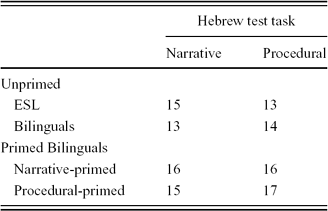
Thus, the design constituted a four (Group – unprimed ESL, unprimed bilingual, narrative-primed bilingual, and procedural-primed bilingual) by two (Test Task Genre – narrative vs. procedural) design with both factors representing between participant factors. The number of participants in each condition is shown in Table 1.
Number of participants by condition.

Three dependent measures were used. The first of these dependent measures is sentence reading times, a measure which has been shown to be significantly sensitive to passage difficulty (e.g., Schmalhofer & Glavanov, Reference Schmalhofer and Glavanov1986). A second measure required children to reorder the sequence of sentences that made up each task. That is, the sequence of sentences of each task was randomized and participants had to provide a number, indicating for each sentence its correct place in the original text they had read, a task that has been employed in many studies of children's (e.g., McClure, Mason & Barnitz, Reference McClure, Mason and Barnitz1979; Stein & Glenn, Reference Stein, Glenn and Freedle1979) and adults' (Benton, Kraft, Glover & Plake, Reference Benton, Kraft, Glover and Plake1984) reading ability, as well as bilingual children's (e.g., Verhoeven, Reference Verhoeven1994) reading comprehension in the two languages. The sentence sequencing task provides two measures: sentence sequencing mistakes and time to correct sentence sequencing. Studies with children have shown that performance on sentence sequencing tasks is sensitive to the difficulty of the reading passage, with older children being much more successful than younger ones (e.g., McClure et al., Reference McClure, Mason and Barnitz1979; Stevens & Yussen, Reference Stevens and Yussen1988). The more difficult the passage, the more time it should take to sequence the sentences and the more sequencing mistakes should occur (cf., Brunyé, Taylor, Rapp & Spiro, Reference Brunyé, Taylor, Rapp and Spiro2006; Glenberg & Langston, Reference Glenberg and Langston1992).
Results
Of the 129 participating children, the data of four could not be used in the analyses since these children had one or more missing data points. Preliminary examination of the data indicated that six additional children did not perform the ordering task as required and pushed the number button, indicating sentence order, almost at random. Such participants had very short ordering latencies and 10 ordering errors. The data of these participants were also dropped from all statistical analyses. Consequently, the analyses reported below were performed on the 119 remaining participants.
We present the results in two sections. First we present the reading data and then we present the sentence sequencing data. Note that for all analyses which are based on measurements of reaction time (i.e., reading time and sentence sequencing time), the data were analyzed after performing a logarithmic transformation and pooling the data across the three tasks of each genre. The means we present below have been re-transformed to reflect actual reaction times.
Reading time of the first texts
The first analyses were conducted to examine whether the groups differed in their reading time of the Hebrew versus the English versions of the same texts. Note that the unprimed groups read the texts only in Hebrew and that the first texts that the primed groups read were in English. This allows one to compare the reading times of the Hebrew versus the English versions of the texts. To conduct this analysis, we created a new variable which combined the unprimed groups' reading times for the Hebrew text and the primed groups' reading times of the priming text which they read in English. We conducted an analysis in which language of the first text read (Hebrew/English) and genre (narrative/procedural) were the only variables. This analysis showed that Language was marginally significant, F(1,115) = 3.54, p < .07, η2 = .043, such that participants who read the first text in Hebrew tended to read it somewhat faster than those who read the first text in English. The mean retransformed per sentence reading times were 403.64 ms (SD = .144) and 459.73 ms (SD = .178) for the Hebrew versus the English text. More importantly for our purposes, genre was not significant, either as a main effect or in interaction with language, both Fs < 2, n.s.
Since in the previous analysis the data of the two unprimed groups – ESL and bilinguals – were pooled, our next analysis examined their individual reading times to see whether the genre of the texts impact reading times. Recall that both of these groups read the text only once, in Hebrew. In an analysis of variance with Group (2 – ESL and bilinguals) and Test Task Genre (2 – narrative vs. procedural) on the log transformed reading times averaged over the three tasks, there were no main effects or interactions, all Fs < 1. Here again, then, genre was not significant, either as a main effect or in interaction with language group.
In our next analysis, the ESL children were not included and we examined the reading times of the first text in the three groups of bilingual children: unprimed, narrative-primed, and procedural-primed. Note again that primed participants read the priming text in English whereas unprimed participants read the test task in Hebrew. Hence, this comparison allows us to draw conclusions as to whether participants who first read the English text (which eventually served as a prime for the Hebrew text) read it at the same rate as unprimed participants read the Hebrew text. In an analysis on the log transformed data, with Group (3 – unprimed, narrative-primed, procedural-primed) and Genre (narrative vs. procedural) as between participant factors, the analysis showed no significant effects, all Fs < 2, n.s. Thus, irrespective of genre, bilingual participants who read the English text as their first text read it at the same speed as bilingual participants who read the same text in Hebrew. This finding underlines the fact that our bilinguals were relatively balanced in terms of their proficiency in English and in Hebrew. Concomitantly, this null effect undermines the possibility that primed bilingual children translated the text into Hebrew as they were reading the English text. This is because had they done so, the additional time required for spontaneously translating the text into Hebrew would have resulted in their taking longer to read the English priming text than it took the unprimed bilinguals to read the Hebrew text.
Test task reading times
Turning our attention to test task reading times, we conducted an analysis on the log transformed Hebrew test task reading times of the three bilingual groups, with Group (3) and Test Task Genre (2) as factors. This analysis showed only a main effect for Group, F(2,85) = 6.81, p<.005, η2 = .138. The means for this main effect were 408.32 ms (SD = .132) for the unprimed group, 309.03 ms (SD = .143) for the narrative-primed group, and 307.61 ms (SD = .15) for the procedural-primed group. Further analyses showed that this main effect was due to the fact that the unprimed group differed significantly from the two primed groups, with the primed groups reading the Hebrew text significantly more quickly than the unprimed group, F(1,87) = 13.89, p < .001, and the two primed groups not differing from each other in their reading times, F(1,60) < 1, n.s.
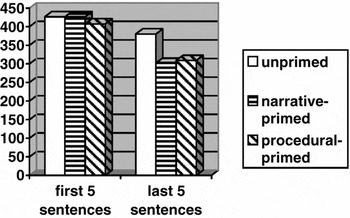
To examine this pattern more closely, we compared the test task reading times of the first five sentences of each task with the last five sentences. In an analysis of variance with Sentence Location (2) as a within participant factor and Group (3) and Test Task Genre (2) as between participant factors, we found a significant main effect for Sentence Location, F(1,84) = 105.26, p < .001, η2 = .556, which was constrained by a significant interaction with Group, F(1,84) = 7.52, p < .001, η2 = .152. The relevant means for this interaction are shown in Figure 1. As evident in the figure, whereas there was no difference between language groups on the first five sentences of each task, all Fs < 1, n.s., the primed groups read the last five sentences more quickly than the unprimed group, F(2,85) = 4.75, p < .05.
Test task reading times, in milliseconds, by Group and Sentence Location, bilinguals only (pooled across the three tasks, by sentence).

In the second analysis, conducted to test the effect of prior presentation of material in the narrative versus procedural genre within the primed groups, we compared the sentence reading times of the English priming task and the Hebrew test task. Since these participants read the same material twice, once when they read it as a prime in English and once when they read it as the test task in Hebrew, we labeled this within participants factor Repetition. An analysis of variance with two between participants factors (Prime Genre, Test Task Genre) and one within participant factor (Repetition) was conducted on the log transformed reading times. This analysis showed only a main effect for Repetition, F(1,60) = 61.51, p<.001, η2 = .506. None of the other effects were significant, all Fs < 1, n.s. The means were 459.20 ms (SD = .178) and 308.32 ms (SD = .146) per sentence for the priming sentences versus the test sentences.
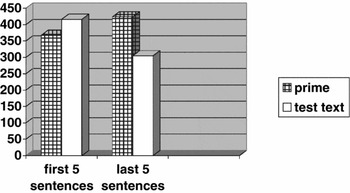
Next, within participants, we examined the reading times of the first five sentences versus the last five sentences of the priming task and the test task in the two primed groups. In an analysis with Sentence Location (2) and Repetition (2) as within participant factors and Group and Test Task Genre as between participant factors, there were several significant effects: a main effect for Sentence Location, F(1,60) = 18.58, p < .001, η2 = .236, a marginally significant interaction between Sentence Location and Group, F(1,60) = 3.18, p < .10, a main effect for Repetition, F(1,60) = 11.95, p < .001, η2 = .164, and an interaction of Repetition and Sentence Location, F(1,60) = 159,.61, p < .001, η2 = .725. The relevant means for the significant interaction are shown in Figure 2.
Prime and test task reading times, in milliseconds, by Sentence Location, primed bilinguals only (pooled across the three tasks, by sentence).

Further tests showed that the first five sentences of the test task were read significantly more slowly than those of the priming text, F(1,60) = 13.03, p < .001, whereas the last five sentences of the test task were read significantly more quickly than those of the priming text, F(1,60) = 86.11, p < .001. Contrary to the hypothesis, however, the two genres did not appear to be more difficult for these participants and they spent the same amount of time reading procedural versus narrative genre material in each of their two languages.
Test data
Recall that when participants were required to sequence the sentences, they were presented with the same text – in the same language and in the same genre – that they had read at test time with the sequence of the sentences randomized. Two dependent measures were assessed at test time: sentence sequencing mistakes and the time required to correctly sequence the sentences.
Sentence sequencing mistakes
First, we examined the number of mistakes made by the two groups of unprimed participants, ESL learners and bilinguals, on the sentence sequencing task. An analysis of variance with Group (2 – ESL and bilingual) and Test Task Genre (2) revealed no significant differences, all Fs < 1, n.s.
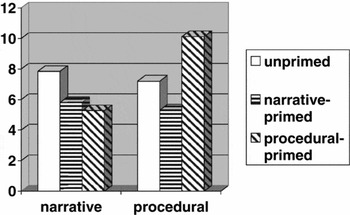
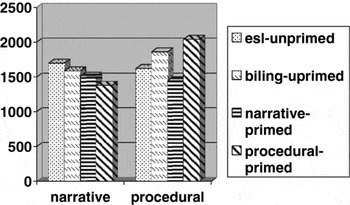
For our next analysis, the ESL children were not included and we compared the number of sentence sequencing mistakes of the unprimed bilingual group and the two primed groups of bilingual children. In an analysis of variance with Group (3) and Test Task Genre (2), we found a significant interaction between Group and Test Task Genre, F(2,85) = 3.15, p < .05, η2 = .069. The means for this significant interaction are shown in Figure 3. As is evident in this figure, the interaction emerged because primed participants who read both the prime and the test task material in procedural genre made significantly more sentence sequencing mistakes than all other groups, F(1,116) = 7.99, p < .01. But in addition, unprimed children made significantly more sequencing mistakes than the narrative-primed group as well as than the procedural-primed, narrative-tested group, F(1,99) = 5.21, p < .05.
Sentence ordering mistakes, by Group and Test Task Genre, bilinguals only (out of 30).

Correct sentence sequencing time
Next, we conducted analyses on correct sentence sequencing time. To do so, we created a variable, correct sentence sequencing time, which was computed as total sentence sequencing time divided by the number of correctly sequenced sentences, out of 30, with this per sentence correct sequencing number being log transformed to conduct the analyses. Analyses were conducted with, and without, covarying test task reading times. All the means we present below have been retransformed.
In the first of these analyses, we compared the correct sentence sequencing time of the two unprimed groups, ESL and bilinguals. In an analysis of variance with Group (2) and Test Task Genre (2) as factors, we found no significant differences, all Fs < 1, n.s., and this pattern did not change when test task reading times were covaried, all Fs < 1, n.s., although test task reading times was a significant covariate, F(1,46) = 8.76, p < .005.
Analyses were then conducted on the correct sentence sequencing times of the bilingual unprimed group and the two groups of primed bilingual children. A Group (3) by Test Task Genre (2) analysis of variance on the correct sentence sequencing times showed no significant differences, all Fs < 2, n.s. With test task reading times covaried, the covariate was significant, F(1,82) = 27.67, p < .001, and there was a marginally significant effect for Test Text Genre, F(1,82) = 3.76, p < .06. The retransformed means were 1475.91 ms per sentence for correct sequencing in the narrative genre versus 1769.54 ms per sentence for correct sequencing in the procedural genre. To clarify whether narrative genre serves to facilitate or procedural genre serves to inhibit, we conducted further comparisons with both of the unprimed groups, ESL and bilinguals. Neither of these unprimed groups differed from the narrative-primed group in correct sentence sequencing times for narrative genre material, all Fs < 1, n.s. When we compared the correct sentence sequencing times of the two unprimed groups – ESL and bilinguals – who read the procedural genre text, with the procedural-primed group who also read the procedural genre text, we found that both of the unprimed groups had faster correct sentence sequencing times: F(1,27) = 3.34, p < .08, for the comparison with the unprimed bilingual group, and F(1,26) = 4.90, p < .05, for the comparison with the unprimed ESL group. The relevant retransformed means for these comparisons are shown in Figure 4.
Correct sentence ordering times, in milliseconds, by Group and Test Task Genre (per sentence, averaged over the ten sentences for each of three texts).

Thus, procedural priming in children's one language serves to increase both the number of mistakes in sentence sequencing and the time required for correct sentence sequencing in their other language.
Discussion
The current study addressed cross-language priming in procedural versus narrative genre in bilingual children's one language on their subsequent performance on either the same genre or the other genre in their other language. There are two unique aspects to our study. First, we used the same content and the same words in texts varying in genre to assess children's performance on procedural versus narrative genre material. In previous research, definitive conclusions regarding possible differences between the two genres could not be reached because both the content and the words of the material presented in the two genres differed. Second, our study is also unique in its use of multiple measures of assessment as dependent measures of processing difficulty of the two genres. We used text reading times, subsequent mistakes in sentence sequencing, and correct sentence sequencing times as dependent measures. The importance of this multiple assessment is evident in the finding of differences between the various measures, as we discuss below.
In conducting this study, we first questioned whether sentences in procedural genre are harder to process than the same sentences in narrative genre. To reiterate, in English and in Hebrew, procedural texts ellipse the subject of the sentence and consequently, in both languages, procedural texts are shorter than the equivalent narrative texts. In terms of word-based reading times, then, one would expect procedural text to be read faster than the equivalent narrative text. If, however, procedural text is harder to process, it should either take longer, or as long, to read procedural text despite sentence length.
To examine these alternatives, we conducted several different comparisons. The first of these comparisons focused on the reading time of Hebrew versus English, procedural and narrative versions of the same texts. We compared the unprimed groups' reading time of the Hebrew text and the primed groups' reading time of the priming text which they read in English. Because these were the only texts read by the unprimed groups and the first texts read by the primed groups, this comparison allows us to draw conclusions as to possible differences between the two languages of presentation and the two genres. We found only a marginally significant effect for language, such that groups who read the first text in Hebrew tended to read it somewhat faster than those who read the first text in English.
This marginally significant effect raises the possibility that the bilingual children who were reading the text the first time in English may have been simultaneously translating the English text into Hebrew as they were reading. However, when we compared the reading times of the first text in the three groups of bilingual children – unprimed bilinguals who read the texts in Hebrew, and narrative-primed, and procedural-primed bilinguals who read the priming texts in English – we found no significant differences between the groups. Hence, bilingual participants read the texts at the same speed irrespective of whether the texts were in Hebrew or in English. This finding underlines that our bilinguals were relatively balanced in terms of their proficiency in English and in Hebrew but more important, this finding obviates the possibility that the primed participants were spontaneously translating the texts into Hebrew. Had they done so, it would have taken them significantly longer to read the English priming text.
Critically from our perspective, in all the analyses reported above, genre was not significant, either as a main effect or in interaction with language. In the comparison between the two groups that read the texts in Hebrew, the unprimed ESL and unprimed bilinguals, we also found no impact of genre in terms of reading times. The procedural texts, then, were not read more quickly then the narrative texts despite the fact that the procedural texts were shorter. This suggests that it may be more difficult to process procedural than narrative genre material and that this is the case in both English and in Hebrew. As we will see, this is also the conclusion warranted by the results of further analyses which we discuss below.
Turning our attention to the reading of the test task, which all participants read in Hebrew, we again focus on the question of possible differences between narrative and procedural genre as well as the possible impact of cross-language priming. First, we found significant effects of cross-language priming. In reading the Hebrew test text, children who did not read the English prime texts differed significantly from the two primed groups, with the two primed groups reading the test text significantly more quickly than the unprimed group, and with the two primed groups not differing from each other in their reading times of the test text. As well, children who had read the priming texts in English, subsequently read the Hebrew test texts more quickly than they had read the priming texts. We can therefore conclude that this difference is a function of the fact that the primed children had previously read the priming text in English. But how did priming work in these bilingual children? Our data indicate that these bilingual children did not apparently translate the text into their other language. First, if bilingual children had spontaneously translated the English priming text into Hebrew as they were reading, their reading times for the priming text would have been expected to be longer than the reading times of those participants who read the test text in Hebrew the first time. We did not find this to be the case.
Is it possible that primed participants constructed a language-independent representation that was also accessible to their other language? The results do not offer support for this possibility. Primed children read the first five sentences of the test task significantly more slowly than they had read the first five sentences of the priming text and they did not differ from unprimed children in their reading times of the first five sentences of the test task. This finding – which parallels the pattern found by Friesen and Jared (Reference Friesen and Jared2007) in adult bilinguals – implies that the test material in Hebrew was not immediately recognized by these children as having been read before in English. If they had spontaneously translated the English text into Hebrew or had constructed a language-independent representation, they should have recognized that the two texts were identical and should have read all the sentences in the Hebrew test text more quickly. It was only when primed children kept reading the sentences of the test text, that they “realized” that the text they were reading in Hebrew was the same text they had previously read in English and evidenced the benefit of prior exposure to the text in their other language.
Importantly, though, in terms of reading times, priming with cross-language procedural text was as effective as priming with cross-language narrative text, raising serious questions about the possibility of divergent representation of procedural versus narrative text, an issue we will return to below. Across all these comparisons, no genre effects emerged and participants spent the same amount of time reading procedural versus narrative genre material in each of their two languages.
Recall that two additional measures were used to test the hypotheses, with the first of these being the number of mistakes on the sentence sequencing task which was in the same language and of the same genre as the test task. The first question we address in this context is whether there are genre effects in the number of sentence sequencing mistakes. Comparisons of the two unprimed groups showed that they did not differ in the number of sentence sequencing mistakes they made on narrative versus procedural genre material. Apparently, then, these two genres of text did not differ in terms of their relative difficulty as assessed by the number of sentence sequencing mistakes of unprimed children. However, we found that cross-language priming reduced the number of sentence sequencing mistakes, so that all children who were either narrative-primed or narrative-tested made fewer sentence sequencing mistakes than unprimed children. Hence, priming in English had several effects. It led to longer reading times of the first five sentences of the Hebrew test task in primed children, to overall shorter reading times of the test material in Hebrew in English-primed children, and it reduced the number of sentence sequencing mistakes in either narrative-primed or narrative-tested children. But the pattern of results is complicated by the finding that children who were both primed and tested in procedural genre made significantly more sentence sequencing mistakes than any of the other groups, whether primed or unprimed. Hence, although priming in English did facilitate children's Hebrew reading performance and reduced their subsequent sentence sequencing mistakes in Hebrew, this was not the case for procedurally-primed and procedurally-tested children, an issue we will return to below when we discuss the findings for correct sentence sequencing times.
The last measure assessed during the test phase was the time required to correctly sequence the sentences that constituted the text of the reading phase. Correct sentence sequencing times also showed an effect for genre only for bilingual children. Unprimed ESL and bilingual participants did not differ in their time to correctly sequence sentences in narrative versus procedural genre. Hence, when ESL and Hebrew–English bilingual children need to rely on previously read Hebrew text, they are able to derive the logical sequence of the sentences, irrespective of the genre in which they read the text originally. As well, irrespective of the genre in which the priming text was originally read, there was no difference between groups in correct sentence sequencing times of narrative genre sentences. However, for procedural genre sentences, those children who had been primed with English procedural text and tested in Hebrew procedural text, took significantly longer than all other participants to correctly sequence the sentences. Even though reading times did not evidence genre effects, both the number of sentence sequencing mistakes and correct sentence sequencing times clearly indicate that procedural genre material is harder to process. This finding is important since these differences emerged after covarying task reading times and can not be accounted for by the amount of time devoted to reading the test passages. Thus, irrespective of the time these bilingual children allotted for reading the test material, procedural genre material was still harder for them to sequence in the correct order. Let us not forget that although the primed groups read the test task more quickly than the unprimed groups, once their test task reading times were covaried, only the genre of the test material was relevant in determining how long it took them to sequence the sentences.
It is important to note that in the procedural genre, self is the implicit agent but in the narrative genre, a third person is the agent and this self/other difference could arguably have contributed to the patterns that were found above. However, this possibility is undermined by the data of the two unprimed groups. The two unprimed groups, who read the Hebrew text either in procedural or narrative genre, read both genres of texts at the same speed. Moreover, there were no significant differences between these two unprimed groups in their sentence sequencing errors and their correct sentence sequencing times, underlining the fact that procedural text is more difficult to process despite the fact that it is shorter in the number of words.
Importantly, then, our data indicate that bilingual, primed children are largely insensitive to the genre of the material they read, allocating the same amount of time to reading both narrative and procedural material, irrespective of the language in which the material is presented. That is, bilingual children do not seem to be aware of the greater difficulty of procedural material for them. They subsequently pay a price for this lack of awareness, though. First, they make significantly more sequencing mistakes on procedural genre material when primed with procedural genre material. As well, even with task reading times covaried, they take longer to correctly sequence sentences in the procedural genre, especially when primed by procedural genre material in their other language.
Why would this be the case? An explanation that only relies on the transformation of procedural text into a declarative representation or a mental model cannot account for the pattern of these data. That is, if as has been argued (e.g., Bovair & Kieras, Reference Bovair, Kieras, Barr, Kamil, Mosenthal and Pearson1996; Dixon, Reference Dixon1982, Reference Dixon1987a, Reference Dixon and Tomlinb), procedural genre material is transformed into a mental model of the text, then presumably procedural-primed children would have had this representation available when they engaged in sentence sequencing and they should have evidenced the same pattern of mistakes and correct sentence sequencing times as those children who did not previously see the procedural primes. The fact that they did differ from the unprimed children in the number of their sequencing mistakes and in their correct sentence sequencing times implies that the mental model that they constructed when reading the prime text somehow interfered with subsequent construction of the mental model they constructed for the test task itself.
An explanation that seems more tenable is one that centers on how procedural text is processed (e.g., Burnham & Anderson, Reference Burnham and Anderson1991; Guthrie, Bennett & Weber, Reference Guthrie, Bennett and Weber1991). To elaborate, Guthrie and his colleagues have argued that procedural texts create a heavy load on the user's memory, primarily because each of the separate steps must be independently represented. This means that the surface structure of the text needs to be maintained, in contrast with narrative texts whose surface structure is rapidly lost and for which primarily gist is maintained (Flores D'Arcais, Reference Flores D'Arcais1974; Raney, Reference Raney2003). The preservation of surface structure, and particularly information about the language of the procedural text, means that during the test task in our study, the independent procedural steps need to be mapped onto each other across the two languages and this mapping is difficult to conduct. The fact that procedural text is as easy to read as narrative text is misleading for bilinguals because they fail to realize that they need to map the two language representations onto each other to maintain the viability of the sequence of steps of procedural texts. A change in genres, then, either from narrative to procedural genre or vice versa, is facilitative because it does not entail this cross-language mapping of the necessary steps in the procedures.
In general, our data suggest that it is necessary to reconsider the language used to provide instructions in teaching a second language. Language learners, even fairly proficient ones like the bilingual children in our study, do not seem to find it easy to deal with and process procedural material. The paradoxical implication of this pattern, though, is that for those who are not proficient in both languages, the provision of instructions in their dominant language may be helpful because cross-language mapping, which is the source of the problem, does not occur in the first place, suggesting that explicit translation of instructions on the part of second language teachers may have an important contribution in the ESL classroom, a possibility that future research needs to directly address.
An important finding in our study is that when the two genres of text are equated, procedural genre and narrative genre material are read at the same rate, despite the fact that procedural text is shorter because the subject is implicit. For children who only read the texts in Hebrew, irrespective of whether they were ESL or bilingual, sentence reading times, sentence sequencing mistakes, and correct sentence sequencing times were the same for the two genres, indicating that the two genres do not differ in difficulty when one reads them in a language in which one is proficient. At least as assessed by sentence sequencing mistakes and correct sentence sequencing times, this difficulty is evident when the same material is read in the procedural genre in another language. We believe that the differentiation between narrative and procedural genre is a critical one and that our data and the approach presented here provide an important step towards answering basic questions regarding how bilinguals process procedural text in their two languages. Of course, as noted by one of the reviewers, the narratives we provided in our study represent “the very minimal prerequisite” for narrative discourse and narrative discourse is generally more complex. However, experimental rigor demanded that we make the narrative and procedural discourse as similar as possible and this was done by making the wording and the sentence structure of the texts as similar as possible in the two genres. We think that this equivalence is critical for drawing conclusions about the two genres and that such conclusions could not have been drawn without this equivalence.
It is important to note that our participants were not required to carry out the procedures and that generally, instructions, whether provided orally or in written format, are not generally followed by tasks like sentence reordering but rather by a requirement to carry out the procedures themselves. On the other hand, in order to carry out instructions, procedural material, whether orally delivered or in written format, needs to be processed and so the important question is whether the fact that such instructions are in procedural rather than narrative genre has an impact for the bilingual. As we have shown in this study, procedural genre material is more difficult for bilinguals. As Catrambone (Reference Catrambone1990) notes, though, there is a trade-off between the time to read and comprehend instructions versus the time to perform the specified steps and succeed at the task at hand. This trade-off needs to be investigated more thoroughly in future research, and especially in the context of both proficient and less proficient bilinguals.
Finally, in this study, we compared Hebrew–English bilingual children. One may well ask whether our results are generalizeable to bilinguals in other languages, and especially bilinguals whose two languages are more similar both orthographically and in grammatical structure. Although we cannot draw any definitive conclusions in this regard, the fact that our data in some ways parallel the findings of Friesen and Jared (Reference Friesen and Jared2007) with French–English bilinguals makes us confident that our results are generalizeable and will prove to be both theoretically valid and empirically robust.
Appendix. Sample task
“Danny makes disappearing ink”/“How to make disappearing ink”
Danny squeezed a lemon/Squeeze a lemon.
He took a pen and cleared off the tip so ink cannot be seen/Take a pen and clear off the tip so the ink cannot be seen.
He poured some lemon juice into a small cup/Pour some lemon juice into a small cup.
He inserted the pen into the juice/Insert the pen into the juice.
He wrote in big, bold letters/Write in big, bold letters.
He waited for the “ink” to dry and then it disappeared/Wait for the “ink” to dry and then it disappears.
He lit a candle/Light a candle.
He held up the paper with the writing towards the flame/Hold up the paper with the writing towards the flame.
He brought the paper as close as possible to the candle without burning it/Bring the paper as close as possible to the candle without burning it.
He waited for the letters to reappear/Wait for the letters to reappear.