Introduction
The concept of response time with minimal interval is intimately related to the practice of emergency medicine. In Emergency Medical Services (EMS), numerous pathologies may evoke the possibility of life-threatening emergencies or imply time-sensitive conditions, such as cardiac arrest, major trauma, acute myocardial infarction, or acute stroke.Reference Schnegg, Pasquier, Carron, Yersin and Dami 1 - Reference Sasson, Rogers, Dahl and Kellermann 5 Limited response times and short delays in reaching the patient therefore are considered as statutory requirement and quality performance indicators.Reference Song, Shin and Park 6 , Reference Feero, Hedges, Simmons and Irwin 7 The concept of time-sensitive conditions, of course, also is important in children.Reference Zafrullah Arifin and Gunawan 8
Previous studies have been published on the ideal (recommended) response time for EMS, mainly focusing on the time period from notification of the ambulance to arrival on site. However, this delay is composed of different sequences, including the interval from ambulance notification to its departure. This interval has been studied in a limited number of studies and mainly was analyzed as a quality indicator.Reference De Maio, Osmond and Stiell 9 - Reference Leleu, Capuano, Ferrua, Nitenberg, Minvielle and Schiele 11
The factors influencing this time interval are poorly understood. At the alarm, the indication of a pediatric emergency situation, a multi-casualty condition, or an unusual situation could result in a different response time, with a reduced or prolonged departure interval. As pediatric conditions may represent up to 10% of all EMS interventions in an urban area, it is of the utmost interest to analyze the impact of information on pediatric age in the notification regarding EMS response time. As pediatric missions are not frequent, the hypothesis was that the stress linked to the information of the patient being a child may have an impact on departure interval. Stress may be linked to limited skills in pediatrics due to lack of practice, to the emotional fear to face a suffering child, or to a strong capacity to identify with the parents. This may shorten or extend this delay.
The primary objective was to investigate the impact of the patient’s age, as indicated in the notification, on departure intervals. The hypothesis was that pediatric cases could generate shorter departure intervals, potentially due to enhanced psychological stress. The second objective was to assess the rate of departure intervals of less than three minutes, which has been set as a target in this EMS.
Methods
Context
This study took place in the State of Vaud, in the western part of Switzerland. A unique centralized dispatch center (DC) covers a population of 750,000 and handles 80,000 calls per year. All emergency medical dispatchers (EMDs) are paramedics or nurses with at least five-years field experience. The EMDs use criteria-based guidelines, based on caller descriptions of signs and symptoms, and also can rely on their own medical background and personal experience to ask questions they consider appropriate to the situation. They use an electronic dispatching application using keywords to determine dispatch priority and the appropriate rescue vehicles (ambulance or rescue helicopter) and type of professionals (paramedics with or without emergency physicians) to be sent to the scene. Each call is processed by only one EMD from interview to dispatch. The EMDs identify the medical needs, define a priority dispatch level, or make a do-not-dispatch decision. When appropriate, they deliver telephone-guided, life-saving maneuvers to bystanders.Reference Clark, Winchell and Betensky 12 The EMDs notify prehospital teams with plain text messages (not codes), which ideally contain a precise address, a keyword regarding the nature of the suspected medical problem, and the type of patient (adult vs pediatric), and when it is known, the age of the patient.
Response Time Definition and Monitoring
In this EMS,Reference Dami, Fuchs and Yersin 13 as opposed to other systems,Reference Pittet, Burnand, Yersin and Carron 14 - Reference Nogueira, Pinto and Silva 16 ambulances are not dispatched within the territory while awaiting their next assignment, but instead wait in their base; paramedics are not required to stay on board the ambulance. When alarmed, ambulances notify their departure and arrival on site to the DC either by using radio communication or a Global Positioning System/GPS-related tracking system.
The DC records the following standard times: first call ring, call answering, notification to the ambulance, ambulance departure, arrival on site, departure from the scene, and arrival at the hospital. All those times are recorded on the same support, the dispatch computed-aided system. There is no consensus on dispatch time intervals.Reference Nogueira, Pinto and Silva 16 - Reference Hoogervorst, van Beeck, Gosling, Bezemer and Bierens 18 The “departure interval” was defined as the interval from notification to departure of the ambulance. In this EMS, the target for this interval is less than three minutes.
Study Design
This was a 3-year retrospective observational study carried out from January 1, 2010 through December 31, 2012.
Data Collection
The DC provided access to its data set. Notification and ambulance departure times, which define the departure interval, were recorded. Night time was defined from 7:00 pm to 6:59:59 am. All notifications (text messages) sent to the EMS teams, containing the address, keyword, and indications regarding the age of the patient, were recorded. Finally, patients’ birthdates registered by paramedics at the end of the mission also were collected.
Study Population
All missions requiring an immediate departure, excluding inter-hospital transfers, were included. Missions with erroneous data regarding the patient’s age (less than 0 days and more than 115 years) or erroneous data regarding response intervals (less than 0 seconds or more than 600 seconds) were excluded.
Age Groups
Departure intervals for two groups were compared: pediatric (<16) vs adult patients. Missions were classified as pediatric cases when the notification contained a precise age, when age was given in numbers of months, weeks, or days, or when the message contained terms like “child,” “baby,” “infant,” or “newborn.”
All other missions were classified as adult cases by default. The DC’s database contains patients’ precise birthdates transmitted by paramedics after the mission. This information was not used for group classification as it was not known by the EMS teams at the beginning of the mission. However, it was used for post hoc quality control of age-related categories.
Clinical Categories
All missions were grouped according to the content of the notification message. Four clinical categories were defined: dyspnea, trauma, loss of consciousness, and respiratory or cardiac arrest. For each category, a list of eligible keywords was established to allow the notification messages to be classified.
Using these lists, an automatic search of chains of characters in the notification messages, which contain keywords and complementary information, was conducted. A custom-made algorithm from Visual Basic for Application (Microsoft Corp.; Redmond, Washington USA) was used.
The end result of the automatic classification was adjudicated manually. For each category, 200 messages automatically sorted in the category, and 200 messages automatically excluded from it, were selected randomly and their content verified manually for sorting errors. The sorting algorithm then was adjusted in order to achieve better sensitivity and specificity. The final algorithm was adjusted to have a sensitivity and specificity of >99%.
Missions fulfilling criteria for more than one category were classified in the “more than one category” group only. Missions fulfilling none of the criteria were classified in the “no category” group.
Statistic Analysis
For each age group and each clinical category, the mean and median departure times were calculated in seconds. The significance of the result was assessed by a Fisher’s test. The limit of significance was set at P ≤ .05. Significance of the categorical variable was assessed using the chi-square test. All calculations were made using the software IBM SPSS, Version 22.0 (Released 2013; IBM Corp.; Armonk, New York USA). The influence of the clinical category and the hour of the notification (night time vs day time) on the departure interval using two-way analysis of variance (ANOVA) were analyzed.
Ethics Committee and State Approvals
This study was authorized by the Lausanne University (Lausanne, Switzerland) Ethics Committee for human research.
Results
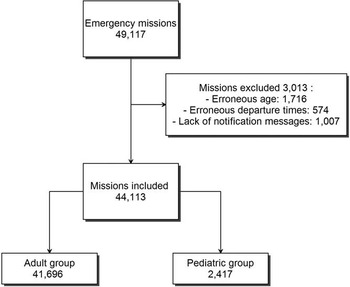
From January 1, 2010 through December 31, 2012, a total of 47,119 missions were completed. Of these, 3,013 (6.4%) were excluded because of data being incomplete or obviously erroneous. Finally, 44,113 missions were included (Figure 1). The criteria for inclusion in the pediatric group were met by 2,417 (5.5%) missions.
Flow Chart.

The mean departure interval for the adult group was 152.9 seconds, whereas it was 149.3 seconds for the pediatric group (P =.018). The median departure interval was 144 seconds in the adult group and 140 seconds in the pediatric group (Table 1).
Departure Time by Age Groups

The proportion of departure intervals within the 3-minute target for all missions was 70.3%. This proportion was higher for the pediatric group (73.0%) than for the adult group (70.3%), but was not significant (P =.11). During night time, the proportion of missions reaching the target fell to 58.3%.
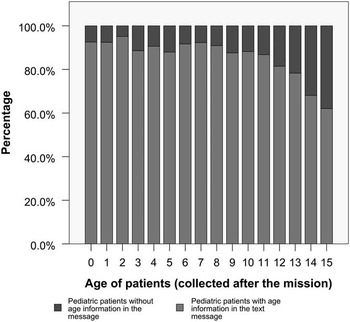
The older the children were, the less frequent the indication of age on the notification message, with more than 30% of notifications regarding patients aged 15 having no indication of age (Figure 2).
Proportion of Pediatric Patients, According to Age (by hospital admission), Whose Text Messages Included Sufficient Information to be Classified in the Pediatric Group.

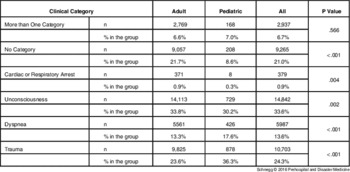
Missions during night time represented 37% of all missions. There were significantly more adult cases during night time (P <.001; Table 2).
Distribution of Night Missions by Age Groups (37% of total)

The distribution of the clinical categories was inhomogeneous. Dyspnea and trauma were over-represented in the pediatric group, while unconsciousness was over-represented in the adult group. Of all missions, 29% were attributed to more than one category and 21% to no category (Table 3).
Distribution of Missions by Age Groups and Clinical Categories

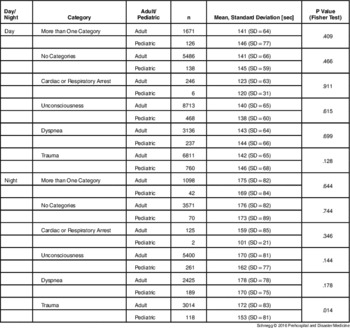
The multivariate analysis, according to the time of the day and clinical category, showed that the differences between groups remained non-significant except for the trauma category during night time (Table 4).
Departure Time by Age Groups and Clinical Categories

Discussion
The hypothesis of shorter departure intervals for pediatric situations was confirmed. The departure interval for the pediatric group was four seconds shorter than for the adult group. This result was statistically significant, but probably had no clinical impact. Although it is known that the indication of an unusual, potentially stressful situation (such as pediatric life-threatening injury) may induce numerous reactions with “stunned”-like behaviors and slow thinking and also may cause prolonged departure intervals, this does not seem to be the case in this study.Reference Breen, Woods, Bury, Murphy and Brazier 19 , Reference Lammers, Byrwa and Fales 20
To the authors’ knowledge, this study is the first to specifically analyze the departure interval in relation to the presence of indications about pediatric emergencies.
The topic is of importance, as taking care of pediatric patients is considered stressful by paramedics, with a potentially detrimental effect on prehospital procedures.Reference Cottrell, O’Brien and Curry 21 , Reference Warren, Jones, Shafi, Roden-Foreman, Bennett and Foreman 22 The main reasons accounting for this are the emotional stress of caring for children and the quite low exposure to this type of patient, which represents approximately only 10% of paramedics’ case mix.Reference McGarry, Girdler and McDonald 23 - Reference Houtekie, Meert, Thys, Guy-Viterbo and Clement de Clety 28
The proportion of departure intervals within the target of three minutes was 70.3%, without significant difference between the two age groups. During night time, this rate falls to 58.3%, as paramedics are allowed to sleep on their base and are not required to stay on board their vehicles. This rate needs to be improved as the literature recommends time intervals of two to three minutes.Reference Schmid and Doerner 17 , Reference Hoogervorst, van Beeck, Gosling, Bezemer and Bierens 18
Approximately one-third of missions were realized during night time. The proportion of adult cases was greater during night time hours. This already has been described in other epidemiological studies on pediatric cases.Reference McGarry, Girdler and McDonald 23 , Reference Seidel, Hornbein, Yoshiyama, Kuznets, Finklestein and St Geme 26
Dyspnea and trauma were over-represented in the pediatric group, while unconsciousness was over-represented in the adult group (Table 3). This difference was expected from a previous experience.Reference McGarry, Girdler and McDonald 23 Significantly more missions, mainly related to chest pain and stroke suspicions, were attributed to the “no category” in the adult group (Table 3).
In the multivariable analysis, similar response times for pediatric and adult patients is observed for all sub-groups, with one exception (trauma during night time) for which there is no explanation.
Limitations
Benchmarking with other EMS is difficult to establish as the EMS described in this study is based on a criteria-based dispatch system and on stationary ambulances.
Pediatric missions represented only five percent of all missions. This rate is similar to previous results published.Reference McGarry, Girdler and McDonald 23 - Reference Seidel, Hornbein, Yoshiyama, Kuznets, Finklestein and St Geme 26 When the text messages and final birthdates recorded at the end of the mission were compared, the result was that the older the child, the less likely the text message was to contain clear indications on the pediatric nature of the case. From a clinical point of view, the importance of knowing a patient’s age decreases when the patient gets older as the patient does not then benefit from specific material or protocols and is treated as an adult. Nevertheless, this limitation may have reduced the number of pediatric cases potentially usable for analysis and comparison.
Conclusion
A statistically significant departure interval difference between adult and pediatric missions when the emergency team had knowledge of the age of the patient was found. The difference, however, probably was not significant from a clinical point of view (four seconds).
During night time, only 53% of ambulances had a departure interval within the three minutes set as gold standard in this EMS.
Contributions
Bruno Schnegg, Fabrice Dami, and Pierre-Nicolas Carron designed the study, the first and last authors performed the analysis, and all authors contributed to the writing and reviewing of the manuscript.