Recent progress in early diagnosis and treatment has increased the life expectancy of patients with CHD. Nowadays, 90% of newborns diagnosed with CHD will live to adulthood, and this population has been increasing at the rate of ~5% per year.Reference Warnes1–Reference Hoffman and Kaplan4 The prevalence of CHD is changing all over the world and nowadays there are more adults affected than children.Reference Marelli, Mackie, Ionescu-Ittu, Rahme and Pilote5
As survival rates increase, research on psychosocial sequelae in CHD patients become critical; at present, it has mainly been focused on issues such as perception of quality of life,Reference Loup, Weissenfluh, Gahl, Schwerzmann, Carrel and Kadner6 psychosocial adjustment, psychiatric morbidity, and neurocognitive impairment. Thus, the evaluation of these variables is becoming increasingly important for patients with CHD. Quality of life is a multi-dimensional construct that refers to the individuals’ perceptions of physical, emotional, and social well-being and functioning.Reference Goldbeck and Melches7, Reference Gottmaker, Walker, Weitzman and Sobol8
At present, the findings of studies on quality of life in CHD patients are not consensual. Some studies reported poorer psychological well-being in patients compared with healthy controls,Reference Rose, Köhler, Köhler, Sawitzky, Fliege and Klapp9, Reference Spijkerboer, Utens, De Koning, Bogers, Helbing and Verhulst10 whereas others claimed that there was no difference between the two groups, and even others stated that the congenital nature of the disease leads to the development of a stronger sense of coherence in these patients and a better quality of life than in healthy people.Reference Fekkes, Kamphuis and Ottenkamp11, Reference Moons, Deyk and Marquet12
Patients with CHD often have persistent cardiac defects and lesions that may affect quality of life and psychosocial adjustment,Reference Rietveld, Mulder and Van Beest13 and they may be considered at increased risk of emotional difficulties, although generally a good adjustment is reported.Reference Fekkes, Kamphuis and Ottenkamp11, Reference Bellinger and Newburger14, Reference Kovacs, Saidi and Kuhl15
Several features associated with poor quality of life in CHD patients have been identified and include cardiac instability,Reference Moons, Deyk, Marquet, Bleser, Geest and Budts16 severity of the disease,Reference Goldbeck and Melches17, Reference Latal, Helfricht, Fischer, Bauersfeld and Landolt18 motor functioning, and autonomy.Reference Krol, Grootenhuis, Destrée-Vonk, Lubbers, Koopman and Last19
Interestingly, when we compare self-reports of patients and observations made by parents and partners, the second are more likely to see the psychosocial adjustment of patients as worse than their own selves, highlighting more behavioural and emotional problems.Reference Bellinger and Newburger14, Reference Gaynor, Nord and Wernovsky20, Reference Spijkerboer, Utens, Bogers, Verhulst and Helbing21 Thus, it is a matter of main concern to understand which variables have a detrimental effect on psychosocial adjustment and well-being of the patients and which ones increase resilience and ability to adapt. Therefore, the objective of our study was to systematically address the question of which demographic and clinical variables have an impact over quality of life, psychosocial adjustment, and psychiatric morbidity.
Materials and methods
Patients
The study enrolled 137 CHD patients (79 male and 58 female) ranging in age from 12 to 26 years old (mean age: 17.60±3.450 years) who are followed up in consultation in the Pediatric Cardiology or Adult Cardiology Departments of a tertiary hospital in Portugal. We excluded patients who had not achieved a basic educational level that enables them to understand and complete the written questionnaires; we only included patients who had complete medical records. Patients with associated extracardiac malformations or chromosomopathies were excluded from the study.
The study also included 128 relatives of the patients who accepted to participate and completed the observational versions of the questionnaires.
At the time of the interview, four patients were married and one was divorced. All the other patients were single (132). Of the patients, 20 were employed full- or part-time, seven were unemployed, and all the others were students (110).
With regard to the educational level, one patient completed first 4 years in school, 20 patients completed 6 years, 55 patients completed 9 years, 55 patients completed the whole secondary education, and six patients had a university degree.
Patients’ clinical files were provided by the department of Cardiology or Pediatric Cardiology. The congenital cardiac malformation was cyanotic in 71 patients, and acyanotic in 66 patients. According to the clinical files, at the time of diagnosis, 38 patients had a severe form of CHD, 25 had a moderate form, and 74 had a mild form. In all, four patients had severe residual lesions, 27 had moderate residual lesions, and 105 had mild residual lesions.
The diagnosis was determined during the neonatal period for 73 patients, before the first birthday for 31 patients, between the ages of 1 and 3 years for five patients, between the ages of 3 and 6 years for eight patients, between the ages of 6 and 12 years for 11 patients, and between the ages of 12 and 18 years for nine patients. In several patients, the main CHD was combined with other heart diseases. The following pathologies were observed: transposition of the great arteries in 20 patient, of them, four had ventricular septal defect, one had aortic stenosis, one had pulmonary stenosis, and two had coarctation of the aorta; tetralogy of Fallot in 30 patients; coarctation of the aorta in 13 patients, besides those two referred above; ventricular septal defect in 19 patients, of them, one had interrupted aortic arch, and another had mitral insufficiency; atrial septal defect in 16 patients, of them, one had mitral atresia and pulmonary hypertension; atrioventricular septal defect in five patients; aortic stenosis in eight patients; pulmonary stenosis in 13 patients; single ventricle in two patients, one of them had pulmonary atresia, and one had pulmonary stenosis; patent ductus arteriosus in two patients; double outlet right ventricle in one patient; Ebstein anomaly in three patients; and pulmonary atresia in five patients. Of the 103 patients who underwent surgery, the first surgery was performed during the neonatal period for six patients, before the first birthday for 35 patients, between the ages of 1 and 3 years for 19 patients, between the ages of 3 and 6 years for 21 patients, between the ages of 6 and 12 years for 11 patients, between the ages of 12 and 18 years for 10 patients, and after 18 years of age for one patient.
One or more of the following psychiatric disorders had been diagnosed for 27 patients (19, 7%) before the interview: minor or major depressive syndrome (n=14), panic disorder (n=3), anxiety disorder (n=6), or manic syndrome (n=3), and cyclothymic personality (n=1).
Assessment instruments
Complete clinical history – for example, diagnosis, severity and category of CHD, course of illness, surgeries, presence of residual lesions, and treatment with medication – and demographic information – for example, marital status, educational level, and occupation – were collected in a questionnaire.
The patients also responded to a semi-structured interview covering topics such as social support, family educational style, environment, self-image, functional limitations, educational background, and emotional adjustment.
A standardised psychiatric interview (SADS-L) was conducted to obtain a clinical diagnosis of any psychopathological disorders that may have existed before the interview. The patients completed self-reported questionnaires such as WHOQOL-BREF for the assessment of their quality of life, and YSR or ASR for the assessment of psychosocial adjustment. One of their caregivers completed an observational version of the same questionnaires – Child Behaviour Check List or Adult Behaviour Check List, according to the age of patients.Reference Endicott and Spitzer22, Reference Hesselbrock, Stabenau and Hesselbrock23
The WHOQOL-BREF is a self-reported questionnaire that assesses subjective quality of life in both healthy individuals and those with wide range of psychological and physical disorders. It is a 26-item Likert-type scale with ratings from 1 to 5. For almost all the scale items, higher scores reflect a higher quality of life. However, for three items (questions 3, 4, and 26), higher scores reflect a lower quality of life. The first two questions of the instrument assess general quality of life. The WHOQOL-BREF also assesses four dimensions of quality of life: physical (questions 3, 4, 10, 15, 16, 17, and 18), psychological (questions 5, 6, 7, 11, 19, and 26), social (questions 20, 21, and 22), and environmental (questions 8, 9, 12, 13, 14, 23, 24, and 25).Reference Skevington, Lotfy and O’Connell24, Reference Canavarro, Simões and Vaz Serra25
YSR or ASR are self-reported questionnaires that assess behavioural problems of youth or adults in the last 6 months. It is a 112-item Likert-type scale for youth (YSR) and 123-item scale for adults (ASR), with ratings from 0 to 2. Items on the youth version are grouped into eight syndromes: withdrawn, somatic complaints, anxious/depressed, thought problems, attention problems, aggressive behaviour, delinquent behaviour, and social problems. Items on the adult version are also grouped into eight syndromes: withdrawn, somatic complaints, anxious/depressed, thought problems, attention problems, aggressive behaviour, rule-breaking behaviour, and intrusive behaviour. Both versions allow measurement on two scales: internalisation – sum of scores on withdrawn behaviour, somatic complaints, feelings of anxiety and depression, and subtracting item 103 – and externalisation – sum of scores on delinquent behaviour and aggressive behaviour. The Child Behaviour Check List and the Adult Behaviour Check List are observational versions of the same questionnaires to be completed by the caregivers about behaviour problems in the patients. For their similarities, and to have a better representative sample, the results of YSR and ASR, as well as Child Behaviour Check List and Adult Behaviour Check List, were pooled.Reference Achenbach and Rescorla26, Reference Achenbach and Rescorla27
Procedure
Prospective patients were contacted before or after scheduled hospital appointments. The subjects were asked to participate after being fully informed of the objectives and procedures of the investigation. Those who agreed completed an informed consent form approved by the hospital’s ethical committee, which followed international conventions guaranteeing the rights of the patients.
Design
All the assessment measures were obtained on a single occasion. Clinical data were collected retrospectively using each patients’ clinical records, with assistance from hospital medical staff.
Methods of statistical analysis
Statistical analyses of the data were performed using the IBM Social Package for the Social Sciences (SPSS), version 20.0 (SPSS, Chicago, Illinois, United States of America). The distribution of all the variables was tested. Differences for parametric variables were established using Student’s t-tests, and differences for non-parametric variables were established using Mann–Whitney U tests and χ2 tests of association.
Results
We found a 19.7% lifetime prevalence of psychopathology (27.6% in female and 13.9% in male). Of our patients, 48% had retentions in school (M=1.61 year±0.82).
There were no significant differences in quality of life for the presence/absence of psychiatric diagnosis. However, quality of life (physical dimension: t=−2.926; p=0.004) is worse in complex than in moderate-to-mild forms of the CHD as well as psychosocial adjustment, with patients exhibiting more internalisation problems (u=1310.000; p=0.019) and more delinquent behaviour (u=1435.000, p=0.042). Cyanotic patients, compared with acyanotic patients, have worse quality of life on physical (t=−2.575; p=0.011) and environmental (t=−3.149; p=0.002) dimensions.
Patients with moderate-to-severe residual lesions had worse perception of quality of life than those with mild lesions, in the physical dimension (t=−2.379; p=0.019). These patients also show worse psychosocial adjustment, with more somatic complaints (u=525.500; p=0.039) and internalisation problems (u=1217.000; p=0.035).
It was observed that female patients had more somatic complaints (u=590.500; p=0.007), more feelings of anxiety/depression (u=1566.000; p=0.002), thought problems (u=1578.500; p=0.001), aggressive behaviours (u=1552.500; p=0.001), internalisation (u=1296.000; p=0.000), and externalisation (u=1724.500; p=0.049) problems in psychosocial adjustment scales. They also show worse quality of life on environmental dimension (t=2.856; p=0.05).
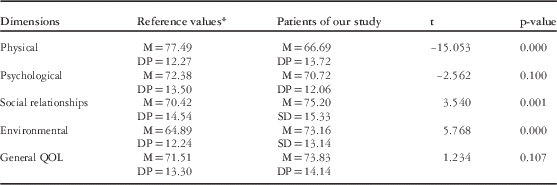
The perception of quality of life in CHD patients is better than in the Portuguese population, as a whole, in the social relationships and environmental dimensions, but not in the physical dimension (Table 1).
Comparison between reference values and the values presented by the patients in QOL.
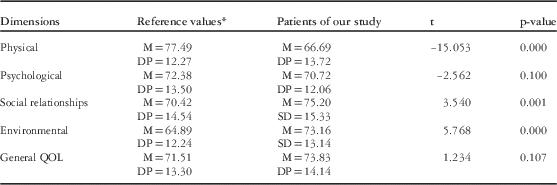
QOL=quality of life
* For the Portuguese population as a whole
Patients who had undergone surgery (n=103) had the worse perception of quality of life, on the physical (t=−3.202; p=0.002), psychological (t=−2.949; p=0.004) social relationships (t=−1.982; p=0.049), and general dimensions (u=1269.000; p=0.011) than those who were not operated upon (n=34). Those patients who had undergone more than two surgeries also had worse quality of life, on the physical (t=−3.541; p=0.024), psychological (t=−2.145; p=0.014), and general dimensions (u=1659.500; p=0.004). In the assessment of psychosocial adjustment, they also showed higher scores in withdrawn behaviours (u=1335.000; p=0.036), attention problems (u=1262.000; p=0.014), and externalisation problems (u=1209.500; p=0.032).
Patients with physical limitations (n=44) showed a worse perception in physical (t=−3.123; p=0.002), psychological (t=−2.902; p=0.004), and general quality of life (u=1532.000; p=0.012) than those without physical limitations (n=93). They also showed more withdrawn behaviour (u=1454.000; p=0.006), anxiety/depression (u=1499.500; p=0.011), delinquent behaviour (u=1586.500; p=0.032), and internalisation problems (u=1435.000; p=0.016).
Patients with need for medication showed worse quality of life only in the physical dimension (t=−2.252; p=0.026) than those who were not medicated.
Patients with better academic performance showed better quality of life on psychological (t=2.454; p=0.015), environmental (t=2.577; p=0.011), and general dimensions (u=1351.000; p=0.015). Those with poor academic performance showed worse psychosocial adjustment, with more feelings of anxiety and depression (u=1312.500; p=0.013), more attention problems (u=1171.500; p=0.001), and more externalisation problems (u=1190.500; p=0.005).
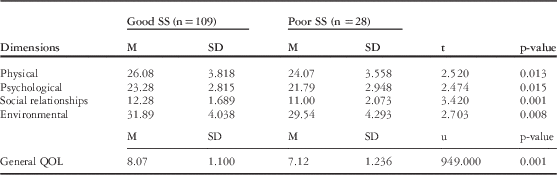
Social support is very important in improving quality of life of the patients in all dimensions (Table 2). Patients with poorer social support also showed more withdrawn behaviour (u=781.000; p=0.000) and more social problems (u=1011.000; p=0.010) in psychosocial adjustment scales.
Comparison of patients with good and poor SS (more or less SS) in the various dimensions of QOL.
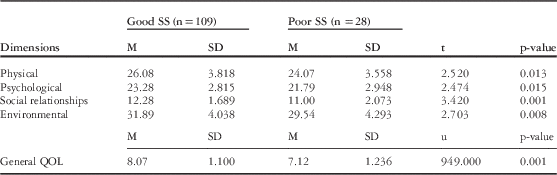
QOL=quality of life; SS=social support
Discussion
The number of patients with CHD in adulthood has been increasing all over the world owing to advances in early diagnosis and medical and surgical treatment.Reference Marelli, Mackie, Ionescu-Ittu, Rahme and Pilote5 This changing horizon creates new challenges to research and the need to investigate aspects that are beyond survival, such as feelings of well-being, satisfaction with life, emotional adjustment, proneness to psychopathology, and the cognitive functioning of patients.
We believe that our study contributes mainly to analyse the impact of different demographic, clinical, and psychosocial variables on the perception of quality of life, on psychosocial adjustment, and on psychiatric morbidity of CHD patients.
To determine the extent to which these factors enhanced resilience or had a detrimental effect on individuals with CHD, we analysed factors such as severity of illness, number of surgeries, presence of residual lesions, presence of cyanosis, occurrence of psychopathologic disorders, education and academic achievement, size and functioning of the social support network, and physical abilities and limitations.
A puzzling finding of our study is that CHD patients, in the whole, perceive in a better way their quality of life than the healthy population. However, and despite being counterintuitive, these results confirm published data from other authorsReference Fekkes, Kamphuis and Ottenkamp11, Reference Moons, Deyk and Marquet12 and may be explained by the presence of some buffer variables, such as family environment and cohesion, and social support.
However, when we look into different subgroups of patients, we find that those who underwent surgery showed a worse perception on their quality of life than the whole group. These facts, more expected, may be explained by the daily life restrictions and residual side effects that limit physical performance and activity, and by the feeling of life threat and fragility, occurring in surgeries.
The comparison between cyanotic and acyanotic patients and those with moderate-to-severe or those with mild residual injuries also showed worse perception on the quality of life. Complex CHD show a worse psychosocial adjustment and quality of life than moderate-to-mild forms of disease as well.
Previously published data point out some variables that are good predictors of behavioural and emotional problems in CHD patients, including being a female, having low exercise capacity, having restrictions imposed by physicians, having a severe heart lesion, having undergone surgery in early infancy, and having had a greater number of heart operations.Reference Van Rijen, Utens and Roos-Hesselink28–Reference Hülser, Dubowy, Knobl and Meyer30 In our study, we also found that being a female patient, having poor academic performance, having a complex form of CHD, having moderate-to-severe residual lesions, having been undergone surgery, and having physical limitations are good predictors of poor psychosocial adjustment.
In our study, we found a 19.7% lifetime prevalence of psychopathology, which was almost the double in female patients than in males. The women also revealed worse psychosocial adjustment with more feelings of anxiety and depression and more somatic complaints, among other signs. In other published studies on the prevalence of psychiatric disorders in general population of different countries, the lifetime rate of anxiety and depressive disorders has been much higher in women than in men.
Other studies reveal that younger CHD patients are more likely to have psychopathology than the older ones.Reference Kovacs, Saidi and Kuhl15, Reference Van Rijen, Utens and Roos-Hesselink31 We could not confirm this tendency in our patients.
On the contrary, studies on the likelihood of CHD patients to have psychopathological disorders show conflicting results, some revealing a higher tendency of patients compared with general population and others showing a similar rate to those of peers.Reference Utens, Bieman, Verhulst, Meijboom, Erdman and Hess32, Reference Cox, Lewis, Stuart and Murphy33
In Portugal, there are no final data on psychiatric morbidity nationwide, although some estimation on the prevalence of psychiatric disorders in the general population could be made on the basis of partial studies.34 According to our results, and emphasising the importance of our study, we conclude that our patients seem to show a slightly increased proneness to psychopathology.
Acknowledgement
None.
Financial Support
This research was supported by a grant from CESPU.
Conflict of Interest
The authors have no conflicts of interest to disclose.
Ethical Standards
International conventions guaranteeing the rights of the patients were fully respected. To ensure that, the procedures of the study were previously analysed and approved by the hospital’s ethical committee.