


Introduction
Obesity/overweight is a complex and multifaceted problem, for which the physical, economic and social costs are well documented and concerning. A number of psychological theories of obesity/overeating have been proposed but have not always been confirmed in empirical studies or remain to be tested. As yet, most theories have not led to well evidenced treatment. Relatively little research on the potential cognitive processes underlying high body mass index (BMI), overweight or obesity exists. In addition, there is limited empirical evidence for the role of disrupted parental bonding in higher BMI. Interestingly, cognitions about the self, negative self-beliefs or schema are widely believed to be formed in the early parental-child relationship. However, little is known about the relationship between parental relationships, negative self-beliefs and obesity/overweight. An integrated meta-cognitive and cognitive theory (Cooper, Todd and Wells, Reference Cooper, Todd and Wells2009), outlines how negative self or core beliefs derived from early experiences are risk factors for disordered eating, while a range of cognitions, i.e. positive, negative and permissive thoughts, including meta-cognitions, maintain both disordered eating and related behaviours. Preliminary evidence supports this notion, for example, in those who binge eat; to date, however, the potential relationship between parent-child relationships, negative self-beliefs, eating disorder (ED) related cognitions and BMI has not been tested empirically. The current study investigated the potential mediating role of two types of cognitions (negative self-beliefs and positive, negative and permissive thoughts related to eating, weight and shape) in the relationship between parent-child relationships and BMI in a female community sample. It was hypothesized that disrupted parent-child relationships (i.e. decreased parental warmth and care, and increased parental overprotection and intrusion) would be linked to higher BMI and that this relationship would be mediated by cognition (i.e. negative self-beliefs and ED related thoughts).
Method
Participants and procedure
Female participants were recruited from the community and completed the study online. Exclusion criteria included: under 18-years-old, not fluent in English as a written language, and not resident in the UK. Data collection was performed online using snowball sampling. The study was advertised on internet websites (Google, Facebook and local free advertising sites). Participants were asked to complete the self-report questionnaires presented in the measures section.
Measures
Participants reported gender, age, ethnicity, marital status, employment status, number of years in full-time education, and weight and height to determine BMI. Participants completed the following questionnaires.
The Eating Disorders Thoughts Questionnaire (EDTQ; Cooper, Todd, Woolrich, Somerville and Wells, Reference Cooper, Todd, Woolrich, Somerville and Wells2006)
This measure has 26 items and three subscales measuring positive, negative and permissive thoughts about eating (key maintaining factors in the meta-cognitive model: Cooper et al., Reference Cooper, Todd and Wells2009). It has good construct and criterion-related validity and discriminates people with an ED from dieting and non-dieting groups (Cooper et al., Reference Cooper, Todd, Woolrich, Somerville and Wells2006).
The Core Belief Questionnaire (ED-CBQ; Fairchild and Cooper, Reference Fairchild and Cooper2010)
This measure has 47 statements representing negative beliefs about the self relevant to EDs (e.g. vile, repugnant), with 5 subscales: self-loathing; unassertive/inhibited; demanding/needing help and support; abandoned/isolated; and high standards for self. These beliefs are thought to develop relatively early in life from attachment relationships (Cooper et al., Reference Cooper, Todd and Wells2009). Participants rate each statement according to the extent to which it describes how they feel about themselves. The subscales have adequate internal consistency and construct validity (Fairchild and Cooper, Reference Fairchild and Cooper2010).
The Parental Bonding Index (PBI; Parker, Tupling and Brown, Reference Parker, Tupling and Brown1979)
This is a 25-item retrospective questionnaire measuring perception of maternal and paternal bonding during the first 16 years of life. It has two subscales: care and overprotection, measuring parental styles as perceived by the child. Lower care scores and higher overprotection scores indicated unhealthy parent-child bonding. It has good internal consistency and re-test reliability (Parker et al., Reference Parker, Tupling and Brown1979).
Results
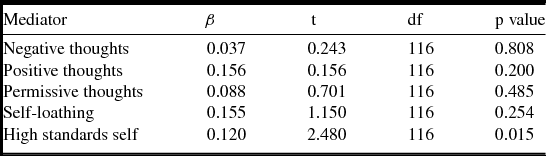
In total, 118 women (mean age = 31.7, SD = 9.8, range 18 to 67) completed the study. The sample ethnicity was white (92.4%), Asian (4.2%), Black (0.8%), Mixed (0.8%) and Other (1.7%). Participants were single (38.1%), married (39%), divorced (3.4%), co-habiting (16.9%) and widowed (0.8%). The majority came from a professional background (56.8%) as well as: student (16.1%), skilled (3.4%), housewife (10.2%), clerical (5.9%), manual (2.5%) and other (5.0%). Years spent in full time education ranged from 10 to 24 (mean number of years = 16.26, SD = 3.49). The mean BMI was 25.8 (SD = 5.8, range 16.9 to 46.6). In total 57.6% (68) were normal weight (BMI = 18.5–24.99), 21.2% (25) were overweight (BMI > 24.99) and 18.6% (22) were obese (BMI > 29.99). Data sets were complete, with the exception of missing scores for two participants (for one the parental overprotection scale score could not be computed, the other for whom the maternal care subscale could not be derived). Baron and Kenny's (Reference Baron and Kenny1986) recommended steps were applied to test whether disrupted parental bonding was related to obesity (i.e. high BMI) and whether this relationship was mediated by the cognitions measured. Four conditions must be met for mediation to be tested. First the predictor (the PBI subscales) must be associated with the outcome variable (BMI). This was met in that multiple regression analysis found a significant relationship between BMI and both maternal subscales (maternal care, adjusted R2 = .078, F(1,116) = 10.78, p < .009; maternal overprotection adjusted R2 = .026, F(1,116) = 14.12, p = .045 and paternal overprotection adjusted R2 = .05, F(1,115) = 7.07, p = .009 (indicating overprotection and lower maternal care was related to higher BMI). No significant relationship was observed for paternal care so this was omitted from further analyses. Total adjusted R2 was .077, and is important for comparison with variance accounted for in the final model (condition 4, where the potential mediators are included). The second condition is that the predictor (PBI subscales) must be associated with the mediator (subscales of the cognition measures). All multiple regression analyses were significant. Adjusted R2 values ranged from .025 to .177, all p values were <.05, and Beta values ranged from -.904 to 1.77. The third condition is that the mediator (subscales of the cognition measures) must be associated with the outcome variable (BMI). This was met in that all multiple regression equations including the cognition subscales with BMI were significant except for the following ED-CBQ subscales, omitted from further analyses: unassertive/inhibited, demanding/needing help and abandoned/isolated. Adjusted R2 values for the included variables ranged from .074 to .129, all p values were <.002, and Beta values ranged from -1.33 to .129. Of note, the association between the ED-CBQ subscale high standards for self and BMI, unlike the other associations between cognitions and BMI, were negative; thus high BMI was linked to low standards for self. In the fourth and final condition hierarchical regression analyses examined whether the influence of the predictor (the PBI subscales) on the outcome variable (BMI) was reduced after controlling for the effects of the mediator (cognition subscales); with reduction indicating partial or full mediation depending on the strength of the reduction. The equation was significant overall (F = 6.06, df = 5,110, p<.001) and the adjusted R2 value was .18, suggesting (as expected) greater variance in BMI was accounted for in this analysis than in analyses before potential mediators were introduced (i.e. in condition 1 where .077 of the variance was explained). Relationships between BMI and the independent variables (PBI subscales: maternal care, maternal overprotection or paternal overprotection) ceased to be statistically significant when the mediator (subscales of the EDTQ or ED-CBQ) was added, with one exception (see Table 1). Mediation thus occurred for all subscales, except the ED-CBQ high standards for self. Nevertheless, high standards for self appeared likely to be a partial mediator (given some decrease in the significance level when it was introduced compared to that in condition 1). The regression analysis assumptions were met. Tolerance values indicated that multicollinearity was not a problem. Sobel tests were conducted to assess the significance of the mediation effects obtained. One test (high standards as a mediator) showed a trend towards significance (Beta = 1.701, SE = 1.24, p = .08). No other tests reached statistical significance.
Final regression analysis results for the role of cognition as a mediator between parental bonding and BMI*
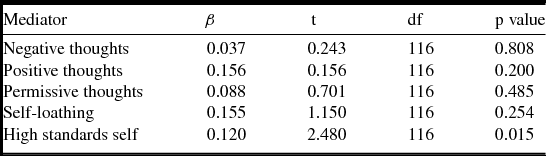
Notes: *Statistical values represent the association between BMI and PBI subscales once mediators have been accounted for. BMI = Body Mass Index; Adj R2 = adjusted R2; N = 117
Discussion
As hypothesized, the relationship between parental bonding (as measured by maternal care and paternal overprotection) and BMI appeared to be mediated by a range of ED thoughts, and some negative self-beliefs. All three ED thoughts were either full or partial mediators; thus these thoughts may all be a useful focus for treatment with cognitive therapy in clinic settings for women who are overweight/obese. These include negative thoughts (e.g. I’ll get fat), positive thoughts (e.g. if I eat it will stop the pain) and permissive thoughts (e.g. It doesn't matter if I keep eating). Self-loathing (e.g. I’m disgusting, I’m vile) and unrelenting, high standards for self (e.g. I’m focused, I’m self-disciplined) were also full or partial mediators between parental bonding and BMI in this sample. These two core beliefs may also be a useful focus for treatment in overweight/obese women. Given their association with BMI it is possible that modifying ED thoughts and specific core beliefs may assist with weight loss. Interestingly, the relationship between BMI and high standards for self was negative, unlike those for the other ED-CBQ subscale-BMI associations. High BMI was therefore associated with low standards for self, and this would need to be taken into account in any therapeutic intervention. Given the relevance of the thoughts and beliefs studied here to EDs, cognitive therapy strategies outlined by clinicians working with ED patients may be useful (e.g. Cooper et al., Reference Cooper, Todd and Wells2009). Further work is needed to confirm these preliminary findings, and to explore their potential treatment implications in more detail. The findings appear to have implications for the development of a cognitive model for overweight and obesity, particularly in women. Cognitions such as those investigated here may need to be incorporated into such a model; moreover, such cognitions may mediate any relationship between overweight/obesity and early parent-child relationships.
There are a number of limitations to this study and these might usefully be addressed in future research. The cross-sectional design limits our understanding of cause and effect; such conclusions ideally require a longitudinal study (e.g. although not predicted theoretically, it is possible that BMI could mediate parental bonding and cognitive variables). There was relatively limited diversity in the demographic composition of the sample, which restricts the applicability of the findings to other populations. It will be important for future studies to also investigate men. Weight and height were self-reported, which can be biased. The sample size is relatively small and, although there is little risk of Type 1 error here, in a larger sample a greater number of significant predictors may have emerged. Snowball sampling may create a community bias, reducing generalizability. Sobel tests were largely non-significant and did not confirm the main findings. However, the Sobel test is known to be highly conservative, with limited power in small samples, and a recent meta-analysis cautions that it may lead to failure to publish otherwise valid results (Hayes and Scharkow, Reference Hayes and Scharkow2013). Moreover, relying on change from statistically significant to non-significant associations when determining mediation may misrepresent the strength of the association; thus failure to find such a change may not mean there is no mediation, and vice versa. Such shifts or non shifts should thus be interpreted cautiously. Finally, our model is psychological and it seems likely that biological and environmental factors and their interplay with psychological variables will need to be included in order to develop a comprehensive model of obesity/overweight.



Comments
No Comments have been published for this article.