





Introduction
Spiritual care is increasingly recognized as a fundamental component of holistic palliative care, particularly within nursing practice, where the focus extends beyond physical treatment to encompass psychological, social, and spiritual well-being (Puchalski et al. Reference Puchalski, Vitillo and Hull2014). Nurses, as primary providers of patient-centered care, play a critical role in addressing patients’ spiritual needs, especially in end-of-life settings where individuals often experience existential distress and seek meaning, comfort, and connection (Cone and Giske Reference Cone and Giske2018). Spirituality, commonly understood as the search for meaning, purpose, and connection with the self, others, or the transcendent, significantly influences how patients cope with life-limiting illness (Bożek et al. Reference Bożek, Nowak and Blukacz2020; Brito et al. Reference Brito, Damiano and Lucchetti2021).
Within Islamic contexts, spirituality is deeply embedded in the relationship between individuals and God, shaping beliefs, values, and coping mechanisms during illness (Baharudin and Nurumal Reference Baharudin and Nurumal2022; Attum et al. Reference Attum, Hafiz and Malik2023). For Muslim patients, spiritual care is often expressed through religious practices such as prayer, recitation of the Qur’an, remembrance (dhikr), and reliance on divine will. These practices are not merely ritualistic but serve as essential coping strategies that foster acceptance, resilience, and inner peace during end-of-life experiences. For nurses and healthcare providers, understanding these culturally embedded meanings is crucial in delivering culturally congruent and spiritually sensitive care.
Despite the recognized importance of spiritual care, healthcare professionals, including nurses, often report limited preparation, confidence, or time to adequately address patients’ spiritual needs (Kannan and Gowri Reference Kannan and Gowri2020). As a result, the responsibility for spiritual care frequently shifts to family caregivers, particularly in collectivist and religiously grounded societies. Family caregivers play a central role in supporting patients’ spiritual well-being by facilitating religious practices, providing emotional reassurance, and maintaining a sense of connection with faith throughout the illness trajectory (Kurtgöz and Edis Reference Kurtgöz and Edis2023).
Within Muslim communities, spiritual care is closely connected to religious values and practices that shape responses to illness, suffering, and end-of-life experiences. Concepts such as sabr (patience), tawakkul (trust in divine will), du’a (supplication), Qur’anic recitation, and preparation for death are often integrated into caregiving practices and coping processes. Family involvement is also highly valued, with caregiving viewed as both a moral and relational responsibility. These practices contribute to emotional comfort, dignity, and spiritual support for patients receiving palliative care.
However, while caregivers contribute significantly to spiritual care, they may encounter challenges such as emotional burden, lack of guidance, and difficulties navigating healthcare systems (Moosavi et al. Reference Moosavi, Rohani and Borhani2021). Furthermore, the perspectives of caregivers may differ from those of healthcare professionals, highlighting a potential gap between informal caregiving practices and formal nursing care delivery. Understanding this dynamic is particularly important in transcultural nursing, where culturally informed care requires alignment between professional practice and patients’ lived experiences.
Although research on spiritual care among Muslim populations has been conducted in countries such as Iran, Turkey, and Pakistan (Lalani et al. Reference Lalani, Duggleby and Olson2019; Yilmaz et al. Reference Yilmaz, Sabanciogullari and Berk2022), studies within the Malaysian context remain limited. Given that Malaysia has a Muslim-majority population and a culturally diverse healthcare environment, exploring spiritual care from a local perspective is essential for informing nursing practice and improving culturally sensitive palliative care.
Recent studies have highlighted the important role of spirituality and family support in palliative care across diverse cultural settings. Family caregivers frequently serve as primary providers of emotional, spiritual, and practical support, particularly in resource-limited settings (Salifu et al. Reference Salifu, Almack and Caswell2021; Sailian et al. Reference Sailian, Salifu and Preston2024). Emerging evidence also emphasizes the need for culturally and religiously sensitive palliative care approaches that recognize the spiritual needs of Muslim patients and families within healthcare systems (Lampinley et al. Reference Lampinley, Filmalter, Orogun, Morerwa and Ofosu-Poku2026).
Therefore, this study aims to explore the perspectives of Muslim family caregivers on spiritual care in palliative care, including their understanding of spiritual care, their roles in its provision, and the challenges they encounter. By situating these perspectives within the context of nursing care, the study seeks to contribute to the development of culturally congruent and spiritually responsive palliative care practices. While grounded in a Muslim context, the findings may offer insights applicable to broader discussions on culturally informed spiritual care in palliative settings.
Research methodology
Study design
This study employed a qualitative descriptive design to explore the perspectives of Muslim family caregivers on spiritual care in palliative care. A qualitative descriptive approach is appropriate when the aim is to provide a comprehensive account of participants’ experiences in their own words and to capture the practical realities of caregiving in clinical contexts (Sandelowski Reference Sandelowski2000). The design was particularly suitable for examining how spiritual care is understood, practiced, and experienced by family caregivers within culturally and religiously grounded palliative care settings. The study was informed by an interpretivist perspective, which emphasizes understanding participants’ subjective meanings and lived experiences related to spiritual caregiving.
This manuscript was prepared in accordance with the Standards for Reporting Qualitative Research (SRQR) guidelines (O’Brien et al. Reference O’Brien, Harris and Beckman2014), and the completed SRQR checklist is provided as supplementary material.
Setting and context
The study was conducted in Kuantan, Pahang, Malaysia, including participants recruited from Sultan Ahmad Shah Medical Centre (SASMEC), a tertiary teaching hospital affiliated with the International Islamic University Malaysia, as well as community settings. As a healthcare environment serving a predominantly Muslim population within a multicultural society, this setting provides a relevant context for examining spiritually and culturally informed caregiving practices in palliative care.
Sampling and recruitment
Participants were recruited using purposive and snowball sampling to ensure inclusion of individuals with direct caregiving experience relevant to the research question. The study included Muslim family caregivers who were actively involved in caring for relatives receiving palliative care.
Inclusion criteria were: (1) Muslim family caregivers aged 18 years or older, (2) able to communicate in Malay or English, and (3) having an adult relative receiving palliative care. Individuals with communication difficulties or cognitive impairment were excluded.
Participants were identified through hospital-based recruitment and personal networks. Initial participants were approached through clinical contacts and REFERRALS, and subsequent participants were recruited through snowball sampling. All participants were provided with detailed information about the study, and written informed consent was obtained prior to participation.
Data collection
Data were collected between April and July 2024 through semi-structured, face-to-face interviews. Semi-structured interviews enabled in-depth exploration of participants’ lived experiences while allowing flexibility for emergent themes (Kvale and Brinkmann Reference Kvale and Brinkmann2009).
Interviews lasted approximately 15–20 min and were conducted in Malay or English, depending on participants’ preference. All interviews were audio-recorded with consent and transcribed verbatim. Field notes were also taken to capture contextual observations and reflections during the data collection process.
Interview guide development
The interview guide was developed based on relevant literature on spiritual care, palliative care, and Islamic perspectives on health and caregiving, as well as consultation with academic supervisors. Questions were designed to explore caregivers’ understanding of spiritual care, their roles in providing such care, and the challenges encountered.
Example questions included:
• “Can you describe what spiritual care means to you as a Muslim family caregiver?”
• “What roles do you play in providing spiritual care to your relative?”
• “What challenges do you encounter when providing spiritual care?”
These questions allowed participants to reflect on their experiences and articulate the meaning and practice of spiritual care in palliative contexts.
Data analysis
Data were analyzed using reflexive thematic analysis following Braun and Clarke (Reference Braun and Clarke2006). The analysis involved several iterative stages:
1. Familiarization with the data through repeated reading of transcripts;
2. Initial coding of meaningful segments;
3. Development of candidate themes;
4. Review and refinement of themes;
5. Defining and naming themes; and
6. Interpretation of themes in relation to spiritual care and caregiving context.
The analysis was primarily inductive, allowing themes to emerge from participants’ accounts while maintaining sensitivity to cultural and religious meanings embedded in the data.
Trustworthiness
Trustworthiness was ensured using Lincoln and Guba’s (Reference Lincoln and Guba1985) criteria of credibility, dependability, confirmability, and transferability. Credibility was enhanced through prolonged engagement with the data, peer discussion, and cross-checking of transcripts. Dependability was supported by maintaining a clear audit trail of coding and analytic decisions. Confirmability was ensured through reflexive practices, including analytic memo writing to minimize researcher bias. Transferability was facilitated through thick description of participants, context, and findings, allowing readers to assess applicability to other settings.
Sample adequacy
A total of 12 participants were included in the study. Data collection continued until sufficient informational depth was achieved, and additional interviews yielded no substantially new insights relevant to the study objectives. This provided confidence that the data adequately represented participants’ perspectives on spiritual care in palliative caregiving.
Results
Participant characteristics
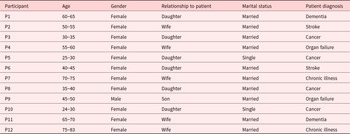
A total of 12 Muslim family caregivers participated in this study. Participant characteristics are presented in Table 1.
Participant characteristics (n = 12)

Table 1 Long description
Participant characteristics are listed by participant ID, age range, gender, relationship to patient, marital status, and patient diagnosis. Ages range from 24 to 83, with age bands including 24 to 30, 25 to 30, 30 to 35, 35 to 40, 40 to 45, 45 to 50, 50 to 55, 55 to 60, 60 to 65, 65 to 70, 70 to 75, and 75 to 83. Gender is female for P1 through P8 and P10 through P12, and male for P9. Relationship to patient is daughter for P1, P3, P5, P6, P8, and P10; wife for P2, P4, P7, P11, and P12; and son for P9. Marital status is married for all participants except P5 and P10, who are single. Patient diagnosis is cancer for P3, P5, P8, and P10; stroke for P2 and P6; dementia for P1 and P11; organ failure for P4 and P9; and chronic illness for P7 and P12.
Overview of themes
Three major themes emerged from the analysis:
1. Understanding of spiritual care;
2. Roles of family caregivers in spiritual care; and
3. Challenges in providing spiritual care.
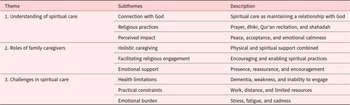
Each theme reflects how caregivers conceptualize, enact, and navigate spiritual care within the context of palliative caregiving, as stated in Table 2.
Summary of themes and subthemes

Table 2 Long description
Three themes are listed with subthemes and brief descriptions. Theme 1, Understanding of Spiritual Care, includes, Connection with God, described as maintaining relationship with God; Religious practices, described as prayer, dhikr, Quran recitation, and shahadah; and Perceived impact, described as peace, acceptance, and emotional calmness. Theme 2, Roles of Family Caregivers, includes, Holistic caregiving, described as physical and spiritual support combined; Facilitating religious engagement, described as encouraging and enabling spiritual practices; and Emotional support, described as presence, reassurance, and encouragement. Theme 3, Challenges in Spiritual Care, includes, Health limitations, described as dementia, weakness, and inability to engage; Practical constraints, described as work, distance, and limited resources; and Emotional burden, described as stress, fatigue, and sadness.
Theme 1: Understanding of spiritual care
Spiritual care as connection with God
Participants consistently described spiritual care as maintaining the patient’s relationship with God. Spiritual care was understood as a faith-centered practice grounded in religious belief and devotion.
“Spiritual care is about how we maintain her relationship with God…” (P3)
This understanding reflects a theocentric perspective, where caregiving is closely linked to religious responsibility and spiritual accountability.
Religious practices as expressions of care
Spiritual care was operationalized through practices such as prayer (ṣalāh), remembrance (dhikr), Qur’anic recitation, and prompting the shahādah. These practices were adapted according to patients’ physical conditions.
“I remind him to pray and do dhikr…” (P9)
Even when patients were unable to actively participate, caregivers facilitated passive engagement, such as playing Qur’anic recitations.
Perceived impact on patients’ well-being
Participants reported that spiritual care contributed to emotional calmness, acceptance, and inner peace. It was also perceived to support patients in coping with illness and approaching end-of-life with greater serenity.
“He seems more at peace… accepting his fate.” (P9)
This suggests that caregivers perceived spiritual care as contributing to emotional acceptance and psychological comfort during illness.
Theme 2: Roles of family caregivers in spiritual care
Holistic caregiving responsibilities
Caregivers described their roles as encompassing both physical and spiritual dimensions of care, including assistance with daily living activities alongside spiritual support.
“I bathe her… feed her… take care of everything.” (P4)
Caregiving was often shared among family members, reflecting a collective approach.
Facilitating religious engagement
A central role of caregivers was enabling patients to remain spiritually connected. This included encouraging prayer, reciting the Qur’an, and creating a spiritually supportive environment.
“We play Qur’an recitation for him…” (P2)
Caregivers acted as facilitators, especially when patients were physically or cognitively limited.
Providing emotional support and presence
Emotional support emerged as a key component of spiritual care. Caregivers provided reassurance, encouragement, and companionship to reduce patients’ distress.
“I encourage him, so he doesn’t feel sad.” (P9)
Physical presence was perceived as essential in maintaining emotional and spiritual stability.
Theme 3: Challenges in providing spiritual care
Patients’ health limitations
Physical and cognitive impairments, including dementia and reduced consciousness, limited patients’ ability to engage in spiritual practices.
“She does not remember… she has dementia.” (P1)
These conditions created uncertainty for caregivers in delivering meaningful spiritual care.
Practical constraints
Caregivers reported logistical challenges such as work commitments, distance from healthcare facilities, and limited support.
“I had to take leave from work to care for her.” (P8)
“Sometimes I could not stay with him because I had to work and take care of my own family.” (P2)
These constraints affected the continuity and quality of caregiving.
Emotional burden of caregiving
Participants expressed emotional strain, including stress, fatigue, and sadness associated with prolonged caregiving responsibilities.
“It is hard… because she is my mother.” (P3)
“Sometimes I feel exhausted, but I try to stay strong for her.” (P7)
These accounts illustrate the emotional complexity of caregiving and the ongoing effort required to balance personal well-being with caregiving responsibilities.
Summary of findings
Overall, spiritual care was conceptualized as a faith-centered and relational practice embedded within daily caregiving. Family caregivers played a central role in sustaining patients’ spiritual well-being, although their efforts were shaped by patients’ health conditions and constrained by practical and emotional challenges.
Discussion
This study explored the perspectives of Muslim family caregivers on spiritual care in palliative settings, revealing that spiritual care is understood as a faith-centered practice grounded in the relationship between the individual and God, enacted through daily caregiving activities, and shaped by both relational and contextual constraints. The findings highlight the centrality of spiritual care as an integrated dimension of caregiving, rather than a distinct or supplementary component. This aligns with broader understandings of spiritual care as a core element of holistic palliative care that addresses existential and meaning-related needs (Gijsberts et al. Reference Gijsberts, Liefbroer and Otten2019; Quinn and Connolly Reference Quinn and Connolly2023).
Consistent with existing literature, participants conceptualized spiritual care primarily as maintaining connection with God through religious practices such as prayer, Qur’anic recitation, and remembrance (dhikr) (Puchalski et al. Reference Puchalski, Vitillo and Hull2014; Brito et al. Reference Brito, Damiano and Lucchetti2021). This finding resonates with Malaysian-based research, where spiritual care has been described as deeply embedded in patients’ lived experiences and existential reflections during critical illness (Baharudin and Nurumal Reference Baharudin and Nurumal2022). The present study extends this understanding by illustrating how these practices are integrated into everyday caregiving routines and adapted to patients’ physical and cognitive conditions. This supports the view that spirituality in palliative care is operationalized through culturally and religiously meaningful actions that sustain patients’ sense of identity, purpose, and acceptance (Bożek et al. Reference Bożek, Nowak and Blukacz2020; Hvidt et al. Reference Hvidt, Nielsen and Kørup2020).
Importantly, the findings underscore the active role of family caregivers as primary facilitators of spiritual care. In line with previous studies (Lalani et al. Reference Lalani, Duggleby and Olson2019; Kurtgöz and Edis Reference Kurtgöz and Edis2023), caregivers in this study acted as mediators of spiritual practices, emotional support, and religious continuity. Within the Malaysian Muslim context, this reflects a collectivist orientation in which caregiving is both a familial responsibility and a moral obligation. Within the Muslim cultural context, caregiving is often shaped by a strong sense of moral responsibility and compassion grounded in religious belief. This reflects how faith-based values influence caregiving practices and support patients’ spiritual well-being (Attum et al. Reference Attum, Hafiz and Malik2023).
The present findings are also consistent with studies conducted in other cultural contexts where spirituality and family involvement remain central in palliative care. Research in resource-limited settings has demonstrated that family caregivers often assume substantial responsibility for emotional, spiritual, and home-based care due to limited healthcare support and strong familial expectations (Salifu et al. Reference Salifu, Almack and Caswell2021). Similarly, studies exploring dignity and faith in palliative care have shown that spiritual support, religious practices, and family presence contribute significantly to patients’ sense of meaning, comfort, and emotional security during end-of-life care (Dakessian Sailian and Silva et al. Reference Dakessian Sailian, Salifu, Saad and Preston2021; Sailian et al. Reference Sailian, Salifu and Preston2024). These findings suggest that while specific practices may differ across religious and cultural contexts, spirituality and relational caregiving remain universally important dimensions of holistic palliative care.
From a nursing perspective, these findings highlight important implications for transcultural and person-centered care. Although nurses are expected to address patients’ spiritual needs, evidence suggests that many healthcare professionals feel insufficiently prepared or lack confidence in delivering spiritual care (Cone and Giske Reference Cone and Giske2018; Kannan and Gowri Reference Kannan and Gowri2020). This reflects a gap between formal healthcare provision and lived caregiving practices, emphasizing the need for nurses to actively collaborate with family caregivers. Integrating caregivers into care planning may enhance continuity of care and improve patient outcomes, as demonstrated in structured palliative care initiatives (Araki et al. Reference Araki, Shanbhag and Al Qawasmeh2023).
The findings also indicate that spiritual care contributes significantly to patients’ emotional well-being, particularly in fostering peace, acceptance, and coping with illness. This is consistent with research demonstrating that spiritual care enhances psychological adjustment and quality of life in palliative care settings (Benites et al. Reference Benites, Rodin and de Oliveira-Cardoso2022; Yousofvand et al. Reference Yousofvand, Torabi and Oshvandi2023). Within this context, religious coping mechanisms such as acceptance and trust in divine will play an important role in shaping patients’ responses to illness. Caregivers’ facilitation of these orientations may therefore support patients’ emotional and existential resilience.
Despite these positive contributions, caregivers faced multiple challenges, including patients’ health limitations, practical constraints, and emotional burden. Physical conditions such as dementia and reduced consciousness limited patients’ ability to engage in spiritual practices, creating uncertainty for caregivers. In addition, logistical challenges such as work commitments and limited support systems affected the consistency of caregiving. These findings are consistent with existing literature highlighting the multidimensional burden experienced by family caregivers in palliative care (Delalibera et al. Reference Delalibera, Coelho and Barbosa2020; Moosavi et al. Reference Moosavi, Rohani and Borhani2021).
The emotional strain reported by participants further underscores the need for greater support from healthcare systems. Caregiving in palliative contexts is often prolonged and emotionally demanding, and without adequate support, caregivers may experience distress and burnout. From both nursing and ethical perspectives, this calls for a more inclusive model of care that recognizes caregivers not only as providers of care but also as individuals requiring support and guidance.
From a transcultural nursing perspective, this study contributes to a deeper understanding of how spiritual care is shaped by cultural and religious meanings within specific contexts. It emphasizes the importance of culturally congruent care, where nursing practice aligns with patients’ and families’ beliefs, values, and lived experiences. For Muslim patients, spiritual care is inseparable from religious practice, and failure to recognize this may result in fragmented or incomplete care.
Recent evidence further highlights the need for culturally and religiously responsive palliative care guidelines, particularly for Muslim patients and families. Lampinley et al. (Reference Lampinley, Filmalter, Orogun, Morerwa and Ofosu-Poku2026) emphasized that healthcare providers should develop greater awareness of faith-related needs, communication preferences, and family-centered decision-making processes when caring for Muslim patients in palliative settings. Integrating such culturally sensitive approaches into nursing practice may enhance trust, improve patient and caregiver experiences, and strengthen holistic care delivery.
Implications for nursing practice
The findings suggest several implications for nursing practice. First, nurses should actively assess and integrate patients’ spiritual needs into care planning, particularly in palliative settings. Second, nurses should collaborate with family caregivers, recognizing them as key partners in facilitating spiritual care. Third, there is a need to strengthen education and training in spiritual care within nursing curricula, including culturally specific approaches relevant to Muslim patients. Finally, healthcare institutions should develop supportive environments that enable both nurses and caregivers to provide holistic and culturally sensitive care.
Strengths and limitations
This study provides in-depth insight into spiritual care from the perspective of Muslim family caregivers within the Malaysian context, contributing to the limited body of literature in this area. However, several limitations should be acknowledged. The study was conducted within a single geographical setting, which may limit the transferability of findings. Additionally, the sample consisted predominantly of female caregivers, which may influence the perspectives captured. The predominance of female caregivers may reflect gendered caregiving roles commonly observed in family-based palliative care. However, this may limit representation of male caregiving experiences and perspectives. Future research may explore diverse settings and include broader participant groups to enhance understanding of spiritual care across contexts.
Conclusion
Spiritual care is a central and integrated component of palliative caregiving among Muslim families, grounded in religious belief, enacted through daily practices, and sustained through relational commitment. Family caregivers play a vital role in facilitating spiritual well-being, although their efforts are shaped by various challenges. Recognizing and supporting this role within nursing practice is essential for delivering holistic, culturally congruent, and spiritually responsive care in palliative settings.
Supplementary material
The supplementary material for this article can be found at https://doi.org/10.1017/S1478951526103654.
Data availability statement
The data that support the findings of this study are available from the corresponding author upon reasonable request.
Acknowledgments
The authors would like to express their sincere appreciation to all participants who generously shared their experiences and perspectives in this study. Their contributions were invaluable in providing insights into spiritual care in palliative settings. The authors also acknowledge the support from Sultan Ahmad Shah Medical Centre (SASMEC) and the Kulliyyah of Nursing, International Islamic University Malaysia, for facilitating this research. The authors used AI-assisted tools for language refinement and editing; all content, analysis, and interpretation remain the responsibility of the authors.
Author contributions
S.N.S. contributed to conceptualization, data curation, investigation, data collection, data analysis, and writing – original draft preparation. M.F.M.I. contributed to conceptualization, methodology, supervision, and writing – review and editing. S.Z.S. contributed to methodology, validation, supervision, and writing – review and editing. W.N. contributed to supervision, interpretation of findings, and writing – review and editing. All authors reviewed and approved the final manuscript.
Funding
This research received no specific grant from any funding agency in the public, commercial, or not-for-profit sectors.
Competing interests
The authors declare that they have no competing interests.
Ethical approval
Ethical approval was obtained from the International Islamic University Malaysia Research Ethics Committee (IREC) (IREC 2024-129). Permission to conduct the study was granted by Sultan Ahmad Shah Medical Centre (SASMEC). All participants provided informed consent prior to participation.
Ethics and consents
Written and verbal informed consent were obtained from all participants prior to data collection. Participants were assured of confidentiality and anonymity. All data were securely stored and used solely for research purposes.


 Open access

