The annual Fetu Afahye festival in Cape Coast, Ghana culminates with a procession of chiefs through the main streets of the town.Footnote 1 The Fante-speaking Akan communities celebrate the festival each year to commemorate the yam harvest and pay homage to regional chiefs who preside over the area. During the morning of the 2011 celebration, the town's narrow and meandering streets steadily filled with nearly 300,000 spectators, doubling the population of Cape Coast. The crowded streets were jammed with diverse attendees, ranging from community elders to schoolchildren, business owners to informal traders, and African-American ‘roots’ pilgrims to Ghanaians living overseas. The mood was excited, with music blaring from small shops and bars, and friends and passers-by calling out the customary greeting: ‘Afenhyia pa!’ (‘Greet the new year’). Festival attendees jostled for the best view of performances of drumming, dancing and praise songs that commemorated ancestral deities. Asafo companiesFootnote 2 led the procession with collective chanting, drumming and gunfire, and with other performances, each of which communicated the presence of chiefs who followed behind, accompanied by elaborate entourages. Chiefs adorned themselves with ceremonial regalia such as colourful woven textiles, ancestral gold jewellery and antique glass beads, while the multitude of people surrounding the chiefs wore T-shirts displaying images of chiefs or corporate logos.
Festivals enable chiefs to display the pomp and pageantry of the traditional institution of chieftaincy. In fact, festivals are one of the remaining domains where chiefs can command public recognition of their authority. Yet the customary celebration unfolds within a highly commodified space, demonstrating the ways in which chiefs and corporate sponsors compete to assert their interests within the field of festivals (Figure 1). Banners with images of Unilever products such as Royco Tomato Paste, Blue Band Margarine and Lipton Tea hung across the streets. Large posters of Guinness products, including Star Beer, Gordon's Gin and Smirnoff Ice, were glued to the walls of buildings. Temporary kiosks were set up that overflowed with commodities, branded promotional gifts, and print media featuring colourful images advertising global communications firms such as Tigo, Vodafone and MTN.
The festival grounds were saturated with brand logos and commodity images during the 2011 celebration of Fetu Afahye in Cape Coast.

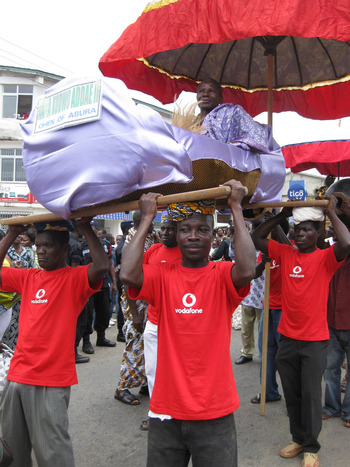
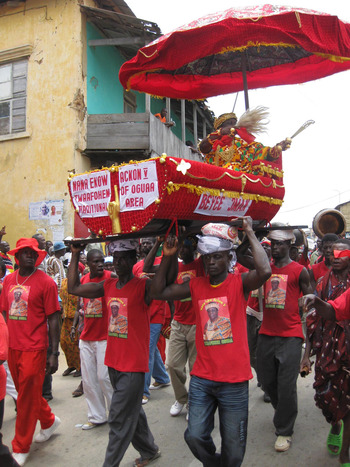
The commercial ambience of the annual festival is punctuated by strikingly dressed bodies that move about the town. Commercial logos not only decorate public space during the annual festival, they also adorn bodies in T-shirts displaying corporate logos (Figure 2). The production and distribution of branded T-shirts is a key marketing strategy for companies that sponsor the event. During the festival's climax – the procession of chiefs – the bodily display of brand names and commodity logos creates a striking visual effect. The T-shirts imprinted with corporate logos are rivalled by a competing T-shirt style with photographic images of particular chiefs within the Cape Coast locality, presenting spectators with another form of branding that is underpinned by local politics (Figure 3).
A chief and his entourage in T-shirts with corporate logos that advertise telecommunications giant Vodafone, Cape Coast, 2011.

A chief and his entourage with T-shirts that display his image, Cape Coast, 2011.

Dressed bodies displaying two different T-shirt styles asserted distinctive judgements about political and moral sensibilities, economic strategies, and chiefs' sense of their own personhood. T-shirts with images of chiefs alluded to a form of political prestige that relied on graded social positions within Akan chieftaincy networks based on kinship affiliation and restricted hereditary privilege. T-shirts with corporate logos relied on the display of commercial allegiances that demonstrated privileged social relations of economic exchange between chiefs and sponsors. In effect, chiefs dressed the bodies of their entourage members to articulate the legitimacy of their political authority in ways that allowed chiefs to broker self-identities as globally constituted and linked to corporate representatives or regionally situated and linked to chiefly lineages.Footnote 3 Over the course of many conversations with chiefs, some presented themselves as both globally constituted and regionally situated, but, when explaining their decisions to adopt a specific T-shirt style, they repeatedly emphasized political lineages or economic relationships.
This article examines how T-shirts index new logics of value that challenge people to reassess the social and economic relationships that are central to the production of political power. By logics of value, I refer to the ways in which people understand the legitimate relationship between economic value (money and access to economic networks) and social values (kinship networks and political authority) (Patico Reference Patico2008). Are chiefs who display their economic relations with corporate sponsors respected because of their connections to such networks? Or is external economic support perceived as incompatible with the legitimate attainment of political authority? While some chiefs embrace sponsors as a source of economic support, others argue that corporate logos linking festival performances to economic sponsors misrepresent the social relations that legitimate chiefly authority. These competing views overlap in the sartorial styles deployed by chiefs during their highly visible status-seeking displays.
Festival T-shirts articulate the complex relationships between chiefs and sponsors and illustrate how the debates and contingencies that accompany corporate support contribute to broader shifts in Ghanaian conceptions of political authority. I argue in this paper that these relations and contentions are expressed through situated bodily practices that demonstrate interconnections and distinctions between economic-based and social-based sources of power. I use the notion of situated bodily practice to convey a sense that dress is socially mediated, embodied and practical (Entwistle Reference Entwistle2001: 34). In her work on the relationship between dress and embodiment, Joanne Entwistle suggests that ‘dress works on the body, imbuing it with social meaning, while the body is a dynamic field which gives life and fullness to dress' (Reference Entwistle2001: 35). The interactive process between dress and the body also resonates with Daniel Miller's notion of objectification, which emphasizes the role of materiality in actively realizing and externalizing identity in everyday life (Miller Reference Miller2005: 8). During festivals, situated bodily practices actively articulate chiefs' political subjectivities; they are also sites for legitimating or critiquing emergent structures of authority. By drawing from Webb Keane's notion of indexicality, I demonstrate how the specific iconography printed on T-shirts signals social connections and practical activities. This observation allows me to provide fresh insights into how festival dress is used to assert political legitimacy.
My exploration of contemporary dress practices in the sphere of festivals alerts us to other historically and socially significant transformations within the field of cultural production and the manner in which they interact with broader global processes. T-shirts draw attention to the conflicting ways in which local political leaders evaluate corporate sponsorship. By advertising people and products, and identifications and affinities, these garments invite an examination of the role of dressed bodies as critical sites where political networks and economic interventions are articulated. Such dress practices give new meaning to the legitimacy and performance of chiefly authorities. Focusing on the linkages between the communicative capacities of dress and the public display of political authority, I seek to capture the dynamics of how sartorial practices articulate logics of value as they emerge through the modalities of festival planning and performance.
FETU AFAHYE, POLITICAL CHALLENGES AND THE ECONOMICS OF CHIEFTAINCY
The celebration of Fetu Afahye has been shaped by the political and economic development of Cape Coast since the rise of the Atlantic economy in the seventeenth century. The festival served to ritually incorporate migrant groups from the inland kingdom of Fetu, who relocated to take advantage of coastal European trade. Ritual activities that take place during the seven-week celebration, ranging from the yam harvest to Asafo bonfires, bull sacrifice and the Bakatue regatta, are a consolidation of ceremonies that were celebrated by different polities before Fetu Afahye was combined into a single event in Cape Coast in the 1690s. Several early accounts document the participation of European traders, who were compelled to attend the festival because they needed the recognition and cooperation of local chiefs to compete over control of trade networks (Apter Reference Apter2014). Considering the long history of commercial exchange between Europeans and the coastal Fante, economic relationships between chiefs and international companies for festival funding seem more like an expected alliance than a surprising connection.
After the early development of European trade, chiefs adapted to several political economic transitions that reshaped their economic allegiances to maintain wealth and power. During the seventeenth century, local chiefs engaged with European merchants and hinterland traders, often diverting revenues from tolls to maintain their households and dependants. Chiefs used their relationships with African and European traders to accumulate and exhibit wealth, which was central to their maintenance of the political order (Arhin Reference Arhin1983). Well into the nineteenth century, chiefs participated in forms of commercial exchange as mediators, independent traders and agents of British commercial houses, exploiting economic networks to expedite the flow of resources from outside (Arhin Reference Arhin1983: 15). Although some chiefs benefited from economic relations with the British, the onset of colonial rule disrupted chiefs' ability to accumulate wealth, which challenged the reproduction of their political authority.
Colonial officials exerted several forms of surveillance and control over chiefs and their subjects. Ordinances were passed that restricted chiefs' right to rule and claims to land, initiating a long process of chiefly subjugation. British colonial officials sought to control the urban space of the Gold Coast capital and in 1932 they passed a Peace Preservation Ordinance that banned the celebration of Fetu Afahye, resulting in thirty years of non-observance (Blankson Reference Blankson1974: 2). The ban marked another defeat for chiefs who were experiencing the destabilization of their vast reign over people and places.
Following Ghana's independence in 1957, President Kwame Nkrumah further weakened the institution of chieftaincy. He stripped chiefs of judicial and administrative functions, redirected stool revenuesFootnote 4 towards the central government, and allowed state officials to recognize and derecognize the status of chiefs (Rathbone Reference Rathbone2000: 125). Blocking economic flows and removing titles, Nkrumah effectively undercut the formal power of chiefs. Chieftaincy stood against Nkrumah's vision of a unitary and modern Ghanaian citizenry, and he publicly upbraided chiefs for their ‘collaboration with the imperialists’ and ‘oppression of the masses’ (Rathbone Reference Rathbone2000: 22). Yet, he also used chiefs to gain a popular base. Chiefs, in turn, selectively extended their political allegiances to extract funding from the central government, especially for community development needs.
In the early 1980s, President J. J. Rawlings agreed to a series of liberalizing economic reforms. Chiefs eager to tap into flows of international capital began to forge new relations with external networks that, to varying degrees, bypassed the state. Increasingly, chiefs cultivated direct relationships with corporate institutions that play a key role in Ghana's economy. For centuries, then, chiefs have accessed capital flows in new and innovative ways. Since chieftaincy positions garner few direct financial rewards, many continue to raise funds and pursue creative income-generating ventures to finance their political responsibilities. In some areas, stools have sources of income from gold mines, oil or businesses on stool lands, while other areas have nothing. Local leaders are charged with stewardship over the land within their jurisdiction, maintenance of ritual objects that belong to the stool, and the supervision of annual rituals such as festivals (Cole and Ross Reference Cole and Ross1977). While chiefs take pride in owning their festivals, the costs of production and participation are far too high for them to bear alone. Now chiefs incorporate corporate funding and negotiate sponsors' demands regarding corporate advertising during festival celebrations.
Large-scale corporate sponsorship began in the early 1980s, a period of severe national economic upheaval. With mounting financial woes, chiefs found it difficult to extract levies in cash and kind from subjects within their areas of jurisdiction. And the variety of networks they had tapped in the past – including municipal assemblies, regionally based businesses, local entrepreneurs and wealthy kin – had dried up. In the 1980s, brewing companies and tobacco firms became the source of almost all festive expenditures. Chiefs welcomed the support of international companies and foreign-owned Ghanaian businesses and, to varying degrees, accepted the demands placed on them by sponsors. Since the early 2000s, multinational telecommunications corporations have funded almost all of the costs of festivals and chiefs increasingly complain that the marketing tactics of the new sponsors have become too aggressive. A high-ranking elderly chief who opposed sponsorship lamented: ‘These days sponsors make their cash donations and think they can take the event for themselves – it is not correct – it is chiefs who own the festival.’
Chiefs' festival participation requires buying new attire and festive regalia, and compensating the people who accompany them during the procession. Chiefly entourages must be paid, fed and clothed, and include drummers, palanquin bearers and praise singers. Other aspects of festival production add to the costs, such as renting chairs and shade structures and ‘refreshing’ people who come to visit chiefs in the palace. Older chiefs noted that, in the past, individuals offered their labour free of monetary compensation, a service rendered by customary obligation. Now, one chief complained, ‘they won't even waste one day to help you!’ Donations by fishermen, farmers, market women and others who made annual contributions helped reduce some costs. Some still make donations, yet the total volume of such contributions is small. As one chief put it: ‘The costs have become too high for us. This is why the sponsors are heavily relied upon. We cannot do it alone.’ Regardless of whether chiefs view corporate funding as a problem or welcome it, all the chiefs I spoke with considered such support an inescapable aspect of festival production.
T-SHIRT INDEXICALITY AND VALUE LOGICS
While chiefs parading in the festival's procession wear wrapped cloth, ranging from hand-woven kente to factory-produced wax prints, T-shirts are most popular among non-elite festival participants. Unlike in other localities in West Africa where commemorative factory-printed textiles are a popular fashion choice, T-shirts are the dominant sartorial style at festivals in Ghana (Bickford Reference Bickford1994; see also other articles in this issue of Africa). By the early 1990s, T-shirts had begun to displace more expensive forms of printed cloth that chiefs customarily provided to festival performers and participants. Yet little attention has been given to the ways in which such garments are used to display political distinction and economic prestige. The T-shirt styles selected by chiefs demonstrated different strategies of political legitimation. These in turn were linked to the introduction of new logics of value that challenged people to acknowledge and reassess the social and economic relations central to the production of chiefly power.
Chiefs who displayed T-shirts with corporate logos embraced sponsors as a source of monetary support. Emphasizing their ability to participate in corporate economic networks, these chiefs asserted the primacy of wealth in the production of political power. Others argued that corporate logos linking festival performances to corporate sponsors misrepresented the social relations that legitimate chiefly authority. A competing strategy of political legitimation was presented by the use of T-shirts with images of chiefs to affirm that their power emerged from the restricted domain of hereditary privilege. Such garments advertised graded social positions based on kinship affiliation rather than economic relationships. In effect, T-shirts mediate how chiefs and spectators evaluate the relationship between kinship, wealth and status. At the same time, the objects themselves are situated and embodied as festival dress, refashioning the ways in which social identities are made public to validate political status. In these ways, T-shirts serve as material indicators that suggest a shift in the way chiefs and festival audiences understand themselves and their social contexts, casting light on the ways in which people assess the relevance of social and economic values as they formulate the logics that underlie social inequality.
The low cost of T-shirts, as well as their ready availability and ease of production, appealed both to chiefs and to corporate sponsors, contributing to the popular use of T-shirts as festival dress. T-shirts are inexpensive and are easy to obtain and reproduce in multiples. Above all, the ease with which motifs can be inscribed on the garments opens up their iconic possibilities by translating specific forms of affiliation and remembrance through the medium of dress. The iconographic potential of T-shirts and their capacity to both index and constitute social relations exemplifies what Karen Tranberg Hansen describes as the eminent malleability of dress (Hansen Reference Hansen2004: 373). In this way, T-shirts are less about fabric than about the fabrication and projection of identities and social relationships (Glass Reference Glass2008).
The semiotic efficacy of T-shirts as a new medium of festival dress is linked to the two general types of iconography they bear: corporate logos and portraits of chiefs. If people have ‘background assumptions about what signs are and how they function in the world’ (Keane Reference Keane and Miller2005: 191), festival audiences, many of whom are Ghanaians with familial, friendly or professional ties to Cape Coast, are critically attuned to the form and communicative function of festival performances. Observers assess the situated bodily practices that constitute chiefly processions based on their observance of festivals year after year and their familiarity with chiefly display. They interpret such performative enactments with the guidance of a shared semiotic ideology that is shaped by the spatio-temporal context in which T-shirts are worn and viewed. The semiotic ideologies that guide how people evaluate T-shirts are never fixed or stable, but they constrain the possibilities of interpretation. Observers relate the embodied garments and their iconography to the chief who distributed them to the people who accompany chiefs during the festival procession.
The efficacy of T-shirts lies in their ability to display discrete motifs. T-shirts are inscribed and function as communication and social interpretation, akin to Roland Barthes’ (Reference Barthes1967) assessment of fashion as existing through communicative systems that construct its meaning. Barthes identifies three types of clothing: image clothing presented as photographed or drawn, written clothing that is described or transformed into language, and real clothing which is the product of technology (Barthes Reference Barthes1967: 3). The unique materialities of printed T-shirts with images of chiefs or corporate logos capture Barthes' description of the iconic structure of image clothing. The photograph of a chief on a garment, for example, allows an observer to identify with the person depicted. The T-shirt has the embodied, practical and technical qualities that constitute real clothing as well as the iconic capacities of represented clothing. Festival T-shirts also capture the qualities of written clothing as they bear names, places, dates or other verbal descriptions. T-shirts inscribed with textual and photographic resemblances are ‘dress made text’ with meanings that can be ‘read’.
Festival T-shirts defy the seminal distinctions presented by Barthes. Real clothing, Barthes writes, ‘is burdened with practical considerations (protection, modesty, adornment); these finalities disappear from “represented clothing,” which no longer serves to protect, to cover, or to adorn, but at most to signify protection, modesty, or adornment’ (Reference Barthes1967: 17). T-shirts with images and inscriptions are prone to signification yet they have a practical function and corporeal dimension. They have a distinctive dual capacity ‘to protect, to cover, or to adorn’ and ‘to signify protection, modesty, or adornment’ (Barthes Reference Barthes1967: 17). In effect, Barthes' semiology takes the analogy between fashion and language too far by disregarding the fundamental corporeality of dress: that is, the way dress acts upon the social and physical body while embodiment gives form and meaning to dress.
T-shirts with images of chiefs inscribe garments with the title (brand) and photograph (symbol) of a chief, transforming the inscription into a logo. Presenting observers with a legible icon, the chief logo T-shirt enables the body and the identity to mimic themselves through dress. The garment then serves to index the political authority of the person advertised by dressed bodies parading alongside the chief depicted on the T-shirts. A similar process is at work in the case of T-shirts with corporate logos, whereby observers visually recognize the commodity logo and thereby consume the brand advertisement. Yet, corporate logos did not merely advertise the company promoted by the logo but also gestured towards chiefs. Semiotic ideologies guide such interpretations. Both performers and spectators are attuned to the relationship between chiefs and members of their entourage, whose embodied displays are understood as extensions of the chiefs' actions and intentions.
T-SHIRTS WITH CORPORATE LOGOS
Corporate T-shirts (Figure 2) index the circuits of global capital that underpin political power. These garments feature a commodity image or a textual representation of the sponsoring company's logo. The T-shirts are distributed free of charge to individual chiefs who have established relationships with particular sponsors. Chiefs must establish or maintain a relationship with a representative at a sponsoring firm in order to receive a sizable number of shirts, which are then distributed to an entourage that may comprise more than fifty members.
However, corporate T-shirts are difficult to acquire. One elder chief, Nana Yaw,Footnote 5 explained the hard work involved in getting sponsors to support his chiefly performance each year. Various phone calls, letters and visits to the local MTN offices were made to procure the garments. The chief relied upon a mutual friend to connect him to an MTN representative working in the corporate offices in Accra, to whom he directed his calls and correspondence about donating T-shirts. Nana Yaw does not have a full-time job or steady income and dedicates all his time to his chiefly responsibilities, including the establishment of development projects in his town on the outskirts of Cape Coast. Since he cannot afford to print T-shirts with his image, he pursues corporate sponsors each year. He explained to me:
A corporate entity will rarely approach you. You have to petition for their support. Once I received my MTN T-shirts I was proud to show I used my influence to get something for my people. In the future I can ask for such things, and more, from those companies.
The chief's ability to obtain and display corporate garments attested to a social relationship of economic exchange. Nana Yaw was able to bolster his political legitimacy by providing resources to his people while also publicizing his influence among sponsors. In this way, corporate sponsors are challenging the relationship between wealth and politics as the reproduction of chiefly authority increasingly depends on the ability to influence external economic networks.
Chiefs receive T-shirts and distribute them to the people who accompany them during the procession on the morning of the festival. Although chiefs often make demands on sponsors concerning the appearance and number of T-shirts, sponsors rarely oblige and T-shirts are often provided between one and three days prior to the celebration of the festival. Chiefs rarely return shirts if they do not meet their standards. Usually, chiefs expect that the colour of the T-shirts will match the brand: Coca-Cola, for example, provides red T-shirts. Both the colour and logo of T-shirts are constant areas of contention between chiefs and sponsors.
During a weeknight on the eve of the 2011 celebration of Fetu Afahye's procession of chiefs, I sat in the outdoor courtyard of Nana Kwabena's four-bedroom home on the outskirts of Cape Coast. Nana Kwabena is a mid-level chief who has been deeply involved in the planning of the festival for over two decades and has served on the festival's planning committee for several years. As a long-standing member of the festival planning committee, Nana Kwabena has established relationships with corporate representatives from several sponsoring companies, and he calls upon them each year to assist the planning committee with donations in cash and kind that help offset festival expenses. On this Friday evening, his house was busy with the comings and goings of family, friends and members of his Asafo company, all of whom were engaged in tasks relating to the upcoming festival celebration. Men unpacked boxes of schnapps, women cleaned fish for Saturday's meal, and two men sat at the far corner of the courtyard stretching an animal skin across a small drum. A young man arrived to deliver two large boxes on behalf of one of the event's major sponsors, Guinness Brewery. The delivery was much anticipated as it contained roughly a hundred T-shirts that Nana Kwabena would distribute to members of his Asafo company and other family, friends and supporters who were to accompany him during the procession of chiefs. Nana Kwabena maintained a friendship with the manager of the Guinness office in Cape Coast and he often called on him to donate beverages for community functions throughout the year.
Immediately, Nana Kwabena opened one of the large boxes, revealing the contents: black Guinness T-shirts. Nana recoiled and frowned when his eyes rested on the garments. He was outraged. ‘I can't believe this! I told them no black. We are celebrating a festival, not advertising a funeral!’ Such discrepancies point to the difference of power between chiefs and sponsors. Economically dominant sponsoring representatives often dictate the terms of the relationship. Although chiefs who request T-shirts agree to promote the brand as part of the exchange, sponsors recognize that chiefs need the garments to dress their entourage members. They also recognize that chiefs who have petitioned for sponsorship often lack economic resources and rely on sponsors for material support as well as the prestige linked to their affiliation with a global firm. Some chiefs complained that sponsors took advantage of them and remarked that they were dissatisfied with the terms of exchange, but concurred that it was not in their best interests to aggravate their relationships and jeopardize the long-term potential of economic support. Nana Kwabena rarely criticized sponsors, but in the past couple of years his dismay with sponsors had increased. ‘Each year it is worse,’ he said. ‘They throw dust in our eyes. But we need the support.’
Despite mounting tensions over sponsors' inability to cooperate with chiefs or offer them adequate funds and resources, most chiefs accept the use of garments with corporate logos. In fact, chiefs with limited economic resources, such as Nana Yaw and Nana Kwabena, actively pursued and tended to their relationships with representatives at sponsoring companies to ensure future support. Beyond the much needed contributions that sponsors provide, the acquisition and display of corporate T-shirts are a material means through which chiefs' connections to global economic networks are made public and linked back to their own political influence. They also stressed that relations they built with sponsors in the course of festival planning might be tapped in the future to petition for other forms of support relating to the development of the chiefs' particular areas of jurisdiction.
Although corporate T-shirts index chiefs' lack of independent wealth, chiefs did not view corporate T-shirts as emblematic of their poverty. Rather, chiefs discussed the garments in ways that emphasized their ability to influence representatives of sponsoring firms. When I asked another divisional chief to discuss his use of corporate logo T-shirts, he addressed my question by explaining the long-term connections between chieftaincy and trans-Atlantic economic actors:
We are Fante. This is a coastal town. We have been mixing with Europeans and dealing with their influence for [a] long time. The European blending happened early. Our cultures have been mixing ever since. We embrace these companies and it shows our modern-day attitude. Today the whole world is interconnected and more commercial. We want to show that we are a part of that.Footnote 6
Those who adopted the use of T-shirts with corporate logos did not perceive themselves as complicit subjects of corporate domination, but as political actors who could cultivate social networks to access economic capital. Chiefs with this view indicated that they were not merely dependent on sponsors. Rather, they were engaged in a mutual relation of interchange that put chiefs in touch with global economic flows that could be managed to benefit themselves, their subjects, and the celebration of their annual festival.
PARAMOUNT CHIEF: ‘SPONSORS CAN'T TOUCH OUR CULTURE’
Sponsors can't touch our culture. This is not for sale. We welcome all to participate and all have participated accordingly. We welcome all sponsors. They help us reap the benefits of the festival and we will all end up benefiting.Footnote 7
The Fetu Afahye festival centres on the paramount chief. It is a time for the consecration of his ancestral political status and the reproduction of his ultimate authority, which is publicly recognized through his carefully orchestrated processional performance. Likewise, the procession of chiefs climaxes with his arrival and his public appearance is anticipated as ‘the most spectacular display of all’.Footnote 8 The current paramount chief has been in power since 1998. He maintained a professional career as an accountant and continues to serve as a consultant on the board of several public and private organizations. During the procession he demonstrates his chiefly authority through visible signs of affluence. He rests in a palanquin carried by four men. Wearing a brightly coloured, hand-woven kente cloth that symbolizes wealth and nobility, he is adorned with abundant gold jewellery in the form of necklaces, rings, bracelets, armbands and a crown. He carries other regalia, including a ceremonial gold sword, to display his prosperity and authority. An extensive, uniformly dressed entourage accompanies him. During the 2006 celebration, each person surrounding the chief wore a branded Paramount Gin T-shirt; the men who carried him and drummed behind him and the women who fanned him with their cloths and called out his name all embodied the corporate logo as if the chief were symbolically uplifted by the force of the commodity.
The garments worn by the paramount chief's entourage projected his close ties with corporate affiliates. The commodity-specific T-shirts distributed by the chief placed the Paramount Gin corporate logo in clear view. Paramount Distilleries, a Ghanaian beverage company with global operations, provided the garments. According to the paramount chief, there are ‘strings attached to the T-shirts’, which must be produced according to the demands of chiefs. Although his own entourage did not display evidence of such demands, the chief insisted that the provision of garments with corporate logos was a cooperative effort in which chiefs could assert their terms and sponsors would comply. He explained that corporate sponsors must adjust their own marketing strategies to conform to appropriate forms of chiefly display. Many leaders articulated this point, yet the dress practices of chiefs who branded their entourages with corporate logos showed little evidence of such negotiations. The paramount chief also noted that chiefs who used T-shirts that misrepresented political or communal affiliations could be cited for violating codes of aesthetic conduct or what chiefs referred to as ‘traditional protocol’, which they took to mean acceptable modes of material display and corporeal comportment during the performance of cultural rites.
The paramount chief viewed the relationship between chiefs and sponsors as mutually productive. Since sponsors benefit from the marketing potential created by festival publicity and participation, sponsoring companies are more likely to respond positively to the needs of chiefs. Publicly promoting corporate products serves this end, suggested the paramount chief, while maximizing the likelihood that these companies will provide chiefs with sustained economic support. Few chiefs were able to cite instances where relationships built with sponsors during the course of festivals yielded economic gains in alternative spheres, except in two cases. One chief described how his town was made the site of a corporate social responsibilityFootnote 9 initiative by a leading global communications firm. For the project, the firm funded the design and implementation of pipe-borne water. Another chief explained how a different telecom company provided the building materials for the reconstruction of his ‘palace’ or chiefly residence. This exchange was not made public but ‘was a result of friendship and reciprocity toward me’, the chief noted. Although I had no way of confirming this account, I witnessed the chief displaying the same company's logo during his processional performance for three consecutive years.
The display of T-shirts with corporate logos functions as a means to a practical economic end. After all, they are distributed free of charge. This option is likely to appeal to chiefs who have limited economic resources. Acquiring T-shirts with corporate logos, however, is a time-consuming process. In addition to establishing relationships with sponsors, chiefs must send written appeals to sponsoring agencies to petition for T-shirts. Even in the case of the well-connected paramount chief, obtaining corporate T-shirts for the 2006 celebration involved multiple phone calls and meetings, and long periods of waiting. The garments did not arrive in Cape Coast until the dawn of the procession and were hastily delivered to the chief's entourage just hours before the festival. Chiefs' willingness to engage in the work required to obtain corporate T-shirts reflects the value that some attribute to them.
Consider the paramount chief's processional performance. While people gathered near him to visually acknowledge how he represents his wealth, political authority and social prestige, spectators were confronted with multiple images of a single corporate logo depicted on the bodies of the men who uplifted him. All the participants in the chief's entourage who accompanied him throughout the procession wore crisp, white T-shirts branded with a corporate logo. By performing his authority alongside the uniformity of dozens of corporate T-shirts, the chief presented spectators with an alternative representation of the exchange relations that underpin political authority. Although the paramount chief occupies the highest-ranking position within the chieftaincy institution, the dressed bodies surrounding him made no explicit reference to local political identities as distinct, superior, or even relevant. His decision to enact and embody a corporate logo rather than his own chiefly image points to an emergent logic of value: a representation of chiefly authority that privileges external social relationships linking specific chiefs, however precariously, to flows of global economic capital.
T-SHIRTS WITH IMAGES OF CHIEFS
Chiefs critical of corporate advertising, and of sponsorship in general, often choose to produce T-shirts that advertise themselves with their own image (Figure 3). This T-shirt style features a photographic representation of a chief with full name, political title and area of jurisdiction. The chief depicted on the garment commissions the production of such T-shirts and pays for them. Chiefs employ the services of local printers who use a photograph to create a silk-screen resemblance that is printed on the front of the T-shirt. By placing their image on highly visible bodies, chiefs advertise themselves by asserting their title and territorial domain within the chieftaincy hierarchy for spectators to acknowledge. This sartorial convention enables leaders to project their own position within the chieftaincy hierarchy, reasserting the role of chiefly authorities within a space saturated with commercial marks of trade. In so doing, these T-shirts encourage various actors and onlookers to renew their allegiance to chiefs and subvert sponsor dominance within the festival. While some chiefs who print their own T-shirts maintain connections with corporate sponsors, the decision to display chiefly image garments during festival performances further attests to their value as socially significant dress.
Procuring T-shirts with images of chiefs requires a sizable economic investment. Chiefs who used these T-shirts to dress members of their entourage noted that the costs of chiefly image garments were economically prohibitive, yet they also claimed that shirts were necessary festival attire for their entourage members and boasted about their ability to purchase them. Chiefs who had T-shirts made with their image could afford to bear the costs of their production independently or with the assistance of monetary contributions from family or friends. T-shirts with chiefly iconography indicated chiefs' ability to invest in the costly items. Such garments also promoted the integrity and vitality of Fante chieftaincy by projecting their image alongside their names, titles and hereditary affiliations, which could be validated through public display during the festival. And chiefs believed that asserting their royal image was an investment in political recognition that was economically worthwhile.
Of the ten chiefs who regularly participated in the festival's annual procession, four were firmly committed to producing custom-made shirts depicting their image each year. The other six relied on the provision of T-shirts with corporate logos, but most had had custom-made T-shirts printed in the past to commemorate the year in which they were installed as a chief. For example, Nana Kwabena had T-shirts printed with his image once, to mark his thirtieth year of chiefly reign. The fact that chiefs use T-shirts with their image to commemorate the duration of their political tenure further indicates the importance of these garments as a medium through which chiefly authority is recognized and rendered legitimate through the use of images and inscriptions that advertise royal lineage succession, appropriate kin relations, and a divine right to rule. The iconography of chiefly logos alludes to these facets of chieftaincy through inscriptions of chiefly titles that communicate their legislative responsibilities, proper names that reference ancestral or royal lines, and place names that specify their territorial jurisdiction.
Nana Kwasi, a male divisional chief and leading member of the festival's planning committee, was one of the chiefs who had invested in the production of T-shirts with his image. Although Nana Kwasi was in his early fifties, he had been a chief for only three years, succeeding his cousin who had passed away five years earlier. In addition to his chiefly responsibilities, Nana Kwasi owned a successful business manufacturing sachets of filtered drinking water in Accra with distribution channels throughout Ghana. His spacious and well-kept estate a few miles north of Accra's city centre attested to his entrepreneurial success, as did his family home and chiefly palace in Cape Coast, where he spent weekends with his family.
Nana Kwasi emphasized the importance of promoting chieftaincy and alluded to the problems presented by the use of T-shirts with corporate logos. Such T-shirts drew attention to relationships between chiefs and sponsors that were inappropriate because they placed too much emphasis on corporate sponsors within the chiefly domain of festivals. The politics of chiefly recognition was a serious topic for Nana Kwasi, who claimed that the annual festival offered a singular opportunity to display oneself as a member of a royal lineage and a ‘traditional authority’, a common term used to describe chiefs. Nana Kwasi explained that the procession of chiefs was an important venue for public recognition:
T-shirts with your effigy advertise you. All those who come to the festival will see you. We have many people who come from afar and those who come home to celebrate; some of them might not have come home the whole year. Those who come will know your name and recognize you as a chief. Some do this to boast that they have money but what is most important is that they know exactly who you are, what your title is, and that you come from a royal line.Footnote 10
When I asked Nana Kwasi about his view on the use of T-shirts with corporate logos, he discussed a major problem associated with the performance of corporate affiliation, which resonated with the views of the other chiefs who invested in T-shirts with images of chiefs:
Traditionally, we have symbols that identify you as a chief. An umbrella, the linguist staff, or these days, shirts with your image. When you dress those who surround you with Tigo T-shirts, what are you communicating to the public? Are you saying you are a chief representing Tigo? Is it Tigo who enstooledFootnote 11 you? Unfortunately, this is the impression.Footnote 12
Nana Kwasi identified a shared concern among chiefs who oppose the use of corporate logos or commodity images within chiefly performances: that festival observers will acknowledge corporate logos and chiefs' affiliations with sponsors in ways that redefine the authority of chieftaincy and misrecognize the social relations that underpin political reproduction.
The situated embodied practices that form part of the chiefs' displays are informed by a semiotic context in which the assemblage of embodied material practices that chiefs put together serves as an extension of their legitimacy. Likewise, the use of corporate logos attributes recognition and gives power to corporate entities in ways that directly relate to chiefly authority. During the procession, chiefs aim to advertise themselves and foster their political recognition within a local hierarchy of power, rather than promoting companies that play a dominant role in Ghana's liberalized economy. The problem that Nana Kwasi aptly pointed to was that commodity logos draw attention to corporate brands in ways that have specific symbolic implications. When he rhetorically asked, ‘Is it Tigo who enstooled you?’, he indicated that the legitimacy of chiefly authority was being challenged by commercial affiliations. He found it objectionable to present the reign of chiefs, reproduced through royal lineages and consecrated by ancestral relations, as a product of exchange relationships sanctified by a corporate institution.
Other chiefs who held this view also suggested that corporate T-shirts did not follow ‘traditional protocol’. Interestingly, it was not the material form of T-shirts that posed a problem. Rather, they singled out the iconography of T-shirts with corporate logos as potentially subversive. They viewed T-shirts with chiefly images as acceptable dress with motifs suited to ceremonial display, while they deemed the embodiment of corporate logos inappropriate. Those who opposed corporate interventions had independent financial resources and were less reliant on donations from sponsors. Likewise, they could afford to uphold a view of ‘tradition’ that excluded recourse to corporate actors.
QUEEN MOTHER: ‘THE FESTIVAL'S IMPORTANCE WILL BE LOST’
It's not right. Eventually the festival's importance will be lost. The companies come and they say they are sponsoring the festival for GH₵10,000 [US$5,000Footnote 13 ] and they bring ten cartons of drinks and a few crates of minerals.Footnote 14 Have they actually sponsored the whole thing for GH₵50,000 [US$25,000]? No! So because of that should we sell our birth right? It's like selling our birth right! We are talking against slavery and the slave trade and its consequences for Africa and yet indirectly we offer ourselves and our age-long traditions for a pittance, for money.Footnote 15
Nana Amba Eyiaba was enstooled as the queen mother of EffutuFootnote 16 in 1982. In addition to fulfilling her chiefly responsibilities, she pursued a career within the Ghana Education Service, where she acted as Deputy Regional Director for the Central Region. Later she was appointed as Commissioner of the Electoral Commission of Ghana. Now retired, she is on the board of the Council of Women Traditional Leaders, where she advocates for women in traditional leadership positions and focuses on ‘the representation of queen mothers from different traditional areas within Ghana’.Footnote 17
Each year the queen mother prepares for the festival by printing T-shirts that bear her image. As she told me: ‘These shirts adhere to traditional protocol because they showcase traditional authorities.’ Her choice to commission T-shirts at her own expense is strategic and fulfils several functions. By asserting her political identity, textually and visually, the garment projects her allegiance to the people of Cape Coast at the same time as it draws attention to her own political persona. Over many conversations, the queen mother expressed dismay with sponsors and the proliferation of T-shirts with corporate logos:
Many of us didn't take kindly to those things because it is the companies' products or brands that are in focus more than the festival. There needs to be a forum about this, because our tradition is being lost in these festivals, lost to the companies. It's time we sat with these companies and went into a proper agreement as to what should be done, about what is traditional and what is not traditional and what should be prohibited.Footnote 18
T-shirts imprinted with images of chiefs offer a material means to express the importance of cultural heritage and its connection to chieftaincy. The queen mother's assertion that it is now ‘brands that are in focus more than the festival’ suggests that corporate actors violate the aesthetic conventions of festival performances to gain recognition for their brands. The queen mother viewed T-shirts with corporate logos as privileging the interests of commercial organizations in ways that compromise the appropriate reproduction of ancestral traditions. She explained how the display of corporate brands during the processional performance exploits the communicative capacity of chiefs' self-presentations, promoting and celebrating commodities and brand names rather than chiefs and local political hierarchies. ‘The procession is about the only time that you showcase yourself to your people, you showcase your authority,’ the queen mother urged. ‘We must use it. It belongs to us. It is our festival.’
Discussions about T-shirts with corporate logos invoked critiques from a number of chiefs who shared the queen mother's position. Corporate T-shirts indexed the increasing control corporate sponsors exerted over chiefs who depend on their economic patronage. As a result of the aggressive circulation of brand images within the ritual space of Fetu Afahye, some chiefs complained that the visual dominance of embodied corporate logos severed the festival from its political relationships of production. Chiefs with this view said that they could not regulate festival performances to ensure that they proceeded according to customary demands. The beauty of the procession, the queen mother elaborated, ‘was the chiefs and their entourages proceeding in their regalia, with their entourage members in their traditional colours, or at least with shirts that advertise their chief’. The queen mother described how these garments assert resistance to the interventions of sponsors while maintaining the ‘customary’ character of the procession despite the quintessentially modern, mass-produced form of T-shirts.
A growing concern about commercial interventions parallels the queen mother's claim that sponsor activities must be regulated and, in some cases, prohibited. During the planning of the 2011 celebration, chiefs critical of sponsors attempted to alter the production and inclusion of corporate T-shirts. The chair of the planning committee explained: ‘We are trying to control these companies. We have said if you want to bring us T-shirts don't print anything on them. If you insist, make the logo very small and don't place it on the centre of the shirt. We've written to the companies requesting this.’ Yet sponsors failed to heed the demands of the planning committee and several chiefs continued to prominently display corporate logos.
The sponsors' reluctance to cooperate with chiefs highlights the power inequality between chiefs and sponsors. The chiefs' disgruntlement over the unequal terms of their relations points to broader issues that extend beyond assertions that corporate logos are not ‘traditional’ or that they are too visually assertive. Chiefs know that sponsors seek to exploit the marketing potential of the festival. They also recognize that sponsors have promoted the growing popularity of festivals through their publicity channels and the support they provide. As the festival increases in scale, chiefs have become more and more reliant upon corporate financial support. Sponsors recognize their significance in the production of the event and use this leverage to their advantage.
Like the queen mother, the chiefs who were most critical of sponsors enjoyed some economic independence and were less dependent on sponsor resources. They were more openly critical of sponsors, whom they perceived as exploiting chiefs by drawing them into a relationship of economic domination. Moreover, they suggested that sponsors jeopardize the integrity of the festival by altering its form and meaning. Corporate interventions transform historically rooted and locally situated performances of chiefly power by linking practices aimed at the reproduction of political authority to economically dominant firms.
CONCLUSION
Chiefs carefully employed textual and graphic references, using the visual and sensorial impact of dress, to actively draw attention to their authority. The distinctive iconography of the T-shirts, however, signified different sets of relationships. The juxtaposition of the two dominant trends in T-shirt styles suggests a shift in the value logics that constitute the production of political authority. Some chiefs linked the legitimacy of their position to social networks that were generationally reproduced through lineage succession and kinship, as demonstrated by their use of T-shirts with chiefly images. Other chiefs used T-shirts with corporate logos in a strategic attempt to publicly perform their ties to sponsors, displaying a distinct logic of value that related political authority to participation in global economic networks.
Despite the implications of sponsor interventions, more than half of the chiefs who performed in the procession did not oppose sponsors or the display of corporate allegiances during festival performance. Rather than emphasize their economic dependence on sponsors, many welcomed their support and sought to cultivate long-term relationships with sponsors in an attempt to establish new sites and sources of wealth creation. Some chiefs I spoke with did not register the participation of corporate sponsors as something new or out of the ordinary. Like the chief who claimed that ‘sponsors have always been here’, these chiefs were historically accustomed to negotiating the influence of external groups, whether seventeenth-century European merchants, colonial administrators or governmental representatives. Several chiefs who participated in this discourse did not perceive engagement with corporate sponsors as a new or conflicting circumstance. Social relationships with the potential to yield economic gain were considered to be a practice central to the reproduction of political power.
However, tensions between chiefs and sponsors are growing. More chiefs have become publicly critical of sponsors' participation in festival events, and especially of their aggressive marketing tactics. Chiefs refer to the ways in which corporate logos violate ‘traditional protocol’, deploring the sponsors and the chiefs who promote their brands. These dynamics are especially fraught because dress is a readily identifiable way of policing and participating in discourses of aesthetic legitimacy. During annual celebrations, situated embodied practices served as a medium to both resist and promote sponsor interventions while articulating new forms of political legitimacy. And festival T-shirts convey new directions in the performance of chiefly authority while alerting viewers to the political and economic negotiations that accompany corporate sponsorship.
ACKNOWLEDGEMENTS
I am grateful to the many Cape Coast chiefs and members of the festival planning committee who graciously offered me their time, wisdom and intellectual camaraderie. My thanks also extend to Karen Tranberg Hansen, Robert Launay and Jessica Winegar, my colleagues Brooke Bocast and Alana Glaser, and the anonymous reviewers for general feedback and insightful comments. This article draws on my thesis, which was supported by the Fulbright Foundation and Northwestern University, and preliminary research supported by the University of California. Earlier versions of this article were presented at the Dress, Popular Culture, and Social Action in Africa Conference at Northwestern University in 2009, the Revisiting Modernization Conference at the University of Ghana at Legon in 2009, and the African Studies Association Annual Meeting in New Orleans in 2009. I thank those audiences for stimulating comments and questions that contributed to the present version.