Nosocomial infections caused by methicillin-resistant Staphylococcus aureus (MRSA) are associated with significant adverse outcomes and increased health care costs.Reference Cosgrove, Qi, Kaye, Harbarth, Karchmer and Carmeli 1 As traditional microbiological methods for MRSA screening are slow, it was hypothesized that rapid screening tests may improve MRSA control.Reference Boyce, Havill, Kohan, Dumigan and Ligi 2 – Reference Polisena, Chen, Cimon, McGill, Forward and Gardam 8 However, results of current studies using polymerase chain reaction (PCR) technologies were disappointing.Reference Diekema and Climo 4 – Reference Polisena, Chen, Cimon, McGill, Forward and Gardam 8 PCR-based studies had one major limitation: rigorous contact isolation until patients had received their screening result was not performed because the time from sampling to notification of PCR results was still too long.
Therefore, the aim of the present study was to compare the effect of an ultrarapid random excess reverse transcription PCR in combination with preemptive isolation precautions from admission onwards with a conventional microbiological screening and isolation procedure in a high-risk population.
METHODS
The study took place in all departments of the Unfallkrankenhaus Berlin, one of the largest emergency hospitals in Germany. The pre-study period (data available for 8 months) was characterized by low-intense conventional microbiology screening and 1 limited outbreak. Study phase 1 (6 months) started in September 2007. Patients were not on contact isolation until the laboratory results were available after a mean (SD) time of 62.8 (15.7) h. Study phase 2 started in March 2008 following the implementation of an ultrarapid PCR MRSA screening regime and ended in September 2010 (31 months). Only in phase 2, patients were kept isolated from admission onwards.
High-risk patients, according to modified guidelines of the Robert Koch Institute,Reference Schweickert, Geffers and Farragher 9 were as follows: (1) patients with a known history of MRSA colonization/infection, (2) patients admitted from hospitals with endemic MRSA, (3) patients with at least 2 of the following characteristics: nursing home residents, dialysis patients with a tissue infection, patients with invasive devices, age at least 65 years with acute sialadenitis or diabetic gangrene.
Screening was performed by systematic sampling of the anterior nares, inguinal and perineal region, and—when indicated—sampling of catheter insertion sites, skin lesions, or urine, using sterile double plastic swabs premoistened with saline solution (Copan Italy). Mean (SD) time from collection to notification of test results decreased to 1.98 (0.98) h in phase 2. Systematic surveillance was performed, as introduced in 1999. All MRSA-positive patients were kept isolated from the other patients. MRSA control measures, including contact isolation of MRSA carriers and first-degree contact patients, hygiene measures of healthcare workers, and perioperative antibiotic prophylaxis and topical decolonization in MRSA carriers (with mupirocin), did not change over time and throughout the study. Surveillance measures were supported by regular teaching of the standard procedures and by monitoring consumption of hand rub disinfectant (2.96–3.02 L/1,000 patient-days; 247–252 L/month). Postdischarge surveillance to identify MRSA surgical site infections was conducted during follow-up visits.
For PCR (but not for microbiological) testing, the samples of right and left nostril and the samples of perianal and inguinal area were pooled. Samples were then placed in elution buffer, vortexed for 10 s, and transferred into cartridges (Xpert MRSA package insert, 300–5188, revision C; Cepheid) and analyzed on the GeneXpert system (Cepheid). Samples were streaked for cultural investigation on Columbia colistin-naladixic acid agar plus 5% sheep blood (Becton, Dickinson and Company) and chromID MRSA agar (bioMérieux). Identification of S. aureus was accomplished with a latex agglutination test (DiaMondiaL Staph Plus Latex Kit). PCR (relative to microbiology) had a constant negative predictive value greater than 99%.
Because no individual data were available, Poisson regression models for each of the outcomes were used. Models were adjusted for MRSA patient-days and the ratio of the number of MRSA patients on admission divided by the total number of admissions as well as for case mix (using the patient-refined diagnosis-related groups) to adjust for severity of illness. One abrupt intervention effect—that is, one jump or drop in the outcome after the implementation of the reverse transcription PCR MRSA screening (between study phases 1 and 2), was allowed. Statistical analysis was performed with SAS, version 9.4 (SAS Institute), with SPSS, version 22 for Windows (IBM).
The study was approved by the ethics committee of the Charité-University Medicine, Berlin.
RESULTS
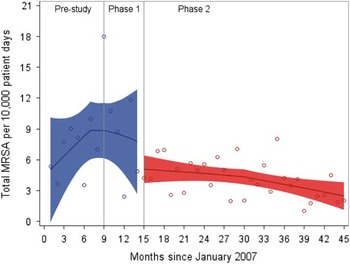
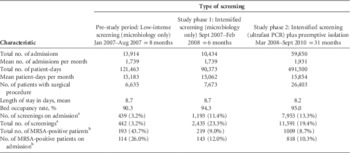
Compared with the pre-study period and study phase 1 (Table 1), the mean number of admissions and mean number of patient-days per month increased during study phase 2. Length of stay decreased and bed occupancy rate slightly increased. The number of screenings on admission increased from 3.2% (pre-study period) to 11.4% and 13.3% in study phases 1 and 2, respectively, whereas the number of MRSA-positive patients in relation to the number of total screenings decreased from 43.7% (pre-study period) to 9.0% and 8.7% in study phases 1 and 2, respectively. The total number of MRSA-positive patients increased from approximately 5 cases per 10,000 patient-days (beginning of pre-study period) to approximately 7 at the end of study phase 1 (Figure 1). The adjusted regression coefficient per month was odds ratio (OR) =1.101 (95% CI, 0.960–1.067), P=0.65. After implementation of the PCR screening, a significant decrease in nosocomial MRSA cases per 10,000 patient-days below 3 at the end of phase 2 was observed: OR per month =0.967 (95% CI, 0.944–0.990), P =.0061. This decrease was mainly driven by a decrease in nosocomial MRSA colonizations per 10,000 patient-days: OR per month =0.959 (95% CI, 0.927–0.993), P =.0185. A nonsignificant decline in nosocomial MRSA infections per 10,000 patient-days was observed: OR per month =0.983 (95% CI, 0.951–1.016), P =.29.
The number of total nosocomial methicillin-resistant Staphylococcus aureus (MRSA) cases per 10,000 patient-days in the pre-study period, in study phase 1 (blue circles), and in study phase 2 (red circles), and LOESS splines (blue line for pre-study period and study phase 1, red line for study phase 2). The blue and red graphic areas display the 95% CIs.

Characteristics in Study of Preemptive Isolation Precautions of Patients at High Risk for Methicillin-Resistant Staphylococcus aureus (MRSA) in Combination With Ultrarapid Polymerase Chain Reaction (PCR) Screening

a In parentheses the percentage of screenings in relation to the total number of admissions.
b In parentheses the percentage of MRSA-positive patients in relation to the number of screenings on admission.
DISCUSSION
There is uncertainty over the clinical efficacy of intensified PCR-based MRSA screening at hospital admission. It is believed that rapid MRSA tests are not superior to culture-based screening.Reference Boyce, Havill, Kohan, Dumigan and Ligi 2 The most important finding of our study was the continuous reduction in the nosocomial colonization rate after preemptive isolation precautions of all MRSA-risk patients in combination with ultrarapid PCR screening. Likewise, total MRSA cases per 10,000 patient-days significantly decreased. Nosocomial infection rates (nonsignificantly) decreased despite a higher MRSA burden in phase 2.
A limitation of this study is the short length of phase 1 relative to phase 2, and the occurrence of an outbreak in the pre-study period. The improvement in observation phase 2 may in part be the consequence of the more rigorous screening under the study conditions. It seems unlikely, however, that this is the main reason for the marked decrease in transmission rates in phase 2. We did not observe a trend in phase 1, but a continuous decline during phase 2. An active surveillance program had been started in the hospital more than 10 years ago, and this was the first time that a significant long-term reduction of nosocomial infections and colonizations was reached. The study was performed in the context of high MRSA pressure in Europe. The MRSA pressure was still increasing during the whole study phase (Online Supplementary Figure). Similar to other studies, we did not observe any adverse events of the contact precautions.Reference Croft, Liquori and Ladd 10
The study results are relevant for prevention of nosocomial infections in general. Data suggest that the first 2–3 hospital days are critical for the spread of bacteria. Only the combination of ultra-rapid PCR screening of all high-risk patients with preemptive isolation precautions, and rigorous hygiene management substantially reduced the MRSA transmission rate.
ACKNOWLEDGMENTS
Financial support. None reported.
Potential conflicts of interest. M.W. reports that he received payment for travel and/or meeting expenses from Cepheid and Roche Diagnostics. All other authors report no conflicts of interest relevant to this article.
SUPPLEMENTARY MATERIAL
To view supplementary material for this article, please visit http://dx.doi.org/10.1017/ice.2016.204.