

INTRODUCTION
Memory is a complex phenomenon, which involves a number of distinct systems and processes (Schacter & Tulving, 1994). Explicit memory can be distinguished from implicit memory. Three stages are typically considered for the study of explicit memory: (1) Encoding of the information, which consists in the initial processing of the stimuli or events and their transfer into long-term memory by means of active processes such as elaboration or organization. (2) Storage of the learned information over a period of time during which the mnemonic traces are susceptible to decay. Storage efficiency is usually assessed by forgetting rate. (3) Finally, retrieval of this information, which refers to the access of previously encoded memories (Baddeley, 2002). Conditions that are associated with memory impairment may differently affect these stages. In patients diagnosed with schizophrenia, a deficit at the encoding stage has been robustly established (see Cirillo & Seidman, 2003, for a review). By contrast, retention of the material over time was found unimpaired in many studies (e.g., Hill et al., 2004; Holthausen et al., 2003; Moritz et al., 2001).
Determining the extent to which each memory stage is affected by schizophrenia is important because it may help specify the neurophysiological dysfunctions involved in the disease. Furthermore, identifying the factors that contribute to the impairment would help understand and remedy it. A meta-analysis indicated that positive symptoms were unrelated to memory efficiency, and that the influence of negative symptoms was moderate (Aleman et al., 1999). Thus, other factors should be investigated.
Slowing of processing speed was proposed as an important cause of memory deficiency in various populations, mostly the elderly (Salthouse, 1996). Generalized slowing was observed in patients diagnosed with schizophrenia (Schatz, 1998), and the potential influence of this factor on cognition has started to become an object of investigation. A few recent studies have reported the role of psychomotor slowing on memory (Holthausen et al., 2003; Sanfilipo et al., 2002) or other cognitive functions such as IQ (Badcock et al., 2004) and verbal fluency (van Beilen et al., 2004), as well as on work performance (Lysaker et al., 2005; Milev et al., 2005) in these patients. In previous research we observed a significant association between processing speed and verbal memory efficiency in a schizophrenic sample (Brébion et al., 2001). More specifically, slowing of processing speed influenced the encoding of lists of words by either rote rehearsal or semantic organization, but did not influence their storage. In agreement with our data, Hartman et al. (2003) reported that patients diagnosed with schizophrenia were slower than healthy controls in encoding information.
The mechanism through which psychomotor slowing affects memory efficiency ought to be better specified. Processing speed is not a unitary construct (Chiaravalloti et al., 2003), and slowing of different motor or cognitive functions may lead to deficiency in various stages of memory, or deficiency in more or less effortful memory components. Slowing in reading or rehearsing at the acquisition phase may impede the efficiency of encoding the items that are to be processed by rote rehearsal (Burgess & Hitch, 1992). Accordingly, Salamé et al. (1998) observed that schizophrenic patients' impairment in serial recall and digit span was determined by slowness in reading rate. Cognitive slowing may prevent effortful mental operations such as organization of the material at encoding. Slowing in manual dexterity may impede recall efficiency when written recall is required; indeed, longer time spent in writing down the first recalled words increases the probability for the other words to decay from short-term memory.
In subsequent research conducted in another schizophrenic sample (Brébion et al., 2006), we attempted to determine which type of speed was involved in the relationship with verbal memory efficiency. Lists of words with increased levels of semantic organization were presented. We studied the relationship between the recall of each type of list and three measures of processing speed assumed to capture various types of slowing. The Digit Symbol Substitution Test from the WAIS-R involves a cognitive and a motor speed component. Trail Making Test-A time was used as a measure of motor speed. Stroop color naming time was an approximation of the articulation rate. Regression analyses, including the three processing speed measures, revealed that Digit Symbol Substitution Test score was the only predictor of the organizable lists requiring deep encoding, whereas Trail Making Test-A time was the only predictor of the non-organizable list assumed to be processed in a more superficial way. This pattern of results suggests that in these patients, motor speed is a limiting factor for the relatively undemanding memory processes, whereas cognitive speed is involved in the more effortful processes. However, the design did not enable us to study the effect of slowing on the storage component of memory, nor to tease apart the encoding from the retrieval processes. This latter distinction is usually achieved by comparing free recall and recognition scores (Grober & Buschke, 1987). Free recall requires active retrieval of the learnt information. By contrast, a recognition task provides full retrieval support, and therefore immediate recognition performance reflects mainly the efficiency of encoding processes.
In another task administered to mostly the same participants, we used lists of mixed high- and low-frequency words as another way of varying encoding difficulty. Rare words are assumed to require more effort and attention at the processing stage than frequent words, and therefore to undergo deeper encoding (Malmberg & Nelson, 2003). Free recall and recognition of these lists in immediate and delayed condition were required. The low-frequency words were better recognized than the high-frequency ones, suggesting that they had been more deeply encoded (Brébion et al., 2005). In the current study we investigated the role of different types of processing speed on the recall and recognition of these words. Superficial versus more effortful encoding was assessed by contrasting high- and low-frequency words. Storage was measured by contrasting delayed versus immediate recall. Lastly, contrasting recall and recognition was used as a way of disentangling encoding from retrieval processes. If a processing speed measure were related to recall but not recognition efficiency, this would suggest that it does not concern the encoding processes. Alternatively, an association restricted to the recognition efficiency would suggest that the retrieval processes are not involved.
We hypothesized that articulation rate would be related to the efficiency of encoding, because reading the words faster at acquisition would enable the list to be processed several times during the allocated time, thereby enhancing the mnemonic trace. With regards to the depth of encoding, we expected, based on our previous results, that cognitive speed would have a stronger effect on the recall and recognition of the low- than of the high-frequency words. No effect of any type of slowing was expected on the storage phase. Lastly, considering that a written recall of the information was required, it was expected that manual motor speed would be a limiting factor in recall efficiency.
In a second step, we wished to determine the extent to which recall and recognition deficits in patients were accounted for by slowing of processing speed. We therefore compared the patients to a healthy control group. By means of regression analyses we investigated whether the effect of diagnosis was either reduced or eliminated by entering each processing speed measure. Using a similar method of analysis in a large sample, Holthausen et al. (2003) reported that entering a processing speed score in the regression reduced, but did not eliminate, the group-related variance in measures of verbal learning and retrieval.
Another factor known to affect memory efficiency is depression (Burt et al., 1995). In depressed individuals, depression severity was found to affect the effortful memory processes rather than the more automatic ones (Hartlage et al., 1993). In schizophrenia, the assessment of the potential role of clinical variables on cognition is most often restricted to positive and negative symptomatology. Few studies have investigated the effect of depressive symptoms, which are nonetheless frequently observed in this population. A previous study from our group revealed that depressed mood assessed by the Hamilton Depression Rating Scale strongly affected schizophrenic patients' verbal memory efficiency (Brébion et al., 1997). More particularly, depressive severity impeded the deep encoding processes of semantic organization, whereas it spared the more superficial encoding processes of rote rehearsal as well as the storage phase. Lysaker et al. (2000) reported that in a large sample of patients diagnosed with schizophrenia, higher ratings of depression and anxiety were associated with lower performance in story recall, assumed to involve deep encoding processes, whereas no association emerged with other verbal memory tasks requiring relatively more superficial encoding. Sanfilipo et al. (2002) observed a significant correlation between word memory and depression score in a schizophrenic sample, whereas the correlation with the negative symptom score was near zero. Other groups however failed to reveal any relationship between verbal memory performance and depression in this population (Holthausen et al., 1999; Kohler et al., 1998; Lucas et al., 2004).
In this study we expected depressive severity rather than negative symptoms to affect memory efficiency in the patient sample. More specifically, we hypothesized that depressed mood would be more strongly related to the encoding of the low- than of the high-frequency words. No correlation between depressed mood and the storage measure was expected.
METHOD
Subjects
Forty-eight patients diagnosed with schizophrenia (8 inpatients) were recruited at the Maudsley Hospital, London (31 men, 17 women; 26 Whites, 19 Blacks, 3 Indian/Asiatics; age: m = 34.7, SD = 7.9; number of years of education: m = 12.6, SD = 2.6; NART score: m = 101.1, SD = 14.0). All the patients except three were on antipsychotic medication. The diagnosis was made based on DSM IV criteria following detailed chart review by two senior psychiatrists who reached a consensus. The patients were primarily diagnosed with chronic schizophrenia, with disease duration of over 12 months. Forty of the patients were rated on the Scale for the Assessment of Negative Symptoms (SANS) and on the Montgomery & Asberg Depression Rating Scale (MADRS). For practical reasons (e.g., availability of the psychiatrists), clinical ratings were not conducted for the remaining 8 patients, although these patients were equivalent to the others. The psychiatrists were blind to cognitive results during clinical assessment. The experimenter (GB) was blind to patients' symptoms during testing.
Forty-one healthy control subjects were recruited by local announcements and among hospital staff, and were screened to rule out any current or recent psychiatric history (26 men, 15 women; 27 Whites, 12 Blacks, 2 Indian/Asiatics; age: 35.1, SD = 9.9; number of years of education: m = 13.1, SD = 2.6; NART score: m = 107.0, SD = 10.6). The two groups were equivalent with respect to age, education level, gender distribution, and ethnicity (p > .10 in all cases). However, the healthy controls achieved significantly higher scores on the NART (2nd edition), which provides an estimation of verbal IQ (t(87) = 2.20, p < .05), and therefore this measure was controlled for in the analyses involving group comparisons.
Materials and Methods
Memory Task
Four lists of 16 concrete mono- or bisyllabic words were prepared (A, B, C, D). Each list was made up of 8 high-frequency words and 8 low-frequency words (Kucera & Francis, 1967) in random order. For the high-frequency words the occurrence was more than 42 per million (mean for the four lists: 108.6); for the low-frequency words the occurrence was less than 10 per million (mean for the four lists: 6.6). The four lists were equivalent in total number of syllables. The mean frequency of the 8 high-frequency words was equivalent in the four lists, as was the mean frequency of the 8 low-frequency words. Two of these lists were to be learnt for free recall and recognition—one in immediate and one in delayed condition—and the other two were used as distractors in the recognition task. For half of the subjects lists A and B were presented as targets, whereas lists C and D were used as distractors. The reverse was true for the other half. The order of presentation of the two lists to be learnt was counterbalanced among subjects. This resulted in four experimental conditions of list presentation (A-B, B-A, C-D, D-C). The subjects were randomly assigned to one of these conditions.
Two recognition sheets consisting of lists of 32 words were prepared. One included in random order the words used in lists A and C, and the other one the words used in lists B and D. Thus, whatever the condition, the recognition sheet included 16 target words and 16 distractors.
The subjects were presented with one of the lists printed on a sheet, and informed that they had 45 seconds to learn the words. They were required to read the list aloud at least once. After a five-minute delay filled with other tasks—Digit Symbol Substitution Test, digit span—the subjects were provided with a blank sheet and required to write down as many words as they could remember in any order (delayed recall). Then they were given the corresponding recognition sheet and instructed to circle all the words they could recognize from the list (delayed recognition). The second list to be learnt was then presented for 45 seconds, and the subjects had to recall the words of this list just after learning (immediate recall). Then the second recognition sheet was given (immediate recognition).
The number of high- and low-frequency words recalled in immediate and delayed condition was tallied. The forgetting rate (number of words recalled in immediate minus delayed condition) was computed for the high- and for the low-frequency words and used as a measure of storage efficiency. The recognition index Pr reflecting the accuracy in discriminating target words from distractors (rate of correct recognitions of target words minus rate of false recognitions of non-target words; Corwin, 1994) was computed for the recognition of high- and low-frequency words. Only Pr in the immediate condition was considered, in order to avoid the confound of storage.
Processing Speed Tests
Digit Symbol Substitution Test from the WAIS-R
Subjects were presented with rows of empty boxes labeled by a digit. They were required to fill out these boxes as quickly as they could with a corresponding symbol, according to a digit/symbol code that was permanently displayed. The total number of boxes accurately filled in within 90 seconds was tallied (Wechsler, 1981).
Trail Making Test-A
Subjects were presented with a sheet displaying numbers from 1–25 in random arrangement. They were required to draw a line between the numbers in ascending order as quickly as they could. The time for completion was recorded (Reitan, 1958).
Stroop Color Naming Test
Only the neutral condition of the Stroop Test (Stroop, 1935) was used. Subjects were presented with a sheet displaying blocks of color (red, blue, green) and required to name the color of each block, column by column, as quickly as they could. The time for naming all the blocks was recorded.
All the cognitive and clinical measures followed a normal distribution, with the exception of the Trail Making Test-A time which was normalized by square root transformation before data analyses. All tests were two-tailed.
RESULTS
Group Comparisons
The scores obtained in immediate recall and recognition, storage, and processing speed in each group are presented in Table 1. After NART score was controlled, patients were significantly impaired in the recall and recognition of both high- and low-frequency words but not in their storage. A highly significant deficit was observed in the three processing speed measures.
Scores on the memory and processing speed tests (means and standard deviations), and significance of the group difference after controlling for NART score

Associations Between Memory Efficiency and Processing Speed
The three processing speed measures were significantly intercorrelated in the patient group (Digit Symbol Substitution Test score and Trail Making Test-A time: r = −.70, p < .0001; Digit Symbol Substitution Test score and Stroop color naming time: r = −.62, p < .0001; Trail Making Test-A time and Stroop color naming time: r = .59, p < .0001), as well as in the healthy control group (Digit Symbol Substitution Test score and Trail Making Test-A time: r = −.64, p < .0001; Digit Symbol Substitution Test score and Stroop color naming time: r = −.47, p < .002; Trail Making Test-A time and Stroop color naming time: r = .39, p < .02).
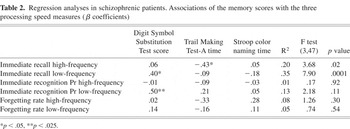
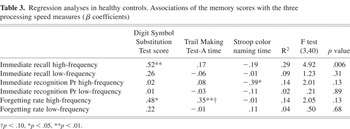
Regressions analyses were conducted in each group on the immediate recall and recognition scores for high- and low-frequency words, as well as on the storage measures. The three processing speed measures were entered as predictors. Results are presented in Table 2 and Table 3.
Regression analyses in schizophrenic patients. Associations of the memory scores with the three processing speed measures (β coefficients)

Regression analyses in healthy controls. Associations of the memory scores with the three processing speed measures (β coefficients)

In patients, the Digit Symbol Substitution Test score was a significant predictor of the recall and recognition of the low-frequency words, as expected. It did not contribute to the recall or recognition of the high-frequency words. The Trail Making Test-A time was the only significant predictor of the recall of the high-frequency words, but did not contribute to their recognition. Contrary to our expectations, Stroop color naming time was not associated with any memory measure. Notably, it was not a predictor of the recognition indices reflecting efficiency of encoding. The forgetting rates for high- and low-frequency words were not significantly predicted by any of the processing speed measures, as expected.
In controls, the Digit Symbol Substitution Test score was the only significant predictor of high-frequency word recall. The efficiency of high-frequency word recognition was predicted by the Stroop color naming time.
Contribution of Each Processing Speed Measure to the Memory Efficiency Impairment
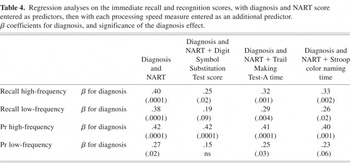
Regression analyses including all the schizophrenic and healthy participants were conducted on the immediate recall and recognition scores for each type of word. Diagnosis and NART score were first entered as predictors, and then each processing speed measure was entered alternatively as an additional predictor. The contribution of diagnosis to each memory score before and after entering the processing speed measures is presented in Table 4. For the recall of the high-frequency words, the significance of the diagnosis effect was reduced, but not eliminated, after each processing speed measure was entered. For recall and recognition of the low-frequency words, the effect of diagnosis was no longer significant when the Digit Symbol Substitution Test score was entered in the regression.
Regression analyses on the immediate recall and recognition scores, with diagnosis and NART score entered as predictors, then with each processing speed measure entered as an additional predictor. β coefficients for diagnosis, and significance of the diagnosis effect.

Associations of Memory Efficiency with Negative Symptoms and Depressed Mood
We studied in the patient sample the correlations of the SANS and MADRS scores with the immediate recall and recognition of high- and low-frequency words, as well as with the storage measures. NART score and use of anticholinergic drugs were partialled out as potential confounds of the associations with clinical symptomatology. The SANS score was not associated with impairment in any of these memory measures. As expected, depressed mood was associated with memory for the low-frequency words, as reflected by a significant negative correlation between MADRS score and the recognition index Pr low-frequency (r = −.37, p < .025). The negative correlation with the recall of the low-frequency words did not reach statistical significance. The correlations of depression score with recall and recognition of the high-frequency words, as well as with the two storage measures, were all near zero.
In order to further investigate the association between encoding of the low-frequency words and depressive score, the correlation was recomputed using a short depression scale including only 4 of the 10 MADRS items (apparent sadness, reported sadness, pessimistic thoughts, and suicidal thoughts), which were considered more specific to depression. The score ranged from 0 to 11 and followed a normal distribution. The correlation of depressed mood with Pr low-frequency was increased when this short scale was used (r = −.51, p < .001). The correlations with recall and recognition of the high-frequency words and with the two storage measures were still near zero. When the Digit Symbol Substitution Test score was added to the covariates, the correlation between Pr low-frequency and the short depression scale score was not markedly affected (r = −.46, p < .005), which suggests that psychomotor slowing did not account for this association.
DISCUSSION
We had demonstrated in previous research the role of processing speed on verbal memory efficiency in patients diagnosed with schizophrenia. The present results confirm that psychomotor slowing is an important factor in the impaired recall and recognition of lists of words in this population. Varying word frequency in the target lists enabled us to assess the differential role of slowing on the effortful encoding of the low-frequency words, relative to the more automatic encoding of the familiar words. The Digit Symbol Substitution Test, which has an important cognitive speed component (Jogems-Kosterman et al., 2001), was a significant predictor of the recall and recognition of the low-frequency words, whereas it did not contribute to either recall or recognition of the high-frequency words. The other two processing speed tests, which mostly include motor components, were not predictive of the recall or recognition of the low-frequency words. Thus, the current study enhances our previous observation that cognitive speed is a crucial mechanism of the effortful memory processes in schizophrenia. Future research should investigate the associations of motor and cognitive speed with the recall of pure lists of high-, medium- and low-frequency words. One might expect that cognitive speed becomes more critical as more effort is required to process the list. Very recently, Morrens et al. (2006) reported that the cognitive, but not the motor, component of the Digit Symbol Substitution Test was correlated with verbal memory score in a schizophrenic sample. The role of cognitive speed in schizophrenia may extend to functions other than memory. Sanfilipo et al. (2002) observed significant correlations between the Digit Symbol Substitution Test score and performance in a number of cognitive tasks. Nelson et al. (1990) reported that cognitive, but not motor speed, was correlated with current IQ. The dissociation in their study is especially striking because measures for both types of speed were derived from the same cancellation task.
Contrary to our hypothesis, articulation rate was not related to encoding efficiency in patients. However, the expected association was observed in the healthy control group, in which the Stroop color naming time was the only significant predictor of recognition accuracy for the high-frequency words. Although the strategy employed by the subjects can only be inferred, this association suggests that in controls the efficiency of encoding these familiar words was dependent on the speed of their subvocal rehearsal, which determines the number of times they could be refreshed. The association did not extend to the rarer words, probably because they underwent deeper processing. The absence of a similar association between articulation rate and encoding in patients suggests that the strategy of rote rehearsal was not used efficiently. It is likely that the mixture of familiar and more difficult words in the target lists has disrupted the serial learning process in this group.
The storage of either type of word was not linked to any processing speed measure in patients, in agreement with our previous research (Brébion et al., 2001). Even though the Digit Symbol Substitution Test score was strongly related to the recall and recognition of the low-frequency words, it was not related to their maintenance in memory over a few minutes. This is compatible with Holthausen et al. (2003) who reported that in a large schizophrenic sample, processing speed was significantly correlated with several memory scores reflecting learning or retrieval, but not with the retention measure. Recently, Kieseppa et al. (2005) observed a similar pattern of associations between processing speed and verbal learning and encoding, but not storage, in patients with bipolar disorders. The finding that slowing was associated with the encoding but not the storage phase is also in agreement with studies conducted in the elderly (Salthouse, 1994).
With regards to the recall phase, it should be noted that our procedure did not enable us to tease apart the cognitive retrieval of the words from their motor handwriting. Trail Making Test-A time was the only predictor of the recall of the high-frequency words in patients, but did not contribute to their recognition. Thus, manual motor speed appears to be unrelated to the encoding of these words, as expected. One may assume that a limiting factor for the recall of the high-frequency words in patients was speed in handwriting. The mnemonic trace associated with the low-frequency words was stronger, and therefore the information could survive the time it took to write it down.
Another purpose of our study was to determine how much of the deficit in patients was accounted for by slowing. It seems that slowing in cognitive speed as assessed by the Digit Symbol Substitution Test score accounted for the deficit in recall and recognition of the low-frequency words, as it did for the deficit in recalling semantically organizable lists in our previous study (Brébion et al., 2006). With regards to the high-frequency words, the significance of the group difference in recall was reduced, but not eliminated, when any of the processing speed measures was entered in the regression. Controlling for the speed measures had no effect on the group difference for recognition of the frequent words, which suggests that poor encoding of these words did not stem from slowing. It is likely that because of processing difficulties, the patients had to devote extra attention to the low-frequency words, thereby neglecting the intermixed frequent words and interrupting the strategy of rote rehearsal commonly used in pure lists. Our results combined with those of the previous study suggest that slowing influences the encoding of the familiar words mostly by preventing rote rehearsal, and has no effect on them when they are not encoded in a serial way.
The major limitation of this study is that the tests used for the assessment of processing speed were multi-faceted, and could only be considered as approximate measures of the concepts they were assumed to reflect. The Digit Symbol Substitution Test seems to be an appropriate measure of processing speed, including motor and cognitive components, even though a small part of the variance is accounted for by memory (Joy et al., 2004). However, the Trail Making Test-A involves an important visual search component in addition to its manual motor component, and therefore is not an accurate measure of manual speed. Contrasting the Digit Symbol Substitution Test with the Symbol Copy Test would be a more reliable way of teasing apart the motor handwriting from the cognitive speed processes. Likewise, the Stroop color-naming task involves a number of processes other than articulation rate. A mere reading rate measure would be more appropriate for the purpose of studying the role of slowing on serial encoding. Thus, although our data clearly reveal the involvement of cognitive speed in the effortful memory processes in schizophrenia, the conclusions regarding the additional role of articulation rate on rote rehearsal, and of manual speed on written recall, must be considered as speculative. The results suggest new roads for research, but they should be replicated with more refined and targeted measures of various types of cognitive and motor speed before any firm conclusion can be drawn.
We observed in previous research that depressed mood affects the effortful encoding processes of semantic organization (Brébion et al., 1997). In this study we attempted to extend this association to another type of effortful encoding. The negative symptom score was not significantly associated with any of the memory measures. This is compatible with a recent study of clinical associations in a large sample (Bell & Mishara, 2006). Negative symptoms might not be an appropriate target for treatment of memory deficits in schizophrenia. By contrast, depressed mood assessed by the MADRS was significantly correlated with the efficiency of encoding the low-frequency words, whereas it spared the more superficial encoding of the familiar words. This pattern of associations is in agreement with the observation that depression affects selectively the effortful memory processes in depressed patients (Hartlage et al., 1993). Manipulating word frequency seems to be an effective way of contrasting different levels of encoding. Again, it would be interesting to use pure lists varying in their average level of word frequency, in order to test the hypothesis that the inverse correlation between memory efficiency and depressed mood increases with the assumed complexity of the material to be processed. Depressive severity was unrelated to the storage measures, in agreement with our previous data. This may contribute to explain the absence of relationship in studies that used delayed recall score as a measure of memory efficiency.
Depression includes various components such as anxiety, sadness, or psychomotor retardation. In the current data it was observed that the sadness component of the scale was strongly related to the encoding impairment. The correlation was still significant after controlling for the Digit Symbol Substitution Test score, which suggests that it was not accounted for by psychomotor retardation associated with the depressive state. Although anxiety is not captured by the MADRS, this factor is likely to make an additional contribution to the memory deficit. The emergence of a significant relationship between memory performance and depressed mood in a schizophrenic sample must depend on the requirements of the memory task in terms of effortful encoding, the prevalence and severity of depression in the sample and the type of depressive component captured by the rating scale.
ACKNOWLEDGMENTS
The first author was funded by grants from the Leverhulme Trust and from the Alexander Gralnick Grant for Research on Schizophrenia, American Psychological Foundation. The authors acknowledge awards from Baily Thomas Charitable Trust, Barnwood House Trust, Making Space, PF Charitable Trust, Sir Samuel Scott of Yews Trust, and Welton Foundation.