Tropical forests play a substantial role in the global carbon cycle, are projected to experience significant changes in climate (Wieder et al. Reference WIEDER, CLEVELAND and TOWNSEND2009) and are currently experiencing dramatic changes in land-use. For instance, Fearnside & Barbosa (Reference FEARNSIDE and BARBOSA2004) reported a mean annual deforestation rate of 18000 km2 y−1 until 2002 in the Brazilian Amazon. Thus, it is fundamental to understand the consequences of those changes on organic matter decomposition and consequently, in carbon and nutrient cycling, in tropical forests. Decomposition is primarily determined by climate (and microclimate), substrate quality and decomposer activity (Lavelle et al. Reference LAVELLE, BLANCHART, MARTIN, MARTIN, SPAIN, TOUTAIN, BAROIS and SCHAFER1993, Wieder et al. Reference WIEDER, CLEVELAND and TOWNSEND2009). In systems where high temperature and rainfall produce near-optimal abiotic conditions for decomposition (Lavelle et al. Reference LAVELLE, BLANCHART, MARTIN, MARTIN, SPAIN, TOUTAIN, BAROIS and SCHAFER1993), micro-environmental changes associated with land-use can exert a disproportionate degree of control over litter decomposition (Barlow et al. Reference BARLOW, GARDNER, FERREIRA and PERES2007). In these systems, microclimatic conditions are primarily determined by vegetation structure and reductions of leaf-litter quality related to land-use have been reported (Barlow et al. Reference BARLOW, GARDNER, FERREIRA and PERES2007, Vasconcelos & Laurance Reference VASCONCELOS and LAURANCE2005). Changes in microclimate and litter quality may result on a modified micro-environment which, in turn, could affect soil fauna activity and the decomposition process itself.
In Amazonia both increase and decrease in decomposition rates have been reported when comparing pastures with forests and secondary forests with primary ones (Barlow et al. Reference BARLOW, GARDNER, FERREIRA and PERES2007, Koutika et al. Reference KOUTIKA, BARTOLI, ANDREUX, CERRI, BURTIN, CHONE and PHILIPPY1997, 2000; Martius et al. Reference MARTIUS, HÖFER, GARCIA, RÖMBKE and HANAGARTH2004, Vasconcelos & Laurance Reference VASCONCELOS and LAURANCE2005). To our knowledge, there are no simultaneous comparisons of decomposition between those three ecosystems; despite their being some of the most extended land-uses in Amazonia. In this context, our aim was to evaluate if land-use change, specifically conversion from primary forest to pastures and subsequent pasture abandonment and secondary-forest growth, can produce changes in the micro-environment (combined effects of microclimate, nutrient availability/litter quality and micro-biota) for decomposition. Through the use of common substrates (the same material incubated in all plots), we were able to evaluate micro-environmental conditions for decomposers independently of substrate quality (Castanho et al. Reference CASTANHO, LORENZO and OLIVERIA2012, Jenny et al. Reference JENNY, GESSEL and BINGHAM1949, Orwin et al. Reference ORWIN, WARDLE, LAURENCE and GREENFIELD2006).
Our experiment was performed in Central Amazonia (2º24′S; 59º52′W). The mean annual temperature is 26 ºC, and the annual rainfall ranges from 1900 to 3500 mm. The dominant vegetation is a primary non-flooded rain forest (canopy 30–35 m high). Pasture areas (vegetation 0.4–1 m tall) were clear-cut and burnt at the beginning of the 1980s; they are partially burned at 3–5-y intervals. Study plots were not burned at least 2 y before the experiment. Some cattle ranches were abandoned after 4 y of use and 20-y-old secondary forest patches (canopy 20–25 m high) were present at the time of our study. To evaluate the micro-environment for decomposition, we used 5 × 5-cm litterbags of 0.3-mm2 nylon mesh filled with 1 ± 0.1 g of air-dried senescent leaves of two common non-native substrates: a rapidly decomposing species, Acalypha communis Müll. Arg., Euphorbiaceae, and a slowly decomposing species, Jarava ichu Ruiz & Pav., Poaceae (Vaieretti et al. Reference VAIERETTI, PÉREZ-HARGUINDEGUY, GURVICH, CINGOLANI and CABIDO2005). For each ecosystem (pasture, secondary and primary forest) we placed four plots at least 1 km apart from each other, guaranteeing independence for decomposition. On each plot, we placed 40 litterbags, 20 with each substrate. We set the experiment up in the field in February 2011 (rainy season) and we collected ten litterbags (five from each substrate) per plot and period after 15, 30, 60 and 90 d. Then, we washed the remaining material in each litterbag, we dried it at 70 ºC to a constant weight and we weighed it. We selected 90 d as an adequate period to detect responses to land-use because previous works have, indeed, detected decomposition differences related to forest structure over shorter periods near our study area (Didham Reference DIDHAM1998).
To test the effects of land-use (pasture, secondary and primary forests), substrate (high- and low-quality), and incubation period (15, 30, 60 and 90 d) on the decomposition (% remaining mass) of two common substrates we used a mixed model analysis of variance. Our data showed both linear and quadratic decays, so we created a quadratic term (time2) to be used as a covariate with time. We considered land-use, substrate and incubation period as fixed factors and plot as random factor. We used the mean % remaining mass per plot as a response variable. To control the dependence among repeated measures, we considered compound symmetry for the co-variance matrix (Pinheiros & Bates Reference PINHEIROS and BATES2000). We tested the significance of the fixed factors and all interaction terms. Since the null hypothesis was rejected, we used Fisher's LSD (0.05 significance level) to identify inter-group differences. We performed all analyses in InfoStat version 2011 (InfoStat Group, UNC, Córdoba, Argentina).
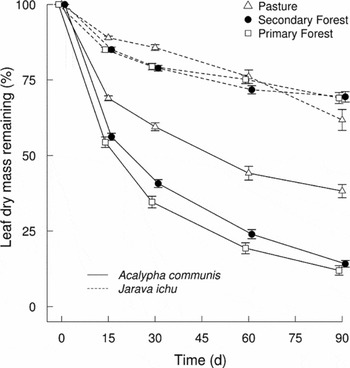
In accordance with their differences in quality (Vaieretti et al. Reference VAIERETTI, PÉREZ-HARGUINDEGUY, GURVICH, CINGOLANI and CABIDO2005), leaf-litter of Acalypha communis decomposed more rapidly (F = 2170; P < 0.0001) than that of Jarava ichu in all three ecosystems. During the 90 d of the experiment, the mean dry mass remaining was, on average, 50% lower for Acalypha communis than for Jarava ichu leaf-litter (Figure 1). The effects of land-use on decomposition depended on the substrate (F = 60.7; P < 0.0001). There were no significant differences in decomposition between ecosystems for low-quality leaves (Jarava ichu) (P ≥ 0.05), while high-quality leaves (Acalypha communis) decomposed slower in pastures than in both forest types (Figure 1).
Dry mass remaining in litterbags filled with leaves of Jarava ichu (low-quality) and Acalypha communis (high-quality), at four retrieval times during 90 d of placement in areas of pasture, 20-y-old secondary forest and primary forest in Central Amazonia. Points are means of 20 litterbags (five litterbags on four plots) retrieved per time interval; bars represent standard error.

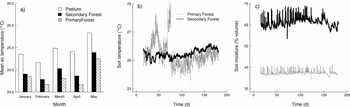
The slower decomposition of high-quality common substrates in pastures would be related to differences in microclimatic conditions between pastures and forests. According to the measurements of the nearest microclimatic stations to our sites (which are located in the same sites of our experiment in pasture and secondary forests, but 30 km distant in primary forest), the air temperature was consistently higher in pastures than forests during our experiment (Figure 2a). Decreased decomposers’ activity as a result of harsher microclimatic conditions (higher soil temperature and lower soil water content) has been found in pastures compared with control forests in Eastern Amazonia (Davidson et al. Reference DAVIDSON, VERCHOT, CATTÂNIO, ACKERMAN and CARVALHO2000). Microclimatic conditions would be similar in secondary and primary forests. During our experiment air temperature was only 0.22 ºC higher in secondary forests (Figure 2a) and this did not translate into higher soil temperature, nor lower water content. Moreover, this was higher in secondary than primary forests (Figure 2b, c). Since primary forest data were recorded about 30 km distant from our study sites, these comparisons may be interpreted with caution. However, previous works have also reported slight differences in microclimatic conditions that did not affect the micro-environment for decomposition in Amazonian secondary and primary forest (Barlow et al. Reference BARLOW, GARDNER, FERREIRA and PERES2007, Mesquita et al. Reference MESQUITA, WORKMAN and NEELY1998, Vasconcelos & Laurance Reference VASCONCELOS and LAURANCE2005). This would explain the similar decomposition of Acalypha communis leaves in 20-y-old secondary forests and primary ones (Figure 1).
Microclimatic data in pasture, secondary and primary forests from the nearest microclimatic stations to the decomposition experiment: mean monthly air temperature (a), soil temperature (b) and soil moisture (c); soil variables were measured at 10-cm soil depth at 10-m intervals during the first 190 d of 2011. Pasture and secondary forest stations are located in the same sites of the decomposition experiment, but the primary forest one is about 30 km distant. Data from the LBA experiment (http://daac.ornl.gov/LBA/lba.shtml).

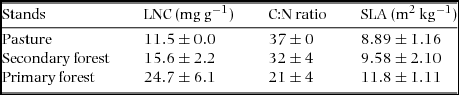
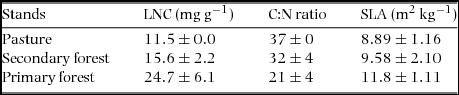
We have found leaf characteristics that suggest enhanced decomposability in abundant species from primary forest compared with species from pastures and secondary forest (Table 1). This could lead to an enhanced activity of decomposers in primary forests and consequently, to higher decomposition of common substrates. Higher decomposability of leaf-litter in primary than secondary-forest species has been reported previously (Martius et al. Reference MARTIUS, HÖFER, GARCIA, RÖMBKE and HANAGARTH2004, Vasconcelos & Laurance Reference VASCONCELOS and LAURANCE2005). This probably occurs also in pastures, as suggested by previous studies, which have reported nutrient depletions related to litter quality in pastures compared with forests in Amazonia (Luizão et al. Reference LUIZÃO, COSTA and LUIZÃO1999, Markewitz et al. Reference MARKEWITZ, DAVIDSON, MOUTINHO and NEPSTAD2004). Modified microclimatic conditions and reductions of litter quality seem to cause a harsher micro-environment for decomposition in Amazonian pastures. While decomposition micro-environment appeared to be similar in primary and secondary forests, most likely their closed canopies result in a favourable microclimate for decomposition.
Mean (± SD) leaf trait values related to leaf-litter decomposability in pastures, 20-y-old secondary forests and primary forests in Central Amazonia. Leaf nitrogen concentration: LNC; specific leaf area: SLA. The five most abundant species of each ecosystem were considered. For LNC and C:N in pastures, only the species which sum to more than 80% of community biomass was included.
The lack of differences in decomposition of low-quality Jarava ichu leaves between pastures and forests could be related to the 90-d period of incubation, which may have been too short to detect differences in this substrate. However, in 90 d Jarava ichu leaves lost about 30% of the initial dry mass (Figure 1), which has been shown to be enough to detect micro-environmental differences associated to ecosystem structure even in shorter periods (Didham Reference DIDHAM1998 in tropical forests, Vaieretti et al. Reference VAIERETTI, CINGOLANI, PÉREZ-HARGUINDEGUY, GURVICH and CABIDO2010 in temperate grasslands). Another possible explanation for the differential responses between our substrates could be the litter quality itself. The main factor in determining decomposition is that one which imposes stronger constraints on biological activities (Castanho et al. Reference CASTANHO, LORENZO and OLIVERIA2012); therefore, Jarava ichu leaves may have been mostly constrained by their low quality (high C:N ratio, lignin content and LTS; low SLA and N and P content; Vaieretti et al. Reference VAIERETTI, PÉREZ-HARGUINDEGUY, GURVICH, CINGOLANI and CABIDO2005). In contrast, the high-quality Acalypha communis leaves, which impose fewer chemical constraints on decomposers, were affected by the modified micro-environment for decomposition under land-use change.
In conclusion, our results have shown that in Central Amazonia (1) the decomposition of high-quality leaf-litter is slower in pastures than in secondary and primary forests, and (2) the micro-environment for decomposition appears to be restored in 20-y-old secondary forests. However, previous studies have shown that not all nutrient cycling functions are restored in the long term (Feldpausch et al. Reference FELDPAUSCH, RONDON, FERNANDES, RIHA and WANDELLI2004, Markewitz et al. Reference MARKEWITZ, DAVIDSON, MOUTINHO and NEPSTAD2004, Martius et al. Reference MARTIUS, HÖFER, GARCIA, RÖMBKE and HANAGARTH2004). Therefore, decomposition experiments with longer incubation periods should be done to clarify if the effects of microclimatic patterns are consistent through one and several years, how these patterns are related to litter production and the potential effects of litter mixtures on decomposition under land-use change.
ACKNOWLEDGEMENTS
We thank Juliana Vendrami and Leo Marajó for field assistance, Laura Pla for statistical advice, Camila Castanho and two anonymous reviewers for their useful comments. Climatic data were provided by the Large Scale Biosphere-Atmosphere experiment in Amazonia (LBA). This work was supported by BDFFP (INPA/Smithsonian) and funded by the Inter-American Institute for Global Change Research (IAI) CRN 2015 and SGP-CRA2015, through US National Science Foundation grants GEO-0452325 and GEO-1138881. This is contribution 627 to the BDFFP technical series.