Implications
Genetic variation in resistance to nematode infections between or within breeds of sheep cannot be fully explained by differences in host immune responses to the infections. The limited size of the host (body/organ) may be able to confine the parasitic infestation, growth, reproduction and survival depending on food and space availability. The aim of this study was to estimate possible correlations between a nematode infection (Haemonchus contortus) and body and organ measurements of lambs. This may partly help to explain individual variation in resistance to nematode infection.
Introduction
Infections with gastrointestinal nematodes are a major source of economic losses in the sheep industry (Davies et al., Reference Davies, Stear and Bishop2005). The haematophagous Haemonchus contortus is considered to be one of the most pathogenic nematodes in sheep due to the blood-sucking habits of the adult worms (Williamson et al., Reference Williamson, Brindley, Knox, Hotez and Loukas2003). The average blood loss was estimated between 0.003 and 0.004 ml/worm per day (Dargie and Allonby, Reference Dargie and Allonby1975), causing severe anaemia. It can also cause weight loss, reduced growth rate and even death in small ruminants (Schallig, Reference Schallig2000).
Abomasal nematodes can directly influence the abomasal environment to enable their survival and reproduction (Hertzberg et al., Reference Hertzberg, Guscetti, Lischer, Kohler, Neiger and Eckert2000). Salman and Duncan (Reference Salman and Duncan1984) described the main histological changes in the abomasum of H. contortus infected lambs, where the primary infection caused loss of the superficial mucous layer, hyperplasia of mucus cells, congestion of mucosal blood vessels, haemorrhages and an increase in the cellularity of the lamina propria. Erosions of the surface epithelial cells and oedema of the mucosa and sub-mucosa were observed after re-infection. An increase in pH value and a decrease in the oxygen content (pO2) of the abomasal fluid after infection with a high number of H. contortus larvae have been reported by Nicholls et al. (Reference Nicholls, Hayes and Lee1987). Moreover, Simpson (Reference Simpson2000) reported that nematodes can decrease acid secretion in the abomasum and increase serum gastrin and pepsinogen concentrations in the abomasum.
Earlier studies have described correlations between the sizes of parasites and the body size of hosts (Harrison, Reference Harrison1915). This suggestion, or what is known now as Harrison's rule, was also proved for different ectoparasites (Morand et al., Reference Morand, Hafner, Page and Reed2000; Johnson et al., Reference Johnson, Bush and Clayton2005). Johnson et al. (Reference Johnson, Bush and Clayton2005), for example, estimated a positive relationship between wing feather size and wing louse body size. Studies in fish have reported that the size of host fish has a strong impact on the abundance and richness of common ectoparasites (Poulin and Rohde, Reference Poulin and Rohde1997; Lo et al., Reference Lo, Morand and Galzin1998; Cable and van Oosterhout, Reference Cable and van Oosterhout2007). These results led to controversial questions such as whether endoparasites generally relate to the size of their environments or their hosts, and whether differences in body and/or organ size of the host partly explains variation between animals with regard to worm burden or faecal egg counts (FECs) in small ruminants.
However, there is no report of such correlations in lambs in the literature we have so far consulted. Therefore, the objective of this study was to estimate the relationship between parasitological parameters with body measurements and abomasal size in lambs experimentally infected with H. contortus.
Material and methods
Experimental flock and design
The experimental flock was located at the Research station ‘Oberer Hardthof’ of the University of Giessen. Lambing of all studied animals occurred indoors during 3 weeks in February 2008. The animals were separated into three groups according to their birth week.
In total, 100 lambs (51 females and 49 males) from German Merino (GM) and four crossbreds (20 lambs/genotype) were used in the study. GM ewes were mated with three to four rams of Texel (TX), Suffolk (SU), German Blackhead Mutton (BM) and Ile de France (IDF), respectively, to produce crossbred lambs.
The lambs were weaned at 12 weeks of age, separated from other sheep and housed indoors throughout the trial period. They were given water and hay ad libitum and about 500 g/lamb per day of concentrate diet (metabolisable energy, 10.8 MJ/kg; crude protein, 18.0%). The infective larvae were supplied by the Institute of Parasitology, University of Giessen, Germany. The larvae were recovered from cultures of faeces derived from previously infected sheep. The larvae were microscopically counted in 100 μl (4 × 25 μl) and that was used in calculating the volume that would contain 5000 H. contortus third larvae (L3). The larvae were younger than 4 weeks. The lambs were each given orally a single-dose infection with 5000 L3 using a syringe at the time of weaning (12 weeks of age). All animals were slaughtered at 19 weeks of age. No anthelmintic treatments were applied during the study.
Body measurements
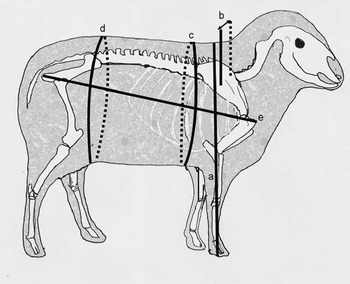
One week before slaughter, five parameters (Figure 1) were measured to describe the body size of the animals (Fourie et al., Reference Fourie, Neser, Olivier and van der Westhuizen2002; Janssens and Vandepitte, Reference Janssens and Vandepitte2004). Wither height (WH) was measured as the vertical distance from the thoracic vertebrae to the ground; shoulder width (SW), as the horizontal distance between the processes on the left and on the right shoulder blade; heart girth (HG) was obtained as the smallest circumference around the animal just behind the foreleg; loin girth (LG) was determined as the circumference around the animal just before the hind leg and body length (BL) was measured from the humeri to the aitchbone (Tuber ischiadicum). All lambs were weighed at birth and at 12, 16 and 18 weeks of age.
The body dimension measurements taken from lambs during the study – a = wither height, b = shoulder width, c = heart girth, d = loin girth and e = body length.

FECs
Individual faecal samples were taken directly from the rectum on the infection day, as well as at 4 and 6 weeks, respectively, after infection (FEC-4, FEC-6). The lambs were sampled twice in the morning of the first 2 days of the 4th and 6th weeks post-infection. The presented FECs were calculated as the average of FECs of the two samples. Faecal samples were analysed using a modified McMaster method (Bairden, Reference Bairden1991) to quantify FECs with saturated NaCl as the floatation fluid. The eggs were counted with a sensitivity of 50 eggs/g of faeces. All samples were analysed on the day of sample collection or the next day.
Necropsy procedure and abomasal measurements
The abomasum of slaughtered lambs was dissociated from the omasum and the duodenum. It was washed with water and then tied off at the junction with the duodenum. The abomasum was then completely filled up with water, which thereafter was emptied in a 5-l beaker to determine the abomasal volume. Adult worms were collected from the abomasum following the guidelines of the World Association for the Advancement of Veterinary Parasitology for evaluating the efficacy of anthelmintics in ruminants (Wood et al., Reference Wood, Amaral, Bairden, Duncan, Kassai, Malone, Pankavich, Reinecke, Slocombe, Taylor and Vercruysse1995). The abomasum was opened along the greater curvature and washed under moderate water pressure. The washing was filled up to 2.5 l and two aliquots (10% of the total content each) were withdrawn from the bucket and mixed with 10% formalin for examination later. All worms in these aliquots were counted and identified according to their sex and then the individual total worm counts were estimated. After collecting the worms, a digital photo of the opened abomasum was taken to determine the abomasal surface area by using the software Adobe® Photoshop® CS2 (Jarou, Reference Jarou2009).
Statistical analysis
Individual FECs and worm burdens were square-root transformed to normalise distributed data. Differences between morphological and parasitological parameters were analysed with the GLIMMIX procedure of SAS by using the following model: Yijkl (m )n = μ + Gi + Sj + (G × S)k + Bl + LW (m ) + eijk (l )mn, (Yijkl (m )n = observed value; μ = overall mean; Gi = fixed effect of genotype (i = 1, 2, 3, 4); Sj = fixed effect of sex (j = 1, 2); (G × S)k = interaction of genotype and sex; Bl = fixed effect of birth type (l = 1, 2); LW (m ) = body weight at 12 weeks was only used to analyse parasitological parameters (covariate); eijk (l )mn = random error).
Pearson's correlation coefficient was used to determine phenotypic correlations among parasitological and morphological parameters. All the statistical analyses were performed with SAS (version 9.1).
Results and discussion
Body and abomasal measurements
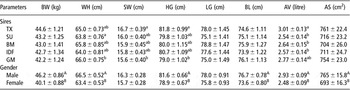
Table 1 shows the least squares means of body and abomasal measurements for the different genotypes and gender. No significant difference (P > 0.05) was observed in the body weight at 18 weeks of age (BW) of the crossbreds. There were no significant (P > 0.05) effects of genotype on LG, BL or abomasal surface area. GM lambs had higher (P < 0.05) WH than SU × GM crossbreds. Significant differences (P < 0.05) for SW and HG were found only between TX × GM and GM, whereas GM lambs had a narrower shoulder and smaller HG than TX × GM. TX × GM had significantly (P < 0.05) larger abomasal volume than SU × GM, BM × GM and IDF × GM. The abomasal volume of GM was not significantly different from those of the crossbreds (P > 0.05). Female lambs had lower BW and smaller body sizes when compared with males. Significant differences (P < 0.01) could be observed between male and female lambs for BW, WH, HG, BL, abomasal volume and abomasal surface area. Male lambs showed higher values in all measured body parameters, which is in agreement with previous reports (Afolayan et al., Reference Afolayan, Adeyinka and Lakpini2006; Sowande and Sobola, Reference Sowande and Sobola2008).
Least squares means (±s.e.) for body and abomasal measurements of lambs by gender and sires – TX, SU, BM, IDF and GM (BW at week 18 of age, WH, SW, HG, LG, BL AV and AS)

TX = Texel; SU = Suffolk; BM = German Blackhead Mutton; IDF = Ile de France; GM = German Merino; WH = wither height; SW = shoulder width; HG = heart girth; LG = loin girth; BL = body length; AV = abomasal volume; AS = abomasal surface.
a,bMeans within the same column with different superscripts are significantly different between the genotypes (P ⩽ 0.05).
A,BMeans within the same column with different superscripts are significantly different between male and female lambs (P ⩽ 0.01).
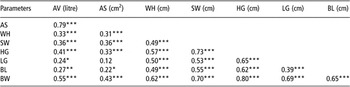
All body and abomasal measurements were highly (P < 0.001) correlated with live weight at 18 weeks of age (Table 2). Body traits exhibited positive correlations with each other (r = 0.39 to 0.80, P < 0.001). Similar findings were reported earlier (Fourie et al., Reference Fourie, Neser, Olivier and van der Westhuizen2002; Janssens and Vandepitte, Reference Janssens and Vandepitte2004). Live weight was highly correlated with HG (r = 0.80, P ⩽ 0.001). In previous studies, HG has already been suggested as the best indicator of BW (Fourie et al., Reference Fourie, Neser, Olivier and van der Westhuizen2002; Janssens and Vandepitte, Reference Janssens and Vandepitte2004; Sowande and Sobola, Reference Sowande and Sobola2008).
Phenotypic correlations among different parameters of body and abomasal measurements in lambs (AV, AS, WH, SW, HG, LG, BL and BW at week 18 of age)

AV = abomasal volume; AS = abomasal surface; WH = wither height; SW = shoulder width; HG = heart girth; LG = loin girth; BL = body length.
*P ⩽ 0.05; **P ⩽ 0.01; ***P ⩽ 0.001.
The correlation coefficients of abomasal volume and surface area with most body parameters were statistically significant (P ⩽ 0.05; Table 2). The values of these correlations were in most cases lower than the correlation coefficients among body measurement traits. That, to some extent, can be expected particularly during growth. In general, the growth of tissues and organs of the body is allometric or proportional to each other (Marple, Reference Marple2003). The body and abomasal size may not grow with the same rapidity or in the same ratio. According to Lyford (Reference Lyford1988), the proportion of abomasal weight to BW decreased from 6.3 g/kg in newborn lambs to 3.7 g/kg in adult animals. The correlations of LG with abomasal size were low and not significant in the case of abomasal surface area. The measure of LG is not dependent on skeletal dimensions. This may be a weakness of this measurement when compared with other body measurements. However, the strong correlations of LG with other body measurements support it as a reliable indicator for body size. Nevertheless, the reason why the LG did not significantly relate to the abomasal surface area cannot be explained. Abomasal size was highly correlated with BW. This supports the findings of earlier studies in cattle (Huber, Reference Huber1969; Clausen, Reference Clausen1999). The correlation between abomasal volume and abomasal surface area was 0.79 (P < 0.001). It may be that the variations in fold thickness, which affect the volume of abomasum, have an impact on the value of this parameter.
Parasitological parameters
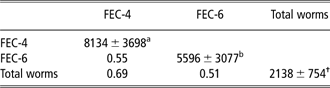
All lambs were free from helminths before infection, as confirmed by the nematode egg-free samples on the infection day. The total number of worms varied from 280 to 3505, with a mean of 2139 (±755). The worms’ sex ratio (female : male) was 0.91 : 1.0. High variation in worm burden among lambs was observed in this study, but such variations are generally not unexpected despite the lambs being experimentally infected. Previous studies have reported high variation among individuals following an experimental infection with H. contortus in lambs. Establishment rates of H. contortus ranged from 4% to 28% in 3-month-old lambs infected with 10 000 L3 (Lacroux et al., Reference Lacroux, Nguyen, Andreoletti, Prevot, Grisez, Bergeaud, Gruner, Brunel, Francoise, Dorchies and Jacquiet2006). Mean FEC-6 (5596 ± 3078) was lower (P < 0.05) when compared with mean FEC-4 (8134 ± 3698; Table 3). This observation agrees with those reported earlier in GM lambs (Gauly et al., Reference Gauly, Kraus, Vervelde, van Leeuwen and Erhardt2002). The peak of eggs excretion of H. contortus was observed in the 4th and 5th weeks post-infection in two different breeds (Shakya, Reference Shakya2007). Estimated correlations (P < 0.001) were positive among all parasitological parameters (Table 3). The correlation coefficient between FEC-4 and FEC-6 was 0.55. Correlations between the total number of worms and square root FECs were 0.69 and 0.51, respectively.
Mean (±s.d.) and phenotypic correlationsFootnote * among parasitological parameters after an experimental infection with 5000 Haemonchus contortus third larvae in lambs

FEC = faecal egg counts.
* All correlation coefficients are significant at P ⩽ 0.001.
a,b Denote significant difference (P ⩽ 0.05) between FECs at 4 and 6 weeks post-infection.
† Mean of establishment rate: 42.7 (±15.1).
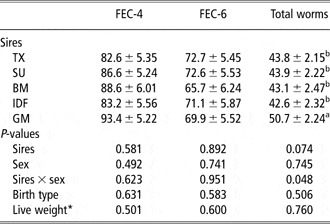
Effects of genotypes of lambs on FECs were generally insignificant, but the GM lambs seem to be more susceptible to infection with H. contortus when compared (P < 0.05) with other crossbreds (Table 4) according to worm burden comparison. Hielscher et al. (Reference Hielscher, Brandt, Erhardt and Gauly2006) reported that the crossbred lambs of Rhoen × GM are more resistant to H. contortus infection compared with purebreds and GM × Rhoen. Therefore, we can suggest that the crossbreeding of GM ewes with sires of other breeds produce lambs that are probably more resistant to nematode infections than GM. However, studies have shown that crossbreds could be sometimes relatively more resistant than the purebreds, especially the susceptible breed (Amarante et al., Reference Amarante, Craig, Ramsey, El-Sayed, Desouki and Bazer1999; Li et al., Reference Li, Miller and Franke2001). Type of birth and live weight at infection time as well as sex of lambs had no effect on any of the parasitological parameters (Table 4). Many studies have reported that male sheep are more susceptible than females to natural or experimental nematode infections around or after the age of puberty (Courtney et al., Reference Courtney, Parker, Mcclure and Herd1985; Barger, Reference Barger1993).
Effects of sires, sex, birth type and live weight at week 12 of age on transformed FEC-4; FEC-6 and worms burden after an experimental infection with 5000 Haemonchus contortus third larvae in lambs

FEC = faecal egg counts; TX = Texel; SU = Suffolk; BM = German Blackhead Mutton; IDF = Ile de France; GM = German Merino.
a,bMeans with different superscripts within a factor are significantly different at P < 0.05.
*Live weight at week 12 of age.
Relationship between morphometric and parasitological parameters
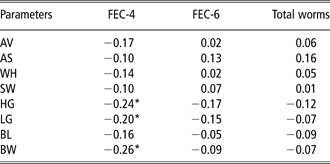
Pearson's correlation coefficients of FECs and worm counts with body and abomasal size measurements are presented in Table 5. The correlations between body measurements and parasitological parameters have been further weakened and are not reliably different from zero, except for the correlations between FEC-4 and LG, HG and BW at 18 weeks of age (P < 0.05). These negative relations might indicate anorexia, which is a common response to parasite infection (Kyriazakis et al., Reference Kyriazakis, Tolkamp and Hutchings1998). The second faecal samples (FEC-6) were collected at the same time when body dimensions were determined, and therefore FEC-6 and worm burden may give a more reliable statement about infection status to estimate the correlations with body measurement than FEC-4. However, the FEC-6 and worm burden do not show any significant relationship with body parameters. FEC at 4 weeks post-infection was higher than the corresponding value at 6 weeks post-infection, probably due to high worm recovery 4 weeks post-infection. This could also explain the differences in the relationships of FEC-4 and FEC-6 with body measurements, especially BW. However, these results were not in agreement with the results obtained in a study carried out by Coltman et al. (Reference Coltman, Pilkington, Kruuk, Wilson and Pemberton2001). The authors reported a negative correlation between hind leg length and FEC following natural infection in Soay sheep, which is a relatively ancient sheep breed and may differ from other more intensively selected breeds.
Phenotypic correlation coefficients of parasitological parameters with body and abomasal measurements traits in lambs (AV, AS, WH, SW, HG, LG, BL and BW at week 18 of age)

AV = abomasal volume; AS = abomasal surface; WH = wither height; SW = shoulder width; HG = heart girth; LG = loin girth; BL = body length; FEC = faecal egg count.
*P ⩽ 0.05.
As the abomasum is the host organ of H. contortus, the relationship between the size of the abomasum and parasitological parameters is more important than other relationships. To the best of our knowledge, this relationship was not previously detected in sheep. In this study, the size of the abomasum did not influence the establishment rate of H. contortus, where the abomasal volume and surface area, respectively, did not significantly correlate with worm counts (0.06 to 0.16; P > 0.05). In addition, the abomasal size did not significantly correlate with FECs at 4 and 6 weeks post-infection (−0.17 to 0.13; P > 0.05). The worm fecundity, as previously proved, is associated with the size of the adult worm (Rowe et al., Reference Rowe, McMaster, Emery and Sangster2008). Therefore, we can suggest that the size of worms was not relevant to the abomasal volume depending on the weak correlations of FEC with the volume and surface area of the abomasum. This indicates that Harrison's rule is not suitable to interpret the interaction between H. contortus and abomasal size.
In theoretical predictions, the size of the habitat can probably affect the establishment and productivity of parasites depending on food and space availability. Similarly, Morand et al. (Reference Morand, Hafner, Page and Reed2000) suggested that the size of parasites may be determined by some physical dimensions of the habitat. Thus, a positive relationship between the abomasal size and parasitological parameters of H. contortus should be expected, but the results of this study did not support this suggestion. The GM lambs had a high number of total worms, even though they did not differ significantly from crossbreds in abomasal volume and surface area. In addition, the TX crossbred lambs had a bigger abomasal volume in comparison with that in other crossbreds, where no significant differences in parasitological parameters could be observed among crossbreds. However, it may be possible that the different intensity of parasitic infections (e.g. increased worm burden) may change this outcome. Following an experimental infection with H. contortus, Yadav et al. (Reference Yadav, Grewal and Banerjee1993) reported a significant difference in abomasal volume between Hisardale lambs, which were more susceptible to infection, and Munjal lambs. The abomasal volume was higher in Hisardale lambs when compared with that in Munjal lambs. However, there was no clear evidence that the difference in abomasal volume affected the infection parameters, where the abomasal volume of control lambs was not compared between breeds and the relationship between infection parameters with the abomasal volume was also not estimated. The organ size is limited by the number and size of their cells (Conlon and Raff, Reference Conlon and Raff1999). Hence, the larger abomasum is constructed from larger or more cells in comparison with smaller ones that may affect the local response of host against infections, especially the cellular response. Furthermore, the parasites can change the environment of their organ host probably to create ideal conditions for their survival and reproduction; for example, the fecundity of H. contortus related to abomasal acidity and their optimum pH range from 4.0 to 4.5 (Honde and Bueno, Reference Honde and Bueno1982). Abomasal nematodes can decrease acid secretion and increase serum gastrin and pepsinogen concentrations in the abomasum (Simpson, Reference Simpson2000). However, it is not clear if the nematode at different levels of infection can similarly alter the environment of the different-sized abomasum. Therefore, the interaction between abomasal size and Haemonchus probably is more complicated than can be understood only by estimating a simple relationship. Additional research with histological and immunological investigation is therefore required.
Lo et al. (Reference Lo, Morand and Galzin1998) reported a positive relationship between host size and common endoparasite abundance in the digestive system of fish. The authors suggested that the larger fish consume more food and are more liable to infection. This suggestion is excluded from this study due to the experimental infection. Therefore, the result of this study should be applied cautiously under natural grazing conditions, where the body size can probably affect grazing behaviour or host dietary habits, which in turn can influence the intake of infective larvae.
Conclusion
The results indicate that there is no direct relationship between body size measurements and parasite infection in lambs of different genotypes, which were experimentally infected with H. contortus. Furthermore, the abomasal volume and surface area apparently do not indicate significant differences in the establishment or fecundity of H. contortus, which suggest that the size of the abomasum is not suitable to explain the variation in the susceptibility of lambs to Haemonchus infection
Acknowledgements
The authors would like to thank the German Research Foundation (Deutsche Forschungsgemeinschaft, DFG) for financial support (SFB 299).