Introduction
Dementia is a chronic debilitating condition that exacts a profound negative impact on patients and their caregivers, consequent to deteriorating intellectual and physical functioning (Feldman et al., Reference Feldman, Van Baelen, Kavanagh and Torfs2005). Enhancing and maintaining quality of life (QoL) in persons with dementia is thus a major priority in dementia care. Indeed, the International Working Group for Harmonization of Dementia Drug Guidelines and the Alzheimer's Society recommend that consideration be given to QoL from the perspectives of patients, family caregivers, and professionals when evaluating the efficacy and appropriateness of therapeutic interventions (Mack and Whitehouse, Reference Mack and Whitehouse2001). The growing emphasis on QoL as a treatment goal in dementia care necessitates its accurate assessment, to facilitate care providers in tailoring effective interventions to improve the well-being of persons with dementia.
QoL is generally accepted as a multi-dimensional construct extending beyond subjective perception to include objective domains such as behavior and functional abilities (Lawton, Reference Lawton1994). While there is still no consensus regarding the procedure for assessment of QoL in dementia, there is cumulative evidence that persons with mild-to-moderate dementia can reliably rate their own QoL (Brod et al., Reference Brod, Stewart, Sands and Walton1999; Logsdon et al., Reference Logsdon, Gibbons, McCurry and Teri2002). Patient-rated QOL emphasizes the individual's subjectively appraised experiences and has been lauded for respecting the autonomy of the person with dementia (Buckley et al., Reference Buckley2012). However, clinicians often become increasingly reliant on caregivers as the primary source of information with deteriorating cognitive function in patients. Unfortunately, significant discordance exists between patient- and caregiver-rated QoL, with tendency for underestimation when rated by caregivers (Logsdon et al., Reference Logsdon, Gibbons, McCurry and Teri2002; Conde-Sala et al., Reference Conde-Sala, Garre-Olmo, Turro-Garriga, Lopez-Pousa and Vilalta-Franch2009; Huang et al., Reference Huang, Chang, Tang, Chiu and Weng2009). This discrepancy has also been interpreted to reflect the unique and independent perspectives of QoL between persons with dementia and their caregivers (Naglie, Reference Naglie2007).
There is substantive literature reporting the separate perceptions of dementia patient's QoL, as rated by persons with dementia and their caregivers, with factors such as cognition, behavior, and functional ability having been variably associated with either patient or caregiver perspectives (Conde-Sala et al., Reference Conde-Sala, Garre-Olmo, Turro-Garriga, Lopez-Pousa and Vilalta-Franch2009; Hurt et al., Reference Hurt2010; Sousa et al., Reference Sousa2013). Recognizing the often poor correlations between patient and caregiver ratings, recent studies sought to explore predictors for the discrepancies between patient's and caregiver's perceptions of QoL, incorporating patient characteristics such as loss of insight into their impairment and behavioral disturbances, caregiver factors including perceived burden of care, as well as nature of the caregiver–patient relationship (Huang et al., Reference Huang, Chang, Tang, Chiu and Weng2009; Zhao et al., Reference Zhao2012; Conde-Sala et al., Reference Conde-Sala2014). However, these studies focused on magnitude of discrepancy and caregiver rating bias toward under-estimation, without differentiating between patients who systematically rate their QoL lower relative to their caregiver ratings from counterparts who rate their QoL higher than their caregivers. Addressing how, in addition to why patient and caregiver ratings of QoL may be disparate, will further guide clinicians in assessment of well-being of persons with dementia and inform clinical decision making.
The objectives of this study were to (i) identify predictors of discrepancy between patient- and caregiver-rated QoL amongst community-dwelling persons with mild-to-moderate dementia, and (ii) differentiate between patients who systematically rate their QoL lower versus those who rate their QoL higher relative to their caregiver ratings, exploring the factors predictive of a poorer self-perceived QoL.
Methods
Study population
We recruited 165 mild-to-moderate community-dwelling dementia patient–caregiver dyads attending the Memory Clinic in Tan Tock Seng Hospital, Singapore, from June 2011 to September 2012. We included patients aged ≥55 years who met Diagnostic and Statistical Manual of Mental Disorders, Fourth Edition (DSM-IV) criteria for dementia with a Clinical Dementia Rating (CDR) global score of >0 and ≤2, indicating the dementia to be of mild-to-moderate severity (Morris, Reference Morris1993; Lim et al., Reference Lim, Chin, Lam, Lim and Sahadevan2005). They had to be accompanied by a reliable caregiver or informant and be fluent in either English or Mandarin. The caregiver or informant had to be the primary caregiver of the patient and be ≥21 years of age. We excluded dementia patients with a CDR score of ≥3 (severe dementia) or 0 (no dementia) and patients with no reliable informant or caregiver. We also excluded patients with mild cognitive impairment and those living in an assisted living facility or nursing home. Patient–caregiver dyads fulfilling inclusion/exclusion criteria were invited to participate in the study by their attending geriatrician. Verbal assent to study participation was obtained from the patients, with written informed consent from the caregivers. Ethics approval was obtained from the National Healthcare Group Domain-Specific Review Board.
Measures
quality of life in alzheimer's disease scale
The dementia-specific QoL-AD (Logsdon et al., Reference Logsdon, Gibbons, McCurry and Teri2002), designed to be self-rated by the cognitively impaired person (QoL-ADp) and proxy-rated by a caregiver (QoL-ADc), was administered separately in interview format to both patient and caregiver. The 13 items in QoL-AD reflect multiple domains of subjective health, with each item being rated on a 4-point Likert scale: 1 = poor, 2 = fair, 3 = good, and 4 = excellent. An overall score was calculated separately for the patient and caregiver reports by summing the 13 items (range 13 to 52), with higher scores indicating higher QoL. We also computed a composite QoL score that took into account ratings by both patient and caregiver, but with higher weighting given to patient's rating (patient-rated QoL-AD is multiplied by 2 before being added to the caregiver-rated QoL-AD, and the sum is divided by 3; Zhao et al., Reference Zhao2012). Good reliability and validity of patient and caregiver reports on QoL-AD have been established (Logsdon et al., Reference Logsdon, Gibbons, McCurry and Teri2002).
correlates of QoL
Patient and caregiver socio-demographics:
We collected socio-demographic data including age, gender, ethnicity, and level of education of patients and caregivers. Information on caregiver employment status was routinely documented.
Inter-personal relationship:
Indicators of inter-personal relationship included nature of caregiver's relationship with the patient, level of caregiver's contribution to patient's care and caregiver's living arrangement with the patient.
Disease-related scales:
Cognitive status was assessed using the Chinese Mini-Mental State Examination (CMMSE, range 0 to 28; Sahadevan et al., Reference Sahadevan, Tan and Chan2000). Functional ability was evaluated on the Bristol Activities of Daily Living Scale (Bristol ADL), a carer-rated instrument consisting of 20 daily-living abilities (range 0 to 60, higher scores indicating greater dependency; Bucks et al., Reference Bucks, Ashworth, Wilcock and Siegfried1996). Psychological and behavioral evaluation was performed via the Cornell Scale for Depression in Dementia (CSDD; Alexopoulos et al., Reference Alexopoulos, Abrams, Young and Shamoian1988), as well as the 12-item informant-based Neuropsychiatric Inventory Questionnaire (NPI-Q; Kaufer et al., Reference Kaufer2000), which assessed symptom severity (summated to yield a total NPI-Q severity score, ranging from 0 to 36) as well as caregiver distress associated with each symptom manifestation (total NPI-Q distress score ranging from 0 to 60). We used the CDR, a structured clinician rating, to determine dementia severity. A trained assessor administered the different scales and questionnaires used.
Caregiver burden was assessed using the Zarit Burden Interview (ZBI) (Zarit et al., Reference Zarit, Reever and Bach-Peterson1980). To further explore the different domains of caregiver burden that may impact on QoL, we used four subscales of the ZBI as identified in our previous study (Cheah et al., Reference Cheah, Han, Chong, Anthony and Lim2012): factor 1 – demands of care and societal impact on caregiver (role strain); factor 2 – confidence or control over the situation (role strain); factor 3 – psychological impact on caregiver (personal strain); factor 4 – worry about caregiving performance.
Statistical analysis:
Descriptive data are presented as means (±SD) for quantitative variables and as absolute and relative frequencies for qualitative variables. The internal consistency reliability of patient and caregiver ratings of QoL-AD was established using Cronbach's α.
Agreement between patient-rated and caregiver-rated QoL-AD scores was examined for both consistency and absolute agreement, using a two-way mixed model, single-measure intraclass correlation coefficient (ICC). Student t-test for paired data was used to evaluate the difference between QoL-ADp and QoL-ADc scores. Discrepancy score for each patient–caregiver dyad was calculated by subtracting caregiver-rated QoL from the respective patient-rated QoL (discrepancy score greater than zero indicating that QoL was under-estimated by caregiver relative to patient rating). To identify predictors of discrepancy between patient- and caregiver-rated QoL, the discrepancy score was entered as the dependent variable in generalized linear regression analyses. The predictor variables examined included patient and caregiver demographics (age, gender, education), disease-related characteristics (cognitive performance, dementia severity, behavioral and psychological symptoms (NPI-Q total severity score and CSDD), Bristol ADL, and caregiver burden), and inter-personal relationship (patient–caregiver relationship and caregiver's level of contribution to patient's care). Predictors with a significance level <0.10 in univariate analyses were included in the multiple linear regression model, with the final model adjusted for both patient and caregiver age and gender.
Finally, we categorized patient–caregiver dyads based on how patient-rated QoL compared against their respective caregiver ratings, comparing dyads with poorer self-perceived QoL (QoL-ADp < QoL-ADc) versus dyads with more positive self-perceived QoL (QoL-ADp > QoL-ADc) in demographic variables, disease-related characteristics, and inter-personal relationship. We performed multiple logistic regression using variables with p < 0.10 in univariate analyses with adjustment for patient and caregiver age and gender, to determine factors for patient's poorer self-perceived QoL relative to their caregiver's rating.
Statistical analyses were performed using the SPSS software (version 19.0). All statistical tests were two-tailed, with p value ≤0.05 considered statistically significant.
Results
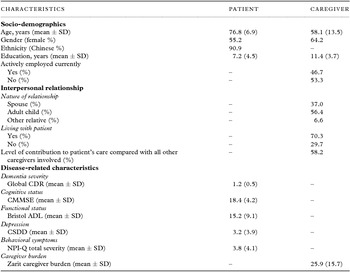
Socio-demographic and disease-related characteristics (Table 1)
Characteristics of 165 patient–caregiver dyads

CMMSE = Chinese Mini-Mental State Examination; CDR = Clinical Dementia Rating; CSDD = Cornell scale for depression in dementia; Bristol ADL = Bristol Activities of Daily Living scale; NPI-Q = Neuropsychiatric Inventory Questionnaire.
165 dementia patient–caregiver dyads were studied. All patients were able to rate their own QoL-AD. The mean age of patients was 76.8 ± 6.9 years, approximately half (55.2%) were women, and majority (95.2%) were living with their spouses and/or children. 127 patients had mild dementia (CDR: 0.5–1) and 38 had moderate dementia (CDR: 2). Mean CMMSE score of the patient cohort was 18.4 ± 4.2 and mean Bristol ADL score was 15.2 ± 9.1. The mean total NPI-Q severity score was 3.8 ± 4.1. 26 patient–caregiver dyads declined study participation. There was no difference in patient age, gender, and CMMSE between participating and non-participating dyads.
Caregivers were predominantly women (64.2%), middle-aged (mean age: 58.1 ± 13.5 years), and spouse (37.0%) or adult child (56.4%) of the person with dementia. 116 caregivers (70.3%) were living with the patient, and average contribution to patient care by the primary caregiver compared with other informal carers involved was 58.2%. Mean Zarit burden score was 25.9 ± 15.7.
Reliability and agreement between patient- and caregiver-rated QoL-AD
The internal consistency of patient and caregiver reports on QoL-AD was good (Cronbach's α = 0.85 and 0.81, respectively).
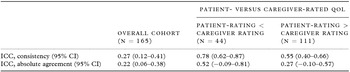
There was poor overall agreement between patient- and caregiver-rated QoL-AD, with low ICC values in both absolute agreement (ICC = 0.22, 95% CI = 0.06–0.38) and consistency (ICC = 0.27, 95% CI = 0.12–0.41).
Only ten (6.1%) patient–caregiver dyads achieved equivalent QoL ratings (QoL-ADp = QoL-ADc). Patient-rated QoL was lower than the rating provided by the caregiver (QoL-ADp < QoL-ADc) in 44 (26.7%) dyads, and higher than caregiver-rated QoL (QoL-ADp > QoL-ADc) in 111 (67.2%) dyads. In subgroup analysis, there were moderate-to-good consistency, but moderate-to-poor absolute agreement between patient and proxy ratings (ICC, consistency = 0.78, 95% CI = 0.62–0.87 for QoL-ADp < QoL-ADc dyads; ICC, consistency = 0.55, 95% CI = 0.40–0.66 for QoL-ADp > QoL-ADc dyads (Table 2)).
Agreement between patient and caregiver perceptions of QoL

QoL = quality of life; ICC = intraclass correlation coefficient.
Predictors of discrepancy between patient and caregiver-rated QoL
Mean patient-rated QoL-AD was 34.3 ± 6.5 and mean caregiver-rated QoL-AD was 30.4 ± 5.3. Patient-rated QoL was significantly higher than caregivers’ ratings, with mean difference between patient- and caregiver-rated QoL-AD being 3.8 ± 7.1 (df = 164, t = 6.96, p < 0.001).
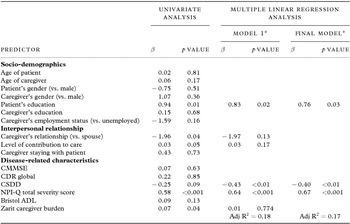
Predictor variables associated with discrepancy in QoL ratings between patient and caregiver are displayed in Table 3. We included patient educational level, caregiver's relationship with patient, caregiver's level of contribution to patient care, CSDD, total NPI-Q severity, and Zarit caregiver burden as predictors in multiple linear regression analysis as these factors had a univariate p value <0.10. Discrepancy between patient- and caregiver-rated QoL was significantly predicted by patient educational level (β = 0.76, p = 0.03), CSDD (β = –0.40, p < 0.01), and total NPI-Q severity (β = 0.67, p < 0.001) in the multiple regression model. The final model including patient educational level, depressive and neuropsychiatric symptoms, and adjusted for both patient and caregiver demographics, accounted for 17% of the variance in discrepancy between patient and caregiver ratings.
Predictors of discrepancy between patient- and caregiver-rated QoL-AD (n = 165)

aAdjusted for patient and caregiver age and gender, as well as variables with univariate p < 0.10.
CMMSE = Chinese Mini-Mental State Examination; CDR = Clinical Dementia Rating; CSDD = Cornell scale for depression in dementia; NPI-Q = Neuropsychiatric Inventory Questionnaire; Bristol ADL = Bristol Activities of Daily Living Scale.
Dyads with poorer self-perceived QoL versus dyads with more positive self-perceived QoL
This analysis excluded ten patient–caregiver dyads with equivalent QoL ratings (QoL-ADp = QoL-ADc).
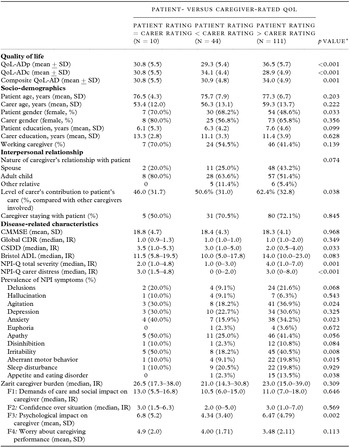
Dyads with poorer self-perceived QoL scored significantly lower in QoL-ADp and significantly higher in QoL-ADc compared with dyads with more positive self-perceived QoL. Composite QoL-AD score was also significantly lower in dyads with poorer self-perceived QoL (30.9 ± 4.8 vs. 34.0 ± 4.9, p = 0.001; Table 4).
Comparison between dyads with poorer versus more positive self-perceived QoL

*Comparing patient rating < carer rating versus patient rating > carer rating.
CMMSE = Chinese Mini-Mental State Examination; CDR = Clinical Dementia Rating; CSDD = Cornell scale for depression in dementia; Bristol ADL = Bristol Activities of Daily Living Scale; NPI-Q = Neuropsychiatric Inventory Questionnaire; F1 = factor 1: demands of care and societal impact on caregiver (role strain); F2 = factor 2: confidence or control over the situation (role strain); F3 = factor 3: psychological impact on caregiver (personal strain); F4 = factor 4: worry about caregiving performance; QoL-ADp = QoL-AD self-rated by patient; QoL-ADc = QoL-AD proxy-rated by caregiver; IR = interquartile range.
There were more female patients (p = 0.033), a lower level of caregiver contribution (50.6 ± 31.0% vs. 62.4 ± 32.8%, p = 0.038), and trend of being cared for by a non-spouse caregiver (p = 0.074) in dyads with poorer self-perceived QoL. Greater patient depression but less severe neuropsychiatric symptoms was associated with poorer self-perceived QoL. Agitation, anxiety, irritability, aberrant motor behavior, and appetite disorder were the individual neuropsychiatric symptoms that were significantly less prevalent with poorer self-perceived QoL.
Global caregiver burden on ZBI was similar but psychological impact on caregiver (reflecting personal strain) was significantly lower in dyads with poorer self-perceived QoL (Table 4).
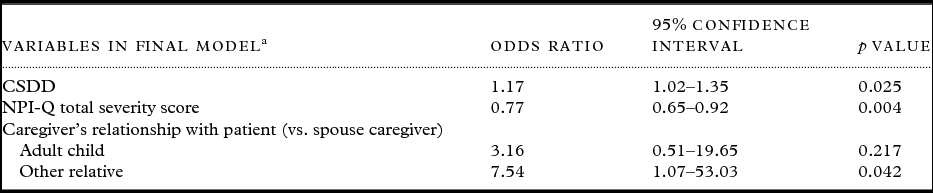
In multiple logistic regression adjusting for patient and caregiver age and gender, as well as variables with univariate p < 0.10 (nature of relationship, level of caregiver contribution, patient educational level, Bristol ADL, CSDD, NPI-Q severity, and personal strain domain of ZBI), poorer self-perceived QoL was significantly predicted by patient depression, severity of neuropsychiatric symptoms, and nature of relationship between patient and caregiver (Table 5).
Multiple logistic regression for poorer self-perceived QoL (n = 155; 44 dyads with poorer self-perceived QoL)

aAdjusted for patient and caregiver age and gender, patient educational level, level of caregiver's contribution to patient's care, Bristol ADL, and psychological impact subscale of Zarit caregiver burden.
CSDD = Cornell scale for depression in dementia; NPI-Q = Neuropsychiatric Inventory Questionnaire.
Discussion
Our study adds to the growing body of literature supporting different perceptions by patients and their caregivers towards QoL for persons with mild-to-moderate dementia. Although there was a tendency for over-estimation of QoL by patients, with mean patient-rated QoL significantly higher than caregiver rating, 26.7% of patients had rated their QoL worse than their caregivers had perceived. By focusing on separate groups of patients with poorer verus more positive self-perceived QoL (relative to their caregivers’ ratings), this study furthers current understanding of the sources of discrepancy between patient and caregiver perspectives of QoL, which is vital given the anticipated reliance on caregiver ratings in persons with severe dementia who are unable to self-assess their own QoL.
When patient–caregiver dyads were dichotomized according to poorer versus more positive self-perceived QoL, we found improved agreement between self- and caregiver-rated QoL, especially in dyads with poorer self-perceived QoL, supporting the need to differentiate between patients who systematically rate their QoL lower versus those who rate their QoL higher relative to their caregiver ratings.
While the association between educational level and patient-rated QoL had been previously observed among patients with dementia (Huang et al., Reference Huang, Chang, Tang, Chiu and Weng2009; Li et al., Reference Li2012), the influence of education on dyadic rating discrepancy has yet been reported. Educational level may serve as a surrogate of socio-economic status and access to available resources that facilitate adjustment of goals and expectations to positively impact on self-perceived QoL (Carr et al., Reference Carr, Gibson and Robinson2001), but caregivers who maintain their views on normal standards may assume the losses experienced by patients a source of distress, thereby contributing to discordance in perceived QoL of the person with dementia (Vogel et al., Reference Vogel, Mortensen, Hasselbalch, Andersen and Waldemar2006). Patients were more likely to have a worse perception of QoL than their caregivers with increasingly distant relationship shared with their caregiver, as indicated by the progressively higher odds of poorer self-perceived QoL when cared for by spouse, adult child, and other relative respectively, despite there being no difference in caregiver burden. Further, while 95.2% of patients were living with their spouse and/or children, the person they live with may not be the primary caregiver, evident by only 70.3% of caregivers sharing the same residence with the patient, although living arrangement did not influence dyadic rating discrepancy. The nature of relationship between patient and caregiver has been previously reported to influence both patient and caregiver perceptions of QoL (Conde-Sala et al., Reference Conde-Sala, Garre-Olmo, Turro-Garriga, Lopez-Pousa and Vilalta-Franch2009). Our findings further suggest that persons with dementia value the relationship shared with their caregivers.
Caregiver- but not patient-rated QoL has been influenced by neuropsychiatric symptoms (Karttunen et al., Reference Karttunen2011) and, with poorer insight of deficits in presence of neurospychiatric symptoms (Vogel et al., Reference Vogel, Waldorff and Waldemar2010), may explain the lower odds of poorer self-perceived QoL with higher NPI-Q severity score. Attention should be given to the symptoms of agitation, anxiety, irritability, aberrant motor behavior, and appetite disorder, as these were significantly more prevalent in dyads where caregivers rated QoL lower than patient self-ratings. The higher odds for poorer self-perceived QoL in depression supports earlier reports that patients with mild-to-moderate dementia preserve full insight into their mood (Matsui et al., Reference Matsui2006), reinforcing the importance of mood as an intervention target in persons with dementia.
Neither cognitive performance nor dementia severity was associated with dyadic rating discrepancy, supporting earlier suggestion that QoL and cognition may be independent constructs (Banerjee et al., Reference Banerjee2009), but further research into this complex relationship is warranted (Hurt et al., Reference Hurt2010). Contrary to earlier studies (Zhao et al., Reference Zhao2012; Pfeifer et al., Reference Pfeifer, Drobetz, Fankhauser, Mortby, Maercker and Forstmeier2013), caregiver burden (global and sub-domains) did not predict discordance between patient- and caregiver-rated QoL. The association of psychological stress domain of caregiver burden with negative caregiver QoL perceptions and patient QoL perception being influenced by feelings of guilt in caregivers (Conde-Sala et al., Reference Conde-Sala, Garre-Olmo, Turro-Garriga, Lopez-Pousa and Vilalta-Franch2009) justify further exploration of impact of different domains of caregiver burden on QoL.
Several limitations of this study are worth noting. We were unable to ascertain the potential influence of anosognosia (awareness of deficits) although dementia severity, known to be associated with worsening anosognosia (Kashiwa et al., Reference Kashiwa, Kitabayashi, Narumoto, Nakamura, Ueda and Fukui2005), was not associated with magnitude of discrepancy nor likelihood of poorer self-perceived QoL. We had focused on patient characteristics (cognition-related factors, depression, behavioral symptoms, and functional status) as contributors to dyadic rating discrepancy, with burden being the only caregiver characteristic examined. As QoL is a subjective state, its assessment may be influenced by the proxy's psychological well-being. The inclusion of broader domains of the caregiving experience, such as burden, depression, and the caregiver's own QoL, may offer greater insight into sources of dyadic rating discrepancy, as our current model explains only 17% of the observed discrepancy between patient- and caregiver-rated QoL. Finally, only 6.6% of the patients in our study cohort were cared for by other relative, and this small number is likely contributor to the wide confidence intervals observed in the logistic regression analyses.
In conclusion, improving QoL should be a goal in the management of persons with dementia. Persons with dementia, even at the moderately severe stage, can reliably rate their own QoL. The presence of dyadic rating discrepancy in QoL should draw the clinician's attention to patient depression and neuropsychiatric symptoms, which are potentially modifiable correlates and thus the emphasis of interventions seeking to optimize QoL in persons with dementia. While persons with dementia generally have a more positive perception of QoL than their caregivers, patients with poorer self-perceived QoL represent a group that warrant clinicians’ concern, given their lower composite QoL-AD score compared with their counterparts with more positive self-perceived QoL.
Conflict of interest
None.
Description of author's roles
L. Tay performed the statistical analysis and wrote the manuscript. M. S. Chong and K. C. Chua designed the study, supervised the data collection and contributed to writing the manuscript. W. S. Lim, M. Chan and Y. Y. Ang helped in patient recruitment and contributed to writing the manuscript. E. Koh contributed to writing the manuscript.
Acknowledgments
This study was funded by the National Healthcare Group (NHG) Small Innovative Grant 2011/005. L. Tay is supported by the NHG Clinician Scientist Career Scheme grant CSCS/13001. M. S. Chong is supported by the NHG Clinician Scientist Career Scheme grant 2012/12002.