Introduction
Every one seems to agree that the form of government in France, Portugal, and Ukraine is different from the form of government in Italy, Germany, and Denmark, on the one hand, and Brazil, the Philippines, and the United States, on the other hand. In Italy, Germany, and Denmark, the government is strictly subject to the confidence of a legislative majority in order to exist and the head of state exercises purely ceremonial functions. These countries have a parliamentary form of government. In Brazil, the Philippines, and the United States, the government does not need the confidence of a legislative majority in order to exist; once in place, the legislature plays no role in the survival of the government. In these countries, the government is only responsible to a popularly elected president. These are countries with a presidential form of government. In France, Portugal, and Ukraine, the government needs the confidence of a legislative majority in order to exist, but also depends on a directly elected president who serves for a fixed term. These systems are considered to be mixed in the sense that they combine the main features of parliamentary and presidential democracies: assembly and president responsibility.
Unfortunately, this definition of mixed systems is not sufficient to characterize satisfactorily the way in which they operate. When we qualify a democracy as ‘presidential’, we know we are talking about systems in which the government is headed by a directly elected president. Presidential democracies are different in many respects, including the way the president is elected (by a plurality of voters, by a system of two turns, by an electoral college, by the congress if no candidate obtains a majority of votes), the time they serve in office (most often four years, but occasionally five or six years), their ability to run for re-election (one re-election allowed, no re-election allowed, re-election allowed after one term out, and only very rarely unrestricted re-election), or the legislative powers the constitution grants them. But in all presidential democracies, the president, once chosen, is the head of the government, which, once formed, cannot be dismissed by the assembly. Similarly with parliamentary democracies. In some of them the head of state is a monarch and in others an indirectly elected president or an appointed administrator, in some the legislature must be renewed every four years and in others every three or five years, in some the government needs to be formally invested by the parliament and in others such an act is unnecessary, in some the government can itself invoke a motion of confidence and in others it cannot – but, in all of them, the government is subject to the confidence of a legislative majority, which, if lost, implies the dismissal of the government as a whole.
Mixed systems do not share such common features. On the one hand, we have systems like France where the president is an effective power in the process of government formation and dismissal, actively participates in governing, and is regarded as being at least partially responsible for policies and outcomes. The presidency is a desirable post, and is increasingly so, as attested by the competitiveness of presidential elections in that country. On the other hand, we have systems such as Iceland – where presidential elections are often uncontested and the directly elected president is commonly perceived as ‘a figurehead and symbol of unity rather than a political leader’ (Kristinsson, Reference Kristinsson and Elgie1999: 87)Footnote 1 – and Finland – where even before the 2000 constitution that codified a more ceremonial role for the president, the system had functioned like a parliamentary democracy (Raunio, Reference Raunio2004). Identifying a democratic constitution as mixed does not really convey the way the system operates. We need more information to know if it is a system in which the president really matters – that is whether the government is effectively dependent on the president in order to exist – or if, although constitutionally allowed to influence the existence of the government, the president plays a more ceremonial, symbolic role. Thus, although all mixed systems have constitutions that combine a directly elected president with a government that needs the confidence of the parliament in order to exist, not all of them have presidents who effectively participate in the political process and share governing responsibilities with the prime minister. Yet, such constitutional systems are supposed to matter for the way politics unfolds, for the government's capacity to govern, for the accountability of the government to its citizens, and even for the consolidation of democracy.
Our goal in this paper is to study the effect, if any, of mixed constitutions. We start by defining mixed constitutions and proceed to study the relationship between the form of government – mixed versus pure parliamentary constitutions – and government instability, government accountability with respect to economic outcomes, the government's legislative effectiveness, and the survival of democracy. Based on data for all democracies in which governments are based on assembly confidence between 1946 and 2006, we show that mixed constitutions are of little consequence for these outcomes. We then consider whether the way presidential powers are allocated in mixed constitutions matters for the effective importance of presidents in these systems. We conclude with some remarks about the reasons why a relatively large number of countries have been adopting popular presidential elections, even as they also require that governments obtain the confidence of a legislative majority in order to exist.
Parliamentary and mixed systems
We have argued elsewhere (along with virtually everyone else) that we can distinguish three types of democracies in terms of the way the executive is formed: presidential, parliamentary, and mixed (Cheibub, Reference Cheibub2007; Cheibub and Gandhi, Reference Cheibub and Gandhi2006). Here we want to retract that claim and say that, as far as the formation and survival of the government goes, there is one fundamental difference that defines two types of democratic regimes. The difference has to do with the role of the legislative assembly in the existence of the government and it distinguishes those systems in which the assembly cannot affect the survival of the government – called presidential – from those in which it can – called parliamentary.
Thus, the assembly confidence requirement is the key feature to distinguish forms of government in democratic systems. In presidential systems, the legislative assembly has no bearing on the existence (survival) of the government. In some it may have a say in the formation of the government such as in Switzerland where the assembly invests the government, or in Bolivia where it will elect the government if the popular vote fails to generate a majority winner, or in the United States where (parts of) the legislature has to approve cabinet-level appointments. It may also be the case that the assembly can remove individual members of the government, as in Peru. However, in all of these cases, once formed, the government – or its head as defined by the constitution – cannot be removed by any act of the assembly.Footnote 2
A lot has been written about presidential constitutions and here we want to leave them aside. In this paper we focus exclusively on the systems in which the constitution requires that the government elicit the confidence of a legislative majority in order to exist. One particular variety of this kind of system has become popular in recent times: systems that combine government responsibility to the assembly with a popularly elected president. Such systems are said to be distinct since they specify a mixed or dual executive, wherein there is a division of responsibility between the president – the head of state – and the prime minister – the head of the government. This is different from systems in which the president (or some other head of state, such as the monarch or the governor-general) plays a merely formal role in politics. The uniqueness of mixed constitutions, therefore, is supposed to come from the fact that it combines a directly elected president with an assembly dependent government, which is supposed to confer governing capacity to both the head of state and the head of government; in these systems they have to share governing responsibilities, which may lead to conflict between the two.
But does it matter? And can we account for the actual behavior of actors on the basis of the constitutional provisions? Among the several claims that are made about these systems, there are two that stand out: that they operate according to the design of constitutional framers, that is that they operate in accordance with their specific constitutional provisions; and that this design has consequences, either directly or in interaction with other characteristics of a country's polity, for the performance of the system. These are the questions we want to address here and to do so we need an operational definition of mixed systems that does not pre-judge the answers. For this reason, we follow Elgie (Reference Elgie and Elgie1999: 13; see also Reference Elgie2004) and define mixed systems as those ‘where a popularly elected, fixed-term president exists alongside a prime minister and cabinet who are responsible to parliament’ and do not include in the definition of these systems anything about the powers of the president being ‘quite considerable’ (Duverger, Reference Duverger1980: 66; Shugart and Carey, Reference Shugart and Carey1992) or ‘substantial’ (O'Neil, Reference O'Neil1993: 197, footnote 4).
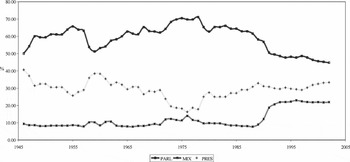
Constitutions with these two characteristics – assembly confidence and popular election of the president – have become popular lately among newly democratizing countries: 22% of the 114 democracies that existed in 2002 were mixed, versus 45% that were parliamentary and 33% that were presidential. Although still the least frequent type of constitution among democratic systems, the number of mixed systems in 2002 stands in sharp contrast with that number in 1946, when only three countries – Austria, Finland, and Iceland – out of 32 with a democratic form of government had a mixed constitution. In relative terms, the expansion of mixed systems took place at the expense of both parliamentary and presidential democracies; the increase in the number of mixed democracies by 13 percentage points implied a reduction of five and eight percentage points in the number of parliamentary and presidential democracies, respectively Figure 1.
Distribution of Forms of Government Among Democracies, 1946–2002.

Mixed systems were then to become more widely adopted. The first addition to the three systems in existence in 1946 came when France, in 1958, adopted De Gaulle's constitution. There were short-lived experiences in Brazil (1961–63) and Pakistan (1972–77); Portugal, which democratized in 1976, adopted a mixed system that remains in place to this date. The steady increase in the absolute and relative number of countries with mixed constitutions started with the 1989 transition to democracy in Poland. Between 1990 and 1992, mixed constitutions were adopted in Bulgaria, Cape Verde, the Central African Republic, the Comoros Islands, the Congo, Lithuania, Macedonia, Madagascar, Mali, Mongolia, Niger, Romania, Russia, São Tomé e Príncipe, Slovenia, and Ukraine. Some of these regimes (e.g., Congo, Comoros Islands and Niger) have collapsed since they were first adopted, but the proportion of mixed democracies among the set of democracies was about the same in 2002 as it was in 1992.
The amount of scholarly attention paid to mixed democracies has followed a similar pattern, with a flurry of recent studies that seek to understand whether the government's responsibility to both the president and the assembly is a curse or a blessing, with, to no one's surprise, positions varying considerably from one scholar to another. Here we enter the fray by arguing that, in the end, it does not really matter, at least to a number of important outcomes.
Outcomes
Government stability
Are mixed systems more unstable than parliamentary ones? The answer to this question has been invariably positive, with blame lying squarely on the constitutional design itself: dual legitimacy, shared power, ambiguity about who is the decisive actor, and the opportunities for conflict that they provide – all translate into governments that do not last very long in power.
There is a large literature that focuses on the duration of cabinets in parliamentary democracies (reviewed in Laver, Reference Laver2002). Only a few studies, notably Roper (Reference Roper2002), have studied the duration of cabinets in systems that combine assembly confidence and a directly elected president. Cabinets in these systems, as we know, can be removed from office in the middle of the legislative term and they are unstable in the extent to which this happens. Thus, countries where cabinets serve the length of the legislative term are said to be more stable than countries where cabinets change in the middle of the legislative term.Footnote 3
Here we do not focus on the formal survival of the cabinet since, in our view, this is not the most relevant measure of government stability. True, a system such as the one in post-war Italy, where cabinets were frequently brought down by votes of no-confidence, is more unstable than a system such as the one in England, where cabinets often serve their full term and are only rarely brought down by a vote of no-confidence. Yet, it is also true that once we scratch the surface of Italian governments we find a remarkable degree of stability in the system, which is reflected in the fact that prime ministers, parties, and coalitions remain in power over a succession of formal governments (Mershon, Reference Mershon1996). Moreover, the end of a government due to the occurrence of an election can be hardly conceived as a sign of instability.
Here we focus on two measures of government stability: the tenure of the individual head of government and the party of the head of government (the prime minister). In the first case, the event is defined by the change of prime minister, whereas, in the second, it is defined by the change in the party of the prime minister. There are two other measures of government stability that we are not able to use at this point due to lack of data. The first one disregards minor changes in the partisan composition of the government and consequently considers that a change of government occurs only when the main coalition member changes. This is a strong version of the alternation measure that we use in this paper. The second measure focuses on ministerial turnover.
Caretaker governments are included in our analysis, but they do not always constitute an event. A caretaker government will be counted as a new government only if it is headed by a new prime minister or if it is composed by parties that are different from the ones that composed the regular government. We understand that caretaker governments have a reduced or limited mandate. But if incumbency has advantages (or disadvantages), caretaker governments should enjoy (or suffer) them, at least in part. Many governments assume a caretaker status after they resign, remain in office relatively unchanged, and then resume their original status as a regular government. If this sequence of events – regular government to caretaker to regular government – all took place under the same prime minister or the same party, we do not consider that a change has occurred.
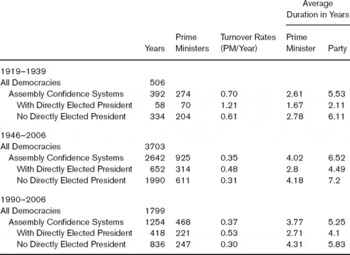
Table 1 presents prime minister turnover rates in assembly confidence systems for different time periods. In general, instability was higher in the inter-war period, when assembly confidence systems experienced a new prime minister every 1.4 years (about 17 months), than in the post-war period, when a new prime minister would come to power every 2.9 years (about 35 months). Mixed systems, however, have always experienced higher turnover rates: one about every ten months in the inter-war period, and one about every two years in the post-war period. The tenure of parties was also shorter in the inter-war than in the post-war period, as well as in mixed than in parliamentary systems, regardless of period. In the inter-war period, parties held the position of prime minister for four and a half years in mixed systems and for over seven years in parliamentary systems. Table 1 also reports the turnover rates and average duration for the 1990–2006 period, when many countries adopted mixed constitutions. As can be seen, there was a slight overall increase in instability, but no significant increase in the instability of mixed systems relative to parliamentary systems.
Turnover and Average Duration of Prime Ministers in Assembly Confidence Systems

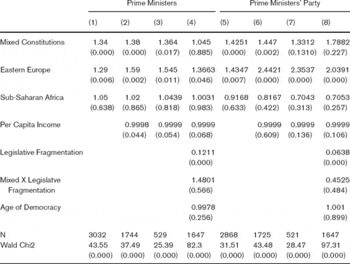
Table 2 presents the results of survival models in which we estimate the impact of directly elected presidents on the survival of prime ministers and their parties in assembly confidence systems. We find that, after controlling for location (Eastern Europe and Sub-Saharan Africa) and per capita income, prime ministers and their parties have shorter tenures in systems with mixed constitutions than in pure parliamentary regimes.
Duration of Prime Ministers and Their Parties in Office, Assembly Confidence Systems (Cox Proportional Hazard Model)

Models 1 and 5:1919–2006
Models 2, 4, 6 and 7: Post-1946
Models 3 and 7: Post-1989
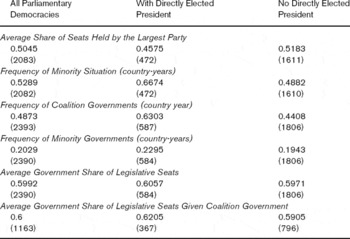
But this is not the end of the story. Examine Table 3, where we present information on legislative fragmentation, minority situation, coalition and minority governments, and the share of legislative seats held by the government in both parliamentary and mixed systems for the 1946–2006 period. As we can see, mixed systems tend to have more fragmented legislatures; on average the largest party holds 46% of the seats in mixed systems, against 52% in parliamentary systems. Thus, the typical parliamentary democracy has a majoritarian party, whereas the typical mixed democracy has no party with a majority of seats.
Legislative Fragmentation and Government Legislative Situation in Parliamentary Democracies (1946–2006)

This should come as no surprise when we consider that few mixed democracies adopt majoritarian, first-past-the-post electoral systems. As a matter of fact, in our sample, only Madagascar had both a mixed constitution and a majoritarian electoral system. In turn, 21 countries in the sample, representing 31% of the observations in parliamentary systems, adopted a first-past-the-post electoral system. Thus, the type of electoral system in democracies that adopt a mixed constitution leads to a relatively high degree of legislative fragmentation, which in turn leads to a higher frequency of minority situations in these systems. We observe legislatures with no majority party in about two-thirds of the years of mixed democracies, whereas the same is true for less than half of the time in parliamentary democracies. The pressures for coalition formation, therefore, are stronger in mixed democracies and, indeed, we find that coalition governments exist 64% of the time in mixed systems, against 44% in parliamentary systems. Nothing else seems to differentiate the two systems: they are relatively similar in the frequency with which they experience minority governments (23% in mixed and 19% in parliamentary), and in the average share of seats held by governments, both in general (61% versus 60%) and when the government is composed of multiple parties (62% versus 59%). Thus, the differences between the two types of assembly confidence systems seem to be their degree of legislative fragmentation and the way they respond to this fragmentation: legislative fragmentation is higher in assembly confidence systems with a directly elected president and, accordingly, they more frequently form coalition governments.
Coalition governments, in turn, are more unstable than single-party governments (Lijphart, Reference Lijphart1999; Laver and Schofield, Reference Laver and Schofield1998; Dodd, Reference Dodd1974; Warwick, Reference Warwick1994). Parties come and go into the government in systems where multiparty coalitions are the norm or are needed more, and, in this way, governments are often undone. The question, therefore, arises as to whether the higher turnover rates of prime ministers and their parties observed in mixed systems are caused by the fact that they disproportionately have coalition governments. It is reasonable to suppose, moreover, that the instability generated by legislative fragmentation and coalition governments would be compounded in a mixed system given the potential for conflict between the president and the prime minister.
Mixed democracies are also younger than their parliamentary counterparts (a topic to which we return below). In 2006, the average age of democracies that had a parliamentary constitution was 47 years whereas that of those with mixed constitutions was 25 years. Moreover, as noted by others (Pugačiauskas, Reference Pugačiauskas1999; Baylis, Reference Baylis1996; Protsyk, Reference Protsyk2006), mixed constitutions have been adopted by many transitional countries that are struggling to establish their democratic systems. Government instability in these countries, therefore, can be attributed to either the circumstances surrounding the transition itself or the newness of the democracy.Footnote 4 The results in Table 2 (further discussed in the analyses below) already indicate that the transitional effect, plausibly captured by the variable indicating location in Easter Europe, does increase turnover of both prime ministers and their parties.
Thus, there are two competing hypotheses about higher turnover rates in mixed systems. One about the presence of a directly elected president, which provides opportunities for conflict and, consequently, higher turnover rates of leaders and parties. The other that argues that instability of democracies that adopt a mixed constitution has more to do with contextual factors: the type of electoral system they adopt (and the legislative fragmentation that it generates) and the fact that they are relatively new regimes often observed in transitional countries. Models 4 and 8 in Table 2 present the results of a proportional hazards model estimation with duration of prime ministers and their parties as the dependent variable, respectively. As can be verified, the independent effect of mixed constitutions on the duration in office of prime ministers and their parties completely disappears once we control for the age of the democratic regime, legislative fragmentation (as measured by the share of seats held by the largest party), and the interaction of legislative fragmentation and mixed constitutions. The coefficient of the legislative fragmentation variable alone indicates that in parliamentary systems it increases rather than decreases the duration of leaders and their parties in office. As before, per capita income has a minor impact on the survival of leaders and of parties, being in Africa makes no difference, and being in Eastern Europe increases instability. It seems, thus, that the relative instability of prime ministers and their parties in mixed constitutions is more an effect of their electoral systems, which lead to higher levels of legislative fragmentation and frequent coalition governments, than of the constitutional framework itself. Footnote 5
Accountability to economic outcomes
We define accountability as the sensitivity of the head of government's survival in office to economic outcomes (Cheibub and Przeworski, Reference Cheibub, Przeworski, Przeworski, Stokes and Manin1999). A system is said to be more accountable if the probability that the head of the government will remain in office declines as economic outcomes deteriorate. This, of course, is not the only possible way to operationalize accountability, but it conforms to our common sense notion of what it means for democratic governments to be accountable for their actions, that is that their chances of being removed from office will increase if outcomes the voters care about are negative. One of the advantages of this way of operationalizing accountability over what we commonly find in the cross-national literature – changes in votes for the incumbents – is that it measures what matters – the ability of incumbents to remain in power – directly.Footnote 6
We focus on prime ministers in both pure parliamentary and mixed systems since it is the prime minister who heads the government and is, hence, responsible for economic policy. In mixed systems, however, this responsibility may be, willingly or unwillingly, shared with a president, thus giving prime ministers an opportunity to avoid or shift responsibilities for negative economic outcomes. Hence, accountability in the sense defined here could be weaker in mixed than in pure parliamentary systems due to the possibility that voters will not be able to assign responsibility for the economic outcomes they observe.Footnote 7
In order to study the differences in accountability in mixed and parliamentary systems, we estimate two types of models: a logit model in which the dependent variable is dichotomous and is coded 1 for the years in which there is a change of prime ministers, and a survival model, which estimates the impact of specific factors on the likelihood that a prime minister will be removed from office at time t, given that the prime minister has been in office at time t–1. If there is no time-dependence in the survival of prime ministers in office, the two models should yield very similar estimates.
The three economic outcomes we consider here are the rate of growth of real GDP, budget balances, and inflation rates.Footnote 8 The expectation is that as growth declines and inflation increases, the probability that a prime minister will remain in office falls. The expectation regarding budget balances is not clear ex ante. Research on political budget cycles – evidence for which seems to be rather strong for all democracies (Alt and Lassen, Reference Alt and Dreyer Lassen2006) but particularly for new democracies (Brender and Drazen, Reference Brender and Drazen2005) – suggests that higher budget deficits should be positively correlated with the survival of incumbents in office. However, budget deficits may be unsustainable and consequently may be associated with negative economic conditions. Since the argument we are considering is that the impact of economic outcomes on the survival of prime ministers in office may be attenuated in mixed systems (due to the presence of a directly elected president), all models should include a term that interacts the mixed system indicators with the economic variables. Alternatively, we can estimate the effect of economic outcomes on the survival of prime ministers separately for the two regimes.
We estimated a series of proportional hazard survival models, taking one economic outcome at a time. As in the previous section, all models control for the level of economic development (real per capita income), for the age of the democratic regime, and for the location of the country in Eastern Europe or Sub-Saharan Africa. Additionally, we also control for the occurrence of elections since they are one of the main mechanisms, though not the only as Cheibub and Przeworski (Reference Cheibub, Przeworski, Przeworski, Stokes and Manin1999) have demonstrated, for removing incumbents in democratic regimes. The results are not entirely encouraging and rather than presenting results for nine models,Footnote 9 here we will simply summarize the inferences they allow us to make. Essentially, we find that economic outcomes (with the exception of economic growth) have an effect on the survival of prime ministers in parliamentary regimes, but that the magnitude of this effect is close to non-existent: all estimated hazard rates associated with economic outcomes are around 0.999 (for budget balances and economic growth) and 1.01 (for inflation).
The hold prime ministers have on office in mixed systems, in turn, is completely immune to economic outcomes; none of the coefficients associated with them was remotely close to acceptable levels of statistical significance. We even controlled for situations of cohabitation, that is those in which the president and the prime minister are from different political parties. If it is true that the institutional set up of mixed systems blurs voters' ability to assign responsibility for economic outcomes, this should be even more true when the head of the government and the head of the state come from different parties.Footnote 10 Yet, this makes no difference; in no case of mixed systems do economic outcomes matter for the survival of prime ministers in office. Thus, in both parliamentary and mixed systems, the effect of economic outcomes on the survival of prime ministers in office is either non-existent or so small as to make it virtually irrelevant. For this reason, we conclude that parliamentary and mixed systems do not really differ in terms of accountability of the government with respect to economic outcomes; the probability that the head of the government will remain in office is not affected in any significant way by economic outcomes in either system.
Legislative effectiveness
This is an area about which there is a lot said, but little is based on systematic study of cross-national data, which is mostly due to a dearth of adequate data. By legislative effectiveness we mean the proportion of government initiated/sponsored projects that become law. This is what Saiegh (Reference Saiegh, Sebastian2004) calls the government's ‘batting average’, and is defined as the ratio between the number of executive proposals approved and the number of executive proposals introduced in the lower house of the national legislature.
Given the available data, it seems that governments in mixed systems are not any less effective than governments in parliamentary systems. Coefficients for the type of democratic systems are never significant, even after controls are introduced. It could be the case that it is not the regime per se, but the interaction between the type of constitution and the political conditions under which the government exists that matters for the government's effectiveness (Skach, Reference Skach2005). Thus, the combination of a mixed constitution with governments that control a legislative majority would not be any less effective than governments in a parliamentary system. In turn, mixed constitutions with minority governments would essentially spell disaster since governments would be incapable of securing legislative approval for its program.
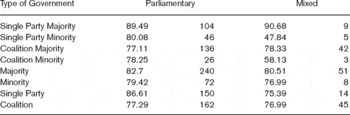
Unfortunately the data on legislative effectiveness are too sparse for this argument to be subject to rigorous empirical testing (below, however, we will address it with respect to the survival of democracy). Table 4 summarizes the available data on the government's legislative effectiveness as a function of government status. As we can see, single-party majority governments do best in both parliamentary and mixed systems. In parliamentary systems, single-party minority governments are slightly more effective in getting their legislative agenda approved than coalition majority and coalition minority governments. The difference is not large and will probably disappear once other factors are controlled for; but what matters is that single-party minority governments, coalition majority governments, and coalition minority governments are probably equally effective in parliamentary systems. Regarding mixed systems, the data in Table 4 suggest that the coalition effect, as in parliamentary systems, is virtually non-existent, but that minority governments do poorly when it comes to their legislative effectiveness. Yet, inferences on the basis of these data are highly risky; there are just eight years of minority governments in mixed systems with valid data on legislative effectiveness: Poland in 1991 and Portugal in 1976–77, 1985–86, and 1995–97. It is too little for a conclusion to be reached.
Government Legislative Effectiveness in Parliamentary and Mixed Systems by Coalition and Majority Status of the Government

Entries are the percentage of government sponsored laws approved in a year and the number of country-years.
There are theoretical arguments, however, which suggest that government effectiveness should not be any lower in mixed systems with single-party minority governments than in mixed systems with coalition majority governments, on the one hand, or pure parliamentary systems with minority governments, on the other hand. Governments in systems with assembly confidence – whether pure parliamentary or mixed – only exist to the extent that there is no legislative majority willing to replace them. Portfolio minority governments in these systems are always supported by legislative majorities. Consequently, whether the government is composed of one or more parties that together may or may not control more than 50% of legislative seats should not matter for the government's capacity to govern. This logic, as demonstrated elsewhere (Cheibub et al., Reference Cheibub, Przeworski and Saiegh2004), also extends to presidential systems, with results that are broadly similar: that minority governments are often supported by a legislative majority, which implies that the government's legislative effectiveness should be at least as high as that of other types of government. Those who see danger in minority governments in general do so because they fail to distinguish between portfolio and legislative coalitions (Skatch, 2005; Mainwaring, Reference Mainwaring1993).
Democratic survival
Are democracies that adopt mixed systems more likely to die? Mixed systems are supposed to be inherently problematic, prone to conflicts between presidents and prime ministers and to legislative paralysis; crises abound which may, eventually, lead to the breakdown of democracy. Plausible as it may sound, the notion that democracies with a mixed constitution are more likely to become dictatorships finds no support in the data.
Model 1 in Table 5 presents population-averaged logit estimates of the probability that an assembly-confidence democratic system will experience a transition to dictatorship. Whereas per capita income reduces (albeit by not very much) and the number of past transitions to dictatorship and location in Africa increase the probability that a democratic regime will die, the form of government has no effect (this result is robust to other control variables). The coalition and majority status of the government do not modify this result: minority mixed systems (model 2) or single-party mixed systems (model 3) are not more likely to die than majority mixed systems or coalition mixed systems.
Transition to Dictatorships: Population-Averaged Logit Estimates with Robust Standard Errors Clustered on Countries

Unfortunately there are too few cases of mixed single minority governments for reliable estimators of their impact on the death of democracy to be generated. But given that neither the coalition status nor the majority status of the government matter for the survival of democracy, we find it unlikely that single minority governments would survive.
Skach (Reference Skach2005) argues that ‘divided minority governments’ in mixed systems are particularly prone to breakdown. These are the cases in which the government is a minority government and the president and the prime minister do not belong to the same party (the instances of so-called ‘cohabitation’). These are the governments that, according to her, combine ‘the most risk-prone subtype of presidentialism (divided government) with the most risk-prone sybtype of parliamentarism (minority government). It combines, potentially, the worst-case scenario of both these frameworks – the gridlock of presidentialism with the cabinet instability of parliamentarism – into one’ (Skach, Reference Skach2005: 124). Yet, these cases are rare: between 1946 and 2002, 43% of the mixed systems for which the status of the government could be assessed were under cohabitation and 13% where minority governments; this means that only 4% of these mixed systems were minority systems with a president and a prime minister from different parties. During this time, there was one case of democratic breakdown of a ‘divided minority government’ mixed system (Niger 1995). These numbers suggest a very short expected life for mixed systems under these conditions; yet, the results may or may not change once other factors are controlled for. We cannot know what will happen as analysis is impossible with such a paucity of cases. A different mode of analysis – such as case studies – might generate valuable evidence, but the choice of cases would have to guarantee that obvious alternative explanations for the breakdown of democracy were ruled out – that is, alternative to the hypothesis that the breakdown was caused by the status of the government in combination with the type of constitution. Unfortunately, the most recent attempt in this direction – Skach's analysis of the breakdown of democracy in Weimar Germany – fails on this count since this is probably one of the most overdetermined case of democratic breakdowns in the twenthieth century. No claim for the relevance of a single causal factor can be made from it.
Constitutional powers of the president
We find thus, that systems which require the government to obtain parliamentary confidence and at the same time institute a directly elected president are not any different from pure parliamentary systems (that is, systems in which the government needs parliamentary confidence and the head of state – a monarch, an appointed leader, or an indirectly elected president – performs no more than ceremonial functions). There may be differences, some of which we were able to detect; but nothing that strikes us as so significant to suggest that countries with mixed constitutions pay a price in terms of performance. Why is that?
One possible reason is that mixed systems are just too heterogeneous. They include cases that are, on the one hand, not ‘truly’ mixed in the sense that they function virtually like a pure parliamentary system, and, on the other hand, they include cases that in reality operate (almost) like a presidential system. Such heterogeneity has been widely recognized and has led some to exclude countries such as Iceland, Ireland, and Austria from the set of semipresidential or mixed systems. Hence, further distinctions are thought to be necessary.
Shugart and Carey (Reference Shugart and Carey1992: 23–5) proposed that we distinguish ‘premier-presidential’ from ‘president-parliamentary’ systems. Although they both require assembly confidence and a directly elected president, they argue that these systems differ in the degree of powers they grant the president. Specifically, in president-parliamentary systems the president appoints and dismisses cabinet ministers, whereas in premier-presidential they do not. Moreover, while governments in these systems are also subject to parliamentary confidence, in president-parliamentary constitutions it is the president, and not the legislative majority that reconstitutes the government. Although both president-parliamentary and premier-presidential systems are subject to problems stemming from the lack of clarity in the division of responsibility between the president and the assembly, confusion is more likely in the former than in the latter (Shugart and Carey, Reference Shugart and Carey1992: 75).
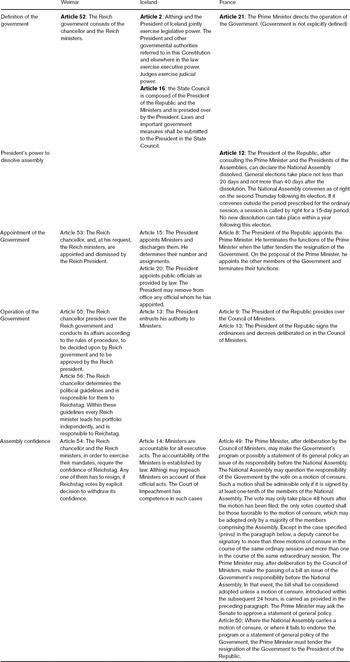
Although mixed systems vary considerably in the way the president and prime ministers interact, we doubt that this variation is due to the features of their constitutions themselves. Constitutions that allow for equally strong presidents may have very different patterns of interaction between the head of state and the head of government. Consider, for example, the constitutions of Iceland (1944), Germany (1919), and France (1958), whose stipulations regarding the president's power of dissolution of the assembly, appointment/removal of the government, and other presidential powers are summarized in Appendix 1. Regarding government formation and assembly dissolution, the German and French constitutions read, in many ways, very much like the Icelandic constitution. Yet, Iceland's political system, as we saw, is considered to function like a parliamentary democracy, Weimar is considered to be the epitome of presidential-parliamentary systems, which are characterized not only by the government's assembly responsibility but also by the primacy of the president (Shugart and Carey, Reference Shugart and Carey1992: 24), and France is considered to be the prototypical mixed, semi-presidential, or premier-parliamentary system (Duverger, Reference Duverger1980; Shugart and Carey, Reference Shugart and Carey1992; Sartori, Reference Sartori1994). Thus, according to the Weimar constitution, the prime minister is appointed and dismissed by the president (article 53); the same is true, however, of the prime minister in France (article 8) and in Iceland (article 15). In Iceland, article 24 allows the president to dissolve the assembly with no limitations to this power; in France, according to article 12, the president must consult the prime minister and the presidents of the assemblies before dissolving the assembly, and must wait a year in order to be able to do it again; in Weimar, article 25 allowed the president to dissolve the assembly, but only once for the same reason.
There are other presidential powers specified by the constitution that do not really distinguish these countries, or that grant more constitutional powers to the president who is, in practice, the weakest:
• France and Weimar give the president broadly similar and strong emergency powers (articles 16 and 48, respectively), although the Weimar constitution explicitly states that whatever measures are taken by the president must be suspended if the parliament demands so; the Icelandic president, in turn, has limited emergency powers, being able to act under such powers only when the parliament is not in session.
• The Icelandic (article 26) and the Weimar (article 73) presidents may reject a bill and cause it to be subject to a popular referendum, something the president of France cannot do, unless requested by the government or by a joint motion of the lower and upper houses (article 11). The only thing the French president can do unilaterally is to ask parliament to reconsider a law within ten days of its approval (article 10).
• The French constitution is silent about the President's ability to initiate laws; the Weimar constitution explicitly denies the president the ability to initiate laws by stating that laws are to be proposed by members of parliament and members of the government (article 68), which consists of the prime minister (the chancellor) and the ministers (article 52). Article 25 of the Icelandic constitution, in turn, states that the president may have bills and draft resolutions submitted to the parliament.
• Finally, article 2 of the Icelandic constitution states that the president and ‘other governmental authorities referred to in this Constitution and elsewhere in the law’ jointly exercise executive power, and article 16 states that the State Council is composed of the president and the government ministers, is presided by the president, and is the locus where ‘laws and other important government measures’ must be submitted to the president. The French constitution provides for an ambiguous role for the president in the government: while article 21 designates the prime minister as the one who ‘directs the operation of the government’, the president presides over the Council of Ministers (article 9) and must sign ‘the ordinances and decrees deliberated on in the Council of Ministers’ (article 13). As to the Weimar constitution, as seen above, the president is not part of the government (article 52).
So, constitutional features are not sufficient to distinguish mixed systems in which the president ‘really’ matters from those in which the president plays no significant role in politics. It is more likely that political conditions and historical circumstances are the factors leading to divergent practices under similarly ‘mixed’ constitutions.
In order to systematically examine the impact of presidential constitutional powers on the performance of mixed systems we coded these powers as specified by the constitutional document. In all, we consulted 45 original constitutional texts and amendments for 31 countries that adopted a mixed constitution at any time between 1919 and 2006.Footnote 11
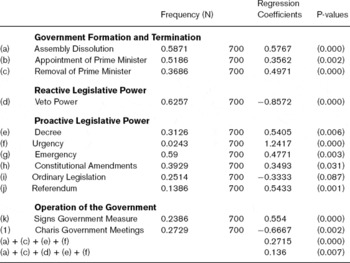
There are several indices of presidential powers available in the literature (e.g., Shugart and Carey, Reference Shugart and Carey1992; Metcalf, Reference Metcalf2000; Frye, Reference Frye1997), although none, to our knowledge, that covers as extensive a period of time and number of countries as ours. Moreover, many of the existing indices are based on aggregation procedures that we find to be unsatisfactory (e.g., the addition of scores over ordinal variables). The details of the variables related to presidential powers can be found in Appendix 2. We organized these variables in such a way as to convey information about the powers of the presidents in four different areas: (a) government formation and termination (the president's power to nominate the prime minister, the power to remove the prime minister, and the power to dissolve the assembly); (b) reactive legislative powers (veto power); (c) proactive legislative powers (power to issue decrees, to request urgency in the treatment of legislative proposals, emergency powers, and the power to initiate constitutional amendments, ordinary legislation, and to propose popular referendums); and (d) operation of the government (whether the president must sign government measures and whether he/she chairs the meetings of the government). Table 6 displays the frequency of country-years in each of these provisions.
Constitutional Presidential Powers In Mixed Constitutions

Coefficients generated by population-averaged panels estimation using the number of presidential candidates as dependent variable.
As a first approximation to these variables, we will use them to investigate two aspects of mixed democracies: their impact on government instability (as defined above), and their ability to distinguish strong and weak mixed systems. Thus, we ask the following questions:
(a) Are mixed systems with constitutionally strong presidential powers more unstable than those with presidents who, apart from being directly elected, have no or just a small constitutional role to play in governing? It is plausible to expect that conflict and instability will be more likely to emerge when the president has significant constitutional powers that can be invoked against the prime minister.
(b) Do the constitutional powers of the president account for at least some of the variation we observe in mixed systems regarding the effective role presidents play in politics? In other words, are constitutionally strong presidents more likely to be politically relevant than those with little or no constitutional powers? The comparison of the constitutions of Iceland, Weimar, and Fifth Republic France suggest that the answer to this question is negative.
Presidential powers and government instability
The results are unambiguous, if not very surprising or interesting: presidential constitutional powers make no difference whatsoever to the turnover of prime minister or their parties in systems that combine assembly confidence and a directly elected president.
We estimated models similar to the ones presented in Table 2, but only for mixed systems. We always included the variables indicating location in Eastern Europe and Africa. We ran models with and without per capita income since the inclusion of this variable considerably reduces the number of observations. We also included the age of the democratic regime. We controlled for whether the government is a multi-party or single party coalition, minority or majority, as well as for legislative fragmentation. We both did and did not cluster the standard errors by country. Most importantly, we experimented with a number of different ways to aggregate the indicators of presidential powers. We used each of the 12 indicators of presidential powers separately, we added the powers in each of the four categories and entered them one at a time, and we experimented with specific combinations of these powers (e.g., constitutions that grant the president some power in government formation and termination versus those that grant none; constitutions that grant strong powers versus those that grant weak or no power). Finally, we examined if these powers would have an impact when the president and the prime minister came from different parties. In all of these specifications, the variables indicating presidential powers were not even remotely statistically significant. There are, of course, other specifications and alternative methods of aggregating presidential powers that we could try (Baliev, Reference Beliaev2006, for instance, uses factor analysis to generate a measure of presidential powers). We believe, however, that this is unlikely to turn out any statistically or substantively significant relationship between the constitutionally defined powers of presidents in mixed systems and the government instability of these systems.
Political importance of presidents
Although they have become very popular in the recent past, we doubt that mixed constitutions have been adopted with the explicit goal of dividing authority between a directly elected president and a government responsible to the parliament. It is more likely that the choice was to create a system with assembly confidence and, at the same time, to institute a head of state that, by virtue of his/her independence from the parliamentary majority, would somehow guarantee the continuity of the state. That this head of state was to be elected by popular vote is almost the default option, given the lack of legitimacy of the alternatives.
One question that is intriguing, of course, is why similarly designed constitutions entail practices that are as divergent as the ones we observe in Iceland, Austria, Cape Verde, Central African Republic, France, Iceland, Madagascar, Russia, and the Ukraine. In order to address this question we need to systematically consider the relative importance of constitutional provisions, political and partisan factors, and historical circumstances. All of these factors are relatively easy to operationalize in a cross-national context. The difficulty lies in finding an adequate dependent variable that captures the differences in political practices we want to explain.
Here we explore two possible variables. They both seek to capture the effective importance of the president in the political system and are based on features of the presidential contest: the number of effective presidential candidates and the margin between the first and the second placed presidential candidate. The idea is that the political importance of the president will be correlated with the competitiveness of the presidential election. Thus, where the president is irrelevant, elections will be unimportant and we will observe few candidates competing and a large margin between the first and the second placed candidates; where the president is important, we will observe a relatively high number of presidential candidates (more people will want that job) and smaller margins of victory (the race will attract high-quality candidates with good electoral prospects, thus offering good alternatives for voters to choose from).
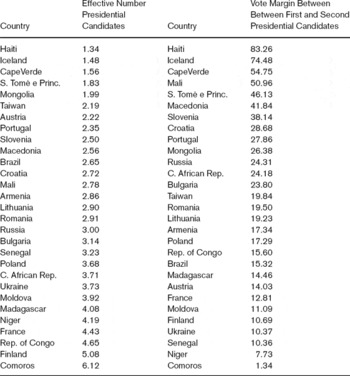
These variables do have some face validity in the sense that, broadly speaking, they classify the cases in the way we would expect them to be classified. Thus, as we can see in Table 7, Iceland, Cape Verde, Ireland, Mongolia, Austria, and Slovenia, countries with relatively unimportantFootnote 12 presidents, have lower average values of presidential candidates and high margins in presidential contests. In turn, the Comoros Islands, Finland (before, 2000), France, Madagascar, Niger, the Ukraine, and Senegal, countries where presidents are thought to effectively ‘share’ power with prime ministers, have a relatively high average number of candidates and low margins of victory in presidential contests. At the same time, presidential contests have become increasingly less competitive in Portugal and Poland, where presidents have become less important, and increasingly more competitive in France, where the presidency remains important. But these indicators also generate less fitting classifications, with Haiti displaying the lowest number of presidential candidates and the highest margin of victory, and Russia situated toward the upper end in terms of margins of victory, suggesting that presidents in these countries are not important. This, however, as we know, is not the case.
Effective Number of Presidential Candidates and Vote Margin Between First and Second Presidential Canditates (Mixed Systems)

Is the political importance of presidents related to their constitutional powers? On the basis of our preliminary analysis of the data, the answer seems to be indefinite, although with some promising avenues for further exploration. We estimated the impact of presidential constitutional powers on both the number of presidential candidates and the margin between the first and second placed candidates in presidential races. Regarding the latter, we find no impact of presidential powers, however they are defined. Regarding the number of presidential candidates, the story is different. The coefficients for the presidential variables (entered separately) generated by population-averaged panel models, controlling for Eastern Europe and Africa, are presented in Table 6. As we can see, almost all variables related to presidential powers are positively related to the number of presidential candidates, indicating that constitutionally more powerful presidencies do attract more candidates into the presidential race. Only three variables yielded negative and significant coefficients: the president's power to chair meetings of the government, the president's ability to initiate ordinary legislation, and, surprisingly, veto power. We do not know how to interpret these coefficients and feel that a model that is better specified may allow us to make sense of them. Note, however, that when presidential powers are variously aggregated, their impact on the number of presidential candidates remains positive and significant (lower panel of Table 7).Footnote 13 Thus, overall, presidential powers seem to make the office of the president more attractive, at least as indicated by the number of candidates competing to hold it.
Conclusion
We would like to conclude with some rather speculative remarks and an indication of how we intend to proceed in this project.
The process underlying the interaction between directly elected presidents and prime ministers in today's mixed democracies is not unlike the process that characterized the interaction between monarchs and parliaments as the latter asserted their primacy in what are now parliamentary democracies. Both powers try to assert their preeminence and engage in a struggle to do so. Victory, if at all forthcoming, is always political in the sense that one of the powers recognizes that the alternative to giving in and relinquishing power is unsustainable – some kind of deadlock or outright war. Presidents, even under constitutions that give them a lot of powers, will find that they have to appoint governments that they would have preferred to avoid as long as that government needs to obtain the confidence of a legislative majority in order to exist.Footnote 14
An equilibrium may be eventually found and the constitution may or may not be adjusted to reflect it. In Finland, for example, the 2000 constitution introduced subtle changes in language to reflect a practice that was, according to most observers, already essentially parliamentary, with the president playing no more than a formal role in the government formation process. Thus, its section 61, preserves a role for the president in government formation, but one that is explicitly subject to the will of parliament: ‘The Parliament elects the Prime Minister, who is thereafter appointed to the office by the President of the Republic. The President appoints the other Ministers in accordance with a proposal made by the Prime Minister.’ Similarly with government termination, as stipulated by section 64: ‘The President of the Republic grants, upon request, the resignation of the Government or a Minister. The President may also grant the resignation of a Minister on the proposal of the Prime Minister. The President shall in any event dismiss the Government or a Minister, if either no longer enjoys the confidence of Parliament, even if no request is made.’ Thus, in the 2000 Finnish constitution, the president's role is to simply ratify a decision that was made by the legislative majority. But such explicit ‘adjustment’ is not really necessary, either because the practice may not be written anywhere (such as in England, where there is no written stipulation that the monarch only plays a formal role in government formation and that the government exists only as long as it enjoys the support of a legislative majority) or because the written constitution does not reflect political practice (such as in Denmark, where article 3 of the constitution states that legislative power is vested in the KingFootnote 15 and the parliament conjointly, and that executive power is vested in the King; article 2, in turn, states that the King can dissolve the parliament at any time; and article 14 states that the King appoints and dismisses the prime minister and other ministers). In all these cases an effective balance was found between the head of state and the head of government (even if tilted in favor of one actor or the other), and in some cases it was made explicit in the written constitution. Thus, it is not surprising that the mere presence of a directly elected president, or the specific powers allocated to the head of state in the constitutional document, is not found to be of great significance when accounting for variation in the way democratic systems operate.
The question remains as to why so many countries that adopt the parliamentary formula – assembly confidence – in their new constitutions also adopt a directly elected president.Footnote 16 Why do they not adopt a purely parliamentary constitution by designing a symbolic or ceremonial presidency? The need for a directly elected president has been justified in two basic ways. In the Weimar constitution, the president was conceived as a counter to the power of the parliament; the fact that president's power originated directly in the people would allow him to balance the parliamentary characteristics of the system. The thinking underlying the Gaullist 1958 constitution, in turn, was more of a president who would stand above politics and, in this way, serve as the adjudicator of political conflicts. An additional reason, we believe, is the widespread belief among both constitution makers and constitution analysts that the leadership of the state must not be subject to the whims of a majority. Whereas the government can, and must, reflect the preferences of the majority at the time, the state, it is believed, must have an existence that transcends this majority. What matters, thus, is the ‘fixed’ aspect of the head of state office. The use of some kind of elections to choose who will occupy it is peripheral; it follows from the fact that such choice can no longer be justified on hereditary grounds.
Yet, we are not sure whether solid arguments justifying the notion that the head of state must be ‘fixed’, immune to temporary majorities, even exist. This notion – that the state must endure beyond the government – may very well be just an assumption held by both practicioners and analysts. That this must be the case, however, is not true. Note that there are at least three countries in the contemporary world with constitutions which require the government to be responsible to a legislative majority and which do not provide for a head of state with fixed terms: South Africa, Kiribati, and the Marshall Islands. In South Africa, the head of state and government are one and the same person, who is named the President. However, according to the 1996 constitution (as well as the interim 1994 constitution), this ‘president’ is subject to a vote of no-confidence by a majority of the National Assembly, which, if approved, requires the president's resignation and the formation of a new government. The fact that votes of no-confidence have been far from likely in South Africa has nothing to do with what the constitution says, we believe, and everything to do with the fact that parliament has been dominated by a single party that holds about two-thirds of the seats since competitive elections were held in 1994. Had such a large majority not existed, the relation between the government and the parliament in South Africa would have been considerably different, with issues of government survival due to legislative action probably occupying the forefront of political life.
Thus, what distinguishes contemporary forms of democratic governments is whether they have assembly confidence or not. Given assembly confidence, whether the president is directly elected or not is, on average, irrelevant. Governance in assembly confidence systems is guaranteed not by the way the president is elected, but by other institutional features that strengthen the government (that is, that component of the political structure that needs to obtain the confidence of the legislature): mechanisms that allow the government to shape the legislative agenda, to organize a legislative majority, and to keep it reasonably together in the face of the multiplicity of often contradictory interests legislators must reconcile in the course of their careers. To say that France became governable as it moved from the Fourth to the Fifth republics because of the constitutional provisions regarding the president is to disregard other, probably more significant constitutional changes also introduced with the 1958 constitution: e.g., the package vote (article 44.3), which allows the government to close debate on a bill and force an up or down vote on a proposal containing only the amendments proposed or accepted by the government; or the confidence vote procedure (article 49.3), which, when invoked by the government, stops debate on a bill and, if no motion of censure is introduced and adopted, implies approval of the bill shaped by the government.Footnote 17 As Huber (Reference Huber1996: 2) states:
The rules included in the [1958] Constitution to strengthen the French government against the legislature seem formidable. The Constitution contains provisions that grant control of the legislative agenda to the government, that limit the right of deputies to submit and vote amendments, that limit opportunities for deputies to gain information and expertise, and that even limit opportunities for members of parliament to vote on bills themselves. Since these rules of legislative procedure were actually placed in the Constitution, the members of parliament cannot easily change or get rid of them. The National Assembly under the Fifth Republic is therefore often regarded as one of the weakest legislatures in any modern democracy.
These features are not rare in mixed constitutions. In our sample of all such constitutions since 1919, we find that 59% of the cases (country years) allow the government to request a confidence vote on specific legislation, 48% grant the government control over the budget process, 35% place restrictions on the assembly's ability to pass a vote of no confidence in the government, 37% forbid legislators from serving in the government, and 23% contain provisions that allow the government to request urgency in the treatment of legislative proposals.Footnote 18 Thus, maybe what matters for the performance of democratic systems is not the mere presence or absence of a directly elected president, but the ways in which those with executive powers are able to exert control over the legislative process. We have evidence from both case studies and statistical analysis suggesting that this is what matters for both presidential (Figueiredo and Limongi, Reference Figueiredo and Limongi2000a and Reference Figueiredo and Limongib, Siavelis, Reference Siavelis2000, Cheibub, Reference Cheibub2007) and parliamentary democracies (Döring, Reference Döring1996); we hope to be able to address this issue for mixed constitutions as we continue to work on this paper.
Appendix 1. Government formation and assembly dissolution in three mixed constitutions: Weimar (1919), Iceland (1944) and France (1958)

Appendix 2. Coding presidential powers
We coded 12 variables that indicate the powers of the president, grouped into four categories: government formation and termination, reactive powers, proactive powers, and operation of the government. We consulted 45 documents (original constitutions and amendments) for 31 countries. The documents are part of the Constitutions Project at the Cline Center for Democracy, University of Illinois at Urbana-Champaign.
Government formation and termination
dissability : President's right to dissolve the assembly.
Dummy variable coded 1 if the president can unilaterally (or freely) dissolve the assembly, 0 otherwise. We believe that the fundamental aspect about dissolution is whether the president can act unilaterally or not. When the president cannot act unilaterally, it is either because there is no dissolution or because the president merely enacts the provisions pre-established by the constitution when the appropriate circumstances arise.
appointpm : Dummy variable coded 1 when the president may appoint the prime minister unconstrained, 0 otherwise. The 0 category includes the cases in which the president appoints the prime minister as specified by the constitution (e.g., the leader of the largest party) and the cases in which the president appoints a prime minister on the proposal of, or after consultation with, some other actors. We have an additional variable indicating the role of the president in appointing the ministers of the government. It turns out that in all the cases in which the president has a limited role to play in appointing the prime minister, the president also plays a limited role in appointing the rest of the government: either the president plays no role at all or the president simply appoints the individual ministers designated by the appointed prime minister. Some presidents who can appoint the prime minister unconstrained can also appoint individual members of the government (while others simply appoint those ministers designated by the prime minister). For this reason, we found that the details about who appoints specific ministers add no new information to the variable indicating the president's power to freely appoint the prime minister.
terminate : Dummy variable coded 1 when the president can remove the prime minister and/or individual ministers unconstrained, 0 otherwise. This includes cases in which the constitution provides no language on the basis of which the president could remove any part of the government, as well as the cases in which the constitution stipulates that the president must accept the government's resignation when it is submitted.
Legislative process (reactive power)
presveto : Dummy variable coded 1 when the president has (any type of) veto power, 0 when the president has no veto power. In 65% of the country years, presidents in mixed constitutions have veto power; in 72% of these, veto is only total and in the remaining 28% the president can veto a bill totally or partially (the Congo, Madagascar, Mali, Niger, Haiti, Mongolia, France, and Armenia). The countries in which the president does not have veto power include Austria, Finland, Ireland, Croatia, and Slovenia. In Finland, the original 1919 constitution granted veto power to the president, which was removed with the 1928 reform. Presidential veto was reinstated, however, in 1987, in the middle of a series of reforms in the direction of a more purely parliamentary system, which culminated with the 2000 constitution that significantly strengthened the power of the prime minister.
Legislative process (proactive powers)
presdecree : Dummy variable coded 1 when the president has some kind of decree powers (even if shared with the government) and 0 for the cases in which the president has no decree powers. Thirty-eight per cent of cases under a mixed constitution have no decree powers. In some cases only the president has decree powers, constitutional or delegated; in other cases this power is vested in the government; and in some other cases both the president and the government can issue decrees.
prescamend : Dummy variable coded 1 if the president has the power to initiate constitutional amendments and 0 if the president cannot initiate constitutional amendments.
presurg : Dummy variable coded 1 when the president does have the power to request urgency, 0 otherwise. The only two constitutions that allow the president to request urgency in the treatment of a legislative bill are the ones in Ukraine (1996) and Senegal (2001). In Ukraine, the president is the only actor who can do so, whereas in Senegal this power is shared with the government. The modal category is the absence of urgency provisions for either the president or the government, although a number of constitutions (Cape Verde, Madagascar, France, Poland, Romania, Armenia, and Moldova) do allow the government to request urgency in the legislative treatment of bills.
presemerg : Dummy variable coded 1 if the president has emergency powers, 0 if the president does not have emergency powers. Emergency powers appeared for the first time in a parliamentary constitution in Weimar Germany. Over 55% of the cases under a mixed constitution provide the president with emergency powers.
presordinary : Dummy variable coded 1 when the president has the (non-exclusive) power to initiate ordinary legislation, and 0 when the president cannot initiate legislation. In no case does the president have the exclusive power of legislative initiative.
presref : Dummy variable coded 1 when the president is allowed to initiate a referendum and 0 otherwise. In some countries – Central African Republic, Madagascar, Niger, Romania, and Weimar Germany – the president is the only actor who is allowed to propose a referendum. In addition to these, Cape Verde, Poland, and Ukraine also allow the president to propose a referendum, although other actors may also do so. In most mixed constitutions, the president is the one who can formally call a referendum. We distinguish, however, the cases in which the president can initiate the referendum from the cases in which the president calls the referendum on the proposal or motion of some other actor. The constitutional text in France places it in the latter category (even though De Gaulle did call a referendum in the early 1960s, an act that many considered to be unconstitutional): Article 11: The President of the Republic, on a proposal by the Government when Parliament is in session or on a joint motion of the two Assemblies, published in either case in the Journal Officiel, can submit to a referendum any Government bill that deals with the organization of the public powers, or with reforms relating to the economic or social policy of the Nation and to the concurrent public services, or which provides for authorization to ratify a treaty that, although not contrary to the Constitution, might affect the functioning of the institutions.’
Operation of the government
preschair : Dummy variable coded 1 if the president is allowed to chair the meetings of the government and 0 if the president cannot (although, in some of these cases, the president may attend them). In several constitutions, the president chairs meetings of the government, even though in some of these cases the president may delegate this function to the prime minister. The countries in which this is the case include most of the African mixed constitutions (Central African Republic, Congo, Madagascar, Mali, Niger, and Senegal), Haiti, France, Iceland, Armenia, and Ukraine.
pressign : Dummy variable coded 1 if the president must sign government decisions, 0 when government decisions do not need to be signed by the president. The vast majority of cases are coded 0, that is government decisions do not need to have the signature of the president (and thus government may act without consent of the president). The relatively few cases (163) in which president must sign government decisions include Congo, Mali, Niger, and France. Madagascar and Iceland are also included in these cases. In these countries, the procedure is a bit more complicated, but it amounts to having the president sign government decisions: the prime minister presides over cabinet meetings and the president presides over a state council; laws and important government measures must be submitted to the president in the state council.