Implications
The most common breeding scheme in international white pig populations involves a crossbreeding program implemented in a pyramidal structure. It allows exploitation of both individual and maternal heterosis and complementarity between populations as well as the dissemination of genetic progress from the elite populations. However, this crossbreeding system has not yet been implemented in Iberian pig populations. The aim of this study was to explore the crossbreeding parameters between two Iberian pig strains and to suggest a suitable crossbreeding design to improve the performance of the Iberian pig industry.
Introduction
Iberian pig breed is an autochthonous population from the Iberian Peninsula. This breed is comprised of many locally distributed strains with remarkable phenotypic and genomic differences as a result of selective breeding, important demographic fluctuations and a scarce genetic flow among herds (Fabuel et al., Reference Fabuel, Barragán, Silió, Rodríguez and Toro2004). Nevertheless, all these strains are characterized by their adaptation to harsh environmental conditions in the South West of the Iberian Peninsula (dehesa) and their adipogenic nature (López-Bote, Reference López-Bote1998). Iberian pig breeding is mainly focused on obtaining the raw material for cured meat products of top quality and price (Fernández et al., Reference Fernández, de Pedro, Núñez, Silió, García-Casco and Rodríguez2003). Traditionally, these products come from Iberian pigs reared outdoors and fed on grass and acorns in the so-called ‘montanera’ system. However, due to increasing sales of this type of dry-cured product, nowadays most of the commercialized cured products are from individuals crossed between Iberian sows and Duroc boars grown in intensive commercial farms (López-Bote, 1998).
The development of organized breeding programs is scarce and relatively recent in the Iberian pig breed (Silió, Reference Silió2000). Additionally, the pyramid crossbreeding system is practically absent compared with modern pig production in commercial populations (Visser et al., Reference Visser, Pong-Wong, Whittemore and Haley2000). The aim of crossbreeding is to exploit both heterosis and line complementarity. Thus, its implementation in Iberian pig breeding schemes has the potential to significantly improve performance. One of the procedures to identify an efficient crossbreeding scheme is the diallelic cross, which has been widely used by plant and animal breeders to study the efficient use of genetic resources in crossbreeding (Eisen et al., Reference Eisen, Hörstgen-Schwark, Saxton and Bandy1983; Wolf et al., Reference Wolf, Nitter, Fewson, Jakubec and Soukupová1991; Christie and Shattuck, Reference Christie and Shattuck1992). In contrast with most of the ‘white’ pig populations where many studies of this kind were conducted before the 90s (Johnson, Reference Johnson1981; McLaren et al., Reference McLaren, Buchanan and Johnson1987). To the best of our knowledge only one diallelic cross experiment was performed in the Iberian populations back in the 50s and with ancient Iberian pig strains (Silió et al., Reference Silió, Rodríguez, Toro and Rodrigáñez1994; Fernández et al., Reference Fernández, Rodríguez, Rodrigáñez, Silió and Toro2002).
The aim of this study was to estimate the crossbreeding effects on growth from birth to slaughter and on carcass traits from a 2×2 full diallelic cross experiment performed on two contemporary Iberian pig strains and under intensive management in order to define future crossbreeding strategies.
Material and methods
Animals and experimental design
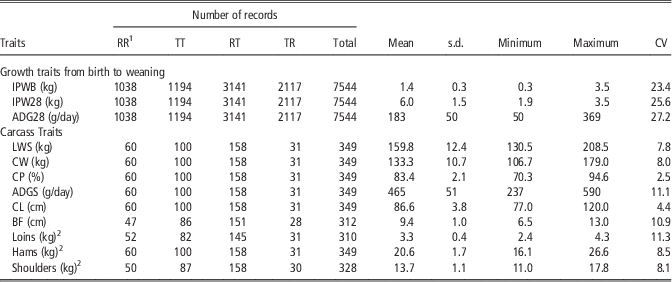
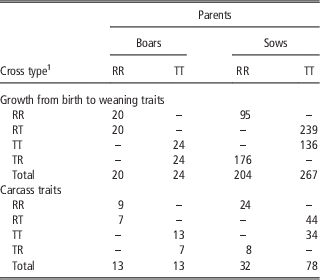
All management and experimental procedures involving live animals were approved by the Research Ethics Committee of the IRTA. The data sets used in this study came from a designed diallelic experiment involving two Iberian strains (Retinto: RR, Torbiscal: TT) and their reciprocal crosses (RT, TR). The Retinto line is currently the largest livestock line in the Iberian pig (Benito et al., Reference Benito, Vazquez, Menaya, Ferrera, Garcıa-Casco, Silio, Rodrigañez and Rodrıguez1998). This line is representative of the phenotype retinto color. The genetic origin of the Torbiscal line, which is the result of the union of four ancestral strains, has been previously described by Fernández et al. (Reference Fernández, Rodríguez, Rodrigáñez, Silió and Toro2002) and Fabuel et al. (Reference Fabuel, Barragán, Silió, Rodríguez and Toro2004). During the experiment, animals were kept in intensive commercial pig breeding conditions from birth to slaughter. The animals were fattened ad libitum until slaughter at a commercial abattoir with an average age of 340 days (around 160 kg). Two main data sets were used in this diallelic cross study. The first dataset contained: Individual piglet weight at birth (IPWB); Individual piglet weight at weaning at 28 days (IPW28); and Average daily gain from birth to weaning at 28 days (ADG28). These traits were collected from 2010 to 2013 in two commercial farms (6236 and 1208 records, respectively) where both strains and their reciprocal crosses were represented. The second data set comprised growth and carcass traits at slaughter (~340 days and ~160 kg). The weight of the warm carcass and the premium cuts (the total weight of the two trimmed hams, shoulders and loins, respectively) were individually recorded in a commercial slaughterhouse. The number of records, strain distribution and the summary statistics for all traits are presented in Table 1 and Table 2.
Number of records and statistical descriptors for the traits analyzed

IPWB=individual piglet weight at birth; IPW28=individual piglet weight at weaning (28 days); ADG28=average daily gain from birth to weaning (28 days); LWS=live weight at slaughter; CW=carcass weight; CP=carcass performance; ADGS=average daily gain from birth to slaughter; CL=carcass length; BF=backfat at 4th rib.
1 Breed of boar×breed of sow; R=Retinto; T=Torbiscal.
2 Total weight of the two hams, shoulders and loins, respectively.
Distribution of parents (boars and sows) by cross type
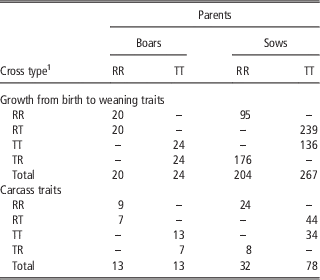
1 Breed of boar×breed of sow; R: Retinto; T: Torbiscal.
Statistical analysis
The following Bayesian model was fitted for growth traits until 28 days after birth (IPWB, IPW28 and ADG28):
 $$\eqalign{Y_{{icjkln}} \,=\, \mu \,{\plus}{TB}_{{icjln}} \, {\plus} \, {\tf="OTfd69539f_BI" g}_{{ic}} {\bibeta} _{c} \, {\plus} \, {FYS}_{j} \, {\plus}\, {SEX}_{k} \, {\plus} \, {PO}_{l} \cr \ \quad {\plus} \, p_{{icjln}} \, {\plus} \, e_{{icjkln}} $$
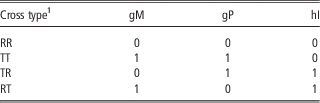
where Y icjkln is one observation of the trait being analyzed; µ is the overall mean; TB icjln is a covariable of total number of pigs born in the same litter as the individual; g ic is a vector 1×3 that indicates the proportion of genes from the parental strains of each individual (with values 0, 1) and the coefficients of the heterosis effects from each i cross according to the equivalent model of Dickerson (Reference Dickerson1969) (see Table 3); β c is a vector that contains maternal and paternal average genetic effects of breeds (gM and gP), and individual heterosis (hI) (c=gM, gP and hI, respectively), FYS j is jth farm year season (1 year season every 3 months for each farm: 16 levels), SEX k is kth sex (2 levels), PO l is lth parity (five levels), p icjln is the effect of common environment (litter: 1207 levels) and e icjkln is the residual error term of the model. The model for IPW28 and ADG28 was included by total born alive instead of total born (TB). Note, that the classical Dickerson model for F1 crosses and parents breed is decomposed on direct and maternal average genetic effects (gI′ and gM′) and individual heterosis (hI′). The model proposed here is an equivalent model in which gI=gP×2, gM′=gM−gP and hI′=hI.
Design of the covariate matrix of the proportion of genes from the two paternal strains for maternal and paternal average genetic effects of breeds (gM and gP), and individual heterosis (hI) from each cross

1 Breed of boar×breed of sow; R=Retinto; T=Torbiscal.
The mean performance of cross types C i (i=RR, TT, TR and RT) was computed, for each iteration, as the sum of the maternal and paternal average genetic effects of breeds (gM and gP), and individual heterosis (hI):
 $$C_{i} ={\tf="OTfd69539f_BI" g}_{{{ic}}} \bibeta _{c} .$$
Note that the solution for cross CRR is zero and consequently the interpretation of the C parameter is the difference between cross type effects TT, TR and RT and the cross type effect RR.
Further, the model to analyze growth traits at slaughter and premium cuts traits was:
 $$Y_{{icjkln}} = \mu {\plus}{\tf="OTfd69539f_BI" g}_{{ic}} \bibeta _{c} {\plus}D_{j} {\plus}{BACH}_{k} {\plus}{SEX}_{l} {\plus}p_{n} {\plus}e_{{icjkln}} $$
where Y
icjkln
is one observation of the trait being analyzed, µ is the overall mean,
g
ic
and
β
c
are vectors that contain, respectively, the same coefficients and effects as the piglet growth traits model, D
j
is a covariable of the days from birth to slaughter for each j individual; BACH
k
is kth contemporary group effect (11 levels) considered as the animals tested at the same time and within each fattening building, SEX
l
is lth sex (two levels), p
n
is the effect of common environmental litter (98 levels) and e
icjkln
is the residual of the model. The model for ADG did not include the covariate D
j
. As for the piglet growth traits, C
i
(i=RR, TT, TR and RT) was computed in each iteration as
 $C_{i} ={\tf="OTfd69539f_BI" g}_{{ic}} \bibeta _{c} .$
Bayesian inference was used to analyze all traits. It was assumed that the traits were conditionally distributed as follows:
 $${\tf="OTfd69539f_BI"y\,\mid\, b,p},\sigma _{e}^{2} \,\sim\,{N}({\tf="OTfd69539f_BI" X b}{\plus}{\tf="OTfd69539f_BI" Wp},{I}\sigma _{e}^{2} )$$
where
b
is the vector including the systematic effects (TB, C, FYS, SEX and OP for weaning traits and D, C, BACH and SEX for finishing traits);
p
is the vector of common litter effects including genetic and environmental effects of the litter;
 $\sigma _{e}^{2} $
is the residual variance,
X
and
W
are the known incidence matrices and
I
an identity matrix of appropriate order. Bounded uniform priors were assumed for the systematic effects (
b
). A multivariate Gaussian prior distribution was assumed for the litter effects
 $$p{\rm \,\mid\,}\sigma _{p}^{2} \,\sim\,{N}(0,\,I \sigma _{p}^{2} )$$
where
 $\sigma _{p}^{2} $
is the common litter variance and
I
is the identity matrix of the same order as the levels of the common litter effects. Bounded uniform priors were used for the residual and common litter variances (
 $\sigma _{{e}}^{2} ,\sigma _{{p}}^{2} $
, respectively). An exploratory analysis was performed to include random additive and maternal additive genetic effects. However, no relevant differences in the estimation of crossbreeding effects were found because the distribution of progenies of boars and sows was balanced across cross types (see Table 2). Thus, for the sake of simplicity and given the small amount of data of slaughter and premium cuts, random additive genetic effects were not included in the model.
Bayesian inference via Markov chain Monte Carlo methods was used to analyze the data. The fully conditional distributions for
b
and
p
parameters were univariate Gaussian and inverted scaled χ
2 distributions for the
 $\sigma _{{ e}}^{2} ,\sigma _{{ p}}^{2} $
variances. Marginal posterior distributions of all unknowns were estimated using the Gibbs sampling algorithm (e.g. Geman and Geman, Reference Geman and Geman1984). The free software TM by Legarra et al. (Reference Legarra, Varona and López de Maturana2008) was used for all Gibbs sampling procedures. After exploratory analyses, we used a single chain with a total of 100 000 samples for each analysis, after a burn-in period of 10 000. Convergence was tested separately for all dispersion parameters using the Raftery and Lewis (Reference Raftery and Lewis1992) algorithm and the Z criterion of Geweke (Reference Geweke1992). Effective sample size was evaluated using the method of Geyer (Reference Geyer1992), and Monte Carlo sampling errors were computed using the time series procedures described by Geyer (Reference Geyer1992).
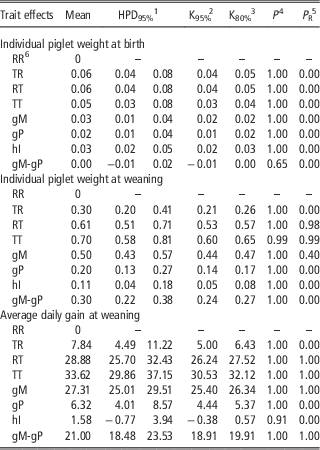
Following Blasco (Reference Blasco2005) and Hernandez et al. (Reference Hernandez, Guerrero, Ramirez, Mekkawy, Pla, Ariño, Ibáñez and Blasco2005), the following summary statistics were obtained from each marginal posterior distribution including the mean, the highest posterior density at 95% (HPD95%), the guaranteed value with a probability of 95% or 80% (limit of the interval [k, +∞) when the posterior value is greater than zero, or the limit (−∞, k] when the posterior value is lower than zero), the probability of the posterior being greater or lower than zero (P) and the probability of relevance P R (probability of the posterior value being greater than a relevant value). The probability of relevance is a useful tool because it reflects whether the estimates from the parameters are not only significant in the classical sense but also relevant. However, the relevancy value is arbitrary and has to be determined for each case depending on its economic and biological importance. In this study, we have determined the relevancy level as one-third of the observed phenotypic standard deviation of each trait (see Tables 4, 5 and 6).
Features of the estimated marginal posterior distribution of the cross type effects (RR, TR, RT and TT), maternal and paternal genetic effects of breeds (gM and gP), and individual heterosis effect (hI) for individual piglet weight at birth (IPWB) and at weaning (IPW28) in kg and average daily gain at weaning in g (ADG28)

1 HPD95%: highest posterior density interval at 95% of probability.
2 K95% limit of the interval [k, +∞) at 95% of probability.
3 K80% limit of the interval [k, +∞) at 80% of probability.
4 P: Probability of the posterior value being greater than zero.
5 P R: Probability of relevance; probability of the posterior value being greater than one third of the standard deviation of the trait.
6 Breed of boar×breed of sow; R=Retinto; T=Torbiscal.
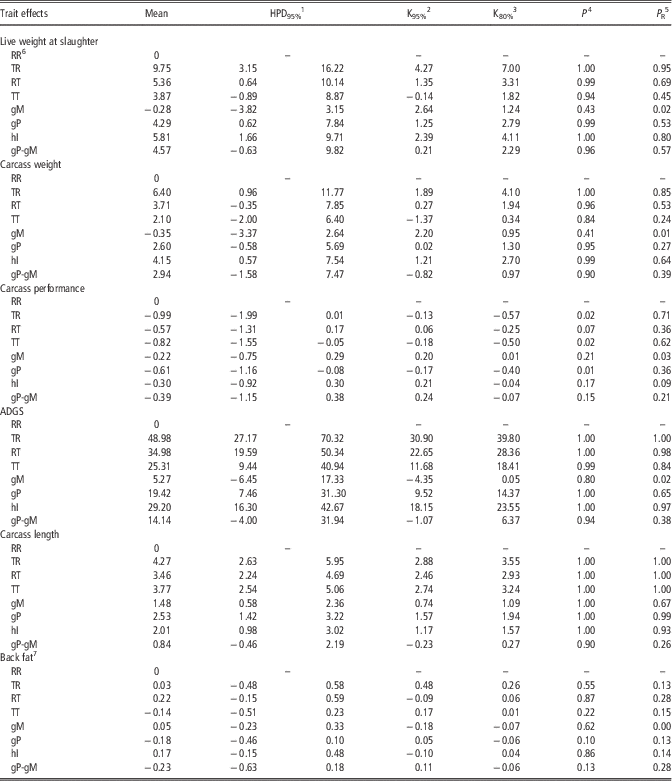
Features of the estimated marginal posterior distribution of the cross type effects (RR, TR, RT and TT), maternal and paternal genetic effects of breeds (gM and gP), and individual heterosis effect (hI) for live weight at slaughter (LWS), carcass weight (CW) and carcass performance (CP) in kg, average daily gain at slaughter in g (ADGS), and carcass length (CL) and backfat at 4th rib in cm (BF)

1 HPD95%: highest posterior density interval at 95% of probability.
2 K95% limit of the interval [k, +∞) at 95% of probability.
3 K80% limit of the interval [k, +∞) at 80% of probability.
4 P: probability of the posterior value being greater than zero.
5 P R: probability of relevance; probability of the posterior value being greater than one third of the standard deviation of the trait.
6 Breed of boar×breed of sow; R=Retinto; T=Torbiscal.
7 Back fat measure with a ruler at the 4th rib in the slaughterhouse.
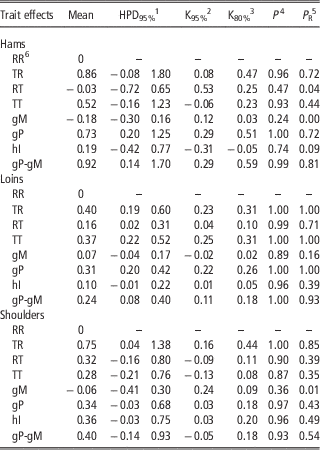
Features of the estimated marginal posterior distribution of the cross type effects (RR, TR, RT and TT), maternal and paternal genetic effects of breeds (gM and gP), and individual heterosis effect (hI) for hams, loins and shoulders in kg

1 HPD95%: highest posterior density interval at 95% of probability.
2 K95% limit of the interval [k, +∞) at 95% of probability.
3 K80% limit of the interval [k, +∞) at 80% of probability.
4 P: Probability of the posterior value being greater than zero.
5 P R: probability of relevance; probability of the posterior value being greater than one-third of the standard deviation of the trait.
6 Breed of boar×breed of sow; R=Retinto; T=Torbiscal.
Results
Growth traits from birth to weaning
Features of the estimated marginal posterior distribution of the differences between cross type effects, maternal and paternal genetic effects of breeds (gM and gP), and individual heterosis (hI) for growth traits from birth to weaning are shown in Table 4. Differences between cross type effects were observed for all traits (IPWB, IPW28, ADG28) with a probability of being greater than zero of 1. However, these differences were only relevant for the traits IPW28 and ADG28 where the Torbiscal strain (TT) was used as mother (RT and TT). In the same sense, although the probability that gM, gP and hI were greater than zero was high for most of the traits, no relevant differences were found, except for ADG28 in which gM clearly affected the trait with a P R of 1 of being greater than gP.
Growth and carcass traits at slaughter
Growth and carcass traits at slaughter also revealed differences between cross type effects (see Table 5), with the only exception of backfat thickness (BF). However, in contrast with growth traits from birth to weaning, the TR cross showed the highest differences from the RR cross. The TR cross was clearly superior, achieving the highest values for all growth and carcass traits at slaughter, except for carcass performance that provided the lowest value. In general, the posterior mean of the RT and TT differences from RR cross were similar and around half of the TR cross differences. In particular, these differences of TR from RR cross were important for live weight at slaughter (LWS), average daily gain at slaughter (ADGS) and carcass length (CL) traits, with an 80% probability of being higher than 7.00 kg, 39.80 g/day and 3.55 cm, respectively. These differences were mainly caused by hI effect followed by gP effect. The posterior mean of gI explained from 3% to 5% of these traits and the posterior mean estimates of gP were clearly greater than gM. Nevertheless, the probabilities of relevance of this difference were small.
Premium cuts traits
The results for premium cuts traits (hams, loins and shoulders) were in agreement with those for growth and carcass traits at slaughter. TR cross showed the highest differences from RR cross (see Table 6) with posterior means of 0.86 kg (~4% of the trait), 0.40 kg (~12% of the trait) and 0.75 kg (6% of the trait) for hams, loins and shoulders, respectively. These differences can mainly be explained by the gP effect. The HPD95% of gP for hams was clearly different from zero whereas the posterior mean of gM and hI effects were small and zero was included in its HPD95% intervals. Moreover, the posterior value of the difference between gP and gM was at least 0.59 kg (3% of the trait) with a probability of 80%. The posterior value of the gP effect for loins was at least 0.26 kg (8% of the trait) with a probability of 80% and P R of 100%, whereas gM and hI did not show significant values. The cross type differences for shoulders trait were mainly explained by gP and hI effects. The posterior distribution of gM did not show significant values and both gP and hI effects were clearly different from zero. Nevertheless, their P R were smaller than for hams and loins.
Discussion
The results here presented were obtained from a 2×2 diallelic cross experiment using a reparameterization of Dickerson’s model that allows to estimate gM, gP effects jointly. This could help to determine whether cross populations might be an efficient method of utilizing heterosis and breed resources on contemporary Iberian pig strains such as Retinto and Torbiscal. It is particularly relevant since systematic crossbreeding is not a standard procedure in Iberian pig breeding schemes. Additionally, this study could help to elucidate the presence of relevant non-additive effects in the genetic determinism of the analyzed traits.
Growth traits from birth to weaning
The results showed important differences of crossbreeding effects on growth traits from birth to weaning. The posterior means of hI for IPWB (0.03 kg) and IPW28 (0.11 kg) were in the range of previous results reported by Johnson (Reference Johnson1981). Nevertheless, although these hI estimates were clearly different from zero, they represented only around 2% of the mean performance of traits and close to one-eighth of its standard deviation. This percentage was slightly lower than the average reported by Johnson (Reference Johnson1981) of around 2.8% and considerably lower than those reported by Bidanel et al. (Reference Bidanel, Caritez and Legault1990) with 6% of hI for IPBW and 14% for IPBW28. Nevertheless, this may be because these results come from a crossbreeding experiment performed on distantly related breeds such as Meishan and French Large White. In a crossbreeding experiment between commercial maternal lines, Cassady et al. (Reference Cassady, Young and Keymaster2002) found a higher percentage of hI than our findings for IPWB (8%) but similar for IPW28 (3%). Further, our hI results are similar to those reported for IPW at 21 days in a previous experiment with ancient Iberian pig strains (Silió et al., Reference Silió, Rodríguez, Toro and Rodrigáñez1994). These results would suggest small differences in allelic frequencies for genes involved in growth at weaning between the Iberian strains involved.
The maternal influence of early growth in pigs has been widely recognized for many years (Robison, Reference Robison1972). Our results showed a negligible gM effect for IPWB, whereas for IPW28 and ADG28 traits gM effect was important (5% and 21% of the trait, respectively). This would confirm a relevant maternal influence in the early growth of Iberian pig populations. In particular, the superior mothering ability of the T strain with respect to the R strain was reported. It can be argued that this difference may be caused by the differences of prolificacy between populations, as the litter size of T population is lower than R. However, the model was corrected by total born and total born alive for traits recorded at birth and weaning, respectively. Additionally, analyses without this correction for litter size were performed and the results did not markedly change. Thus, the differences among crosses, especially important for ADG28, should be attributed to the Torbiscal mothering ability.
Growth, carcass and premium cuts traits at slaughter
In contrast to growth traits at weaning, the TR cross performed best for most of the growth, carcass and premium cuts traits at slaughter. This would suggest that the strong influence of the sow during suckling fell considerably after weaning in agreement with the classical pattern reported for growth traits in pigs (Bidanel et al., Reference Bidanel, Caritez and Legault1990). The differences between crosses for growth, carcass and premium cuts traits at slaughter can mainly be explained by the hI and gP parameters. Both hI and gP posterior distributions were clearly different from zero for all growth, carcass and premium cuts traits at slaughter, except for BF. In particular, contrary to the negligible hI found for IPW28 and ADG28, hI was significant for LWS and ADGS in growth traits at slaughter. These results concur with those reported by Cassady et al. (Reference Cassady, Young and Keymaster2002) in commercial maternal lines and García-Casco et al. (Reference García-Casco, Fernández, Rodríguez and Silió2012) with different Iberian pig strains. Both studies revealed a significant increase of direct heterosis (hI) on weight depending on the increase in age. However, our hI estimates were lower than those reported by these authors. The hI was also relevant for CL in disagreement with the findings of Cassady et al. (2002) and Johnson (Reference Johnson1981). In premium cuts traits, hI was significantly different from zero but was not relevant and was in agreement with other studies for Loin area in cm (Johnson, Reference Johnson1981; Cassady et al., Reference Cassady, Young and Keymaster2002).
The gP crossbreeding effect was more relevant for premium cuts, especially for hams (4%) and loins (~9%). This would explain the difference in performance for premium cut traits between the reciprocal crosses (RT and TR). Additionally, these phenotypic differences might suggest the presence of paternal genomic imprinting, as the main difference between reciprocal crosses is the parent of origin. Previous studies using gametic relationship matrices have showed a substantial paternal imprinting for effects on rate and composition of pig growth (de Vries et al., Reference de Vries, Kerr, Tier, Long and Meuwissen1994). Imprinting is an epigenetic phenomenon related to histone and/or DNA methylation that determines the ability of a gene to be expressed (Feil and Khosla, Reference Feil and Khosla1999). It is a widely recognized phenomenon in pig breeding (de Koning et al., Reference de Koning, Rattink, Harlizius, van Arendonk, Brascamp and Groenen2000). In particular, IGF-2 is a paternal QTL related to muscle growth in pig (Van Laere et al., Reference Van Laere, Nguyen, Braunschweig, Nezer, Collette, Moreau, Archibald, Haley, Buys, Tally, Andersson, Georges and Andersson2003; Estelle et al., Reference Estelle, Mercade, Noguera, Perez-Enciso, Ovilo, Sanchez and Folch2005). These authors found that the paternal A allele decreased fat measurements and increased carcass weight, hams weight, shoulders weight and loins area. However, studies performed on some purebreed Iberian strains showed that IGF-2 was not segregating in these populations and they were all homozygous (G/G) (Carrodeguas, et al., Reference Carrodeguas, Burgos, Moreno, Sanchez, Ventanas, Tarrafeta, Barcelona, Lopez, Oria and Lopez-Buesa2005; Ojeda et al., Reference Ojeda, Huang, Ren, Angiolillo, Cho, Soto, Lemús-Flores, Makuza, Folch and Pérez-Enciso2008). Thus, these differences cannot be explained by the IGF-2 mutation but might be due to other imprinted genes. Nevertheless, these results are only signs of paternal imprinting and more specific studies as such the performed by de Vries et al. (Reference de Vries, Kerr, Tier, Long and Meuwissen1994) will be needed to support this hypothesis.
Conclusion
The relevance of the crossbreeding parameters varied depending on the traits analyzed. Growth traits at weaning exhibited a negligible individual heterosis effect, whereas its importance increased for growth traits at slaughter. The maternal breed effect was clear with respect to growth at weaning (ADG28). Its effect seems to be replaced by a paternal breed effect for growth, carcass and premium cuts traits at slaughter. These results could reveal some signs of paternal imprinting genes. Nevertheless, further studies are needed in order to support these findings. From an alternative point of view, the results obtained from this study could prove valuable for the establishment of a suitable crossbreeding system in Iberian pig breeding schemes. The T strain exhibited a clear superiority for growth performance at weaning given its positive maternal breed effect, suggesting no relevant advantages from crossbreeding. Nevertheless, for growth, carcass and premium cuts traits at slaughter TR was the best cross type due to the individual heterosis effect of crossing the two strains (T and R) and the paternal breed effect of the T strain. These results strengthen the idea of using crossbreeding programs in Iberian pigs and, in this particular case, the implementation of a crossbreeding system based on the TR cross type.
Acknowledgments
The authors acknowledge the technicians of the IRTA (M.J. García-Santana) and of the INGAFOOD Company (Manuel Ramos, Lourdes Muñoz and Pilar Diaz) for cooperating in the experimental protocol and their technical support. The work was partially funded by the Center for Industrial Technological Development (CDTI) grant IDI-20100447 and by the grant RTA2012-00054-C02-01 from the Instituto Nacional de Investigación y Tecnología Agraria y Alimentaria (INIA), Spain.