INTRODUCTION
A ria, often known as a drowned river valley, is a submerged coastal landform. Rias form when sea levels rise or plate tectonics cause coastal levels to fall. When this happens, valleys which were previously at sea level become submerged. The result is often a very large estuary at the mouth of a relatively insignificant river (or else sediments would quickly fill the ria). There are many rias around Europe: the south coast of England, Galicia and the rest of the northern coast of Spain, Portugal, etc. Rias are sometimes confused with fjords. Fjords are formed in drowned valleys like rias, but fjords are created by glaciers not by rivers. Rias and fjords can also be compared with firths, estuaries or bays.
The Galician rias are a special and complex kind of estuarine system, and there has been an ongoing interest in them during the last thirty years. The rias had their origin in flooded river valleys, and have a high primary productivity due to upwelling and regular incoming of nutrients (Nombela et al., Reference Nombela, Vilas and Evans1995). These systems would greatly benefit from a scientific study of their environment because of their great economic and social importance (e.g. fisheries, bivalve culture on rafts and shellfish resources). In this context, the study of the composition and distribution of the benthic communities is of great interest, because they are considered as good indicators of the conditions of marine sediments (Bellan, Reference Bellan1967, Reference Bellan1984; Pearson & Rosenberg, Reference Pearson and Rosenberg1978; Gray & Mirza, Reference Gray and Mirza1979; Bellan et al., Reference Bellan, Desrosiers and Willsie1988).
Frequent studies have also been made on the benthos living on soft substrata in recent years on the Galician coast (Viéitez & Baz, Reference Viéitez and Baz1988; Junoy & Viéitez, Reference Junoy and Viéitez1989, Reference Junoy and Viéitez1990; Mazé et al., Reference Mazé, Laborda and Luis1990; Currás & Mora, Reference Currás and Mora1991, Reference Currás and Mora1992; Palacio et al., Reference Palacio, Lastra and Mora1991; Pérez Edrosa & Junoy, Reference Pérez Edrosa and Junoy1993). However, there is a lack of studies in some small rias, such as Ría de Aldán. The main objectives of this paper were to characterize the composition and distribution of the polychaete fauna on the subtidal soft bottoms of the Ría de Aldán as well as studying the influence of the measured environmental variables on the distribution patterns. It will also provide a baseline to investigate potential changes, such as possible effects due to oil spills or other human impacts.
MATERIALS AND METHODS
Study area
The Ría de Aldán is located on the southern margin of the mouth of the Ría de Pontevedra, between 42°16′40″–42°20′50″N and 8°49′–8°52′W. This ria has a maximum depth of 45 m, and its mouth is oriented northwards. Salinity values are around 36‰. There is an increase in salinity values from the inner to the outer part of the ria (Parada, Reference Parada2004).
Sample collection and processing
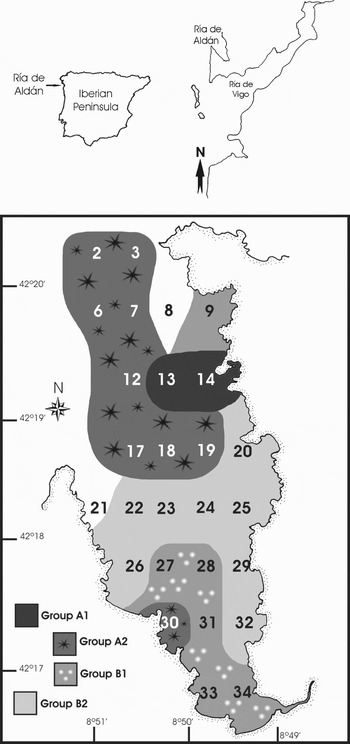
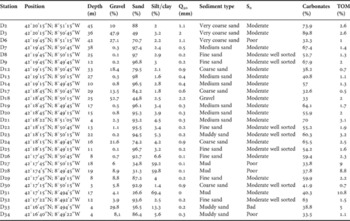
The sampling programme, which covered the full extent of the ria to provide sufficient information on the distribution of the different species of polychaetes, comprised 27 stations (Figure 1). Quantitative sampling was carried out, during July–August 1997, using a Van Veen grab with a sampling area of 0.056 m2. Five replicates were taken at each station, which accounted for a total area of 0.28 m2. Samples were sieved through a 0.5 mm mesh, and fixed in 10% buffered formaldehyde solution for later sorting and identification of the fauna. An additional sediment sample was taken at each station to analyse granulometric composition, carbonates, and organic matter content. The following granulometric fractions were considered: gravel (GR, >2 mm), very coarse sand (VCS, 1–2 mm), coarse sand (CS, 0.5–1 mm), medium sand (MS, 0.25–0.5 mm), fine sand (FS, 0.125–0.25 mm), very fine sand (VFS, 0.063–0.125 mm), and silt/clay (<0.063 mm). Median grain size (Q50) and sort coefficient (S0) (Trask, Reference Trask1932) were also determined for each sample. Sediment types were characterized according to the method described by Junoy (Reference Junoy1996). Carbonate content (%) was estimated by treatment of the sample with hydrochloric acid. The total organic matter content (TOM, %) was estimated from the weight loss after placing samples in a furnace for 4 h at 450°C (Table 1).
Locations of sampling stations in the Ría de Aldán and spatial distribution of polychaete assemblages in the ria as determined by multivariate analysis.

Position, depth and sedimentary characteristics of sampling stations in the Ría de Aldán.

Q50, median grain size; S0, sort coefficient; TOM, total organic matter.
Data analysis
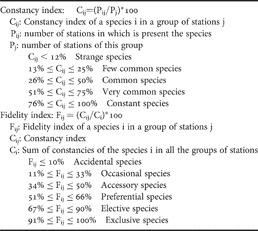
Several univariate measures were calculated for each sampling station: total abundance of all polychaetes (N), number of species (S), the Shannon–Wiener diversity index (H′, as log2), and Pielou's evenness (J). For any given site, species with ≥4% of total abundance were considered as dominant (Field et al., Reference Field, Clarke and Warwick1982). Polychaete assemblages were determined through non-parametric multivariate techniques as described by Field et al. (Reference Field, Clarke and Warwick1982) using the PRIMER v5.0 (Plymouth Routines in Multivariate Ecological Research) software package (Clarke & Warwick, Reference Clarke and Warwick1994). A similarity matrix between 27 sampling stations was constructed by means of the Bray–Curtis similarity coefficient by first applying fourth root transformation on species abundance to minimize the contribution of the most abundant species. The polychaete assemblages were investigated from this matrix by cluster analysis based on the group-average sorting algorithm, as well as an ordination by means of non-metric multidimensional scaling (MDS). Differences in faunistic composition between samples were tested using the 1-way ANOSIM (analysis of similarities) test. The SIMPER (similarities percentages) program was next used to identify species that greatly contributed to the differentiation of station groups. The species present in each group of stations were further classified according to the constancy and fidelity indices (Glémarec, Reference Glémarec1964; Cabioch, Reference Cabioch1968) (Table 2).
Constancy and fidelity indices.

The BIO-ENV procedure (belonging to the PRIMER package), and the canonical correspondence analysis (CCA, using the CANOCO v4.02, Canonical Community Ordination package; Ter Braak, Reference Ter Braak1988) were used to research the possible relationship between polychaete distribution in the ria, and the measured environmental variables. The forward selection was employed in the latter to detect which variables explained the most variance in the species data. All variables expressed in percentages were previously transformed by log (x + 1).
RESULTS
Sediments
In the Ría de Aldán, sediments are mainly sandy in nature. Coarser sandy granulometric fractions are more prevalent at the mouth of the ria, and muddy bottoms are restricted to inner and sheltered areas. There is a decrease in grain size and an increase in organic content between the outer and inner areas of the ria.
Abundance, species richness and diversity
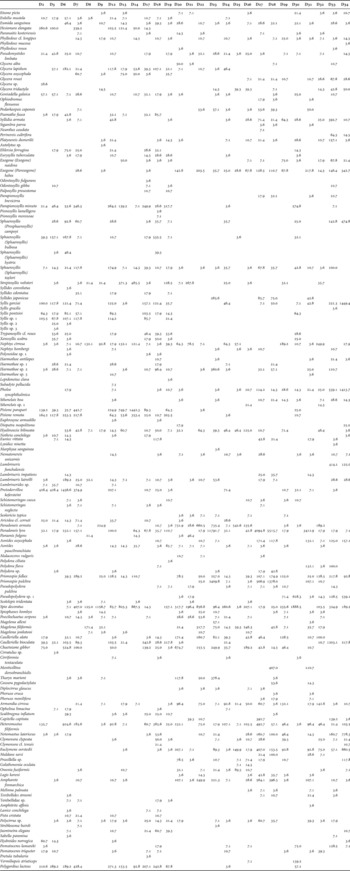
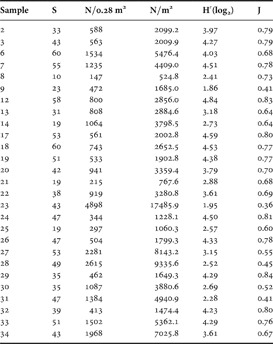
The 27 samples analysed yielded a total of 28,878 polychaete specimens belonging to 145 species in 36 families (Table 3). Syllids and spionids were the dominant families in terms of species number, having respectively 28 and 13 species. The paranonids Paradoneis lyra (Southern, 1914) and Paradoneis armata Glémarec, 1966, the spionids Spio decoratus Bobretzky, 1870 and Prionospio pulchra Imajima, 1990, the pisionid Pisione parapari Moreira, Quintas & Troncoso, 2000, the capitellid Heteromastus filiformis (Claparède, 1864), the dorvilleid Protodorvillea kefersteini (McIntosh, 1865) and the syllid Syllis garciai (Campoy, 1982) accounted for 50% of all polychaetes.
List of species found in the area (densities per square metre) at each station.

Values of univariate measures are shown in Table 4. The lowest abundance values were recorded at Station 8 (147 specimens/0.28 m2), while the highest were recorded at Station 23 (4898 specimens/0.28 m2). The number of species varied between 10 (Station 8), and 60 (Stations 6 and 18), while diversity ranged between H′: 1.86 (Station 9) and H′: 4.84 bits (Station 12). Evenness showed low values on sediments with a high dominance of Paradoneis lyra (Stations 23, 28 and 31) and Spio decoratus (Stations 9 and 30), and with low diversity values. In other nearby studied areas, diversity and density values were lower than in Aldán. In Baiona (Moreira et al., Reference Moreira, Quintas and Troncoso2006), diversity varied between H′: 4.32 and H′: 1.52 while density ranged between 1990 and 70 specimens/0.28 m2. The Ensenada de San Simón (Cacabelos, Reference Cacabelos2005) had a maximum diversity value of H′: 3.997, and the minimum value was H′: 1.171. The highest abundance in San Simón was 3025 specimens/0.28 m2 and the lowest was 31 specimens/ 0.28 m2. Diversity varied between H′: 3.72 and H′: 1.23 in Ensenada de O Grove (Quintas, Reference Quintas2005). The highest value of density in this inlet was 6599 specimens/0.28 m2. This value was higher than in Aldán because the sampling site of O Grove is on a Zostera bed.
Number of species per 0.28 m2 (S), total abundance per 0.28 m2 (N/0.28 m2), total abundance per m2 (N/m2), Shannon–Wiener diversity index (H′), and Pielou's evenness (J) for each sampling station in the Ría de Aldán.

Multivariate analysis
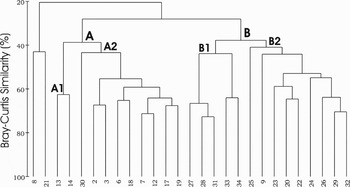
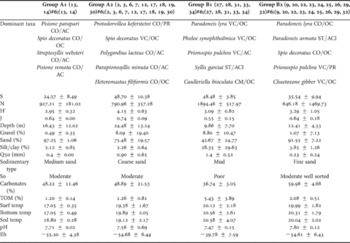
The ANOSIM test revealed significant differences in faunistic composition between all sites, except 7 and 12 (r: 0.18, P > 0.05), and 29 and 32 (r: 0.188, P > 0.05). Cluster analysis showed the presence of two large groups of stations (Figure 2): group A, subdivided into A1 (medium sand bottoms) and A2 (coarser sand sediments); and group B, subdivided into B1 (muddy sediments) and B2 (fine sand bottoms). MDS ordination showed similar results to those of the dendrogram, with an acceptable stress value (0.13). The abiotic and faunistic characteristics of four assemblages are summarized in Table 5 and their locations in the Ría de Aldán are shown in Figure 1.
Polychaete assemblages in the Ría de Aldán as determined by cluster analysis based on the Bray–Curtis similarity coefficient.

Summary of biotic and physical characteristics of the four assemblages derived from multivariate analysis. Dominant species are listed in order of dominance.

S, number of species; N, number of individuals; H′, Shannon–Wiener diversity index; J, Pielou's evenness; Q50, median grain size; S0, sort coefficient; TOM, total organic matter; bottom temp, bottom temperature; surf temperature, sea surface temperature; sed temperature, sediment temperature; AC, accessory; ACI, accidental; CM, common; CO, constant; OC, occasional; PR, preferential; ST, strange; VC, very common.
Results of the SIMPER analysis showed that Polygordius lacteus Scheneider, 1868, Paradoneis armata and Parapionosyllis minuta (Pierantoni, 1903) explained most of dissimilarity between groups A2 and B2. Streptosyllis websteri Southern, 1914 and Protodorvillea kefersteini contributed greatly to the differentiation of A2 from A1. Pisione parapari differentiated group B2 from A1. Group A2 differed from B1 due to Polygordius lacteus, Parapionosyllis minuta and Pisione remota (Southern, 1914). Paradoneis armata differentiates group B2 from B1. Pisione parapari and Streptosyllis websteri differentiate group A1 from B1.
The BIO-ENV procedure showed that very coarse sand, coarse sand, very fine sand, depth and TOM were the environmental variables that showed the highest correlations with faunistic data in combination (ρw: 0.551). Very fine sand and coarse sand were the variables with the best correlations when each variable was considered alone (ρw: 0.462 and 0.339 respectively).
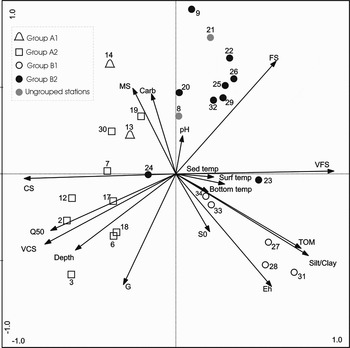
The forward selection of CCA selected very fine sand, very coarse sand, silt/clay and depth as the variables explaining most of the variance in the species data (P = 0.005). Axes I and II were the most important in CCA ordination, accumulating 30.6 of species variance and 38.9 of species–environment variance. Very fine sand and coarse sand showed the highest correlations with axis I. Cluster site groups dominated by coarser granulometric fractions are distributed on the right of the graph, while fine sand–muddy assemblages are on the left, following a gradient defined by a decrease in median grain size (Figure 3).
Canonical correspondence analysis (CCA) ordination of stations and environmental variables relative to axes I and II for the Ría de Aldán. Gravel (G); very coarse sand (VCS); coarse sand (CS); medium sand (MS); fine sand (FS); very fine sand (VFS); median grain size (Q50); sort coefficient (S0); bottom temperature (bottom temp); sea surface temperature (surf temp); sediment temperature (sed temp); carbonate content (carb); and total organic matter content (TOM).

Description of assemblages
Group A1 comprised two sites (13 and 14) of medium sand sediment. The assemblage was numerically dominated by Pisione parapari and Spio decoratus, and it was characterized by the presence of Glycera oxycephala Ehlers, 1887 and Hesionura elongata (Southern, 1914) (elective species).
Group A2 comprised coarser sandy sediments (sites 2, 3, 6, 7, 12, 17, 18, 19 and 30) and was characterized by the greatest depths. This group exhibited the highest diversity and evenness values. The most abundant species were Protodorvillea kefersteini and Spio decoratus. Ehlersia ferrugina Langerhans, 1881, Syllis pontxioi San Martín & López, 2000 and Trypanosyllis cf. rosea Grube, 1863 were found only here.
Group B1 (sites 27, 28, 31, 33 and 34) was characterized by muddy sand and the shallowest depths. This group showed the highest organic matter content and the highest total abundance value mainly due to the abundance of the paraonid Paradoneis lyra. This assemblage was characterized by the presence of Eunice vittata (delle Chiaje, 1828), Glycera rouxi Audouin & Milne-Edwards, 1833, Melinna palmata Grube, 1870, and Terebellides stroemi Sars, 1835 (elective species).
Group B2 mainly comprised fine sandy stations with higher values of carbonates (sites 9, 20, 22, 23, 24, 25, 26, 29 and 32). The most abundant species was Paradoneis lyra due to its abundance at site 23. Other abundant species were Paradoneis armata, Spio decoratus and Prionospio pulchra. This group was characterized by the presence of Magelona filiformis Wilson, 1959 (elective species).
Species affinities
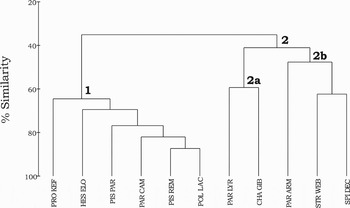
Cluster and MDS analysis performed on the abundance data of the species considered as dominant in each site showed the existence of two major species groups at 40% similarity level (Figure 4). Group 1 included species mostly found in coarse and medium sands (cluster groups A1–A2). Conversely, group 2 comprised species found in muddy and fine sandy sediments. Subgroup 2a comprised species with higher abundance in muddy sediments such as Paradoneis lyra and Chaetozone gibber Woodham & Chambers, 1994 (site group B1), while subgroup 2b was composed of species found in fine sand sediments (cluster group B2).
Dendrogram based on cluster analysis showing the classification of species with a numerical dominance ≥4% at any given site. Species code: CHA GIB, Chaetozone gibber; HES ELO, Hesionura elongata; PAR ARM, Paradoneis armata; PAR LYR, Paradoneis lyra; PAR CAM, Parapionosyllis minuta; PIS PAR, Pisione parapari; PIS REM, Pisione remota; POL LAC, Polygordius lacteus; PRO KEF, Protodorvillea kefersteini; SPI DEC, Spio decoratus; and STR WEB, Streptosyllis websteri.

DISCUSSION
The grain size gradient seemed to be the primary determining factor in the structuring of our polychaetes communities. The distribution of the molluscan assemblages in the Ría de Aldán also follows this sedimentary gradient (Lourido et al., Reference Lourido, Gestoso and Troncoso2006). Polychaetes and molluscs of another Galician ria have the same distribution as well (Moreira et al., Reference Moreira, Quintas and Troncoso2005, Reference Moreira, Quintas and Troncoso2006; Troncoso et al., Reference Troncoso, Moreira and Urgorri2005). In the Ría de Aldán, the grain size gradient is characterized by an increase in finer sandy fractions from the mouth of the ria towards the inner margins. The granulometry of the bottom is a consequence of the hydrodynamic regime in Galician rias. The presence of coarser sediments in the mouth is due to a stronger hydrodynamism (Troncoso et al., Reference Troncoso, Urgorri and Parapar1993) while a deposition of finer fractions occurs in inner, sheltered areas.
Two major faunistic assemblages were determined through multivariate analysis, groups A and B, subdivided into groups A1, A2, B1 and B2.
Group A1 had the lowest value of diversity because of its homogeneous sediment (medium sand) having a smaller variety of microhabitats. The assemblage ‘Goniadella– Spisula’ (Salzwedel et al., Reference Salzwedel, Rachor and Gerdes1985) is found in similar sediment in the North Sea. Pisione remota, Nephtys cirrosa Ehlers, 1868 and Goniadella galaica Rioja, 1923 (Goniadella bobretzkii in the North Sea) are the common species between the North Sea and Aldán. Baiona (north-western Spain) presents a ‘medium sand community of Grania– Streptosyllis websteri’ (Moreira, Reference Moreira2003). In this area of Ría de Aldán there is also a high dominance of Streptosyllis websteri.
The coarse sandy sediments of group A2 provide many microhabitats that support a high biodiversity of polychaetes (Villora-Moreno, Reference Villora-Moreno1997). Interstitial polychaetes live in those sediments with low organic content, occupying and moving through the holes between grains of sand. This coarse material has a high heterogeneity of interstitial environments (Simboura et al., Reference Simboura, Nicolaidou and Thessalou-Legaki2000), as well as high diversity, evenness and species numbers. Thus A2 had the greatest values of these univariate parameters, having high dominances of syllids and spionids. Furthermore, group A2 has a fauna that could be included among the different varieties of the ‘Branchiostoma lanceolatum–Venus fasciata community’ (Thorson, Reference Thorson1957). Several authors have reported the presence of similar faunal associations in other areas of Galicia, such as Ría da Coruña (López-Jamar & Mejuto, Reference López-Jamar and Mejuto1985), Ría de Ares-Betanzos (Troncoso et al., Reference Troncoso, Urgorri and Parapar1993) and Ensenada de Baiona (Moreira et al., Reference Moreira, Quintas and Troncoso2005). There are several different typical polychaetes in the ‘Branchiostoma lanceolatum–Venus fasciata community’ (Thorson, Reference Thorson1957) depending on the area. In the North Atlantic area (Glémarec, Reference Glémarec1973) and in Brittany (Toulemont, Reference Toulemont1972), these polychaetes are Polygordius lacteus and Aglaophamus rubella (Michaelsen, 1897). In Baiona (Moreira, Reference Moreira2003), the typical polychaetes are Nephtys cirrosa, Glycera lapidum Quatrefages, 1865 and Polygordius appendiculatus Fraipont, 1887. In the English Channel (Cabioch, Reference Cabioch1968), Nephtys cirrosa and Lumbrineris latreilli Audouin & Edwards, 1834 are the typical polychaetes. Ría de Aldán shares typical polychaetes present in these sediments (Polygordius lacteus, Glycera lapidum and Lumbrineris latreilli) as well as the molluscs Arcopagia crassa (Pennant, 1777) and Clausinella fasciata (da Costa, 1778) (Lourido et al., Reference Lourido, Gestoso and Troncoso2006).
The high dominance of Goodallia triangularis (Montagu, 1803) and Pisione parapari in groups A1 and A2 would define the presence of a facies of this community in the Ría de Aldán. This facies was already reported in Ensenada de Baiona (Moreira et al., Reference Moreira, Quintas and Troncoso2005) as ‘coarse sands of Goodallia triangularis–Pisione parapari’.
The greatest abundance of polychaetes was recorded in the muddy sands belonging to group B1, mainly due to the paraonid Paradoneis lyra. Paraonids are small and slender animals living in this muddy sediment where they feed on organic matter (Liebermann, Reference Liebermann1999). Group B1 can be considered an ‘Abra alba community’ (Petersen, Reference Petersen1918) according to the fauna living in this sediment. The ‘Abra alba’ community has been reported along European coasts in different types of muddy sediments (Glémarec, Reference Glémarec1964; Rees & Walker, Reference Rees and Walker1983; Gentil et al., Reference Gentil, Irlinger, Elkaim and Proniewski1986; Lastra et al., Reference Lastra, Mora, Sánchez and Troncoso1988, Carpentier et al., Reference Carpentier, Dewarumez and Leprêtre1997; Thiébaut et al., Reference Thiébaut, Cabioch, Dauvin, Retiére and Gentil1997) as well as in Galician rias (Cadée, Reference Cadée1968; Olabarría et al., Reference Olabarría, Urgorri and Troncoso1998; Sánchez-Mata & Mora, Reference Sánchez-Mata and Mora1999; Moreira et al., Reference Moreira, Quintas and Troncoso2005; Troncoso et al., Reference Troncoso, Moreira and Urgorri2005). The characteristic polychaetes in this Abra alba community are Nephtys hombergii Savigny, 1818, Pista cristata (Müller, 1776), Melinna palmata, Euclymene oerstedii (Claparède, 1863), Lagis koreni Malmgren, 1866, Pherusa eruca (Claparède, 1870), Sthenelais boa (Johnston, 1839) (Cabioch, Reference Cabioch1968; Lastra, Reference Lastra1991). The last five of those polychaetes as well as the molluscs Abra alba (Wood, 1802), Abra nitida (Müller, 1776), Nucula nitidosa Winckworth, 1930, Corbula gibba (Olivi, 1792) and Mysella bidentata (Montagu, 1803) are the species showing preference for the muddier sediments of Aldán (group B1).
Group B2 had fine sands, where there were abundant deposit-feeder polychaetes such as spionids and cirratulids. The former live in tubes made of bottom material held together by mucus, and the latter dig their way through sediment (Liebermann, Reference Liebermann1999). Chamelea striatula (da Costa, 1778), Mysella bidentata, Thracia papyracea (Poli, 1791), Spiophanes bombyx (Claparède, 1870), Glycera tridactyla Schmarda, 1861 and Nephtys cirrosa are present in group B2. These species characterize this group as a ‘Venus gallina community’ (Thorson, Reference Thorson1957). The Venus community turns into a Tellina community by a decrease in the abundance of Chamelea striatula and Thracia papyracea and by an increase in the numbers of Angulus tenuis (da Costa, 1778) and Fabulina fabula (Gmelin, 1791). The Tellina community was described by Stephen (Reference Stephen1930, Reference Stephen1933) as ‘boreal Lusitanian Tellina community’ for the Scottish coast and by Thorson (Reference Thorson1957) as ‘Tellina tenuis–Tellina fabula community’.This community is characterized by the polychaetes Nephtys hombergii, Magelona johnstoni Fiege, Licher & Mackie, 2000, Magelona filiformis, Nephtys cirrosa and Owenia fusiformis delle Chiaje, 1844. The last three of those species are in this group B2.
In our study area we found a high number of species of polychaetes in comparison to other Galician rias. Those other rias have higher organic matter content and muddier sediments (López-Jamar, Reference López-Jamar1978, Reference López-Jamar1981).
In the present case, bottom characteristics are certainly the major factor controlling the polychaete fauna distribution.
ACKNOWLEDGEMENTS
The authors express their gratitude to their laboratory colleagues for their invaluable help with many tasks, including sample collection, and also to the Spanish Education and Science Ministry for the FPU scholarship.