Introduction: a long and winding road of transition
Indonesia and Thailand have gone through major regime transitions. In the past, the studies of military interventions in politics in the two countries launched a discourse on ‘guided democracy’ (Kroef, van der, Reference Kroef and van der1957) and ‘demi-democracy’ (Dhiravegin, Reference Dhiravegin1991). Democracy with adjectives (Collier and Levitsky, Reference Collier and Levitsky1997) underlines the blurred and often inconsistent boundaries used to demarcate regime types. This article holds that Indonesia from 1971 to 1999 and Thailand from 1979 to 2001 (excluding 1991–92 when it was under outright authoritarianism) were not simply democracies with some defects, defined here as countries that allow free and fair elections devoid of substantial irregularities and respect fundamental civil liberties, however experience weaknesses in governance along with non-participative political culture, but fell firmly within the category of hybrid regime. And because during that period these countries were non-democratic but also non-authoritarian, they should be called ‘hybrids’ instead of ‘democracy with adjectives’ to avoid validating any pseudo-democratic governments and prevent conceptual confusion. The characterization of Indonesia and Thailand as hybrid regimes during certain periods is shared by scholars such as Leonardo Morlino (Reference Morlino2008), Leah Gilbert and Payam Mohseni (Reference Gilbert and Mohseni2011), Andrea Cassani (Reference Cassani2012), and Jean-François Gagné (Reference Gagné2012), for example.
The transition from a hybrid regime to a democracy in Indonesia began around 1999 after the fall of President Surhato. The four constitutional amendments concluded in 2002 indicated Indonesia was well on its way to democratization. Since the first direct presidential election in 2004, the Indonesian governmental system has been relatively stable and on the road to steady democratic consolidation (Bhakti, Reference Bhakti and Rolfe2004; Weber, Reference Webber2005).
The latest movement from a hybrid regime towards democracy in Thailand began after the promulgation of the 1997 Constitution that led to the 2001 election. Although the 1997 Constitution was widely recognized as one of the most democratic constitutions in its history, paradoxically it provided the basis for Prime Minister Thaksin Shinawatra's dominant power and ultimately the impetus for the 2006 military coup (Hicken, Reference Hicken2006; Kuhonta, Reference Kuhonta2008). The most recent military takeover in May 2014 completed the unfinished business of the 2006 coup by ousting Yingluck, Thaksin's sister. The prime minister and the head of the military junta, General Prayut Chan-o-cha, appointed a committee to draft the 2017 Constitution that was approved by 61.4% of the voters in the referendum with a 59.4% voter turnout.
Against these backdrops, the task of this article is twofold. The first is to study the transition of the two hybrid regimes with military legacies in the Southeast Asia region, namely Indonesia and Thailand, in order to answer why a transition to democracy in Indonesia during the period 1999–2004 was successful, whereas the transition in Thailand during the period 1997–2006 has culminated in a reversion to authoritarianism.Footnote 1 The second is to inspect the composition of cabinets and parliaments and how they were formed, with the focus on the Abdurraham Wahid's and the Megawati Sukarnoputri's administrations for Indonesia and the Thaksin Shinawatra's two administrations for Thailand, in order to explain the different outcomes in the two countries. The cabinets and parliaments studied here operate under different government systems: a presidential system in Indonesia, and parliamentary system in Thailand. The objective of this article is not to discuss the consequences of institutional design between parliamentary and presidential regimes, which is well covered by a substantial political science literature (Linz, Reference Linz, Linz and Valenzuela1994; Stepan and Skach, Reference Stepan, Skach, Linz and Valenzuela1994; Huber, Reference Huber1996). I do not claim that cabinet and parliament composition sufficiently account for why a hybrid regime in Indonesia was able to make a transition to democracy, whereas Thailand's hybrid regime fell back into autocracy. I only believe that an analysis of these two institutions helps expand our understanding of the success and failure of regime transition.
Two major arguments are presented. First, I argue that a departure between Indonesia's and Thailand's paths to democracy lies in the representative institutions’ ability to bridge divisions in society and create an atmosphere of inclusiveness. By inclusiveness, I mean the status of including many different socio-political groups and treating them as fairly and equally as possible. Thailand's inability to reach political inclusiveness was a result of institutional design as well as Thaksin's political style. Low inclusiveness led to diminished legitimacy. The Thaksin's government faced challenges of diminished legitimacy while also suffering from weak alliances. On the contrary, during the Indonesian transition period, major segments of society were included in major junctures of decision-making processes. Although there were many disagreements among various groups of civilian and military leaders and social movements, the efficacy in re-distributing power and resources to networks of societal elites who were previously excluded allowed a successful transition in Indonesia (Fukuoka, Reference Fukuoka2013).
Secondly, I maintain that Indonesia's institutional rearrangements appeared to sustain popular participation and engendered momentum for fostering democracy by struggling to eradicate authoritarian remnants, specifically the military and police, implanted as tutelary institutions. On the other hand, institutional reform in Thailand was characterized by a tendency to prolong elite domination by establishing tutelary institutions to minimalize the roles of elected bodies. These contrasting aims resulted in divergent characteristics of the political institutions and the outcomes of regime transition in the two countries.
The article begins with a brief review of concepts concerning hybrid regimes and democratization. Then I proceed to describe the composition of Indonesia's and Thailand's cabinets and parliaments, and evaluate their institutional designs and attempts at re-engineering. The concluding remarks will focus on the different aspects of the transition processes.
Hybrid regimes and democratization
The third wave of democratization produced many types of regimes that do not fit conventional classifications. These regimes are not outright autocracies because they hold elections from time to time, provide some form of pluralism and competition among political parties, but they also lack many features of democracies such as the capacity to change rulers by the people, free and fair elections, and the principle of respect for civil liberties. These non-democratic, non-authoritarian regimes are referred to as hybrid regimes.
However, there are different kinds of hybrid regimes. This has produced inevitable disagreements over their conceptualization (Munck, Reference Munck1996; Morlino, Reference Morlino2009; Gilbert and Mohseni, Reference Gilbert and Mohseni2011; Cassani, Reference Cassani2014), resulting in many hybrid regime subtypes based on the genre of the regime's decisive arbiter, its ability to abuse state resources, dominate elections, and allow participation, rights, and liberties. The hybrid regime subtypes include for example, hegemonic party-system (Diamond et al., Reference Diamond, Linz and Martin Lipset1995: 8), illiberal democracies (Zakaria, Reference Zakaria1997: 27–30), electoral authoritarianism (Schedler, Reference Schedler2002: 36–7; Case, Reference Case2011: 1), competitive authoritarianism (Levitsky and Way, Reference Levitsky and Way2002: 53–9), semi-authoritarian (Ottaway, Reference Ottaway2003: 3), and autocracy with elections (Brownlee, Reference Brownlee2007: 25). A shared feature across these regimes is the cohabitation of democratic elements with the enduring practice of authoritarian governance (Schedler, Reference Schedler2002; Ottaway, Reference Ottaway2003). Many works capture the specific identities of hybridity by paying attention to the competitiveness of the electoral arena, namely whether a strong incumbent political party and state institutions constrain the organizational ability of the opposition, thus enabling a dominant party state to immerse its presence into civil society (Brownlee, Reference Brownlee2009: 517–20; Levitsky and Way, Reference Levitsky and Way2010: 321). Apparently, free and fair elections, a minimum condition for democracy, is crucial to separating regime types; however, the identities of the hybrid regimes encompass various institutional arrangements besides electoral competition. In this article, I draw heavily on the work of Gilbert and Mohseni (Reference Gilbert and Mohseni2011), which apply multi-dimensional perspectives to classify hybrid regimes, to capture the characteristics of Indonesia's and Thailand's hybridity. The characteristics that they use to justify their categorization are competitiveness (rules of the game that fairly structure electoral competition), tutelary interference (reserved domains of non-elected institutions such as militaries, monarchies, or religious authorities that engage in politics), and civil liberties (such as freedom of speech, assembly, and the right to alternative sources of information). Gilbert and Mohseni label Indonesia between 1999 and 2004 a tutelary (military interference) illiberal hybrid regime, and likewise brand Thailand circa 1990s up to 2010, specifically between 1992 and 1995 and 2007 and 2009 as a tutelary (military and monarchy interference) illiberal hybrid regime and between 1996 and 2005 as a tutelary (military and monarchy interference) liberal hybrid regime.
Based on these three dimensions, since the second election in 1971, Indonesia is illustrative of the tutelary hybrid regime with an unfair structure of competition and lack of competitiveness reflected in Golkar's ability to control campaign activities, disqualify candidates, and review speeches. In 1973, President Suharto slashed the number of parties participating in the election to three (Ufen, Reference Ufen2006), and the only two legal opposition parties were a creation of Suharto himself, designed to foster internal infighting (Gagné, Reference Gagné2012: 172) Suharto was not directly elected, but won seven consecutive presidential nominations by the People's Consultative Assembly (MPR), many of whose members were nominated by him. His own political party, Golkar, dominated the House of Representatives until he stepped down in 1998. Notably, Indonesia’ one-party state with a highly personalized executive operated against the backdrop of the military's inordinate influence over political institutions. The Indonesian military (Tentara Nasional Indonesia/TNI) had appointed representation in both the local and national legislatures; out of 500, 100 seats in the 1987 legislative election were reserved for the military (Weatherbee, Reference Weatherbee1986: 142). Its socio-political role was justified by the Dwifungsi (Dual Function) doctrine and the kekaryaan policy that allowed active military officers to serve in strategic positions in the bureaucracy and state-owned corporations (Crouch, Reference Crouch1978: 344). The three features – Suharto's personalization, tutelary influence of the military, and dominant limited multiparty – demonstrated Indonesia's ‘triple hybrid’ regime (Geddes, Reference Geddes1999).
On the civil liberties axis, Indonesia and Thailand were alike; they did not score high in safeguarding civil rights and civil liberties, albeit with divergent degrees at different times. Poor law enforcement, limited freedom of expression, and state censorship were evident in both countries. But there was a distinctive feature that separated Thailand's hybridity from that of Indonesia's; Thailand seemed to have a relatively fair and even electoral playing field for competing political parties, reflected in the rather high turnover. It must be mentioned, however, that although the electoral arena played an important role in the distribution of power, winning elections did not necessarily produce a change of a prime minister. Specifically, the prime minister was not necessarily the result of an election. Thus, setting up a political party and contesting elections was not seen as essential mechanism for the ruling elites in seizing the state power. In contrast to rules twisted in favor of Suharto's Golkar, political party acts and electoral laws, in Thailand, the rules, excluding those under the 1997 Constitution, were wittingly created to curtail the influence and performance of all political parties across the board, motivated largely by distrust and fear of politicians. This might explain an absence of a dominant party until the 2005 election. The prolonged attempt to circumvent political parties resulted in a weak institutionalization of the party system, which was unable to become an agent of political change.
The 1978 ConstitutionFootnote 2 allowed General Kriangsak Chamanan, who did not run in a multi-party election in 1979, to form a government predominantly out of the support of the senators,Footnote 3 appointed by him just before the election result was announced (Ramsay, Reference Ramsay1980). Prime Minster Kriangsak was forced to resign and replaced by General Prem Tinsulanonda. The period between 1980 and 1988 under Prime Minister Prem was widely branded as a ‘semi-democracy’ because the military continued to play a strong political role within the parliamentary framework (Maisrikrod, Reference Maisrikrod and Laothamotas1997: 152) as the prime minster was not elected, but was invited by a coalition of political parties, the Senate was appointed by the prime minister, and political legitimacy came down from the monarchy, not from elected agencies. In fact, these characteristics matched well with Gilbert and Mohseni's hybrid regimes’ identities, especially the dimension on tutelary interference that produced constraints on the agency of national legislation and elected leaders by unelected bodies. In light of this example, although there is an inclination to explain hybrid regimes as an offshoot of the third wave (Levitsky and Way, Reference Levitsky and Way2002: 6; Schedler, Reference Schedler2006: 3), I hold that hybrid regimes are not new. In the Thai case, a hybrid regime has continued to exist since 1978, displaying a blend of elections as rituals and authoritarian features rooted in its historical development since the transformation from absolute monarchy in 1932.
Regarding the potential of hybrid regimes to transition, Levitsky and Way argue that hybrid regimes – what they term competitive authoritarianism – are not destined towards eventual democratization (Levitsky and Way, Reference Levitsky and Way2002). This does not mean, however, that hybrid regimes are naturally unstable and easy to breakdown either. Every hybrid regime has its own distinct dynamics and movements. Thailand is an example of a hybrid regime that has demonstrated the ability to endure, and hybrid institutions continue to stabilize and recur in a circular pattern. After a certain period of military government, democratic structures such as electoral process, the House of Representatives, and the legal system were brought back into operation, but these institutions were ably manipulated in order to preserve the dominance of the hybrid regime via tutelary institutions. In recent years, Thailand has shifted towards authoritarianism to the extent that it can be argued that the country is now in the process of ‘exiting’ democracy (Tamada, Reference Tamada2014). It is expected that Thailand will return to multiparty elections in the next few years after implementation of the 2017 Constitution. However, the entire institutional arrangements will induce Thailand to remain as a hybrid regime, despite the democratic façades set up to legitimize the political system,
Indonesia, on the other side, is an example of a hybrid regime that eventually democratized. The transition phase between 1994 and 2004 was the initial movement away from an authoritarian arrangement where non-democratic institutions and procedures were gradually replaced by new democratic structures. Some Indonesian scholars maintain that Indonesia is a consolidated democracy because no short- or long-term threats of regression to the authoritarian rule exist and the system has found a self-perpetuating equilibrium with a low probability of democratic breakdown (Abdulbaki, Reference Abdulbaki2008; Mujani and Liddle, Reference Mujani, William Liddle, Aspinall and Mietzner2010; Hillman, Reference Hillman2011).
Landscape and the formation of cabinets
There have been at least two studies comparing the roles of the courts in Indonesia and Thailand (Leyland and Harding, Reference Leyland and Harding2008; Dressel and Mietzner, Reference Dressel and Mietzner2012), but an examination of the structures and formations of cabinets and parliaments in the two countries are still limited. Verdi Hadiz, Richard Robinson, and Michael Buehler are among the scholars who studied the roles of elected institutions during the transition period in Indonesia. While Hadiz (Reference Hadiz2010) and Robison and Hadiz (Reference Robison and Hadiz2004) maintain that a small group of wealthy individuals rooted in the previous regime continue to define politics in Indonesia's democratized era, Buehler (Reference Buehler, Ford and Pepinsky2014) argues that state elites started to reach out in the political arena because they had to compete with one another in a new competitive environment. As a result, state elites have become much more dependent upon society than during under the Suharto's presidency. In his study, Aaron Stern (Reference Stern2006) identifies the Thai legislature's positive role in shaping prospects for regime change with substantial influence over the formulation and implementation of public policy. Stern states that such an improvement is rooted in a better relationship between the legislature and the civil society. From another perspective, Jürgen Rüland et al. stipulate that the feeble role of the Thai parliament, compared to extra-parliamentary forces, contributed to negative democratic consolidation (Rüland et al., Reference Rüland and Nelson2004: 25–94).
In this section, I contend that cabinet and parliamentary actors are important determinants of the democratic potential that can deepen or restrain democratic consolidation. While Indonesia had more diverse and inclusive cabinets that led to democratic deepening, the lack of inclusiveness in Thailand's cabinets resulted in a failure of democratic transition and subsequently the tutelary institutions were installed to curtail democracy.
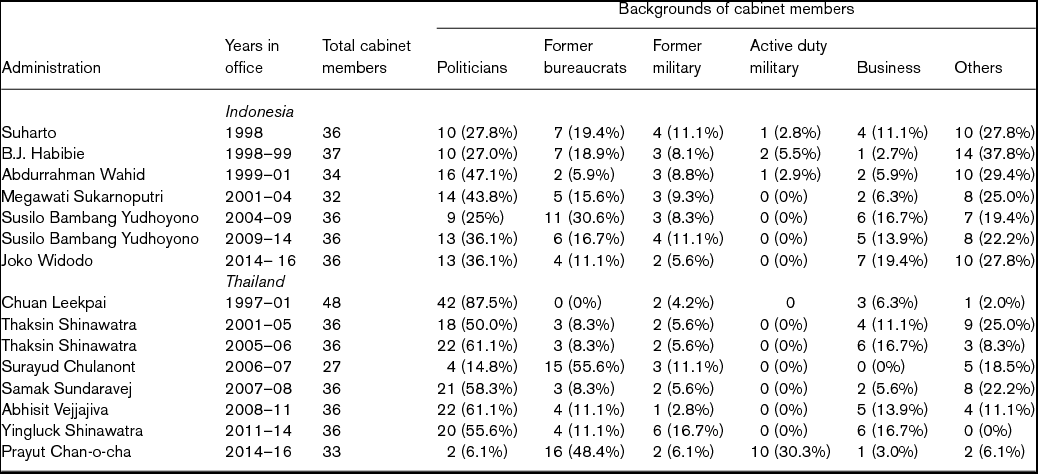
Table 1 shows that four social profiles dominated the cabinets in Indonesia and Thailand, namely politicians, former state bureaucrats, business persons, and former military officers.Footnote 4 In Indonesia, at least one active military officer participated in each of Suharto's, Habibie's, and Wahid's administrations, but from 2001 onward, there was no duty military officer in the Indonesian cabinets. Regarding Thailand, since the amendment of the 1992 Constitution and during the adoption of the 1997 and 2007 Constitutions, active duty military officers and bureaucrats were prohibited from serving in the cabinet. Only after the recent coup in 2014 were ten active duty military officers allowed to join the cabinet. Notably, in both countries, there has been the continued presence of retired military personnel among cabinet ministers, around 5.6%–11.1% in Indonesia and 2.8%–16.7% in Thailand. The high ratio of former bureaucrats in both countries was remarkable as well, as high as 30.6% in Indonesia. Under the interim government led by General Surayud Chulanont, installed by the 2006 military junta, the majority, or 55.6%, of the Thai cabinet ministers were former bureaucrats. In many respects, ministers with military and bureaucracy backgrounds in both countries were granted cabinet positions as intermediary players, conduits for intercession, negotiation, communication and bargaining that interfaced between the old establishment and new participatory institutions. The ratio of career politicians and ministers with business backgrounds in Indonesia has steadily increased since the democratization process started in 1999, varying from 25% to 47.1% and from 5.9% to 19.4%, respectively. As expected, in Thailand, the number of career politicians and business persons was noticeably high during the elected government (1997–2006 and 2007–14), approximately 50%–61% of politicians and 11%–6% of cabinet members with business backgrounds. The fluctuation is obvious; the ratio of career politicians grew extremely low under the military-led cabinets (2006–07 and 2014–present).
Backgrounds of cabinet members, Indonesia (1998–2017) and Thailand (1997–2017)

Source: Indonesia's data came from Indonesia's Office of Cabinet Secretary of Republic Indonesia (Sekretariat Kabinet Republik Indonesia) http://setkab.go.id/en/ (cabinet profile) and from The Jakarta Post, ‘Jokowi's new Cabinet: Who's the boss now?’, 28 July, 2016a, http://www.thejakartapost.com/longform/2016/07/28/whos-the-boss-now.html. (accessed 30 July, 2016). Thailand's data came from Thailand's Secretariat of the House of Representatives https://www.parliament.go.th/ewtadmin/ewt/parliament-parcy/main.php?filename=index-5---EN and Secretariat of the Cabinet of Thailand http://www.soc.go.th/eng/.
Besides these differences and some similarities in terms of professional backgrounds mentioned above, upon closer examination I found that the divergence in the results of the democratization processes between Indonesia and Thailand was based primarily on the ability to integrate different social forces into the political institutions instead of pushing these forces into opposition. In order to gain people's trust and support, Abdurraham Wahid formed an inclusive and representative cabinet, called ‘the National Unity Cabinet’ (Mackie, Reference Mackie1999). The cabinet, composed of prominent figures such as Vice President Megawati Sukarnoputri, Akbar Tanjung, Amien Rais, Hasballah M. Saad, and General Waranto, was an act of balancing and of ensuring the representation of traditional elites, religious groups, nationalist factions, political parties, and the military (Gerlach, Reference Gerlach, Derichs and Thompson2013: 273). A broad-based power sharing among major political actors that boded well for national unity and consensus helped Indonesia's nascent democracy withstand challenges and difficulties from the beginning.
Although the Indonesian president has the authority to form a cabinet without formal parliamentary involvement and sole power to appoint and dismiss a minister at will, in practice he or she cannot form a cabinet and appoint cabinet members without the cooperation of the political parties. This is because the president's party has always been a minority party in parliament – Yudhoyono's Partai Demokrat held 10.5% of seats in 2004 and 26% of seats in 2009, and Widodo's Indonesian Democratic Party of Struggle controlled only 19% of MPs in 2014. Under these circumstances, the presidents were under pressure to gain support from the House in order to carry out policies. In 2009, Yudhoyono created a six-party coalition and gave 17 of the 34 cabinet positions to the coalition parties, and, in 2014, Widodo's ruling coalition initially had four major parties, all of which controlled cabinet seats. However, in 2015 and 2016, former opposition parties, the Golkar and the National Mandate Party (PAN), broke away from the opposition block and pledged their support for the government (Syailendra, Reference Syailendra2016; The Jakarta Post, 2016b: 1), resulting in Widodo's six-party coalition administration in 2016. Thus, although Widodo received support from roughly 69% of the House, his ability to govern without parliamentary gridlock and to advance his policy agenda depended critically on coalition building. Although the high number of coalitional partners increased the president's transaction costs for approving and implementing his or her policy agendas, sharing cabinet seats with the medium- and small-sized parties in the coalition helped reduce deadlock, thereby diminishing the risk of authoritarian reversion. This pattern of cabinet inclusion provided an arena of contestation as well as collaboration with the opposition.
Thailand's cabinet is headed by the prime minister, who, since the amendment of the 1992 Constitution, must be an elected MP. Thailand's government format provides executive discretion in choosing cabinet members without requiring parliamentary approval. Therefore, coalition formation takes place behind closed doors and allocation of cabinet seats is confined to the sphere of ‘invisible politics’ (Sartori, Reference Sartori1978: 103), of private negotiation within political parties, or among societal elites. Moreover, it has become an established practice since the beginning of parliamentary democracy in 1932 that the prime minister selects persons, usually (but not necessarily) members of the House of Representatives, as ministers or deputy ministers. In other words, a cabinet member does not have to be an elected representative. This allows an ‘outsider’ to sit in the executive branch, chosen primarily by the coalition's party leaders and not necessarily by the prime minister. As a result, the prime minister normally has no real power to recruit or dismiss a minister outside his or her political party. Thaksin's first coalition government in 2001 was composed of two medium-sized political parties, sections of big business, the state bureaucracy, and former army officers. Four ministerial posts were given each to the Chart Thai party and the New Aspiration party. Thai businessmen, who were Thaksin's close confidants, took other key positions in the cabinet and the defense and deputy defense ministers went to two former army officers, Chavalit Yongjaiyuth and Yuthasak Sasiprapa. The first Thaksin government survived for a complete parliamentary term – a first for Thailand.
When Thaksin formed a single-party government, after the 2005 election, for the first time in Thailand's history, the power of the prime minister in appointing cabinet members was not so much an issue because he hand-picked all cabinet ministers by himself. Thaksin's cabinet in his second term was composed of 14 close confidants, 11 politicians from various factions within the Thai Rak Thai party, six capitalists and four experts in law, education, economy, and finance; only seven ministers out of 35 were drawn from the pool of parliamentary members. The noticeably low ratio of cabinet members outside the four social groups, only 8.3% compared to 25% in his first term cabinet, revealed a drop in the level of inclusiveness. The difference was even more pronounced when measured against Wahid's and Megawati's governments, which included 29.4% and 25%, respectively, of cabinet members with social profiles outside the distinct elite clique of politicians, former state bureaucrats, former military officers, and business persons. The prime ministers of the United Kingdom, such as Thatcher, Blair, and Brown also appointed several ministers from outside the parliament, arguably to widen the skills and experience available to the government. But, such outsiders were appointed as junior peer ministers and so became accountable to the House of Lords (Yong and Hazell, Reference Yong and Hazell2011). The primary purpose of Thailand's constitutional provision, permitting an outsider to sit in the executive branch, was not to promote government effectiveness and expertise, rather it was exploited to nominate people from personal networks, party financiers, and faction leaders who did not run in election. And members of the legislature did not devise a mechanism to ensure that the outsider cabinet members were directly accountable to the parliament. The number and breadth of outside appointments under the Thaksin's second administration reinforced limited participation and narrow involvement, rather than signaling inclusivity. This composition of the cabinet also reflected organizational weakness and the lack of internal party democracy, underlying problems of political reward. This was a configuration that produced more definitive winners and losers in the political field.
Besides the pattern in forming the government, Thaksin's strongman style of leadership also contributed to the shortage of diversity and lack of inclusiveness. Thaksin declared on many occasions prior to the 2005 election (such as during the Thai Rak Thai's Annual Meeting on 27 April 2003 and the party's seminar for election preparation on 27 December 2003) that his Thai Rak Thai party would be the only party forming the government for at least 20 years. To consolidate his power, Thaksin amalgamated other parties and attracted members of other parties to his Thai Rak Thai Party (Sawasdee, Reference Sawasdee2006: 99–117). He was able to recruit opposition MPs to his party despite the constitutional rule banning politicians who had switched parties within 90 days of an election from running, because the prime minister controlled the timing of an election. But Thai Rak Thai members could not defect for fear that Thaksin might dissolve the House and call a snap election to punish them. Such an assertive leadership style was seen as a challenge to the traditional elites in Thailand.
In all respects, the divergence between Indonesia and Thailand was not simply a result of elite miscalculation in the Thai case and elite craftiness in Indonesia, it also reflected deep structural differences in the two countries’ hybrid regimes. The Indonesians’ scattered but strong opposition, both inside and outside electoral politics, as well as pressure to withstand the continued presence of military power convinced the Indonesian political leaders to exercise their authority more cautiously in order to avoid disintegration and to maintain the integrity of the country and the constitution. When President Wahid was accused of corruption and incompetence, he was voted out of office in a parliamentary session (Indrayana, Reference Indrayana2008: 174–79).Footnote 5 President Wahid's state of emergency decree was ignored by the army, which declined to close down parliament as he directed. Then, Megawati succeeded him in a peaceful transition of power (Candland and Nurjanah, Reference Candland and Nurjanah2001).Footnote 6 In contrast in the Thai case, when Thaksin was seen as a threat to Thailand's fledgling democracy (Phongpaichit and Baker, Reference Phongpaichit and Baker2004) for concentrating personal power and did not accept the democratic rules of checks and balances, he was confronted with a solid and broad coalition of opponents, composed of traditional elites, conservative networks, judiciary and bureaucracy that claimed royal moral support by wearing yellow shirts as a symbol of resistance. The Yellow-shirts movement, also known as the People's Alliance for Democracy (PAD) set the stage for the military coup that overthrew the popularly elected government in 2006 (Thabchumpon, Reference Thabchumpon2016: 96). The sturdy alliance between the traditional elites and the continued acceptance of military tutelary interference by the Bangkokian and urban middle class resulted in a critical distinction between Indonesia's and Thailand's transition to democracy.
Landscape of the parliaments and their powers
Generally, Indonesian and Thai members of parliament are predominantly male, aged 40–59, affluent, and highly educated, which is hardly reflective of the countries’ social structures. In Thailand, a rise in the average level of education among members of the House of Representatives from 1996 to 2011 was noticeable;Footnote 7 the number of members holding a master's degree in 2011 was 59.2% and a bachelor's degree was 28%.Footnote 8 After the 2009 elections in Indonesia, women held 18.2% of the seats in the House of Representatives, a rise from 11% in 2004. This impressive number was a result of the enforcement of the 2008 election law stipulating that at least one in every three candidates on a political party's list must be a woman.Footnote 9 The number of Thai parliamentary members who were women, although improving from 5.6% in 1996 to 15.8% in 2011,Footnote 10 was less inspiring.
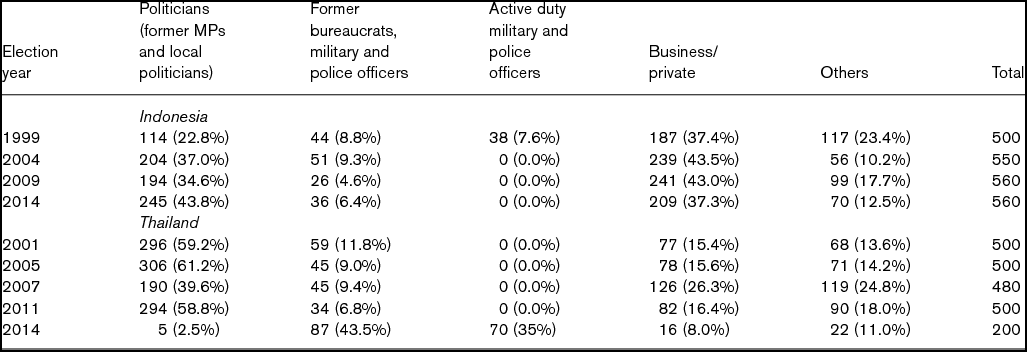
An analysis of legislators’ backgrounds in Table 2 shows that the social profiles of the two parliaments have been very exclusive, composed mainly of three major groups, namely professional politicians, former bureaucrats (including former military and police officers), and business people. The law on the 1999 parliamentary election, which took place during the pre-constitutional amendment period, granted 38 free seats (reduced from 75 previously) from the 500 seats in the Indonesia's DPR, to the Military and Police TNI-Polri. Thus, 462 seats were directly elected from the 21 political parties (Thompson, Reference Thompson1999). Not surprisingly, during the democratic transition period in both countries, a majority of the members of the House of Representatives were those who described themselves as politicians. There has been a steady rise in the ratio of politicians in Indonesia's House of Representatives, up from 22.8% in 1992 to 43.8% in 2014. During the elected governments, the ratio of career politicians in Thailand was even higher when measured against the Indonesia's numbers, specifically, 58.5% in 1996 rising to 61.2% in 2005. As expected, in the 2014 military junta's National Assembly, the politician segment in Thailand plummeted to only 2.5% and was replaced by the retired bureaucrats, who accounted for 43.5%, while active duty military and police officers gained 35% of seats in the National Assembly. Another major demographic group in the two parliaments was business persons; the percentage of legislators with business and private sector backgrounds was as high as 43.5% after the 2004 Indonesian election and 26.3% after Thailand's 2007 election. Former bureaucrats also represented a substantial figure in both parliaments, up to 9.3% in Indonesia in 2004 and as high as 11.8% in Thailand in 2001. Religious activists and academics are among the major occupations of the Indonesian parliamentarians’ social profiles, while lawyers and the self-employed form other groups in the Thai parliament.
Backgrounds of members of the House of Representatives, Indonesia (1999–2014), Thailand (2001–2014)

Sources: Author's calculations based on information from the General Election Commission of Indonesia and the Election Commission of Thailand. Data on the 1996 and 2004 Indonesia's elections come from Leo Suryadinata (Reference Suryadinata2002), Elections and Politics in Indonesia, Singapore: Institute of Southeast Asian Studies, pp. 224–43; and from Inter-Parliamentary Union (Reference Union2004). ‘Indonesia Dewan Perwakilan Rakyat (House of Representatives): Elections Held in 2004’, http://www.ipu.org/parline-e/reports/arc/2147_04.htm (accessed 2 June 2017), respectively.
At first blush, workers, farmers, and peasants seemed to be absent in the parliamentary social profiles of the two countries. However, in Indonesia, the capital–labour cleavage made it possible for these groups to exercise their voice through the party system (Ufen, Reference Ufen2008a); they unionized and cooperated with politicians and political parties. For example, the Gerindra Party has deep ties with the farmers union (Kelompok Tani) in West Java, Sumatra, Kalimantan, and Sulawesi. The Indonesian Workers and Employers Party (Partai Pengusaha dan Pekerja Indonesia) promoted policies for better wages and working conditions; the Indonesian Trade Union Confederation (KSPI) even placed its own candidates into several different parties (ABC News, 2014). Representatives for workers, farmers, and peasants were essentially absent in Thailand, due primarily to the fact that Thai labour unions and farmer associations were weak and fragmented (Chartrakul, Reference Chartrakul2010). The Thai Rak Thai courted rural voters and workers through policies, yet Thaksin studded his cabinets with leading business figures, and concrete linkages between labour/farmer associations and the party hardly existed, or were not meaningfully developed. In fact, socialist, leftist, reformist political parties representing the interest of lower social strata were virtually missing in Thailand. As a result, political parties have been entrenched in business politics. This is in keeping with observations that Thailand's inclusiveness was lower than that of Indonesia's.
Indonesia and Thailand were similar at the time they each held their respective first senatorial elections during the democratic transition. The third amendment to the 1945 Indonesian Constitution rules that the members of the Regional Representative Council (DPD) are elected by the single non-transferable vote system (SNTV) every five years at the same time as the members of the DPR. Each province elects four members, with a total of 132 senatorial seats. But in the April 2004 election, there were only 128 elected senators. In Thailand, prior to the 1997 constitution, members of the Senate were appointed by the King on the recommendation of the prime minister. The 1997 Constitution mandated that 200 senators were elected, also using the SNTV system as, but they were not allowed to campaign for elections. The first senatorial election in Thailand was held on 4 March 2000. The term of the Senate was six years, and the prime minister could not dissolve it. The elected Senate could not repeat their tenure for two consecutive terms. In both countries, senators must be non-partisan; in other words, they were prohibited from being affiliated with a political party. Yet, many candidates and elected senators in the 2004 Indonesia and the 2000 Thailand elections were found to have close links to the parties represented in the Houses of Representatives.
Table 3 displays the occupational breakdown of the first elected Senate of Indonesia and Thailand. The elected senators in both countries were dominantly people with business backgrounds: 39% in Indonesia and 34% in Thailand. Former bureaucrats formed the second largest group in both Indonesia's and Thailand's elected Senate, 23% and 9.4%, respectively. The Indonesian Senate was also composed of a high percentage of members identified as politicians, 9.4%, followed closely by people who used to work in the media, 8.6%. In Thailand, the third largest segment, 14.5%, was senators who previously served in the military or police, whereas in Indonesia only five members, or 3.9%, of the senators were retired military or police officers. Lawyers appeared to be the fourth largest group within the Thai Senate, at 12.5%. A substantial business and bureaucratic orientation of the Senates during the democratic transitions reflected the domination and concentration of economic and bureaucratic powers in the two countries. Although the Senate compositions in Indonesia and Thailand were quite similar, Thailand's elected Senate was seen as a source of nepotism among politicians and contaminated its impartial image, thus under the 2007 Constitution, the Thai Senate was transformed from an all-elected body to a half elected, half appointed agency. The appointed elements represented the tutelary institution.
Backgrounds of Indonesia's elected regional representative council (2004–09) and Thailand's elected senators (2000–06)

Source: Indonesia's data came from the Indonesian Regional Representative Council, www.dpd.go.id/en; and from Stephen Sherlock (Reference Sherlock2005) Indonesia's Regional Representative Assembly: Democracy, Representation and the Regions: A Report on the Dewan Perwakilan Daerah (DPD). Australia's data came from the Centre for Democratic Institutions, http://archives.cap.anu.edu.au/cdi_anu_edu_au/_research/2005-06/D_P/DPD%20research%20paper%20Jul%202005.pdf. Thailand's data came from The Election Commission of Thailand, Data, Statistics and Senatorial Electoral Results (2000) Bangkok: The Election Commission; and Thailand's Secretariat of the Senate http://www.senate.go.th/w3c/senate/secretariat.php.
Constitutional remodelling: processes and proposes
The following section recounts the procedures, measures, and intentions of constitution-making throughout the period of democratic transition in Indonesia and Thailand. After the fall of Suharto, the remnants of the hybrid regime forces, specifically the military, bureaucracy, and conservative networks of the Golkar party, were still powerful. Therefore, during the constitutional amendment process, these elements voiced their concerns. At the same time, Indonesia's party system also contributed to open and deliberative debates that took place before the four amendments were passed. The official power to amend the 1945 Indonesian Constitution belonged to the 700-member People's Consultative Assembly (MPR), the 500 members of the House of Representatives (DPR), of which 38 seats were reserved for the military and police officers, and 200 representatives of regional and functional groups. Representatives were selected from leaders of religious groups, various social and economic organizations, and minority groups. The People's Consultative Assembly amended the 1945 constitution four times in 1999, 2000, 2001, and 2002. These amendments resulted in establishing a direct link between voters and the president, empowering parliament, and strengthening the system of checks and balances. Important amendments included limiting presidents to only two terms of office and the direct election of presidents. The rationale for placing constitutional limits on presidential re-election was to prevent incumbents from taking advantage of their position to remain in power. Instituting term limits averted the potential for incumbents to subvert democracy in order to hold onto the presidency. A direct presidential election was significant because it affected the link between the president and voters. However, some scholars fear that a direct election will encourage the personalization of the presidency and a delinking of candidates from political parties (Liddle and Mujani, Reference Liddle and Mujani2007; Ufen, Reference Ufen2008b).
As a result of the third amendment in November 2001, Indonesia has a bicameral parliament. The People's Consultative Assembly is composed of the House of Representatives (Dewan Perwakilan Rakyat – DPR) with 560 seats, and the Regional Representative Council or Senate (Dewan Perwakilan Daerah – DPD) with 132 seats. The 2002 amendment established the Regional Representative Council to serve as the Senate as indicated earlier. The amendment also allowed the House of Representatives to gain more explicit legislative powers and to control the executive branch more effectively. The original text of the 1945 Constitution stated that the power to make laws was held by the president, with the consent of the House of Representatives. The reformed Constitution shifted this power to the House but required that a bill needed ‘joint agreement’ by both the House and the president in order to be passed. This process was to be facilitated by working groups formed between parliamentary members and the relevant ministries, after which the president would sign the bill into law. Since the constitutional reforms, the Indonesian parliament essentially transformed from a rubber stamp legislature into a powerful one. Notwithstanding, that the president maintained veto power, that required a majority vote in the House to override it, and the authority to issue decrees, which made the president a central player in the law-making process and reduced the chronic tendency towards deadlock between the executive and the legislative branches. More importantly, the Indonesian parliament succeeded in passing two cornerstone legislations on security sector reform, establishing the principle of civilian control and supremacy over the military. So far, the military has accepted these outcomes and stayed away from politics. This pro-democracy attitude of the military has contributed to the successful transition and allows Indonesia to progress and advance its democracy.
In 2014, Members of the House were elected by an open-list proportional representation system from 77 constituencies, each returning three to ten members based on population. Voters select their preferred candidate from the list. Each vote counts for both the party and the candidate. In terms of election law, an amendment passed by the House of Representatives in April 2012 stipulated that a party must win at least 3.5% (increased from 2.5%) of the national votes to be eligible for seats in the House. Consequently, the number of political parties contesting the general elections fell from 48 in 1999 to 12 in 2014. Political fragmentation gradually diminished; the number of parties elected to parliament dropped from 16 in 2004 to nine in 2014. It should also be noted that even though Indonesia is the world's largest Muslim country, the majority of its voters favour non-religious platforms, and national politics remains essentially secular.
The constitutional making in Thailand began when the parliament passed a Constitution Amendment Bill in May 1996. It led to the creation of a Constitutional Drafting Assembly (CDA), composed of 99 members. Seventy-six members were selected in total, one from each of the provinces. The others were experts in public law, political science, and public administration, were nominated by universities to be chosen by the parliament. The draft prepared by the CDA had been well explained to the public and was finally ratified by the parliament (Leyland and Harding, Reference Leyland and Harding2008). It was widely dubbed ‘the people's constitution’. That being said, two critical differences between Indonesia's and Thailand's constitutional-making processes were that, first, the Thai parliament was not accommodated in the bargaining for new rules of the game, and, second, the aim of the 1997 Constitution was to allow a strong government governed with as little intervention from the parliament as possible. Thus, the parliament was quite weak and endowed with little power, as compared to the government.
The electoral system for members of the House of Representatives was a vital factor contributing to a powerful government. The new system was put into effect on the 6 January 2001 election. Of the 500 members of parliament, 100 were elected nationwide through a proportional representation (PR) system with a 5% threshold and the other 400 were chosen through a single-member constituency plurality system. The PR system was designed to make the cost of vote-buying too expensive because the size of constituency was too large (the whole country) for any party to buy votes outright. The closed-list PR system, in turn, gave a party leader more control over the party's candidates and their positioning. After two elections, the effective number of parties in the legislature fell dramatically from an average of 6.2 before 1997 to 3.1 in 2001 and 1.6 in 2005, leading to a concern that Thailand was moving towards a two-party, or even one-party system. In the past, no political party had ever won the majority of the MPs, the small and medium-sized parties had great bargaining power and high potential to be in the coalition government. However, this was no longer the case after the change in the electoral system; after the 2005 election, the Thai Rak Thai managed to control the majority seats in the House of Representatives. A critical issue regarding election of the government leader under the PR system was that an elected party leader like Thaksin could claim a popular mandate more than ever before because he was elected from voters of the whole Kingdom of Thailand. After Thaksin was ousted in 2006, electoral systems and rules have been changed many times to thwart a dominant party and curtail the influence of electoral politics.
While Indonesia sailed in comparatively calm waters, Thailand, on the other hand, experienced political upheaval and democratic backsliding. Over the past 15 years, the balance of power between the people's elected representatives and those appointed from the aristocracy and bureaucracy shifted, leading to insecurity, anxiety, and uncertainty among the establishment, as exhibited in the 2017 Constitution. The 2017 Constitution signals a reversal of the 1997 Constitution's experiment. In particular, the new electoral system accords greater power to choose the government and prime minister to the Senate and to medium-sized political parties that do not do well in elections. Under the new MMA (Mixed-Member Apportionment) system, there will be 500 members of parliament (MPs); 350 MPs will be elected by the constituency, and 150 MPs will come from party lists. Each voter has one vote for a constituency candidate. The candidate with most votes wins that constituency. The party list MPs will be elected by combining each party's constituency votes. In other words, the number of votes cast in each constituency will also be used to calculate the number of party list MPs for each political party. This method not only deprives voters of the opportunity to directly elect party list candidates but may also result in a distortion of voters’ true preferences, as they may like the candidate but not the party of the candidate they choose or vice versa. Based on such techniques of translating votes into parliamentary seats, the more a party wins its constituency seats, the less it will be allocated the party list MPs. Consequently, it will be unlikely that any party will win the majority seats in the House. Therefore, a multiparty coalition government is likely to be formed after the election. More importantly, each political party will nominate three individuals for the premiership. These three nominees can be anyone, whether one of its own MP candidates or a complete outsider. This provision would allow a non-elected MP to become prime minister, if chosen by a joint session of the House and the Senate. The reversion to a non-elected prime minister represents a backward move for democracy. Regarding the Senate, for the first five years, there will be 250 appointed senators, with six seats reserved for military leaders. The appointed Senate is allowed to jointly vote with elected members of the House to select the prime minister.
Moreover, under Thailand's 2017 Constitution, the system of checks and balances is lopsided. The Constitutional Court holds the authority to remove the prime minister, MPs, senators, or cabinet ministers from office if they are not ‘apparently honest’ or do not behave according to prescribed moral standards (a definition or standard by which these breaches are to be assessed has not been explicitly detailed). The imposition of moral and ethical standards reflects a de-emphasis of democratic principles. Furthermore, the National Reform Steering Assembly, mainly composed of military leaders and individuals hand-picked by the military, is established to carry out a 20-year national reform programme. The implication is that the new cabinet will be forced to devise and implement policies according to this reform agenda, which might not be consistent with the overall interests of the people. In this light, the elected bodies do not possess real authority to govern; they are subject to the peculiar tutelary control of non-elected societal and bureaucratic elites.
Conclusion
Indonesia and Thailand are countries rooted in authoritarian traditions with a looming threat of military intervention in politics. For Indonesia, democratic transformation which started in 1999 has continually progressed. The military has become sufficiently professionalized so that speculations about a possible military coup have dimmed. The election process appears to be firmly entrenched in Indonesia. Thailand, on the contrary, is still experiencing institutional manipulations alternating with military intervention, resulting in stalemate. Through many twists and turns, Thailand never managed to move beyond a phase of democratic transition, suspended in a hybrid regime mode.
The transition phase experienced in Thailand and Indonesia offers three fundamentally different angles. First, in Indonesia, parliament defines rules through four major constitutional amendments, whereas political rules in Thailand are designed by extra-parliamentary forces, and the function of parliament has been curbed, unable to generate measures necessary to political reform in the long term. Devoid of the parliament's role in debating, deliberating, and bargaining during regime change, the constitutional drafting process was monopolized by intra-elite powers who made rules without being held accountable.
Secondly, in terms of political parties, in both countries, coalition governments are formed for the sake of capturing state patronage rather than ideological and programmatic compatibility. Yet, the difference is that the multiparty system has allowed Indonesia's coalition cabinets to perform relatively well so far, while reducing governability in Thailand. Besides, Indonesia's political parties, which have been organized along the lines of social cleavages, served as agents of political reform. In contrast, in Thailand where the linkage between political parties and segments of society did not exist, once the unintentional effects of the electoral system unprecedentedly produced the rise of a dominant party, the consequence was a single-party government and a prime minister who disregarded the value of inclusiveness. The lack of inclusiveness eroded the legitimacy of democratic advancement.
Thirdly, Indonesia's move toward a more stable democratic regime has been motivated by incremental changes and processes of realignment. The fear of the country's disintegration ensured the principle of inclusiveness, whereas the shift from one regime to another in Thailand occurred in a sudden and abrupt manner and quickly marked a return to the status quo of a hybrid regime. It appears that the 2017 constitutional engineering aims to shift the centre of political power from the legislature and elections to the tutelage of non-democratic institutions, resulting in a weak system of democratic checks and balances. Through the drafting of the Constitution, the military has sought to ensure the long-term supervision of Thai politics.
Thailand's hybrid regime can be perpetual and stabilised as long as the military continue to receive public support from the established members and the middle class who remain resistant to democracy. They prefer the military's interference than the possibility of ‘unruly democracy’ as they view that the Thai masses are not yet ready for democracy. In this scenario, they find the hybrid regime can best satisfy their needs and ease their fears. The Thai experience attests that with clear channels to distribute political patronage, and crafty tutelary political institutions to fragment elite and social forces driving for regime change, a hybrid regime is resilient and not easy to bring down.
About the author
Siripan Nogsuan Sawasdee is an Associate Professor and the Head of Department of Government, Faculty of Political Science, Chulalongkorn University, Thailand. Siripan received a Masters Degree in Comparative Politics from the Johns Hopkins University and a PhD from Kyoto University. Her research interests embrace comparative political parties and electoral systems, political behavior, institutional design, Thai politics, and civic education. Her research entitled ‘Voting Behavior and Pattern of Political Participation of the Thai Electorate in the Conflict Situation’ won an award from the National Research Council of Thailand for the Excellent Research of the year 2016. Her recent research entitled ‘Comparing Democratic Transitions’, funded by King Prajadhipok's Institute. Her forthcoming paper on ‘The Conundrum of a Dominant Party in Thailand’ will be published in the Asian Journal of Comparative Politics.