In her recent article in this journal, Joy Gordon provides an astute history and critique of the evolution and application of smart sanctions within the United Nations system since the mid-1990s.Footnote 1 Her analysis of the strengths and weaknesses of the discrete types of smart sanctions is part of a growing discussion among both academics and practitioners about the future and the utility of these measures.Footnote 2 As always, her continued skepticism about the effectiveness and ethical dimensions of economic sanctions deserves serious consideration and evaluation. In particular, Gordon raises three central concerns: (1) smart sanctions are no more successful than traditional trade sanctions; (2) each type of targeted mechanism has serious flaws; and (3) targeted sanctions did not end the humanitarian damage or the related ethical dilemmas that are embedded into sanctions design and implementation.
In this essay I argue that smart sanctions have been more of a pronounced success than Gordon claims. In addition, I address some of the flaws that she identifies as significant in the discrete types of sanctions. Finally, throughout this essay I project a rather different tone regarding humanitarian and due process issues than Gordon provides. This last, in particular, emerges from my judgment—open to discussion and critique, to be sure—that undergirding the disagreement between Gordon and my analysis here is a fundamental distinction. Gordon's guiding vision of sanctions emanates from what I call the “early '90s hangover.” By this I mean the disposition to employ the Iraq, Federal Republic of Yugoslavia, and Haiti sanctions cases from the early 1990s as the primary examples of sanctions' shortcomings and the lens through which both the general sanctions enterprise and the more narrowly targeted sanctions of this era should be judged.
In a range of articles and especially in her well-known work on Iraq, Gordon has already shown that these cases from the early 1990s were fundamentally flawed. And she rightly notes that smart sanctions were designed specifically to improve upon comprehensive trade sanctions. So it is odd that she and other critics use the excesses of these cases, such as their harsh humanitarian impact or their unfair and imbalanced arms embargoes, for assessing contemporary, targeted sanctions. This is a bit like comparing a 2012 hybrid automobile to autos in 1992. More precise sanctions tools need more precise assessment categories, and these have not emerged from the failed cases of twenty years ago.Footnote 3 I will provide specific examples in discussing humanitarian and arms embargo issues, but I begin by addressing Gordon's core concerns.
Comprehensive Trade vs. Targeted Sanctions
Gordon's first concern, that targeted sanctions are no more successful than general trade sanctions, has varied dimensions.Footnote 4 The first is Gordon's contention—echoing Daniel Drezner—that targeted sanctions, which are applied by the UN Security Council, will always have limited success because UN member states have varied goals in imposing them and quite diverse commitments to enforcing them fully.Footnote 5 But this is true of every public policy that is legislated, whether at the domestic or international level (for example, by a resolution of the Security Council). The measure of success of a policy lies not in the intentions of its framers, nor very much in assessing the roadblocks or inconsistencies that such a policy may manifest in its implementation. Rather, the measure of success lies in the empirical impact of the policy—and, in the case of sanctions, on constraining its targets in the manner specified in the Security Council resolution. Thus, a perfect policy outcome would be one in which the change in behavior of the target perfectly conforms to the resolution imposing the sanctions.
Moreover, because economic sanctions of even the targeted variety are political in nature, they will always be affected by the current tensions within the Security Council, with its various rivalries among regional and other powerful actors, and will invariably fall victim to problems of implementation, monitoring, and compliance. In the worst instances, issues of implementation, monitoring, and compliance are a function of the weak workings of the Security Council, in which major world powers will muster up the organizational strength to legislate targeted sanctions, but will have neither the political will nor the institutional strength to carry them out in full.
A second, data-based point undercuts Gordon's claim that targeted sanctions fare no better than trade sanctions. The global volume of trade for 2010 was nearly $15 trillion, more than double the $6 trillion of 1995. Moreover, the trade-based component of the gross domestic product of most countries has steadily increased as well. Both logically and empirically, then, the application of traditional trade sanctions focused on entire nations in our current era would have a much more substantial dislocation to both unintended secondary entities and, most certainly, the general population than they did in the early 1990s. Trade-based sanctions in 2012 would more rapidly affect the quality of life of average people within a targeted country, and in a more widespread manner. This is an outcome that Gordon clearly wants to avoid. Thus, it is difficult to understand how Gordon could argue that targeted sanctions imposed on those persons and entities most responsible for an objectionable policy, or placed on those who violate existing sanctions, fail to be superior to such broadly affecting trade sanctions.
A third approach to support my argument for the utility of targeted sanctions emerges if we assess their success by examining more than just the general strengths and weaknesses of the discrete types of targeted measures—for example, financial, aviation, and so on—that are analyzed by Gordon. Especially in judging the adequacy of Security Council sanctions, and as a recent book by Andrea Charron convincingly demonstrates, sanctions cases should also be analyzed in terms of the very specific types of violations in international law they are meant to correct and the UN Charter–based goals that the Security Council expressed in adopting them.Footnote 6 Utilizing this lens of analysis points to four types of goals for which sanctions are imposed: to end serious violent conflict; to prevent international terrorism; to control nuclear proliferation; and to protect human rights and civilians during serious violent conflict. After a brief discussion of each of these goals, I assess how well targeted, smart sanctions performed in achieving them.
Four Goals
For most of the first decade of the post–cold war era, Security Council sanctions were imposed on national rulers and nonstate entities with the aim of ending destructive violent conflicts and civil wars. The targets of these sanctions ranged from UNITA in Angola, to nations and factions in the Balkan Wars, to an array of entities and leaders fighting in African states. Not surprisingly, arms embargoes were significant in each of these cases.Footnote 7
The second arena for Security Council sanctions concerns the prevention of international terrorism. This type of sanctions began as a response to Libya's suspected role in the bombing of Pan American flight 103 in 1986 and expanded to employing travel bans and the locking down of financial assets against many individuals and entities accused of engaging in international terrorism. These would include members of the Libyan and Sudanese governments as well as those identified as Taliban and al-Qaeda extremists. The far-reaching UN Security Council Resolution 1373, which was adopted in response to the attacks of September 11, 2001, institutionalized the use of targeted sanctions measures against those listed as terrorist individuals or entities, even though that resolution was not a sanctions resolution per se.Footnote 8
Third, Security Council sanctions regimes have emerged to control the proliferation of weapons of mass destruction. While such scholars as Gordon have been correct to examine and critique the manner in which the Iraqi sanctions episode resulted in unprecedented humanitarian damage, the bitter reality of the UN sanctions from 1990 to 2003 against Iraq is that they played a significant role in disarming Saddam Hussein's arsenal of weapons of mass destruction and in denying him monies that might have been used to purchase other deadly weapons systems. There is a direct continuity from the Iraq sanctions to the more recent targeted measures imposed against attempted proliferator Iran and recent nuclear club member North Korea.Footnote 9
Finally, the most recent and variously used sanctions aim at protecting civilians in the midst of war from atrocities or from being brutalized by dictatorial regimes. Here again there is a clear continuity between the sanctions that were imposed against African entities, such as UNITA in Angola and the Revolutionary United Front as it operated in Sierra Leone and Liberia, and the recent UN sanctions on the Qaddafi regime in Libya. In the former cases, the United Nations was attempting to deny these groups access to natural resources, such as diamonds and timber, the proceeds of which were used to fund ongoing wars with particularly harmful consequences for women and children. By the time the crisis in Libya emerged, a wider principle for proactively shielding innocent civilians—the responsibility to protect—gave added momentum to the imposition of sanctions against the Libyan regime and its supporters.Footnote 10
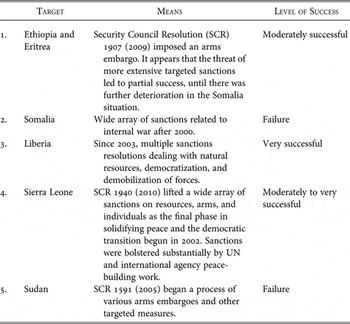
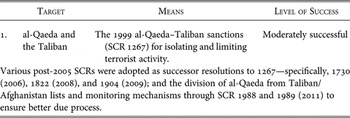
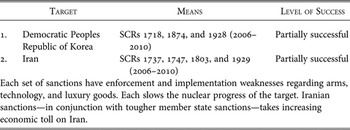
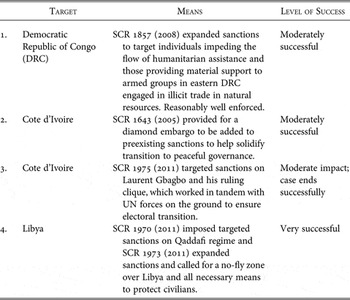
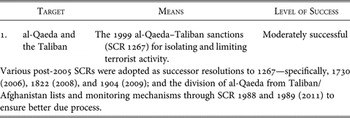
While a fully detailed analysis of the success of targeted sanctions in meeting each of these Security Council goals is beyond the scope of this essay, the brief summative chart below lists each of the cases involving targeted sanctions in each goal environment since 2005, as all sanctions since then were clearly targeted. The ratings are my own judgments—or, more accurately, what I judge to be the general consensus in the UN community regarding these cases.
Sanctions for ending serious violent conflict

Sanctions for preventing international terrorism
Sanctions for controlling nuclear proliferation

Sanctions for protecting human rights and civilians in serious violent conflict

The success of smart sanctions, even considering the attendant difficulties in applying any type of sanction, appears rather high. Of the twelve smart sanctions cases above, two are outright failures, and these come in two of the most intractable violent conflicts on the globe, in Sudan and Somalia. The nuclear nonproliferation cases have had moderate success in slowing or retarding the weapons systems developments of the targets; but we can also allow for a strict interpretation of success in these cases and claim that Iran has not ended uranium enrichment and that North Korea has not dismantled and foresworn its nuclear weapons. For argument's sake, then, let us label these too as failures. This still leaves eight of the twelve cases as moderately to very successful at achieving Security Council objectives, in particular in the core areas of peace and security and human rights.
Humanitarian Impact and Due Process Rights Concerns
Joy Gordon has been the foremost singular intellectual voice calling for close scrutiny of sanctions on humanitarian grounds and for the application of ethical criteria to assess them. Thus, it is not surprising that she has astutely pointed out the serious impact of aviation sanctions on health and other sectors, and the potentially far-reaching legal and ethical dilemmas inherent in the sanctions listing process and in financial sanctions.Footnote 11 No serious analyst of sanctions can claim that smart sanctions have no unintended consequences, or that there are no inconsistencies in particular cases.
The disagreements I have with Gordon's assessment—in addition to the '90s hangover mentioned at the outset—are twofold. First, the humanitarian impact of targeted sanctions is miniscule compared to that during the era of trade sanctions, and Gordon does not place her current examples in that larger context. She does acknowledge that the studies of sanctions in the mid to late 1990s and the practical changes they underwent during this time went a long way toward ameliorating much of their worst humanitarian effects. Her claim that not every set of targeted sanctions is subject to a pre-assessment of impact by the UN Office for the Coordination of Humanitarian Affairs is correct. But that is not because humanitarian concerns are slighted in sanctions design as the Security Council resolution is being formulated. Rather, it is because the Council has had sufficient experience in crafting sanctions so as to preempt many of the potential negative consequences.Footnote 12 And, I would assert, the truer test of whether the sanctions process is committed to avoiding negative humanitarian effects lies in the presence of effective sanctions-monitoring mechanisms, which can aid in correcting unintended consequences. Monitoring mechanisms also allow policy-makers to continually improve the design and implementation of sanctions to bring them more fully in line with the rule of humanitarian law. UN missions, the special representatives of the secretary-general, and the panels of experts for each UN sanctions case all focus on monitoring in ways that did not exist a decade ago.Footnote 13
My second major disagreement with Gordon is again a matter of degree. Specifically, I am referring to her concerns about due process rights and the listing controversy that has engulfed the UN's “1267 regime” for counterterrorism. While I understand her critique, Gordon's judgment is more severe than my own, as I believe she fails to acknowledge a few realities of the past five years.
First, although she describes most of the reforms undertaken over time by the Council regarding delisting and due process, Gordon does not give sufficient weight to these. I would claim that in passing five new resolutions since 2006 the Security Council has undergone a remarkable evolution to a more rights-sensitive system that is consistent with the concerns and claims of the “like-minded states” that championed the due process challenge, and at the same time holds firm to a fundamental distinction made by a number of Security Council members that placing an entity or individual on the sanctions list is an act of preventive security, not a judicial decision subject to judicial review.Footnote 14
Further, Gordon overestimates the significance of a very small number of cases of due process in connection to asset freezes that are currently working their way through the European court system and that comprise this controversy. Moreover, analysts and lawyers of quite different persuasions disagree about the role and place of the European human rights judicial system in evaluating Security Council resolutions in this issue area. In sum, Gordon's concern with targeted sanctions writ large, when the listing due process problem has affected a very small number of individuals, and only in the counterterrorism area, seems overstated.
The Arms Embargo Dilemma
Gordon is correct in identifying the arms embargo as the most flawed and unsuccessful of targeted sanctions. This mechanism is especially critical given the obvious role of illicit arms in stifling virtually all sanctions' goals, and because arms embargoes are the most frequently applied targeted sanction by the UN and regional actors. If arms embargoes cannot be improved, the entire smart sanctions enterprise is undermined on the ground and suspect in policy circles. But there may be room for legitimate optimism in this area.
Many experts, including Joy Gordon, have not acknowledged the adaptations and improvements in arms sanctions design and implementation recently carried out by the United Nations system. Recognizing the importance of the demobilization of arms and of ending the reach of illicit networks to the success of its missions, to UN special envoys, and to peacekeeping units in conflict zones, the Security Council has sought to link the arms embargo enterprise in more dynamic ways to these other ongoing operations. This began in 2005 with Security Council–mandated (Resolution 1584) cooperation between the Liberia Sanctions Committee and Panels of Experts and that of Cote d'Ivoire. Their shared investigations led to tracing arms flows across a number of neighboring countries that had evaded the earlier reach of sanctions. This increased cooperation and knowledge sharing led to plugging some of the leakages in the embargoes. Further, in the Democratic Republic of Congo (DRC) and Liberia, UN arms embargoes have been revamped to allow support for emerging and effective national armed forces as each of those nations moved closer to peace and democratization. The UN Development Programme, through its Rule of Law and Security Programme, has taken on an increased role in monitoring and training national forces as arms embargoes wind down so as to prevent the entry of new arms into the country that might supply remaining factions not fully committed to peace and democracy.Footnote 15
Finally, the cooperation of UN peacekeeping forces associated with UN missions and sanctions has increased over time. Thus, the embarrassing practice of UN Blue Helmets looking the other way as arms merchants conduct their prohibited business is now the exception rather than the norm. In the cases of Liberia, Côte d'Ivoire, the DRC, and even Sudan, Security Council resolutions have mandated explicitly the cooperation of missions in the field with newly specified sanctions. Moreover, UN sanctions committees have sought and received increased cooperation from other UN entities with their panels of experts. Other observers, pointing to the ability and versatility of illicit arms traffickers in penetrating even tightly controlled borders, may see these improvements as insufficient. But recent trends have moved in the direction of increased efficacy of arms embargoes, especially when they are integrated within a wider framework of the creation of peace and stability for a country and region.Footnote 16
Straitjacketing the Scoundrels
If there is a case to be made for both the utility and ethical defense of smart sanctions, it may be unfolding with the recent case of Libya, and the continuing tragedy of brutal violence in Syria, in which the European Union, the Arab League, and the United States have imposed strict sanctions even as the Security Council is deadlocked from doing so. When the UN Security Council passed resolutions 1970 and 1973, there was widespread skepticism about these targeted sanctions. How could a set of asset freezes and travel bans on the Qaddafi family and a few cronies end the dictator's assault on the Libyan people? Certainly the fall of the Libyan regime would not have occurred without an armed rebellion and NATO's military support. But the combination of UN, EU, and U.S. smart sanctions played a considerable role in degrading both the regime's firepower and its support among Libyan elites.
By cutting off nearly half of Qaddafi's usable monies ($36 billion was locked down in the first week of sanctions), the international community immediately denied the dictator the ability to import additional heavy weapons, to hire mercenaries, or to contract with elite commando units. These constraints meant that Tripoli, for example, was not destroyed in an all-out battle. The humanitarian impact of sanctions was negligible, while without the sanctions the Libyan war would have been longer and deadlier.Footnote 17
At the time of this writing, the United States, the EU, and the Arab League have levied heavy financial, travel, and investment sanctions on Syria, all of which dramatically constrain the short-term financial flexibility of the government and the economic elites who support it. Collectively, they virtually end Syria's banking role in the region and show outsiders that there is little future in investing in the country. The logic of sanctions now forces a moment of decision on Syrian elites regarding where their continued support for President Assad will lead. Not surprisingly, a vast majority of the Syrian people protesting in the street in recent months have welcomed these sanctions against the Assad regime, thus increasing their legitimacy.
As the cases of Qaddafi and Assad illustrate, brutal dictators do not leave their posts quietly. Well-defined, narrowly targeted sanctions can be—and already have been—an ethical and efficacious instrument for supporting the drive by citizens to peacefully replace leaders who have no interest in peace, democracy, or human rights. Sanctioning the scoundrels who kill their own people is a necessary, if not sufficient, tool for implementing the norm of the responsibility to protect civilians. Such critics as Joy Gordon help sanctions researchers and practitioners keep the sanctions enterprise focused and honest. But we should not lose sight of the challenges and struggles with the interpretation of evidence, and we need more forward-focused analysis, such as I have attempted to provide here.
Smart sanctions are not flawless, and there is plenty of room to improve their effectiveness, implementation, and due process, and to minimize their potential humanitarian impact. But the experience of the last decade does not reveal an alternative technique that is more effective or more sensitive to humanitarian concerns. Rather, as threats to peace and security in varied forms have arisen over the past decade, smart sanctions have been the tool of choice for the Security Council because these mechanisms help accomplish Council goals. These tools work because the targeting of key individuals and entities has become more refined and because the financial weapons and other commodities that are locked down deny violent and abhorrent actors the resources they need to sustain violence.