The Lower Cretaceous in the Jiuquan Basin is called the Xinminpu (Xinminbao) Group, which is composed of the Chijinpu (Chijinbao), Xiagou and Zhonggou formations in ascending order. Abundant insect fossils have been unearthed from these formations (Chen & Tan Reference Chen and Tan1973; Hong Reference Hong1982; Ma et al. Reference Ma, Lin, Ye and Shen1984; Niu Reference Niu1987; Zheng et al. Reference Zheng, Zhang, Zhang, Li, Wang, Fang, Liu, Jarzembowski, Yan and Wang2015; Wang et al. Reference Wang, Zheng, Hou, Lei, Zhang, Wang, Fang, Jarzembowski and Zhang2016). However, only two dragonfly families, Aeschnidiidae and Hemeroscopidae, have been recorded.
In the Chijinbao Formation, some aeschnidiid dragonflies have been reported (Hong Reference Hong1982; Lin Reference Lin1982; Zhang Reference Zhang1999), but all lack detailed description and need to be revised (Fleck & Nel Reference Fleck and Nel2003). Hong (Reference Hong1982) reported several aeschnidiid dragonflies from the Chijinbao Formation (Chijinqiao Formation in the previous paper), including several nymphs and an adult wing attributed to Brunneaeschnidia jiuquanensis Hong, Reference Hong1982. The attribution of the nymphs by Hong (Reference Hong1982) was still in doubt (Fleck et al. Reference Fleck, Bechly, Nel and Escuillié2002) and B. jiuquanensis was considered to be Aeschnidiidae incertae sedis (Nel & Martínez-Delclòs Reference Nel and Martínez-Delclòs1993). It should be noted that the genus Hebeiaeschnidia Hong, Reference Hong1982 was reported from the Lower Cretaceous Xiguayuan Formation of Hebei Province, north China (Hong Reference Hong1982), not from the Jiuquan Basin. At least 100 specimens of Hemeroscopus baissicus Pritykina, Reference Pritykina and Barsbora1977 were found from the Zhonggou Formation of the Hanxiagou outcrop by the present authors. H. baissicus was widely distributed in the Lower Cretaceous of Russia, central Mongolia, north China and southern Korea (Pritykina Reference Pritykina and Barsbora1977; Carpenter Reference Carpenter1992; Ren et al. Reference Ren, Lu, Guo and Ji1995; Ueda et al. Reference Ueda, Kim and Aoki2005; Vršanský Reference Vršanský2008; Zheng et al. Reference Zheng, Zhang, Zhang, Li, Wang, Fang, Liu, Jarzembowski, Yan and Wang2015). Until now, no other odonatans have been reported from the Jiuquan Basin.
Stenophlebiidae is an extinct family widely distributed in the Jurassic–Cretaceous of Germany, Spain, England, France, China, Mongolia and Kazakhstan (Nel & Jarzembowski Reference Nel and Jarzembowski1996; Bechly et al. Reference Bechly, Dietl and Schweigert2003; Fleck et al. Reference Fleck, Bechly, Martínez-Delclòs, Jarzembowski, Coram and Nel2003; Bechly Reference Bechly, Martill, Bechly and Loveridge2007, Reference Bechly2010; Nel et al. Reference Nel, Fleck, Garcia, Gomez, Ferchaud and Valentin2015; Nel & Huang Reference Nel and Huang2015; Zheng et al. Reference Zheng, Nel, Wang, Jarzembowski, Chang and Zhang2016a, Reference Zheng, Wang, Jarzembowski, Wang, Chang and Zhangb). Stenophlebiidae currently consists of eight genera: Stenophlebia Hagen, Reference Hagen1866; Cretastenophlebia Fleck et al., Reference Fleck, Bechly, Martínez-Delclòs, Jarzembowski, Coram and Nel2003; Hispanostenophlebia Fleck et al., Reference Fleck, Bechly, Martínez-Delclòs, Jarzembowski, Coram and Nel2003; Mesostenophlebia Fleck et al., Reference Fleck, Bechly, Martínez-Delclòs, Jarzembowski, Coram and Nel2003; Cratostenophlebia Bechly, Reference Bechly, Martill, Bechly and Loveridge2007; Gallostenophlebia Nel et al., Reference Nel, Fleck, Garcia, Gomez, Ferchaud and Valentin2015; Yixianstenophlebia Nel & Huang, Reference Nel and Huang2015; and Liaostenophlebia Zheng et al., Reference Zheng, Wang, Jarzembowski, Wang, Chang and Zhang2016b. Sinostenophlebia Hong, Reference Hong1984 (type species: Sinostenophlebia zhanjiakouensis Hong, Reference Hong1984) was attributed to Stenophlebiidae by Hong (Reference Hong1984), but is now considered to be an aeschnidiid dragonfly, and probably be a junior synonym of Leptaeschnidium Pritykina, Reference Pritykina and Barsbora1977 (Zheng et al. Reference Zheng, Wang, Jarzembowski, Wang, Chang and Zhang2016b). Three stenophlebiid damsel-dragonflies (Yixianstenophlebia magnifica Nel & Huang, Reference Nel and Huang2015; Stenophlebia liaoxiensis Zheng et al., Reference Zheng, Nel, Wang, Jarzembowski, Chang and Zhang2016a; and Liaostenophlebia yixianensis Zheng et al., Reference Zheng, Wang, Jarzembowski, Wang, Chang and Zhang2016b) have been previously described from the Lower Cretaceous Yixian Formation of northern China (Nel & Huang Reference Nel and Huang2015; Zheng et al. Reference Zheng, Nel, Wang, Jarzembowski, Chang and Zhang2016a, Reference Zheng, Wang, Jarzembowski, Wang, Chang and Zhangb). Here we describe a new species of stenophlebiid damselfly, attributed to the genus Cretastenophlebia, from the Zhonggou Formation of the Hanxiagou outcrop in the Jiuqian Basin, northwestern China. The new finding adds to the diversity of Stenophlebiidae, and can help us understand the past distribution in time and space of Cretastenophlebia.
1. Material and methods
The specimen described herein was collected from the upper part of the Zhonggou Formation of the Hanxiagou outcrop (GPS: 39° 49′ 30″ N, 97° 15′ 06″ E), about 25 km southwest of Chijin Town, Jiuquan City, Gansu Province, China (locality in Zheng et al. Reference Zheng, Zhang, Zhang, Li, Wang, Fang, Liu, Jarzembowski, Yan and Wang2015, fig. 1). The upper part of the Zhonggou Formation is composed of grey-black or grey-green mudstone yielding bivalves, gastropods, conchostracans, ostracods, insects, fish, pollen, and plants including charophytes (Hong Reference Hong1982; Ma et al. Reference Ma, Lin, Ye and Shen1982, Reference Ma, Lin, Ye and Shen1984; Ma Reference Ma1984; Niu Reference Niu1987; Ye & Zhong Reference Ye and Zhong1990; Deng et al. Reference Deng, Yang and Lu2005; Deng & Lu Reference Deng and Lu2008). The Zhonggou Formation has a total thickness of ca. 194 m and is considered to be early Albian in age (Zheng et al. Reference Zheng, Zhang, Zhang, Li, Wang, Fang, Liu, Jarzembowski, Yan and Wang2015).
The specimen was examined dry and under alcohol using a Nikon SMZ1000 stereomicroscope. Observation was sometimes much better with the surface under alcohol, which improved the contrast between the fossil and the matrix, eliminating the surface irregularity of the matrix. Photographs were prepared using a Canon 5D digital camera, and the line drawings were readjusted and prepared from photographs using image-editing software (CorelDraw X7.0 and Adobe Photoshop CS 6). The specimen is housed at the Nanjing Institute of Geology and Palaeontology, Chinese Academy of Sciences (NIGPAS).
The nomenclature of the dragonfly wing venation used in this paper is based on the interpretations of Riek (Reference Riek1976) and Riek & Kukalová-Peck (Reference Riek and Kukalová-Peck1984), as modified by Nel et al. (Reference Nel, Martínez-Delclòs, Paicheler and Henrotay1993) and Bechly (Reference Bechly1996). The higher classification of fossil and extant Odonatoptera, as well as family and generic characters followed in the present work, is based on the phylogenetic system proposed by Bechly (Reference Bechly1996, Reference Bechly2016) and Fleck et al. (Reference Fleck, Bechly, Martínez-Delclòs, Jarzembowski, Coram and Nel2003) for Stenophlebioptera.
2. Systematic palaeontology
Order Odonata Fabricius, Reference Fabricius1793
Infrasuperorder Stenophlebioptera Bechly, Reference Bechly1996
Superfamily Stenophlebioidea Pritykina, Reference Pritykina and Panfilov1968
Family Stenophlebiidae Needham, Reference Needham1903
Genus Cretastenophlebia Fleck et al., Reference Fleck, Bechly, Martínez-Delclòs, Jarzembowski, Coram and Nel2003
Type species. Cretastenophlebia mongolica Fleck et al., Reference Fleck, Bechly, Martínez-Delclòs, Jarzembowski, Coram and Nel2003; other species Cretastenophlebia jiuquanensis sp. nov.
Cretastenophlebia jiuquanensis sp. nov.
(Figs 1–5)
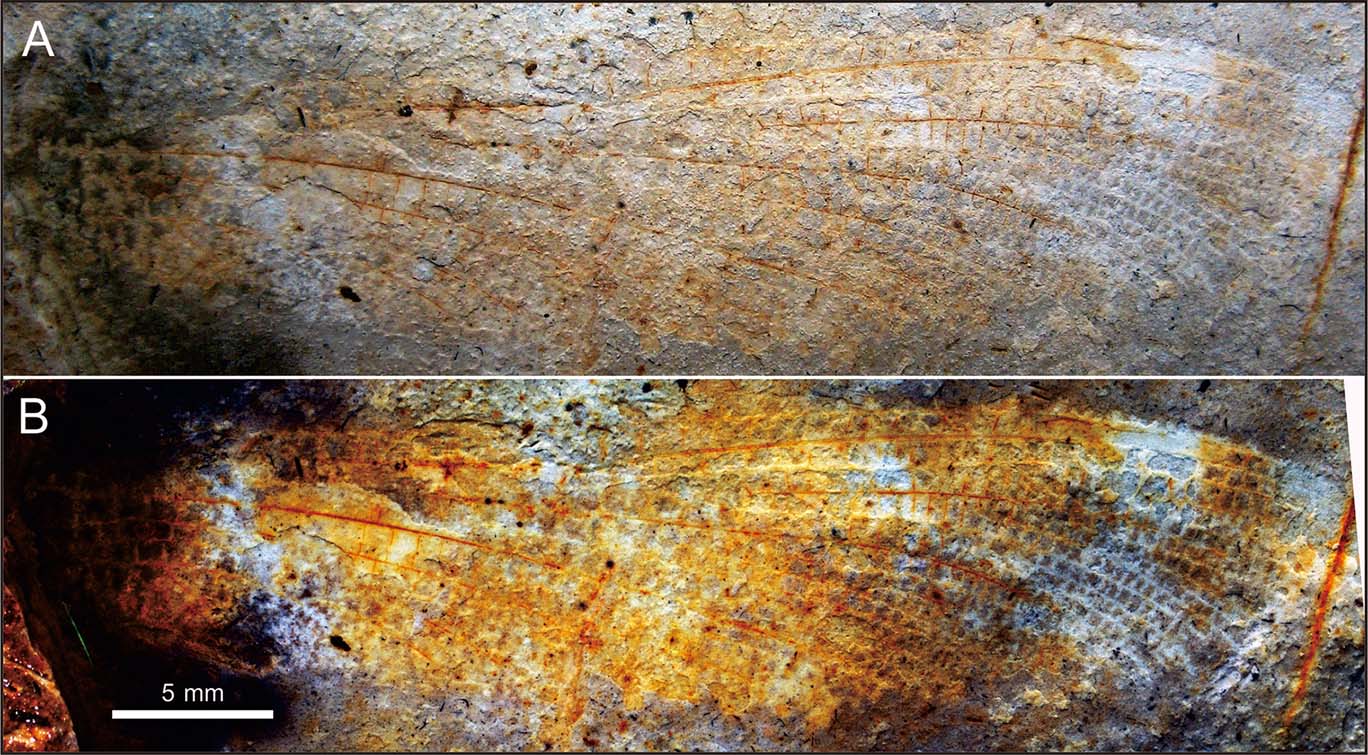
Cretastenophlebia jiuquanensis sp. nov., specimen NIGP 164468, photographs of forewing: (A) dry; (B) under alcohol.

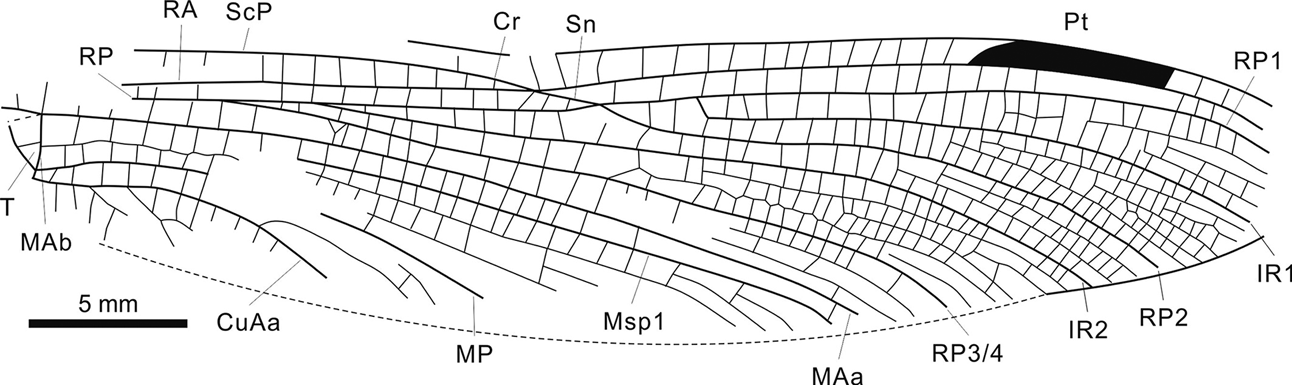
Cretastenophlebia jiuquanensis sp. nov., specimen NIGP 164468, line drawing showing forewing venation. Abbreviations: Cr=nodal cross-vein; CuAa=distal branch of anterior cubitus; IR1, IR2=intercalary radial veins; MA=median anterior; MP=median posterior; Msp1=median supplement; Pt=pterostigma; RA=radius anterior; RP=radius posterior; ScP=subcosta posterior; Sn=subnodal cross-vein; T=discoidal triangle.

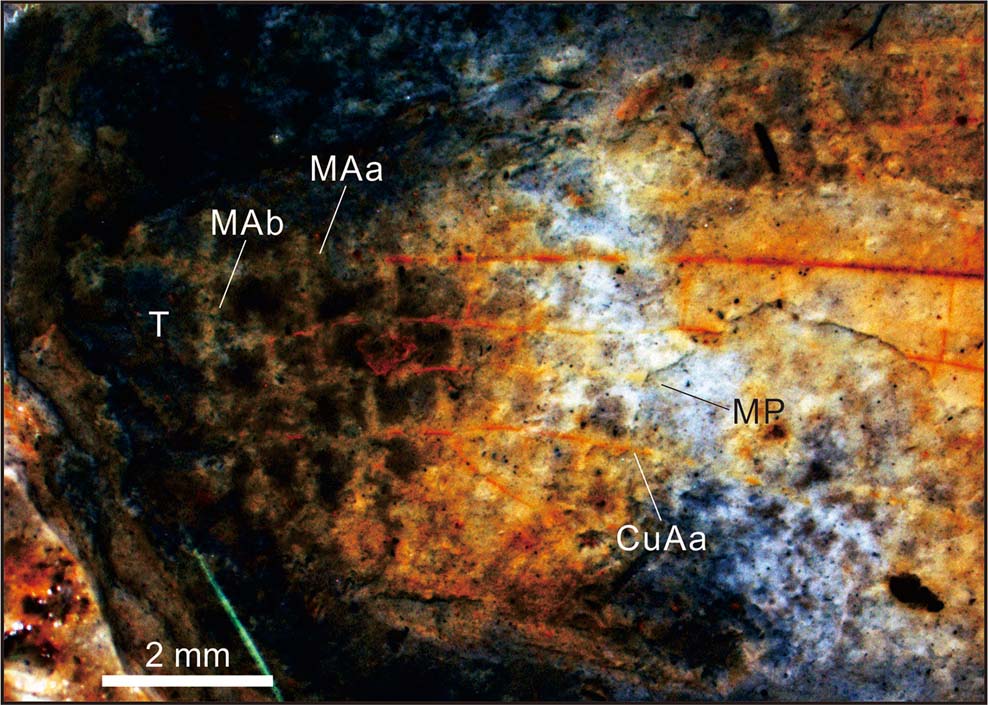
Cretastenophlebia jiuquanensis sp. nov., specimen NIGP 164468, photograph showing detail of wing base. Abbreviations: CuAa=distal branch of anterior cubitus; MA=median anterior; MP=median posterior; T=discoidal triangle.

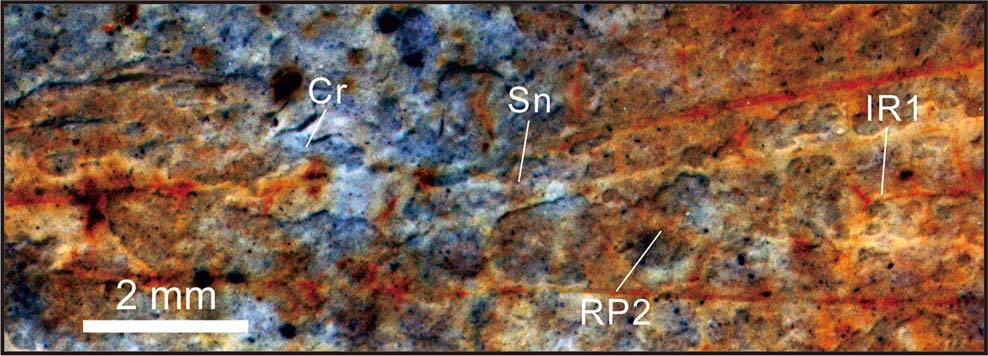
Cretastenophlebia jiuquanensis sp. nov., specimen NIGP 164468, photograph showing detail of nodal area. Abbreviations: Cr=nodal cross-vein; IR1=intercalary radial vein; RP=radius posterior; Sn=subnodal cross-vein.

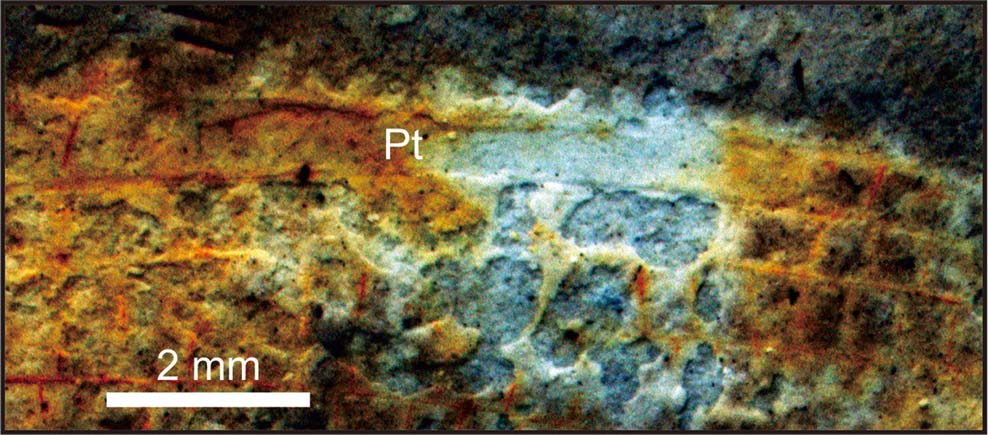
Cretastenophlebia jiuquanensis sp. nov., specimen NIGP 164468, photograph showing detail of pterostigma (Pt).

Material. NIGP 164468, imprint of an incomplete forewing with wing base and apex missing, deposited in the Nanjing Institute of Geology and Palaeontology, Chinese Academy of Sciences, Nanjing, China.
Locality and horizon. Hanxiagou, Chijin Town, Jiuquan City, Gansu Province, northwest China; Zhonggou Formation, Lower Cretaceous (Lower Albian).
Diagnosis. Forewing characters only: discoidal triangle transverse, broad and crossed; IR1 basally straight and distally curved; three cells present along posterior wing margin between IR2 and RP2.
Description. Preserved forewing length 40 mm, estimated complete length 48 mm, estimated complete width at level of N 8.9 mm; distance from MAb to base of Sn, 15.7 mm, from base of Sn to Pt, 13.55 mm. MA divided into MAa and MAb, at an angle of 90°; MAa and MAb slightly curved. T transverse (Fig. 3), divided into two cells, 1.5 mm long and 1 mm wide. CuAa reaching posterior margin basal of nodal level. Area between MP and CuAa widened distally. Postdiscoidal area with two rows of cells basally and greatly widened distally. A slightly curved Mspl and a long, zigzagged, secondary, longitudinal convex vein parallel to MP, beginning just distal of T. Nodal structures somewhat present (Fig. 4), vein Cr between N and RA long, oblique and perfectly aligned with general trend of ScP; Sn short, oblique and well aligned with Cr, covering two cells. Base of RP2 aligned with Sn; no secondary longitudinal short ‘stenophlebiid’ vein present basal of base of RP2, between RP and IR2. 16 postnodal cross-veins present, not aligned with 11 postsubnodal cross-veins. Pt well preserved (Fig. 5), 6.2 mm long and 0.8 mm wide, narrow elongate, with basal side more oblique than distal side. Bases of RP3/4 and IR2 between N and Arc, but closer to N than to Arc. Oblique vein ‘O’ absent. Area between MA and RP3/4 slightly widened distally. IR1 long, non-zigzagged, beginning three cells and 3.1 mm distal of base of RP2. Numerous long supplementary longitudinal veins between main veins.
3. Discussion
Cretastenophlebia jiuquanensis can be attributed to Stenophlebiidae by the following synapomorphies (following Fleck et al. Reference Fleck, Bechly, Martínez-Delclòs, Jarzembowski, Coram and Nel2003): a long, non-zigzagged secondary longitudinal convex vein in the postdiscoidal area, parallel to MP, the base of this vein just distal of discoidal triangle; Cr long, covering more than one cell between RA and RP; pterostigma basally shifted; pterostigma very long; wing elongate and more or less falcate; forewing discoidal triangle, long and transverse; numerous and well defined straight intercalary secondary longitudinal veins reaching posterior wing margin.
Within Stenophlebiidae, the angle between MAa and MAb in C. jiuquanensis is around 90°, a character shared only by Cretastenophlebia, Stenophlebia, Yixianstenophlebia and Liaostenophlebia. Yixianstenophlebia (Y. magnifica) and Liaostenophlebia (L. yixianensis) differ from C. jiuquanensis in having four rows of cells in the postdiscoidal area. C. jiuquanensis shares the following generic characteristics of both Cretastenophlebia and Stenophlebia (following Fleck et al. Reference Fleck, Bechly, Martínez-Delclòs, Jarzembowski, Coram and Nel2003): wing very elongate and falcate; discoidal cell divided into a crossed, elongate transverse triangle and a narrow hypertriangle; angle between MAa and MAb around 90°; nodal cross-vein quite oblique and long; subnodal cross-vein well aligned with nodal cross-vein, quite oblique, and covering cells; pterostigma elongate; pterostigmal brace basally shifted or absent; oblique vein ‘O’ absent; a long Mspl, and a long, zigzagged, secondary, longitudinal vein in postdiscoidal space beginning just distal of triangle; CuA short, reaching posterior wing margin well basal of nodus.
Cretastenophlebia comprises the species Cretastenophlebia mongolica from the Bon-Tsagaan site in central Mongolia. C. jiuquanensis shares a unique character with C. mongolica: no supplementary veinlet below subnodus, just basal of RP2, between RP2 and IR2 (all the other members within Stenophlebiidae have at least one cell below subnodus basal of RP2). As a result, C. jiuquanensis should be attributed to Cretastenophlebia. In addition, C. jiuquanensis has the base of IR1 three cells distal of the base of RP2, and the subnodal cross-vein covers two cross-veins, a feature shared by C. mongolica. The former slightly differs from C. mongolica in the presence of a broad discoidal triangle (more elongate in the latter), curved IR1 (basally quite zigzagged in the latter), and fewer cells along the posterior wing margin between IR2 and RP2 (three cells in the former compared with nine cells in the latter).
The Bon-Tsagaan site is the richest site for insect remains in Mongolia, where the lacustrine sediments have yielded 10,000 insect fossils representing 15 orders (Mostovski & Martínez-Delclòs Reference Mostovski and Martínez-Delclòs2000; Ponomarenko Reference Ponomarenko2016). The odonatan fauna from this site is mainly composed of eight families and is dominated by Hemeroscopus cf. baissicus Pritykina, Reference Pritykina and Barsbora1977 (Ponomarenko Reference Ponomarenko2016). The age of these insect-bearing layers is considered to be either Barremian–Aptian (Mostovski & Martínez-Delclòs Reference Mostovski and Martínez-Delclòs2000) or Aptian (Kania & Wegierek Reference Kania and Wegierek2013; Ponomarenko Reference Ponomarenko2016). Our new specimen is the first record of Cretastenophlebia outside Mongolia, recorded in the Lower Cretaceous (lower Albian) of the Jiuquan Basin, northwestern China.
4. Conclusions
A new damsel-dragonfly, Cretastenophlebia jiuquanensis sp. nov., is described from the Lower Cretaceous Zhonggou Formation of the Jiuquan Basin, northwestern China. Cretastenophlebia jiuquanensis sp. nov. is the second species of Cretastenophlebia, which was first reported from the Lower Cretaceous of Bon-Tsagaan, central Mongolia. The records of Cretastenophlebia and Hemeroscopus baissicus in central Mongolia and the Jiuquan Basin indicate a close insect bio-interchange between two areas during the Early Cretaceous. The new finding increases the diversity and distribution of Stenophlebiidae in China.
5. Acknowledgements
This research was supported (grant numbers in parentheses) by the National Basic Research Program of China (2012CB821900), the National Natural Science Foundation of China (41572010), the Youth Innovation Promotion Association of the Chinese Academy of Sciences (2011224), the Open Projects of the Key Laboratory of Economic Stratigraphy and Palaeogeography, Chinese Academy of Sciences (2016KF05) and the HKU Seed Funding Program for Basic Research (201210159058). We offer our sincere gratitude to Vicki Hammond for editing, and to two anonymous reviewers for the very useful comments on an earlier version of the manuscript.